

Confused between stutter vs studder? You’re not alone. Thousands of people type this exact phrase into Google every month, hoping for a clear answer.
The truth is simple, but most guides make it complicated. This article settles the stutter vs studder debate once and for all, using real dictionary evidence and grammar rules.
By the end, you’ll know exactly which spelling to use, why the other one exists, and how to avoid this mistake forever. Let’s clear up stutter vs studder for good.
Quick Answer: Stutter vs Studder
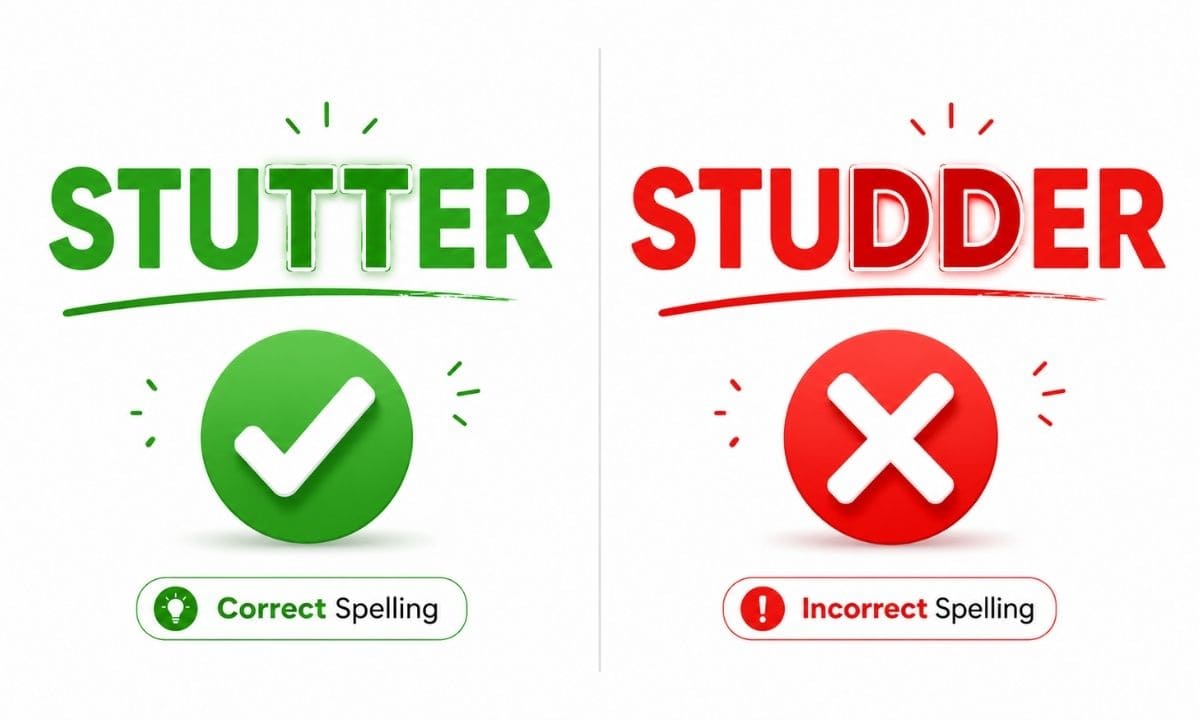
Stutter is the only correct spelling in the English language.
Studder is not a real wordit’s a common misspelling, usually caused by mishearing the “t” sound in casual speech.
Definitions with Examples
Stutter:
To stutter means to speak with involuntary repetitions, pauses, or prolonged sounds.
It can be used as a verb (the action of stuttering) or a noun (the speech pattern itself).
Examples:
✅ “He began to stutter when he got nervous during the interview.”
✅ “Her stutter became less noticeable as she grew more confident.”
✅ “The engine stuttered before finally starting.”
Studder
“Studder” has no dictionary definition.
It’s simply an incorrect spelling of “stutter” that happens when people write the word the way it sounds rather than the way it’s spelled.
Examples:
❌ “He started to studder during the speech.” (Incorrect)
✅ “He started to stutter during the speech.” (Correct)
Why People Confuse Them
The confusion around stutter vs studder comes down to pronunciation, not logic. When Americans and Brits say “stutter” quickly, the double “t” in the middle softens into a soft “d” sounda linguistic feature called flapping.
That soft sound makes “stutter” sound almost like “studder” in casual conversation, especially in American English. Autocorrect tools sometimes don’t catch it because “studder” looks close enough to a real word.
The Grammar Rule Behind Stutter
Rule
English words ending in a short vowel sound followed by a single consonant often double that consonant before adding “-er,” “-ed,” or “-ing.” This is why “stutter” keeps its double “t”; it follows standard English spelling conventions.
Examples
Stop → Stopper
Run → Runner
Stut(ter) → Stutter
(root already carries the doubled consonant)
There is no grammatical pathway that turns “stutter” into “studder.” The “d” spelling doesn’t follow any recognized English spelling rule.
Pronunciation of Stutter
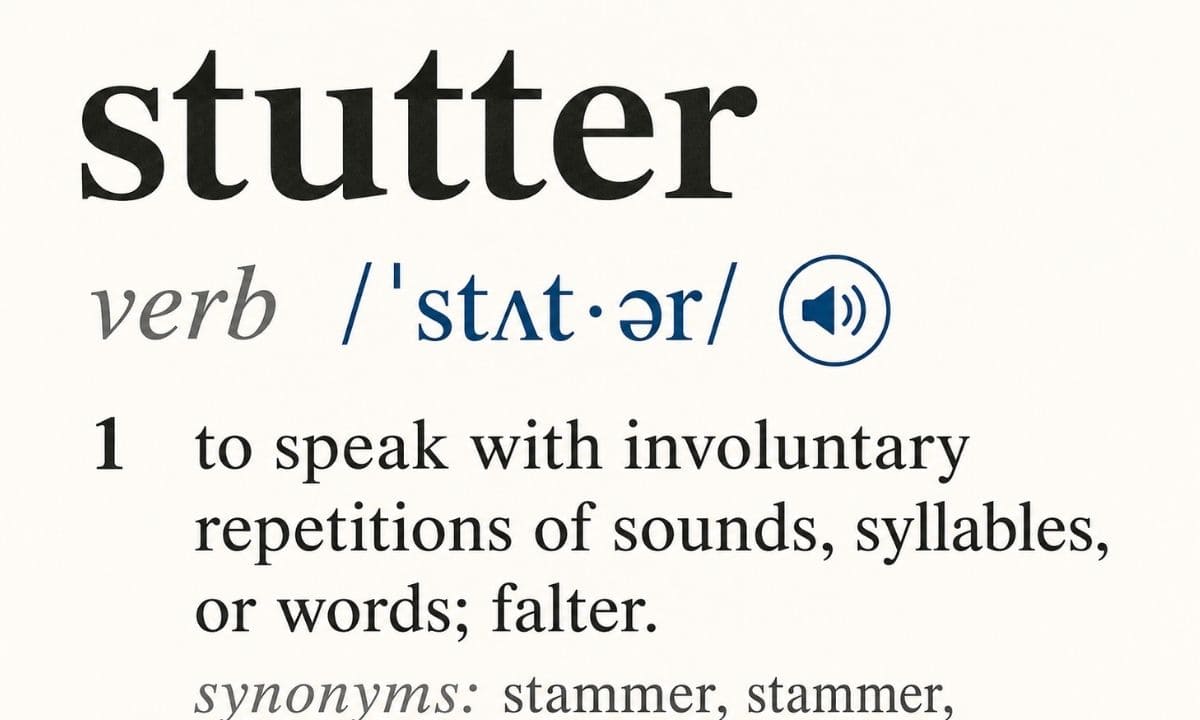
Stutter is pronounced STUH-ter (/ˈstʌtər/).
The stress falls on the first syllable, and the middle “tt” often sounds like a quick “d” due to natural speech patterns.
Pronunciation Tip
Say the word slowly and deliberately, breaking it into two parts: “stut” + “ter.” This helps you spell it correctly even if it sounds different when spoken quickly.
Tone, Context, and Formality
“Stutter” works in formal, medical, casual, and creative writing alike. It’s appropriate in a doctor’s report, a novel, a news article, or a text message. “Studder” isn’t appropriate anywhere because it’s not a recognized word.
The Origin of Stutter
The word “stutter” traces back to Middle English “stutten,” related to the Dutch word “stotteren.” Both roots describe a halting, repetitive action whether in speech or movement.
Easy Rule
If a word sounds like it has a “d” in the middle but you’re unsure, check whether it comes from a root with a doubled consonant. “Stutter” almost always keeps its double “t” in every tense and form.
Examples
Present: stutter
Past: stuttered
Continuous: stuttering
Noun form: stutterer
Stutter vs Studder at a Glance
| Feature | Stutter | Studder |
| Correct spelling | Yes | No |
| Found in dictionaries | Yes | No |
| Part of speech | Verb, Noun | None |
| Common usage | Speech, mechanical repetition | Misspelling only |
| Acceptable in writing | Yes | Never |
Formal vs. Informal Writing
In both formal and informal writing, “stutter” is the only acceptable option.
Academic papers, medical journals, resumes, and casual texts should all use “stutter”; there’s no informal exception that makes “studder” acceptable.
Stutter vs Studder in Adults
Adult stuttering is a recognized speech condition affecting communication and confidence. When discussing this topic in health articles, support forums, or personal essays always use “stutter,” since “studder” carries no medical or linguistic recognition.
When One Choice Sounds Wrong
Correct
✅ “She has struggled with a stutter since childhood.”
✅ “The video kept stuttering due to a weak connection.”
Incorrect
❌”She has struggled with a studder since childhood.”
❌”The video kept stuttering due to a weak connection.”
Common Situations Where Stutter Is Used
Always Use:
- Speech therapy and medical contexts
- Describing nervous or hesitant speech
- Technology (buffering, lag, or glitchy playback)
- Creative writing describing dialogue
Never Use:
- “Studder” in any professional, academic, or casual document
Easy Tip
If spell-check underlines a word in red, trust it. “Studder” will always be flagged, while “stutter” never will.
Stutter vs Studder in Everyday Sentences
“My internet connection keeps stuttering during video calls.”
“He tends to stutter slightly when he’s put on the spot.”
“The old car engine stuttered twice before it finally turned over.”
“Public speaking classes helped reduce her stutter significantly.”
Speech Therapy and the Stutter Conversation
Speech-language pathologists use the word “stutter” exclusively in clinical documentation, therapy plans, and patient communication. This consistency matters for accurate diagnosis and treatment tracking.
Common Mistakes and Quick Fixes
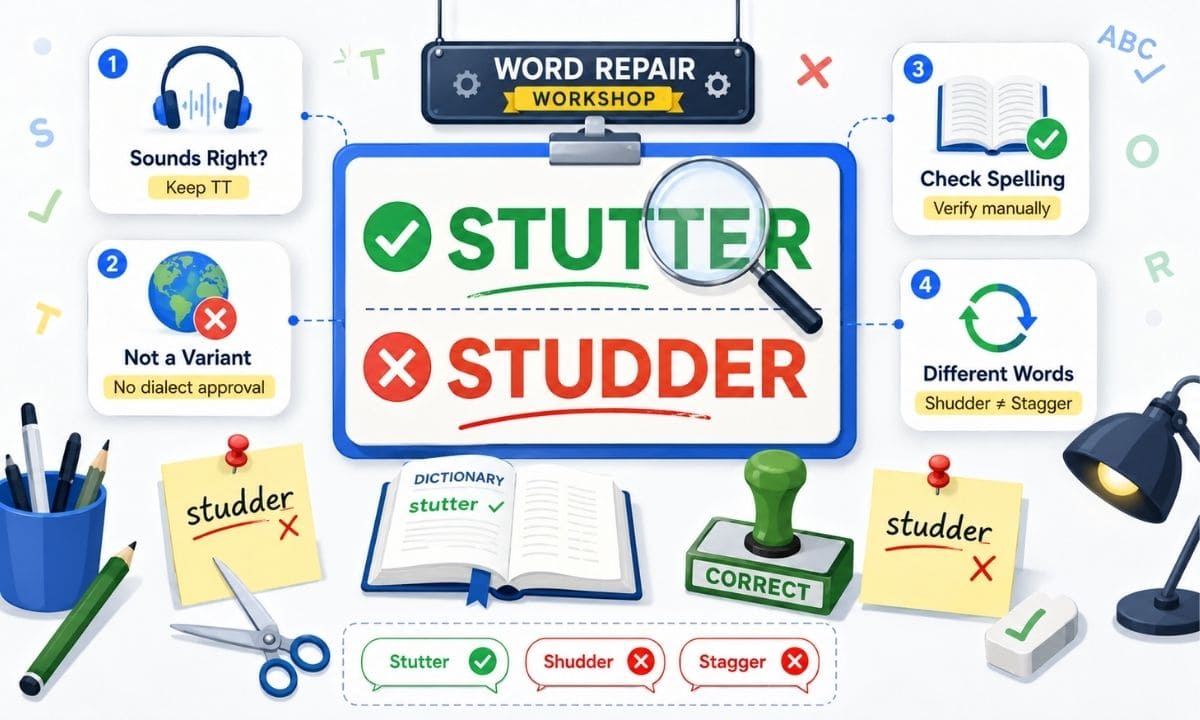
Mistake 1:
Writing “studder” because it sounds right when spoken quickly.
Fix: Remember the double “t” stays, even though it sounds soft.
Mistake 2:
Assuming “studder” is a regional or informal variant.
Fix: No English dialect recognizes “studder” as valid.
Mistake 3:
Trusting autocomplete without double-checking.
Fix: Manually verify unfamiliar spellings using a dictionary.
Mistake 4:
Confusing “stutter” with unrelated words like “shudder” or “stagger.”
Fix: These are separate words with different meaningsdon’t blend them.
Explore More Grammar Guides
Authorized vs Authorised: The Complete Spelling Difference Guide
Anise vs Aniseed: Are They the Same? Find Out the Real Difference
Friend vs Freind: Common Mistake and Correct Usage Explained
Really vs Realy? A Quick Guide to Correct English Spelling (2026)
Gauge Vs Guage: Quick Grammar Guide With Easy Examples
Habit vs Habbit: Common Error, Meaning, and Usage Guide
Why Do People Misspell Stutter vs Studder?
Most people misspell this word because English pronunciation doesn’t always match spelling. The flapped “t” sound common in American English makes “stutter” audibly resemble “studder,” even though the spelling never changes.
Common Phrases
- “Stutter step” (used in sports)
- “Stutter through a sentence”
- “Nervous stutter”
- “Stutter in the engine”
Regional Speech Patterns and the Stutter Sound
Certain regional accents flatten consonant sounds more than others, which increases how often people misspell “stutter” as “studder.” This is purely a pronunciation quirk, not a spelling variation.
Memory Tricks To Remember The Correct Spelling
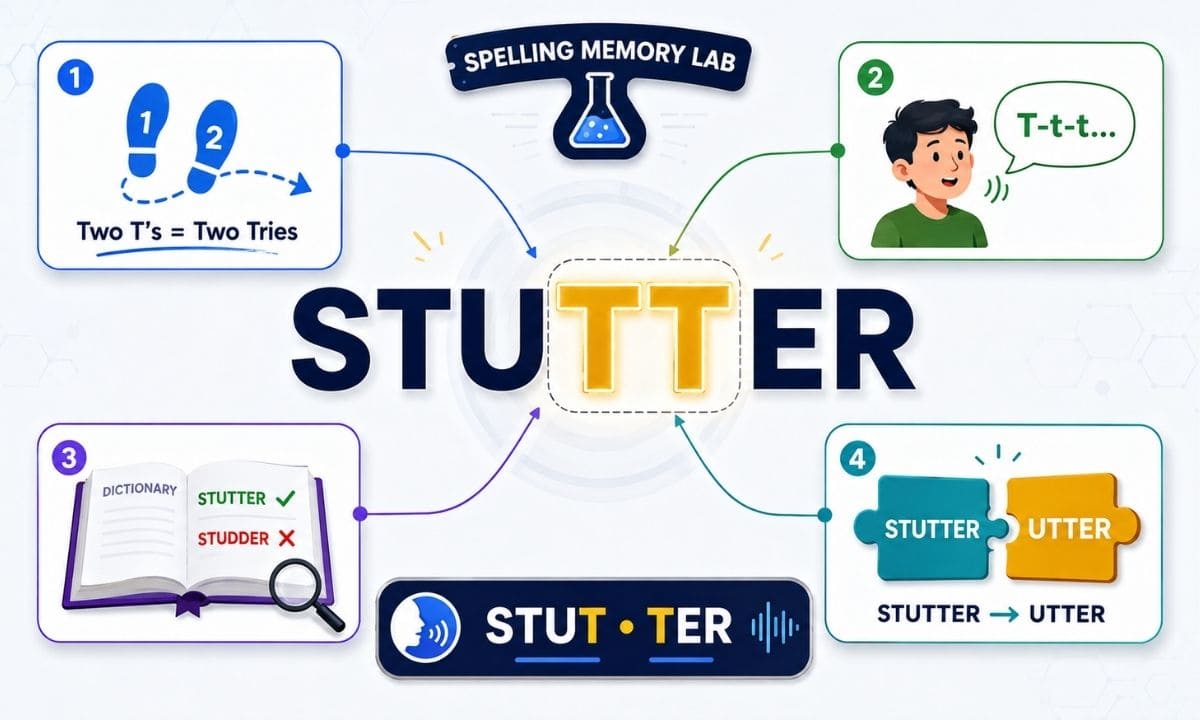
Think: “Stutter has two T’s, just like it takes two tries to say a hard word.”
Picture someone repeating the letter “T” when they stutter: “T-t-today.”
Remember: “Studder” isn’t in the dictionary if in doubt, leave it out.
Associate “stutter” with “utter,” since both share the “utter” sound and spelling pattern.
Say it out loud in syllables: STUT-TER, emphasizing both T’s.
Different Parts of Speech
| Part of Speech | Form | Example |
| Verb | stutter | “He stutters when nervous.” |
| Noun | stutter | “She has a mild stutter.” |
| Adjective (participle) | stuttering | “A stuttering voice on the recording.” |
| Past tense | stuttered | “He stuttered through his speech.” |
How Stutter Functions Grammatically in a Sentence
“Stutter” can act as the main verb, a descriptive noun, or part of a compound phrase like “stutter step,” giving it flexibility across writing styles.
Synonyms And Alternatives For Stutter
Synonyms
Stammer
Falter
Hesitate
Sputter
Mumble
Halt
Examples
- “He stammered his way through the apology.” (formal synonym)
- “The machine sputtered to a stop.” (mechanical synonym)
- “She faltered while reading the announcement.” (hesitation synonym)
Antonyms And Opposite Ideas
Words with the opposite meaning of “stutter” include: flow, articulate, speak fluently, and enunciate clearly.
American vs British English Differences
United States
American English commonly uses “stutter” for the speech condition and casually for mechanical hesitation, like a stuttering engine or stuttering video.
United Kingdom
British English often prefers “stammer” for the speech disorder but still uses “stutter” interchangeably in everyday and technical contexts.
Comparison Table
| Region | Preferred Term | Notes |
| United States | Stutter | Common in medical and casual use |
| United Kingdom | Stammer / Stutter | Both accepted; stammer preferred clinically |
Key Point
Regardless of region, “studder” is never a recognized variant in either American or British English.
Dictionary-Style Word Details
Verb
To speak with involuntary repetition of sounds or syllables.
Noun
A speech pattern marked by repeated sounds, blocks, or prolonged syllables.
Synonyms
Stammer, falter, hesitate, mumble.
Example Sentences
- “The child’s stutter improved after months of therapy.”
- “He stuttered nervously before answering the question.”
Word History
Derived from Middle English “stutten,” related to Dutch “stotteren,” both describing halting or repetitive motion.
Phrases Containing “Stutter”
Stutter step, nervous stutter, stutter through, stuttering engine.
What Major Dictionaries Say
Merriam-Webster’s Stance on Stutter
Merriam-Webster lists only “stutter” as a valid entry, with no cross-reference or acknowledgment of “studder” as an alternate spelling.
Cambridge Dictionary’s Definition
Cambridge Dictionary defines “stutter” the same way’s a speech pattern involving repeated sounds again with zero mention of “studder.”
Oxford English Dictionary Insight
Oxford traces “stutter” back centuries through Germanic language roots, reinforcing that the double-T spelling has remained stable throughout history.
Grammarly and Spell-Check Consensus
Every major grammar tool, including Grammarly and Microsoft Word, automatically flags “studder” as a spelling error and suggests “stutter” instead.
Comparison Table: Stutter vs Studder
| Source | Recognizes “Stutter” | Recognizes “Studder” |
| Merriam-Webster | Yes | No |
| Cambridge Dictionary | Yes | No |
| Oxford Dictionary | Yes | No |
| Grammarly | Yes | No (flagged as error) |
Pro Tip I Learned
The fastest way to confirm any spelling debate like stutter vs studder is to check three major dictionaries at once. If all three agree, the answer is settled.
In list form, remember:
Studder = incorrect, non-standard, always flagged
Stutter = correct, standard, dictionary-approved
Quick Test I Created
Stutter vs Studder Quiz
Fill in the blank with the correct word (stutter/stuttered/stuttering):
He began to ______ when the teacher called on him.
Her ______ became noticeable only under stress.
The old projector kept ______ during the presentation.
I ______ over my words during the toast.
The engine ______ twice before starting.
Speech therapists help people manage a ______.
He ______ nervously while accepting the award.
The Wi-Fi connection was ______ all evening.
She has had a mild ______ since she was five.
Please don’t ______ when reading this aloud.
The actor ______ his lines by mistake.
A ______ voice came through the broken speaker.
His confidence grew, and the ______ faded.
The video call kept ______ due to poor signal.
Children who ______ often outgrow it with therapy.
(Answers: 1. stutter, 2. stutter, 3. stuttering, 4. stuttered, 5. stuttered, 6. stutter, 7. stuttered, 8. stuttering, 9. stutter, 10. stutter, 11. stuttered, 12. stuttering, 13. stutter, 14. stuttering, 15. stutter)
Frequently Asked Questions
Is “studder” ever correct in any dictionary?
No. “Studder” does not appear in Merriam-Webster, Cambridge, or Oxford dictionaries as a valid word.
Why does “stutter” sound like “studder” when spoken?
Because of consonant flapping in casual speech, where the double “t” softens into a quick “d” sound.
What is the correct past tense of stutter?
The correct past tense is “stuttered,” not “studdered.”
Is stutter a noun or a verb?
Stutter functions as both a noun (a speech pattern) and a verb (the act of speaking with repetition).
What’s the British English equivalent of stutter?
British English often uses “stammer,” though “stutter” is also widely understood and used.
Does autocorrect fix “studder” automatically?
Most spell-checkers, including Grammarly and Microsoft Word, flag “studder” and suggest “stutter” as the correction.
Can “stutter” describe non-speech situations?
Yes, “stutter” can describe mechanical hesitation, like a stuttering engine, video, or connection.
What are common synonyms for stutter?
Common synonyms include stammer, falter, hesitate, and sputter.
Is stuttering a medical condition?
Yes, stuttering is a recognized speech disorder that can affect both children and adults.
Why is this comparison searched so often?
Because “stutter vs studder” involves a pronunciation-based spelling confusion that trips up even fluent English speakers..
Conclusion
After exploring every angle of stutter vs studder, the answer remains clear and consistent. Only “stutter” is the correct, dictionary-recognized spelling in English. This settles the stutter vs studder question with confidence.
“Studder” exists only as a common misspelling caused by how the double “t” softens during natural speech. Every major dictionary and grammar tool confirms this in the stutter vs studder comparison.
Next time you’re unsure, remember the rule: keep the double “t,” trust your spell-checker, and use “stutter” in every context. That’s the final word on stutter vs studder in 2026.

8 thoughts on “Stutter vs Studder: Correct Spelling and Meaning Guide in 2026”