

If you’ve ever paused mid-sentence wondering whether to write “the dog bit me” or “the dog bit me,” you’re not alone. English learners and even native speakers sometimes second-guess this word.
The answer is short, simple, and easy to remember once it clicks.
This guide breaks down the past tense of bite, clears up the confusion between bit and bitten, and gives you real examples you can use right away.
Quick Answer: Is the Past Tense of Bite “Bit” or “Bited”?
The correct past tense of “bite is bit, ” not “bited.
” Bite is an irregular verb, so it doesn’t follow the usual rule of adding “-ed” to the end.
Bite → bit → bitten
Correct: The dog bit the mailman.
Incorrect: The dog “bited” the mailman.
There’s also a third form, bitten, which is the past participle. You’ll see that one paired with helper verbs like “has,” “have,” or “had.”
What Is the Past Tense of Bite?
Bite belongs to a group of English verbs called irregular verbs. These verbs change their spelling in the past tense instead of simply tacking on “-ed” like regular verbs (walk → walked, jump → jumped).
Here’s how bite breaks down:
Base form: bite
Simple past tense: bit
Past participle: bitten
Present participle: biting
So when someone asks “what is the past tense of bite,” the short answer is bit. When you need the past participle for perfect tenses or passive sentences, that’s when bitten comes in. “Confusing bit and bitten is a common mistake for English learners.”
Bite vs Bit vs Bitten: What’s the Difference?
Each form of this verb has its own job in a sentence. Once you separate the three, the confusion mostly disappears.
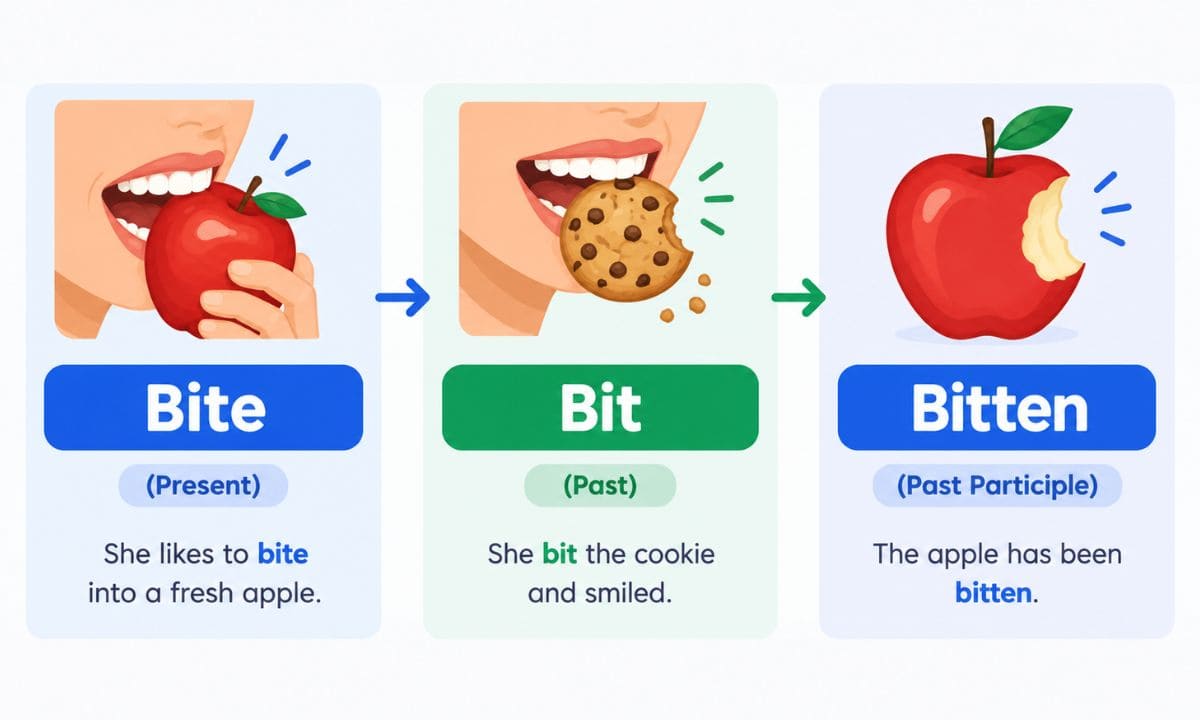
Bite Present Tense
Use “bite” as the base form and for present-tense uses such as habits, general facts, and after modal verbs or “to.”
- Mosquitoes bite at dusk.
- Please don’t bite your nails.
- The snake might bite if you get too close.
Bit Simple Past Tense
“Bit” describes a completed action that happened at a specific point in the past. It stands alone, without any helping verb.
- She bit into the sandwich.
- He bit his tongue during the meeting.
- The fish bit the hook almost instantly.
Bitten Past Participle
“As a past participle, bitten normally appears with an auxiliary verb or in a passive construction.” It teams up with auxiliary verbs like “have,” “has,” “had,” “is,” or “was” to form perfect tenses or the passive voice.
- I have bitten my nails since childhood.
- She had bitten into the apple before noticing the worm.
- The hiker was bitten by a tick.
Bit vs Bited: Comparison Table
Here’s a side-by-side look at why one form works and the other doesn’t.
| Feature | Bit | Bited |
| Grammatically correct? | Yes | No |
| Verb type | Irregular past tense | Incorrect regularized form |
| Used by | Native speakers, dictionaries, style guides | Non-native learners, young children |
| Example sentence | “She bit her lip.” | “She bited her lip.” (wrong) |
| Recognized in dictionaries? | Yes (Merriam-Webster, Oxford, Cambridge) | No |
| Sounds natural in speech? | Yes | No |
Why Is “Bited” Incorrect?
“Bited” shows up because English speakers naturally expect verbs to follow the regular pattern of adding “-ed.
” Think about how children learn language: they hear “walked,” “jumped,” and “played,” then apply that same rule to every verb they encounter, including bite. This is called overregularization, and it’s actually a normal stage of language learning.
But bite comes from Old English and has kept its irregular pattern for centuries. “Modern standard English uses bit as the simple past form and bitten as the past participle.”
If you catch yourself typing “bited,” just swap it for a bit and the sentence instantly sounds right.
When Should You Use “Bit”?
“Bit” fits into several common sentence structures. Here’s where it belongs.
For Completed Past Actions
Use “bit” when describing something that already happened and finished.
- The dog bit the fence post.
- I bit into the pizza before it cooled down.
After “Did,” Use the Base Form
When forming a past-tense question, pair “did” with the base form “bite” not “bit.”
- Did the dog bite you?
- Did she bite her nails during the exam?
Notice that after “did,” the verb goes back to its base form. This trips people up because it feels like “bit” should follow “did,” but it doesn’t.
In Negative Sentences
The same rule applies to negatives. Use “did not” (or “didn’t”) with “bite,” not “bit.”
I didn’t bite my tongue this time.
The dog did not bite the visitor.
When Should You Use “Bitten”?
“Bitten” only appears alongside a helping verb. Here are the two main situations where it belongs.
With Have, Has, or Had
These auxiliary verbs signal the perfect tenses, and “bitten” is the form that goes with them.
- I have bitten my lip more times than I can count.
- She has bitten into the same problem for weeks.
- They had already bitten into the apple before we arrived.
In Passive Sentences
When the subject receives the action instead of performing it, use a form of “be” plus “bitten.”
The apple was bitten before anyone noticed.
He was bitten by a spider.
Three campers have been bitten by mosquitoes.
Explore More Grammar Guides
Stutter vs Studder: Correct Spelling and Meaning Guide in 2026
Friend vs Freind: Common Mistake and Correct Usage Explained
Really vs Realy? A Quick Guide to Correct English Spelling (2026)
Barrel vs Barrell: Correct Spelling, Meaning, and Sentence Examples
Keep vs Kept: Which One Is Correct? Rules, Examples & Tips
Customize vs Customise: Which One Should You Use? Complete Guide
Common Mistakes With Bite, Bit, and Bitten
Here are the errors that show up most often in writing and speech:
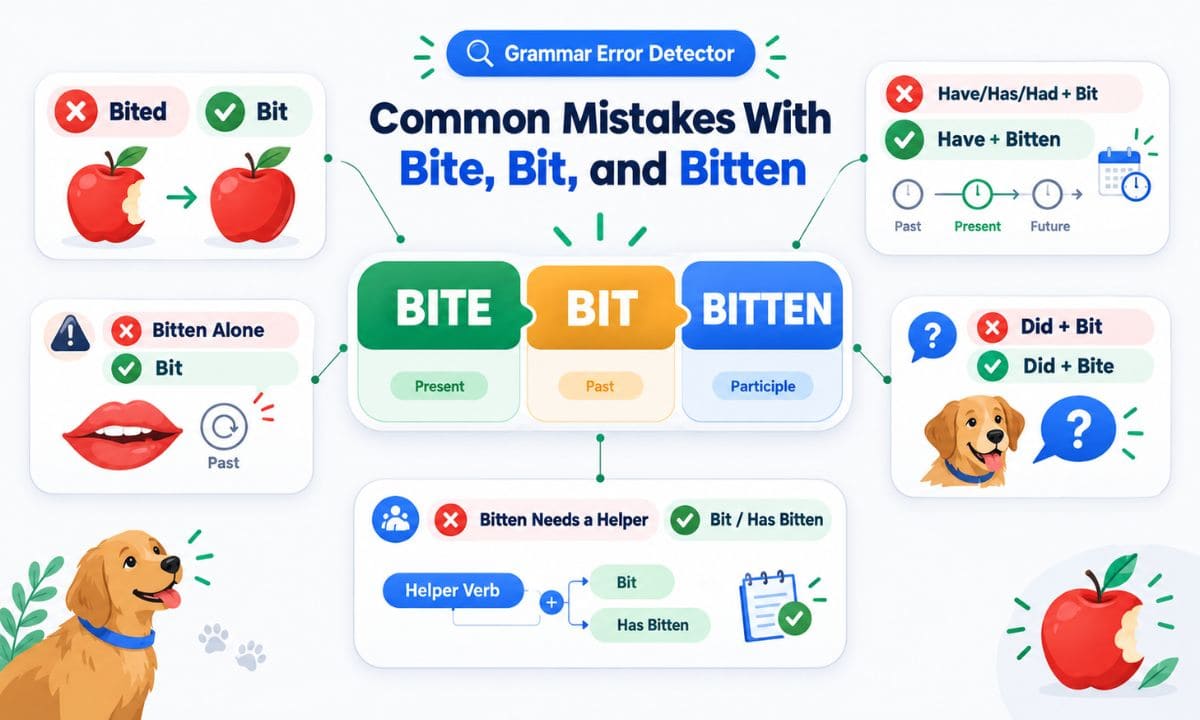
Using “bited” instead of “bit”:
“She bited the apple” should be “She bit the apple.”
Using “bit” after have/has/had:
“I have bit my nails” should be “I have bitten my nails.”
Using “bitten” as a standalone past tense:
“He bitten his lip” should be “He bit his lip.”
Using “bite” after did in the wrong tense:
“Did the dog bit you?” should be “Did the dog bite you?”
Dropping the helper verb with “bitten”:
“The dog bitten him” should be “The dog bit him” or “The dog has bitten him.”
Everyday Examples of Bite, Bit, and Bitten
Seeing all three forms side by side in real-life contexts makes the pattern stick.
| Situation | Bite (Present) | Bit (Past) | Bitten (Participle) |
| Animals | Dogs bite when scared. | The dog bit the mailman. | I’ve been bitten by a dog before. |
| Food | I bite into an apple every morning. | She bit into the burger. | She has bitten the apple twice. |
| Insects | Mosquitoes bite in summer. | The mosquito bit my arm. | I was bitten by mosquitoes all night. |
| Idioms | It doesn’t bite. | He bit off more than he could chew. | The project has bitten the dust. |
Easy Memory Trick: Bite → Bit → Bitten
If the three forms still blur together, try this simple rhyme trick:
Whenever you need the plain past tense, reach for the short, one-syllable word bit.
For bitten, remember that it always needs a partner word. If you can’t add “have,” “has,” “had,” or “was/were” right before it and have the sentence make sense, you probably need it instead.
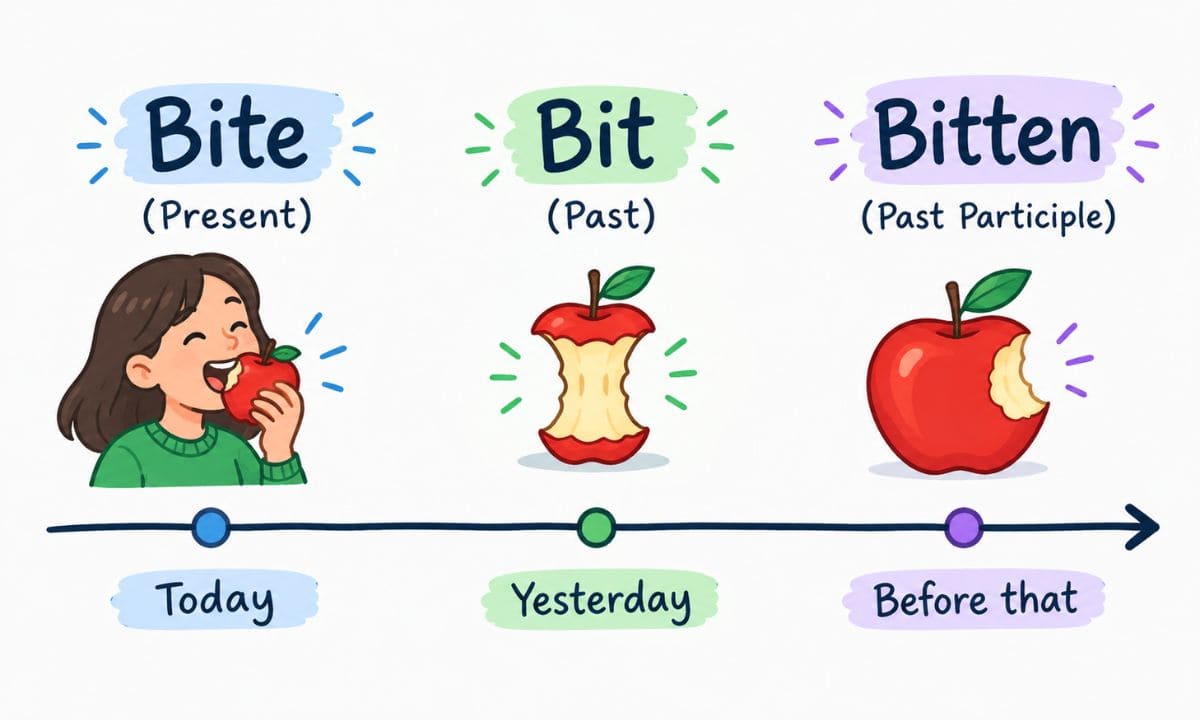
One more trick: think of it as a mini timeline
Today I had a bite. Yesterday I bit. In the past, I have been bitten.
Image prompt suggestion: A hand-drawn style timeline arrow labeled “Today,” “Yesterday,” and “Before that,” with the words bite, bit, and bitten placed above each point.
Bite Verb Forms at a Glance
| Form | Word | Example |
| Base form | bite | I bite my nails when nervous. |
| Third-person singular | bites | She bites her pen while thinking. |
| Simple past | bit | He bit into the toast. |
| Past participle | bitten | We have bitten off more than we can chew. |
| Present participle / gerund | biting | The dog is biting its toy. |
What Do Major Dictionaries Say About “Bite”?
Three of the most trusted English dictionaries confirm the same verb pattern for bite. Here’s what each one actually shows.
Merriam-Webster
Merriam-Webster’s entry lists the principal parts right under the headword: bit, bitten, also bit, biting. That “also bit” note means the dictionary does record an informal, occasional use of “bit” as a past participle, but this shows up rarely and almost never in professionally edited writing. For day-to-day use, the dictionary’s structure makes the standard pattern clear: bit for the simple past, bitten for the participle. merriam-webster
👉 See the full Merriam-Webster entry
Cambridge Dictionary
Cambridge Dictionary marks bite as a B1-level verb and lists its forms directly beneath the pronunciation guide, showing bit as the past tense and bitten as the past participle. The entry’s own example sentences follow that split consistently — a simple completed action uses bit, while any sentence built with a form of “be” switches to bitten.
👉 See the full Cambridge Dictionary entry
Oxford Learner’s Dictionaries
Oxford Learner’s Dictionaries lays out the complete conjugation table for bite: present simple bite/bites, past simple bit, past participle bitten, and the -ing form biting. The example sentences in this entry reinforce the same rule covered earlier in this guide — bit stands alone for finished past actions, while bitten only shows up paired with a helping verb.
👉 See the full Oxford Learner’s Dictionaries entry
Why This Matters
Merriam-Webster represents American English, while Cambridge and Oxford represent British and international usage. All three, built by separate editorial teams, land on the exact same three forms: bite, bit, bitten. None of them recognize “bited” as a word, a variant spelling, or an informal form. When independent, professionally edited dictionaries agree this closely, that’s about as solid a confirmation as English grammar offers.
Quick Test I Created
Bite vs Bit vs Bitten: Quick Student Guide
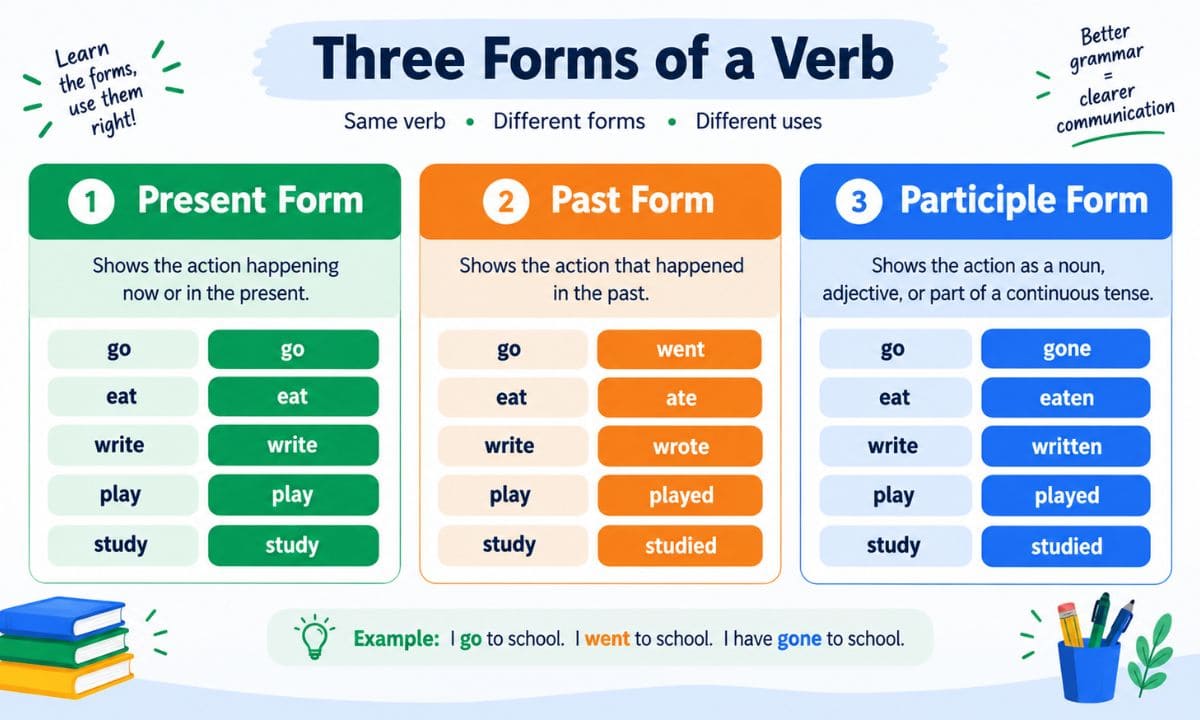
For ESL learners and students studying irregular verbs, here’s a fast reference:
Use bite for present actions, habits, and after “to,” “will,” or “can.”
Use bit for a finished action in the past, with no helper verb needed.
Use bitten only with “have/has/had” or “is/was/were.”
Never use bited it doesn’t exist in standard English.
With questions and negatives (“did,” “didn’t”), go back to the base form bite.
Image prompt suggestion: A clean classroom-style chart or flashcard set showing the three verb forms with color-coded labels (present = green, past = orange, participle = blue).
Frequently Asked Questions
I“Is “bited” the standard past tense of” bite?”
No. The standard simple past form of bite is bit. The past participle is bitten.
What is the past participle of bite?
The past participle of bite is “bitten,” used with have, has, had, or forms of “be.”
Can I say “I have bit my nails”?
No, that’s incorrect. The correct form is “I have bitten my nails,” since “bitten” pairs with “have.”
What’s the difference between bit and bitten?
“Bit” is the simple past tense used alone, while “bitten” is the past participle used with a helper verb.
Why do people say “bited” instead of “bit”?
It happens because English speakers expect regular “-ed” endings, but bite is an irregular verb that doesn’t follow that rule.
Is bite a regular or irregular verb?
Bite is an irregular verb, meaning it doesn’t form its past tense by adding “-ed.”
What is the past tense of “bite the dust”?
The idiom uses “bit” in the past tense: “The old car finally bit the dust.”
How do you use “bit” in a question?
You don’t. Questions use “did” plus the base form: “Did the dog bite you?” not “Did the dog bit you?”
Is “has bit” correct grammar?
No. The correct phrase is “has bitten,” since past participles follow helper verbs like “has.”
What are all three forms of the verb bite?
The three forms are bite (present), bit (past), and bitten (past participle).
Conclusion:
The past tense of bite is a bit plain and simple. ““Bited is not the standard past-tense form of bite.” , no matter how natural it might sound to a beginner. Keep bitten reserved for sentences that already have a helping verb like have, has, had, was, or were.
Once you separate bite, bit, and bitten by their jobs in a sentence, this irregular verb stops being confusing. Practice with the examples above, and it’ll start to feel automatic.
