

Are you confused about whether to use keep vs. kept in a sentence? Both are correct English words, but they have different grammatical uses. Keep is the base form of an irregular verb, while kept is its simple past tense and past participle.
The main difference between keep and kept is their grammatical role and the time of the action. Use keep for present habits, instructions, and after modal verbs. Use kept for completed past actions and after have, has, or had.
In this guide, you’ll learn the difference between keep and kept, the past tense of keep, correct grammar rules, common mistakes, and practical examples to help you choose the right form.
Quick Answer: Keep vs. Kept
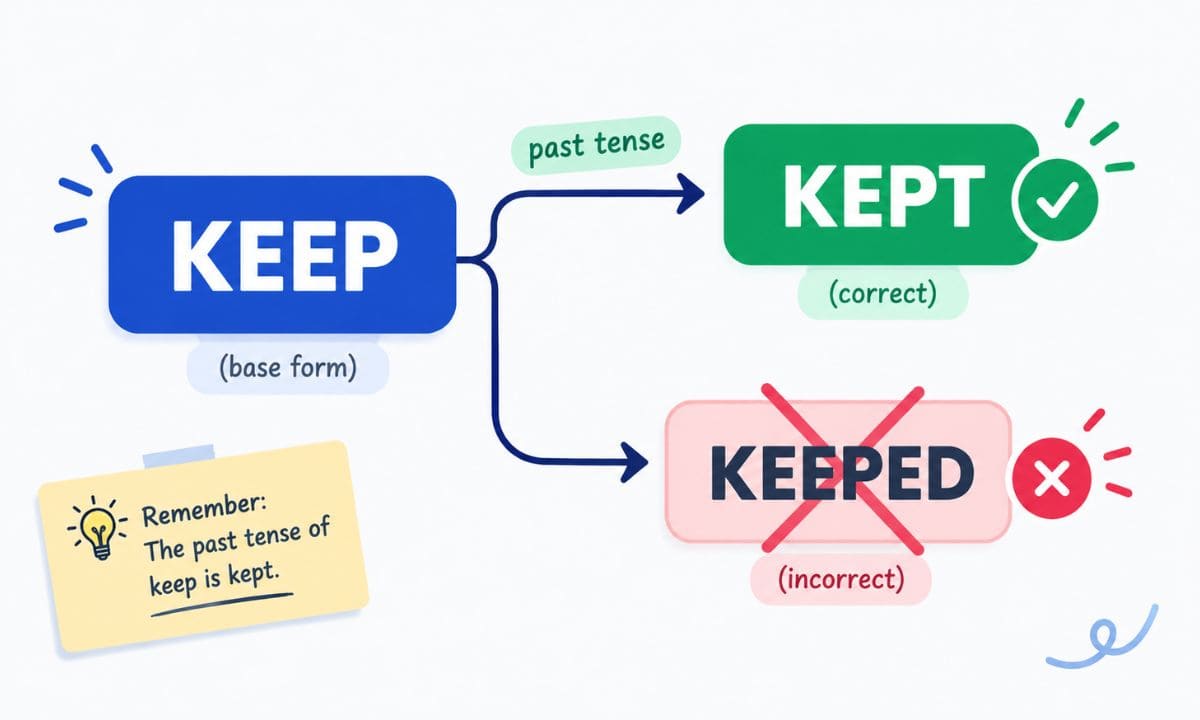
Keep is the base form of the verb.
Keeps is used with he, she, and it in the present simple.
Kept is the simple past tense and past participle.
Keeping is the -ing form used in continuous tenses.
Keeped is incorrect in standard modern English.
| Verb Form | Correct Word | Example |
|---|---|---|
| Base form | Keep | I keep my room clean. |
| Present third-person | Keeps | She keeps a diary. |
| Simple past | Kept | I kept the letter. |
| Past participle | Kept | I have kept the letter. |
| Present participle | Keeping | I am keeping the receipt. |
Easy rule: Keep → Kept → Kept.
Also Read This: gramarnesty.com/time-flies-or-time-flys
What Is the Difference Between Keep and Kept?
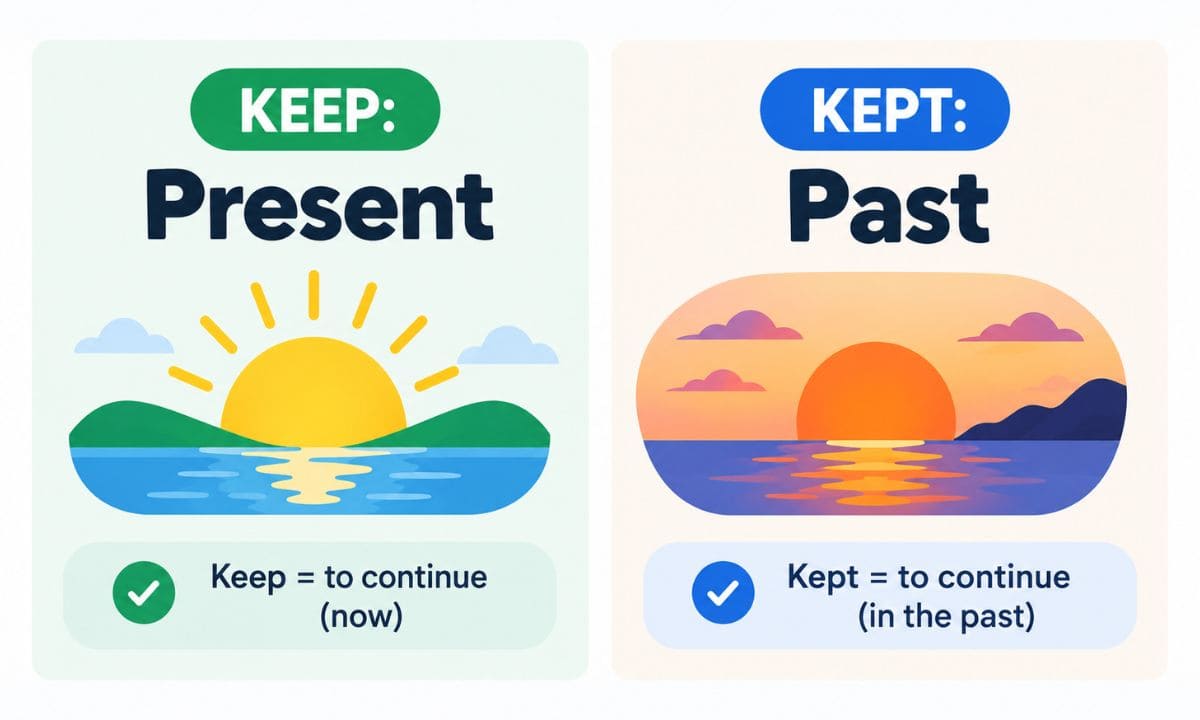
The main difference between keep and kept is their grammatical form. Keep is the base form of an irregular verb, while kept is its simple past tense and past participle.
What Does Keep Mean?
Keep means to hold, retain, maintain, or continue doing something. It is used in the base form, present-tense sentences, instructions, and after modal verbs.
Examples:
- I keep all my receipts in a folder.
- Please keep the door closed.
- She keeps her promises.
- You should keep practicing English.
What Does Kept Mean?
Kept is the past tense and past participle of keep. It describes completed past actions and is also used in perfect tenses and passive constructions.
Examples:
- I kept the ticket as a souvenir.
- She kept her old photographs.
- They have kept the secret.
- The documents were kept in a safe place.
Remember: Keep and kept have related meanings, but they cannot be used interchangeably in every sentence.
Also Read This: gramarnesty.com/time-flies-or-time-flys
Keep vs Kept at a Glance
| Word | Type | Tense | Example |
| Keep | Base verb | Present | I keep my keys in my bag. |
| Keeps | Present (he/she/it) | Present | She keeps a diary. |
| Kept | Simple past | Past | He kept his promise. |
| Kept | Past participle | Perfect/passive | They have kept in touch. |
| Keeping | -ing form | Continuous | I am keeping the receipt. |
Also Read This: gramarnesty.com/puting-vs-putting
Is Keeped Correct or Is Kept the Correct Word?
No. Keeped is not the correct past tense of keep in standard modern English. The correct form is kept.
Many English verbs form their past tense by adding -ed, such as:
- Walk → Walked
- Clean → Cleaned
- Play → Played
However, keep is an irregular verb. It changes to kept instead of following the regular -ed pattern.
| Incorrect | Correct |
|---|---|
| I keeped my promise. | I kept my promise. |
| She has keeped the letter. | She has kept the letter. |
| They keeped working. | They kept working. |
| He keeped the money. | He kept the money. |
Other irregular verbs also change their spelling:
- Sleep → Slept
- Sweep → Swept
- Keep → Kept
Remember: Keep → Kept → Kept. Do not use keeped in standard English.
Also Read This: Additionally-synonyms
Keep vs. Kept: Grammar Rules
Understanding helping verbs and sentence structure makes it easier to choose between keep and kept.
Use Keep After Do, Does, and Did
Use the base form keep after do, does, and did in questions and negative sentences.
Examples:
- Do you keep a diary?
- Does she keep her promises?
- Did you keep the receipt?
- I did not keep the old documents.
Important: Never write “Did you kept it?” The correct sentence is “Did you keep it?”
Use Keep After Modal Verbs
Use keep after modal verbs such as can, will, should, must, and may.
Examples:
- You should keep your room clean.
- I will keep your secret.
- We must keep our promises.
Use Kept for Simple Past Actions
Use kept when an action happened and finished in the past.
Examples:
- I kept the letter yesterday.
- She kept her old phone.
- They kept working until midnight.
Use Kept After Have, Has, and Had
Kept is the past participle, so use it in perfect tense constructions.
Examples:
- I have kept the receipt.
- She has kept her promise.
- They had kept the information private.
Use Keeping in Continuous Tenses
Use keeping, not keep, after forms of the verb be in continuous constructions.
Examples:
- I am keeping my notes organized.
- She is keeping the door open.
- They were keeping the documents safe.
Use Kept in Passive Sentences
Use kept after forms of be when writing passive constructions.
Examples:
- The files were kept in a safe place.
- The room is kept clean.
- The documents have been kept securely.
Grammar reminder: Keep is the base form, kept is the past form and past participle, and keeping is the -ing form.
Also Read This: bit-or-bited
Keep vs Kept: Tense and Grammar
Tense is really the whole game here.
Present simple and present continuous both need keep.
Past simple, past perfect, present perfect, and passive sentences all need to be kept.
If your sentence has a time marker like “yesterday,” “last week,” or “already,” kept is almost always the safer bet.
Sentence Patterns
Keep + noun: I keep a notebook.
Keep + adjective: Keep calm.
Keep + verb-ing: Keep trying.
Keep + object + adjective: Keep the door open.
Kept + noun: She kept a journal.
Kept + verb-ing: He kept talking all night.
| Pattern | Example |
|---|---|
| Keep + noun | I keep a notebook. |
| Keep + adjective | Keep calm. |
| Keep + verb-ing | Keep trying. |
| Keep + object + adjective | Keep the door open. |
| Kept + noun | She kept a journal. |
| Kept + verb-ing | He kept talking. |
| Kept + object + adjective | They kept the door open. |
Also Read This: followup-or-follow-up
Keep vs. Kept: Example Sentences
Here are simple examples showing how keep and kept are used in everyday English.
Examples With Keep
- I keep my phone on silent during meetings.
- Please keep your room clean.
- She keeps all her important documents in a folder.
- We keep in touch with our friends.
- You should keep your promises.
- I will keep this information private.
- They keep practicing English every day.
- Keep trying until you succeed.
- He wants to keep his old photographs.
- Do you keep a personal diary?
Examples With Kept
- I kept my phone on silent yesterday.
- She kept the letter for many years.
- We kept our promise.
- He kept working after dinner.
- They kept their documents in a safe place.
- I have kept all your messages.
- She had kept the secret for years.
- The teacher kept the students busy.
- We kept the windows closed last night.
- He kept calling me throughout the evening.
Keep vs. Kept in Real-Life Situations
| Situation | Keep | Kept |
|---|---|---|
| School | I keep my notes organized. | I kept my notes from last semester. |
| Daily life | We keep our house clean. | We kept our house clean yesterday. |
| Texting | Keep me posted! | I kept your message. |
| Friendship | We keep in touch. | We kept in touch for years. |
| Work | I keep my files organized. | I kept the files in a folder. |
These examples show how the correct verb form changes according to the sentence and time.
Also Read This: halves-vs-halfs
Common Mistakes With Keep and Kept
English learners often confuse keep and kept because keep is an irregular verb. Here are common mistakes and their correct forms.
Using Keeped Instead of Kept
Incorrect: I keeped my promise.
Correct: I kept my promise.
Using Keep for a Finished Past Action
Incorrect: Yesterday, I keep the receipt.
Correct: Yesterday, I kept the receipt.
Using Kept After Did
Incorrect: Did you kept my book?
Correct: Did you keep my book?
Using Keeped After Have
Incorrect: She has keeped the letter.
Correct: She has kept the letter.
Using Keep Instead of Keeping in Continuous Tenses
Incorrect: I am keep my room clean.
Correct: I am keeping my room clean.
Forgetting the Third-Person Singular Form
Incorrect: She keep her documents in a folder.
Correct: She keeps her documents in a folder.
Confusing Keep On and Kept On
Present: I keep on forgetting his name.
Past: I kept on forgetting his name last year.
Quick reminder: Keep, keeps, kept, and keeping have different grammatical uses.
Also Read This: share-synonyms
Which One Should You Use: Keep or Kept?
Choose keep or kept by checking the sentence structure and the time of the action.
Use Keep When:
- Talking about present habits or regular actions.
- Giving instructions or commands.
- Using modal verbs such as will, can, and should.
- Using the base form after do, does, or did.
Examples:
- I keep my wallet in my bag.
- You should keep practicing.
- Did you keep the receipt?
Use Kept When:
- Describing a completed past action.
- Using have, has, or had before the past participle.
- Writing passive sentences with an appropriate form of be.
Examples:
- I kept the receipt yesterday.
- She has kept her promise.
- The documents were kept safely.
Easy Memory Trick
Think:
- Today or regularly → Keep
- Yesterday or completed in the past → Kept
- Have, has, or had → Kept
- Am, is, or are → Keeping in continuous sentences
This simple method can help you choose the correct verb form.
Also Read This: struggle-synonyms
Keep vs. Kept vs. Keeping: Key Differences
| Feature | Keep | Kept | Keeping |
|---|---|---|---|
| Verb form | Base form | Past and past participle | -ing form |
| Main use | Present/base | Past/perfect/passive | Continuous |
| Example | I keep notes. | I kept notes. | I am keeping notes. |
| Helping verbs | Do, does, will, can | Have, has, had; forms of be in passive | Am, is, are, was, were |
Remember that all three are forms of the same verb. Choose the form that fits the sentence structure and tense.
Also Read This: gramarnesty.com/good-morning-vs-goodmorning
What Do Major Dictionaries Say?
What Do Major Dictionaries Say About Keep and Kept?
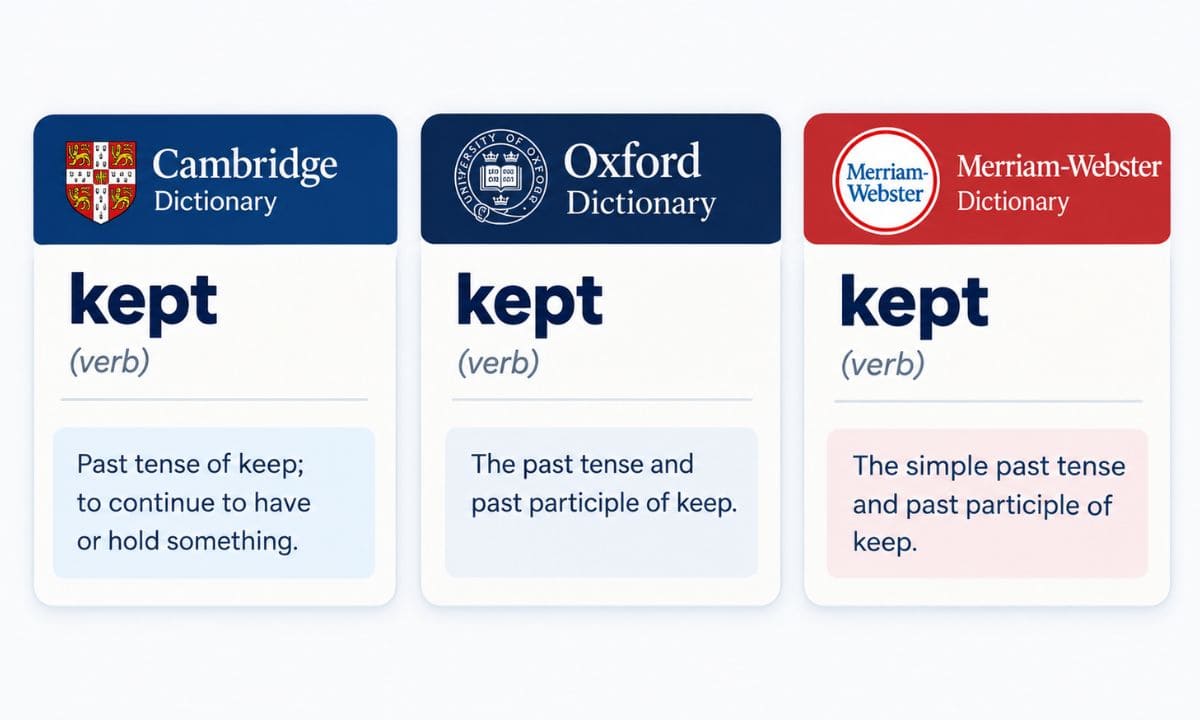
Major English dictionaries identify keep as an irregular verb. Its simple past tense and past participle are both kept.
- Cambridge Dictionary: Explains keep through meanings such as retaining something, continuing to have something, or staying in a particular condition. Kept is its past form.
- Oxford Learner’s Dictionary: Lists the verb forms as keep, keeps, kept, and keeping.
- Merriam-Webster: Provides definitions and usage information for keep, including its irregular past form kept.
These dictionary references support the standard verb pattern:
Also Read This: Take-effect-vs-take-affect
Quick Test I Created
Practice Test: Keep or Kept?
Test your understanding of keep and kept. Fill in each blank with the correct form.
- I ___ my phone in my bag every day.
- She ___ the letter yesterday.
- We have always ___ our promises.
- Please ___ this information private.
- Did you ___ the old photographs?
- He ___ his keys in the drawer last night.
- I am ___ my notes organized.
- They should ___ practicing English.
Answer Key
- Keep
- Kept
- Kept
- Keep
- Keep
- Kept
- Keeping
- Keep
Correct the Mistakes
Incorrect: I have keeped the money.
Correct: I have kept the money.
Incorrect: Did she kept the book?
Correct: Did she keep the book?
Incorrect: He is keep his room clean.
Correct: He is keeping his room clean.
Practice these patterns until you can choose the correct form confidently.
Frequently Asked Questions
What is the difference between keep and kept?
Keep is the base form of the verb, while kept is its simple past tense and past participle. Use keep for present habits and after modal verbs, and kept for past actions and perfect constructions.
Is kept the past tense of keep?
Yes. Kept is the correct simple past tense of keep.
Is keeped or kept correct?
Kept is correct. Keeped is not the standard past form of keep.
What are the three forms of keep?
The three main forms are keep, kept, and kept. Keep is the base form, while kept is both the past tense and past participle.
Should I use keep or kept in a sentence?
Use keep for present habits, instructions, and after modal verbs. Use kept for completed past actions and after have, has, or had.
What does kept mean?
Kept is the past form of keep. It can mean held, retained, maintained, or continued something in the past.
How do you spell keep?
The correct spelling is K-E-E-P. Its past tense is spelled K-E-P-T, not keeped.
What is the past participle of keep?
The past participle of keep is kept. For example: I have kept your message.
Is it correct to say “Did you kept it”?
No. The correct sentence is “Did you keep it?” Use the base form after did.
Should I say “keep saying” or “kept saying”?
Use keep saying for a present or continuing action and kept saying for an action that happened in the past.
- I keep saying the same thing.
- I kept saying the same thing yesterday.
Conclusion: Keep vs. Kept
Keep and kept are both correct forms of the same irregular English verb. Keep is the base form, while kept is the simple past tense and past participle.
Remember this simple pattern:
Keep → Kept → Kept
Use keep for present habits, instructions, and after modal verbs. Use kept for completed past actions and perfect tense sentences. Never use keeped as the standard past form.
Once you understand these rules, choosing between keep and kept becomes much easier.

7 thoughts on “Keep vs. Kept: Difference, Past Tense, Rules & Examples”