

Is it time flies or time flys? It’s time flies, every time. “Time flys” is a spelling mistake in both American and British English.
The mix-up is easy to understand. Most English plurals just add an s, so “flys” looks natural at first glance. But in this phrase, “flies” is a verb, and verbs that end in a consonant plus y follow a different rule.
Below you’ll find the quick answer, the rule behind it, the right form for every tense, and a short quiz to make it stick.
Quick Answer
“Time flies” is correct. “Time flys” is always wrong.
“Flies” is the third-person singular form of the verb fly, and “time” is a singular subject. British and American English agree here, so there is no regional spelling to choose between.
What Does “Time Flies” Mean?
“Time flies” means that time seems to pass much faster than you expect. People say it most often when they are enjoying themselves, staying busy, or looking back at how quickly the years went.
It is an idiom, so nobody is talking about real flight. You can also call it a metaphor, since we picture time with wings even though time can’t fly at all.
Why It’s “Flies,” Not “Flys”

Two small rules sit behind this phrase, and both are easy.
First, the verb form. “Time” works like he, she, or it. A singular subject takes the -s form of the verb, just as we say “she runs” and “it rains.” That is why we write “time flies,” not “time fly.”
Second, the spelling. Look at the letter before the final y:
- Consonant + y: change the y to i and add -es. Fly ends in y, and the letter before it is l, a consonant. So fly becomes flies.
- Vowel + y: keep the y and add -s. Play ends in a vowel (a) plus y, so it becomes plays.
The same pattern shows up all over English:
| Base word | Correct form | Wrong form |
|---|---|---|
| fly | flies | flys |
| cry | cries | crys |
| try | tries | trys |
| carry | carries | carrys |
| study | studies | studys |
| baby | babies | babys |
Also Read This: gramarnesty.com/keep-vs-kept
Spelling rules like this one trip up plenty of writers. The doubling rule in Puting vs Putting is another good example.
Three quick ways to remember it
- The baby test. Nobody writes “babys.” If “baby” turns into “babies,” “fly” turns into “flies.”
- The fries test. You order fries with your burger, not “frys.” Flies works the same way.
- The insect test. You’d write “two flies on the window,” never “two flys.” Same word, same spelling.
Time Flies in Different Forms and Tenses
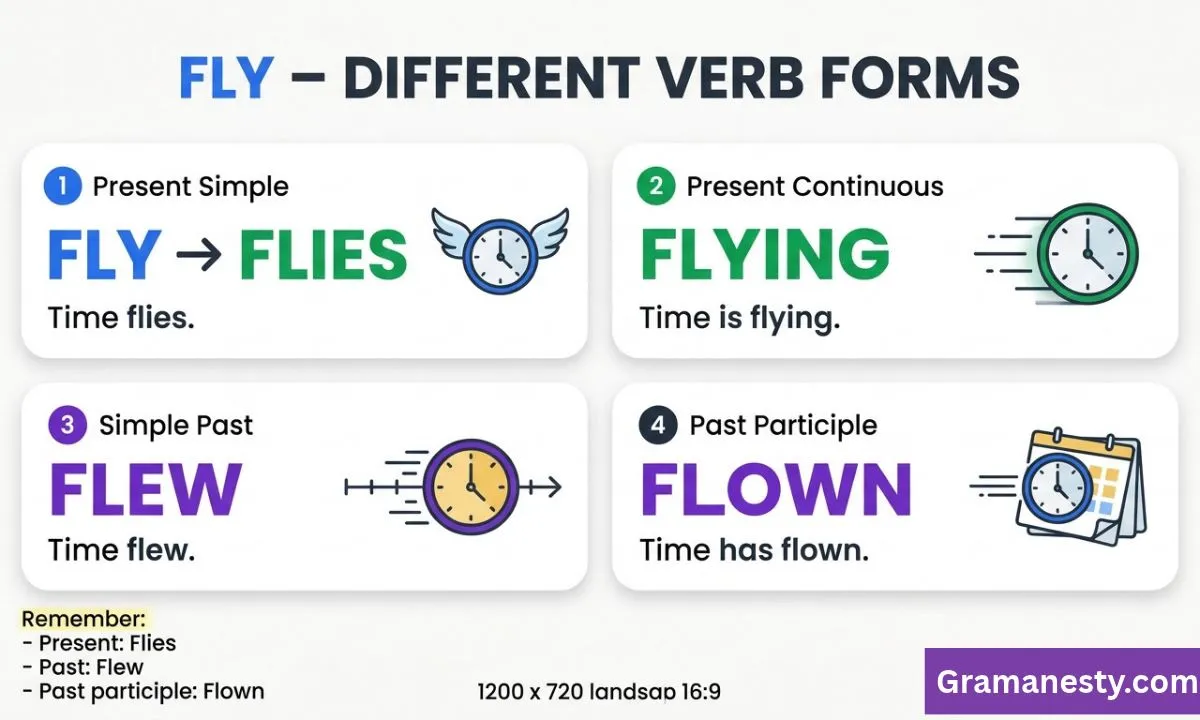
“Fly” is an irregular verb, so its past forms don’t follow the usual -ed pattern. Here is the full set:
| Tense | Correct form | Example |
|---|---|---|
| Present | time flies | Time flies when you’re busy. |
| Present continuous | time is flying | Time is flying this month. |
| Past | time flew | Time flew during the trip. |
| Present perfect | time has flown | Time has flown since we met. |
| Future | time will fly | Time will fly once school starts. |
Writers sometimes slip with the past forms, so watch for “time flied” and “time has flew.” Both are wrong. If irregular verbs give you trouble, Bit or Bited explains a similar pattern.
Also Read This: gramarnesty.com/divide-vs-devide
Time Flies By, Time Sure Flies, and Other Variations
The idiom comes in a few common versions. The verb stays “flies” in all of them.
| Phrase | Correct? | Note |
|---|---|---|
| Time flies by | ✅ Yes | “By” is an adverb that adds the sense of passing. |
| Time sure flies | ✅ Yes | A casual, spoken-style version. |
| Time certainly flies | ✅ Yes | Slightly more formal. |
| How time flies! | ✅ Yes | Often used as an exclamation. |
| Time flies when you’re having fun | ✅ Yes | The most familiar full version. |
| Time flys by | ❌ No | Wrong spelling. |
Time Flies Examples
Here are ten sentences you can borrow or adapt.
Everyday life
- Time flies when you’re on vacation.
- I can’t believe it’s already December. Time flies!
Work and school
- Time flies when you’re working on a project you love.
- Exam week went by in a blur. Time really does fly.
Family and milestones
- Happy 30th! Time flies, but the memories last forever.
- Wow, five years since graduation? Time flies!
Messages and social posts
- Just a quick update: time flies, and our deadline is closer than we think.
- Can’t believe this year is almost over. Time flies when you’re chasing goals.
- It feels like yesterday we moved in. Time sure flies.
- Looking at old photos and thinking, how time flies.
Also Read This: gramarnesty.com/nmms-meaning-in-text
Common Mistakes
| Wrong | Correct | Why |
|---|---|---|
| Time flys | Time flies | Consonant + y changes to ies. |
| Time fly | Time flies | A singular subject needs the -s form. |
| Time flied | Time flew | Fly is irregular in the past tense. |
| Time has flew | Time has flown | “Has” needs the past participle. |
| Two flys in the kitchen | Two flies in the kitchen | The insect follows the same rule. |
The same y to ies idea also explains why we write “leaves” and not “leafs” in most cases. Leafs or Leaves covers that one in detail.
Where Does “Time Flies” Come From?
The idea is more than two thousand years old. The Latin phrase tempus fugit comes from Virgil’s Georgics, a poem about farming and country life from around 29 BC. The line in Book 3 (line 284) reads fugit inreparabile tempus, which people usually translate as “irretrievable time escapes.” You can read more about it on Wikipedia’s Tempus fugit page.
Virgil’s wording is longer than the version we use today. “Tempus fugit” is the short form, and Dictionary.com lists it as meaning “time flies,” with English use recorded from the 1790s.
There is also a famous bit of wordplay: “Time flies like an arrow; fruit flies like a banana.” The joke works because “flies” can be a verb in the first half and a noun in the second. It’s a fun reminder of how much work that one small word does.
Also Read This: gramarnesty.com/tying-vs-tieing
Other Ways to Say “Time Flies”
If you want to avoid repeating the idiom, these alternatives do the job:
| Phrase | Best for |
|---|---|
| Time slips away | Reflective or gentle writing |
| The hours fly by | Everyday conversation |
| Time races by | Energetic, upbeat tone |
| Time whizzes past | Casual speech |
| Where did the time go? | Chatty questions and captions |
| Time moves so quickly | Neutral or formal writing |
| In the blink of an eye | Stressing how sudden it felt |
| Tempus fugit | Literary or classical touches |
Quick Quiz
Pick the correct word for each sentence.
- As we get older, time ______ faster than we expect. (flies / flys)
- Last summer ______ by so quickly. (time flew / time flied)
- Where has the year gone? Time has ______. (flew / flown)
- Two ______ were buzzing near the window. (flys / flies)
- Time sure ______ when you’re busy. (flies / flys)
Answer key: 1. flies, 2. time flew, 3. flown, 4. flies, 5. flies.
Frequently Asked Questions
Is it “time flies” or “time flys”?
It is “time flies.” “Time flys” is a spelling mistake. Fly ends in a consonant plus y, so the y changes to i before -es.
What does “time flies” mean?
It means time seems to pass quickly, usually when you are enjoying yourself or staying busy.
Is “time flys” ever correct in British or American English?
No. Neither variety accepts “flys” in this phrase. Both write “time flies.”
Is “time flies by” correct?
Yes. “By” is an adverb that stresses time passing, and the verb is still “flies.”
Why is it “flies” and not “flys”?
The word ends in a consonant followed by y. English changes that y to i and adds -es for the third-person singular form, just like cry becomes cries.
Is “time flies” an idiom or a metaphor?
It is an idiom. It also works as a metaphor, because time does not literally fly.
What is the past tense of “time flies”?
Use “time flew” for the simple past and “time has flown” for the present perfect. “Time flied” and “time has flew” are incorrect.
Conclusion
Next time you’re typing a caption or signing a card, you can skip the second-guessing: it’s “time flies,” never “time flys.” The reason is simple. Fly ends in a consonant plus y, so it becomes flies when the subject is singular.
Keep the baby, fries, and insect tricks handy, and use flew and flown when you talk about the past. Then you’ll get this phrase right whether you’re writing a text, an email, or a birthday card.

3 thoughts on “Time Flies or Time Flys? Correct Spelling, Rule & Examples”