

Looking for an additionally synonym that fits your sentence? This guide gives you 42 better words and phrases for “additionally,” sorted by tone so you can choose the right one for essays, emails, resumes, and everyday writing.
Every additionally synonym comes with a meaning, an example, and a usage tip.
You will also find transition words, the opposite of additionally, common misspellings, and a short quiz.
Additionally Synonym: The Quick Picks
- Best all-round additionally synonym: also (neutral) or in addition (safe and professional).
- Best formal synonyms for additionally: moreover and furthermore.
- Best casual alternatives: plus and besides.
- Best for essays: moreover, furthermore, and in addition, with finally for the last point.
- Best for a parallel idea: likewise.
- How to choose: check your tone, your audience, and whether you are adding a fact, a reason, or a similar case.
What Is the Best Synonym for Additionally?
The best additionally synonym depends on tone. Use moreover or furthermore in formal writing, in addition in professional emails, also in everyday sentences, and plus in casual chats. Choose besides when you are adding a reason, and likewise when the new point is a parallel idea rather than a new one.
Additionally Synonyms at a Glance: Tone and Best Use
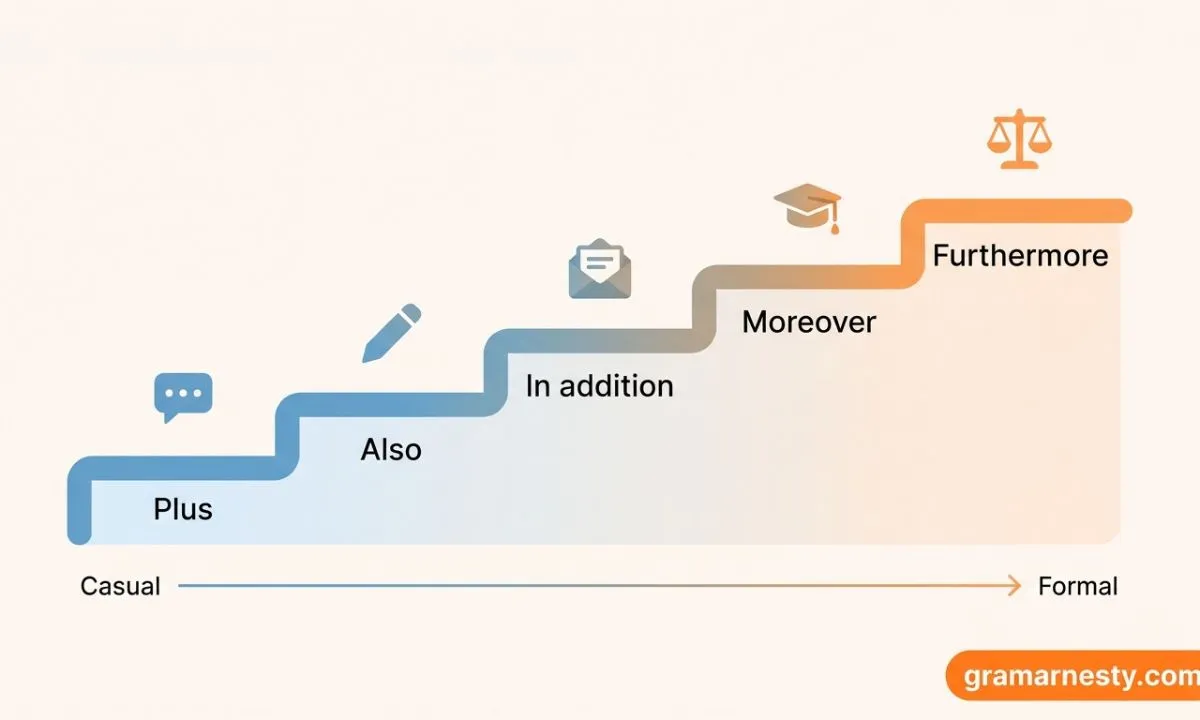
Use this table to compare the most useful alternatives before you read the full list.
| Phrase | Best Use | Avoid In | Tone |
|---|---|---|---|
| Moreover | Essays and reports that need emphasis | Text messages | Formal |
| Furthermore | Academic and legal writing | Casual chat | Formal |
| In addition | Business emails and reports | Very casual notes | Neutral |
| Also | Everyday writing and short emails | Formal openings in strict academic style | Neutral |
| Besides | Adding a reason to support a decision | Neutral fact lists | Informal |
| Plus | Texts and informal notes | Formal essays | Very casual |
| As well | The end of a sentence | The start of a sentence | Casual to neutral |
| What’s more | Blogs and speeches | Legal documents | Semi-formal |
| Likewise | Parallel actions or cases | Adding an unrelated fact | Neutral to formal |
| Not to mention | An obvious extra point | Serious complaints | Casual |
Also Read This: Carmel vs Caramel
What Does “Additionally” Mean?
Definition and Part of Speech
“Additionally” is an adverb that means “in addition” or “also.” Any additionally synonym shares this job: it introduces extra information that supports or extends what you have already said, without changing direction.
Pronunciation of “Additionally”
It is pronounced /əˈdɪʃənəli/, with the main stress on the second syllable: uh-DISH-uh-nuh-lee.
Syllables and Word Formation of “Additionally”
“Additionally” has five syllables: ad-di-tion-al-ly. It is built from addition + -al + -ly, which is why the word ends in a double “l.”
Etymology of “Additionally”
“Additionally” comes from the adjective “additional,” which comes from “addition,” a word with Latin roots in addere, “to add.” Check a dictionary such as Merriam-Webster or Oxford for exact dates.
“Additionally” in a Sentence: 8 Examples
- Email: Attached is the draft. Additionally, I have listed three open questions.
- Essay: Remote work saves commuting time. Additionally, it widens the hiring pool.
- Resume: Managed a team of five. Additionally, trained two new hires.
- School: The class meets on Monday. Additionally, there is an optional lab on Friday.
- Workplace: The office closes at six. Additionally, the car park locks at seven.
- News style: The city will repair the bridge. Additionally, it plans new bike lanes.
- Travel: The tour includes lunch. Additionally, guests receive a free map.
- Review: The phone has a great camera. Additionally, its battery lasts two days.
Is “Additionally” Formal or Informal?
“Additionally” is neutral to formal. It suits emails, reports, and essays, but it can sound stiff in texts or casual speech, where “plus” or “also” feels more natural.
Can You Start a Sentence With “Additionally”?
Yes, you can. Put a comma after it: “Additionally, the team hired two analysts.” Some editors dislike repeating it at the start of every sentence, which is exactly why a good additionally synonym helps.
Also Read This: Carmel vs Caramel
42 Additionally Synonyms With Meanings, Examples, and Usage Tips
Each additionally synonym below is grouped by tone and purpose. Near-synonyms are not always interchangeable, so read each usage tip before you swap one in.
Formal and Academic Synonyms for Additionally
These additionally synonyms carry the most weight in essays, reports, and legal or academic writing.
1. Moreover
Pronunciation: US /ˌmɔːrˈoʊvɚ/ | UK /mɔːrˈəʊvə/
Meaning: Adds a point that strengthens the argument you have just made.
Examples:
- “The method is cheap; moreover, it is easy to scale.”
Usage Tip: Use it after a complete clause in essays and reports. Avoid it in texts and chats.
2. Furthermore
Pronunciation: US /ˈfɝːðɚˌmɔːr/ | UK /ˌfɜːðəˈmɔː/
Meaning: Extends an argument with another supporting point, often in academic or legal writing.
Examples:
- “The study was small. Furthermore, it excluded older adults.”
Usage Tip: Use it when the new point builds on the old one. Do not stack it with “moreover” in the same paragraph.
3. In addition
Pronunciation: US /ɪn əˈdɪʃ.ən/ | UK /ɪn əˈdɪʃ.ən/
Meaning: A neutral, widely accepted phrase for adding information.
Examples:
- “In addition, all staff must complete the safety course.”
Usage Tip: This is the safest choice for business emails. Add “to” before a noun: “In addition to the fee, you pay tax.”
4. Further
Pronunciation: US /ˈfɝː.ðɚ/ | UK /ˈfɜː.ðə/
Meaning: A short formal connector that extends a discussion.
Examples:
- “Further, the committee asked for a revised budget.”
Usage Tip: It appears mostly in formal and legal writing and can sound stiff elsewhere.
5. Over and above
Pronunciation: US /ˌoʊ.vɚ ænd əˈbʌv/ | UK /ˌəʊ.vər ənd əˈbʌv/
Meaning: Beyond what was already stated or required.
Examples:
- “Over and above his salary, he receives a travel allowance.”
Usage Tip: It usually takes a noun, so it joins phrases rather than whole sentences.
6. In conjunction with
Pronunciation: US /ɪn kənˈdʒʌŋk.ʃən wɪð/ | UK /ɪn kənˈdʒʌŋk.ʃən wɪð/
Meaning: Together with, for things that work or happen jointly.
Examples:
- “The clinic runs the program in conjunction with the local school.”
Usage Tip: Use it for partnerships and joint actions, not for a plain extra fact.
7. Equally important
Pronunciation: US /ˈiː.kwə.li ɪmˈpɔːr.tənt/ | UK /ˈiː.kwə.li ɪmˈpɔː.tənt/
Meaning: Signals that the next point matters just as much as the last.
Examples:
- “Equally important, the team needs clear deadlines.”
Usage Tip: Use it only when both points really carry the same weight.
8. Also worth noting
Pronunciation: US /ˈɔːl.soʊ wɝːθ ˈnoʊ.t̬ɪŋ/ | UK /ˈɔːl.səʊ wɜːθ ˈnəʊ.tɪŋ/
Meaning: Flags a useful extra detail.
Examples:
- “Also worth noting, the offer ends on Sunday.”
Usage Tip: It works for side details in guides and reports. Overuse sounds like a habit.
9. Withal
Pronunciation: US /wɪˈðɔːl/ | UK /wɪˈðɔːl/
Meaning: A rare, literary word meaning “in addition” or “besides.”
Examples:
- “He was clever, and kind withal.”
Usage Tip: It is dated, so use it only in deliberately literary writing.
Professional and Neutral Alternatives to Additionally
These additionally synonyms sit between formal and casual. They are polished but not stiff.
10. Also
Pronunciation: US /ˈɔːl.soʊ/ | UK /ˈɔːl.səʊ/
Meaning: The simplest, most common way to add one more idea.
Examples:
- “The app is free. It also works offline.”
Usage Tip: Place it before the main verb. “Also” at the end of a sentence sounds awkward.
11. As well as
Pronunciation: US /æz ˈwel æz/ | UK /æz ˈwel æz/
Meaning: Joins two items or actions inside one sentence.
Examples:
- “She manages sales as well as marketing.”
Usage Tip: It does not start a sentence. Traditionally, the verb agrees with the first subject.
12. Along with
Pronunciation: US /əˈlɔːŋ wɪð/ | UK /əˈlɒŋ wɪð/
Meaning: Joins things that come or happen together.
Examples:
- “The laptop comes along with a two-year warranty.”
Usage Tip: It suits packages and deliverables, not sentence openings.
13. Together with
Pronunciation: US /təˈɡeð.ɚ wɪð/ | UK /təˈɡeð.ə wɪð/
Meaning: Pairs two people or things as a unit.
Examples:
- “The director, together with her team, presented the results.”
Usage Tip: Set it off with commas. It reads well in formal reports.
14. Coupled with
Pronunciation: US /ˈkʌ.pəld wɪð/ | UK /ˈkʌ.pəld wɪð/
Meaning: Shows two factors combining into one effect.
Examples:
- “Rising rent, coupled with low wages, forced many families to move.”
Usage Tip: Best for causes and effects. Avoid it for simple list additions.
15. Beyond that
Pronunciation: US /biˈjɑːnd ðæt/ | UK /biˈjɒnd ðæt/
Meaning: Moves to a further point after finishing the previous one.
Examples:
- “The design is simple. Beyond that, it is durable.”
Usage Tip: It suits presentations and conversational reports.
16. Adding to this
Pronunciation: US /ˈæd.ɪŋ tuː ðɪs/ | UK /ˈæd.ɪŋ tuː ðɪs/
Meaning: Builds smoothly on the sentence you just wrote.
Examples:
- “Adding to this, the survey shows strong demand.”
Usage Tip: Make sure “this” has a clear reference, or reword.
17. On top of this
Pronunciation: US /ɑːn tɑːp əv ðɪs/ | UK /ɒn tɒp əv ðɪs/
Meaning: Adds another point to something just described.
Examples:
- “The course is free. On top of this, every student receives a certificate.”
Usage Tip: It is slightly less formal than “in addition,” so it fits blogs and memos.
18. In addition to this
Pronunciation: US /ɪn əˈdɪʃ.ən tuː ðɪs/ | UK /ɪn əˈdɪʃ.ən tuː ðɪs/
Meaning: A longer version of “in addition.”
Examples:
- “In addition to this, interns will receive mentoring.”
Usage Tip: Use it for rhythm or emphasis. Otherwise, “in addition” is shorter.
19. Alongside this
Pronunciation: US /əˌlɔːŋˈsaɪd ðɪs/ | UK /əˌlɒŋˈsaɪd ðɪs/
Meaning: Presents a second point that happens at the same time.
Examples:
- “Alongside this, the school launched a reading club.”
Usage Tip: It is good for parallel developments in news and reports.
Casual and Conversational Synonyms for Additionally
Use these additionally synonyms in chats, blogs, and spoken English, where “additionally” can sound too formal.
20. Plus
Pronunciation: US /plʌs/ | UK /plʌs/
Meaning: An informal way to add another advantage or point.
Examples:
- “It’s cheap, plus it works great.”
Usage Tip: Fine in texts and casual blogs. Avoid it in formal essays.
21. Too
Pronunciation: US /tuː/ | UK /tuː/
Meaning: The shortest everyday addition word.
Examples:
- “I liked the movie too.”
Usage Tip: It sits at the end of a clause and does not open a sentence naturally.
22. As well
Pronunciation: US /æz ˈwel/ | UK /æz ˈwel/
Meaning: Adds an item at the end of a sentence in a spoken or casual tone.
Examples:
- “She speaks French as well.”
Usage Tip: It sounds a little more polished than “too.”
23. Besides
Pronunciation: US /bɪˈsaɪdz/ | UK /bɪˈsaɪdz/
Meaning: Adds an extra reason, often to support a decision.
Examples:
- “I’m tired. Besides, it’s late.”
Usage Tip: It implies reasoning, so do not use it for neutral facts.
24. What’s more
Pronunciation: US /wʌts ˈmɔːr/ | UK /wɒts ˈmɔː/
Meaning: Adds a point that is often stronger than the last.
Examples:
- “The tool is fast. What’s more, it’s affordable.”
Usage Tip: It is semi-formal and works well in blogs and speeches.
25. On top of that
Pronunciation: US /ɑːn tɑːp əv ðæt/ | UK /ɒn tɒp əv ðæt/
Meaning: Piles another point onto the last one, often a problem.
Examples:
- “The flight was delayed. On top of that, my bag was lost.”
Usage Tip: It works best for complaints or surprises.
26. And also
Pronunciation: US /ænd ˈɔːl.soʊ/ | UK /ænd ˈɔːl.səʊ/
Meaning: A casual connector that stresses one more item.
Examples:
- “Bring your laptop and also a charger.”
Usage Tip: Often “and” or “also” alone is enough, so trim it in tight writing.
27. Added to that
Pronunciation: US /ˈæd.ɪd tuː ðæt/ | UK /ˈæd.ɪd tuː ðæt/
Meaning: An informal way to build on a previous point.
Examples:
- “The house is small. Added to that, the street is noisy.”
Usage Tip: It has a spoken tone and suits informal blogs.
28. Besides that
Pronunciation: US /bɪˈsaɪdz ðæt/ | UK /bɪˈsaɪdz ðæt/
Meaning: A casual way to give one more reason after your main point.
Examples:
- “The hotel is clean. Besides that, the staff are friendly.”
Usage Tip: Use it after you finish a point. Do not repeat “that” in back-to-back sentences.
29. For another thing
Pronunciation: US /fɔːr əˈnʌð.ɚ θɪŋ/ | UK /fər əˈnʌð.ə θɪŋ/
Meaning: Introduces a second reason in an argument.
Examples:
- “I won’t take the job. For one thing, it pays less. For another thing, the commute is long.”
Usage Tip: It normally follows “for one thing,” so it feels incomplete on its own.
Emphatic Synonyms for Additionally
Each additionally synonym here adds a point and also signals that it matters, surprises, or tips the balance.
30. Not to mention
Pronunciation: US /nɑːt tə ˈmen.ʃən/ | UK /nɒt tə ˈmen.ʃən/
Meaning: Adds an obvious extra point as an aside.
Examples:
- “The car is fast, not to mention affordable.”
Usage Tip: It can sound dismissive if the point is negative, so use it with positive details.
31. Not only that
Pronunciation: US /nɑːt ˈoʊn.li ðæt/ | UK /nɒt ˈəʊn.li ðæt/
Meaning: Signals that the next point is even bigger.
Examples:
- “The tool saves time. Not only that, it cuts errors.”
Usage Tip: Do not mix it with the “not only… but also” pattern in the same sentence.
32. More importantly
Pronunciation: US /mɔːr ɪmˈpɔːr.tənt.li/ | UK /mɔː ɪmˈpɔː.tənt.li/
Meaning: Adds a point while ranking it above the previous one.
Examples:
- “It’s cheap. More importantly, it works.”
Usage Tip: Use it only when the second point truly outranks the first.
33. To boot
Pronunciation: US /tə ˈbuːt/ | UK /tə ˈbuːt/
Meaning: Adds a bonus at the end, in a playful, slightly old-fashioned way.
Examples:
- “She’s talented, and kind to boot.”
Usage Tip: Skip it in professional writing.
34. Into the bargain
Pronunciation: US /ˈɪn.tu ðə ˈbɑːr.ɡɪn/ | UK /ˈɪn.tu ðə ˈbɑː.ɡɪn/
Meaning: An older idiom meaning “as an extra on top.”
Examples:
- “He fixed the sink and painted the wall into the bargain.”
Usage Tip: It is idiomatic, so learners may prefer “as well.”
35. As a bonus
Pronunciation: US /æz ə ˈboʊ.nəs/ | UK /æz ə ˈbəʊ.nəs/
Meaning: Highlights an unexpected extra benefit.
Examples:
- “The job pays well, and as a bonus, it’s remote.”
Usage Tip: Use it only for positive additions.
36. On top of everything else
Pronunciation: US /ɑːn tɑːp əv ˈev.ri.θɪŋ ˈels/ | UK /ɒn tɒp əv ˈev.ri.θɪŋ ˈels/
Meaning: Adds a final point to a long list, often a negative one.
Examples:
- “The rent went up, and on top of everything else, the heating broke.”
Usage Tip: Save it for the last item in a series.
37. Not just that
Pronunciation: US /nɑːt dʒʌst ðæt/ | UK /nɒt dʒʌst ðæt/
Meaning: A conversational version of “not only that.”
Examples:
- “The phone is light. Not just that, the battery lasts two days.”
Usage Tip: It is spoken in tone, so choose “not only that” in writing.
Comparison and Closing Phrases Similar to Additionally
This additionally synonym group does slightly different jobs: showing a parallel case or marking the final point.
38. Likewise
Pronunciation: US /ˈlaɪk.waɪz/ | UK /ˈlaɪk.waɪz/
Meaning: Adds a similar case or action.
Examples:
- “He apologized; she did likewise.”
Usage Tip: It points to similarity, so it cannot replace “additionally” when the new idea is different.
39. In like manner
Pronunciation: US /ɪn laɪk ˈmæn.ɚ/ | UK /ɪn laɪk ˈmæn.ə/
Meaning: A formal, old-fashioned version of “likewise.”
Examples:
- “The first team cut costs; in like manner, the second reduced waste.”
Usage Tip: It is rare today but acceptable in formal essays.
40. Last but not least
Pronunciation: US /ˈlæst bʌt nɑːt ˈliːst/ | UK /ˈlɑːst bʌt nɒt ˈliːst/
Meaning: Introduces the final item while stressing that it still matters.
Examples:
- “Last but not least, thank you to our volunteers.”
Usage Tip: Use it only for the final item in a list.
41. Lastly
Pronunciation: US /ˈlæst.li/ | UK /ˈlɑːst.li/
Meaning: Adds the final point in a sequence.
Examples:
- “Lastly, remember to back up your files.”
Usage Tip: Use it after “first” and “second,” not as a plain connector in the middle.
42. Finally
Pronunciation: US /ˈfaɪ.nəl.i/ | UK /ˈfaɪ.nəl.i/
Meaning: Marks the last point after a series.
Examples:
- “Finally, the report recommends a pilot program.”
Usage Tip: Use it at the end only. It can also mean “at last.”
Also Read This: Pricey or Pricy
Better Words for Additionally in an Essay
Adding a Supporting Point
The best additionally synonym for a supporting point is moreover, furthermore, or in addition. Move up in strength: “in addition” for a plain extra, “moreover” for an emphasized one.
Adding the Final Point
Switch to finally or lastly so readers know the list is ending.
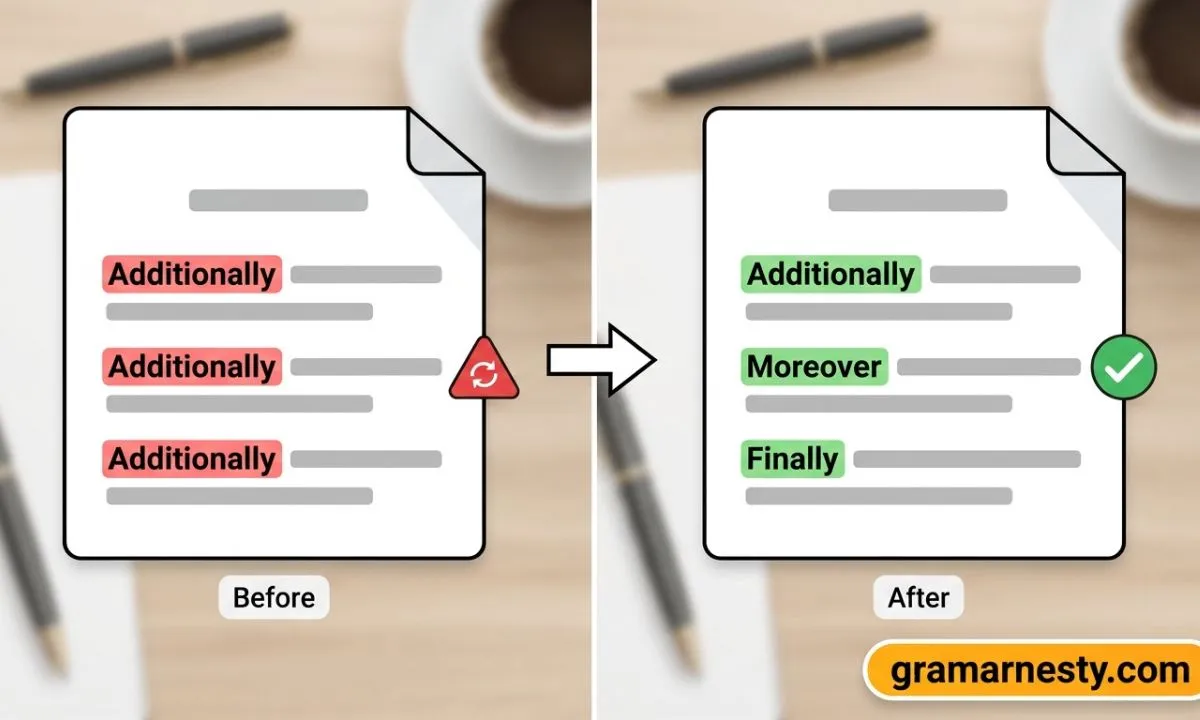
Before and After Essay Example
Original: Remote work saves commuting time. Additionally, it lowers office costs. Additionally, it widens the hiring pool.
Improved: Remote work saves commuting time. Moreover, it lowers office costs. Finally, it widens the hiring pool.
Why it works: The improved version rotates the transitions and signals the end of the list.
Tip: You do not need a transition in every sentence. Sometimes a clear sentence order says it better.
Transition Words Like Additionally

An additionally synonym is only one kind of transition. Pick the group that matches what your next sentence does.
| Purpose | Transition Words | Example |
|---|---|---|
| Adding | moreover, furthermore, in addition | The plan is simple. Moreover, it is cheap. |
| Contrast | however, on the other hand, nevertheless | The plan is cheap. However, it is slow. |
| Cause and effect | therefore, as a result, consequently | Sales fell. As a result, we cut costs. |
| Example | for instance, for example, in particular | Many tools help. For instance, a checklist saves time. |
| Sequence | first, next, finally | First, collect the data. Next, clean it. |
| Conclusion | in conclusion, to sum up, overall | To sum up, the pilot worked. |
Also Read This: Good to Hear Synonym
Additionally vs Moreover vs Furthermore
Dictionaries often treat these three additionally synonym candidates as near-synonyms, so the differences below describe common usage and editorial judgment rather than strict rules.

| Feature | Additionally | Moreover | Furthermore |
|---|---|---|---|
| Core job | Adds extra information | Adds a stronger supporting point | Builds on an argument step by step |
| Emphasis | Low to medium | Medium to high | Medium |
| Tone | Neutral to formal | Formal | Formal to academic |
| Typical place | Emails, reports | Essays, arguments | Academic and legal writing |
| Example | Additionally, the file includes a summary. | The plan is costly; moreover, it is risky. | The data were clear. Furthermore, they were consistent. |
Additionally vs Additional
“Additionally” is an adverb that connects ideas: “Additionally, we need a permit.” “Additional” is an adjective that describes a noun: “We need an additional permit.”
Additionally Synonyms for Resumes, Emails, and Texts

Match your additionally synonym to the document. Here are four before-and-after examples.
Resume
Original: Led a five-person team. Additionally, managed the annual budget.
Improved: Led a five-person team and managed the annual budget.
Why it works: Resume bullets are compact, so a plain “and” beats any transition. In a cover letter, “in addition” or “also” is a safe pick.
Professional Email
Original: Attached is the revised proposal. Additionally, I’ve included last quarter’s figures.
Improved: Attached is the revised proposal. I’ve also included last quarter’s figures for comparison.
Why it works: Moving “also” inside the sentence sounds more natural and less formulaic.
Academic Writing
Original: The sample was small. Additionally, it lacked diversity.
Improved: The sample was small. Furthermore, it lacked diversity.
Why it works: “Furthermore” suits an academic tone and signals that the second limitation builds on the first.
Text Message
Original: I can’t come tonight. Additionally, I’m exhausted.
Improved: I can’t come tonight. Plus, I’m exhausted.
Why it works: “Additionally” sounds stiff in a chat, while “plus” matches the casual tone.
Also Read This: Bit or Bited
What Is the Opposite of Additionally?
“Additionally” has no exact antonym. An additionally synonym adds to a point, so contrast words work as its opposite because they turn the sentence in a new direction.
| Contrast Word | Meaning | Example |
|---|---|---|
| However | Introduces a point that goes against the last one | The plan is cheap. However, it is slow. |
| But | A short, everyday contrast | It’s cheap, but it’s slow. |
| Conversely | Shows the reverse situation | Some students prefer mornings; conversely, others work best at night. |
| On the other hand | Presents a competing view | Remote work saves time. On the other hand, it can feel isolating. |
| In contrast | Highlights a clear difference | Sales rose in March. In contrast, April was flat. |
| Nevertheless | Adds a point despite the previous one | The test was hard. Nevertheless, most students passed. |
What Is the Abbreviation for Additionally?
There is no standard dictionary abbreviation for “additionally.” You may see “addl.” in forms and accounting, but that usually stands for “additional,” not “additionally.” In formal writing, spell the word out or use “also” or “plus” in quick notes.
Dictionary references: Merriam-Webster and Cambridge Dictionary.
Common Misspellings of Additionally
| Wrong Spelling | What Went Wrong | Correct Spelling |
|---|---|---|
| addionally | Missing the second “d” and the “t” | additionally |
| additonally | Missing the “i” after “t” | additionally |
| aditionally | Only one “d” | additionally |
| additionaly | Only one “l” before “y” | additionally |
| addittionally | Extra “t” | additionally |
| additioanlly | Letters “a” and “n” swapped | additionally |
| addiionally | Missing the “t” | additionally |
Memory trick: Spell the parts: addition + al + ly. Because “additional” already ends in “l” and “-ly” starts with “l,” you get a double “l”: additionally.
Additionally in Other Languages
These are common equivalents of the word, not a full additionally synonym list in each language. The best choice still depends on context.
| Language | Common Equivalent |
|---|---|
| Spanish | además |
| French | en outre, de plus |
| German | außerdem, zusätzlich |
| Norwegian | i tillegg |
| Hindi | इसके अलावा |
| Urdu | اس کے علاوہ |
Also Read This: Followup vs Follow Up
Common Mistakes When Choosing an Additionally Synonym
- Using a formal word in a casual message. “Moreover, I love pizza” sounds odd in a text. Try “plus” instead.
- Treating every synonym as an exact swap. “Besides” often gives a reason, not just an extra fact.
- Repeating the same transition. Rotate three or four options in a long document.
- Stacking transitions. “Also, moreover, in addition” adds noise. Pick one.
- Changing the meaning by accident. “Likewise” shows similarity, so it cannot replace “additionally” for a new idea.
Additionally Synonym Cheat Sheet
- Formal: moreover, furthermore
- Professional: in addition, also, along with
- Casual: plus, besides, as well
- Emphatic: not only that, more importantly
- Parallel idea: likewise
- Last point: finally, lastly
Practice Quiz: Test Your Additionally Synonyms
- Which word is the most formal: plus, moreover, or too?
- Fill in the blank: “I don’t want to go out. ____, it’s raining.” (besides or likewise)
- Which spelling is correct: additonally, additionally, or aditionally?
- Which word shows a similar case rather than a new idea: likewise or furthermore?
- Which phrase usually sits at the end of a sentence: as well or moreover?
- Which word turns the sentence in the opposite direction: however or furthermore?
Answer key: 1. moreover. 2. besides. 3. additionally. 4. likewise. 5. as well. 6. however.
Frequently Asked Questions About Additionally Synonyms
What is the best synonym for additionally?
“Also” is the safest everyday choice, and “moreover” works best in formal writing. For professional emails, “in addition” is a reliable option.
What is a formal synonym for additionally?
“Moreover” and “furthermore” are the strongest formal choices. “In addition” works when you want a neutral business tone.
Can I start a sentence with additionally?
Yes, and you should follow it with a comma. If you use it often, swap in another transition to avoid repetition.
Is additionally a transition word?
Yes. It is a transitional adverb that adds information to the previous point.
What is the opposite of additionally?
There is no exact antonym, but contrast words such as “however,” “conversely,” and “on the other hand” work as opposites. They change direction instead of adding to a point.
What is the abbreviation for additionally?
There is no standard dictionary abbreviation for “additionally.” You may see “addl.” for “additional” in forms, but it is better to write the word in full.
What is a better word for additionally in an essay?
“Moreover,” “furthermore,” and “in addition” suit most essays. Use “finally” or “lastly” for the last point.
What is the difference between additionally and additional?
“Additionally” is an adverb that links ideas, while “additional” is an adjective that describes a noun. For example: “Additionally, we need an additional permit.”
Is moreover the same as additionally?
They are close in meaning, but “moreover” usually carries more emphasis. “Additionally” simply adds information.
Conclusion: How to Choose the Right Additionally Synonym
The right additionally synonym depends on your meaning, tone, audience, and context. Use moreover or furthermore for formal writing, in addition for professional emails, also for everyday sentences, and plus for casual messages. Rotate three or four options from this additionally synonym list in longer pieces, and remember that sometimes a plain “and” is the best choice.
Explore More Grammar Guides
Stutter vs Studder: Correct Spelling and Meaning Guide in 2026
collection of English synonyms, antonyms, and alternative words
Opportunity Synonyms: 30+ Words, Alternatives, Meanings and Examples
Share Synonyms: Meanings, Examples and When to Use Each
Kindness Synonyms: Words, Meanings, Examples and How to Use Them

4 thoughts on “Additionally Synonym: 40 Better Words and Phrases With Meanings and Examples”