

“Create” is one of the most overused words in everyday and professional writing. Whether you’re describing a new product, a piece of art, a business plan, or a line of code, “create” gets reached for again and again often because it’s the first word that comes to mind, not because it’s the most precise one.
The problem is that most synonyms for “create” are not truly interchangeable. Words like make, produce, develop, design, generate, and build each carry a slightly different shade of meaning depending on context: physical vs. abstract, sudden vs. gradual, original vs. assembled.
This guide breaks down 25+ synonyms for “create,” explains what each one really implies, and helps you pick the right word every time you write.
What Does “Create” Mean?
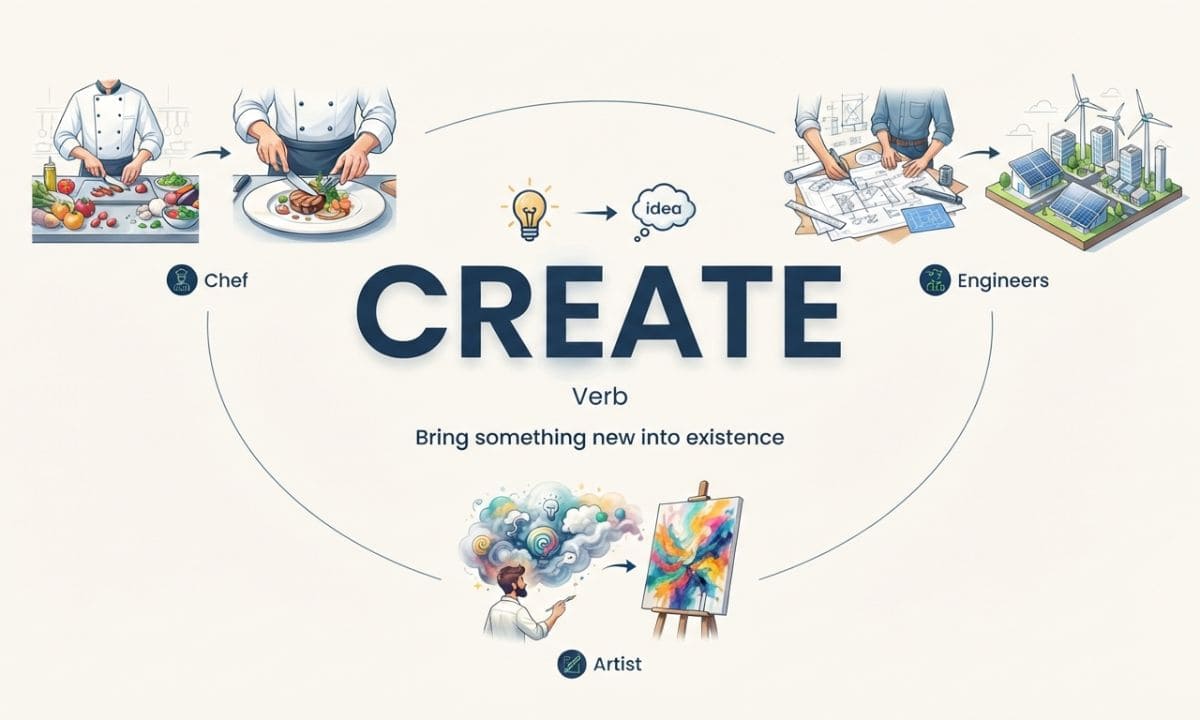
Simple meaning:
To bring something into existence that did not exist before through effort, imagination, thought, or action.
Part of Speech: Verb
Example Sentences:
- The chef created a new dish using local ingredients.
- Engineers created a system to reduce energy waste.
- She created a painting inspired by her hometown.
Semantic note:
“Create” leans toward originality and intention. It suggests that something new is coming into being, rather than simply being assembled, copied, or repeated which is exactly why so many synonyms exist to capture more specific versions of that idea.
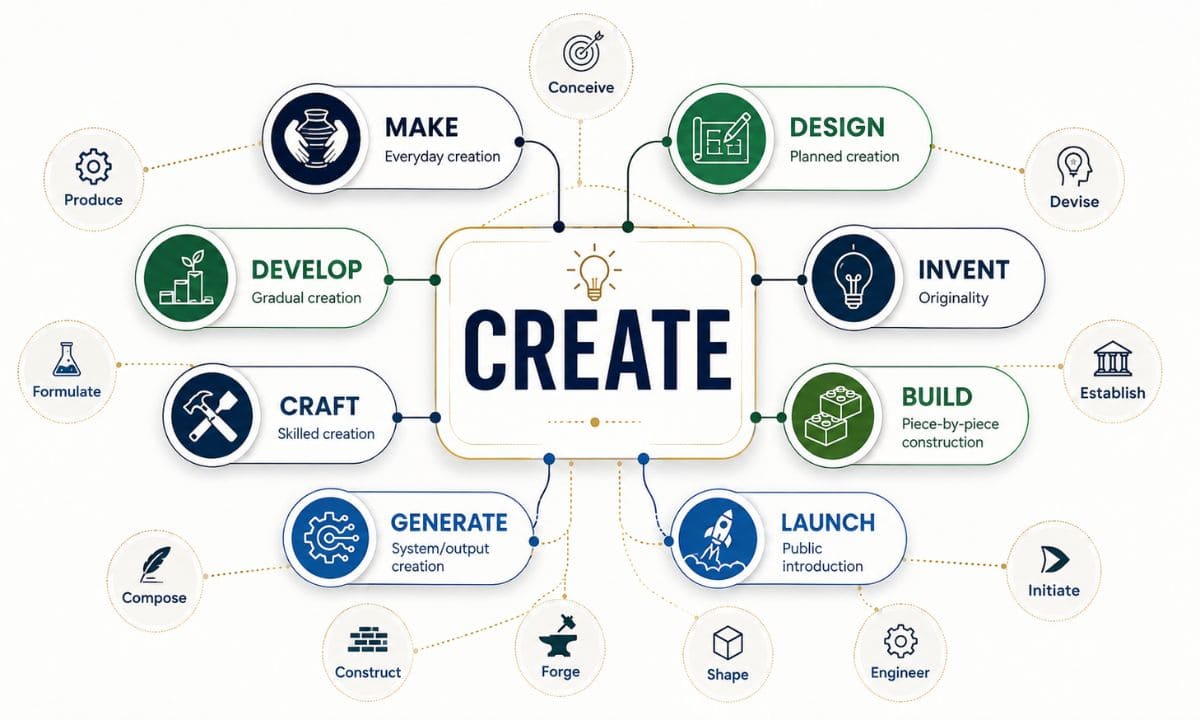
Create Synonyms at a Glance
| Synonym | Best Used For | Meaning |
| Make | General, everyday creation | To produce or bring something into being |
| Produce | Manufacturing, output-based work | To generate a result, product, or output |
| Develop | Gradual, staged creation | To build something up over time |
| Design | Planned, intentional creation | To plan the form or structure of something |
| Generate | Automated or systemic creation | To produce, often via a process or system |
| Build | Structural or step-by-step creation | To construct piece by piece |
| Establish | Institutional creation | To set up something meant to last |
| Form | Shaping something into being | To bring into a particular shape or structure |
| Construct | Physical or logical assembly | To build using defined parts or components |
| Invent | Entirely new, original creation | To originate something not existing before |
| Originate | Source of an idea or process | To be the starting point of something |
| Compose | Artistic or written creation | To create by arranging parts, especially in art/music |
| Formulate | Careful, precise creation | To devise a plan, method, or idea methodically |
| Craft | Skilled, hands-on creation | To make with care and skill |
| Devise | Clever, strategic creation | To plan or invent through thought |
| Fashion | Shaping with effort | To make or shape, often with limited resources |
| Manufacture | Industrial creation | To produce goods on a large scale |
| Institute | Formal, official creation | To establish a system, rule, or organization |
| Found | Founding an organization | To establish something, especially long-term |
| Initiate | Starting a process | To begin or set something in motion |
| Launch | Introducing something publicly | To start or introduce, often a product or plan |
| Conceive | Idea-stage creation | To form an idea or plan in the mind |
| Forge | Deliberate, effortful creation | To create through strong effort or determination |
| Shape | Influencing form or outcome | To give particular form or direction to something |
| Engineer | Technical or strategic creation | To design or bring about carefully, often technically |
| Bring About | Causing something to happen | To cause an event or situation to occur |
| Give Rise To | Indirect creation or cause | To cause something to happen as a result |
Synonyms for 25+ Synonyms for Create
Each synonym below shifts the meaning of “create” slightly; some emphasize planning, others emphasize originality, effort, or scale. Understanding these small differences is what separates generic writing from precise writing.
Make
“Make” is the simplest, most general synonym for create. It works in almost any everyday context without sounding formal or technical.
Examples:
- She made a cake for the party.
- They made a plan to fix the issue.
- He made a decision quickly.
Best for: everyday, casual writing.
Produce
“Produce” emphasizes generating an output or result, often within a process, industry, or system.
Examples:
- The factory produces thousands of units daily.
- The team produced a detailed report.
- The film was produced on a small budget.
Best for: manufacturing, media, or output-driven work.
Develop
“Develop” emphasizes gradual creation, where something is built up over stages rather than appearing all at once.
Examples:
- The company developed a new app over six months.
- Researchers developed a vaccine after years of testing.
- She developed a habit of writing daily.
Best for: long-term or staged projects.
Design
“Design” emphasizes intentional planning of form, structure, or function before something is built.
Examples:
- The architect designed a modern office building.
- They designed a new logo for the brand.
- The engineer designed a more efficient engine.
Best for: creative, technical, or structural planning.
Generate
“Generate” emphasizes creation through a system, process, or automatic mechanism rather than manual effort.
Examples:
- The software generates reports automatically.
- The campaign generated a lot of interest.
- Solar panels generate electricity.
Best for: technology, data, or automated processes.
Build
“Build” emphasizes constructing something piece by piece, often physically or structurally.
Examples:
- They built a new house on the corner lot.
- The startup built its platform from scratch.
- She built a strong team over the years.
Best for: construction, teams, or systems built incrementally.
Establish
“Establish” emphasizes setting something up with the intention that it will last or become permanent.
Examples:
- The founders established the company in 2010.
- New guidelines were established for remote work.
- They established a strong reputation in the industry.
Best for: institutions, policies, or long-term foundations.
Form
“Form” emphasizes shaping something into a particular structure or arrangement.
Examples:
- They formed a committee to review the proposal.
- The clouds formed a distinct pattern.
- A new alliance was formed between the two companies.
Best for: groups, structures, or shapes coming together.
Construct
“Construct” emphasizes building something using defined parts, logic, or components, often physical or intellectual.
Examples:
- Workers constructed the bridge in under a year.
- She constructed a strong argument in her essay.
- The model was constructed using real data.
Best for: physical structures or logical frameworks.
Invent
“Invent” emphasizes originality creating something that has never existed before.
Examples:
- He invented a new type of tool.
- The scientist invented a faster charging method.
- Children often invent games on the spot.
Best for: entirely new ideas, tools, or technologies.
Originate
“Originate” emphasizes being the starting point or source of an idea, trend, or process.
Examples:
- The idea originated from a casual conversation.
- The tradition originated centuries ago.
- The strategy originated within the marketing team.
Best for: tracing the source of something.
Compose
“Compose” emphasizes creating by arranging parts thoughtfully, especially in writing, music, or art.
Examples:
- She composed a song for the film.
- He composed an email explaining the delay.
- The photographer composed the shot carefully.
Best for: artistic, musical, or written creation.
Formulate
“Formulate” emphasizes careful, methodical creation, often of plans, ideas, or strategies.
Examples:
- The team formulated a new marketing strategy.
- Scientists formulated a hypothesis to test.
- She formulated a clear response to the criticism.
Best for: plans, theories, or structured ideas.
Craft
“Craft” emphasizes skillful, careful creation, often implying attention to detail.
Examples:
- The writer crafted a compelling story.
- Artisans crafted the furniture by hand.
- She crafted a thoughtful response to the email.
Best for: creative or skill-based work.
Devise
“Devise” emphasizes clever or strategic thinking behind the creation of a plan or method.
Examples:
- They devised a plan to cut costs.
- Engineers devised a workaround for the bug.
- She devised a new way to organize the data.
Best for: strategies, solutions, or clever methods.
Fashion
“Fashion” emphasizes shaping or making something, often with effort or limited materials.
Examples:
- He fashioned a shelter out of branches.
- The sculptor fashioned a figure from clay.
- They fashioned a solution from available resources.
Best for: resourceful or hands-on creation.
Manufacture
“Manufacture” emphasizes large-scale, often industrial, production of goods.
Examples:
- The company manufactures car parts.
- These shoes are manufactured overseas.
- The factory manufactures thousands of items per week.
Best for: industrial or mass production.
Institute
“Institute” emphasizes formally creating a system, rule, or organization.
Examples:
- The school instituted a new grading policy.
- New safety measures were instituted last month.
- The board instituted stricter guidelines.
Best for: formal rules, systems, or policies.
Found
“Found” emphasizes establishing an organization or institution, often with long-term intent.
Examples:
- She founded the nonprofit in 2015.
- The university was founded over a century ago.
- They founded a company to solve a specific problem.
Best for: organizations, companies, or institutions.
Initiate
“Initiate” emphasizes starting a process or action, without necessarily completing it.
Examples:
- The manager initiated a review of the process.
- Talks were initiated between the two countries.
- She initiated the project last quarter.
Best for: beginnings of processes or actions.
Launch
“Launch” emphasizes introducing something publicly, often a product, service, or initiative.
Examples:
- The company launched a new product line.
- They launched the campaign this morning.
- The app was launched to strong reviews.
Best for: products, campaigns, or public releases.
Conceive
“Conceive” emphasizes forming an idea or plan in the mind, often before any action is taken.
Examples:
- She conceived the idea while traveling.
- The plan was conceived years before it launched.
- He conceived a bold new approach to the problem.
Best for: early-stage ideas or concepts.
Forge
“Forge” emphasizes creating something through strong, deliberate effort, often under pressure.
Examples:
- They forged a strong partnership over time.
- She forged a new career path after college.
- The team forged ahead despite setbacks.
Best for: relationships, paths, or hard-won outcomes.
Shape
“Shape” emphasizes influencing the form, direction, or outcome of something.
Examples:
- Feedback helped shape the final design.
- Early experiences shaped her worldview.
- The committee shaped the new policy.
Best for: influence over form or outcome.
Engineer
“Engineer” emphasizes carefully designing or bringing about something, often with technical or strategic precision.
Examples:
- The team engineered a more efficient process.
- The merger was carefully engineered over months.
- Analysts engineered a new pricing model.
Best for: technical, strategic, or carefully planned outcomes.
Bring About
“Bring about” emphasizes causing something to happen, often as a result of effort or circumstances.
Examples:
- The reforms brought about real change.
- Her leadership brought about a shift in culture.
- The policy was designed to bring about faster growth.
Best for: describing causes and effects.
Give Rise To
“Give rise to” emphasizes something happening as an indirect result or consequence of another factor.
Examples:
- The delay gave rise to widespread frustration.
- New technology gave rise to different work habits.
- Poor communication gave rise to confusion on the team.
Best for: indirect causes or consequences.a Favorable Chance
Chance
The most neutral, everyday way to say opportunity. It fits almost any tone, from casual talk to semi-formal writing.
- I finally got a chance to travel abroad.
- Don’t waste this chance to impress the client.
- She took a chance and applied anyway.
Opening
Suggests a gap or entry point becoming available, often for a role, space, or situation.
- There’s an opening in the sales department.
- The scandal created an opening for a new leader.
- He spotted an opening in the market.
Occasion
Formal and often event-based. It leans toward a fitting moment rather than a general chance.
- It was an occasion to celebrate the merger.
- This felt like the right occasion to speak up.
- They marked the occasion with a toast.
Break
Informal, and implies a sudden or lucky turn of events rather than a planned chance.
- That interview was her big break.
- He finally got a break after years of trying.
- Landing that client was a lucky break.
Shot
Casual and implies a single attempt, often within a limited window of time.
- This is your shot to prove yourself.
- Give me one shot and I won’t let you down.
- He took his shot at the championship.
Prospect
Formal and future-oriented. It implies potential rather than a guaranteed outcome.
- The merger opened new prospects for growth.
- She viewed the offer as a strong prospect.
- Investors are excited about future prospects.
Window
Implies a limited time frame during which something is possible.
- The window to apply closes Friday.
- There’s a small window to fix this before launch.
- They found a window to negotiate better terms.
Possibility
Broader and less certain than opportunity. It doesn’t guarantee a favorable result.
- There’s a possibility of expansion next year.
- He considered every possibility before deciding.
- It remains a possibility, not a promise.
Turn
Implies a designated moment when something becomes available to a specific person.
- It’s finally her turn to present.
- Wait for your turn to speak.
- Each player gets a turn to try.
Moment
A brief, specific point in time when something meaningful can happen.
- This is the moment to make your case.
- She seized the moment and spoke up.
- It was a moment he’d waited years for.
Juncture
Formal, often used for a critical or decisive point in time.
- At this juncture, the company must decide.
- It was a crucial juncture in her career.
- The negotiations reached a delicate juncture.
Scope
Implies room or capacity for something to happen, grow, or improve.
- There’s scope for improvement in this design.
- The role offers scope for creative input.
- They saw scope to expand the business.
Opportunity Window
Combines “opportunity” and “window” to stress a limited, time-sensitive chance.
- The opportunity window for early investors is closing.
- They acted fast within the opportunity window.
- Missing the opportunity window cost them the deal.
Stroke of Luck
Informal, and implies pure chance rather than effort or planning.
- Finding that apartment was a stroke of luck.
- It was a stroke of luck that he showed up.
- A stroke of luck saved the whole project.
Lucky Break
Informal, describing a fortunate event that leads to success.
- Getting noticed by that agent was her lucky break.
- He needed one lucky break to turn things around.
- That phone call turned out to be a lucky break.
Create Synonyms by Context
Different fields favor different synonyms, since each word carries connotations that fit some settings better than others.
Creative writing & art
Best choices:
- craft
- compose
- conceive
- fashion
Example
The novelist crafted a story that felt deeply personal.
Business & strategy
Best choices:
- develop
- establish
- formulate
- launch
Example
The company developed a new strategy to enter the market.
Technology & data
Best choices:
- generate
- build
- engineer
Example
The algorithm generates recommendations based on user behavior.
Science & research
Best choices:
- develop
- formulate
- originate
Example
Researchers formulated a new theory after years of study.
Everyday conversation
Best choices:
- make
- build
- come up with
Example
We made a plan for the weekend.
Synonyms for Business Opportunities
Venture
A new business project, usually involving risk and investment.
- They launched a new venture in clean energy.
- The joint venture proved highly profitable.
- Starting a venture takes courage and capital.
Prospect
A potential client, deal, or business direction with future promise.
- The sales team is chasing a new prospect.
- This partnership looks like a strong prospect.
- They evaluated the prospect carefully before investing.
Market Opening
A gap or emerging demand in a market that’s ready to be filled.
- They spotted a market opening for affordable skincare.
- The market opening didn’t last long before competitors moved in.
- Analysts flagged a market opening in fintech.
Deal
An agreement or arrangement, often financial, between two or more parties.
- They closed the deal after months of talks.
- It was the biggest deal of the year.
- The deal fell through at the last minute.
Proposition
A formal offer or suggestion, often for business collaboration.
- The investor found the proposition appealing.
- He pitched a bold new proposition to the board.
- Their business proposition impressed early backers.
Undertaking
A formal or serious project, task, or commitment.
- The expansion was a massive undertaking.
- She approached the merger as a serious undertaking.
- It’s a risky undertaking for a small company.
Business Avenue
A direction or path a company can pursue for growth.
- Exporting opened a new business avenue for them.
- They explored several business avenues before settling on one.
- Online retail became their main business avenue.
Market Gap
An unmet need or demand within an existing market.
- They built their brand around a clear market gap.
- The startup filled a market gap in eco-packaging.
- Investors love companies that solve a real market gap.
Growth Opportunity
A chance for a business to expand or increase revenue.
- The new region represents a strong growth opportunity.
- They reinvested profits into growth opportunities.
- Management flagged AI as the next growth opportunity.
Niche
A specialized, often underserved segment of a larger market.
- They carved out a niche in vegan skincare.
- Finding your niche makes marketing easier.
- The brand thrives in a small but loyal niche.
Commercial Opening
A favorable moment or gap for commercial activity or sales.
- The holiday season created a commercial opening for the brand.
- They moved fast to seize the commercial opening.
- A commercial opening emerged after the competitor’s exit.
Investment Opportunity
A chance to put money into something with expected returns.
They passed on the investment opportunity due to risk.
The startup pitched itself as a strong investment opportunity.
Real estate remains a popular investment opportunity.
Create Synonyms for Formal Writing
Formal writing benefits from more precise, less casual alternatives to “create.”
Useful choices:
- establish
- formulate
- institute
- construct
- devise
Example
More precise: The team formulated a new policy after reviewing employee feedback.
Basic: The team created a new policy.
Create Synonyms for Professional and Business Writing
| Instead of “Create” | Better Choice |
| Create a plan | Formulate a plan |
| Create a company | Found or establish a company |
| Create a product | Develop or launch a product |
| Create a system | Design or engineer a system |
| Create a rule | Institute a rule |
| Create a report | Produce a report |
| Create a team | Build or form a team |
Create vs. Its Closest Synonyms
Create vs. “Make”
“Create” implies originality and intention; “make” is more neutral and general, often used for simple or physical creation.
Create vs. Produce
“Create” focuses on originality; “produce” focuses on output, often within a process or system, regardless of how original it is.
Create vs. Develop
“Create” can happen instantly; “develop” implies a gradual process across stages or time.
Create vs. Design
“Create” is the broader act of bringing something into existence; “design” refers specifically to planning its structure or form beforehand.
Create vs. Invent
“Create” covers anything new, including art or ideas; “invent” specifically implies something entirely original, often technical, that didn’t exist in any form before.
How to Choose the Right Synonym for Create
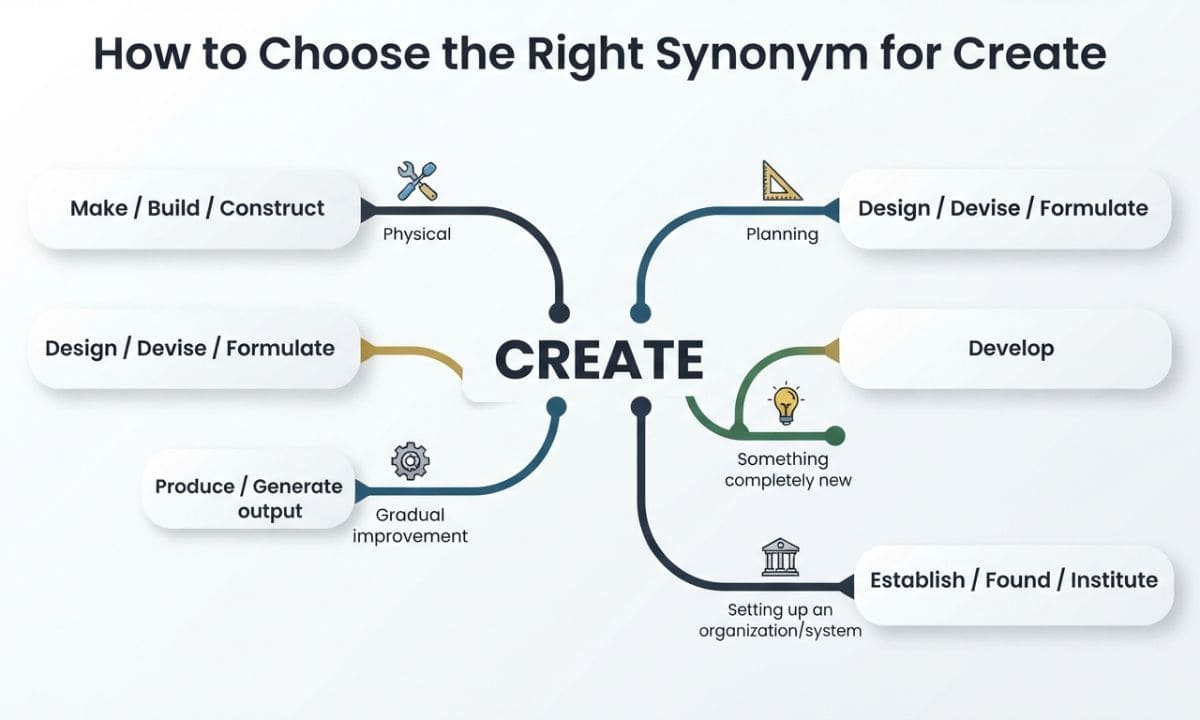
Use this quick decision guide to pick the most accurate word instead of defaulting to “create” every time.
Quick Decision Guide
Is something being physically made? → Use make, build, or construct.
Is something being planned? → Use design, devise, or formulate.
Is something gradually improving? → Use develop.
Is something completely new or original? → Use invent or conceive.
Is something being produced as an output? → Use produce or generate.
Is an organization or system being set up? → Use to establish, found, or institute.
Common Mistakes When Using Create Synonyms
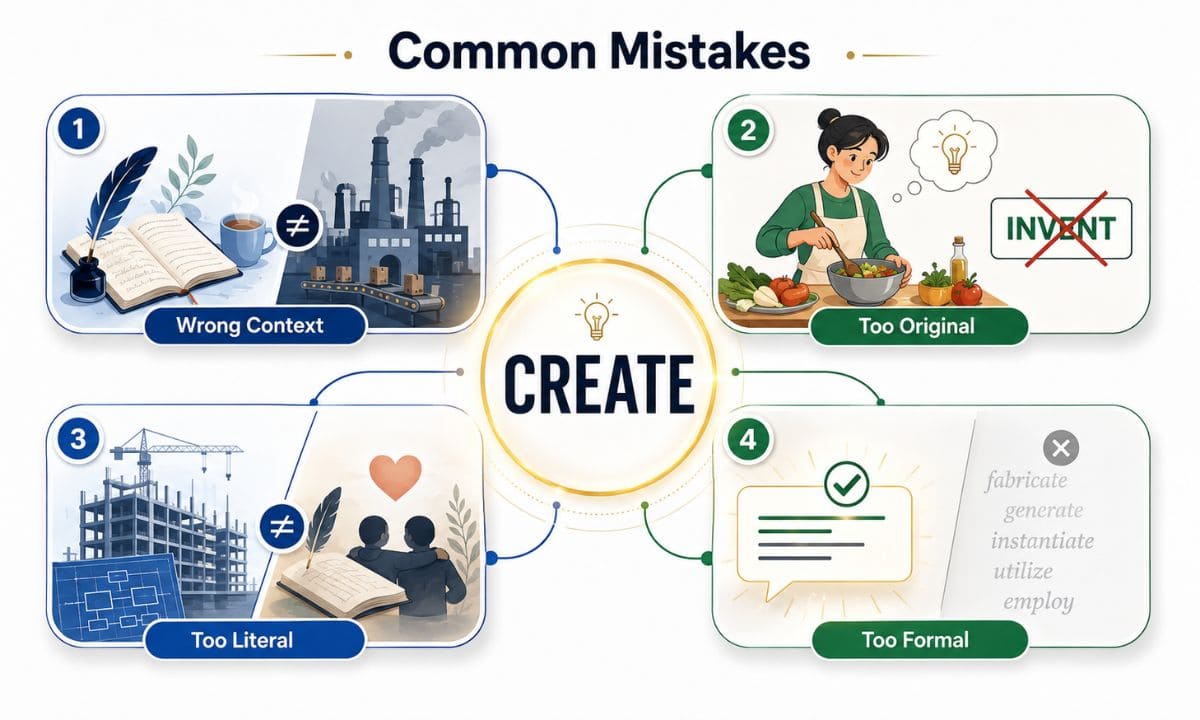
Small misuses can make writing sound awkward or imprecise, even when the intent is correct.
Mistake 1: Treating Every Synonym as Identical
Not every word fits every context, swapping “create” for “manufacture” in a sentence about writing a poem sounds odd because manufacturing implies industrial, repeatable production.
Mistake 2: Using “Invent” for Ordinary Creation
“Invent” implies genuine originality. Saying someone “invented” a to-do list app overstates the novelty if similar apps already exist.
Example:
Incorrect “She invented a new recipe using leftover vegetables.”
Better: “She created a new recipe using leftover vegetables.”
Mistake 3: Using “Construct” for Every Type of Creation
“Construct” fits physical structures or logical arguments, but sounds unnatural for casual or artistic creation, like construct a poem or construct a friendship.
Mistake 4: Choosing a Formal Word Just to Sound Advanced
Words like “institute” or “engineer” can feel forced in casual writing. Precision matters more than sounding sophisticated; the goal is clarity, not complexity.
What Major Dictionaries Say About “Create”
Dictionaries generally agree on the core sense of “create,” though each frames it with a slightly different emphasis origin, imagination, or causation.
Merriam-Webster
Frames “create” around bringing something into existence, often through imaginative or artistic effort.
Oxford Languages / Oxford English Dictionary
Emphasizes causing something to exist, especially something new or original.
Cambridge Dictionary
Focuses on the act of making something happen or exist, frequently in creative or inventive contexts.
Collins Dictionary
Highlights the idea of causing something to come into being through a deliberate act.
The common thread across all four: intention plus originality. That’s the meaning every synonym on this list either preserves, narrows, or shifts slightly away from.
Explore More Grammar Rules
25+ Change Synonyms: Other Ways to Say Change (With Examples)
22+ Activities Synonyms: Other Ways to Say Activities (With Examples)
Opportunity Synonyms: 30+ Words, Alternatives, Meanings & Examples
Frequently Asked Questions
What is the best synonym for create?
“Make” is the most versatile, everyday synonym, though “develop,” “produce,” or “design” may be more precise depending on context.
What is a formal synonym for create?
“Establish,” “formulate,” or “institute” work well in formal or professional writing.
What is another word for creating an idea?
“Conceive” or “devise” both work well for the formation of an idea.
What is another word for creating a business?
“Found” or “establish” are the standard choices for starting a business or organization.
What is another word for creating a plan?
“Formulate,” “devise,” or “develop” all fit well when describing the creation of a plan.
What is the opposite of creating?
Common opposites include “destroy,” “demolish,” or “eliminate,” depending on context.
Conclusion
“Create” is a useful word, but it’s rarely the most precise one available. Choosing between “make,” “develop,” “design,” “produce,” or any of the other synonyms above comes down to context: how original the thing is, how gradual the process was, and how formal the writing needs to be. Keeping this guide handy makes it easier to pick a synonym that says exactly what you mean, instead of defaulting to “create” out of habit.
