

If you have used the word “activities” three times in one paragraph, your writing probably feels flat. It is a safe word, but it is also a vague one.
Activities synonyms help you say exactly what you mean. Depending on your sentence, another word for activities might be tasks, actions, pursuits, hobbies, events, or pastimes.
Some alternatives work best for school and daily routines. Others fit business reports, resumes, or free time. This guide gives you 50+ synonyms for activities with meanings, real examples, and simple tips for choosing the right word.
Quick Answer
The best synonyms for activities include tasks, actions, pursuits, hobbies, pastimes, events, projects, and routines. Use tasks for work responsibilities, hobbies for leisure, events for planned occasions, and pursuits for personal interests. The best alternative depends on what you mean and how it sounds in your sentence.
Also Read This: gramarnesty.com/change-synonyms
What Does “Activities” Mean?
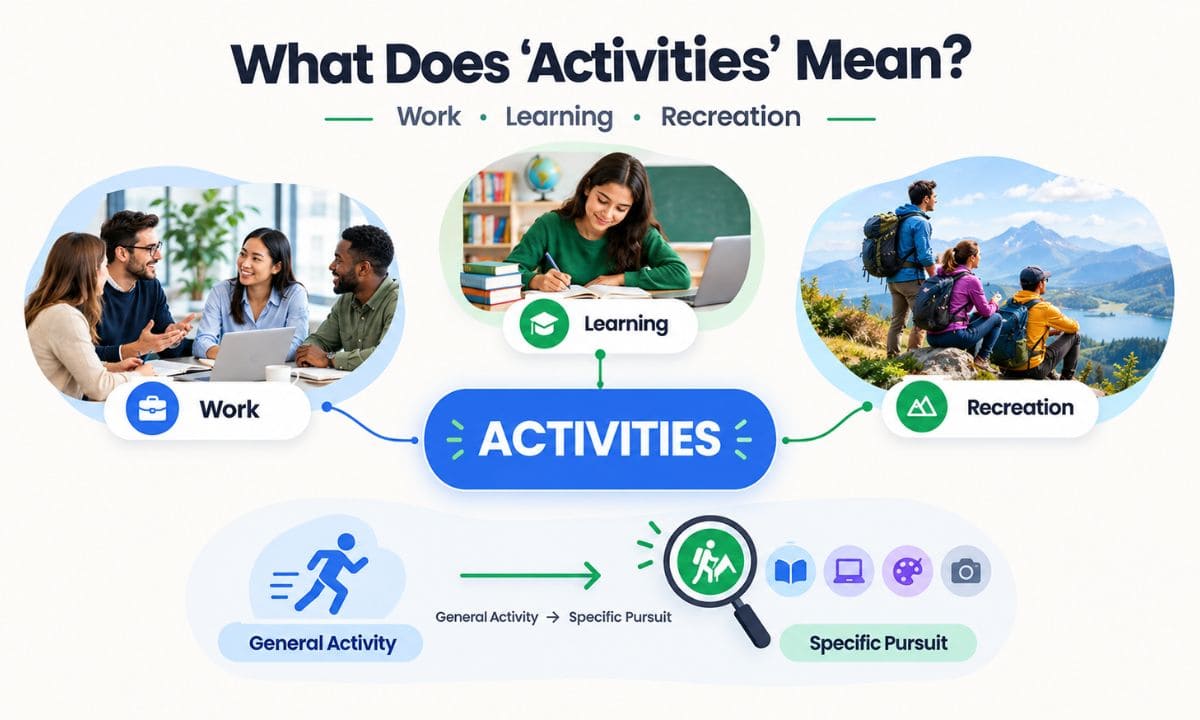
At its core, "activities" refers to things people do, especially planned
or purposeful actions, whether for work, learning, or fun.
Dictionaries usually describe it in two ways. The first is the general state of being active, like physical activity or economic activity. The second is a specific pursuit or organized event, like school activities or recreational activities.
The second meaning is the one most writers use, and it is also the vaguest. “Activities” can mean a business meeting, a hiking trip, a school assignment, or a wedding reception. That is why a more precise synonym for activities makes your writing clearer.
Activity vs. Activities: What’s the Difference?
Activity is the singular form. It refers to one thing a person does. Activities is the plural form. It refers to two or more things people do.
| Word | Example |
| Activity | Reading is my favorite activity. |
| Activities | Reading and swimming are my favorite activities. |
Usage tip: When you look for an activity synonym, choose a word that matches the specific action. For example, “task” may fit a work activity, while “hobby” may fit a leisure activity.
Also Read This: gramarnesty.com/gng-meaning-in-text
Best Synonyms for Activities at a Glance
| Synonym | Best Used For | Tone |
| Tasks | Work responsibilities | Neutral |
| Actions | Things people do | Neutral |
| Pursuits | Interests and goals | Formal |
| Pastimes | Free-time enjoyment | Casual |
| Hobbies | Personal interests | Casual |
| Events | Planned occasions | Neutral-formal |
| Projects | Work with a clear goal | Neutral |
| Assignments | School and delegated work | Neutral-formal |
| Chores | Household duties | Casual |
| Routines | Daily habits | Neutral |
| Exercises | Practice and learning | Neutral |
| Duties | Responsibilities | Formal |
| Programs | Organized activities | Neutral |
| Operations | Business processes | Formal |
| Initiatives | Goal-oriented plans | Formal |
50+ Activities Synonyms and Their Meanings
Here are 50+ solid alternatives to “activities,” each with a clear meaning, best use case, and example sentences so you always know which one fits.
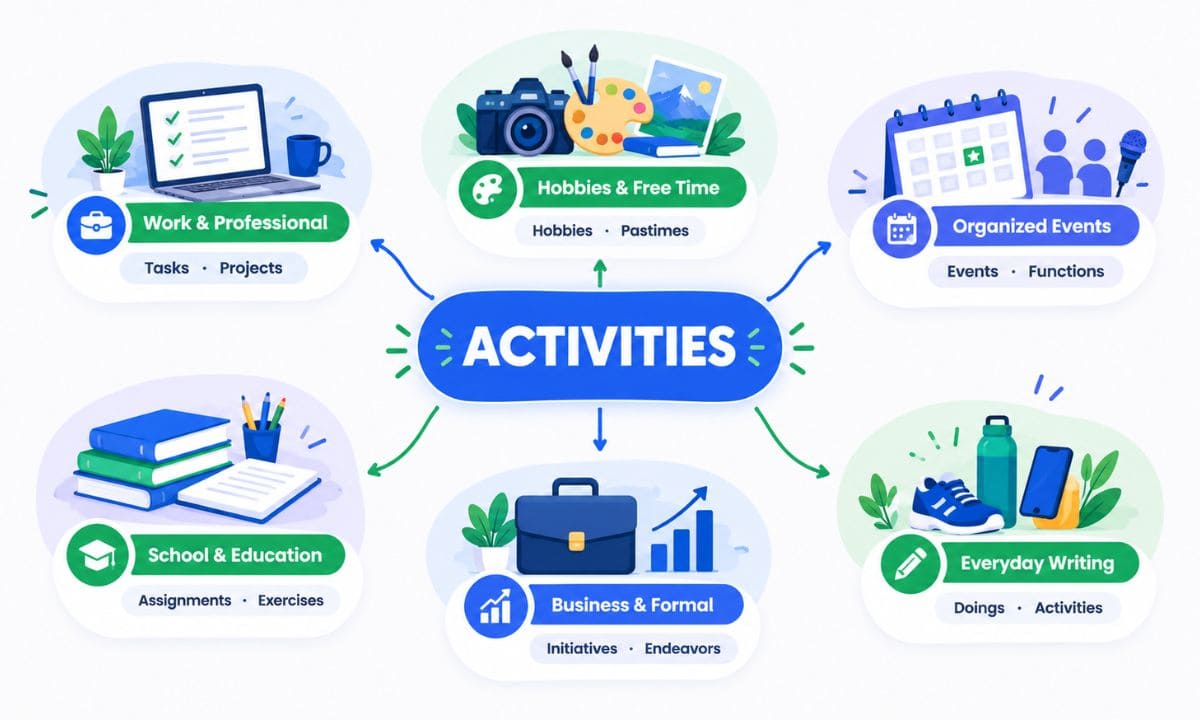
Tasks (noun)
Pronunciation: US /tæsks/ | UK /tɑːsks/
Meaning: Specific pieces of work with a clear goal, such as jobs or to-do list items.
Examples:
- She finished all her tasks before lunch.
- The manager shared the daily tasks with the team.
- Writing emails is one of my main tasks.
Pursuits (noun)
Pronunciation: US /pɚˈsuːts/ | UK /pəˈsjuːts/
Meaning: Interests or goals that someone actively follows over time.
Examples:
- His creative pursuits include painting and poetry.
- She left her job to follow her academic pursuits.
- Their pursuits are listed in the author bio.
Pastimes (noun)
Pronunciation: US /ˈpæs.taɪmz/ | UK /ˈpɑː.staɪmz/
Meaning: Casual ways to spend free time.
Examples:
- Reading and knitting are her favorite pastimes.
- Fishing is one of my grandfather’s pastimes.
- Board games are popular pastimes in our family.
Also Read This: synonyms-for-partner
Endeavors (noun)
Pronunciation: US /ɪnˈdev.ɚz/ | UK /ɪnˈdev.əz/
Meaning: Serious and ambitious efforts, often in business or creative work.
Examples:
- We wish you success in all your future endeavors.
- Her artistic endeavors earned her national praise.
- The company’s new endeavors focus on clean energy.
Undertakings (noun)
Pronunciation: US /ˌʌn.dɚˈteɪ.kɪŋz/ | UK /ˌʌn.dəˈteɪ.kɪŋz/
Meaning: Formal commitments or tasks, often large in size.
Examples:
- Building the new bridge was a huge undertaking.
- The contract lists all the undertakings of both parties.
- Large undertakings need careful planning.
Exercises (noun)
Pronunciation: US /ˈek.sɚ.saɪ.zɪz/ | UK /ˈek.sə.saɪ.zɪz/
Meaning: Repeated practice activities used to build a skill.
Examples:
- The students completed the grammar exercises.
- Daily breathing exercises help me stay calm.
- The coach gave us new fitness exercises.
Events (noun)
Pronunciation: US /ɪˈvents/ | UK /ɪˈvents/
Meaning: Planned occasions that happen on a set date.
Examples:
- The school hosts many events during the year.
- We attended two charity events last month.
- Sports events are popular in this city.
Programs (noun)
Pronunciation: US /ˈproʊ.ɡræmz/ | UK /ˈprəʊ.ɡræmz/
Meaning: Structured sets of activities, often for education or the community.
Examples:
- The library runs reading programs for children.
- She joined two training programs this year.
- Community programs bring neighbors together.
Engagements (noun)
Pronunciation: US /ɪnˈɡeɪdʒ.mənts/ | UK /ɪnˈɡeɪdʒ.mənts/
Meaning: Scheduled commitments such as meetings or speaking appointments.
Examples:
- The author has several speaking engagements this month.
- I have two engagements on Friday.
- He canceled his evening engagements due to illness.
Also Read This: gramarnesty.com/prosperity-synonyms
Projects (noun)
Pronunciation: US /ˈprɑː.dʒekts/ | UK /ˈprɒdʒ.ekts/
Meaning: Planned pieces of work that lead to a final result.
Examples:
- The students are working on science projects.
- Our team has three projects due this quarter.
- She enjoys DIY home projects.
Assignments (noun)
Pronunciation: US /əˈsaɪn.mənts/ | UK /əˈsaɪn.mənts/
Meaning: Tasks given by a teacher or a boss.
Examples:
- The teacher collected the assignments on Monday.
- I have two writing assignments this week.
- His new assignments include training new staff.
Ventures (noun)
Pronunciation: US /ˈven.tʃɚz/ | UK /ˈven.tʃəz/
Meaning: New or risky business activities.
Examples:
- He started several business ventures after college.
- Her new ventures are in the food industry.
- Risky ventures can bring big rewards.
Also Read This: gramarnesty.com/synonyms-for-more
Hobbies (noun)
Pronunciation: US /ˈhɑː.biz/ | UK /ˈhɒb.iz/
Meaning: Personal interests done for enjoyment.
Examples:
- Gardening and painting are her hobbies.
- What hobbies do you have outside work?
- He turned his hobbies into a small business.
Recreation (noun)
Pronunciation: US /ˌrek.riˈeɪ.ʃən/ | UK /ˌrek.riˈeɪ.ʃən/
Meaning: Activity done for relaxation and enjoyment.
Examples:
- The park offers space for outdoor recreation.
- Swimming is her favorite form of recreation.
- The town built a new recreation center.
Functions (noun)
Pronunciation: US /ˈfʌŋk.ʃənz/ | UK /ˈfʌŋk.ʃənz/
Meaning: Formal social or corporate events.
Examples:
- The hotel hosts weddings and other functions.
- He attended several official functions last week.
- The company holds annual social functions.
Operations (noun)
Pronunciation: US /ˌɑː.pəˈreɪ.ʃənz/ | UK /ˌɒp.əˈreɪ.ʃənz/
Meaning: Organized actions that keep a business or system running.
Examples:
- The company’s operations span ten countries.
- She manages daily operations at the factory.
- Operations were paused during the storm.
Proceedings (noun)
Pronunciation: US /prəˈsiː.dɪŋz/ | UK /prəˈsiː.dɪŋz/
Meaning: The formal steps of an official process, such as a court case or conference.
Examples:
- The court proceedings lasted three days.
- The proceedings of the conference were published online.
- Legal proceedings began on Monday.
Occupations (noun)
Pronunciation: US /ˌɑː.kjəˈpeɪ.ʃənz/ | UK /ˌɒk.jəˈpeɪ.ʃənz/
Meaning: Jobs or regular kinds of work.
Examples:
- Teaching and nursing are respected occupations.
- The form asks you to list your occupations.
- Many occupations now allow remote work.
Also Read This: gramarnesty.com/synonyms-for-more
Doings (noun)
Pronunciation: US /ˈduː.ɪŋz/ | UK /ˈduː.ɪŋz/
Meaning: An informal, chatty word for what people do.
Examples:
- She told me all about her weekend doings.
- The local paper reports on the town’s doings.
- What are your doings these days?
Happenings (noun)
Pronunciation: US /ˈhæp.ən.ɪŋz/ | UK /ˈhæp.ən.ɪŋz/
Meaning: Notable events or occurrences.
Examples:
- The newsletter covers local happenings.
- Strange happenings were reported in the old house.
- She keeps up with campus happenings.
Initiatives (noun)
Pronunciation: US /ɪˈnɪʃ.ə.t̬ɪvz/ | UK /ɪˈnɪʃ.ə.tɪvz/
Meaning: Planned actions taken to reach a goal.
Examples:
- The city launched new recycling initiatives.
- Several health initiatives started this year.
- The school supports student-led initiatives.
Practices (noun)
Pronunciation: US /ˈpræk.tɪ.sɪz/ | UK /ˈpræk.tɪ.sɪz/
Meaning: Repeated routines done to build a skill or habit.
Examples:
- Daily writing practices improved her style.
- The team holds two practices each week.
- Good study practices lead to better grades.
Actions (noun)
Pronunciation: US /ˈæk.ʃənz/ | UK /ˈæk.ʃənz/
Meaning: Things people do or decide to do.
Examples:
- Your actions show your true values.
- The company took quick actions to fix the problem.
- Small actions can make a big difference.
Chores (noun)
Pronunciation: US /tʃɔːrz/ | UK /tʃɔːz/
Meaning: Routine tasks done around the house.
Examples:
- The kids finish their chores before dinner.
- Washing dishes is one of my daily chores.
- We share the household chores equally.
Duties (noun)
Pronunciation: US /ˈduː.t̬iz/ | UK /ˈdjuː.tiz/
Meaning: Responsibilities that someone must complete.
Examples:
- Her duties include answering calls and filing reports.
- The guard performed his duties carefully.
- Every citizen has certain duties.
Routines (noun)
Pronunciation: US /ruːˈtiːnz/ | UK /ruːˈtiːnz/
Meaning: Regular daily habits or set patterns of activity.
Examples:
- Her morning routines include yoga and journaling.
- Good sleep routines improve health.
- The kids follow strict after-school routines.
Also Read This: gramarnesty.com/above-average-synonyms
Habits (noun)
Pronunciation: US /ˈhæb.ɪts/ | UK /ˈhæb.ɪts/
Meaning: Things done repeatedly, often without thinking.
Examples:
- Healthy habits start with small steps.
- He has the habit of waking up early.
- Bad habits are hard to break.
Errands (noun)
Pronunciation: US /ˈer.əndz/ | UK /ˈer.əndz/
Meaning: Short trips taken to get something done, like shopping or visiting the post office.
Examples:
- I have a few errands to run this afternoon.
- She spent the morning doing errands in town.
- Saturday is my day for errands.
Responsibilities (noun)
Pronunciation: US /rɪˌspɑːn.səˈbɪl.ə.t̬iz/ | UK /rɪˌspɒn.səˈbɪl.ə.tiz/
Meaning: Things you are expected to handle at work or at home.
Examples:
- Her new job comes with more responsibilities.
- Parents share the responsibilities of raising children.
- He takes his responsibilities seriously.
Jobs (noun)
Pronunciation: US /dʒɑːbz/ | UK /dʒɒbz/
Meaning: Specific pieces of paid or assigned work.
Examples:
- The plumber has three jobs to finish today.
- She does odd jobs around the neighborhood.
- Many jobs now require digital skills.
Work (noun)
Pronunciation: US /wɝːk/ | UK /wɜːk/
Meaning: General effort or employment.
Examples:
- She has a lot of work to do today.
- His work at the hospital is very important.
- Hard work leads to success.
Labors (noun)
Pronunciation: US /ˈleɪ.bɚz/ | UK /ˈleɪ.bəz/
Meaning: Hard physical or mental work (formal tone).
Examples:
- The farmers rested after their long labors.
- His labors finally earned him recognition.
- The book describes the labors of early settlers.
Missions (noun)
Pronunciation: US /ˈmɪʃ.ənz/ | UK /ˈmɪʃ.ənz/
Meaning: Assigned goals or purposeful tasks.
Examples:
- The team completed several rescue missions.
- Her missions as a volunteer took her abroad.
- Space missions need years of preparation.
Campaigns (noun)
Pronunciation: US /kæmˈpeɪnz/ | UK /kæmˈpeɪnz/
Meaning: Organized efforts toward a goal, such as in marketing or charity.
Examples:
- The brand ran two advertising campaigns this year.
- Charity campaigns raised money for the hospital.
- Health campaigns teach people about healthy living.
Drills (noun)
Pronunciation: US /drɪlz/ | UK /drɪlz/
Meaning: Repetitive practice, used in sports, safety, and the military.
Examples:
- The students practiced fire drills at school.
- The coach ran passing drills for an hour.
- Daily vocabulary drills improved my English.
Workouts (noun)
Pronunciation: US /ˈwɝːk.aʊts/ | UK /ˈwɜː.kaʊts/
Meaning: Physical exercise sessions.
Examples:
- She does short workouts every morning.
- His workouts include running and weight training.
- Home workouts save time and money.
Training (noun)
Pronunciation: US /ˈtreɪ.nɪŋ/ | UK /ˈtreɪ.nɪŋ/
Meaning: Structured activity that builds skills.
Examples:
- The new staff received a week of training.
- She is in training for a marathon.
- Online training is now very common.
Also Read This: gramarnesty.com/synonyms-for-interest
Lessons (noun)
Pronunciation: US /ˈles.ənz/ | UK /ˈles.ənz/
Meaning: Teaching or learning sessions.
Examples:
- She takes piano lessons every Tuesday.
- The online lessons are short and easy to follow.
- He gives private lessons in math.
Workshops (noun)
Pronunciation: US /ˈwɝːk.ʃɑːps/ | UK /ˈwɜːk.ʃɒps/
Meaning: Hands-on group learning activities.
Examples:
- The library hosts free writing workshops.
- We joined two cooking workshops last month.
- Teachers attended workshops on classroom skills.
Amusements (noun)
Pronunciation: US /əˈmjuːz.mənts/ | UK /əˈmjuːz.mənts/
Meaning: Light, fun entertainment.
Examples:
- The fair offered many amusements for children.
- Simple amusements kept the kids happy on the trip.
- The resort has amusements for all ages.
Diversions (noun)
Pronunciation: US /dɪˈvɝː.ʒənz/ | UK /daɪˈvɜː.ʃənz/
Meaning: Activities that take your mind off something.
Examples:
- Puzzles are pleasant diversions on long trips.
- She needed a few diversions after a stressful week.
- Music and walks were his favorite diversions.
Entertainments (noun)
Pronunciation: US /ˌen.t̬ɚˈteɪn.mənts/ | UK /ˌen.təˈteɪn.mənts/
Meaning: Shows and enjoyable performances.
Examples:
- The festival offers music and other entertainments.
- Many entertainments are free in the park.
- The hotel provides evening entertainments for guests.
Outings (noun)
Pronunciation: US /ˈaʊ.t̬ɪŋz/ | UK /ˈaʊ.tɪŋz/
Meaning: Short trips taken for fun, like a picnic or a park visit.
Examples:
- The class enjoyed two outings this month.
- Family outings are a highlight of our summer.
- We planned weekend outings to the lake.
Adventures (noun)
Pronunciation: US /ədˈven.tʃɚz/ | UK /ədˈven.tʃəz/
Meaning: Exciting and sometimes risky experiences.
Examples:
- The children loved their jungle adventures.
- She writes about her travel adventures.
- Outdoor adventures build confidence.
Games (noun)
Pronunciation: US /ɡeɪmz/ | UK /ɡeɪmz/
Meaning: Playful activities that follow rules.
Examples:
- The kids played games at the party.
- Board games are fun on rainy days.
- We enjoy word games on long trips.
Gatherings (noun)
Pronunciation: US /ˈɡæð.ɚ.ɪŋz/ | UK /ˈɡæð.ər.ɪŋz/
Meaning: Social meetups of people.
Examples:
- Family gatherings are common during the holidays.
- The town banned large gatherings during the storm.
- She loves small gatherings with close friends.
Celebrations (noun)
Pronunciation: US /ˌsel.əˈbreɪ.ʃənz/ | UK /ˌsel.əˈbreɪ.ʃənz/
Meaning: Events that mark a special occasion.
Examples:
- The town held celebrations for the national holiday.
- Birthday celebrations were held at home.
- Wedding celebrations lasted three days.
Also Read This: gramarnesty.com/share-synonyms
Interests (noun)
Pronunciation: US /ˈɪn.trəsts/ | UK /ˈɪn.trəsts/
Meaning: Things you enjoy and spend time on.
Examples:
- Her interests include music and photography.
- List your interests on the application form.
- He shares many interests with his brother.
Leisure pursuits (noun phrase)
Pronunciation: US /ˈliː.ʒɚ pɚˈsuːts/ | UK /ˈleʒ.ə pəˈsjuːts/
Meaning: Free-time interests, in a formal-casual tone.
Examples:
- Hiking and birdwatching are his leisure pursuits.
- The club offers many leisure pursuits for seniors.
- She has more time for leisure pursuits now.
Recreational activities (noun phrase)
Pronunciation: US /ˌrek.riˈeɪ.ʃən.əl ækˈtɪv.ə.t̬iz/ | UK /ˌrek.riˈeɪ.ʃən.əl ækˈtɪv.ə.tiz/
Meaning: Organized or casual fun activities done for relaxation.
Examples:
- The resort offers many recreational activities.
- Swimming and cycling are popular recreational activities.
- Schools should include recreational activities in the week.
Also Read This: alr-meaning-in-text
Activities Synonyms by Context
Different settings call for different words. Here is a quick breakdown of the best activities synonyms by situation.
Activities Synonyms for Work
- Tasks
- Projects
- Duties
- Operations
- Assignments
Activities Synonyms for School and Education
- Assignments
- Exercises
- Projects
- Programs
- Practices
Activities Synonyms for Free Time
- Hobbies
- Pastimes
- Pursuits
- Recreation
- Amusements
Looking for more ways to describe enjoyment? Check these synonyms for enjoy to describe how you feel about your favorite pastimes.
Activities Synonyms for Events
- Events
- Functions
- Proceedings
- Programs
- Engagements
Planning a social gathering? These party synonyms can help you describe celebrations in more detail.
Activities Synonyms for Professional Writing
- Endeavors
- Undertakings
- Initiatives
- Engagements
- Operations
Activities Synonyms for Daily Life
For everyday routines, these words work best:
- Routines
- Chores
- Tasks
- Habits
- Pursuits
Example: “Her daily activities include exercise, cooking, reading, and household chores.”
Activities Synonyms for Fun
For enjoyable, relaxed time, try these:
- Hobbies
- Pastimes
- Recreational activities
- Amusements
- Adventures
Example: “Camping and hiking are enjoyable pastimes for outdoor enthusiasts.”
Activities Synonyms for Students
For learning and school life, use these:
- Exercises
- Assignments
- Projects
- Classroom tasks
- Learning activities
Example: “The teacher planned interactive exercises and group projects for the students.”
Also Read This: oms-meaning-in-text
Activities Synonyms: Formal vs. Casual
Formal Synonyms for Activities
Endeavors, undertakings, engagements, proceedings, initiatives, and functions all carry a professional or official tone.
Casual Synonyms for Activities
Hobbies, pastimes, doings, happenings, and amusements work best in everyday, relaxed writing.
| Word | Tone | Best Context |
| Endeavors | Formal | Business writing |
| Undertakings | Formal | Legal or official documents |
| Engagements | Formal | Calendars, schedules |
| Proceedings | Formal | Meetings, legal reports |
| Initiatives | Formal | Strategy, nonprofit work |
| Functions | Formal | Corporate events |
| Hobbies | Casual | Everyday conversation |
| Pastimes | Casual | Lifestyle and leisure writing |
| Doings | Casual | Storytelling, personal updates |
| Happenings | Casual | Social recaps |
| Pursuits | Neutral-formal | Bios and profiles |
| Tasks | Neutral | Work and to-do lists |
Examples of Formal and Casual Alternatives
| Original Sentence | Better Alternative |
| We have many activities at work. | We have several professional responsibilities at work. |
| My weekend activities are fun. | My weekend pastimes are enjoyable. |
| The school planned activities. | The school organized educational events. |
| Our daily activities are important. | Our daily routines are important. |
| The company has new activities. | The company has launched new initiatives. |
Activities Synonyms for Professional Writing
Best Formal Alternatives to Activities
For polished, professional writing, lean on endeavors, undertakings, initiatives, and engagements. Each signals purpose and structure without sounding stiff.
Activities on a Resume
Instead of: “I participated in many activities.”
Use: “I contributed to several team projects and professional initiatives.”
Activities in Business Reports
Instead of: “The company reviewed its activities.”
Use: “The company reviewed its operations and strategic initiatives.”
Activities in Academic Writing
Instead of: “Students completed different activities.”
Use: “Students completed structured exercises and collaborative assignments.”
Also Read This: oms-meaning-in-text
What Major Dictionaries Say About “Activities”
Cambridge Dictionary
The Cambridge Dictionary thesaurus entry for activity frames activities broadly as things people do, especially for enjoyment, or as a planned part of work, school, or an organization’s schedule. It also lists related words you can compare with the synonyms above.
Merriam-Webster
Merriam-Webster’s entry for activity covers several senses. These include the general state of being active, a pursuit someone is engaged in, and a form of organized, supervised recreation, such as school or camp activities.
Oxford Languages / Oxford English Dictionary
The Oxford Learner’s Dictionary entry for activity focuses on a thing a person or group does, often for leisure, learning, or as part of regular work. It also shows how the word works as a countable and uncountable noun.
Collins Dictionary
The Collins Dictionary entry for activity describes activity as both the state of being active and any specific pursuit or recreation. That breadth is exactly why more precise synonyms are useful.
How to Choose the Right Synonym for Activities
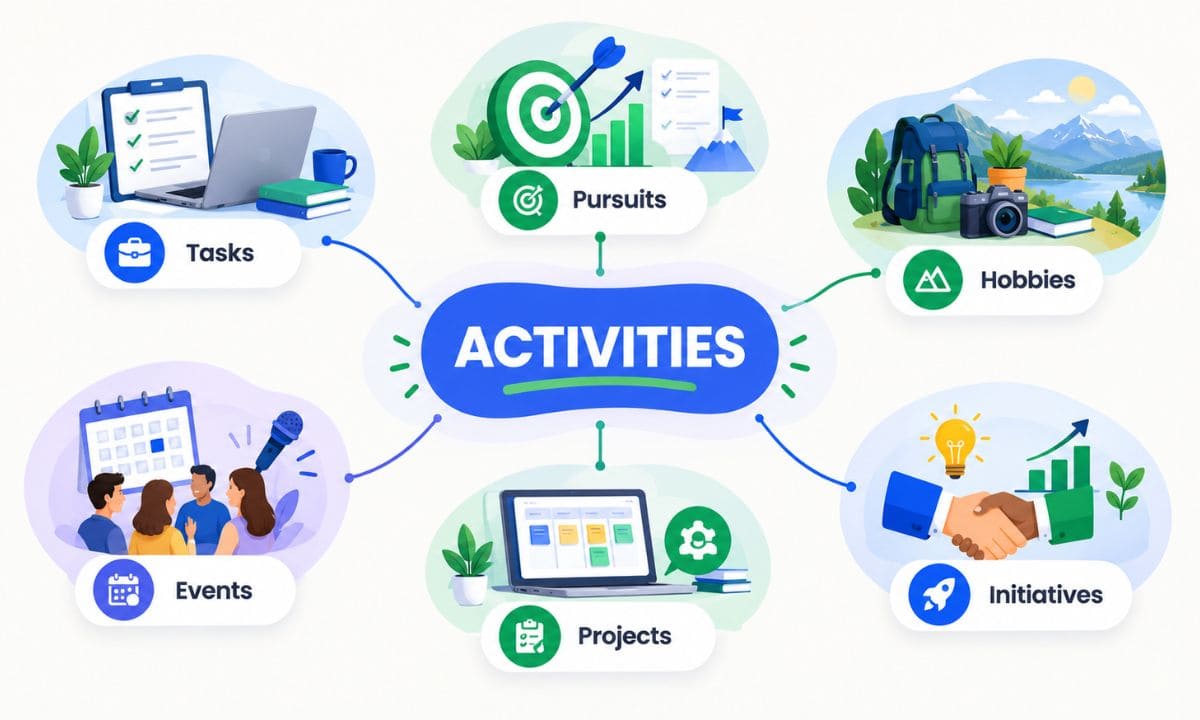
| Context | Best Synonyms | Why Use Them |
| Work and Professional Tasks | Tasks, projects, operations | These words point to clear duties and outcomes. |
| Hobbies and Free Time | Hobbies, pastimes, pursuits | They describe how someone spends personal time. |
| Organized Events | Events, functions, proceedings | They suit a scheduled occasion. |
| School and Education | Assignments, exercises, programs | They fit anything tied to structured learning. |
| Business and Formal Writing | Endeavors, undertakings, initiatives | They sound polished and purposeful. |
| General Everyday Writing | Doings, happenings, or simply “activities” | They work when precision matters less than tone. |
Activities vs. Its Closest Synonyms
Activities vs. Actions
Actions are single instances of doing something. Activities suggest ongoing or repeated involvement.
- Action: Her quick action saved the project.
- Activities: Her weekly activities include coaching and volunteering.
Activities vs. Tasks
Activities can include enjoyable or planned things people do, while tasks usually refer to specific pieces of work that need to be completed.
- Activity: Swimming is my favorite weekend activity.
- Task: I need to finish my homework.
Activities vs. Events
Events are single, scheduled occasions. Activities can happen daily or without a fixed schedule.
- Event: The school’s annual sports day is on Friday.
- Activity: Students join sports activities every afternoon.
Activities vs. Exercises
Exercises exist to build skill or fitness through repetition. Activities cover a much broader range of pursuits.
- Exercise: We did ten grammar exercises in class.
- Activity: The class also had a group drawing activity.
Activities vs. Pursuits
Pursuits imply personal passion or a long-term interest. Activities are more neutral and general.
- Pursuit: Astronomy is one of his lifelong pursuits.
- Activity: Stargazing is a fun evening activity.
Activities vs. Hobbies
A hobby is an activity done regularly for personal enjoyment, while activities can include work, education, responsibilities, and leisure.
Activity: The school organized a photography activity.
Hobby: Photography is my favorite hobby.
Common Mistakes When Using Activities Synonyms
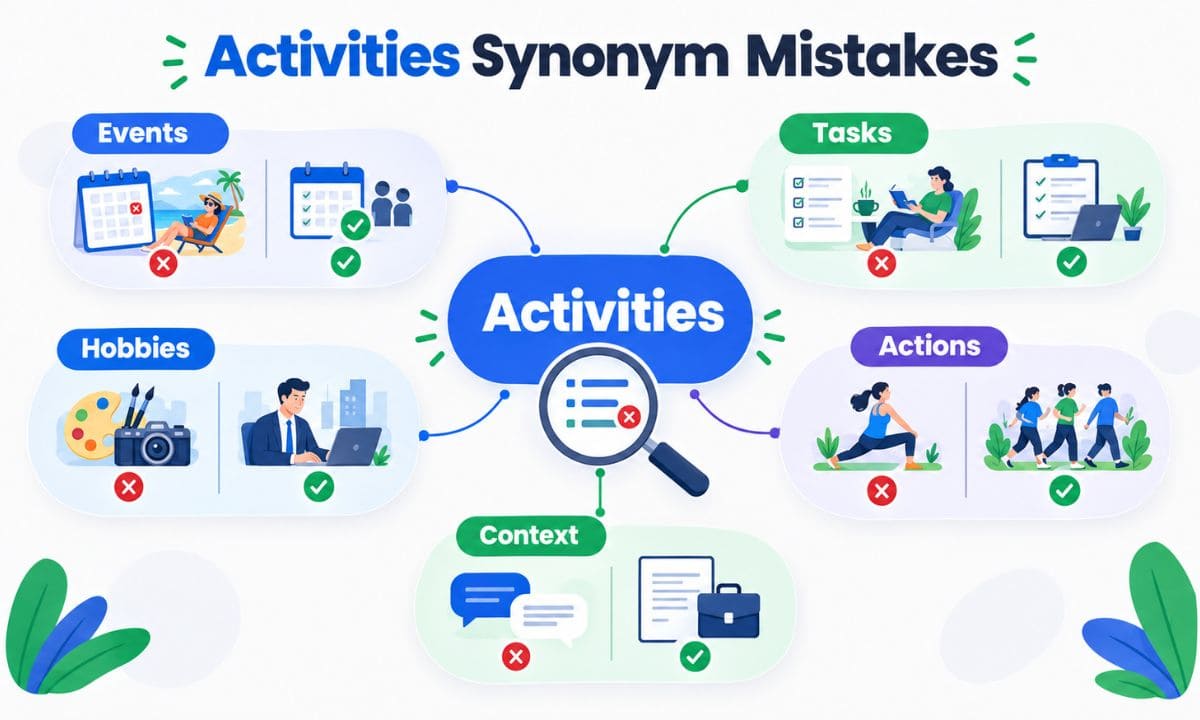
| Common Mistake | Why It Is Wrong | Better Fix |
| ❌ Using “events” for every activity | An event is usually a planned occasion. A daily habit or ongoing hobby is not a scheduled occasion. | ✅ Use habits, pastimes, or routines for ongoing activities. |
| ❌ Using “tasks” for leisure activities | Calling a hobby a “task” makes it sound like an obligation instead of something enjoyable. | ✅ Use hobbies, pastimes, or pursuits. |
| ❌ Using “hobbies” for professional work | Hobbies are unpaid personal interests. Job duties are not hobbies, even when someone enjoys them. | ✅ Use tasks, projects, or assignments for work. |
| ❌ Confusing “actions” with organized activities | An action is a single act. An organized activity usually involves planning, structure, or repetition. | ✅ Use programs, initiatives, or activities. |
| ❌ Using “chores” or “duties” for enjoyable activities | These words describe things you must do. Calling a weekend hike a “duty” makes it sound like a burden. | ✅ Use outings, pursuits, or recreation. |
| ❌ Using “operations” for personal activities | “Operations” suits businesses and organized systems. “My morning operations include coffee and journaling” sounds odd. | ✅ Use routines: “My morning routine includes coffee and journaling.” |
| ❌ Mixing singular and plural forms | A synonym must match the number of your sentence, so the verb and article must change too. | ✅ “Reading is a relaxing pastime,” not “Reading are a relaxing pastime.” |
| ❌ Choosing a synonym that does not match the context | A formal word like “undertakings” feels out of place in a casual text. “Doings” sounds too loose in a business report. | ✅ Match the word to the tone: casual for chats, formal for business writing. |
Activities Synonyms in Sentences
Instead of: “We had a full weekend of activities.”
Try: “We had a full weekend of events, from a farmers market to a picnic.”
Why it works: Events are planned occasions, so the sentence becomes clearer.
Instead of: “Her daily activities keep her busy.”
Try: “Her daily routines keep her busy.”
Why it works: Routines are repeated habits, which is what “daily” suggests.
Instead of: “The department reviewed its activities.”
Try: “The department reviewed its key operations and initiatives.”
Why it works: Both words fit business writing and sound more specific.
Instead of: “The syllabus lists many activities.”
Try: “The syllabus includes weekly exercises and a final group project.”
Why it works: Exercises and projects are specific school terms.
Instead of: “What activities do you enjoy?”
Try: “What hobbies or pastimes do you enjoy?”
Why it works: Both words suit free time and sound more natural in this question.
Instead of: “Chores and activities fill my Saturday.”
Try: “Chores and errands fill my Saturday.”
Why it works: “Errands” is more precise because it means short trips to get things done.
Explore More Synonyms Guide
25+ Struggle Synonyms: Better Ways to Say Struggle (With Examples)
25+ Share Synonyms: Meanings, Examples & When to Use Each
Additionally Synonyms: 20+ Words, Meanings, Examples & How to Use Them
Kindness Synonyms: 25+ Words, Meanings, Examples & How to Use Them
25+ Share Synonyms: Meanings, Examples & When to Use Each
History Synonyms: 22+ Words, Meanings, Examples & How to Use Them
25+ Crazy Synonyms: Meanings, Examples, and How to Use Them
Frequently Asked Questions
What is another word for activities?
Common alternatives include tasks, actions, pursuits, pastimes, events, and hobbies, depending on the context.
What is a formal synonym for activities?
Endeavors, undertakings, and initiatives all work well in formal or professional writing.
What is a professional word for activities?
Operations, engagements, and initiatives are common professional substitutes for activities.
What is a synonym for activities in school?
Assignments, exercises, programs, and practices are the most natural fits for school contexts.
What is another word for fun activities?
Pastimes, hobbies, recreational activities, and amusements all describe fun, leisure-based activities.
What is another word for daily activities?
Routines, chores, tasks, and habits are common ways to describe daily activities.
What is the difference between activities and tasks?
Tasks are specific, assigned duties with a clear goal, while activities can be broader and more open-ended.
What is the difference between activities and events?
Events are single, scheduled occasions, while activities can be ongoing, repeated, or unscheduled.
What is a synonym for activity?
A synonym for activity depends on the context. Common alternatives include action, task, pursuit, exercise, and undertaking. Choose the word that best describes what someone is doing.
What is the difference between activity and activities?
Activity is the singular form and means one thing a person does. Activities is the plural form and means two or more things.
What is the difference between activities and pursuits?
Activities is a general term for things people do, while pursuits usually describe interests, goals, or activities someone follows with dedication.
What is another word for activities on a resume?
Use projects, initiatives, responsibilities, or engagements. For example: “I contributed to several team projects and professional initiatives.”
What is the difference between activities and hobbies?
A hobby is something you do regularly for personal enjoyment. Activities is a wider word that can include work, school, responsibilities, and leisure.
Conclusion
“Activities” isn’t wrong. It is just overused. Once you know the difference between a task, a pursuit, an event, and an endeavor, your writing gets sharper without any extra effort.
Pick the word that matches your setting: casual for hobbies, structured for work, and formal for business and strategy. Bookmark this list of activities synonyms and come back whenever “activities” shows up too often in your draft.

1 thought on “50+ Activities Synonyms: Better Words for Work, School & Free Time”