

“More” is one of the first words English learners pick up, and one of the first words writers overuse. It can mean a larger amount, one extra thing, a higher level, or an added point.
That range is why no single replacement works everywhere.
This guide gives you 70 synonyms for more, each with a meaning, an example and a usage tip. You will also find comparisons of the closest alternatives, common mistakes, and what four major dictionaries say about the word.
Quick Answer: What Are the Best Synonyms for More?
More means a greater amount, degree or number, or something additional.
Common alternatives include additional, extra, further, another, greater, increased, added, higher, beyond and expanded.
There is no single “best” synonym. The right word depends on meaning, sentence structure, quantity, degree, tone, context and audience.
| Alternative | What it does well | Quick example |
| additional | Adds to what already exists (formal-neutral) | We need additional chairs. |
| extra | Beyond what is usual or required | Bring an extra charger. |
| further | Next step or more detail | Further details follow. |
| another | One more of a countable thing | Take another biscuit. |
| greater | Larger in degree, size or importance | Greater care is needed. |
| increased | Has risen from an earlier level | Increased demand slowed deliveries. |
| added | Put on top of something | The added cost surprised us. |
| higher | A higher level on a scale | Prices are higher this year. |
| beyond | Past a limit or amount | It went beyond our budget. |
| expanded | Larger in range or scope | An expanded menu launched. |
What Does “More” Mean?
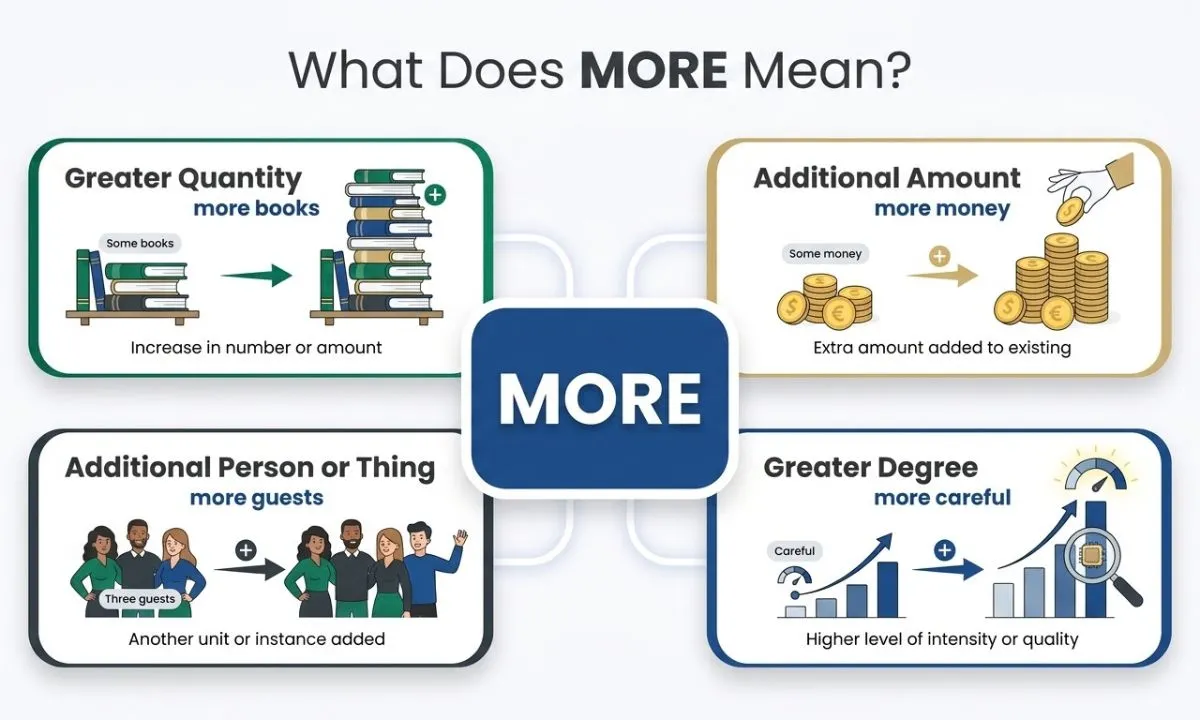
In simple English, “more” points to a greater quantity, a greater degree, or something extra.
It can come before a noun (more time), stand alone (I need more), modify a verb (she reads more), or form a comparative (more careful).
More as an Increase
A rise from an earlier level: More of the budget now goes to transport.
Alternatives: increased, growing, higher, an increase.
More as an Additional Amount
Extra of something uncountable, such as time or water: Could you give me more time?
Alternatives: additional, extra, further. Avoid another here.
More as an Additional Person or Thing
Extra countable items: Several more guests arrived.
Alternatives: additional, other, another (one item), further.
More as a Greater Degree
A higher level of a quality or action: The instructions are more detailed.
Alternatives: to a greater extent, heightened, stronger, deeper, only when the noun allows it.
Quantity vs. degree.
Quantity answers “how much or how many?” (more apples, more traffic).
Degree answers “how strongly or how far?” (more tired, more clearly).
Many wrong substitutions happen when a word built for one job is used for the other: higher suits numbers on a scale, while heightened suits feelings and awareness.
70 More Synonyms, Grouped by Tone
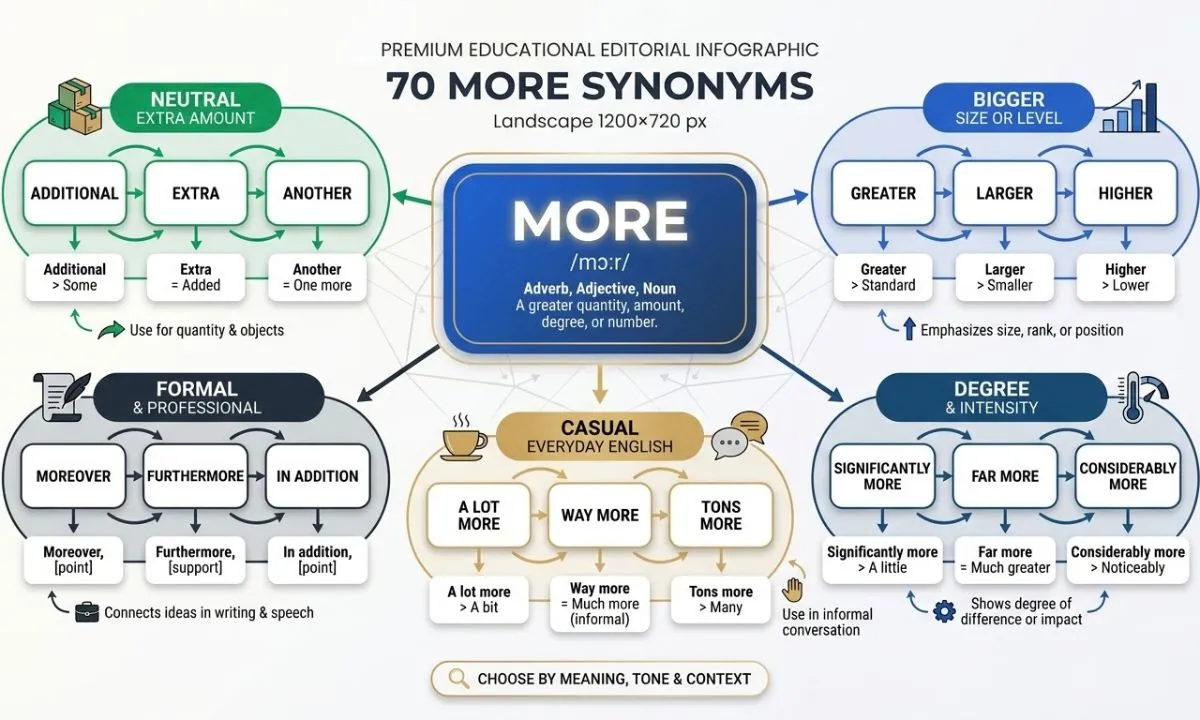
Some of these 70 entries are single words and some are short phrases. Not all of them replace “more” in the same way, so each usage tip says whether the entry is a direct replacement, a contextual alternative (works only for one meaning), a related word (adds or compares, but does not stand in for “more”), or pattern-limited (works only in certain sentence structures).
Group 1: Neutral words for an extra item or amount
additional
Meaning:
Added to what already exists; extra in number or amount.
Example:
The school hired additional teachers after enrollment rose.
Usage Tip:
Formal-neutral and a direct replacement for “more” before a noun (more teachers becomes additional teachers). It cannot stand alone as a pronoun (“I need additional”) and cannot be followed by “than.”
extra
Meaning:
More than is usual, needed or already counted.
Example:
Pack an extra jumper in case the evening turns cold.
Usage Tip:
Neutral and common in speech. It replaces “more” before nouns, but it carries a hint of “beyond the normal amount,” so extra time is not always identical to more time. Direct replacement in the noun position.
another
Meaning:
One more of the same kind, or a different one from the same group.
Example:
Could I have another pillow, please?
Usage Tip:
Neutral. Use it with singular countable nouns, or with a number plus a plural unit (another three weeks). It fails with uncountable nouns (“another water”) and means “one additional,” not “an unspecified amount.” Pattern-limited.
further
Meaning:
Additional, going beyond what has been said or done; also to a greater distance or degree.
Example:
The report recommends further testing before the bridge reopens.
Usage Tip:
Formal-neutral. It pairs naturally with abstract nouns: further information, questions, research, delay. It often suggests the next stage of a process. As an adverb it also works (look into it further). Direct replacement in those collocations.
added
Meaning:
Put in addition to something that was already there.
Example:
The added weight made the backpack hard to carry.
Usage Tip:
Neutral. It fits things that were attached on top of a base: added cost, added pressure, added benefit. It sounds odd with ordinary countable nouns (“added friends”). Contextual alternative.
other
Meaning:
Further ones of a group; different from those already mentioned.
Example:
Do you have any other questions before we begin?
Usage Tip:
Neutral. In questions and negatives, any other questions often replaces any more questions. But “other” also signals “different,” so use it only when the extra items are distinct. Contextual alternative.
else
Meaning:
In addition; besides what has already been mentioned.
Example:
What else did the manual say about the warranty?
Usage Tip:
Neutral. It follows question words and indefinite pronouns: what else, anything else, who else. It can replace “more” in What more can I do? but never before a noun. Pattern-limited.
yet another
Meaning:
One more of something, usually with the sense that there are already several.
Example:
The printer jammed, and now there is yet another error message.
Usage Tip:
Neutral to informal, often with mild frustration or humor. It stresses repetition. Like another, it needs a singular countable noun. Skip it in formal reports unless you truly mean to emphasize the pile-up.
fresh
Meaning:
Additional and newly supplied, often replacing or following earlier material.
Example:
The reviewers asked the team to collect fresh data.
Usage Tip:
Neutral. Fresh evidence, fresh supplies, fresh data mean “new and additional.” Because it also implies newness, it is not a pure synonym. Do not use it when the only point is a larger amount. Contextual alternative.
extended
Meaning:
Lasting longer or reaching further than the usual or original.
Example:
The library keeps extended hours during exam week.
Usage Tip:
Neutral-formal. It stands in for “more” only in the sense of more time, range or coverage (extended deadline means more time to finish). It does not work for counting things. Contextual alternative.
again
Meaning:
One more time; repeated.
Example:
Play the last chorus again, please.
Usage Tip:
Neutral. It replaces once more and one more time, not “more” in general. Try again and try once more are close in meaning, while once again sounds slightly more emphatic. Pattern-limited.
farther
Meaning:
At or to a greater physical distance.
Example:
We walked farther along the beach before turning back.
Usage Tip:
Neutral. Traditionally it is tied to physical distance, while further covers abstract progress (further discussion). Many writers use further for both, but farther is safe for distance. It replaces “more” only in sentences about how far. Contextual alternative.
Group 2: Neutral words for a bigger size, amount or level
greater
Meaning:
Larger in size, amount, degree or importance.
Example:
Greater care is needed when handling the older manuscripts.
Usage Tip:
Formal-neutral. It works best with abstract nouns (greater care, risk, accuracy, demand) and in a greater number of. It sounds wrong with everyday items (“greater cookies”). It covers both quantity and degree, but only with suitable nouns. Contextual alternative.
larger
Meaning:
Bigger in size or number.
Example:
A larger crowd gathered once the music started.
Usage Tip:
Neutral. Use it when size or number is the main point (a larger crowd, a larger portion). It needs a noun that can be large, so “larger advice” fails. Direct replacement for measurable things.
bigger
Meaning:
Larger in size, scale or importance; the everyday version of larger.
Example:
Small habits can have a bigger effect than people expect.
Usage Tip:
Neutral to casual. It is natural in speech and relaxed writing. In formal documents, greater or larger usually reads better. Direct replacement when scale is the point.
higher
Meaning:
At a greater level, rate or amount on a scale.
Example:
Rents are higher in the city centre than in the suburbs.
Usage Tip:
Neutral. It fits numbers and levels: prices, scores, temperatures, rates. It does not work for countable people or objects (“higher guests”). Use them for comparisons. Contextual alternative.
increased
Meaning:
Having become greater in number, size or degree.
Example:
Increased rainfall flooded the lower fields.
Usage Tip:
Neutral-formal. This participle adjective implies a rise from an earlier, lower level, so use it only when something has actually changed. It sits before nouns (increased demand) and cannot be a pronoun or take than. Pattern-limited.
expanded
Meaning:
Made larger in size, range or scope.
Example:
The clinic now offers an expanded range of evening appointments.
Usage Tip:
Neutral-formal, common in business and institutional writing. It suggests growth in scope or coverage, so expanded services means a wider range, not simply a bigger number. Contextual alternative.
growing
Meaning:
Becoming larger or more numerous over time.
Example:
A growing number of commuters now cycle to work.
Usage Tip:
Neutral. A growing number is a natural stand-in for more and more. It describes ongoing change, so it does not work for a single, fixed comparison. Pattern-limited.
heavier
Meaning:
Greater in weight, intensity or amount, especially for traffic, rain, workload or penalties.
Example:
Heavier traffic is expected on Friday evening.
Usage Tip:
Neutral. It works only with nouns that can be “heavy” in this figurative way: traffic, rainfall, losses, fines, schedules. It is a collocation, not a general replacement. Contextual alternative.
elevated
Meaning:
Higher than normal or expected.
Example:
The sensor recorded elevated noise levels near the airport.
Usage Tip:
Formal and technical, common in science, safety and health reports. It implies a comparison with a baseline, so do not use it for ordinary amounts. Contextual alternative.
an increase
Meaning:
A rise in amount, size or degree (noun).
Example:
The shop reported an increase in weekend visitors.
Usage Tip:
Neutral-formal. It does not swap in directly. “There were more visitors” becomes “There was an increase in visitors,” which rebuilds the sentence. Related word that needs in plus a noun.
a larger amount
Meaning:
A bigger quantity of something, used where “more” works as a noun.
Example:
Baking at altitude calls for a larger amount of flour.
Usage Tip:
Formal-neutral. Use amount with uncountable nouns and number with countable ones (a larger number of guests). It is wordier than “more,” so keep it for places where clarity matters. Direct replacement for the noun use.
broader
Meaning:
Wider in range, scope or variety.
Example:
The new course takes a broader view of climate policy.
Usage Tip:
Neutral-formal. It replaces “more” when you mean more range, not more quantity (a broader audience means more kinds of people). Think “wider,” not “extra.” Contextual alternative.
Group 3: Formal and professional alternatives
moreover
Meaning:
Besides what has been said; introduces a related point that adds weight.
Example:
The plan is affordable; moreover, it can be built within a year.
Usage Tip:
Formal. This is a sentence connector, so it can replace “and what’s more” but never “more” before a noun. Place it after a semicolon or full stop and follow it with a comma. It is overused in student essays, so ration it. Related words.
furthermore
Meaning:
In addition, adds another point that supports the argument.
Example:
The tool is free to use. Furthermore, it works offline.
Usage Tip:
Formal. It does the same job as moreover and works best when the new point is as strong as the last one. A connector only, so it never replaces “more” in a quantity phrase. Related word.
additionally
Meaning:
As an extra point or item.
Example:
Applicants must submit a résumé. Additionally, two references are required.
Usage Tip:
Formal-neutral. It is more flexible than moreover and appears often in workplace writing. Some editors prefer also when the extra is small. It cannot modify a noun (“additionally students”). Related words.
in addition
Meaning:
As well as; besides.
Example:
In addition to the fee, buyers pay a small delivery charge.
Usage Tip:
Neutral-formal. Use in addition to before a noun, or In addition, to start a sentence. It adds items to a list but does not carry the idea of a larger amount. Related words.
supplementary
Meaning:
Added to complete, support or improve something that already exists.
Example:
Supplementary materials are posted on the course website.
Usage Tip:
Formal and academic. It implies the extra item supports a main item, not just any extra. Supplementary reading is more precise than more reading. Contextual alternative.
a supplement
Meaning:
Something added to complete or improve something else (noun).
Example:
The Saturday paper comes with a supplement on gardening.
Usage Tip:
Formal-neutral. It is a countable noun, so it does not replace “more” as a pronoun. Watch for confusion with dietary supplements in some contexts. Related words.
in excess of
Meaning:
More than a stated amount or limit.
Example:
Delays in excess of two hours qualify for compensation.
Usage Tip:
Formal and legal-sounding. It replaces more than before a specific figure or limit and sounds stiff in conversation. Pattern-limited: it needs a number or threshold after it.
exceeding
Meaning:
Going beyond a stated amount or limit.
Example:
Vehicles exceeding 3.5 tonnes may not use this lane.
Usage Tip:
Formal, typical of rules and regulations. It follows the noun and means more than. It does not replace “more” before nouns. Pattern-limited.
beyond
Meaning:
Further than a point, limit or amount.
Example:
The final bill went well beyond our estimate.
Usage Tip:
Neutral. It means “past a limit” (beyond expectations, beyond budget). As a preposition it needs an object, so it cannot stand in for “more” before a noun. Contextual alternative.
over
Meaning:
More than a stated number or amount.
Example:
Over forty volunteers signed up.
Usage Tip:
Neutral. With numbers, over 40 means more than 40 and is standard English, although some formal style guides prefer more than. It does not work for non-numeric comparisons. Pattern-limited.
upwards of
Meaning:
More than; at least a certain figure, often approximate.
Example:
Upwards of two thousand fans queued outside the arena.
Usage Tip:
Neutral-formal, common in news writing. It suggests “at least this many and possibly well over.” Use it only before approximate numbers, and sparingly. Pattern-limited.
over and above
Meaning:
In addition to; beyond what is required or expected.
Example:
She worked over and above her contract hours that month.
Usage Tip:
Formal-neutral. The emphasis is on going past a standard, so a reference point must be clear from context. It cannot replace “more” on its own. Contextual alternative.
excess
Meaning:
More than is needed, allowed or usual.
Example:
Excess baggage is charged by the kilo.
Usage Tip:
Formal-neutral, either as an adjective (excess baggage) or a noun (an excess of caution). It carries a “too much” flavor, so it is not a neutral swap for “more.” Contextual alternative.
to a greater extent
Meaning:
To a larger degree.
Example:
Younger readers rely on video to a greater extent than older ones.
Usage Tip:
Formal. It replaces “more” when it modifies a verb (rely more becomes rely to a greater extent) and usually pairs with than. It expresses degree, not quantity. It is wordy, so use it where tone calls for it.
to a higher degree
Meaning:
At a greater level or intensity.
Example:
The new model is accurate to a higher degree than its predecessor.
Usage Tip:
Formal and technical. It leans toward measurable qualities such as accuracy, skill or precision. Wordier than “more,” and wrong for amounts of things. Contextual alternative.
Group 4: Stronger words for degree, intensity and improvement
far more
Meaning:
A much larger amount or degree.
Example:
Far more residents walk to the station now that the path is lit.
Usage Tip:
Neutral. This is a stronger version of “more,” not a replacement, because “far” strengthens it. It works before nouns, with adjectives (far more careful) and as a pronoun.
much more
Meaning:
A large amount more, used with uncountable nouns and adjectives.
Example:
Much more attention goes to sleep than a decade ago.
Usage Tip:
Neutral. Use it with uncountable nouns (much more time). With countable nouns, switch to many more. Like far more, it intensifies rather than replaces.
considerably more
Meaning:
A noticeably larger amount or degree.
Example:
Repairs cost considerably more once the warranty ends.
Usage Tip:
Formal-neutral. It suggests a difference you can see or measure without giving the exact figure. It works with nouns, adjectives and verbs.
significantly more
Meaning:
A notably larger amount, large enough to matter.
Example:
Customers spent significantly more during the evening sale.
Usage Tip:
Formal. In research writing, “significantly” often means statistically significant, so avoid it when you have no data to back that up. In everyday writing, considerably is a safer choice.
substantially more
Meaning:
A large amount, usually in relation to a base figure.
Example:
The renovated hall can seat substantially more guests.
Usage Tip:
Formal, common in business and policy writing. It implies the difference is large and meaningful. Do not use it for small changes.
a great deal more
Meaning:
A large amount more.
Example:
There is a great deal more to learn about deep-sea ecosystems.
Usage Tip:
Formal-neutral with a polished, slightly traditional tone. It works with uncountable nouns (a great deal more information). For countable nouns, use far more or many more.
even more
Meaning:
More still, on top of an amount or degree that is already high.
Example:
The final climb was even more exhausting than the first.
Usage Tip:
Neutral. It strengthens “more” and sets up a comparison with something already large. It is useful when you want to avoid repeating much more, but it is an intensifier, not a replacement.
still more
Meaning:
Further additional amounts; “yet more.”
Example:
Still more rain is forecast for the coast.
Usage Tip:
Neutral-formal with a slightly literary feel. It stresses continuing accumulation. Here “still” means “in addition,” not “even now.”
all the more
Meaning:
By an even greater amount because of something just mentioned.
Example:
The win felt all the more special after so many setbacks.
Usage Tip:
Neutral. It goes before adjectives or adverbs (all the more impressive) and needs a reason in the context. It cannot replace “more” as a noun. Pattern-limited.
heightened
Meaning:
Increased in intensity or level, especially awareness, tension or security.
Example:
Security was heightened around the stadium.
Usage Tip:
Formal-neutral. It suits abstract nouns such as awareness, tension, risk and interest. It describes intensity, so it never works for counted objects. Contextual alternative.
intensified
Meaning:
Made stronger or more extreme.
Example:
Search efforts intensified as night fell.
Usage Tip:
Formal. It describes things that grow stronger: efforts, pressure, storms, competition. It does not describe amounts. Contextual alternative.
amplified
Meaning:
Made larger or stronger, especially a sound, signal or effect.
Example:
The empty hall amplified every footstep.
Usage Tip:
Neutral-formal. It began as a sound term and now also works for effects and risks (amplified risk). It is tied to the idea of magnification, so use it with care. Contextual alternative.
enhanced
Meaning:
Improved in quality, value or strength.
Example:
The update comes with enhanced privacy controls.
Usage Tip:
Formal-neutral and very common in product copy. It claims “better,” not just “more,” so use it only when quality has improved. Overuse makes writing sound like marketing.
improved
Meaning:
Better than before.
Example:
Improved lighting made the street feel safer.
Usage Tip:
Neutral. It is about quality, not quantity: more lighting and improved lighting make different claims. Choose it when the point is that something got better. Contextual alternative.
better
Meaning:
To a higher standard or greater degree (adverb).
Example:
I understand the plan better after the demonstration.
Usage Tip:
Neutral. It can stand in for “more” with verbs like know, like, understand (know better, like better). Because it implies quality, it is not a general substitute. Pattern-limited.
stronger
Meaning:
Having greater force, intensity or effect.
Example:
A stronger signal is needed in the basement.
Usage Tip:
Neutral. It describes force or intensity. Stronger evidence is not the same as more evidence: one is about quality, the other about amount. Contextual alternative.
deeper
Meaning:
Greater in depth, intensity or level of understanding.
Example:
The second chapter offers a deeper look at wage data.
Usage Tip:
Neutral. It pairs with abstract nouns: deeper understanding, analysis, concern. It borrows the image of depth, so it has no link to counted quantity. Contextual alternative.
Group 5: Casual alternatives for everyday speech
a lot more
Meaning:
A large amount more.
Example:
I have a lot more laundry than I expected.
Usage Tip:
Casual-neutral. It works before uncountable and plural nouns, as a pronoun, and before adjectives (a lot more expensive). In formal writing, swap in considerably more. Direct replacement for strengthened “more.”
lots more
Meaning:
Many or much more; the casual version of a lot more.
Example:
There are lots more photos on my phone if you want to see them.
Usage Tip:
Casual, mostly spoken or relaxed written English. It works as a pronoun or before plural and uncountable nouns.
loads more
Meaning:
Plenty more; British informal.
Example:
There are loads more biscuits in the tin.
Usage Tip:
Casual, mostly British. The grammar matches lots more. Because some international readers will not recognize it, avoid it in content aimed at a global audience.
heaps more
Meaning:
A great deal more.
Example:
We have heaps more chairs in the shed.
Usage Tip:
Casual and regional, common in British, Australian and New Zealand English. It may sound unusual elsewhere, so know your audience.
tons more
Meaning:
A huge amount more.
Example:
Tons more people showed up than we planned for.
Usage Tip:
Casual exaggeration. “Tons” is not literal. It suits speech and chats but would look careless in a formal report.
way more
Meaning:
A lot more.
Example:
This route has way more hills than I remembered.
Usage Tip:
Informal. “Way” is an intensifier and works best with adjectives and nouns in speech or text messages (way more expensive). Keep it out of essays and professional email.
plenty more
Meaning:
A good amount more, often used to reassure that supply is ample.
Example:
Help yourself, there is plenty more in the kitchen.
Usage Tip:
Neutral-casual. It works as a pronoun or before nouns, and often signals “don’t worry, there’s still a lot left.” It does not work with adjectives (“plenty more tired”). Pattern-limited.
and then some
Meaning:
And even more than that.
Example:
The team gave one hundred percent, and then some.
Usage Tip:
Casual idiom. It comes after a statement of amount or effort and adds a sense of exceeding it. It cannot replace “more” in the middle of a sentence. Pattern-limited.
on top of that
Meaning:
In addition; as a further point, often something annoying or impressive.
Example:
The train was late, and on top of that, the heating was broken.
Usage Tip:
Casual-neutral connector. It replaces what’s more, not “more” before a noun, and it often introduces another problem. Related words.
what’s more
Meaning:
And, adding a point that matters even more.
Example:
The hotel is cheap, and what’s more, it is right by the beach.
Usage Tip:
Neutral-casual. It is common in speech and informal writing, always with a comma after it. It builds on a previous point, so it is not a swap for the noun use of “more.” Related words.
besides
Meaning:
In addition; also; used to add a further reason.
Example:
I don’t feel like going out. Besides, it is raining.
Usage Tip:
Casual-neutral. As an adverb it adds a stronger reason; as a preposition it means in addition to. Do not confuse it with beside (next to). It cannot replace “more” before a noun. Related words.
also
Meaning:
In addition; too.
Example:
She plays the violin and also teaches.
Usage Tip:
Neutral. It adds an extra item or idea and says nothing about quantity. It usually sits before the main verb. Use it for adding, not comparing. Related words.
plus
Meaning:
And in addition; informal links between items.
Example:
The package includes a charger, plus a spare cable.
Usage Tip:
Casual. As a connector it adds items, and after numbers it can mean “more than” (a 40-plus crowd). Avoid it in formal prose. Contextual alternative.
to boot
Meaning:
As well; in addition.
Example:
He is a talented cook and a kind host to boot.
Usage Tip:
Casual, a little old-fashioned or playful. It goes at the end of a clause and adds a final good or surprising point. It is rare in professional writing and can confuse beginners. Related words.
More Synonyms by Context
“More” is neutral, but its alternatives are not. Each brings its own tone and grammar, so think about where the sentence will be read.
Synonyms for More in Everyday English
Short, familiar words win: extra, another, bigger, longer.
Example: Take some extra napkins, just in case.
Synonyms for More in Professional Writing
Use additional, further, expanded, increased, enhanced.
Example: We secured additional funding for the third quarter.
Synonyms for More in Academic Writing
Be precise about what increased: a greater proportion of, supplementary, to a greater extent.
Example: A greater proportion of respondents reported daily use.
Synonyms for More in Formal English
Try further, moreover, in excess of, over and above.
Example: Fees in excess of the agreed limit will be refunded.
Synonyms for More in Casual Conversations
Spoken English allows way more, tons more, loads more, and then some.
Example: There’s loads more where that came from.
Synonyms for More When Talking About Quantity
Use words that count: a larger number of, many more, over, upwards of. Use numbers for countable things and amount for uncountable ones.
Example: Over two hundred runners crossed the line before noon.
Synonyms for More When Talking About Degree
Use to a greater extent, heightened, much more, deeper.
Example: Anxiety heightened as the results date approached.
Synonyms for More When Talking About Improvement
When “more” quietly means “better,” say so: improved, enhanced, stronger, broader, expanded.
Example: Stronger password rules reduced break-ins.
More Synonyms by Tone
Two words can share a meaning and still suit different readers, so match the word to the relationship.
Formal Alternatives to More
additional, further, supplementary, in excess of, moreover.
Example: Please submit any supplementary documents by the closing date.
Neutral Alternatives to More
extra, another, higher, larger, greater, added.
Example: The shop added another shelf near the entrance.
Casual Alternatives to More
a lot more, lots more, loads more, tons more, way more, plenty more.
Example: We’ve got plenty more seats if you need them.
Stronger Alternatives to More
far more, considerably more, substantially more, a great deal more. Use them only when the difference is truly large.
Example: Enrollment is substantially higher than forecast.
Professional Alternatives to More
additional, further, expanded, increased, enhanced.
Example: We have expanded the support team and are tracking increased demand weekly.
More vs. Its Closest Alternatives
These words are often listed together, but they behave differently.
| Word | Main Meaning | Best Used For | Tone | Example |
| more | A greater amount, degree or number | Almost any quantity or comparison | Neutral | We need more volunteers. |
| additional | Added to what exists | Extra items before a noun | Formal-neutral | We need additional volunteers. |
| extra | Beyond the usual or required | Things given on top of a standard | Neutral | Bring an extra pair of shoes. |
| further | Next step, more detail, greater distance | Information, steps, discussion | Formal-neutral | Further details will follow. |
| another | One more | A single added countable item | Neutral | Add another volunteer to the list. |
| greater | Larger in degree, size or importance | Abstract nouns, extent | Formal-neutral | Greater caution is advised. |
| increased | Has become larger | Change over time | Neutral-formal | Increased interest filled the room. |
More vs. Additional
“Additional” is an adjective, so it needs a noun (additional tickets, never “I want additional”) and cannot make a comparison (“additional than”). Use “more” for standalone and comparative uses.
More vs. Extra
“Extra” suggests something beyond a standard amount (extra fee, extra time). “More” has no such assumption. In speech, “extra” can also intensify (extra careful).
More vs. Further
“Further” often signals the next stage and suits abstract nouns (further questions, further research). Further information implies information beyond what was already given.
More vs. Another
“Another” means one more and takes a singular countable noun (another chair). “Another information” is wrong, so use “more” or “further” for uncountable nouns.
More vs. Greater
“Greater” suits size, degree and importance with abstract nouns (greater risk). You can ask for more soup, but not “greater soup.”
More vs. Increased
“Increased” is a participle adjective that says something has risen. Increased demand means demand went up; more demand just describes a larger amount. It cannot be a pronoun, take than, or describe countable items: more guests arrived, not “increased guests arrived.”
Formal vs. Casual More Synonyms
The same idea changes shape depending on the audience.
| Idea | Formal | Neutral | Casual |
| Asking for more time | We would appreciate additional time. | Could we have more time? | Can we get a bit longer? |
| Wanting more money | We request supplementary funding. | We need extra funding. | We need way more cash. |
| Needing more people | The project requires further staff. | We need more people. | We need loads more hands. |
Formal Synonyms
additional, further, supplementary, in excess of, moreover. Use in contracts, reports and academic papers.
Neutral Synonyms
extra, another, higher, larger, added, even more. They work almost everywhere.
Casual Synonyms
loads more, way more, tons more, plenty more, and then some. Use with friends and in chats.
How to Choose the Right Synonym for More
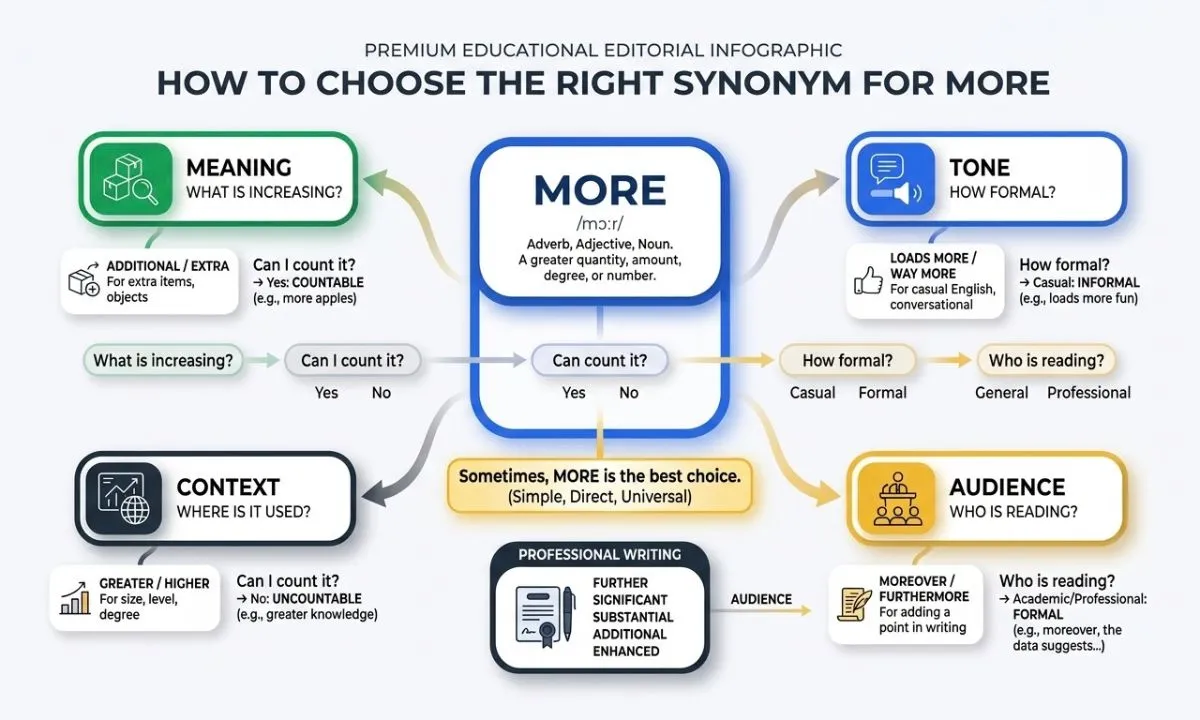
Ask four quick questions: What is increasing? Can I count it? How formal should this be? Who is reading? Often the best answer is to keep “more.”
Choose a Synonym Based on Meaning
Additional and extra fit extra items, greater and higher fit size and level, and moreover adds a point.
Choose a Synonym Based on Tone
We require further assistance (formal), We need more help (neutral), We need loads more help (casual).
Choose a Synonym Based on Context
“Elevated levels” fits a safety report; “elevated friends” is not English. Read the sentence aloud to test it.
Choose a Synonym Based on Audience
English learners and international readers prefer plain words like extra and higher. Slang like heaps more may not travel well.
Choose a Synonym for Professional Writing
Accuracy beats variety. Additional budget is a neutral request, extra budget suggests a one-off, and increased budget suggests a rise from the current level.
Common Mistakes When Using More Synonyms
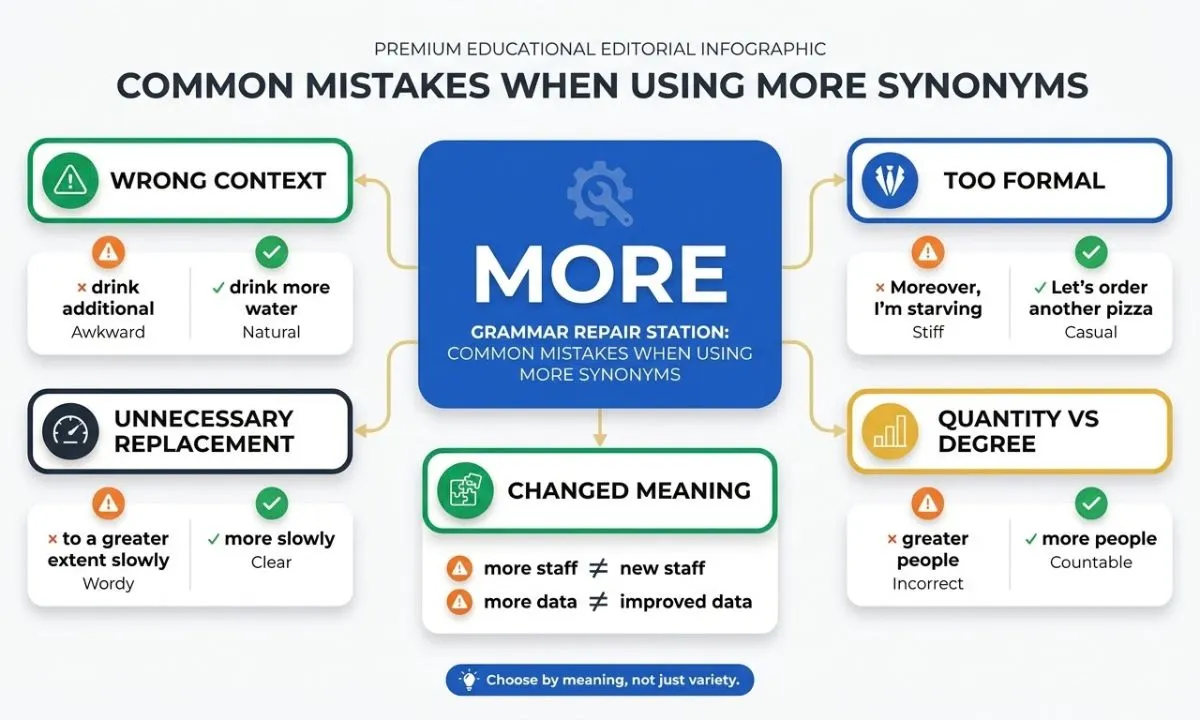
Using the Wrong Synonym for the Context
Awkward: The doctor told him to drink additional.
Better: The doctor told him to drink more water.
Using Formal Words in Casual Sentences
Awkward: Moreover, I’m starving, so let’s order additional pizza.
Better: I’m starving. Let’s order another pizza.
Replacing More When It Is Already the Best Choice
Awkward: Could you speak to a greater extent slowly?
Better: Could you speak more slowly? (or slow down a little)
Confusing Quantity With Degree
Awkward: Greater people attended the event.
Better: More people attended the event.
Using Synonyms That Change the Original Meaning
We need more staff is not the same as We need new staff (which can imply replacement), and more data is not improved data (which is about quality).
More Synonyms in Sentences
Everyday English Examples
- The kids asked for another bedtime story.
- We stayed longer than we planned.
- Prices were higher at the airport shop.
Professional Writing Examples
- Please submit any additional receipts before month-end.
- The vendor has proposed an expanded service package.
- We will provide further updates as the project progresses.
Academic Writing Examples
- Further evidence is required to confirm the trend.
- The second sample showed a higher rate of error.
- A broader dataset would improve the reliability of the analysis.
Formal English Examples
- Should you require any additional assistance, please contact the office.
- The board has requested further documentation.
Casual Conversation Examples
It was a great trip, and then some.
Want another coffee, or are you done?
She’s got tons more energy than I do.
What Major Dictionaries Say About “More”
The summaries below are paraphrased from the entries as checked online while preparing this article. Check each dictionary directly if you need exact wording.
Cambridge Dictionary
Lists “more” as a determiner, pronoun and adverb meaning a larger or extra number or amount, and as a way to form comparatives. Its grammar guide calls it a quantifier for additional quantities, amounts and degree, and notes that any more as an adverb means “no longer.”
Merriam-Webster
Gives adjective, adverb, noun and pronoun senses: greater, additional, further, “in addition,” “to a greater or higher degree,” and a greater quantity or amount. It treats “more” as the comparative of many and much.
Oxford Languages
I checked the Oxford Learner’s Dictionaries (Oxford University Press). “More” is a determiner and pronoun meaning a larger number or amount, and an adverb that forms comparatives or means “to a greater degree.” It also notes what’s more for adding a point that matters even more.
Collins Dictionary
Marks “more” as a determiner, pronoun and adverb, with examples such as more quickly. Its thesaurus lists extra, added, additional, further and supplementary for the “extra” sense, and moreover, also and what’s more for the “moreover” sense.
Explore More Synonyms Guide
25+ Struggle Synonyms: Better Ways to Say Struggle (With Examples)
25+ Policy Synonyms: Useful Alternatives, Meanings & Examples
Kindness Synonyms: 25+ Words, Meanings, Examples & How to Use Them
20+ Primary Synonyms: Other Ways to Say “Primary” With Meaning & Examples
25+ Share Synonyms: Meanings, Examples & When to Use Each
Frequently Asked Questions
What is the best synonym for more?
There is no single best option. Additional suits formal writing before nouns, extra is flexible, and greater or higher work for degree and level.
What is another word for more?
Additional, extra, further, another, added, greater, higher and increased. For “moreover,” try furthermore or what’s more.
What is a formal word for more?
Additional, further, supplementary and in excess of. To add a point, use moreover or furthermore.
What is a professional synonym for more?
Additional, further, expanded, increased and enhanced. Use increased only when something actually rose.
What is a simple synonym for more?
Extra and another for items, bigger and higher for size and level. They suit English learners.
What can I say instead of more?
For extra things, extra, additional or another. For level, higher or greater. For emphasis, far more or even more. If “more” sounds natural, keep it.
What is a stronger word for more?
Considerably more, substantially more, far more or a great deal more. For feelings and effects, heightened or intensified.
How can I avoid repeating the word more?
Vary the structure: use a number (five extra tickets), a comparative (higher), or rewrite (The plan costs less and lasts longer). Don’t force a synonym where “more” is clearest.
What are good synonyms for more in academic writing?
Additional, further, greater, broader, supplementary and to a greater extent. Avoid casual choices like way more.
Conclusion: Choose the Right Synonym for More
There is no single replacement that works in every sentence. The right synonym for more depends on meaning, quantity, degree, context, audience and tone.
Replace “more” only when the new word says what you mean. A plain “more” often reads better than a clumsy substitute.
