


Looking for the best primary synonyms? The right alternative depends on what you mean by primary. Words like main, chief, principal, and key describe importance, while first and initial refer to order or sequence.
Other alternatives, such as essential, fundamental, and central, work in specific situations. However, these words are not interchangeable in every sentence.
In this guide, you’ll find 20+ synonyms for primary, with clear meanings, practical examples, and usage tips. You’ll also learn which alternatives work best in everyday conversations, academic writing, and professional communication.
Quick Answer: What Is the Best Synonym for Primary?
Main is the best general synonym for primary because it naturally describes the most important part of something.
Other alternatives depend on the context:
- Chief: When describing the highest rank or authority.
- Principal: For formal or academic importance.
- Key: When highlighting an important factor or role.
- Essential: When something is necessary.
- Fundamental: When describing a basic principle or foundation.
- Central: When referring to the main focus or idea.
- First / Initial: When describing order or sequence.
- Foremost: When emphasizing the highest importance or position.
Choose the word that matches your intended meaning rather than replacing primary with any synonym from a general list.
Also Read This: gramarnesty.com/gng-meaning-in-text
What Does Primary Mean?
Primary is an adjective used to describe something that comes first in importance, order, or development. It can also refer to something basic, original, or central to a particular subject.
The exact meaning depends on the noun it describes. For example, a primary goal refers to the most important objective, while a primary source refers to original material used in research.
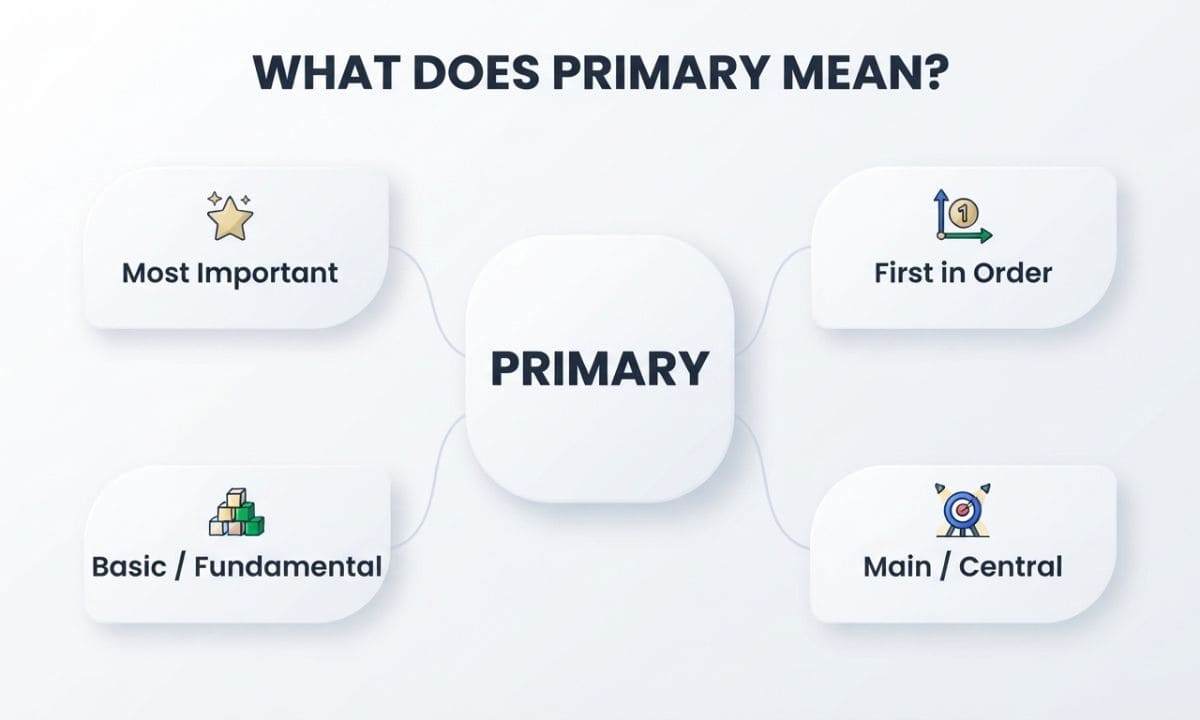
Primary Meaning “Most Important”
Here, primary highlights rank or priority above everything else in a group.
Example: “Customer satisfaction is our primary goal this year.”
Primary Meaning “First in Order”
This sense refers to the sequence that comes before everything else in time or steps.
Example: “The primary stage of the project involves research and planning.”
Primary Meaning “Basic or Fundamental”
Here, primary describes something that forms the base or root of a system, without being derived from anything else.
Example: “Reading and writing are primary skills taught in early education.”
Primary Meaning “Main or Central”
This use points to the central idea or focus around which other things revolve.
Example: “The primary theme of the novel is resilience.”
Primary Meaning “Original or Direct”
In research and education, primary can describe information or material that comes directly from an original source rather than being interpreted or summarized by someone else.
Example: “The researcher used primary sources to support the historical analysis.”
In this context, primary is connected to originality and direct evidence rather than general importance.
Also Read This: synonyms-for-partner
Best Synonyms for Primary at a Glance
| Synonym | Best Used For | Tone |
|---|---|---|
| Main | General importance | Neutral |
| Principal | Formal importance or rank | Formal |
| Chief | Highest rank or authority | Formal |
| Key | Important factors or roles | Neutral |
| Essential | Something necessary | Neutral |
| Fundamental | Basic principles or foundations | Formal |
| Central | Main focus or idea | Neutral |
| Leading | Top position or influence | Professional |
| Foremost | Highest importance or rank | Formal |
| Major | Significant size or impact | Neutral |
| Paramount | Highest priority | Formal |
| Core | Central or essential part | Neutral |
| Basic | Foundational or simple requirements | Neutral |
| Initial | First stage or beginning | Neutral |
| First | Order or sequence | Neutral |
| Dominant | Greatest influence or control | Neutral |
Note: These alternatives have different meanings. Some describe importance, while others refer to sequence, necessity, or influence. Always check the context before using one as a replacement for primary.
Also Read This: gramarnesty.com/prosperity-synonyms
50+ Primary Synonyms and Their Meanings
Below are more than 20 alternatives to primary, each with its own shade of meaning. Some overlap closely with primary; others fit only in specific situations.
Main
Pronunciation: US /meɪn/ | UK /meɪn/
Meaning: Most important or largest in size, amount, or importance.
Examples:
The main reason for the delay was bad weather.
Please use the main entrance.
Principal
Pronunciation: US /ˈprɪnsəpəl/ | UK /ˈprɪnsɪpəl/
Meaning: First in rank or importance; chief.
Examples:
Her principal concern is the safety of the students.
Agriculture is the country’s principal source of income.
Chief
Pronunciation: US /tʃiːf/ | UK /tʃiːf/
Meaning: Highest in rank or most important.
Examples:
Cost was the chief factor in our decision.
He is the chief engineer on the project.
Key
Pronunciation: US /kiː/ | UK /kiː/
Meaning: Extremely important to success or understanding.
Examples:
Communication is key to a good relationship.
She played a key role in the team’s victory.
Major
Pronunciation: US /ˈmeɪdʒɚ/ | UK /ˈmeɪdʒə/
Meaning: Greater or more important than others of its kind.
Examples:
Pollution is a major problem in big cities.
The company made a major announcement today.
Also Read This: gramarnesty.com/synonyms-for-more
Central
Pronunciation: US /ˈsentrəl/ | UK /ˈsentrəl/
Meaning: Most important; forming the main focus of something.
Examples:
Trust is central to any successful partnership.
The central idea of the book is hope.
Essential
Pronunciation: US /ɪˈsenʃəl/ | UK /ɪˈsenʃəl/
Meaning: Absolutely necessary; extremely important.
Examples:
Water is essential for life.
Good planning is essential for success.
Fundamental
Pronunciation: US /ˌfʌndəˈmentl/ | UK /ˌfʌndəˈmentl/
Meaning: Forming the basic and most important part of something.
Examples:
Honesty is a fundamental value in our school.
They disagreed on fundamental issues.
Foremost
Pronunciation: US /ˈfɔːrmoʊst/ | UK /ˈfɔːməʊst/
Meaning: Most important or leading in position.
Examples:
She is one of the foremost scientists of her time.
Safety is our foremost priority.
Paramount
Pronunciation: US /ˈpærəmaʊnt/ | UK /ˈpærəmaʊnt/
Meaning: More important than anything else; supreme.
Examples:
The safety of passengers is paramount.
Accuracy is of paramount importance in medicine.
Core
Pronunciation: US /kɔːr/ | UK /kɔː/
Meaning: Most important or central part of something.
Examples:
Teamwork is a core value of our company.
The core issue is a lack of funding.
Basic
Pronunciation: US /ˈbeɪsɪk/ | UK /ˈbeɪsɪk/
Meaning: Forming the simple base or starting point of something.
Examples:
Everyone should know basic first aid.
The course teaches basic computer skills.
Prime
Pronunciation: US /praɪm/ | UK /praɪm/
Meaning: Of first importance or best quality.
Examples:
The prime objective is to reduce costs.
He is the prime suspect in the case.
Leading
Pronunciation: US /ˈliːdɪŋ/ | UK /ˈliːdɪŋ/
Meaning: Most important or in the top position.
Examples:
She is a leading expert in climate science.
Heart disease is a leading cause of death.
Dominant
Pronunciation: US /ˈdɑːmɪnənt/ | UK /ˈdɒmɪnənt/
Meaning: Having the greatest power, influence, or presence.
Examples:
English is the dominant language in business.
The company holds a dominant position in the market.
Predominant
Pronunciation: US /prɪˈdɑːmɪnənt/ | UK /prɪˈdɒmɪnənt/
Meaning: Most common or most noticeable in a group or area.
Examples:
Rice is the predominant crop in this region.
Blue was the predominant color in the painting.
Cardinal
Pronunciation: US /ˈkɑːrdɪnəl/ | UK /ˈkɑːdɪnəl/
Meaning: Of greatest importance; fundamental.
Examples:
Honesty is a cardinal rule in our team.
Never leaving a fire unattended is a cardinal rule of camping.
Premier
Pronunciation: US /prɪˈmɪr/ | UK /ˈpremiə/
Meaning: First in importance, rank, or quality.
Examples:
It is the nation’s premier research university.
The event is the premier showcase for new talent.
Primary-level
Pronunciation: US /ˈpraɪmeri ˈlevl/ | UK /ˈpraɪməri ˈlevl/
Meaning: Relating to the first or basic stage of something, especially education.
Examples:
She teaches at the primary level in a village school.
The program offers primary-level training for beginners.
Also Read This: gramarnesty.com/above-average-synonyms
Principal-level
Pronunciation: US /ˈprɪnsəpəl ˈlevl/ | UK /ˈprɪnsɪpəl ˈlevl/
Meaning: At the main or highest level of responsibility.
Examples:
Principal-level decisions are made by the board.
He was promoted to a principal-level position.
First
Pronunciation: US /fɜːrst/ | UK /fɜːst/
Meaning: Coming before all others in order, time, or importance.
Examples:
Our first priority is customer satisfaction.
She was the first person to arrive.
Initial
Pronunciation: US /ɪˈnɪʃəl/ | UK /ɪˈnɪʃəl/
Meaning: Happening at the beginning.
Examples:
The initial results look promising.
My initial reaction was surprise.
Earliest
Pronunciation: US /ˈɜːrliɪst/ | UK /ˈɜːliɪst/
Meaning: Coming first in time.
Examples:
The earliest known writing is over 5,000 years old.
Please reply at your earliest convenience.
Original
Pronunciation: US /əˈrɪdʒənəl/ | UK /əˈrɪdʒənəl/
Meaning: Existing from the beginning; the source from which others come.
Examples:
The original plan was much simpler.
She kept the original copy of the contract.
Introductory
Pronunciation: US /ˌɪntrəˈdʌktəri/ | UK /ˌɪntrəˈdʌktəri/
Meaning: Serving as a first step or beginning.
Examples:
He signed up for an introductory course in design.
The book begins with an introductory chapter.
Preliminary
Pronunciation: US /prɪˈlɪmɪneri/ | UK /prɪˈlɪmɪnəri/
Meaning: Coming before the main part or event.
Examples:
Preliminary results will be released next week.
The team held a preliminary meeting.
Foundational
Pronunciation: US /faʊnˈdeɪʃənəl/ | UK /faʊnˈdeɪʃənəl/
Meaning: Forming the basis on which something else is built.
Examples:
Reading is a foundational skill for learning.
The report outlines the foundational principles of the law.
Underlying
Pronunciation: US /ˌʌndɚˈlaɪɪŋ/ | UK /ˌʌndəˈlaɪɪŋ/
Meaning: Basic and important but not obvious at first.
Examples:
We need to find the underlying cause of the problem.
The underlying message of the film is hope.
Root
Pronunciation: US /ruːt/ | UK /ruːt/
Meaning: The basic source or cause of something.
Examples:
Poverty is the root cause of many social problems.
The root issue is poor communication.
Groundwork
Pronunciation: US /ˈɡraʊndwɜːrk/ | UK /ˈɡraʊndwɜːk/
Meaning: Basic work done to prepare for later progress.
Examples:
Early research laid the groundwork for the new law.
Good groundwork makes the final project easier.
Also Read This: gramarnesty.com/synonyms-for-interest
Basic-level
Pronunciation: US /ˈbeɪsɪk ˈlevl/ | UK /ˈbeɪsɪk ˈlevl/
Meaning: At the simplest or most elementary stage.
Examples:
The class is designed for basic-level learners.
A basic-level understanding of math is required.
Initial-stage
Pronunciation: US /ɪˈnɪʃəl steɪdʒ/ | UK /ɪˈnɪʃəl steɪdʒ/
Meaning: Relating to the very first phase of a process.
Examples:
The disease is easier to treat at the initial stage.
The project is still in its initial-stage planning.
First-line
Pronunciation: US /ˈfɜːrst laɪn/ | UK /ˈfɜːst laɪn/
Meaning: Used first, as the main or earliest course of action.
Examples:
Rest and fluids are first-line treatments for a cold.
Training is our first-line defense against errors.
Direct
Pronunciation: US /dəˈrekt/ | UK /dɪˈrekt/
Meaning: Without anything or anyone in between; immediate.
Examples:
She has direct access to the manager.
The direct cause of the fire was a faulty wire.
Firsthand
Pronunciation: US /ˌfɜːrstˈhænd/ | UK /ˌfɜːstˈhænd/
Meaning: Obtained directly from the original source or experience.
Examples:
He has firsthand experience of working abroad.
The reporter gave a firsthand account of the event.
Also Read This: gramarnesty.com/share-synonyms
Original-source
Pronunciation: US /əˈrɪdʒənəl sɔːrs/ | UK /əˈrɪdʒənəl sɔːs/
Meaning: Coming directly from the first or true origin.
Examples:
Historians prefer original-source documents.
Always check the original-source data before quoting it.
Centralized
Pronunciation: US /ˈsentrəlaɪzd/ | UK /ˈsentrəlaɪzd/
Meaning: Controlled or organized from one central point.
Examples:
The company uses a centralized system for orders.
A centralized database stores all the records.
Pivotal
Pronunciation: US /ˈpɪvətl/ | UK /ˈpɪvətl/
Meaning: Of great importance because everything else depends on it.
Examples:
Her speech played a pivotal role in the campaign.
This was a pivotal moment in his career.
Critical
Pronunciation: US /ˈkrɪtɪkəl/ | UK /ˈkrɪtɪkəl/
Meaning: Extremely important or necessary.
Examples:
Sleep is critical for a healthy mind.
It is critical that we finish on time.
Crucial
Pronunciation: US /ˈkruːʃəl/ | UK /ˈkruːʃəl/
Meaning: Extremely important for success or failure.
Examples:
Teamwork is crucial to winning this match.
The next hour is crucial for the rescue.
Significant
Pronunciation: US /sɪɡˈnɪfɪkənt/ | UK /sɪɡˈnɪfɪkənt/
Meaning: Important enough to have a noticeable effect.
Examples:
There was a significant increase in sales.
She made a significant contribution to the research.
Influential
Pronunciation: US /ˌɪnfluˈenʃəl/ | UK /ˌɪnfluˈenʃəl/
Meaning: Having a strong effect on people or events.
Examples:
He is one of the most influential writers of his generation.
The report was influential in changing the policy.
Preeminent
Pronunciation: US /priˈemɪnənt/ | UK /priˈemɪnənt/
Meaning: Better or more important than all others.
Examples:
She is the preeminent authority on ancient history.
The firm is preeminent in the field of law.
Outstanding
Pronunciation: US /aʊtˈstændɪŋ/ | UK /aʊtˈstændɪŋ/
Meaning: Exceptionally good or clearly better than others.
Examples:
He received an award for outstanding service.
The team gave an outstanding performance.
Superior
Pronunciation: US /suːˈpɪriɚ/ | UK /suːˈpɪəriə/
Meaning: Higher in rank, quality, or importance.
Examples:
This phone has superior battery life.
She reported the problem to her superior officer.
Supreme
Pronunciation: US /suˈpriːm/ | UK /suˈpriːm/
Meaning: Highest in authority, rank, or degree.
Examples:
The Supreme Court has the final say in legal matters.
He made a supreme effort to finish the race.
Foreground
Pronunciation: US /ˈfɔːrɡraʊnd/ | UK /ˈfɔːɡraʊnd/
Meaning: The most noticeable or important position or part.
Examples:
Education should stay in the foreground of our plans.
The speaker brought the issue to the foreground.
Chiefmost
Pronunciation: US /ˈtʃiːfmoʊst/ | UK /ˈtʃiːfməʊst/
Meaning: Highest in rank or importance (rare and formal).
Examples:
Honor was his chiefmost concern.
The chiefmost goal of the mission was safety.
Underpinning
Pronunciation: US /ˌʌndərˈpɪnɪŋ/ | UK /ˌʌndəˈpɪnɪŋ/
Meaning: A basic idea or structure that supports something.
Examples:
Trust is the underpinning of every strong team.
The theory provides the underpinning for the whole study.
Keynote
Pronunciation: US /ˈkiːnoʊt/ | UK /ˈkiːnəʊt/
Meaning: The central theme or main idea of something.
Examples:
Fairness was the keynote of her speech.
The keynote of the festival is unity.
Also Read This: gramarnesty.com/share-synonyms
Primary Synonyms by Context
The best alternative for primary depends on whether you are describing importance, necessity, focus, or order. Use these categories to find a word that fits your sentence naturally.
When Primary Means “Most Important”
Use main, chief, principal, foremost, or paramount.
Example: “Safety is our primary concern.”
Better alternatives:
- Safety is our main concern.
- Safety is our chief concern.
- Safety is our foremost priority.
When Primary Means “Essential or Necessary”
Use essential, fundamental, core, or cardinal.
Example: “Communication is a primary requirement for teamwork.”
Alternative: “Communication is an essential requirement for teamwork.”
When Primary Means “Central or Main Focus”
Use central, key, dominant, or core.
Example: “Trust is a primary theme in the discussion.”
Alternative: “Trust is a central theme in the discussion.”
When Primary Means “First or Earliest”
Use first or initial.
Example: “The primary stage involves collecting information.”
Alternative: “The initial stage involves collecting information.”
When Primary Means “Original or Direct”
Use original or firsthand when the context refers to information or evidence collected directly from a source.
Example: “The researcher collected primary information through interviews.”
Alternative: “The researcher collected firsthand information through interviews.”
Remember that these words have different meanings. Choose an alternative that preserves the original sentence’s meaning.
Also Read This: gramarnesty.com/especially-synonyms
Primary Synonyms: Formal vs Casual
The right synonym for primary depends on your audience and writing style. Everyday writing usually needs simple words, while formal writing may require more precise alternatives.
| Casual or Neutral | Formal Alternative | Example |
|---|---|---|
| Main | Principal | Our principal objective is growth. |
| Main | Chief | Our chief concern is safety. |
| Key | Paramount | Security is paramount to our success. |
| Basic | Fundamental | These are fundamental principles. |
| First | Initial | The initial stage requires planning. |
| Main | Central | Trust is central to teamwork. |
| Important | Foremost | Safety remains our foremost priority. |
Which Tone Should You Choose?
- Casual: Main, first, basic.
- Neutral: Key, central, core.
- Formal: Principal, chief, fundamental.
- Strong emphasis: Paramount, foremost.
Do not choose a formal word simply to sound professional. Make sure its meaning fits the sentence.
Primary Synonyms for Professional Writing
In professional communication, the best synonym for primary should sound clear, precise, and appropriate for the situation. The following alternatives work well in workplace emails, business reports, and formal documents.
Best Professional Alternatives
Principal – Formal responsibilities and objectives
Example: “She is the principal investigator of the research project.”
Key – Important factors and business decisions
Example: “Customer feedback is a key factor in our strategy.”
Core – Company values and central features
Example: “Transparency is a core value of our organization.”
Leading – Competitive position and industry status
Example: “The company is a leading provider of business software.”
Essential – Necessary requirements
Example: “This training is essential before employees begin their duties.”
Examples in Workplace Emails
- Primary objective → Main objective
- Primary concern → Chief concern
- Primary responsibility → Principal responsibility
- Primary requirement → Essential requirement
Examples in Business Reports
- Primary factor → Key factor
- Primary market → Main market
- Primary strategy → Core strategy
- Primary issue → Central issue
Examples in Academic Writing
- Primary argument → Central argument
- Primary principle → Fundamental principle
- Primary research material → Original research material, when referring to original sources
Choose the alternative that communicates the same idea without changing the intended meaning.
What Major Dictionaries Say About “Primary”
Major dictionaries explain primary through several meanings, including first in importance, first in order, and basic or original. These distinctions help readers understand why different synonyms work in different situations.
Cambridge Dictionary
Cambridge explains primary in terms of greatest importance and earliest stages. These meanings support alternatives such as main, principal, and initial, depending on the sentence.
Merriam-Webster
Merriam-Webster provides definitions and related words that help distinguish primary from alternatives such as main and chief. Its thesaurus is also useful for exploring different senses of the word.
Oxford English Dictionary
The Oxford English Dictionary provides historical and contextual information about primary, including its connection with the idea of being first or foremost.
Collins Dictionary
Collins provides definitions, examples, and related vocabulary for primary. Its coverage also helps explain why technical expressions such as primary colors and primary sources require context-specific interpretation.
Dictionary definitions are a useful starting point, but a synonym should always fit the meaning of the sentence in which it is used.
Also Read This: gramarnesty.com/other-ways-to-say-take-care
How to Choose the Right Synonym for Primary
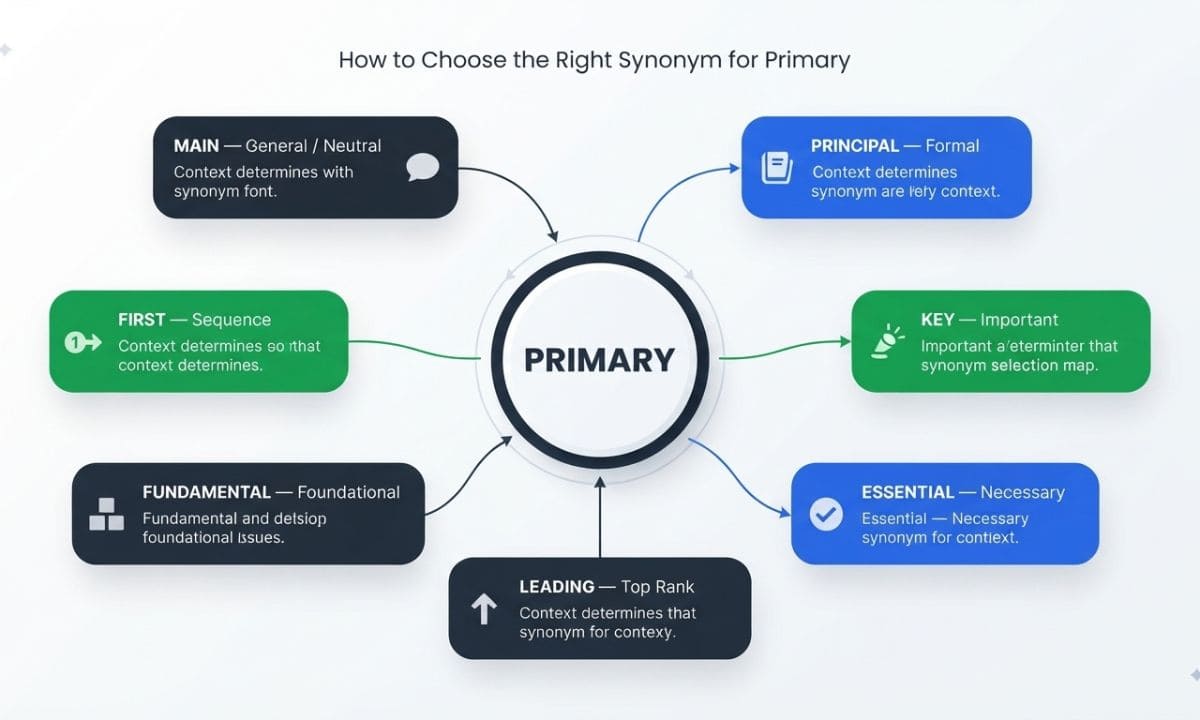
Choose “Main”
For general writing that needs a neutral, easy tone.
Choose “Principal”
For formal writing, legal text, or job titles.
Choose “Key”
When highlighting important factors or people.
Choose “Essential”
When something is truly necessary, not just important.
Choose “Leading”
For top position, rank, or industry status.
Choose “Fundamental”
For basic principles or foundational ideas.
Choose “First”
When the point is order or sequence, not importance.
Quick Guide: Which Primary Synonym Should You Choose?
| If You Mean… | Choose |
|---|---|
| The most important thing | Main |
| The highest formal priority | Principal |
| The most influential factor | Key |
| Something necessary | Essential |
| A basic foundation | Fundamental |
| The central idea | Central |
| The earliest stage | Initial |
| The highest priority | Paramount |
| The original material | Original |
Before replacing primary, ask yourself whether the sentence refers to importance, order, necessity, or originality. This simple check will help you avoid awkward or inaccurate word choices.
Also Read This: gramarnesty.com
Primary vs Its Closest Synonyms
Some synonyms sit so close to primary that swapping them feels automatic. But small differences in meaning still matter.
Primary vs. Main
Primary can suggest rank, order, or origin. Main is simpler and only points to size or importance. “Main entrance” works; “primary entrance” sounds oddly technical.
Primary vs. Principal
Principal leans formal and often applies to people or money (as in loan principal). Primary is broader and fits both abstract and concrete ideas equally.
Primary vs. Chief
Chief usually attaches to a role or title chief officer, chief concern. Primary works more generally across goals, causes, and sources.
Primary vs. Major
Major implies scale or significance, not necessarily rank. A “major update” isn’t always the “primary update” , it just means a big one.
Primary vs. Essential
Primary means first or most important. Essential means necessary something the system cannot function without. Not everything primary is essential, and not everything essential is primary.
Primary vs. Fundamental
Primary often relates to order or rank. Fundamentals relate to structure of the base layer everything else depends on. A fundamental rule isn’t always the primary rule in a list.
Primary vs Main vs Principal vs Chief
| Word | Main Difference | Example |
|---|---|---|
| Primary | First in importance, order, or development | Primary objective |
| Main | The most important or largest part | Main objective |
| Principal | Highest in rank or importance; often formal | Principal objective |
| Chief | Highest-ranking or most important | Chief concern |
Quick Tip: Main is usually the simplest alternative for everyday writing. Principal is more formal, while chief often emphasizes rank, responsibility, or priority.
Also Read This: gramarnesty.com/policy-synonyms
Common Mistakes When Using Primary Synonyms
Small mix-ups here can confuse readers or weaken your point. Here’s what to watch for.
Using “Essential” When You Only Mean “Main”
Mistake: “Coffee is my essential morning drink.”
Correction: “Coffee is my main morning drink.” Essential implies you can’t function without it and use it carefully.
Using “First” When You Mean “Most Important”
Mistake: “Safety is our first concern.”
Correction: “Safety is our main concern.” First refers to order, not rank.
Confusing “Principal” With “Principle”
Mistake: “Our principle goal is growth.”
Correction: “Our principal goal is growth.”
Explanation: Principal is an adjective that means main or most important. Principle is a noun that refers to a rule, belief, or basic truth.
Example: “Honesty is an important principle in our organization.”
Using “Leading” Without a Sense of Position or Prominence
Mistake: “This is a leading ingredient in the recipe.”
Correction: “This is the main ingredient in the recipe.” Leading needs a competitive or ranked context to make sense.
Assuming Every Synonym Works in Every Sentence
Mistake: Swapping “primary” for “cardinal” in casual writing: “That’s my cardinal reason for calling.”
Correction: “That’s my main reason for calling.” Formal words like cardinal or paramount can sound out of place in casual sentences.
Using “Initial” When You Mean “Most Important”
Mistake: “Customer safety is our initial concern.”
Correction: “Customer safety is our primary concern.”
Explanation: Initial refers to the beginning of a process or sequence. Primary can describe the most important concern or priority. Use the word that matches your intended meaning.
Also Read This: gramarnesty.com/keep-vs-kept
Primary Synonyms in Sentences
Understanding synonyms becomes easier when you see how they work in everyday, academic, professional, and formal sentences.
Everyday Examples
- “Her main concern is finding a new apartment.”
- “The basic idea behind the project is simple.”
- “First, gather all the materials.”
Academic Examples
- “The central argument of the essay focuses on education.”
- “This is a fundamental principle of the theory.”
- “The initial findings supported the hypothesis.”
Professional Examples
- “Our key objective this quarter is customer retention.”
- “She is the principal contact for this account.”
- “Transparency remains a core value across all departments.”
Formal Examples
- “Safety is of paramount importance to this organization.”
- “He is one of the foremost experts in his field.”
- “Honesty is a cardinal principle of professional conduct.”
Quick Usage Reminder
Main works well in general sentences, principal suits formal contexts, essential describes necessity, and initial refers to the beginning of a sequence. Always choose the word that preserves your intended meaning.
Also Read This: Synonyms for Partner
Frequently Asked Questions
What is the best synonym for primary?
Main is the best general synonym for primary because it naturally describes the most important part of something. Principal and chief are useful in more formal contexts.
What is another word for primary?
Other words for primary include main, chief, principal, key, central, fundamental, essential, and foremost. The best choice depends on the intended meaning.
What is a formal synonym for primary?
Principal, paramount, foremost, and fundamental can work as formal alternatives. Choose one according to the context.
Is main a synonym for primary?
Yes. Main is one of the closest alternatives when primary means most important or central. However, primary can also describe order, development, or original sources.
Is principal the same as primary?
They have similar meanings when describing importance. However, principal is often more formal and can also refer to a school leader or the original amount of a loan.
What is the opposite of primary?
Secondary is the most common opposite of primary. It generally describes something less important or following the main item.
What is a synonym for primary in professional writing?
Principal, key, central, and core are useful alternatives in professional writing when they fit the sentence.
What is a synonym for primary in academic writing?
Fundamental, principal, central, and initial can work in academic writing, depending on whether you mean importance, foundation, focus, or sequence.
Can essential always replace primary?
No. Essential means necessary, while primary usually means first or most important. The words overlap in some situations but are not interchangeable in every sentence.
Does leading work as a synonym for primary in every sentence?
No. Leading is appropriate when describing a top position, influence, or competitive status. It does not always mean first in importance.
What is the difference between primary and initial?
Primary can describe the most important thing, while initial describes something that happens at the beginning of a process or sequence.
What is another word for primary source?
Original source or firsthand source can work when referring to material or information obtained directly from its source. The best alternative depends on the type of research material.
Conclusion
Choosing the right primary synonym depends on the meaning you want to express. Main is the easiest alternative for everyday writing, while principal and chief work well in formal contexts.
For something necessary, choose essential. For basic ideas, use fundamental. When describing the beginning of a process, initial or first may be more accurate.
The best synonym is not always the most sophisticated word. It is the one that communicates your meaning clearly and naturally.
