

Looking for other ways to say take care? “Take care” is warm, but it gets repeated fast. This guide gives you 70 fresh options for work, friends, travel, and hard days.
Need another way to say take care that fits the moment? Here you will find professional ways to say take care for emails and casual ways to say take care for texts. Each phrase has a clear meaning, a real example, and a quick usage tip.
Not sure what to say instead of take care? These synonyms for take care are sorted by tone and situation. You will also get take care alternatives for friends and easy ways to say take care in an email. Pick the other ways to say take care that match your message.
At a Glance: Which Alternative Should You Use?
How to choose: check your relationship, the medium, and whether you mean goodbye, “be safe” or “I hope you’re okay.”
Best all-round swap: “All the best.”
Professional email: “Kind regards” or “Best wishes.”
Casual chat or text: “Take it easy” or “Talk soon.”
Travel and safety: “Safe travels” or “Stay safe.”
Emotional support: “Be gentle with yourself” or “I’m thinking of you.”
Quick Answer: What Are the Best Alternatives to “Take Care”?
The best alternative to “take care” depends on what you mean. Use “Kind regards” or “Best wishes” in work emails, “Take it easy” with friends, “Safe travels” before a trip, and “Be gentle with yourself” when someone is struggling. Match the phrase to your relationship, your tone and whether you’re saying goodbye or offering support.
Examples of How to Say “Take Care” in Different Situations
Here’s how other ways to say take care look in real life.
Ending a work email: “Kind regards” or “Best wishes.”
Leaving a friend’s place: “Catch you later” or “Get home safe.”
Before a flight: “Safe travels. Text me when you land.”
After bad news: “I’m thinking of you. I’m here if you need me.”
To someone unwell: “Rest up” or “Feel better soon.”
In a formal letter: “Yours sincerely” or “Respectfully.”
Linguistic Breakdown of “Take Care”
Connotative Meaning of “Take Care”
- “Take care” feels warm, kind, and gently protective.
- It can work as a goodbye, a safety wish, or a sign that you care about someone’s wellbeing.
Examples:
- “Thanks for coming. Take care!”: a friendly goodbye.
- “It’s icy out there, take care”: a wish for someone’s safety.
Etymology of “Take Care”
- “Take” entered English from Old Norse taka.
- “Care” comes from Old English caru or cearu, meaning “sorrow, anxiety, grief,” and later “serious attention” or “concern.”
- According to Etymonline.com, “take care” in the sense of “be careful” dates from the 1580s.
- When it became a common farewell is not confirmed, so verify this before publishing if you want to state a date.
Pronunciation of “Take Care”
- Pronunciation: TAYK KAIR
- IPA: US /teɪk ker/ | UK /teɪk keə/
Syllables and Affixation Pattern of “Take Care”
Stress: The main stress usually falls on “care.”
Syllable division: take | care
Base words: Take + Care
Affixes: None. Both words are base forms.
Word formation: Take (verb) + care (noun) = an idiomatic imperative phrase
Part of speech: Verb phrase (imperative: verb + noun)
Syllables: Two (one in each word)
Is It Professional and Polite to Say “Take Care”?
Yes, usually. “Take care” is polite and warm in most workplaces, and it’s fine with colleagues you know. In a first message to a client, a formal complaint or a legal email, it can sound a little too personal. That’s where professional ways to say take care, such as “Kind regards” or “Best wishes,” fit better.
Pros and Cons of Using “Take Care” in Writing and Conversation
Pros of Saying “Take Care”
🟢 It’s warm, short and understandable everywhere.
🟢 It works in speech, text and email.
🟢 It suits almost any relationship, from friend to coworker.
🟢 It carries a caring tone without a long message.
Cons of Saying “Take Care”
🔴 It’s generic. Readers may skim past it.
🔴 It can sound like “be careful,” which feels odd if nothing risky is happening.
🔴 It sometimes hints that someone is unwell or in trouble.
🔴 It’s too casual for very formal letters.
List of Alternative Ways to Say “Take Care”
Professional ways to say take care (work and email)
1. Best Wishes
Pronunciation: US /best ˈwɪʃɪz/ | UK /best ˈwɪʃɪz/
Meaning: Best wishes is a warm, general closing that wishes the reader well.
Examples:
- Thanks for the update, and best wishes with the launch.
- She signed the card with best wishes for his new job.
2. Kind Regards
Pronunciation: US /kaɪnd rɪˈɡɑːrdz/ | UK /kaɪnd rɪˈɡɑːdz/
Meaning: Kind regards is a polite, courteous way to close an email.
Examples:
- Kind regards, Maya. I’ll send the revised file by Friday.
- He ended the message to the new client with kind regards.
3. Warm Regards
Pronunciation: US /wɔːrm rɪˈɡɑːrdz/ | UK /wɔːm rɪˈɡɑːdz/
Meaning: Warm regards is a friendlier closing for people you already know well.
Examples:
- Warm regards, Daniel. Thanks again for covering my shift.
- I closed the note to my longtime colleague with warm regards.
4. All the Best
Pronunciation: US /ɔːl ðə best/ | UK /ɔːl ðə best/
Meaning: All the best is a general good-luck wish that ends a message on a positive note.
Examples:
- I’m moving teams next week, so all the best with the rebrand.
- All the best for your exams, and let me know how it goes.
5. Wishing You Well
Pronunciation: US /ˈwɪʃɪŋ juː wel/ | UK /ˈwɪʃɪŋ juː wel/
Meaning: Wishing you well is a gentle wish for someone’s wellbeing with no specific event attached.
Examples:
- Thanks for your patience this month. Wishing you well.
- We’re sorry to see you go and are wishing you well in your next role.
6. Look After Yourself
Pronunciation: US /lʊk ˈæftər jɔːrˈself/ | UK /lʊk ˈɑːftə jɔːˈself/
Meaning: Look after yourself and ask someone to protect their own health and energy.
Examples:
- That’s a heavy week. Look after yourself, and tell me what I can take off your list.
- You’ve been working late again, so please look after yourself.
7. Be Well
Pronunciation: US /biː wel/ | UK /biː wel/
Meaning: Be well is a short wish for someone’s general health and happiness.
Examples:
- Thanks for your time today. Be well.
- It was lovely seeing you at the reunion. Be well!
8. Stay Well
Pronunciation: US /steɪ wel/ | UK /steɪ wel/
Meaning: Stay well and wish someone good health, especially during cold and flu season.
Examples:
- Half the office has a cold, so stay well.
- Winter is coming, so stay well and keep warm.
9. Please Stay Safe
Pronunciation: US /pliːz steɪ seɪf/ | UK /pliːz steɪ seɪf/
Meaning: Please stay safe is a serious request to avoid danger during storms, unrest, or risky work.
Examples:
- The storm hits your area tonight, so please stay safe.
- Crews are working near the highway, so please stay safe out there.
10. Wishing You a Smooth Week Ahead
Pronunciation: US /ˈwɪʃɪŋ juː ə smuːð wiːk əˈhed/ | UK /ˈwɪʃɪŋ juː ə smuːð wiːk əˈhed/
Meaning: Wishing you a smooth week ahead is a friendly closing that looks forward to the days to come.
Examples:
- Great meeting today. Wishing you a smooth week ahead.
- With the launch on Wednesday, I’m wishing you a smooth week ahead.
Casual ways to say take care (take care alternatives for friends)
11. Take It Easy
Pronunciation: US /teɪk ɪt ˈiːzi/ | UK /teɪk ɪt ˈiːzi/
Meaning: Take it easy tells someone to relax and not push themselves too hard.
Examples:
- Long shift? Take it easy tonight.
- Take it easy this weekend and don’t answer any emails.
12. Catch You Later
Pronunciation: US /kætʃ juː ˈleɪtər/ | UK /kætʃ juː ˈleɪtə/
Meaning: Catch you later is a casual goodbye that implies you will meet again without a fixed plan.
Examples:
- I’m heading to practice. Catch you later!
- Gotta run, so catch you later at the gym.
13. See You Soon
Pronunciation: US /siː juː suːn/ | UK /siː juː suːn/
Meaning: See you soon signals that you expect to meet again before long.
Examples:
- Thanks for dinner. See you soon!
- The movie starts at eight, so see you soon.
14. Talk Soon
Pronunciation: US /tɔːk suːn/ | UK /tɔːk suːn/
Meaning: Talk soon promises another chat or message in the near future.
Examples:
- Got to run, but talk soon.
- Thanks for the call, and talk soon about the budget.
15. Cheers
Pronunciation: US /tʃɪrz/ | UK /tʃɪəz/
Meaning: Cheers is an informal goodbye or thanks, especially in British and Australian English.
Examples:
- Cheers, mate, see you Thursday.
- He waved and said cheers as he left the pub.
16. Have a Good One
Pronunciation: US /hæv ə ɡʊd wʌn/ | UK /hæv ə ɡʊd wʌn/
Meaning: Having a good one is a relaxed wish for the rest of someone’s day.
Examples:
- Heading out now. Have a good one!
- Thanks for the coffee, and have a good one.
17. Keep in Touch
Pronunciation: US /kiːp ɪn tʌtʃ/ | UK /kiːp ɪn tʌtʃ/
Meaning: Keep in touch and ask someone to stay in contact after you part ways.
Examples:
- Good luck at university. Keep in touch!
- It was great working with you, so keep in touch.
18. Don’t Be a Stranger
Pronunciation: US /doʊnt biː ə ˈstreɪndʒər/ | UK /dəʊnt biː ə ˈstreɪndʒə/
Meaning: Don’t be a stranger is a playful invitation to reconnect soon.
Examples:
- Great seeing you! Don’t be a stranger.
- You’re always welcome here, so don’t be a stranger.
19. Later
Pronunciation: US /ˈleɪtər/ | UK /ˈleɪtə/
Meaning: Later is a very short slang goodbye used between close friends.
Examples:
- Later, Sam.
- He grabbed his bag, shouted “later,” and left.
20. Stay Cool
Pronunciation: US /steɪ kuːl/ | UK /steɪ kuːl/
Meaning: Stay cool is a relaxed sign-off, or a literal wish for someone to stay comfortable in hot weather.
Examples:
- Heatwave this week. Stay cool!
- Drink plenty of water and stay cool out there.
Travel and safety alternatives
21. Stay Safe
Pronunciation: US /steɪ seɪf/ | UK /steɪ seɪf/
Meaning: Stay safe and wish someone protection from danger, accidents, or illness.
Examples:
- Roads are icy tonight. Stay safe out there.
- Thanks for the visit, and stay safe on the way home.
22. Safe Travels
Pronunciation: US /seɪf ˈtrævəlz/ | UK /seɪf ˈtrævlz/
Meaning: Safe travels wishes someone a trouble-free journey.
Examples:
- Safe travels, and send photos from Lisbon!
- Our flight leaves at dawn, so thanks for the lift, and safe travels to you too.
23. Drive Safe
Pronunciation: US /draɪv seɪf/ | UK /draɪv seɪf/
Meaning: Drive safely asks someone to drive carefully.
Examples:
- Drive safe. It’s foggy near the bridge.
- She hugged him at the door and said, “Drive safe.”
24. Mind How You Go
Pronunciation: US /maɪnd haʊ juː ɡoʊ/ | UK /maɪnd haʊ juː ɡəʊ/
Meaning: Mind how you go is a British farewell meaning “be careful on your way.”
Examples:
- Thanks for popping round. Mind how you go.
- It’s pouring outside, so mind how you go.
25. Get Home Safe
Pronunciation: US /ɡet hoʊm seɪf/ | UK /ɡet həʊm seɪf/
Meaning: Get home safe expresses a hope that someone reaches home without trouble.
Examples:
- Text me when you’re in. Get home safe.
- It’s late, so get home safe, everyone.
26. Text Me When You Land
Pronunciation: US /tekst miː wen juː lænd/ | UK /tekst miː wen juː lænd/
Meaning: Text me when you land and ask for a message confirming that someone has arrived safely.
Examples:
- Long flight tomorrow. Text me when you land.
- Have a great trip, and text me when you land.
27. Watch Yourself Out There
Pronunciation: US /wɑːtʃ jɔːrˈself aʊt ðer/ | UK /wɒtʃ jɔːˈself aʊt ðeə/
Meaning: Watch yourself out there is an informal warning to stay alert.
Examples:
- It’s slippery on the roads. Watch yourself out there.
- The trail gets steep near the top, so watch yourself out there.
28. Be Careful
Pronunciation: US /biː ˈkerfəl/ | UK /biː ˈkeəfl/
Meaning: Be careful is a direct warning to avoid risk.
Examples:
- The stairs are wet, so be careful.
- Be careful with that hot pan.
29. Have a Safe Trip
Pronunciation: US /hæv ə seɪf trɪp/ | UK /hæv ə seɪf trɪp/
Meaning: Have a safe trip is a neutral wish for a safe journey.
Examples:
- Have a safe trip, and say hello to your parents.
- We’ll miss you, so have a safe trip.
30. Safe Journey
Pronunciation: US /seɪf ˈdʒɜːrni/ | UK /seɪf ˈdʒɜːni/
Meaning: Safe journey is a wish for a safe trip that is especially common in British English.
Examples:
- Safe journey home, everyone.
- The train leaves soon, so safe journey!
Emotional support alternatives
31. Be Gentle with Yourself
Pronunciation: US /biː ˈdʒentl wɪð jɔːrˈself/ | UK /biː ˈdʒentl wɪð jɔːˈself/
Meaning: Be gentle with yourself encourages kindness toward oneself during a hard time.
Examples:
- You’ve had a brutal month. Be gentle with yourself.
- Be gentle with yourself while you recover.
32. I’m Thinking of You
Pronunciation: US /aɪm ˈθɪŋkɪŋ əv juː/ | UK /aɪm ˈθɪŋkɪŋ əv juː/
Meaning: I’m thinking of you telling someone they are on your mind.
Examples:
- I know the hearing is today. I’m thinking of you.
- Whatever happens this week, I’m thinking of you.
33. Sending You Strength
Pronunciation: US /ˈsendɪŋ juː streŋθ/ | UK /ˈsendɪŋ juː streŋθ/
Meaning: Sending you strength offers encouragement during a difficult stretch.
Examples:
- Sending you strength this week.
- I can’t be there, but I’m sending you strength today.
34. Hang in There
Pronunciation: US /hæŋ ɪn ðer/ | UK /hæŋ ɪn ðeə/
Meaning: Hang in there encourages someone to keep going through a rough patch.
Examples:
- Finals end Friday. Hang in there!
- The project is almost done, so hang in there.
35. Lean on Me
Pronunciation: US /liːn ɑːn miː/ | UK /liːn ɒn miː/
Meaning: Lean on me offers real, practical support.
Examples:
- If the move gets overwhelming, lean on me.
- You don’t have to handle this alone, so lean on me.
36. Rest Up
Pronunciation: US /rest ʌp/ | UK /rest ʌp/
Meaning: Rest up tells someone to recover by resting.
Examples:
- Big game tomorrow. Rest up.
- You’ve had a long trip, so rest up tonight.
37. Go Easy on Yourself
Pronunciation: US /ɡoʊ ˈiːzi ɑːn jɔːrˈself/ | UK /ɡəʊ ˈiːzi ɒn jɔːˈself/
Meaning: Go easy on yourself is a casual reminder not to be too hard on yourself.
Examples:
- It was one bad review. Go easy on yourself.
- You did your best, so go easy on yourself.
38. I’m Here if You Need Me
Pronunciation: US /aɪm hɪr ɪf juː niːd miː/ | UK /aɪm hɪə ɪf juː niːd miː/
Meaning: I’m here if you need me to offer support without pressure.
Examples:
- No need to reply. I’m here if you need me.
- Take all the time you need, and I’m here if you need me.
39. Keep Your Chin Up
Pronunciation: US /kiːp jɔːr tʃɪn ʌp/ | UK /kiːp jɔː tʃɪn ʌp/
Meaning: Keep your chin up encourages someone to stay positive after a setback.
Examples:
- The interview didn’t work out. Keep your chin up.
- Things will improve, so keep your chin up.
40. You’ve Got This
Pronunciation: US /juːv ɡɑːt ðɪs/ | UK /juːv ɡɒt ðɪs/
Meaning: You’ve got this to express confidence in someone’s ability.
Examples:
- Presentation tomorrow? You’ve got this.
- Deep breath, you’ve got this.
Warm and affectionate alternatives
41. Love You
Pronunciation: US /lʌv juː/ | UK /lʌv juː/
Meaning: Love you is a direct expression of affection between close people.
Examples:
- Love you. Call me later.
- Bye, Mom, love you!
42. Miss You Already
Pronunciation: US /mɪs juː ɔːlˈredi/ | UK /mɪs juː ɔːlˈredi/
Meaning: Miss you already says you will miss someone as they leave.
Examples:
- Miss you already. Come back soon.
- The visit was too short, and I miss you already.
43. Big Hug
Pronunciation: US /bɪɡ hʌɡ/ | UK /bɪɡ hʌɡ/
Meaning: Big hug is an affectionate virtual hug.
Examples:
- Big hug, and thank you for listening.
- Sending you a big hug from across the ocean.
44. Sleep Well
Pronunciation: US /sliːp wel/ | UK /sliːp wel/
Meaning: Sleep well is an evening goodbye that wishes someone good rest.
Examples:
- Long day. Sleep well.
- Goodnight, and sleep well!
45. Sweet Dreams
Pronunciation: US /swiːt driːmz/ | UK /swiːt driːmz/
Meaning: Sweet dreams are a tender bedtime wish.
Examples:
- Sweet dreams, little ones.
- She kissed him goodnight and whispered, “Sweet dreams.”
46. Stay Warm
Pronunciation: US /steɪ wɔːrm/ | UK /steɪ wɔːm/
Meaning: Stay warm is a cold-weather version of “take care.”
Examples:
- Snow tonight. Stay warm!
- Bundle up and stay warm on the way home.
47. Take Good Care of Yourself
Pronunciation: US /teɪk ɡʊd ker əv jɔːrˈself/ | UK /teɪk ɡʊd keər əv jɔːˈself/
Meaning: Take good care of yourself is a stronger, more emphatic version of “take care.”
Examples:
- You’ve been working nonstop. Take good care of yourself.
- Rest, eat well, and take good care of yourself.
48. Keep Smiling
Pronunciation: US /kiːp ˈsmaɪlɪŋ/ | UK /kiːp ˈsmaɪlɪŋ/
Meaning: Keep smiling is a cheerful, optimistic goodbye.
Examples:
- Keep smiling, and I’ll see you at the reunion.
- Bad day? Keep smiling, tomorrow will be better.
49. Until Next Time
Pronunciation: US /ənˈtɪl nekst taɪm/ | UK /ənˈtɪl nekst taɪm/
Meaning: Until next time leaves the door open for a future meeting.
Examples:
- Great workshop. Until next time!
- Thanks for a lovely evening, and until next time.
50. Treat Yourself Well
Pronunciation: US /triːt jɔːrˈself wel/ | UK /triːt jɔːˈself wel/
Meaning: Treat yourself well encourages rest and kindness toward oneself.
Examples:
- After the deadline, treat yourself well.
- You earned a break, so treat yourself well this weekend.
Formal and ceremonial alternatives
51. Stay in Good Health
Pronunciation: US /steɪ ɪn ɡʊd helθ/ | UK /steɪ ɪn ɡʊd helθ/
Meaning: Staying in good health is a formal wish for continued wellbeing.
Examples:
- Please stay in good health, and thank you for your service.
- We hope you stay in good health in the years ahead.
52. Yours Sincerely
Pronunciation: US /jʊrz sɪnˈsɪrli/ | UK /jɔːz sɪnˈsɪəli/
Meaning: Yours sincerely is a formal letter closing used when you have named the recipient, following the usual British convention.
Examples:
- Dear Ms Patel, … Yours sincerely, Priya Shah.
- The cover letter ended with yours sincerely and her full name.
53. Respectfully
Pronunciation: US /rɪˈspektfəli/ | UK /rɪˈspektfəli/
Meaning: Respectfully is a formal closing that signals respect for rank or office.
Examples:
- Respectfully, A. Khan.
- The officer signed the report respectfully.
54. Sincerely
Pronunciation: US /sɪnˈsɪrli/ | UK /sɪnˈsɪəli/
Meaning: Sincerely is the standard formal closing in American letters and emails.
Examples:
- Sincerely, Lena Ortiz.
- He finished the application email with “Sincerely.”
55. Wishing You Continued Success
Pronunciation: US /ˈwɪʃɪŋ juː kənˈtɪnjuːd səkˈses/ | UK /ˈwɪʃɪŋ juː kənˈtɪnjuːd səkˈses/
Meaning: Wishing you continued success is a formal, career-focused good wish.
Examples:
- Thank you for the partnership. Wishing you continued success.
- We’re proud of your work and wishing you continued success.
56. Farewell
Pronunciation: US /ferˈwel/ | UK /feəˈwel/
Meaning: Farewell is a formal or dramatic goodbye, often a final one.
Examples:
- Farewell, and thank you for twenty years.
- The crew said farewell to the old ship.
57. Until We Meet Again
Pronunciation: US /ənˈtɪl wiː miːt əˈɡen/ | UK /ənˈtɪl wiː miːt əˈɡen/
Meaning: Until we meet again is a formal, warm goodbye that expects a reunion.
Examples:
- Until we meet again, my friend.
- She waved from the platform and said, “Until we meet again.”
58. Godspeed
Pronunciation: US /ˈɡɑːdspiːd/ | UK /ˈɡɒdspiːd/
Meaning: Godspeed is a wish for safe travel or success, with religious roots.
Examples:
- Godspeed on your journey.
- The pastor wished the volunteers godspeed as they left.
59. With Appreciation
Pronunciation: US /wɪð əˌpriːʃiˈeɪʃn/ | UK /wɪð əˌpriːʃiˈeɪʃn/
Meaning: With appreciation is a thankful, professional closing.
Examples:
- With appreciation, Marcus.
- I ended the letter to my mentor with appreciation.
60. Blessings
Pronunciation: US /ˈblesɪŋz/ | UK /ˈblesɪŋz/
Meaning: Blessings is a warm, faith-leaning goodbye.
Examples:
- Blessings to you and your family.
- She closed the message with blessings for the new year.
Situation-specific alternatives
61. Get Well Soon
Pronunciation: US /ɡet wel suːn/ | UK /ɡet wel suːn/
Meaning: Get well soon and wish someone a quick recovery from illness.
Examples:
- Get well soon. The team misses you.
- The class signed a card saying get well soon.
62. Feel Better Soon
Pronunciation: US /fiːl ˈbetər suːn/ | UK /fiːl ˈbetə suːn/
Meaning: Feeling better soon is a softer, more casual recovery wish.
Examples:
- Feel better soon! I’ll send you my notes.
- Rest up and feel better soon.
63. Enjoy Your Break
Pronunciation: US /ɪnˈdʒɔɪ jɔːr breɪk/ | UK /ɪnˈdʒɔɪ jɔː breɪk/
Meaning: Enjoy your break and wish someone a good stretch of time off.
Examples:
- Enjoy your break. See you in January.
- Classes are done, so enjoy your break.
64. Have a Restful Evening
Pronunciation: US /hæv ə ˈrestfl ˈiːvnɪŋ/ | UK /hæv ə ˈrestfl ˈiːvnɪŋ/
Meaning: Have a restful evening is a calm, polite closing for the end of the day.
Examples:
- Thanks for the call. Have a restful evening.
- The meeting is over, so have a restful evening.
65. Enjoy Your Weekend
Pronunciation: US /ɪnˈdʒɔɪ jɔːr ˈwiːkend/ | UK /ɪnˈdʒɔɪ jɔː wiːkˈend/
Meaning: Enjoy your weekend with a Friday-style closing.
Examples:
- Enjoy your weekend, and thanks for your help.
- See you Monday, and enjoy your weekend!
66. Wrap Up Warm
Pronunciation: US /ræp ʌp wɔːrm/ | UK /ræp ʌp wɔːm/
Meaning: Wrap up warm is a British-leaning reminder to dress for the cold.
Examples:
- Snow forecast. Wrap up warm!
- It’s freezing outside, so wrap up warm.
67. Don’t Overdo It
Pronunciation: US /doʊnt ˌoʊvərˈduː ɪt/ | UK /dəʊnt ˌəʊvəˈduː ɪt/
Meaning: Don’t overdo it is a reminder not to push too hard.
Examples:
- First day back? Don’t overdo it.
- The workout can wait, so don’t overdo it.
68. Pace Yourself
Pronunciation: US /peɪs jɔːrˈself/ | UK /peɪs jɔːˈself/
Meaning: Pace yourself is advice to spread your effort over a long task.
Examples:
- Marathon week ahead. Pace yourself.
- There are three exams to go, so pace yourself.
69. Have a Good Rest of Your Day
Pronunciation: US /hæv ə ɡʊd rest əv jɔːr deɪ/ | UK /hæv ə ɡʊd rest əv jɔː deɪ/
Meaning: Have a good rest of your day is a neutral, polite closing.
Examples:
- Thanks for stopping by. Have a good rest of your day.
- Your order is ready, so have a good rest of your day.
70. Until We Speak Again
Pronunciation: US /ənˈtɪl wiː spiːk əˈɡen/ | UK /ənˈtɪl wiː spiːk əˈɡen/
Meaning: Until we speak again is a slightly formal goodbye after a call or email thread.
Examples:
- Let’s pick this up next week, and until we speak again, take care.
- Until we speak again, thank you for your patience.
Comparison Table of the 10 Best Alternatives to “Take Care”
These ten other ways to say take care earn their place by working in the widest range of situations. Regional notes are general tendencies, not rules, and many of these phrases are understood everywhere.
| Phrase | Meaning | Best Use | Worst Use | Tone | US vs. UK Usage |
| Best wishes | Wishing you well | Work emails, cards | Urgent or tense messages | Warm, neutral | Common in both |
| Kind regards | Polite sign-off | Clients, new contacts | Close friends | Polite, formal | Common in both; especially familiar in British business email |
| Stay safe | Avoid danger | Storms, risky travel | Everyday goodbyes | Caring, serious | Common in both |
| Safe travels | Have a good journey | Flights, road trips | Local errands | Warm | Common in both; “safe journey” is more British |
| Take it easy | Relax, don’t overwork | Friends, coworkers | Formal letters | Casual | Heard widely; often sounds American |
| Be well | Good health to you | Warm professional closings | Legal or financial notices | Gentle | More often American |
| Look after yourself | Protect your wellbeing | Busy or stressful times | Formal contracts | Sincere | More often British |
| Mind how you go | Be careful leaving | In-person goodbyes | Writing to international readers | Friendly | Distinctly British |
| Hang in there | Keep going | Tough patches, exams | Serious loss | Encouraging | Common in both |
| Be gentle with yourself | Be kind to yourself | Emotional support | Casual goodbyes | Tender | Common in both |
“Take Care” vs. Similar Goodbye Phrases: What Is the Difference?
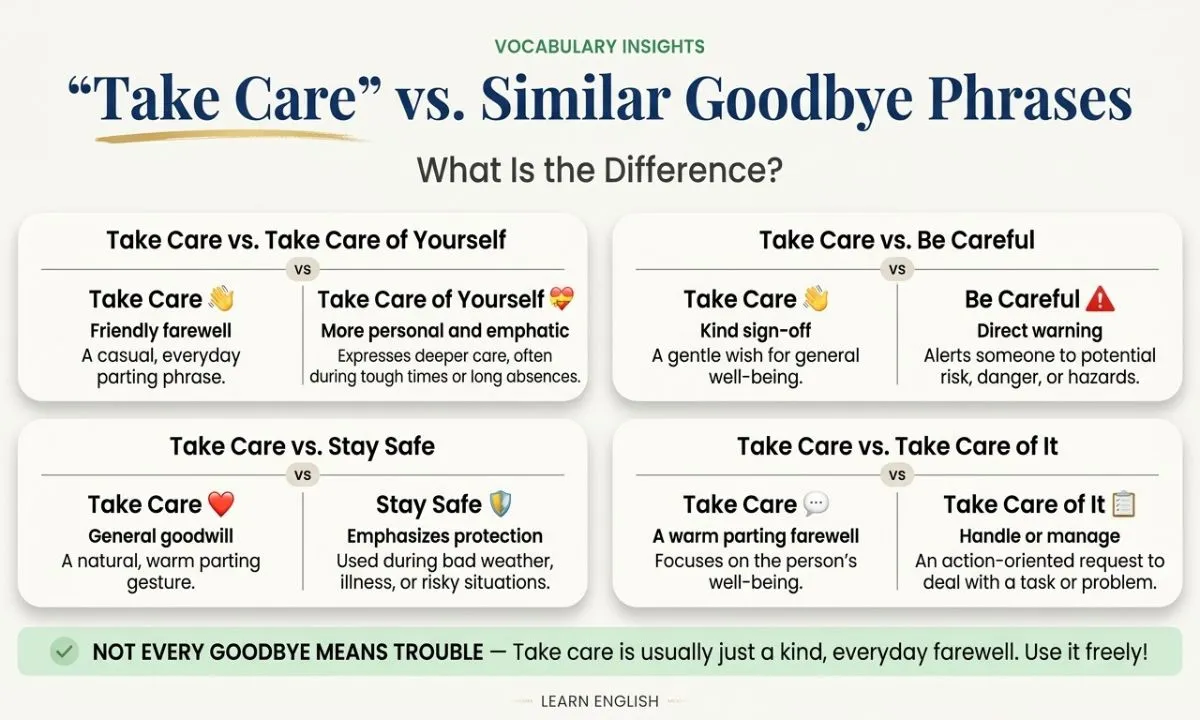
“Take care” vs. “Take care of yourself”: The longer version is more personal and a bit more emphatic.
Example: “You’ve been up all week. Take care of yourself.”
“Take care” vs. “Be careful”: “Be careful” is a direct warning about risk. “Take care” is usually a friendly goodbye.
“Take care” vs. “Stay safe”: “Stay safe” points to danger, weather or illness. Use it when safety is actually in play.
“Take care” vs. “Take care of it”: The second means “handle it,” not “look after yourself.” Don’t mix them up in a sign-off.
One common myth: “take care” always means someone is in trouble. It doesn’t. Most of the time it’s just a kind farewell.
How to Choose the Right Alternative to “Take Care”
Choosing between other ways to say take care comes down to five quick checks.
Audience: Boss, client or friend? The closer you are, the more casual you can go.
Medium: Email leans formal. Texts and voice notes can be loose.
Intent: Goodbye, safety wish, support or thanks? Pick the phrase that does that job.
Situation: Travel, illness, bad news and holidays each have a better fit than a generic “take care.”
Sound check: Read it aloud. If you wouldn’t say it, don’t send it.
Before-and-After Examples of “Take Care” Alternatives
Original: Thanks for the proposal. Take care.
Improved: Thanks for the proposal. Kind regards, Amira.
Why it works: Swaps a casual closing for a polite, professional one.
Original: Bye, take care!
Improved: Bye, get home safe!
Why it works: Names the actual concern, which is the walk home.
Original: I heard about your dad. Take care.
Improved: I heard about your dad. I’m thinking of you, and I’m here if you need anything.
Why it works: Replaces a generic closing with real support.
Original: Safe flight tomorrow. Take care!
Improved: Safe travels tomorrow. Text me when you land!
Why it works: Adds a small, practical action.
Original: See you Monday. Take care.
Improved: See you Monday. Enjoy your weekend!
Why it works: Fits the day and lifts the mood.
Original: Thanks for the update. Take care.
Improved: Thanks for the update. Wishing you a smooth week ahead.
Why it works: Specific and friendly without being too personal.
“Take Care” in Different Languages
Here are common equivalents. Native speakers may prefer different phrases depending on formality, so check with one before using them in important writing.
| Language | Phrase | Pronunciation | Notes |
| Spanish | Cuídate | KWEE-dah-teh | Informal. Use “Cuídese” for formal “you.” |
| French | Prends soin de toi | prahn swan duh twah | Informal. “Prenez soin de vous” is formal or plural. |
| German | Pass auf dich auf | pahss owf dikh owf | Informal. “Mach’s gut” is a common goodbye too. |
| Italian | Abbi cura di te | AB-bee KOO-rah dee teh | Warm and slightly formal in tone. |
| Portuguese | Cuide-se | KWEE-dih-see (Brazil) | Common and polite. |
| Mandarin | 保重 (bǎozhòng) | bao-JONG | Often used for long goodbyes or travel. |
| Japanese | お体に気をつけて (o-karada ni ki o tsukete) | oh-kah-rah-dah nee kee oh tsoo-keh-teh | Literally “be careful of your body.” |
| Arabic | اعتنِ بنفسك (i’tani bi-nafsik) | ee-TAH-nee bee-NAF-sik | Masculine form shown; the feminine form differs. |
| Hindi | अपना ध्यान रखना (apna dhyaan rakhna) | UP-nah DYAAN RUHK-nah | Informal and caring. |
Common Mistakes to Avoid When Using Alternatives to “Take Care”
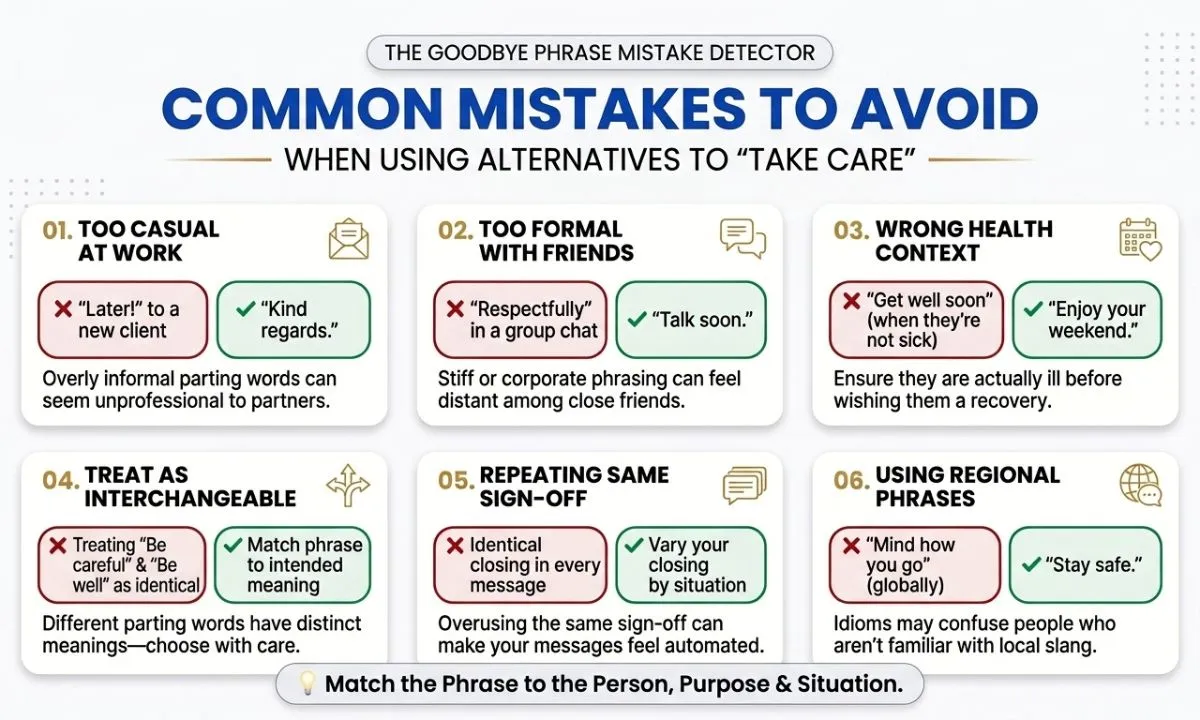
Even good synonyms backfire when they don’t fit. Watch for these slips.
🔴 Going too casual at work. “Later!” to a new client feels abrupt. Try “Kind regards.”
🔴 Being too formal with friends. “Respectfully” in a group chat sounds like a joke. Try “Talk soon.”
🔴 Using a health phrase when health isn’t the topic. “Get well soon” confuses people who aren’t sick. Try “Enjoy your weekend.”
🔴 Assuming every phrase is interchangeable. “Be careful” warns. “Be well” wishes. Read the tip before you swap.
🔴 Repeating the same sign-off every time. Vary it by situation so it still feels meant.
🔴 Choosing a regional phrase for a global audience. “Mind how you go” may puzzle non-British readers. Try “Stay safe.”
Explore More Synonyms Guide
Above Average Synonyms: 70 Better Ways to Say “Above Average” Clearly
Synonyms for Legislature: 70 Clear Words for Better Communication
20+ Primary Synonyms: Other Ways to Say “Primary” With Meaning & Examples
History Synonyms: 22+ Words, Meanings, Examples & How to Use Them
70+ Important Synonyms: Other Ways to Say “Important” With Meaning & Examples
Frequently Asked Questions
What Are the Best Alternatives to “Take Care”?
The best other ways to say take care are “All the best,” “Best wishes” and “Stay safe.” Together they cover most situations. Pick by context: “Kind regards” for work, “Take it easy” for friends, and “Safe travels” for trips.
What Can I Say in a Professional Email Instead of “Take Care”?
Use “Kind regards,” “Best wishes” or “Warm regards.” They’re polite, widely accepted and fit most business settings.
What Is a Simple Alternative to “Take Care”?
“Stay safe” or “All the best” are the simplest swaps. Both are short, natural and understood everywhere.
How Can I Say “Take Care” Casually to Friends?
Try “Take it easy,” “Catch you later” or “Talk soon.” For a more caring tone, say “Get home safe.”
Is “Take Care” Formal or Informal?
You can call that person “uplifting,” “warm,” “upbeat,” or “radiant.” A phrase like “a positive presence” also works.
Can I Use “Take Care” in Business Emails?
Yes, usually, especially with people you already know. With new clients or formal notices, a phrase like “Kind regards” is safer.
Does “Take Care” Imply Someone Is Ill?
No. It’s a general good-bye wish. If you want to mention illness, use something specific, like “Get well soon.”
Which Phrases Are Best for Wishing Someone Safety While Traveling?
“Safe travels,” “Have a safe trip” and “Get home safe” work well. Add “Text me when you land” if you want a practical touch.
How Do I Express Emotional Support Instead of Saying “Take Care”?
Say what you feel: “I’m thinking of you” or “I’m here if you need me.” A specific offer lands better than a generic sign-off.
Conclusion: Choose the Best Way to Say “Take Care” for Every Situation
“Take care” isn’t wrong. It just isn’t always the best fit. Start with the situation, then pick the phrase that matches your relationship and tone. Work email, friend, trip, hard week. Each has a better option. Next time you reach for “take care,” ask what you actually mean, and say that. And if you want more variety, keep going back to these other ways to say take care until a few feel like yours.

1 thought on “Other Ways to Say Take Care: 70 Better Goodbyes for Work and Daily Life”