

English is full of one-letter word pairs that trip up even careful writers, and bellow vs below is one of the trickiest. The two words look almost identical on the page but mean completely different things once you say them out loud. Getting bellow vs below right saves you from an awkward typo in an email, essay, or report.
Below is a common preposition and adverb that points to a lower position, level, or amount. Bellow is a verb and a noun tied to a loud, deep sound, like a shout or an animal’s roar. Most bellow vs below mix-ups come down to one missing or extra “L.”
This guide breaks down the meaning, spelling, grammar, pronunciation, and usage of both words in plain language. You’ll find sentence examples, common mistakes, a short quiz, and answers to frequent questions. By the end, choosing correctly between bellow vs below will feel automatic.
Quick Answer: Bellow vs Below
| Word | Part of Speech | Core Meaning | Example |
| Below | Preposition / Adverb | Lower position, level, or amount | “The valley lies below the mountain.” |
| Bellow | Verb / Noun | To shout loudly / a loud roaring sound | “He bellowed across the field.” |
Bellow Meaning and Definition
What Does “Bellow” Mean?
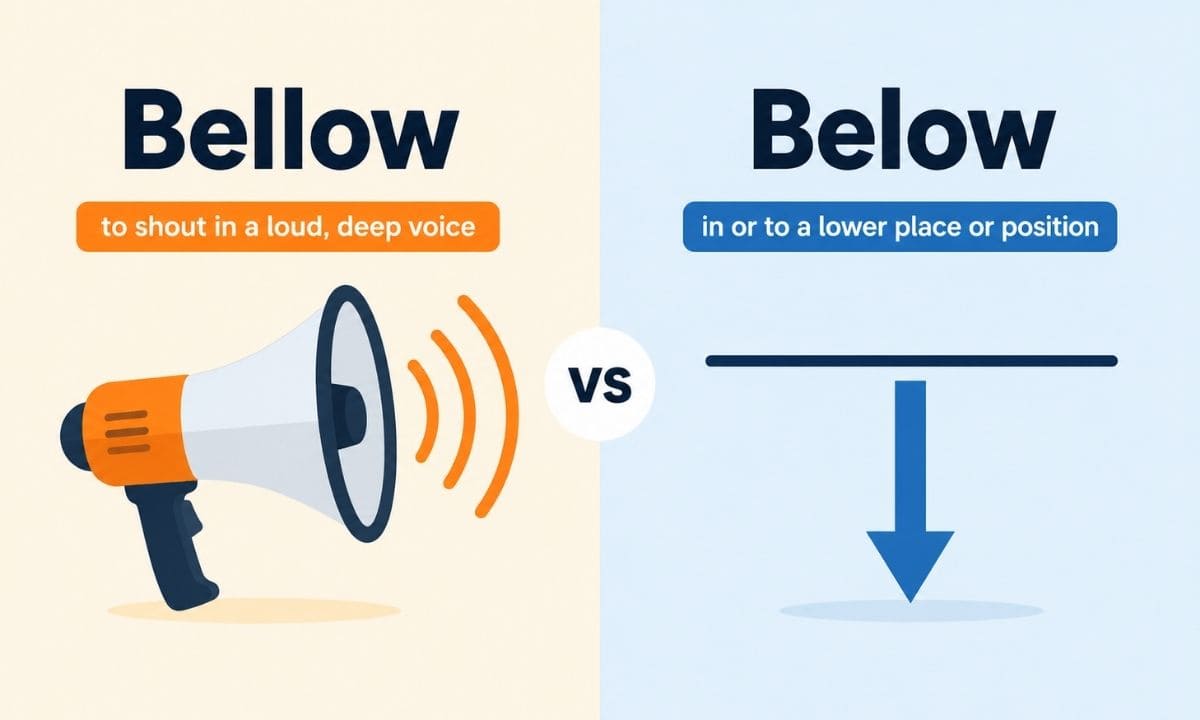
Bellow means to shout or roar in a loud, deep voice, often out of anger, pain, or excitement.
As a noun, a bellow is that same loud sound, think of a bull’s roar or a coach shouting from the sideline.
How to Use “Bellow” in a Sentence
Bellow changes jobs depending on the sentence.
Bellow as a Verb: “The coach bellowed instructions from the sideline.”
Bellow as a Noun: “A deep bellow rolled through the barn.”
Example Sentences With “Bellow”
The sergeant bellowed orders at the new recruits.
A loud bellow echoed through the canyon as the bull charged.
She had to bellow just to be heard over the crowd.
Below – Meaning and Definition
What Does “Below” Mean?
Below describes something in a lower position, rank, level, or amount compared to something else.
It’s the direct opposite of “above.”
How to Use “Below” in a Sentence
Below as an Adverb: “See the chart below for details.”
Below as a preposition: “The fish swam below the surface.”
Example Sentences With “Below”
Temperatures dropped below freezing overnight.
His test score fell below the class average.
The note is printed below the signature line.
Bellow vs Below: The Key Difference

Bellow Refers to a Loud Sound
Bellow is about noise, a shout, roar, or booming voice.
Below Refers to a Lower Position or Level
Below is about location, rank, or amount, and it never involves sound.
Bellow vs Below in Context
| Context | Correct Word | Example |
| Loud sound or shout | Bellow | “He bellowed in frustration.” |
| Lower position or level | Below | “The basement is below the kitchen.” |
The Grammar Rules Behind “Bellow” vs “Below”
When to Use “Bellow”
Use bellow when describing a loud, deep vocal sound, whether as a verb or a noun.
When to Use “Below”
Use below when pointing to a lower place, rank, or number, whether as a preposition or an adverb.
Why They Cannot Be Used Interchangeably
The two words belong to different grammatical categories and carry unrelated meanings. Swapping one for the other changes the sentence’s meaning entirely or makes it grammatically wrong.
Bellow vs Below: Part of Speech
Is “Bellow” a Verb or Noun?
Bellow works as both: a verb (“to bellow”) and a noun (“a loud bellow”).
Is “Below” a Preposition or Adverb?
Below also does double duty: a preposition (“below the table”) and an adverb (“listed below”).
Grammar Examples
| Word | Function | Example Sentence |
| Bellow | Verb | “The lion bellowed at dusk.” |
| Bellow | Noun | “A loud bellow shook the tent.” |
| Below | Preposition | “Sign your name below the line.” |
| Below | Adverb | “Full details are given below.” |
How to Pronounce “Bellow” and “Below”
Pronunciation of “Bellow”
Bellow is pronounced BEL-oh (/ˈbɛloʊ/), with a short “e” sound like in “bell.”
Pronunciation of “Below”
Below is pronounced bih-LOH (/bɪˈloʊ/), with the stress on the second syllable.
If you need exact phonetic detail, check a reliable dictionary such as Merriam-Webster or Cambridge Dictionary.
Pronunciation Difference
The double L in bellow shortens the vowel before it, while below’s single L keeps a softer, more open sound. The two words are not homophones, so listening carefully helps as much as reading carefully.
Bellow vs Below: Spelling Difference
Bellow Has a Double L
Two L’s, two syllables, one loud sound.
Below Has Only One L
Just one L, formed from “be” plus “low.”
Easy Spelling Rule to Remember
Think of the double L in “bellow” as matching a loud “bell” sound. Think of “below” as literally spelling out “be low” being at a lower level.
Bellow vs Below in Everyday Sentences
Examples With “Bellow”
The crowd bellowed with laughter at the comedian’s joke.
A bellow of pain came from the injured player.
Examples With “Below”
The apartment below ours gets more sunlight.
Prices below $50 qualify for free shipping.
Similar Sentence Patterns
Notice how bellow usually follows a person, animal, or crowd as the subject making noise, while below almost always follows a noun describing position, rank, or number.
Common Mistakes With “Bellow” and “Below”
Confusing the meanings using one word while thinking of the other’s definition.
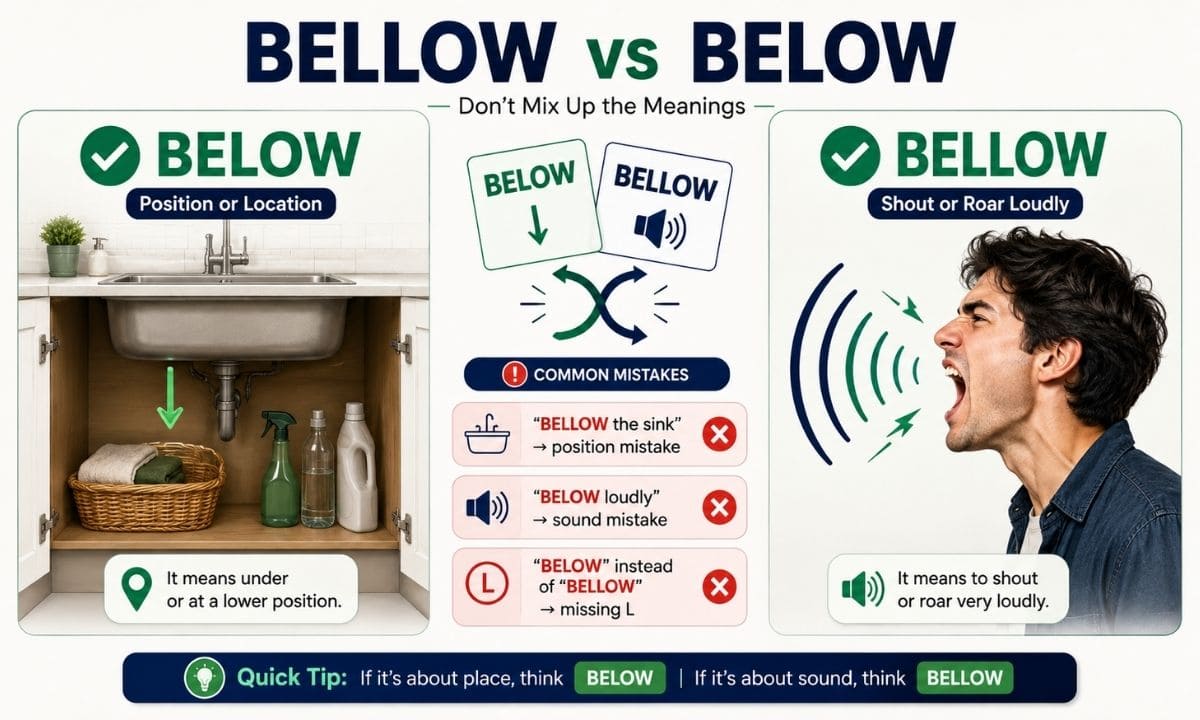
Using “bellow” for position writing “the shelf bellow the sink” instead of “below.”
Using “below” for a loud sound writing “he bellowed in anger” instead of “bellowed.”
Misspelling “bellow” dropping the second L and accidentally writing “below” instead.
Why Do People Confuse “Bellow” and “Below”?
Similar spelling only one letter separates them.
Similar pronunciations both end in the same “-ow” sound.
Confusion over the double L makes it easy to forget which word has it.
Fast typing and typos autocorrect doesn’t always catch the swap.
Context-based confusion writing quickly without checking part of speech.
Explore More Grammar Guides
Stutter vs Studder: Correct Spelling and Meaning Guide in 2026
Anise vs Aniseed: Are They the Same? Find Out the Real Difference
Friend vs Freind: Common Mistake and Correct Usage Explained
Really vs Realy? A Quick Guide to Correct English Spelling (2026)
Volume vs Volumn: 1 Common Mistakes and Correct Usage Explained
Habit vs Habbit: Common Error, Meaning, and Usage Guide
Using vs Useing: Which Spelling Is Correct? Find Out Now
Divide vs Devide: Meaning, Examples, and Spelling Made Easy
Outing vs Outting: Common Mistakes and the Correct Usage Explained
Bellow vs Below: Common Phrases
| Phrase | Meaning |
| Bellow with anger | Shout loudly out of rage |
| Bellow with laughter | Laugh very loudly |
| Below average | Lower than the typical standard |
| Below the surface | Hidden or not immediately obvious |
| Below the line | Outside the main budget or focus |
| Below zero | A temperature under freezing point |
Bellow vs Below: Synonyms and Alternatives
Synonyms for “Bellow”
Roar
Shout
Yell
Holler
Thunder
Synonyms for “Below”
Beneath
Under
Underneath
lower than
Example Sentences
He roared instead of bellowed, but the meaning stayed the same.
The cat hid underneath, well below the porch steps.
Bellow vs Below in Formal and Informal Writing
“Bellow” in Formal Writing
Used sparingly in formal writing, often in narrative or descriptive contexts:
“The executive bellowed his disapproval across the boardroom.”
“Below” in Formal Writing
Common in formal and technical writing:
“Refer to the table below for full results.”
“Bellow” in Informal Writing
Frequently used in casual storytelling and dialogue for emphasis or humor.
“Below” in Informal Writing
Used constantly in everyday speech and text: “Check the link below.”
American vs British English
Is “Bellow” Spelled the Same in Both?
Yes, “bellow” keeps the same spelling in American and British English.
Is “Below” Spelled the Same in Both?
Yes, “below” is also spelled identically in both varieties.
Key Point
Spelling doesn’t change between regions, though pronunciation can shift slightly British speakers often use a more rounded vowel sound than American speakers.
The Origin and Etymology of “Bellow” and “Below”
Where Does “Bellow” Come From?
Bellow traces back to Old English roots connected to loud animal cries, later shaped by Middle English forms describing roaring or shouting.
Where Does “Below” Come From?
Below developed from Middle English, formed by combining “by” and “low,” literally meaning “at a low position.”
How the Words Developed
Over centuries, bellow narrowed to describe loud human or animal sounds, while below settled firmly into describing physical or figurative lower position.
What Dictionaries Say About “Bellow” and “Below”
Dictionary Definition of “Bellow”
“Merriam-Webster defines bellow as a loud, deep cry or roar and records both noun and verb uses.”
Dictionary Definition of “Below”
Dictionaries define below as a term indicating a lower place, rank, or amount, functioning as a preposition or adverb.
Pronunciation and Word Class
Every major dictionary agrees on the two-syllable pronunciation for both words and confirms their differing word classes.
Example Sentences
Dictionary entries typically pair bellow with animal or human shouting, and below with spatial or numerical comparisons.
Word History
Most dictionaries trace both words to Old and Middle English, reflecting how naturally they entered everyday speech.
Bellow vs Below at a Glance
| Feature | Bellow | Below |
| Meaning | Loud shout or roar | Lower position or level |
| Word Class | Verb / Noun | Preposition / Adverb |
| Spelling | Double L | Single L |
| Pronunciation | BEL-oh | bih-LOH |
| Opposite of | Whisper | Above |
Bellow vs Below: Quick Proofreading Tip
Check the Meaning First
Ask yourself: does this sentence involve a loud sound, or a lower position?
Remember the Double L in “Bellow”
Two L’s for a loud, booming sound.
Think “Lower Level” for “Below”
One L, and it literally spells “be low.”
Quick Test I Created
Bellow vs Below Quiz
Test yourself with these quick questions before checking the answer key at the end.
- Fill in the blank: “The lion let out a loud ___.” (bellow / below)
- Fill in the blank: “The keys are ___ the mat.” (bellow / below)
- Which word is a preposition bellow or below?
- Which word can be a noun meaning “a loud roar”?
- True or False: Bellow and below are homophones.
- Which word has a double L?
- “Temperatures fell ___ zero.” Choose the correct word.
- “He ___ed with rage.” Choose the correct word.
- Which word means the opposite of “above”?
- Which word functions as a verb?
- “See the notes ___.” Choose the correct word.
- Which word describes sound rather than position?
Answer Key: 1. bellow, 2. below, 3. below, 4. bellow, 5. False, 6. bellow, 7. below, 8. bellow, 9. below, 10. bellow, 11. below, 12. bellow
Frequently Asked Questions
Is “bellow” or “below” correct?
Both are correct words, but they mean different things. Bellow means to shout loudly; below means in a lower position.
What is the difference between bellow and below?
Bellow refers to a loud sound or shout, while below refers to a lower position, level, or amount.
What does “bellow” mean?
Bellow means to shout or roar loudly, or the loud sound itself.
What does “below” mean?
Below means in a lower position, rank, or amount compared to something else.
Is “bellow” a noun or a verb?
Bellow can be both a noun and a verb, depending on the sentence.
Is “below” a noun or a verb?
Below is mainly a preposition or adverb, not a noun or verb.
How do you pronounce “bellow”?
Bellow is pronounced BEL-oh, with a short “e” sound.
How do you pronounce “below”?
Below is pronounced bih-LOH, with stress on the second syllable.
Why does “bellow” have two Ls?
The double L reflects its Old English roots tied to loud, roaring sounds.
Can “bellow” and “below” be used interchangeably?
No, they have completely different meanings and grammatical functions, so they cannot be swapped.
What is another word for “bellow”?
Common synonyms include roar, shout, yell, and holler.
What is another word for “below”?
Common synonyms include beneath, under, and underneath.
Conclusion
Bellow vs below comes down to sound versus position. Bellow describes a loud shout or roar and works as a verb or noun, while below points to a lower place, level, or amount and works as a preposition or adverb. One extra letter completely changes the meaning.
Remembering the difference gets easier with a simple trick: picture the double L in “bellow” as a loud bell, and read “below” as “be low.” These small mental cues make bellow vs below far less confusing during fast writing or proofreading.
Whether you’re drafting an email, an essay, or a story, checking the meaning and part of speech before you type takes just a second. Keep this guide handy, and choosing correctly between bellow vs below will soon become second nature.
