

Ever typed “volumn” and then paused, wondering if that’s actually right? You’re not alone. This is one of the most common spelling mix-ups in English, and it trips up native speakers just as often as learners.
Here’s the short version: volume vs volumn isn’t really a debate. Only one of these is a real word.
So why does “volumn” show up so often? Blame pattern matching. English has a whole cluster of words that end in a silent “n” tacked onto “m” think column, autumn, solemn, and hymn. Your brain sees “volu-m” and instinctively reaches for that familiar “-mn” ending, even though volume doesn’t belong to that family at all. It’s a completely reasonable guess, just not the correct one.
This guide breaks down why the mistake happens, how to pronounce the word correctly, and where you’ll see “volume” used in real life from music players to math class to your favorite book series.
Quick Answer: Volume vs Volumn
Volume is the correct spelling.
Volumn is a misspelling that doesn’t appear in any standard English dictionary.
Whether you’re talking about sound, space, quantity, or a book, the word you want is always “volume.”
Volume vs Volumn: What Is the Difference?
There isn’t a real difference in meaning, because only one of these words actually exists.
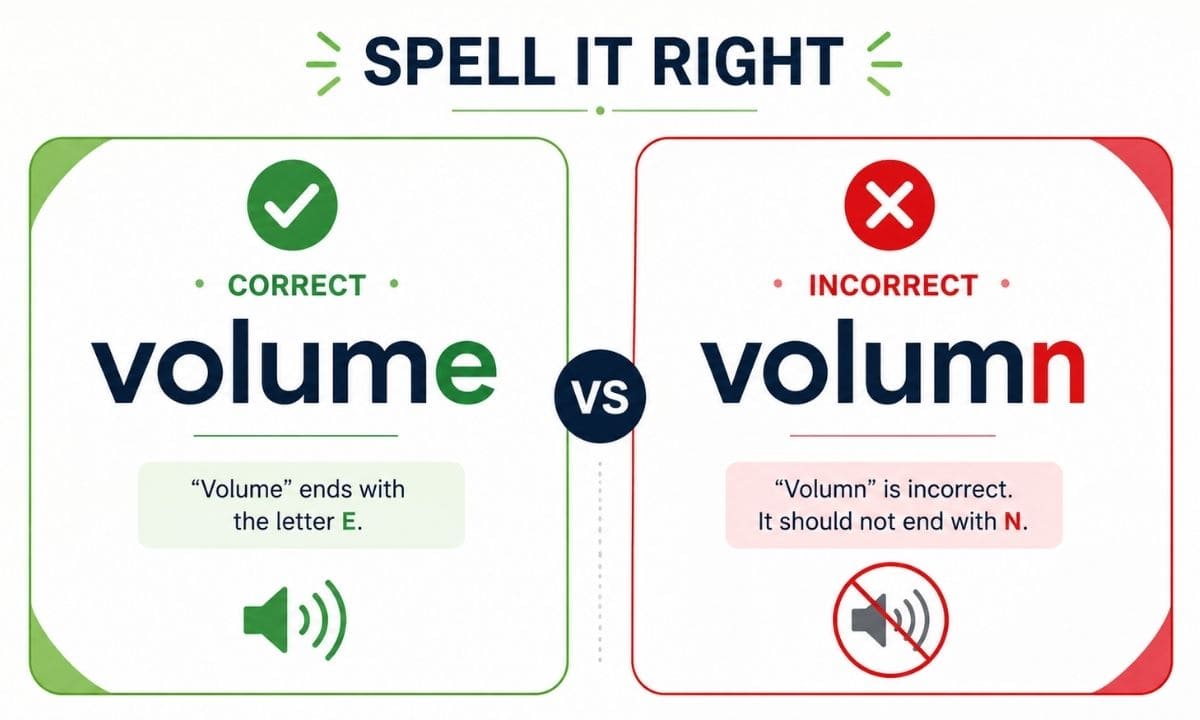
Volume:
Volume is a noun (and occasionally a verb) covering four main senses: physical space, sound level, general amount, and a book. More on each below.
Volumn:
Volumn” has no entry in Merriam-Webster, Oxford, Cambridge, or Collin.
It’s a spelling error that happens when people write the word the way it sounds rather than the way it’s spelled.
Examples of Volume in Sentences
✅Turn up the volume so I can barely hear the song.
✅The recipe calls for one cup of liquid by volume.
✅Trading volume on the stock market spiked this morning.
✅She’s reading the second volume of the trilogy.
✅The gym has seen a higher volume of new members this year.
Why Is “Volume” Sometimes Misspelled as “Volumn”?
Pronunciation Can Cause Confusion
When people say “volume” quickly, the final “e” almost disappears, which pushes some writers toward an “-mn” spelling instead, similar to “autumn” or “column.”
The “-ume” Ending Is Easy to Forget
English has plenty of “-ume” words:
costume, perfume, assume but since they aren’t used daily, the pattern doesn’t always stick.
Typing and Autocorrect Errors
Fast typing is a big culprit.
A rushed sentence or a phone keyboard can swap letters easily, and not every spellchecker flags “volumn” as wrong.
Confusion With Similar-Looking Words
Words like “column” and “autumn” end in a silent “-mn” sound. Since “volume” ends with a similarly soft sound, the brain borrows that pattern by mistake.
How to Pronounce Volume
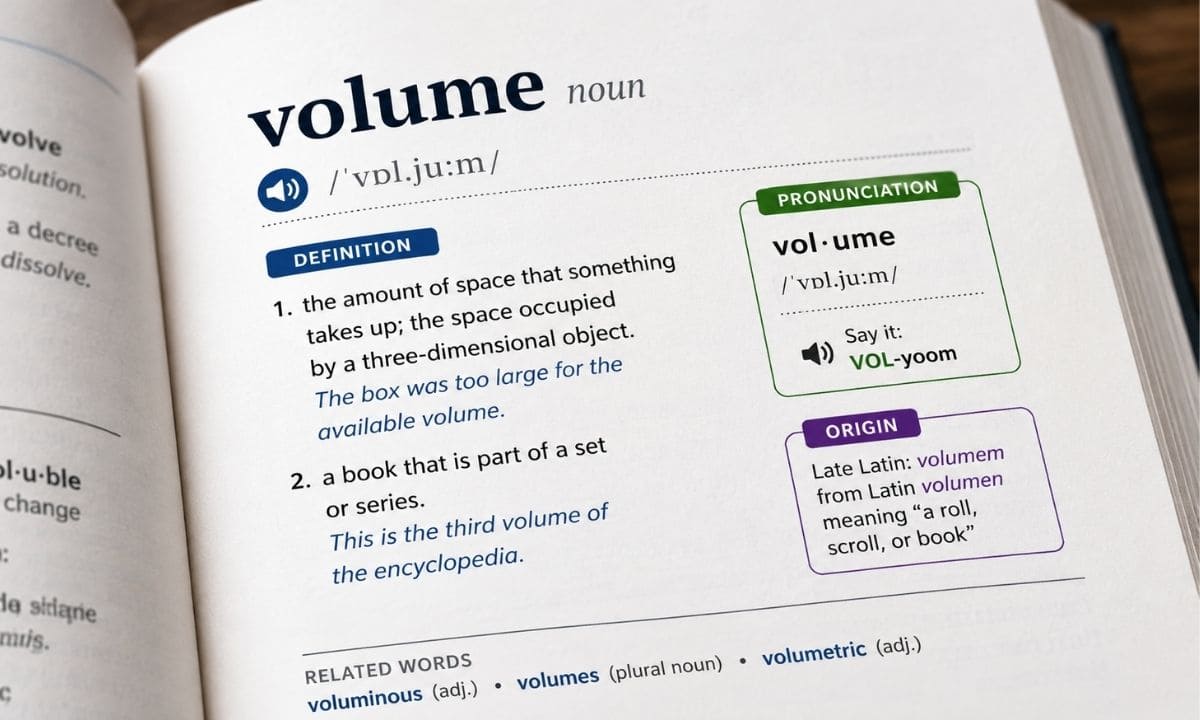
Volume Pronunciation
Volume is pronounced VOL-yoom,
or in IPA: /ˈvɒl.juːm/ (British) and /ˈvɑːl.juːm/ (American).
Pronunciation Tip
The final “e” is silent, but it still matters. It’s what makes the “u” say its long sound (“yoom”) instead of a short one.
Drop the “e” in writing, and you lose the reason the word sounds the way it does.
What Does “Volume” Mean?
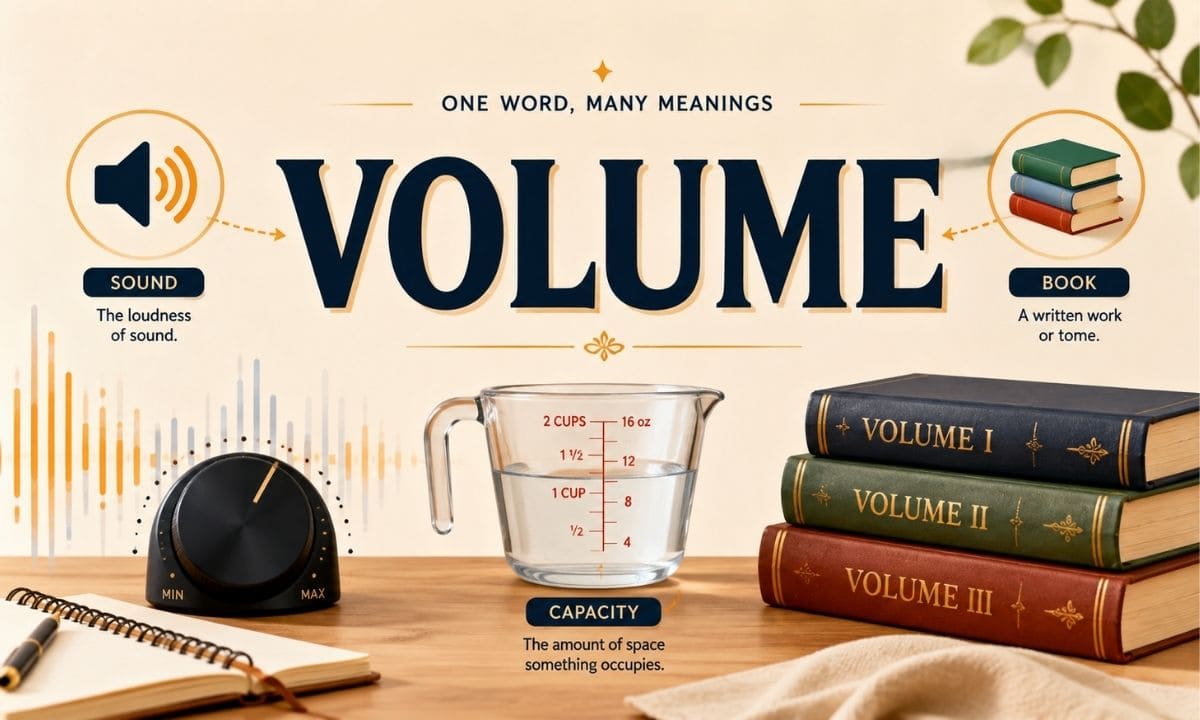
Volume as the Amount of Space
In math and science, volume measures three-dimensional space, usually in liters or cubic meters.
The volume of the box is 24 cubic feet.
Volume as the Level of Sound
The meaning most people reach for first is how loud or quiet something is.
Please lower the volume during the call.
Volume as the Amount or Quantity of Something
Volume also describes a general amount, especially in business and data.
Call volume doubled during the sale.
Volume as a Book or Publication
A volume can be a single book, or one within a larger set.
This encyclopedia set has twelve volumes.
Is “Volume” a Noun or a Verb?
Noun
Most of the time, “volume” works as a noun naming a quantity, a sound level, or a book, as in “The volume of traffic increases every summer.
Verb
” It’s rarely used as a verb (meaning to grow in bulk or amount), and mostly in technical writing, as in “Sales volumed sharply after the campaign launched.”
The Origin and Etymology of “Volume”
The word traces back to the Latin volumen, meaning “a roll” or “something rolled up.” Ancient texts were written on scrolls, and each rolled scroll was called a volumen.
As scrolls gave way to bound books, “volume” shifted to mean a single book and from there, English speakers stretched the word to describe amount, space, and loudness too.
Easy Spelling Rule to Remember “Volume”
If a word sounds like it ends in “-oom” but is spelled with “u,” it almost always ends in “-ume,” not “-umn.”
Examples
Costume
Perfume
Assume
Resume
Volume
Volume vs Volumn at a Glance
| Feature | Volume | Volumn |
| Correct spelling | ✅ Yes | ❌ No |
| Found in dictionaries | ✅ Yes | ❌ No |
| Used in formal writing | ✅ Yes | ❌ Never |
| Common meaning | Sound, space, quantity, book | None (misspelling) |
Formal vs. Informal Writing: Volume
Is “Volume” Used in Formal Writing?
Yes, and confidently so.
It appears in academic papers, business reports, legal documents, and everyday professional emails without issue.
Is “Volumn” Ever Acceptable?
No. There’s no context casual texting included where “volumn” is the correct choice.
Common Situations Where “Volume” Is Used
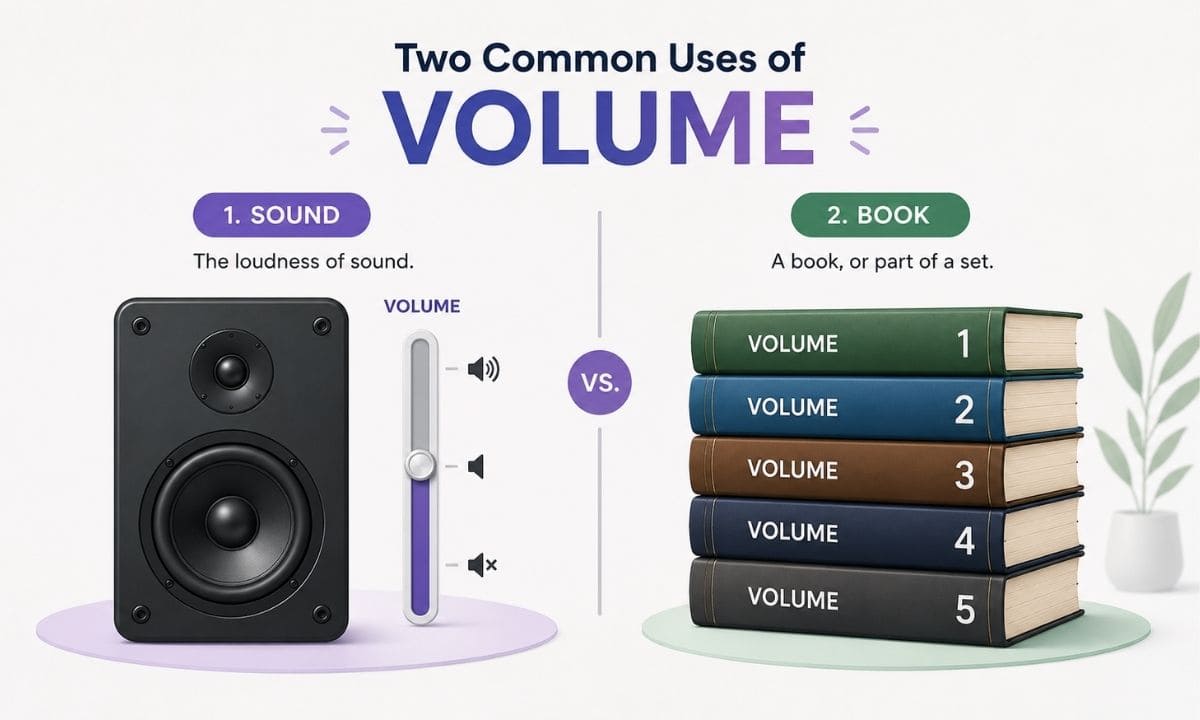
Audio and music:
Adjusting how loud a speaker, TV, or instrument sounds.
Mathematics and science:
Calculating the space inside a shape, container, or substance.
Books and publications:
Naming a single book within a series or collection.
Everyday conversation:
Describing amounts, like traffic, crowd size, or workload.
Business and data:
Tracking sales figures, website traffic, or trading activity.
Explore More Grammar Guides
Stutter vs Studder: Correct Spelling and Meaning Guide in 2026
Anise vs Aniseed: Are They the Same? Find Out the Real Difference
Friend vs Freind: Common Mistake and Correct Usage Explained
Really vs Realy? A Quick Guide to Correct English Spelling (2026)
Gauge Vs Guage: Quick Grammar Guide With Easy Examples
Habit vs Habbit: Common Error, Meaning, and Usage Guide
WAlways Use “Volume” Never Use “Volumn”
Whether you’re talking about sound, space, quantity, or a book, “volume” is always the right choice.
There’s no exception;
it’s not a regional spelling, a shorthand, or an accepted variant. It’s simply incorrect in every form of English.
Easy Tip to Remember the Correct Spelling
Think of the phrase “volume up
.” The word “up” rhymes with the “ume” sound at the end, a small trick that reinforces the correct ending every time you use it.
Volume vs Volumn in Everyday Sentences
Sound: The volume on my headphones is too high.
Space: This container has a volume of two liters.
Books: I just finished volume three of the series.
Quantity: Our email volume dropped over the holidays.
Mathematics: Find the volume of the cylinder using the formula.
Common Mistakes With Volume
Mistake 1: Writing “Volumn” Instead of “Volume”
The most frequent error, usually caused by how the word sounds when spoken.
Mistake 2: Omitting the Final “e”
Writing “volum” drops the letter that shapes the word’s pronunciation.
Mistake 3: Confusing Spelling With Pronunciation
Because the final “e” is silent, some writers assume it isn’t needed but silent letters still belong in the spelling.
Mistake 4: Assuming “Volumn” Is an Informal Variant
Some think “volumn” is a casual shortcut. It isn’t a straightforward error, not an accepted alternative.
Common Phrases With “Volume”
Turn up the volume
Turn down the volume
Volume of a sphere
High volume
Low volume
Volume one
Memory Tricks to Remember the Correct Spelling

Remember the “-ume” ending is the same pattern as costume and perfume.
Break the word into syllables: vol-ume.
Connect it with “volume up” , a phrase you already know by heart.
Write it three times in a row when practicing spelling.
Use it in a sentence to build muscle memory for the correct form.
Synonyms and Alternatives for “Volume”
| Meaning | Synonyms |
| Sound level | Loudness, intensity, amplification |
| Amount or quantity | Amount, bulk, mass, quantity |
| Physical space | Capacity, size, dimensions |
Opposite Ideas and Related Terms
Low volume means quiet or small in amount;
High volume means loud or large in amount,
The same word works in both directions, depending on context.
You can “increase the volume” (louder or bigger) or “decrease the volume” (quieter or smaller), and both are standard, correct usages.
American vs British English: Volume vs Volumn
United States
American English uses “volume” exclusively, in every context sound, space, books, and data.
United Kingdom
British English also uses “volume” exclusively there’s no regional variant that supports “volumn.” No English-speaking country recognizes it as correct; this isn’t a British-vs-American spelling split, it’s simply a typo everywhere.
Dictionary-Style Word Details
| Detail | Information |
| Word class | Noun (also used as a verb) |
| Pronunciation | /ˈvɒl.juːm/ (UK), /ˈvɑːl.juːm/ (US) |
| Core definitions | Space occupied, sound level, amount, a book |
| Synonyms | Loudness, capacity, quantity, bulk |
| Example sentence | The volume of the room echoed with music. |
| Word history | From Latin volumen (“a roll”), via Old French volume |
Dictionary Evidence for “Volume”
Merriam-Webster, Oxford, Cambridge, and Collins all list “volume” as a standard entry with multiple senses, matching pronunciation, and shared Latin roots.
None of them list “volumn” as an alternate or accepted spelling searching for it either returns no results or redirects straight to “volume.”
Quick Proofreading Tip for “Volume”
Before submitting any document, use your editor’s find-and-replace tool to search for “volumn.” If it appears anywhere, replace it with “volume” with no exceptions needed.
Quick Test I Created
Volume vs Volumn Quiz
Answers follow the questions.
Correct spelling: “volume” or “volumn”?
True/False: “Volumn” is in Merriam-Webster.
Latin root word of “volume”?
Fill in the blank: Turn ___ the volume.
Correct sentence: “The tank’s volumn is 10 liters” or “…volume is 10 liters”?
Most common part of speech for “volume”?
True/False: “Volumn” is accepted British spelling.
What does the silent final “e” affect?
Same “-ume” pattern as “volume”: costume or column?
“High volume” in business means what?
True/False: “Volume” can mean a single book.
Plural of “volume”?
Answer Key: 1. Volume 2. False 3. Volumen 4. Up 5. Volume 6. Noun 7. False 8. Pronunciation (“oo” sound) 9. Costume 10. A large amount of activity 11. True 12. Volumes
Frequently Asked Questions
Is “volume” or “volumn” correct?
“Volume” is correct. “Volumn” is a misspelling with no dictionary support.
Is “volumn” a word?
No, it isn’t recognized in any standard English dictionary.
Why do people spell volume as volumn?
Mostly because of pronunciation habits and confusion with similar-sounding words like “column” and “autumn.”
How do you spell volume correctly?
V-O-L-U-M-E remembers the silent “e” at the end.
How do you pronounce volume?
It’s pronounced VOL-yoom, or /ˈvɑːl.juːm/ in American English.
What does volume mean?
It can mean loudness, physical space, total quantity, or a single book in a series.
Is volume the same in American and British English?
Yes, the spelling and core meaning are identical in both varieties of English.
What are the different meanings of volume?
Sound level, physical space, amount of something, and a book within a set are the four main meanings.
Can “volumn” ever be used in casual writing?
Not even in texts or social media, “volume” is the only correct spelling.
Does spellcheck always catch “volumn”?
Not always, especially in fast typing or on mobile keyboards, so manual proofreading still helps.
Conclusion
The takeaway is simple: volume is correct, and volumn isn’t a real word in any form of English. The confusion usually comes down to how the word sounds when spoken, but connecting the “-ume” ending to familiar words like costume and perfume makes the correct spelling stick. Whether you’re adjusting the sound, measuring a container, tracking sales figures, or picking up the next book in a series, “volume” is always the word you want.

1 thought on “Volume vs Volumn: 1 Common Mistakes and Correct Usage Explained”