

Repeating the same word over and over flattens even the most honest writing. If you keep typing “struggle” in every sentence about a hard project or a rough week, the writing starts to feel stiff instead of real.
That’s where struggle synonyms come in handy. Whether you’re writing a resume, a personal essay, or just texting a friend, swapping “struggle” for a more precise word makes your point land harder. This guide covers 25+ struggle synonyms, sorted by meaning and tone, so you can pick the right struggle synonym every time.
By the end, you’ll know which struggle synonyms fit formal writing, which sound casual, and which are best left out of a job application.
Quick Answer
The best general-purpose struggle synonyms are challenge, difficulty, effort, and hardship.
For formal or professional writing, use challenge, adversity, or obstacle.
For emotional or personal struggles, hardship, ordeal, or setback tend to fit best.
What Does “Struggle” Mean?
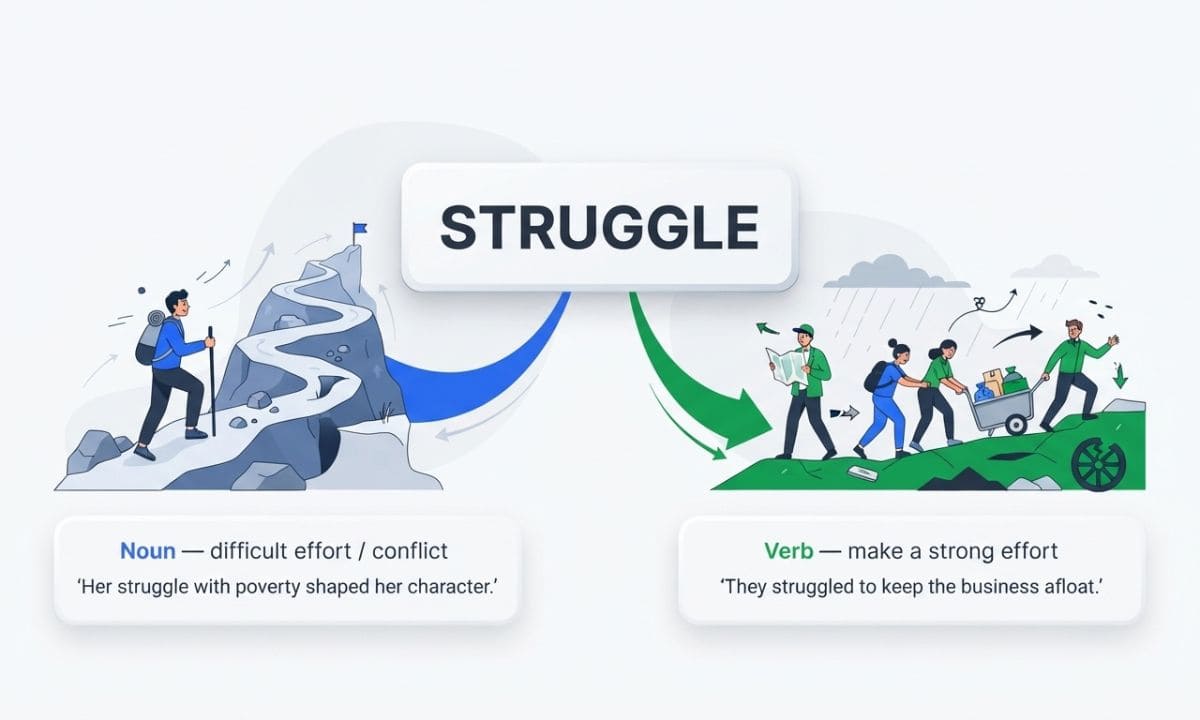
“Struggle” can work as either a noun or a verb, and the meaning shifts slightly depending on which one you’re using.
Struggle as a Noun
As a noun, struggle refers to a hard or prolonged effort, or a conflict between two forces: “Her struggle to finish the degree took five years.”
Struggle as a Verb
As a verb, struggle means to make a strong effort under difficult conditions: “The team struggled with a shrinking budget.”
Best Struggle Synonyms at a Glance
Here’s a quick snapshot before we dig into the full list of struggle synonyms.
| Synonym | Best Used For | Tone |
| Challenge | General difficulty, work tasks | Neutral / Professional |
| Hardship | Financial or life difficulty | Formal / Serious |
| Effort | Physical or mental exertion | Neutral |
| Adversity | Serious misfortune | Formal / Literary |
| Grapple | Wrestling with a problem | Neutral |
| Cope | Managing a hard situation | Neutral |
| Persevere | Continuing despite difficulty | Formal / Motivational |
| Battle | Fighting against something | Dramatic / Emotional |
25+ Struggle Synonyms and Their Meanings
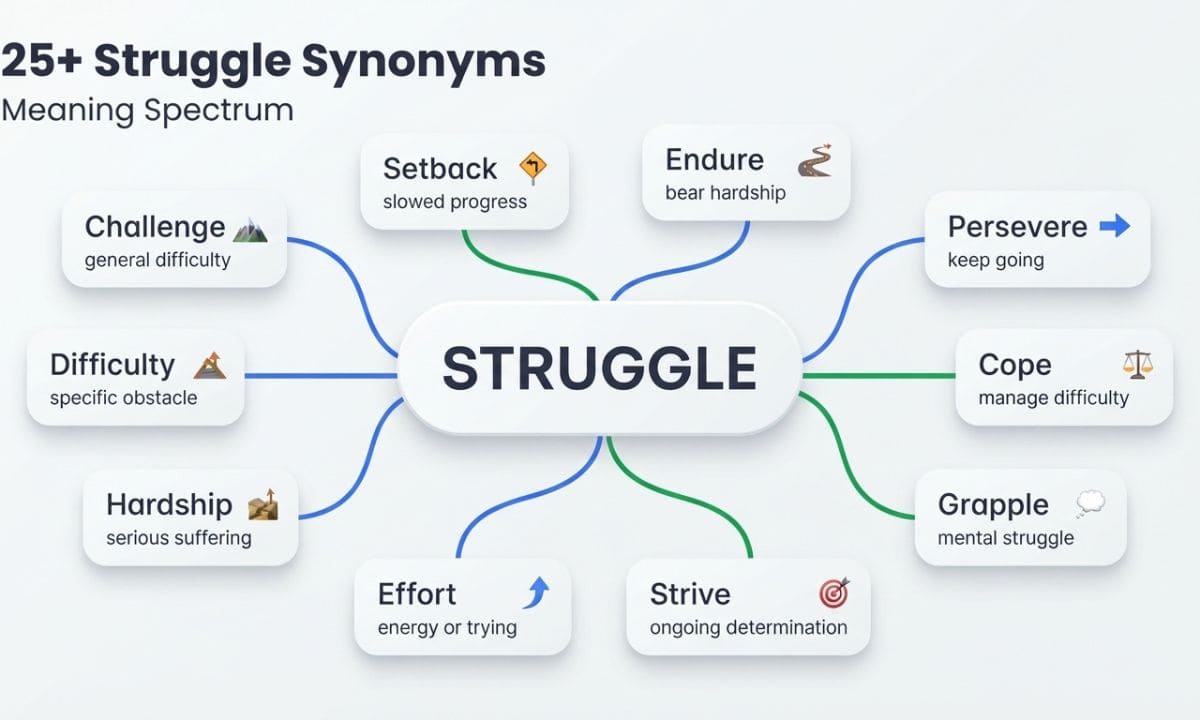
Below is a detailed breakdown of struggle synonyms: what each one means, when to use it, and how it sounds in a real sentence. Use this as a reference whenever “struggle” feels too repetitive or too vague for what you’re trying to say.
Challenge
Meaning:
A task or situation that tests your ability or resolve.
Best for:
General difficulty, work tasks, everyday writing. Challenge is one of the safest replacements for struggle when you want a neutral, professional tone. It tests you without sounding negative or dramatic.
Examples:
- “Learning a new language was a real challenge.”
- “The team faced a challenge meeting the deadline.”
- “Every job comes with its own set of challenges.”
Usage tip:
Use challenges when the situation tests you but doesn’t overwhelm you.
Difficulty
Meaning:
An obstacle or problem that makes something hard to do.
Best for:
Naming a specific obstacle rather than an ongoing experience. Difficulty points to the obstacle itself, not the emotional weight of dealing with it. It’s a plain, factual word.
Examples:
- “She had difficulty reading the small print.”
- “There was some difficulty getting the visa approved.”
- “He explained the difficulty of the assignment.”
Usage tip:
Use difficulty to name the obstacle without adding emotional tone.
Hardship
Meaning:
Severe suffering or difficult circumstances, often financial or physical.
Best for:
Serious life circumstances, formal or reflective writing. Hardship carries real emotional weight, so save it for situations that genuinely involve suffering.
Examples:
- “The family endured years of financial hardship.”
- “War brought hardship to the entire region.”
- “He spoke about the hardship of losing his job.”
Usage tip:
Avoid hardship for small, everyday inconveniences. It can sound exaggerated.
Adversity
Meaning:
Serious misfortune or difficulty.
Best for:
Formal essays, speeches, literary writing. Adversity is a more elevated word than struggle, often used to describe overcoming serious misfortune.
Examples:
- “She showed strength in the face of adversity.”
- “His success came despite early adversity.”
- “They rebuilt their lives after adversity struck.”
Usage tip:
Use adversity in formal or motivational contexts, not casual conversation.
Effort
Meaning:
Physical or mental energy applied to accomplish something.
Best for:
Describing exertion without implying failure. Effort is neutral; it highlights the act of trying rather than the pain of struggling.
Examples:
- “She put a lot of effort into the presentation.”
- “It took real effort to finish the marathon.”
- “His effort didn’t go unnoticed.”
Usage tip:
Use effort to emphasize trying hard, not the difficulty itself.
Endeavor
Meaning:
A serious attempt or undertaking.
Best for:
Formal or business writing. Endeavor sounds more polished than struggle and works well in professional or academic contexts.
Examples:
- “The company’s latest endeavor is expanding overseas.”
- “He endeavored to finish the project on time.”
- “Their endeavor to save the old building succeeded.”
Usage tip:
Use endeavor for deliberate, purposeful attempts, not accidental difficulty.
Strive
Meaning:
To make great effort to achieve something over time.
Best for:
Describing ongoing ambition or determination. Strive implies sustained effort toward a goal rather than a single hard moment.
Examples:
- “She strives to improve every day.”
- “They strive for excellence in everything they do.”
- “He strove to keep his promise.”
Usage tip:
Use strive when the effort is long-term and goal-focused.
Toil
Meaning:
Long, exhausting work.
Best for:
Literary or descriptive writing about hard labor. Toil has an old-fashioned, almost poetic quality, often describing manual or exhausting work.
Examples:
- “Farmers toiled in the fields from dawn to dusk.”
- “Years of toil finally paid off.”
- “He toiled over the manuscript for months.”
Usage tip:
Avoid toil in modern business writing; it can sound overly dramatic.
Labor
Meaning:
Hard physical or mental work.
Best for:
General descriptions of work or effort. Labor emphasizes the work itself, often physical, rather than the emotional difficulty.
Examples:
- “The labor of building the house took months.”
- “She labored over the report late into the night.”
- “Their labor finally produced results.”
Usage tip:
Use labor when describing sustained, effortful work.
Grapple
Meaning:
To struggle to understand, control, or deal with something.
Best for:
Mental or abstract problems. Grapple works well for describing the process of wrestling with an idea, decision, or difficult topic.
Examples:
- “Scientists are grappling with the new data.”
- “She grappled with the decision for weeks.”
- “The company grappled with rising costs.”
Usage tip:
Use grapple for mental or conceptual struggles, not physical ones.
Wrestle
Meaning:
To struggle physically or mentally with an issue.
Best for:
Personal or emotional struggles. Wrestle suggests an internal back-and-forth, often used for emotional or moral dilemmas.
Examples:
- “He wrestled with his conscience.”
- “She wrestled with the decision to move.”
- “The team wrestled with a tough call.”
Usage tip:
Use wrestling for internal conflict, not external tasks.
Cope
Meaning:
To manage a difficult situation successfully.
Best for:
Emotional resilience, everyday conversation. Cope focuses on managing a hard situation, not necessarily solving it.
Examples:
- “She’s learning to cope with stress.”
- “He copes well under pressure.”
- “They coped with the loss together.”
Usage tip:
Use cope when the goal is managing, not overcoming, the difficulty.
Persevere
Meaning:
To continue trying despite difficulty or delay.
Best for:
Motivational or reflective writing. Persevere shifts the focus from the difficulty itself to the determination to keep going.
Examples:
- “She persevered despite repeated setbacks.”
- “He persevered through years of rejection.”
- “They persevered until the project succeeded.”
Usage tip:
Use persevere to highlight resilience rather than hardship.
Persist
Meaning:
To continue firmly despite opposition or difficulty.
Best for:
Determination in the face of obstacles. Persistence is similar to perseverance but slightly more neutral and common in everyday use.
Examples:
- “The rumors persisted for weeks.”
- “She persisted with her plan despite criticism.”
- “He persisted until he got an answer.”
Usage tip:
Use persistence when something continues despite resistance.
Endure
Meaning:
To bear something painful or difficult without giving up.
Best for:
Serious, often prolonged hardship. Endure carries more weight than cope, implying patience through real pain.
Examples:
- “They endured harsh winters without heating.”
- “She endured months of chemotherapy.”
- “The community endured the storm’s aftermath.”
Usage tip:
Use endure for serious, often long-lasting difficulty.
Battle
Meaning:
To fight hard against something.
Best for:
Dramatic or emotional writing. Battle adds intensity, often used for illness, addiction, or major life challenges.
Examples:
- “She battled cancer for two years.”
- “He battled his own doubts before the game.”
- “The company battled falling sales.”
Usage tip:
Use battle for serious, high-stakes struggles, not minor tasks.
Fight
Meaning:
To resist or oppose something with effort or determination.
Best for:
Casual or motivational contexts. Fight is more casual than battle but still conveys strong effort and resistance.
Examples:
- “She fought to keep her job.”
- “He fights for what he believes in.”
- “They fought through the tough season.”
Usage tip:
Use fight for active, determined resistance.
Conflict
Meaning:
A clash or disagreement between opposing sides.
Best for:
Describing tension between two parties. Conflict specifically requires opposition; it doesn’t work for solo struggles.
Examples:
- “There was conflict between the two departments.”
- “Their conflict lasted for years.”
- “The conflict was resolved through mediation.”
Usage tip:
Only use conflict when two sides are genuinely opposing each other.
Contend
Meaning:
To compete with or deal with a problem.
Best for:
Formal writing about handling challenges. Contend suggests dealing with a difficult situation, often competitively.
Examples:
- “She had to contend with a heavy workload.”
- “The team contended with bad weather.”
- “He contends with criticism regularly.”
Usage tip:
Use contend when describing dealing with an ongoing problem.
Strain
Meaning:
Great physical or mental effort or pressure.
Best for:
Describing pressure or tension. Strain highlights the pressure of an effort, often implying it’s close to a breaking point.
Examples:
- “The strain of the deadline was obvious.”
- “Years of strain took a toll on their marriage.”
- “He felt the strain of overwork.”
Usage tip:
Use strain to emphasize pressure rather than the task itself.
Flounder
Meaning:
To struggle helplessly or clumsily.
Best for:
Casual, conversational writing. Flounder implies a lack of control, often used for situations where progress feels impossible.
Examples:
- “The new employee floundered without guidance.”
- “The company floundered after losing its main client.”
- “She floundered through the interview.”
Usage tip:
Use flounder to show helplessness, not just difficulty.
Fumble
Meaning:
To handle something awkwardly or clumsily under pressure.
Best for:
Informal storytelling. Fumble suggests a momentary lapse rather than an ongoing struggle.
Examples:
- “He fumbled his words during the speech.”
- “She fumbled with the keys in the dark.”
- “The player fumbled the ball.”
Usage tip:
Use fumble for brief, clumsy moments, not long-term difficulty.
Trial
Meaning:
A difficult experience that tests endurance or character.
Best for:
Formal or reflective writing. Trial suggests a testing experience, often one of several difficult events over time.
Examples:
- “The trials of parenthood are well known.”
- “She faced many trials before succeeding.”
- “Their trial by fire made them stronger.”
Usage tip:
Use trial for experiences that test character over time.
Ordeal
Meaning:
A painful or difficult experience.
Best for:
Serious, often traumatic situations. Ordeal is heavier than trial, usually describing something distressing or prolonged.
Examples:
- “The hostages’ ordeal lasted three days.”
- “Surgery was a painful ordeal for him.”
- “The whole process was an ordeal.”
Usage tip:
Reserve ordeal for genuinely difficult or traumatic experiences.
Setback
Meaning:
A problem that slows down or reverses progress.
Best for:
Describing temporary obstacles. Setback is neutral and practical, often used in business or project updates.
Examples:
- “The delay was a minor setback.”
- “They faced several setbacks before launch.”
- “A setback in funding delayed the project.”
Usage tip:
Use setbacks for temporary problems, not ongoing hardship.
Plight
Meaning:
A difficult or unfortunate situation.
Best for:
Describing someone else’s hardship with empathy. Plight is often used to describe the situation of others, especially in news or advocacy writing.
Examples:
- “The plight of refugees drew global attention.”
- “Her plight moved the entire community.”
- “The charity highlighted the plight of stray animals.”
Usage tip:
Use plight when describing another person’s or group’s hardship, not your own.
Attempt
Meaning:
An effort to do something, with an uncertain outcome.
Best for:
Describing trying without guaranteed success. Attempt is neutral and focuses on the act of trying rather than the difficulty involved.
Examples:
- “He made an attempt to fix the car himself.”
- “Her first attempt failed, but she tried again.”
- “They attempted to reach the summit.”
Usage tip:
Use attempt when the outcome is uncertain, not guaranteed.
Struggle Synonyms by Context
Not every synonym fits every situation. Here’s how to sort the list by what you’re actually describing.
For General Difficulty
No deep emotional weight, just something hard to do.
Challenge
Difficulty
Strain
Fumble
For Hard Life Circumstances
Financial trouble, illness, loss, or long-term hardship.
Hardship
Adversity
Ordeal
Plight
Setback
For Making an Effort
Focus is on trying hard, not necessarily failing.
Effort
Endeavor
Strive
Toil
Labor
Attempt
For Conflict or Opposition
Two sides pushing against each other.
Battle
Fight
Conflict
Contend
For Dealing With a Difficult Problem
Mental or technical challenges.
Grapple
Wrestle
Cope
Flounder
For Continuing Despite Difficulty
Highlights resilience over the difficulty itself.
Persevere
Persist
Endure
Struggle Synonyms: Formal vs Casual
Tone matters as much as meaning. Here’s a simple breakdown so you don’t accidentally use a casual word in a formal email, or vice versa.
| Word | Tone | Best Context |
| Challenge | Formal | Resumes, business writing |
| Adversity | Formal | Essays, speeches |
| Hardship | Formal | Legal, financial, personal writing |
| Persevere | Formal | Motivational or reflective writing |
| Cope | Neutral | Everyday conversation |
| Grapple | Neutral | Articles, analysis |
| Fumble | Casual | Informal storytelling |
| Flounder | Casual | Conversational writing |
Struggle Synonyms for Professional Writing
In resumes and workplace emails, “struggle” can sound negative or unpolished. A more measured word keeps the same honesty without sounding like a complaint.
Example Transformation
Basic: “I struggled to meet the deadline.”
Professional: “I navigated a tight deadline and adjusted my workflow to deliver on time.”
Another Example
Basic: “She struggles with public speaking.”
Professional: “She is actively developing her public speaking skills.”
Synonyms for Resumes and Emails
Navigated challenges
Overcame obstacles
Worked through complex issues
Adapted to demanding circumstances
Managed a difficult transition
What Major Dictionaries Say About “Struggle”
Leading dictionaries agree that struggle covers several related ideas, which is why so many struggle synonyms exist in the first place.
Cambridge Dictionary
Cambridge Dictionary treats it as effort against difficulty both trying hard to do something and the noun for that hard, prolonged attempt.
Merriam-Webster
Merriam-Webster splits struggle into physical effort, a difficult situation, and a fight between opposing sides.
Oxford
Oxford Languages frames it as making a great effort to achieve or resist something.
Collins Dictionary
Collins Dictionary covers both the everyday verb sense and the noun sense describing a fight or contest.
Because struggle carries so many shades of meaning, no single synonym replaces it perfectly. Context matters more than finding one “correct” alternative.
How to Choose the Right Synonym for Struggle
Picking from a list of struggle synonyms is easy once you know what each one signals. Use this quick guide when you’re unsure which word fits best.
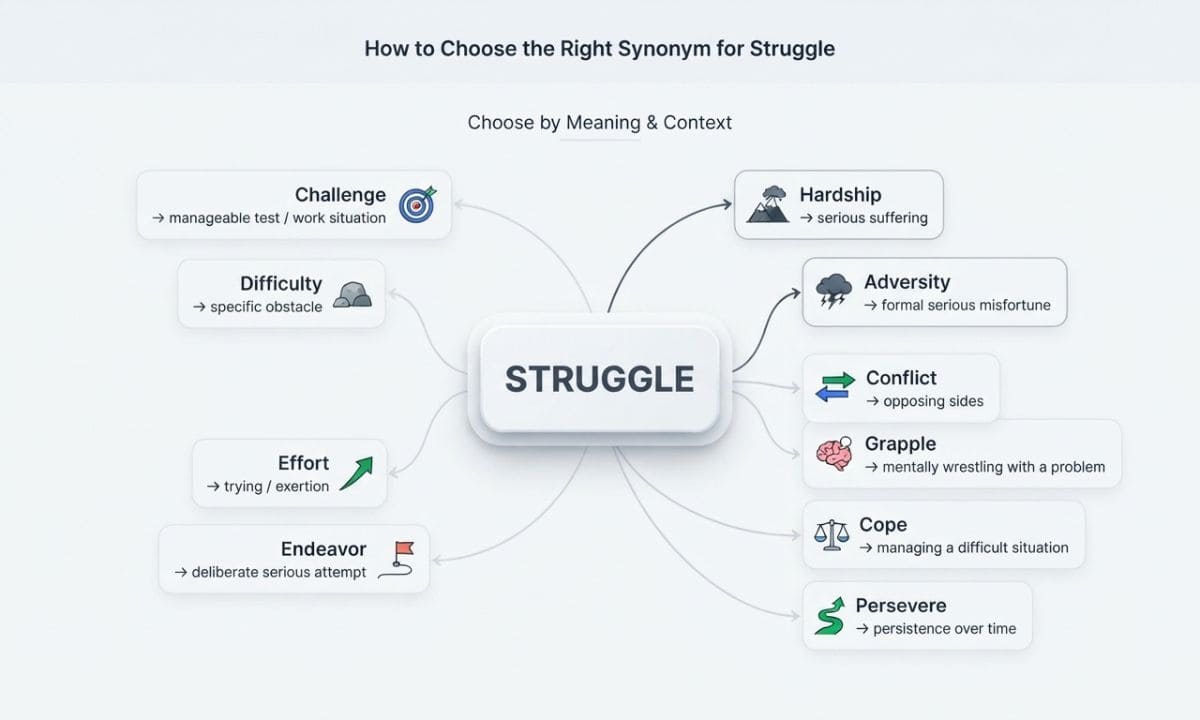
Use Challenge when:
The situation is testing but manageable, especially at work.
Use Difficulty when:
You’re naming a specific obstacle, not the whole experience.
Use Hardship when:
The situation involves real suffering, like poverty or illness.
Use Adversity when:
You want a formal or literary tone for serious misfortune.
Use Effort when:
The focus is on trying, not necessarily on hardship.
Use Endeavor when:
You’re describing a deliberate, serious attempt.
Use Conflict when:
Two sides are actually opposing each other.
Use Grapple when:
You’re mentally wrestling with an idea or problem.
Use Cope when:
The goal is managing a hard situation, not solving it.
Use Persevere when:
You want to highlight persistence over time.
Struggle vs Its Closest Synonyms
Among all the struggle synonyms covered so far, a few get confused most often. Here’s the quick distinction:
Struggle vs Challenge:
A challenge is the test itself; struggle is the effort of dealing with it.
Struggle vs Difficulty:
Difficulty is the obstacle; struggle is the ongoing action of getting past it.
Struggle vs Hardship:
Hardship points to serious, often long-term suffering; struggle can describe something smaller.
Struggle vs Adversity:
Adversity is a formal, literary word for serious misfortune; struggle fits everyday speech too.
Struggle vs Effort:
Effort is neutral exertion; struggle implies that effort is meeting resistance.
Struggle vs Conflict:
Conflict involves opposition between two sides; struggle can happen with no opponent, like struggling with a math problem.
Common Mistakes When Using Struggle Synonyms
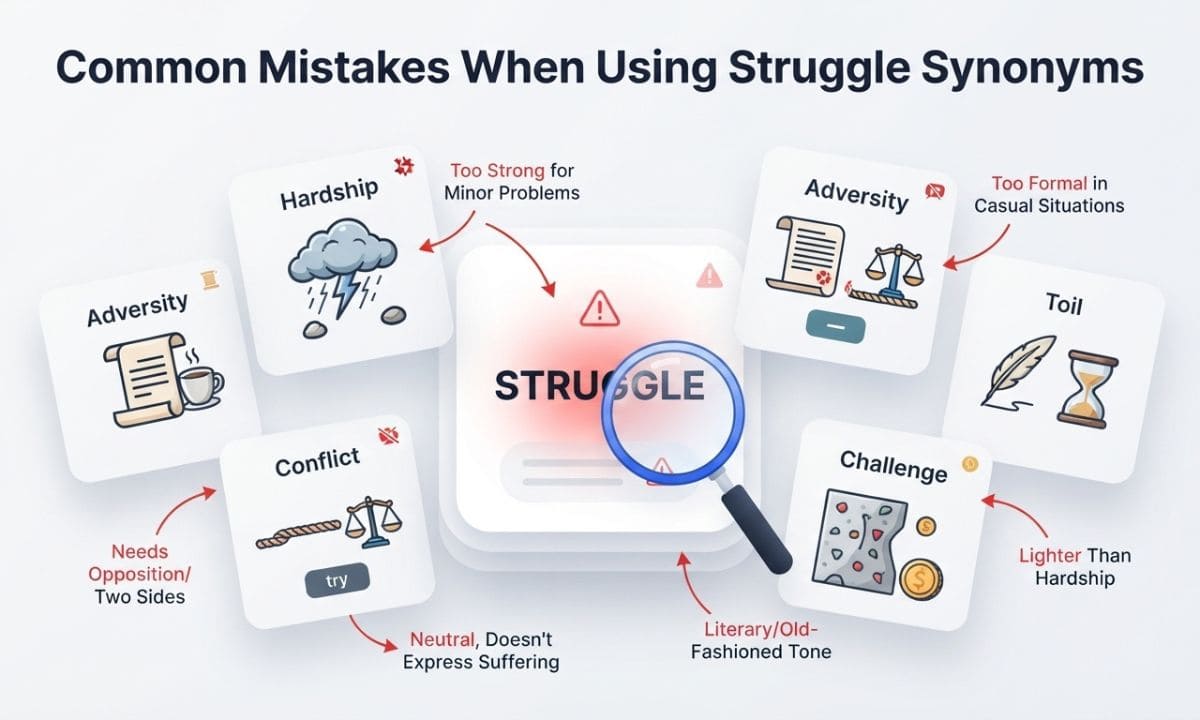
Not every one of these struggle synonyms is interchangeable. A few common slip-ups:
Treating every synonym as interchangeable. “Hardship” and “challenge” carry very different weight.
Using “hardship” for minor problems. Calling slow Wi-Fi a “hardship” sounds exaggerated.
Using “adversity” in casual situations. It can sound overly formal or dramatic in everyday chat.
Using “conflict” when there’s no opposition. Conflict needs two sides; a solo task isn’t a conflict.
Using “effort” when you mean suffering. Effort is neutral and doesn’t capture emotional pain.
Using “toil” in every professional sentence. It sounds literary or old-fashioned in a modern email.
Struggle Synonyms in Sentences
Seeing struggle synonyms side by side with the original word makes the tone shift easier to spot.
Example 1 Work
Struggle: “She struggled to complete the project.”
Challenge: “She faced a challenge completing the project.”
Example 2 Life
Struggle: “He struggled financially.”
Hardship: “He experienced financial hardship.”
Example 3 Problem
Struggle: “The team struggled with the technical issue.”
Grapple: “The team grappled with the technical issue.”
What Is the Best Synonym for Struggle?
There’s no single best answer, since it depends on tone and context.
Quick Answer:
For everyday and professional writing, “challenge” is the safest, most versatile struggle synonym.
For emotional or serious situations, “hardship” or “adversity” carry more weight.
Explore More Synonyms Guide
Opportunity Synonyms: 30+ Words, Alternatives, Meanings & Examples
25+ Share Synonyms: Meanings, Examples & When to Use Each
Additionally Synonyms: 20+ Words, Meanings, Examples & How to Use Them
Kindness Synonyms: 25+ Words, Meanings, Examples & How to Use Them
25+ Perspective Synonyms: Other Ways to Say Perspective (With Examples)
History Synonyms: 22+ Words, Meanings, Examples & How to Use Them
30+ Honest Synonyms: Other Ways to Say Honest Synonyms With Meaning & Examples
Frequently Asked Questions
What is the best synonym for struggle?
“Challenge” works best in most everyday and professional contexts because it’s neutral and widely understood.
What is a formal word for struggle?
“Adversity” or “hardship” are the most formal struggle synonyms, often used in essays and serious writing.
What is another word for struggling with something?
“Grappling with” or “wrestling with” both describe the act of struggling with a problem or decision.
What is a positive synonym for struggle?
“Endeavor” carries a more positive, forward-looking tone than struggle, focusing on effort rather than difficulty.
What is a professional way to say “struggle”?
Phrases like “navigated challenges” or “worked through obstacles” sound professional without sounding negative.
Is “challenge” the same as “struggle”?
Not exactly. A challenge is the test itself, while struggle describes the effort of getting through it.
What is the difference between struggle and hardship?
Hardship usually implies real, ongoing suffering, while struggle can describe something as small as a single hard task.
What is the difference between struggle and adversity?
Adversity is a more formal, serious term for misfortune, while struggle fits both minor and major difficulties.
Can “effort” be used as a synonym for struggle?
Sometimes, but effort is neutral it doesn’t capture the resistance or difficulty that struggle implies.
What is the opposite of struggle?
Common opposites include ease, comfort, and success, since they describe the absence of difficulty.
Conclusion
“Struggle” is a useful word, but leaning on it too often makes writing feel repetitive. Once you know the range of struggle synonyms from neutral words like “challenge” and “effort” to heavier ones like “hardship” and “adversity” you can match your tone to the moment instead of settling for the first word that comes to mind.
The key is context. A resume needs a different word than a personal essay, and a casual text needs something looser than a formal report. Keep this list of struggle synonyms handy, and swapping out the overused word will start to feel natural.
Next time you catch yourself typing “struggle” for the third time in one paragraph, come back to this guide and pick a synonym that actually fits.
