

“Crazy” does a lot of jobs. It can describe a strange hat, a risky plan, a hectic week, a fan who loves a band, or, less kindly, someone’s mental state.
So a useful list of synonyms for crazy has to sort words by meaning and tone instead of piling them up. Pick the wrong one and “that concert was crazy” starts to sound like a diagnosis.
This guide groups 70 alternatives by sense, shows each in a sentence, and flags the ones that need care. Most are near-synonyms or context-specific replacements rather than perfect matches. English works that way.
Quick Answer: What Is the Best Synonym for Crazy?
“Crazy” can mean mentally unstable, strange, extreme, exciting, irrational, extremely busy, or very enthusiastic, and each meaning wants its own word.
Start by asking what you actually mean:
Bizarre for strange,
Absurd for illogical,
Hectic for busy,
Incredible for impressive.
Best Everyday Synonyms for Crazy
Wild, absurd, bizarre, outrageous, intense, hectic, ridiculous, unbelievable.
Best Synonyms for Crazy People
Describe the behavior you mean: eccentric, unpredictable, impulsive, overwhelmed. If you’re talking about a real person’s mental health, skip slang and name the situation plainly, such as “a person experiencing a mental health condition.” Words like insane, deranged, and psycho aren’t neutral labels.
Best Synonyms for Crazy Ideas and Behavior
For ideas: irrational, absurd, far-fetched, unrealistic, off the wall. For behavior: reckless, erratic, bizarre, unusual, impulsive.
Best Positive Synonyms for Crazy
When “crazy” means impressive or thrilling: incredible, extraordinary, mind-blowing, epic, wild, unreal.
Best Polite Alternatives to Crazy
Unusual, unexpected, unconventional, surprising, unrealistic, challenging. These describe the thing without judging the person.
What Does “Crazy” Mean?
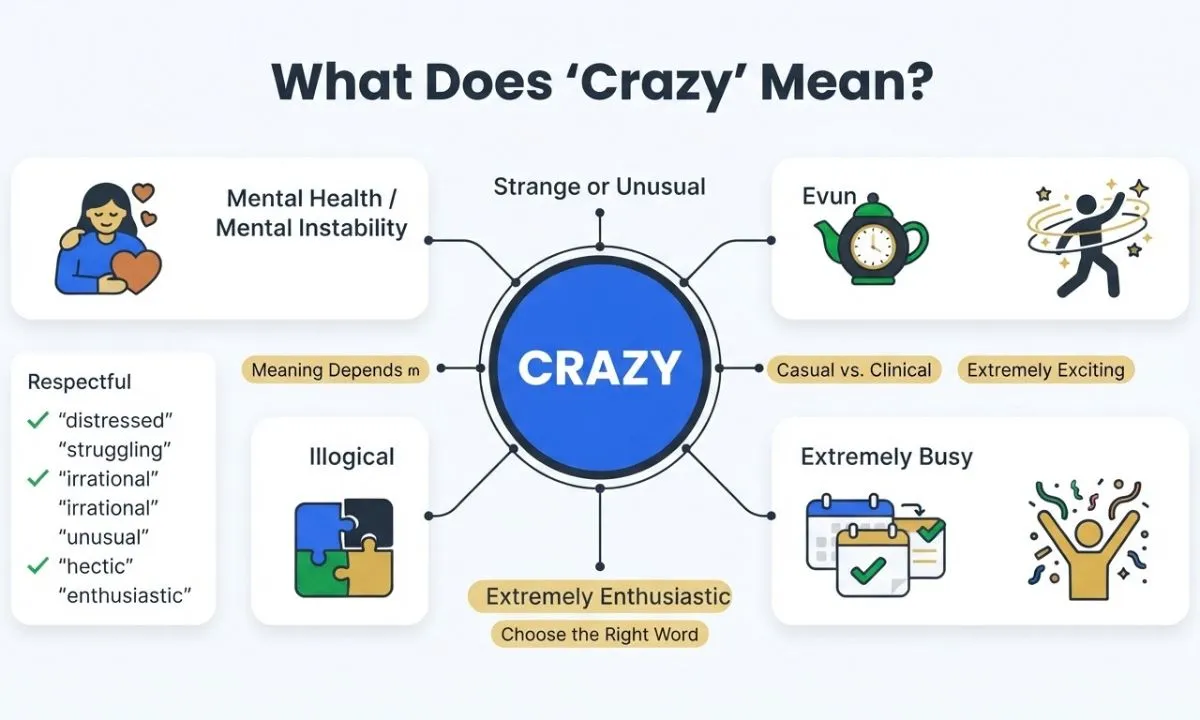
In everyday English the word has at least six working senses.
Dictionaries such as Merriam-Webster list several of them separately, from “bizarre” to “excited” to “stupid.”
Crazy Meaning as Mentally Unstable
When “Crazy” Refers to Mental Health
Casual use and clinical language are different things. Oxford Learner’s Dictionaries marks some uses tied to mental illness as potentially offensive.
Everyday slang about weather or traffic isn’t a medical statement, and medical terms shouldn’t be borrowed as slang.
Better and More Respectful Alternatives
Name the experience: distressed, struggling, in crisis, or the specific condition if the person has shared it.
Crazy Meaning as Strange or Unusual
Words for Something Strange or Unusual
Bizarre, peculiar, eccentric, offbeat, unconventional. These describe the oddness without judging anyone’s mind.
Crazy Meaning as Extremely Exciting
Words for an Exciting or Extreme Experience
Wild, intense, thrilling, unbelievable, incredible. Choose by the feeling: thrilling for fun, intense for pressure.
Crazy Meaning as Illogical
Words for an Illogical or Ridiculous Idea
Irrational, absurd, ridiculous, nonsensical, illogical. Illogical is the calmest. Ridiculous has an edge.
Crazy Meaning as Extremely Busy
Words for an Extremely Busy Schedule
Hectic and packed are neutral. Frantic adds stress. Overloaded points to workload.
Crazy Meaning as Extremely Enthusiastic
Words for Strong Enthusiasm or Passion
Passionate and enthusiastic are warm. Devoted is loyal. Obsessed and fanatical lean negative.
Best Synonyms for Crazy at a Glance
| Synonym | Best Used For | Tone |
| Bizarre | Strange events, objects | Neutral |
| Absurd | Illogical ideas | Neutral to formal |
| Irrational | Reasoning, fears, decisions | Formal |
| Reckless | Risky behavior | Serious |
| Hectic | Busy schedules | Neutral |
| Frantic | Rushed, anxious activity | Urgent |
| Eccentric | Unconventional people | Gentle |
| Quirky | Charming oddness | Warm |
| Bonkers | Over-the-top situations | Casual, funny |
| Wacky | Silly, playful things | Playful |
| Incredible | Impressive experiences | Positive |
| Mind-blowing | Astonishing results | Enthusiastic |
| Outrageous | Shocking or bold | Mixed |
| Passionate | Strong enthusiasm | Positive |
70 Synonyms for Crazy, Grouped by Meaning and Tone
Not all 70 are dictionary synonyms in every context. Some are near-synonyms, some are idioms, and some only replace one sense of “crazy.” Read each tip before swapping a word in.
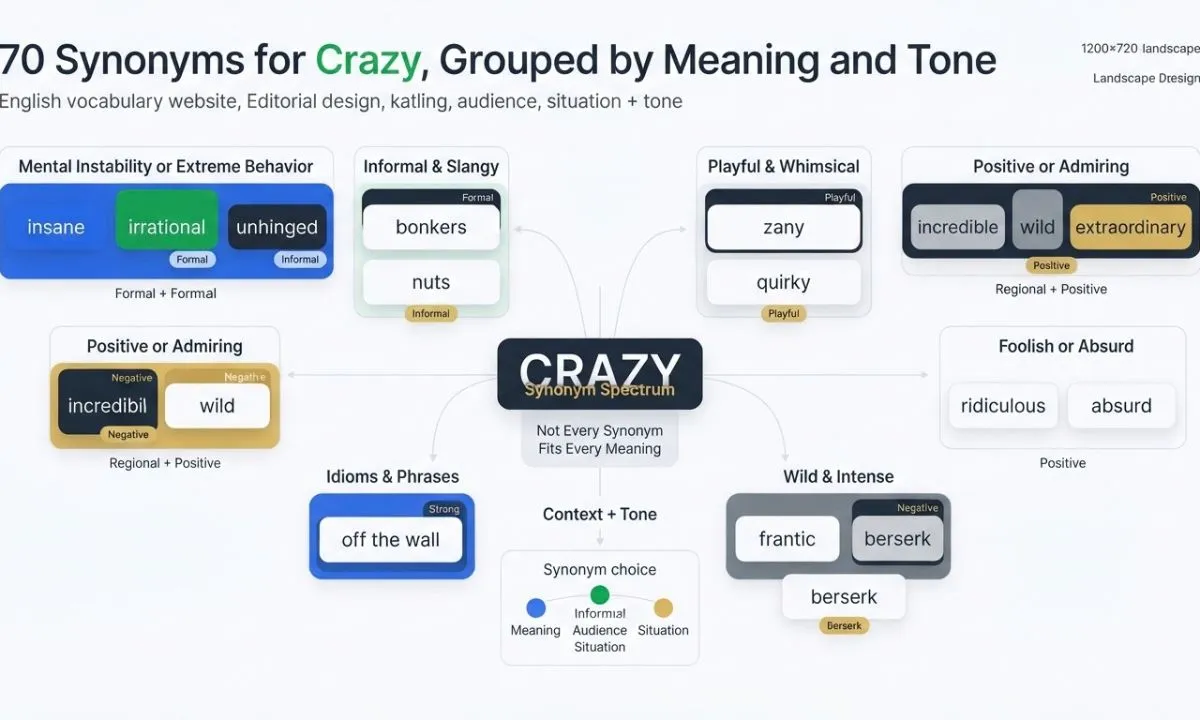
Mental Instability or Extreme Behavior
These words come closest to the mental-health sense of “crazy,” and several are clinical terms. Use them carefully, and not as casual labels for real people.
Insane
Meaning:
Once a clinical term, now outdated in medicine. In everyday speech it means wildly irrational or extreme.
Example:
He called the budget insane, then approved it anyway.
Usage Tip:
Fine for things and decisions. Don’t use it to describe a person with a mental illness.
Deranged
Meaning:
Thrown into mental disorder, often with a hint of menace.
Example:
The film’s villain is a deranged collector who mails his victims a single glove.
Usage Tip:
It belongs mostly to crime stories and thrillers. About a real person, it stigmatizes.
Unhinged
Meaning:
Acting without restraint, like a door off its hinges.
Example:
His midnight email rant got unhinged by the third paragraph.
Usage Tip:
Common in news writing. It judges behavior, so don’t treat it as a diagnosis.
Demented
Meaning:
Informally, wildly irrational or twisted. Medically, it relates to dementia, a condition affecting memory and thinking.
Example:
The cartoon wizard let out a demented cackle.
Usage Tip:
Keep it to fiction and humor. Using it casually can hurt people affected by dementia.
Delusional
Meaning:
Holding a firm false belief despite clear evidence. Casually, it means wildly unrealistic.
Example:
Thinking we can launch by Friday with no designer is delusional.
Usage Tip:
It has clinical roots. For plans, unrealistic is kinder and more accurate.
Irrational
Meaning:
Not based on reason or logic.
Example:
His refusal to read the contract was irrational, given the money involved.
Usage Tip:
A strong neutral choice for fears, reactions, and decisions. It describes thinking without diagnosing anyone.
Unstable
Meaning:
Not steady. Applied to people, it suggests volatile emotions or mental state.
Example:
Engineers closed the bridge after declaring it unstable.
Usage Tip:
Best for structures, markets, and situations. About a person, it’s vague and loaded.
Disturbed
Meaning:
Troubled or upset. In older usage, mentally disordered.
Example:
Even seasoned reporters left the courtroom disturbed.
Usage Tip:
Safer as a reaction (“disturbed by the footage”) than as a label for someone’s mind.
Psychotic
Meaning:
A clinical term for experiencing psychosis, a loss of contact with reality.
Example:
The doctor explained that a psychotic episode can be treated.
Usage Tip:
Medical contexts only. Never use it, or “psycho,” as casual slang.
Mentally unsound
Meaning:
A formal and legal phrase for lacking a sound mind.
Example:
The lawyer argued that the will was signed by someone mentally unsound.
Usage Tip:
Keep it in legal or historical writing. It reads coldly in conversation.
Informal and Slangy
Everyday slang, mostly lighthearted. Several are regional.
Nuts
Meaning:
Informal for crazy in nearly any sense, from absurd to wildly excited.
Example:
The crowd went nuts when the band walked on.
Usage Tip:
Friendly and common for excitement or chaos. Avoid it when talking about someone’s mental health.
Bonkers
Meaning:
Silly, absurd, or wildly over the top. British in origin, now widely understood.
Example:
The price is bonkers for a cardboard sofa.
Usage Tip:
Funny and low-stakes. Works best for situations and prices.
Bananas
Meaning:
Wildly excited, angry, or out of control, usually in “go bananas.”
Example:
The kids went bananas when they saw the pool.
Usage Tip:
Very informal and cheerful. Good for kids, parties, and reactions.
Loony
Meaning:
Silly or eccentric. It comes from “lunatic.”
Example:
Her loony plan to mail a pizza actually worked.
Usage Tip:
Dated and mocking. As a noun for a person, it’s insulting. Use it for ideas.
Cuckoo
Meaning:
Silly or out of touch, in a cartoonish way.
Example:
Quit your job to raise alpacas? Cuckoo, but I’m intrigued.
Usage Tip:
Comic and old-fashioned. It teases, so it’s best between friends.
Batty
Meaning:
Mildly eccentric or scatterbrained.
Example:
My batty neighbor leaves tiny hats on garden gnomes.
Usage Tip:
Gentle and a bit old-fashioned. Often used affectionately in British English.
Barmy
Meaning:
British slang for daft or foolish.
Example:
Paying that much for parking is barmy.
Usage Tip:
UK flavor. American readers may not recognize it.
Crackers
Meaning:
British informal for silly or eccentric.
Example:
You’d be crackers to turn down free tickets.
Usage Tip:
Mild and jokey. It’s more regional than most slang here.
Mad
Meaning:
In British English, crazy or foolish. In American English, usually angry.
Example:
You’d be mad to sail in this wind.
Usage Tip:
Check your audience. In the US it often reads as “angry,” not “crazy.”
Loopy
Meaning:
Dazed or a little irrational, often from tiredness.
Example:
After thirty hours awake, we all got loopy.
Usage Tip:
Best for temporary, mild states. It isn’t a judgment of character.
Playful and Whimsical
Light, humorous words for odd but harmless things.
Zany
Meaning:
Comically odd, clownish.
Example:
The troupe’s zany sketches had the whole theater laughing.
Usage Tip:
Affectionate. A good fit for entertainers and performance.
Wacky
Meaning:
Funny-odd and unconventional.
Example:
Wacky Hat Day turned the office into a parade.
Usage Tip:
Playful for events, outfits, and personalities. It’s too light for serious topics.
Goofy
Meaning:
Silly in a harmless, slightly clumsy way.
Example:
His goofy grin disarmed every skeptic in the room.
Usage Tip:
Warm and kid-friendly. It reads as affection, not criticism.
Kooky
Meaning:
Offbeat in a charming way.
Example:
She’s the kooky inventor everyone in town knows.
Usage Tip:
Affectionate, though it can sound patronizing if the person didn’t invite the label.
Daffy
Meaning:
Silly and scatterbrained. Daffy Duck is the usual association.
Example:
That’s a daffy idea, but I like it.
Usage Tip:
Cartoonish and dated. Good for light humor.
Screwball
Meaning:
Unconventional or impractical. Also a name for a fast, farcical style of comedy film.
Example:
His screwball proposal had a one-in-a-million chance.
Usage Tip:
Works for ideas and plans, and for describing comic stories.
Madcap
Meaning:
Impulsive and fun-loving, sometimes reckless but cheerful.
Example:
They set off on a madcap road trip with no map.
Usage Tip:
Learn positive. Ideal for adventures and chases.
Off the wall
Meaning:
Unconventional and unexpected.
Example:
That off-the-wall question changed the whole pitch.
Usage Tip:
Good in creative or business brainstorms, where unusual is a compliment.
Quirky
Meaning:
Pleasantly unusual.
Example:
The café is quirky, with mismatched chairs and a resident parrot.
Usage Tip:
The most polite entry here. Use it when you like the oddness.
Harebrained
Meaning:
Foolish and ill-considered.
Example:
Another harebrained scheme to dig a pool by hand.
Usage Tip:
Aim it at ideas, not people. It carries mockery.
Idioms and Phrases
Colorful expressions that usually say “irrational” or “out of touch.” Most are informal, and some are regional.
Out of one’s mind
Meaning:
Beyond rational thought. Also used for being overwhelmed.
Example:
You’d have to be out of your mind to skip that offer.
Usage Tip:
Fits decisions. Avoid it in mental-health contexts.
Out to lunch
Meaning:
Absent-minded or mentally elsewhere.
Example:
Sorry, I was out to lunch during that whole meeting.
Usage Tip:
Milder than “crazy.” It means spaced out.
Off one’s rocker
Meaning:
Behaving irrationally, in a teasing way.
Example:
You’re off your rocker if you think I’ll wake at 4 a.m.
Usage Tip:
Jokey and slightly dated, mostly American.
Off one’s trolley
Meaning:
The British counterpart of “off one’s rocker.”
Example:
He’s off his trolley, selling a car to buy a canoe.
Usage Tip:
UK flavor. Outside Britain it may need explaining.
Lost one’s marbles
Meaning:
Lost sense or sanity, humorously.
Example:
Did you lose your marbles, wearing shorts in a blizzard?
Usage Tip:
Teasing. Don’t use it for aging or memory loss.
A few sandwiches short of a picnic
Meaning:
A joking way of saying someone isn’t thinking clearly.
Example:
After that speech, I wondered if he was a few sandwiches short of a picnic.
Usage Tip:
Funny among friends. It’s insulting about a real person’s intelligence and is mainly British and Commonwealth.
Not all there
Meaning:
Slightly dazed, or lacking full mental sharpness.
Example:
She seemed not all there after the long flight.
Usage Tip:
Judgmental and can hint at cognitive impairment. Use sparingly.
Round the bend
Meaning:
Crazy, or at the end of one’s patience.
Example:
The delays are driving me round the bend.
Usage Tip:
Mostly British and mild. “Drive someone round the bend” is the common form.
Going off the deep end
Meaning:
Suddenly losing control or overreacting.
Example:
She went off the deep end when the email leaked.
Usage Tip:
Describes a moment, not a personality.
Bats in the belfry
Meaning:
Old-fashioned for eccentric or crazy.
Example:
Grandpa had bats in the belfry, but he told great stories.
Usage Tip:
Vivid and dated. Works well in storytelling.
Wild and Intense
Words about speed, force, and loss of control, from busy workplaces to clinical territory.
Frenzied
Meaning:
Wildly excited or uncontrolled.
Example:
Frenzied shoppers swarmed the doors at midnight.
Usage Tip:
Great for crowds, markets, and rushes of activity.
Frantic
Meaning:
Rushed and anxious.
Example:
Her frantic search for the passport ended in the dryer.
Usage Tip:
Adds urgency and stress, which suits deadlines and emergencies.
Manic
Meaning:
Extremely energetic and frenzied. Clinically, it relates to mania.
Example:
Monday at the airport was manic.
Usage Tip:
Use it for pace, not people. Mania is a real clinical state.
Feral
Meaning:
Wild and untamed, as with animals that have returned to the wild.
Example:
The kids were practically feral by the end of the road trip.
Usage Tip:
Humorous exaggeration. Avoid it for actual people in serious situations.
Berserk
Meaning:
In a violent, uncontrolled rage.
Example:
The crowd went berserk when the referee blew the call.
Usage Tip:
Strong, for rage or chaos. It comes from Norse warrior legend.
Rabid
Meaning:
Extremely fanatical. Literally, affected by rabies.
Example:
The team has rabid fans who camp outside for days.
Usage Tip:
Learn negative. Be careful applying it to politics or groups of people.
Wild
Meaning:
Uncontrolled, untamed, or thrilling.
Example:
It was a wild weekend of storms, delays, and one lucky ferry.
Usage Tip:
One of the most flexible choices. It can be neutral or positive.
Hysterical
Meaning:
Overcome by uncontrollable emotion, or extremely funny.
Example:
Her story about the lost luggage was hysterical.
Usage Tip:
As a label for a person’s emotions it has a gendered history. Prefer distraught or overwhelmed. “Hysterically funny” is fine.
Maniacal
Meaning:
Wildly intense, like a maniac.
Example:
He greeted the news with a maniacal grin.
Usage Tip:
Common for villains and obsession. It exaggerates, so don’t use it for real mental health.
Frenetic
Meaning:
Fast, energetic, and disordered.
Example:
The frenetic pace of the trading floor leaves no room for lunch.
Usage Tip:
Not clinical. A good professional choice for pace and atmosphere.
Foolish or Absurd
Words for bad judgment, nonsense, and risky choices.
Ridiculous
Meaning:
So silly it deserves mockery.
Example:
The queue was ridiculous, wrapping around the block twice.
Usage Tip:
Broad and safe. It carries mild scorn.
Preposterous
Meaning:
Contrary to reason, absurd on a grand scale.
Example:
The claim that he built the boat in a weekend is preposterous.
Usage Tip:
Slightly formal or humorous. Good for claims.
Absurd
Meaning:
Wildly illogical.
Example:
It’s absurd to schedule a meeting about meetings.
Usage Tip:
Neutral to formal. A clean substitute for “crazy” when it means illogical.
Senseless
Meaning:
Lacking sense or purpose.
Example:
The senseless delay cost the team a full week.
Usage Tip:
Carries a serious tone. It also appears in “senseless violence.”
Nonsensical
Meaning:
Making no sense.
Example:
The error message was nonsensical, just strings of symbols.
Usage Tip:
Best for instructions, arguments, and text.
Ludicrous
Meaning:
So foolish it’s laughable.
Example:
Charging fifty dollars for a bottle of tap water is ludicrous.
Usage Tip:
Comic scorn. Good for prices and claims.
Idiotic
Meaning:
Extremely stupid.
Example:
Texting while driving is an idiotic habit.
Usage Tip:
Aim it at actions. “Idiot” was once a clinical term, so it’s insulting for people.
Reckless
Meaning:
Careless about danger.
Example:
Reckless driving was cited in the report.
Usage Tip:
Accurate and common in news and legal writing for risk-taking.
Foolhardy
Meaning:
Bold and rash, ignoring risk.
Example:
Crossing the frozen lake in April was foolhardy.
Usage Tip:
Literary and slightly formal. It suggests courage with poor judgment.
Illogical
Meaning:
Not following logic.
Example:
The plan is illogical because step three undoes step two.
Usage Tip:
Calm and academic. Best for arguments and reasoning.
Positive or Admiring
Here “crazy” becomes praise. These words mean impressive, astonishing, or thrilling.
Incredible
Meaning:
So good it’s hard to believe.
Example:
The view from the summit was incredible.
Usage Tip:
Warm, positive, and understood everywhere.
Unreal
Meaning:
So extraordinary it feels not quite real.
Example:
That last-second goal was unreal.
Usage Tip:
Casual and youthful. Good for sports and performances.
Insane (as in “that skill is insane”)
Meaning:
Positive slang for extraordinary, skill or talent beyond normal.
Example:
Her piano speed is insane.
Usage Tip:
Context makes it clear. Skip it in formal writing, and remember some readers dislike it because of mental-health associations.
Wild (as in “that was a wild ride”)
Meaning:
Thrilling and unpredictable.
Example:
The season was a wild ride from the first game to the last.
Usage Tip:
Great for experiences. It can hint at risk as well as excitement.
Mind-blowing
Meaning:
Astonishing, enough to overwhelm expectations.
Example:
The special effects were mind-blowing.
Usage Tip:
Enthusiastic and a bit hyped. It suits reviews and reactions.
Outrageous
Meaning:
Shocking, bold, or beyond normal limits.
Example:
The chef’s outrageous dessert comes served in a lightbulb.
Usage Tip:
It can praise or criticize, so rely on context. “Outrageous prices” is negative. “Outrageous talent” is positive.
Extraordinary
Meaning:
Far beyond the usual.
Example:
She showed extraordinary patience with the toddler.
Usage Tip:
Formal and positive. Works in professional and serious writing.
Epic
Meaning:
Grand or heroic. Slang for great.
Example:
Our camping trip was epic: rain, a lost canoe, and a perfect sunrise.
Usage Tip:
Casual. It signals scale or memorable drama.
Fantastic
Meaning:
Wonderful. It began as “of fantasy.”
Example:
The food at that little place was fantastic.
Usage Tip:
Safe, positive, and widely understood.
Unbelievable
Meaning:
Hard to believe, for good or bad.
Example:
The comeback was unbelievable.
Usage Tip:
Tone depends on context. “Unbelievable service” and “unbelievable delay” point in opposite directions.
Crazy Synonyms by Context
Another Word for a Crazy Person
Neutral Alternatives for a Person
Eccentric, unconventional, unpredictable, impulsive.
Informal Alternatives for a Person
Oddball, character, wild card. Friendly only between people who know each other well.
Polite Alternatives for a Person
Unique, spirited, unconventional. If mental health is the topic, use respectful, specific language and avoid labels like “crazy” or “psycho.”
Synonyms for a Crazy Idea
Words for an Illogical Idea
Irrational, absurd, nonsensical.
Words for an Unusual Idea
Unconventional, off the wall, far-fetched.
Words for an Extreme Idea
Radical, outrageous, over the top.
Synonyms for Crazy Behavior
Uncontrolled Behavior
Erratic, frenzied, berserk.
Strange Behavior
Bizarre, peculiar, odd.
Extreme Behavior
Reckless, excessive, extreme.
Synonyms for Crazy Excited
Words for Extreme Excitement
Thrilled, ecstatic, elated, overjoyed.
Informal and Casual Expressions
Pumped, stoked, hyped, buzzing.
Synonyms for Crazy Busy
Professional Alternatives for Busy
Heavily booked, at capacity, swamped, overextended.
Casual Alternatives for Extremely Busy
Slammed, buried, run off my feet.
Synonyms for Crazy Good
Positive Alternatives for Crazy Good
Exceptional, remarkable, outstanding, superb.
Informal Alternatives for Exceptional
Insanely good, next-level, unreal.
Synonyms for a Crazy Situation
Chaotic Situations
Chaotic, turbulent, frenzied.
Unexpected Situations
Unforeseen, surprising, bizarre.
Difficult or Uncontrolled Situations
Unmanageable, volatile, out of hand.
Formal and Professional Synonyms for Crazy
Choose the word that fits the meaning. A formal word that doesn’t match is worse than a casual one that does.
Neutral Alternatives
Unusual, unexpected, surprising.
Formal Alternatives
Irrational, unreasonable, extraordinary, unconventional.
Professional Alternatives
Unrealistic for plans, demanding for schedules, volatile for markets, exceptional for results.
Casual and Funny Synonyms for Crazy
Casual Words
Nuts, wild, bonkers, bananas.
Funny and Playful Words
Zany, wacky, goofy, madcap.
Informal Expressions
Off one’s rocker, round the bend, lost one’s marbles. Many are regional or dated and won’t suit professional writing.
Positive Synonyms for Crazy
Crazy Meaning Extremely Exciting
Thrilling, wild, electrifying.
Crazy Meaning Extremely Impressive
Incredible, extraordinary, mind-blowing, remarkable.
Crazy Meaning Highly Enthusiastic
Passionate, devoted, avid, keen. “She’s crazy about hiking” becomes “She’s passionate about hiking” with the same warmth.
Polite Alternatives to Crazy
Clear, accurate wording beats a gentle-sounding label that says nothing.
Respectful Alternatives for People
Describe what’s happening: struggling, overwhelmed, going through a hard time. For unusual personalities: unconventional, eccentric.
Neutral Alternatives for Behavior
Unusual, unexpected, out of character, erratic.
Better Words for Ideas and Situations
Unrealistic, risky, chaotic, surprising.
Crazy vs. Similar Words
| Pair | Key Difference |
| Crazy vs. Insane | “Insane” is a stronger word with clinical history. Both are informal for extreme things. |
| Crazy vs. Mad | “Mad” in British English can mean crazy. In American English it usually means angry. |
| Crazy vs. Wild | “Wild” suggests untamed energy and is often positive. |
| Crazy vs. Strange | “Strange” is neutral oddness. “Crazy” adds judgment or intensity. |
| Crazy vs. Irrational | “Irrational” describes thinking without reason. It’s calmer and more formal. |
| Crazy vs. Unusual | “Unusual” is mild and neutral. “Crazy” implies it’s extreme. |
Common Mistakes When Using Crazy Synonyms
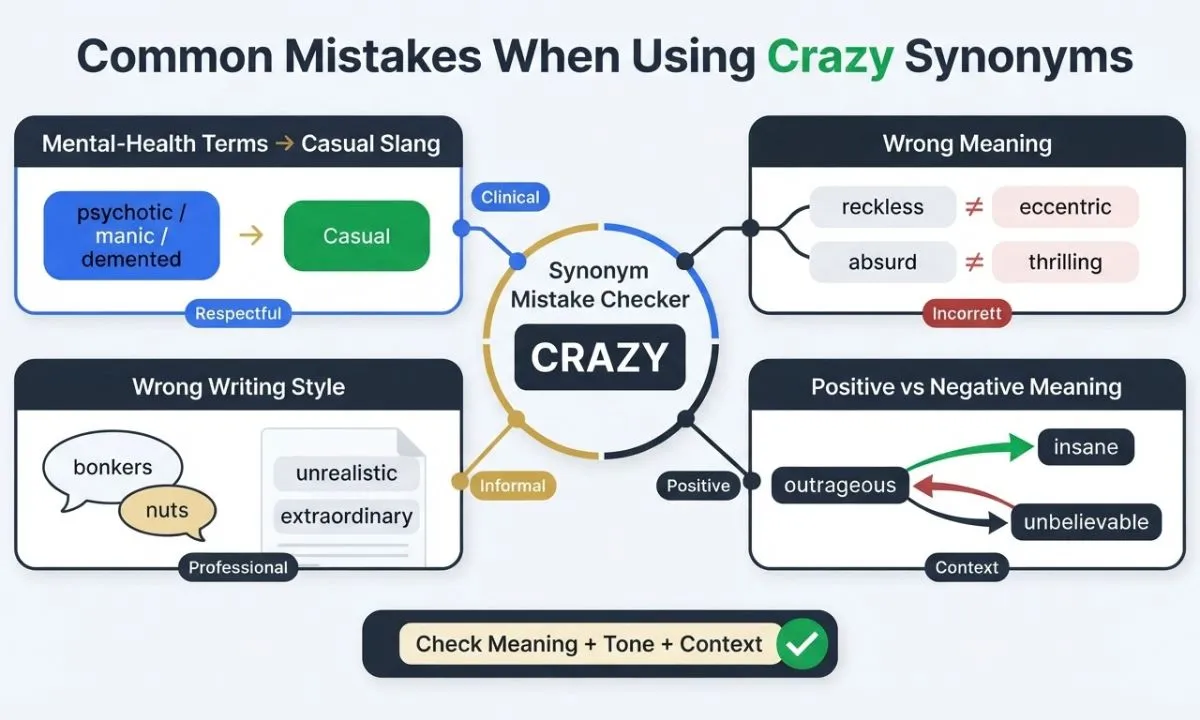
Using Mental-Health Terms as Casual Descriptions
Psychotic, manic, and demented are clinical terms. Using them as slang blurs real conditions.
Choosing a Word With the Wrong Meaning
Reckless isn’t eccentric, and absurd isn’t thrilling.
Using Informal Words in Professional Writing
Bonkers and nuts don’t belong in reports. Unrealistic or extraordinary do.
Confusing Positive and Negative Meanings
Outrageous, insane, and unbelievable can praise or criticize. Let context make it clear.
Ignoring Tone and Context
A word that works with friends can sound cruel in a review or a meeting.
How to Choose the Right Synonym for Crazy
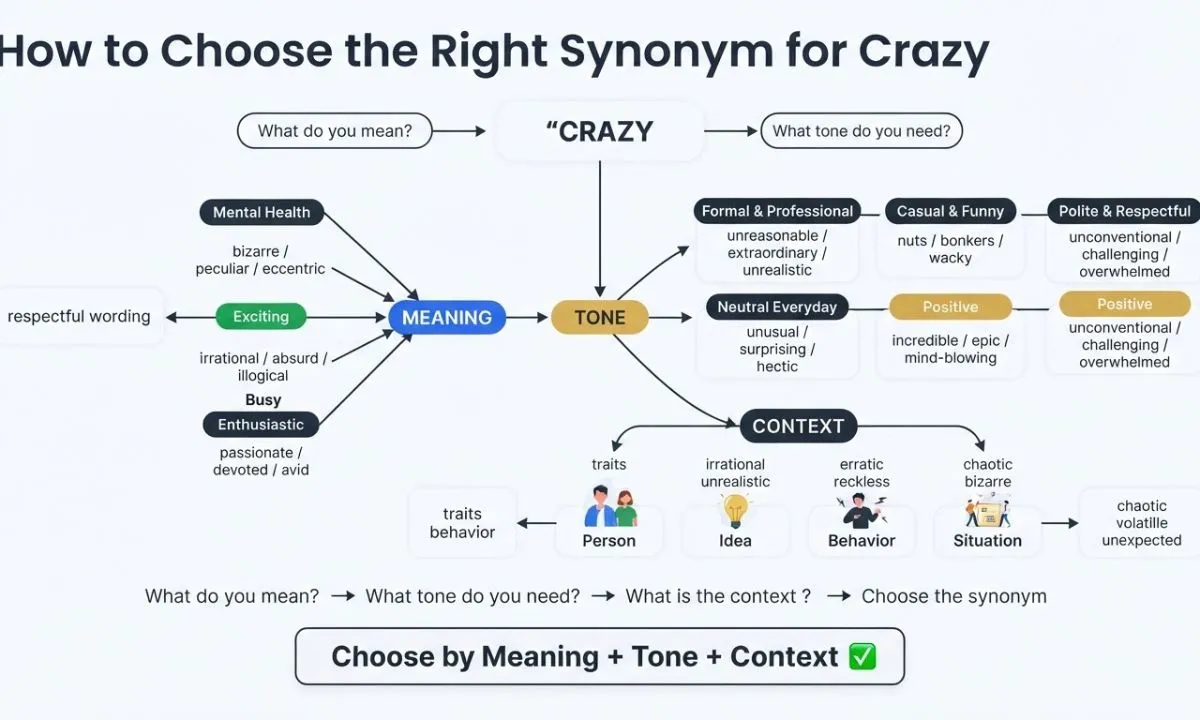
Consider the Meaning
Does “Crazy” Mean Mentally Unstable?
Name the situation instead of using slang.
Does “Crazy” Mean Strange or Unusual?
Try bizarre, peculiar, or eccentric.
Does “Crazy” Mean Exciting or Extreme?
Try wild, intense, or thrilling.
Does “Crazy” Mean Illogical?
Try irrational, absurd, or illogical.
Does “Crazy” Mean Extremely Busy?
Try hectic, packed, or slammed.
Does “Crazy” Mean Extremely Enthusiastic?
Try passionate, devoted, or avid.
Consider the Tone
Formal and Professional Tone
Unreasonable, extraordinary, unrealistic.
Neutral Everyday Tone
Unusual, surprising, hectic.
Casual and Funny Tone
Nuts, bonkers, wacky.
Positive Tone
Incredible, epic, mind-blowing.
Polite and Respectful Tone
Unconventional, challenging, overwhelmed.
Consider the Context
Choosing a Word for a Person
Describe traits or behavior, not mental state.
Choosing a Word for an Idea
Pick irrational, unrealistic, or off the wall depending on how serious the flaw is.
Choosing a Word for Behavior
Erratic, reckless, and bizarre each point to something different.
Choosing a Word for a Situation
Chaotic, volatile, and unexpected say more than “crazy.”
Crazy Synonyms in Sentences
Everyday Examples
“That weekend was wild.”
“The traffic was ridiculous.”
Professional Examples
“The timeline is unrealistic.”
“Her results were extraordinary.”
Examples for People
“He’s an eccentric inventor.”
“She’s been overwhelmed lately.”
Examples for Ideas
“The idea is off the wall, but worth testing.”
“That argument is illogical.”
Examples for Behavior
“Driving that fast is reckless.”
“His behavior was erratic all evening.”
Examples for Situations
“The launch day was chaotic.”
“It was a surprising turn of events.”
What Major Dictionaries Say About “Crazy”
Cambridge Dictionary
Cambridge Dictionary has a full entry for “crazy” with learner-friendly examples. Check the live entry for its current wording and usage labels.
Merriam-Webster
Merriam-Webster’s thesaurus separates the word into distinct senses: bizarre, psychotic, stupid, excited, weird, uneven, and twisted. It also lists a noun use meaning a person with a severely disordered state of mind. The dictionary shows adverb use too, as in “crazy good.” It dates the first known use to 1582.
Oxford Languages
Oxford Learner’s Dictionaries lists “not sensible” as a core sense, with extra uses for being very angry, very enthusiastic, or very excited. It marks the noun “crazy” as an offensive word for someone with strange ideas or mental illness. It also says “craziness” used for mental illness can be offensive.
Collins Dictionary
Collins English Dictionary also covers “crazy” in its everyday senses. Check the current entry for exact definitions and regional labels.
Explore More Synonyms Guide
Above Average Synonyms: 70 Better Ways to Say “Above Average” Clearly
Synonyms for Legislature: 70 Clear Words for Better Communication
20+ Primary Synonyms: Other Ways to Say “Primary” With Meaning & Examples
History Synonyms: 22+ Words, Meanings, Examples & How to Use Them
70+ Important Synonyms: Other Ways to Say “Important” With Meaning & Examples
Frequently Asked Questions
What is the best synonym for crazy?
There’s no single best one. Choose by meaning: bizarre for strange, absurd for illogical, hectic for busy, incredible for impressive.
What is another word for crazy?
Common alternatives are wild, absurd, bizarre, outrageous, and irrational. The right one depends on what you mean.
What are some polite synonyms for crazy?
Try unusual, unconventional, surprising, or unrealistic. These describe without judging.
What is a positive synonym for crazy?
Incredible, extraordinary, epic, and mind-blowing all work. Each praises something impressive or exciting.
What is a synonym for a crazy person?
Avoid the label when you can. Say eccentric, unpredictable, or describe the behavior. For mental health, use respectful, specific language.
What are synonyms for crazy ideas?
Try irrational, absurd, far-fetched, off the wall, or unrealistic.
What is another word for crazy behavior?
Erratic, reckless, bizarre, or impulsive, depending on what the behavior looks like.
What is another word for crazy excited?
Thrilled, ecstatic, elated, or casually pumped and stoked.
What is another word for crazy busy?
Hectic, swamped, overloaded, or casually slammed.
Conclusion
The best synonyms for crazy depend on what you actually mean, who’s reading, and what tone you want.
The more precisely you choose your synonym for crazy, the clearer and more engaging your sentence becomes. Use serious words like insane or deranged for mental instability, playful words like wacky or zany for quirky personalities, and professional words like unconventional or overwhelming when you need polish.
Strange, exciting, illogical, busy, enthusiastic, and mentally unwell are six different ideas, and each deserves its own word. When it’s a real person’s mental health, choose plain, respectful language over slang every time.
