

You type a sentence, reach the apostrophe, and freeze. Whose vs Who trips up students, native speakers, and even paid writers. Both words sound exactly the same, so your ear gives you zero help.
Here’s what makes Whose vs Who’s so slippery. The apostrophe looks like it should show ownership, because in most English words it does. With this pair, it doesn’t. That single exception causes almost every mistake people make.
This guide fixes it for good. You’ll get one short rule for Whose vs Who’s, a five-second test, real examples from emails and texts, the mistakes to avoid, and a quick quiz at the end.
Quick Answer: Whose or Who’s?
The Short Rule
The whole Whose vs Who’s problem comes down to one line.
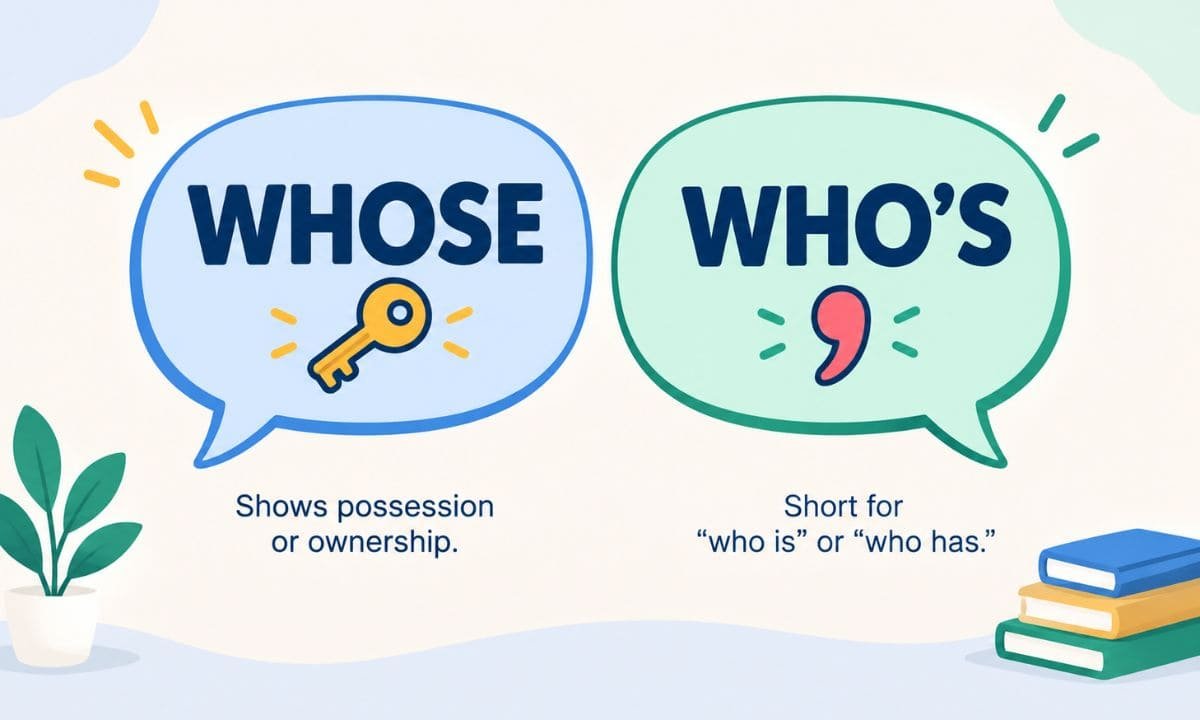
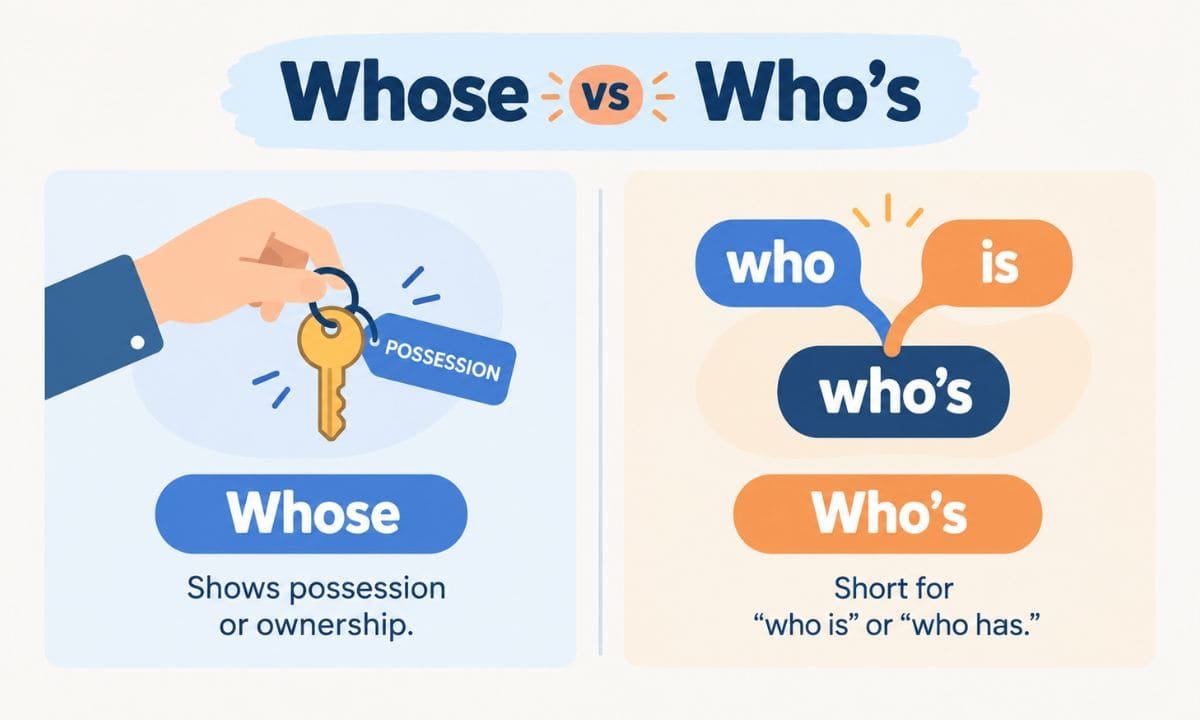
Whose shows possession.
Who’s is short for who is or who has. That’s the whole rule.
Whose = Possession
Use whose when you want to know who something belongs to.
- Whose jacket is on my chair?
- She’s the teacher whose class always fills up first.
Who’s = Who Is / Who Has
Use who’s only when you can split it into two words.
Who’s finished the report? (who has)
Who’s driving tonight? (who is)
Whose vs Who’s: What’s the Difference?
The Main Difference at a Glance
| Whose | Who’s | |
| Word type | Possessive determiner / relative pronoun | Contraction |
| Means | Belonging to whom | Who is / Who has |
| Apostrophe? | No | Yes |
| Followed by | Usually a noun | Usually a verb or adjective |
| Example | Whose phone is ringing? | Who’s calling you? |
Why These Two Words Confuse People
English taught you that ‘s means ownership Sara’s bag, the dog’s bowl. So who feels possessive.
But possessive pronouns break that habit.
Look at the family: his, hers, its, theirs, ours, yours, whose. Not one of them takes an apostrophe.
So the apostrophe in who’s isn’t ownership at all. It’s just a missing letter.
Whose vs Who’s in One Sentence
Whose coat is that, and who’s wearing it?
Read that line twice. It holds the entire Whose vs Who’s difference in eight words.
What Does “Whose” Mean?
Whose as a Possessive Word
Whose is the possessive form of who. It answers the question “belonging to which person?”
It nearly always sits right in front of a noun.
- Whose keys are these?
- Whose turn is it?
Whose as a Question Word
You use it to ask about ownership or about relationships.
- Whose car blocked the gate?
- Whose sister works at the bank?
Whose in Relative Clauses
This is where writers slip. Who also links a description to a person or a thing.
- The author whose book we read is speaking tonight.
- A city whose streets flood every July.
Whose Works for Things, Not Just People
Plenty of people think it only describes humans. It doesn’t. Dictionaries list it for objects and ideas too. A word whose meaning keeps changing reads far better than the stiff word the meaning of which keeps changing.
Examples of “Whose” in Sentences
Whose shoes are drying by the door?
Whose idea was the surprise party?
I found a wallet, but I don’t know whose it is.
He’s a manager whose team never misses a deadline.
What Does “Who’s” Mean?
Who’s as a Contraction
Who squeezes two words into one. The apostrophe replaces the letters you dropped.
Who’s = Who Is
- Who’s at the door?
- Do you know who’s in charge here?
Who’s = Who Has
- Who’s already eaten?
- She’s the one who’s lived here longest.
How Context Reveals the Meaning
The words after who tell you which version you mean. A -ing word or an adjective points to who is. A past participle (seen, taken, eaten, finished) points to who has. You never have to consciously choose readers to sort it out instantly.
Examples of “Who’s” in Sentences
I can’t remember who booked the room.
Who’s bringing dessert?
Tell me who’s still waiting outside.
Who’s got the charger?
Whose vs Who’s Pronunciation
How to Pronounce Both Words
Both sound like /huːz/ rhyming with shoes. There is no audible difference at all.
Why They Sound Identical
They come from the same root word, who.
One added a possessive ending centuries ago; the other lost letters through everyday speech. The sound stayed put.
Why Pronunciation Never Helps Here
Because your ears can’t split them, Whose vs Who’s is purely a writing problem. Speak freely, nobody can hear your mistake. Type carefully, though, because readers spot it in a second.
Whose vs Who’s: At-a-Glance Comparison
| Word | Correct? | Meaning | Typical Usage |
| Whose | ✅ Always a real word | Belonging to whom | Whose laptop is this? |
| Who’s | ✅ Always a real word | Who is / who has | Who’s using the laptop? |
| Whose is | ✅ | Ownership question | Whose umbrella is this? |
| Who’s book | ❌ | Wrong needs a possessive | Should be whose book |
| Whose coming | ❌ | Wrong needs a contraction | Should be who’s coming |
The Key Difference to Remember
Noun after it?
Use whose. Verb after it? Use who’s. That shortcut handles roughly nine out of ten Whose vs Who’s decisions.
How to Remember the Difference Between Whose and Who’s
The “Who Is” Memory Trick
Swap the word for who is, then read the sentence out loud.
- Spot the word in your sentence.
- Replace it with who is.
- Does it still make sense? Keep who’s.
- Does it sound broken? Switch to whose.
- Still unsure? Try who has as a backup.
Run it on this: Who’s / Whose turn is it? → “Who is it?” Nonsense. So you need whose.
Now try: Who’s / Whose ready to order? → “Who is ready to order?” Perfect. So you need who’s.
A 5-Second Grammar Check
Short on time?
Ask one question: am I talking about ownership, or am I shortening two words?
✅Ownership wins, write whose.
✅Shortening wins, write who’s.
Whose vs Who’s in Everyday English
Here’s how Whose vs Who’s shows up in the writing you actually do every day.
In Emails and Work Messages
- Could you confirm whose budget this falls under?
- Who’s joining the 3 p.m. call?
In Text Messages
- Whose turn is it to drive?
- Who’s free tonight?
On Social Media
- Tag the friend whose birthday it is.
- Guess who’s back in town.
In School and Academic Writing
- A researcher whose findings changed the field.
- The student who’s submitted early gets feedback first.
Common Whose vs Who’s Grammar Mistakes
These five slip-ups cause almost every Whose vs Who’s error you’ll see online.
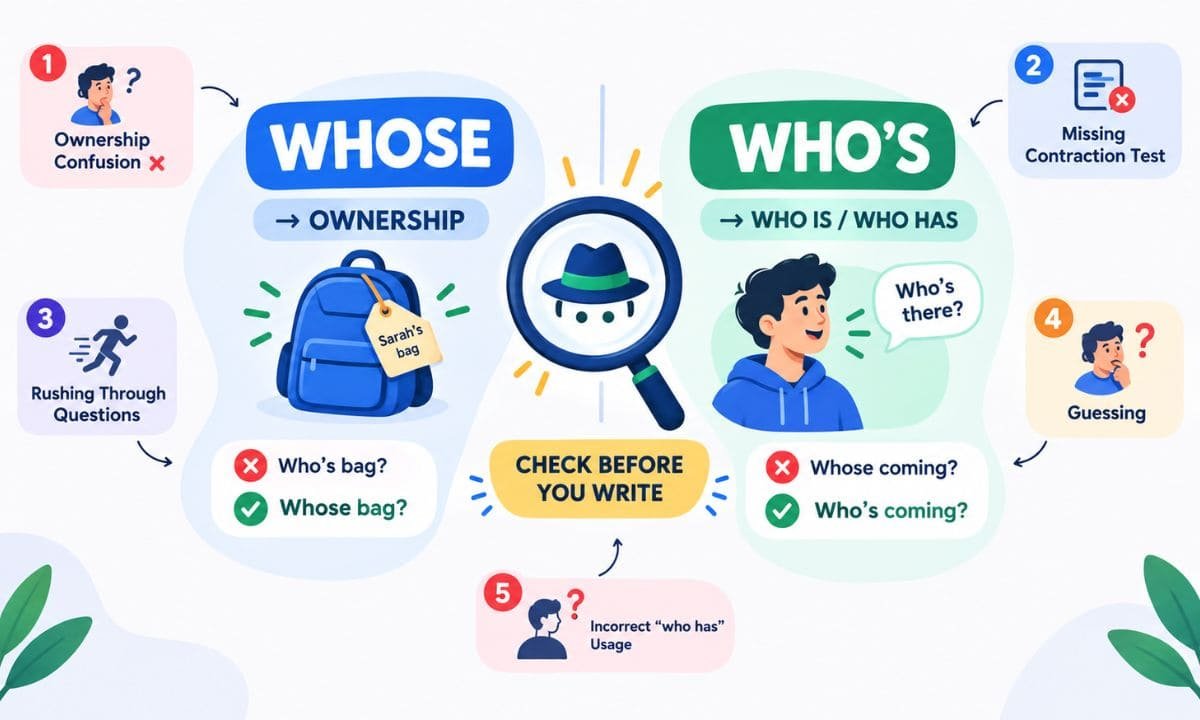
Mistake 1 Using who’s for ownership.
❌ Who’s bag is this? → ✅ Whose bag is this?
Mistake 2 Using whose where a contraction belongs.
❌ Whose coming with us? → ✅ Who’s coming with us?
Mistake 3 Skipping the “who is” test.
Two seconds of checking prevents the error entirely.
Mistake 4 Mixing them up in questions.
Questions feel fast, so writers guess. Slow down and look at the next word.
Mistake 5 Forcing who’s when who has doesn’t fit.
❌ Who’s the tallest person’s coat? → ✅ Whose coat is the tallest person’s?
Correct and Incorrect Examples
Seeing Whose vs Who’s side by side makes the pattern obvious.
| ❌ Incorrect | ✅ Correct | Why |
| Who’s dog barked all night? | Whose dog barked all night? | Ownership, not a contraction |
| Who’s going to fix this? | Who’s going to fix this? | Means who is going |
| I know who’s car that is. | I know whose car that is. | Car is a noun, so use whose |
| Whose took my pen? | Who’s taken my pen? | Means who has taken |
Correct the Sentence: Quick Practice
Fix these two before you scroll:
- Who’s laptop is charging in the hall?
- Do you know who handles the refund?
(Answers: 1 whose. 2 who’s.)
Formal vs Informal Usage
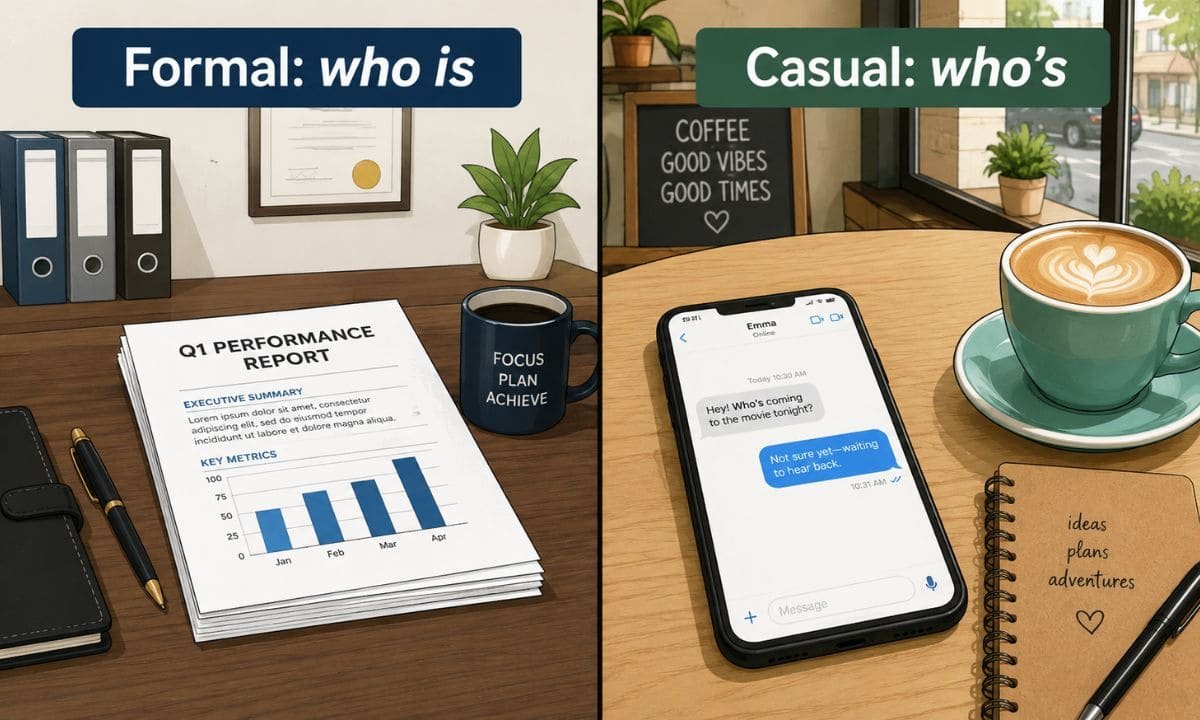
Register changes your tone, but it never changes the Whose vs Who’s rule.
Whose in Formal Writing
Fully accepted everywhere reports, essays, contracts, journals. Use it freely.
Who’s in Formal Writing
Contractions read as casual. In academic papers and legal documents, write who is or who has in full instead.
Both in Casual English
Texts, chats, captions, emails to colleagues who fit naturally and sound friendly. The Whose vs Who’s choice never changes with tone, though. Only the contraction’s formality shifts.
Explore More Grammar Guides
Stutter vs Studder: Correct Spelling and Meaning Guide in 2026
Friend vs Freind: Common Mistake and Correct Usage Explained
Really vs Realy? A Quick Guide to Correct English Spelling (2026)
Barrel vs Barrell: Correct Spelling, Meaning, and Sentence Examples
Customize vs Customise: Which One Should You Use? Complete Guide
What Major Dictionaries Say
Cambridge, Merriam-Webster, and Oxford all agree, and their entries line up neatly:
Whose every major dictionary lists it as a determiner and pronoun used to ask who something belongs to, to identify which person or thing you mean, and to add extra detail about a person or thing.
Whose for objects dictionary entries also record whose as the possessive of which, which is why phrases like a word whose meaning escapes me or an animal whose fur changes colour are perfectly correct.
The same dictionaries list it only as the shortened form of who is or who has. Usage guides add the detail that seals it: possessive pronouns such as his, hers, theirs, its, and whose never take apostrophes.
The takeaway: no reputable dictionary recognises who’s as a possessive. That settles the Whose vs Who’s debate at the source.
Quick Test I Created
Quick Quiz: Can You Choose Correctly?
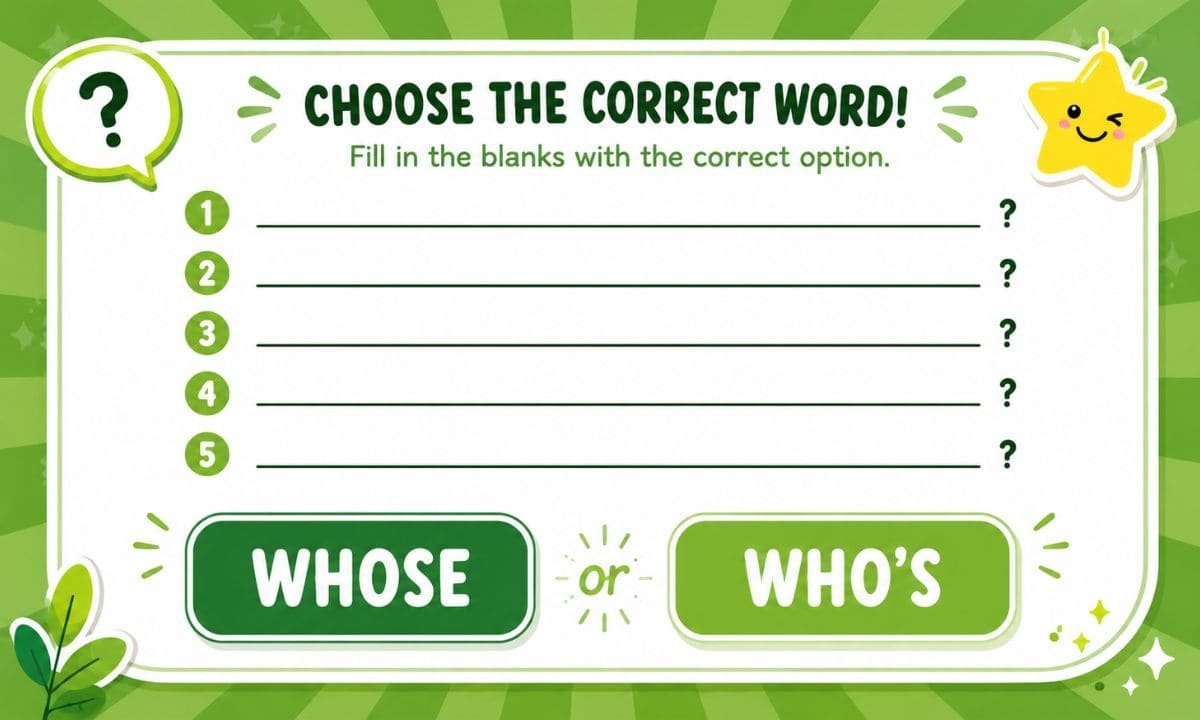
Five quick Whose vs Who’s questions. Fill in the blank:
- ______ turn is it to present?
- ______ been using my headphones?
- She’s the neighbour ______ garden won the prize.
- Do you know ______ coming to dinner?
- ______ signature is on this form?
Answers: 1. Whose 2. Who’s 3. whose 4. who’s 5. Whose
The Easy Rule Behind the Answers
Every answer came from the same check. Ownership → whose.
Two words squeezed together → who’s. Master that, and Whose vs Who’s stops being a question.
Frequently Asked Questions
Is “whose” ever the same as “who’s”?
No. They sound alike but never share a meaning, so they’re never interchangeable.
What is the difference between whose and who’s?
Whose shows possession. Who’s is short for who is or who has.
What does “whose” mean?
It means “belonging to which person” and usually sits right before a noun.
What does “who’s” mean?
It means who is or who has, with the apostrophe standing in for the dropped letters.
Is “who’s” short for “who is”?
Yes, and that’s its most common use in everyday speech and writing.
Can “who’s” mean “who has”?
Yes. Who’s finished already? it clearly means who has.
How do I remember the difference?
Swap the word for who is. If the sentence still works, use who’s; if not, use whose.
Is “whose” used only for people?
No. It works for objects and ideas too, as in a book whose ending surprised everyone.
Is “whose” acceptable in formal writing?
Yes, completely. It appears in academic, legal, and professional writing without issue.
Is “who’s” acceptable in formal writing?
It’s fine in emails, but spell out who is or who has in essays and official documents.
Why do who and who sound the same?
Both come from who, and both ended up pronounced /huːz/, rhyming with shoes.
Can whose and who’s be swapped?
Never. Swapping them changes the meaning and reads as a clear spelling error.
Conclusion
Whose owns something. Who’s is two words wearing a disguise. Noun after it, write whose. Verb after it, write who’s.
Don’t trust the apostrophe; it’s the reason people get this wrong. Trust the swap test instead. Say who is out loud, listen to whether the sentence holds up, and pick your word. Do that a handful of times and Whose vs Who’s will stop slowing you down for good.
