

You’re about to send an important email. You type, “Thanks for your…” and then you freeze. Is it advise or advice?
You’re not alone. Advise or advice is one of the most common word mix-ups in English. The two words look almost identical, sound almost identical, and mean related things.
The good news is that the rule takes about 30 seconds to learn. This guide covers the difference between advise and advice with plain explanations, real examples, a quick quiz, and memory tricks that actually stick.
Quick Answer

Advise is a verb.
It means to recommend something or give guidance.
Example:
I advise you to save your work.
Advice is a noun.
It means the guidance itself.
Example:
Thanks for the advice.
If it’s an action, use advise. If it’s a thing you give or receive, use advice.
Simple Background
Both words come from the same family. They trace back through Old French to Latin roots tied to seeing and viewing.
Advice arrived first, meaning an opinion or a view on what to do.
Advise grew out of it as the action of giving that opinion.
Pronunciation is where things get tricky:
- Advise ends with a “z” sound and rhymes with wise and size.
- Advice ends with an “s” sound and rhymes with ice and nice.
In fast speech, that tiny difference is easy to miss.
On the page, it’s a single letter (s versus c). That’s why so many people mix up advise vs advice, even confident writers.
Similar pairs, like practice and practise in British English, make it even more confusing.
Clear Explanation of the Difference
The difference between advise and advice comes down to grammar.
One is a verb. The other is a noun.
Advise (verb)
To advise means to recommend, counsel, or inform someone. It’s something a person does. Its forms are advise, advises, advised, and advising.
You’ll see it in a few common patterns:
Advise someone to do something: The doctor advised him to rest.
Advise that: I advise that you back up your files.
Advise against something: Experts advise against skipping breakfast.
Advise someone of something (inform): Please advise us of any changes.
Advice (noun)
Advice is the recommendation itself. It’s a thing you give, get, ask for, or ignore.
Here’s the part many people miss: advice is uncountable.
That means:
You say some advice, good advice, or a piece of advice.
You don’t say an advice or advices.
Examples:
That’s a useful piece of advice.
She gave me great advice about my resume.
I need some advice on buying a laptop.
Usable vs Useable Comparison Table
Here’s a side-by-side look at advise vs advice.
| Feature | Advise | Advice |
| Part of speech | Verb | Noun |
| Meaning | To recommend or counsel | A recommendation or guidance |
| Pronunciation | /ədˈvaɪz/ (ends in “z”) | /ədˈvaɪs/ (ends in “s”) |
| Rhymes with | wise, size | ice, nice |
| Countable? | Not applicable (it’s a verb) | No (uncountable) |
| Other forms | advises, advised, advising | advice only (no plural) |
| Example | I advise you to apply early. | Her advice was helpful. |
| Quick memory hook | Action = advise | Ice is a thing = advice |
Explore More Grammar Guides
Stutter vs Studder: Correct Spelling and Meaning Guide in 2026
Friend vs Freind: Common Mistake and Correct Usage Explained
Really vs Realy? A Quick Guide to Correct English Spelling (2026)
Barrel vs Barrell: Correct Spelling, Meaning, and Sentence Examples
Keep vs Kept: Which One Is Correct? Rules, Examples & Tips
Carmel vs Caramel: Simple Difference, Pronunciation & Memory Trick
Which One to Use and When
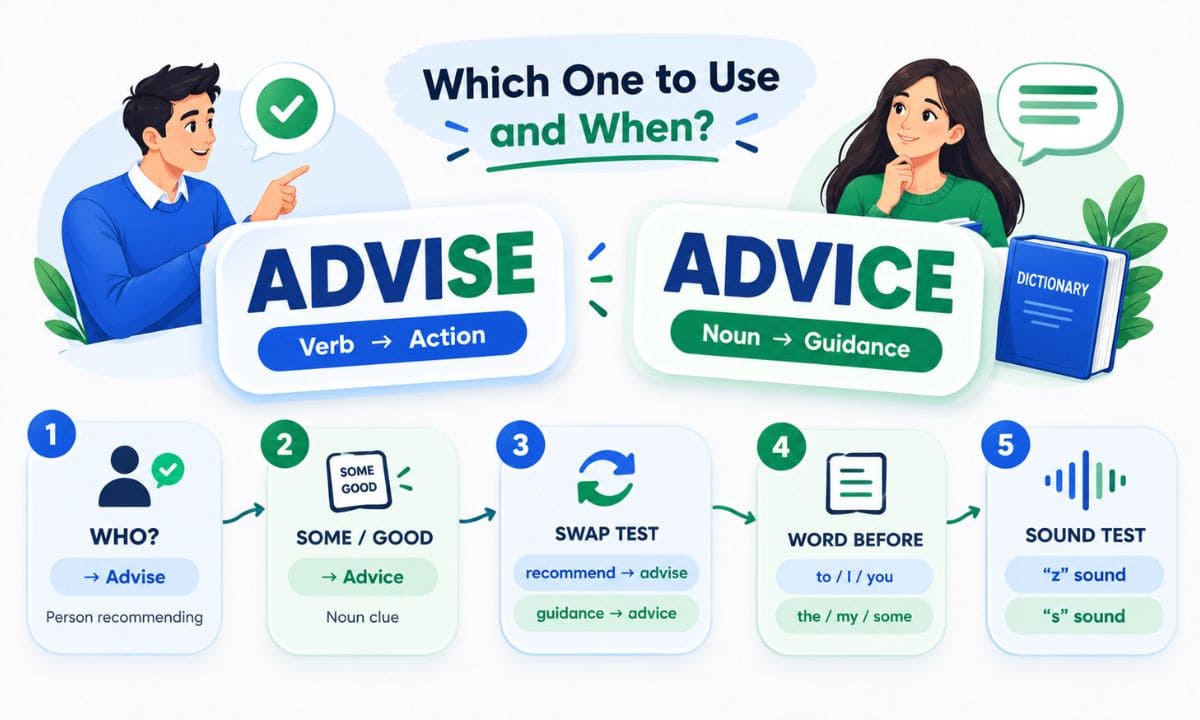
Not sure which to pick? These simple rules settle it fast.
Rule 1: Is someone doing the recommending?
Use advise.
Example:
I advise you to double-check.
Rule 2: Can you put “some,” “good,” or “a piece of” in front of it?
Use advice.
Example:
Some advice works.
Some advise doesn’t.
Rule 3: Try the swap test.
Replace the word with recommend. If the sentence still works.Use advise.
Replace it with guidance. If that works, use advice.
Rule 4: Look at the word before it.
After to or a subject like I, we, they, she, you almost always need the verb advise.
After the, my, your, some, any, good, bad, you need the noun advice.
Rule 5: Check the ending sound.
If you’d say it with a “z,” it’s advise.
If you’d say it with an “s,” it’s advice.
Wondering about advise or advice which is correct in a tricky sentence?
Run those five rules in order. One of them will settle it.
Common Mistakes People Make
Here are the errors that show up most often, with the fix for each.
❌ Can you advice me on this?
✅ Can you advise me on this?
❌ I need some advise.
✅ I need some advice.
❌ Thanks for your advise.
✅ Thanks for your advice.
❌ She gave me an advice.
✅ She gave me a piece of advice.
❌ He gave me many advices.
✅ He gave me a lot of advice.
❌ I would advice against it. → ✅ I would advise against it.
Notice the pattern? Most mistakes happen when writers use the noun spelling for an action, or the verb spelling for a thing.
One bonus note: adviser and advisor are both correct spellings for the person who gives advice. Pick one and stay consistent.
Everyday Real Life Examples
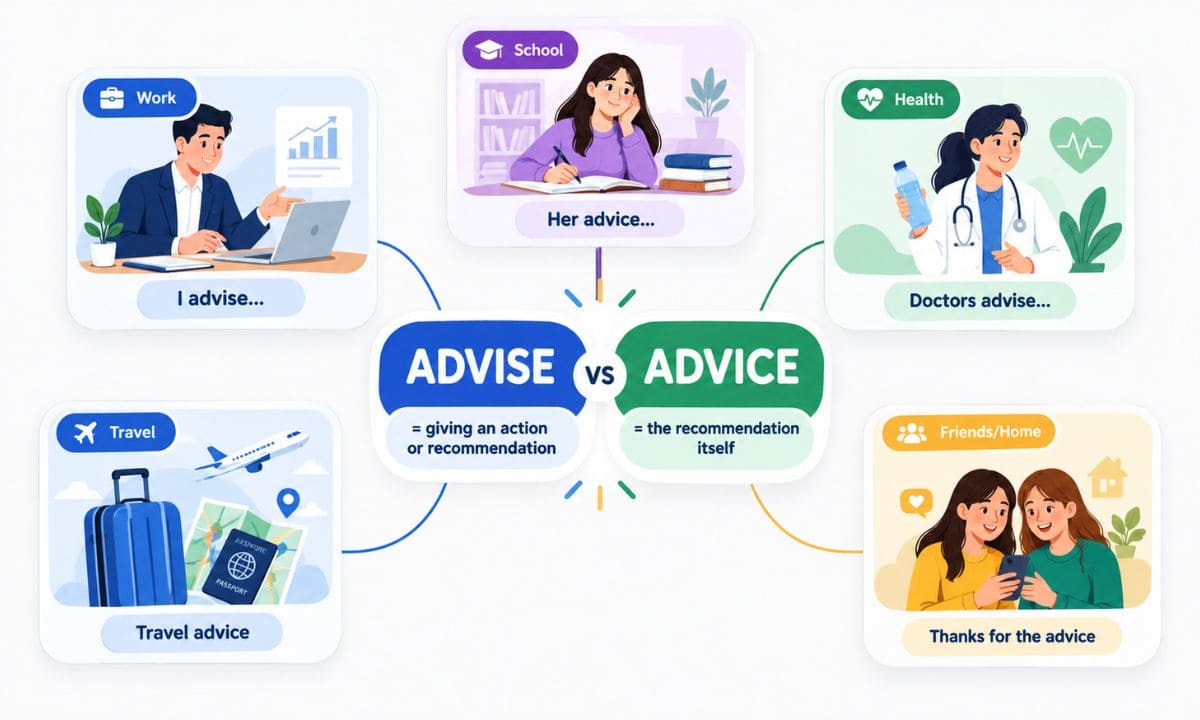
Seeing advise or advice examples in context makes the rule stick. Here are practical sentences for both words.
Examples with “advise”
At work: “I advise you to send that report before noon.”
At school: “My teacher advised me to start the essay early.”
Health: “Doctors advise drinking plenty of water in hot weather.”
Travel: “We advise travelers to arrive two hours before their flight.”
Texting a friend: “I’d advise against replying while you’re angry.”
Examples with “advice”
At work: “Her advice about the client meeting saved us.”
At school: “Can I ask for your advice on choosing a major?”
Health: “Follow your doctor’s advice and get plenty of rest.”
Home: “My grandmother’s advice was always practical.”
Texting a friend: “Thanks for the advice. You were right.”
What Do Major Dictionaries Say About Advise or Advice?
The major references agree, which makes the rule easy to trust.
Merriam-Webster lists advise as a verb meaning to give counsel or recommend, and also to inform or notify someone.
It lists advice as a noun meaning a recommendation about a decision or course of action.
Oxford dictionaries follow the same split.
Advise is the verb.
Advice is the noun, and Oxford’s learner resources mark it as uncountable, which is why “an advice” and “advices” sound wrong to native speakers.
Both also accept adviser and advisor as valid spellings.
If you want to double-check any sentence, look up the word in either dictionary and confirm its part of speech.
Advise or Advice Practice Test
Fill in each blank with advise or advice. Answers are at the bottom.
- My mentor gave me some great career ______.
- I ______ you to read the contract carefully.
- Could you ______ me on which laptop to buy?
- Thank you for your ______. It really helped.
- The lifeguards ______ swimmers to stay near the shore.
Answers:
advise (a verb, the lifeguards are doing it)
advice (a noun, something you receive)
advise (a verb, an action)
advise (a verb, follows “could you”)
advice (a noun, follows “your”)
Pro Tips
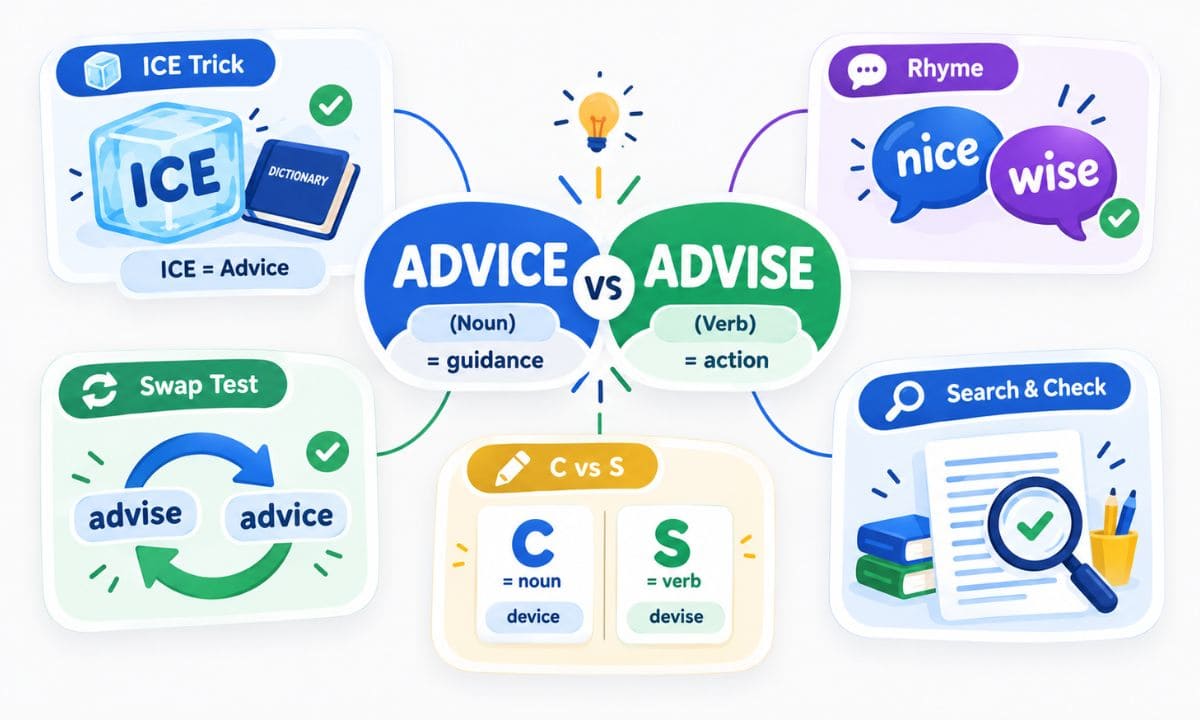
Here are easy ways to never mix these up again.
1. Remember the “ice” trick. Advice has ice hiding inside it. Ice is a noun, and so is advice.
2. Use the rhyme. Advise rhymes with wise. Advice rhymes with nice. Say it out loud if you’re stuck.
3. Do the swap test. If recommendations fit, write advise. If guidance fits, write advice.
4. Learn the pattern. Other pairs work the same way: device (noun) and devise (verb), prophecy (noun) and prophesy (verb). The c spelling is usually the noun, and the s spelling is the verb.
5. Proofread with search. Before you publish, search your document for “advise.” Every hit should be an action. Then search for “advice.” Every hit should be a thing.
Frequently Asked Questions
Advise or advice: which is correct in a sentence?
Both are correct, but they do different jobs. Use advise when you mean the action of recommending, and advice when you mean the recommendation itself.
What is the difference between advise and advice?
Advise is a verb, and advice is a noun. I advise you to rest uses the verb. Rest is good advice uses the noun.
Is advice countable?
No. Advice is an uncountable noun, so you can’t say an advice or advices. Say some advice, a lot of advice, or a piece of advice instead.
Is it “advise you” or “advice you”?
It’s always advise you. Since you’re describing an action, you need the verb. I advise you to call ahead.
Is “Please advise” correct?
Yes. Advise is the verb, and you’re asking someone to weigh in, so the grammar is fine. Tone is the catch. In a lot of inboxes it reads a little cold, like you’re handing the problem back. “Please advise on next steps” is clearer, and “Could you let me know how you’d like to handle this?” is friendlier.
Can I say “an advice”?
Nope. Advice has no singular or plural, so a and an are out. Say some advice, good advice, or a piece of advice.
Is “advices” a word?
Technically, yes, just not one you need. Banks and shippers use it for notices, like “remittance advices.” Anywhere else, drop the s. And if you actually wanted the verb, it’s advises: She advises new students.
Should I say “advice” or “advise me”?
Depends what the sentence needs. Want someone to recommend? Can you advise me on which plan to pick? Want to name what you’re asking for? I’d appreciate your advice on which plan to pick. Both work. “Advice me” and “your advise” don’t.
Is “thank you for your advice” correct?
Yes, exactly right. Your signals a noun, and the noun is advice. “Thank you for your advise” is the one to avoid.
Conclusion:
The difference between advise and advice is simple once you see it. Advise is the verb (the action), and advice is the noun (the thing). Remember the “ice” trick, try the swap test, and you’ll get it right every time.
Next time you’re stuck on advise or advice, ask yourself one question: Am I doing something, or naming something? Your answer tells you which word to use.
