

You’re writing an email and want to explain that something can be used, works properly, or is ready for a particular purpose. Then you pause: should you write “usable” or “useable”?
This small spelling question causes confusion for many English writers.
The good news is that the answer is simple. Let’s settle the spelling first and then explore why these two forms are often confused.
Quick Answer: Is It Useable or Usable?
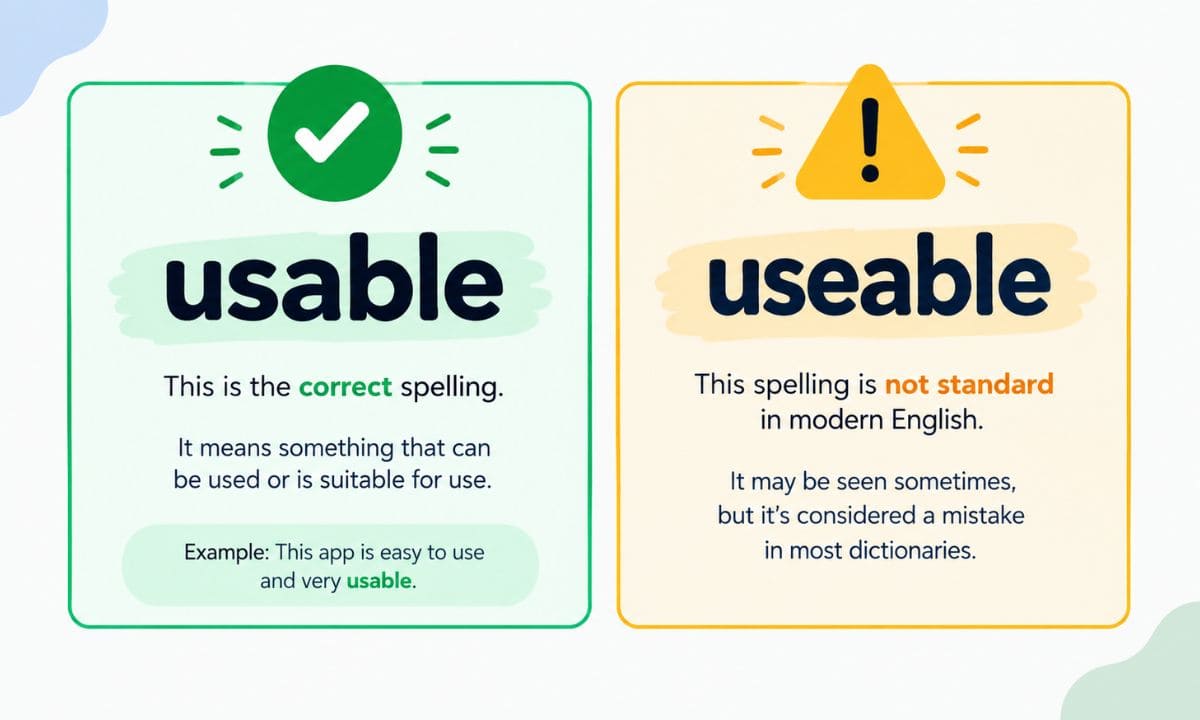
The Correct Spelling: Usable
Usable is the standard and preferred spelling.
Is “Useable” Also Correct?
Yes, technically. “Useable” is a recognized variant rather than a simple spelling error.
However, it is much less common, so usable is generally the better choice when you want modern, polished writing.
What Does Usable Mean?
Usable Meaning
Usable describes something that works, functions properly, or is suitable for a particular purpose.
An object, tool, space, or piece of information is usable when it can actually be put to use.
Usable as an Adjective
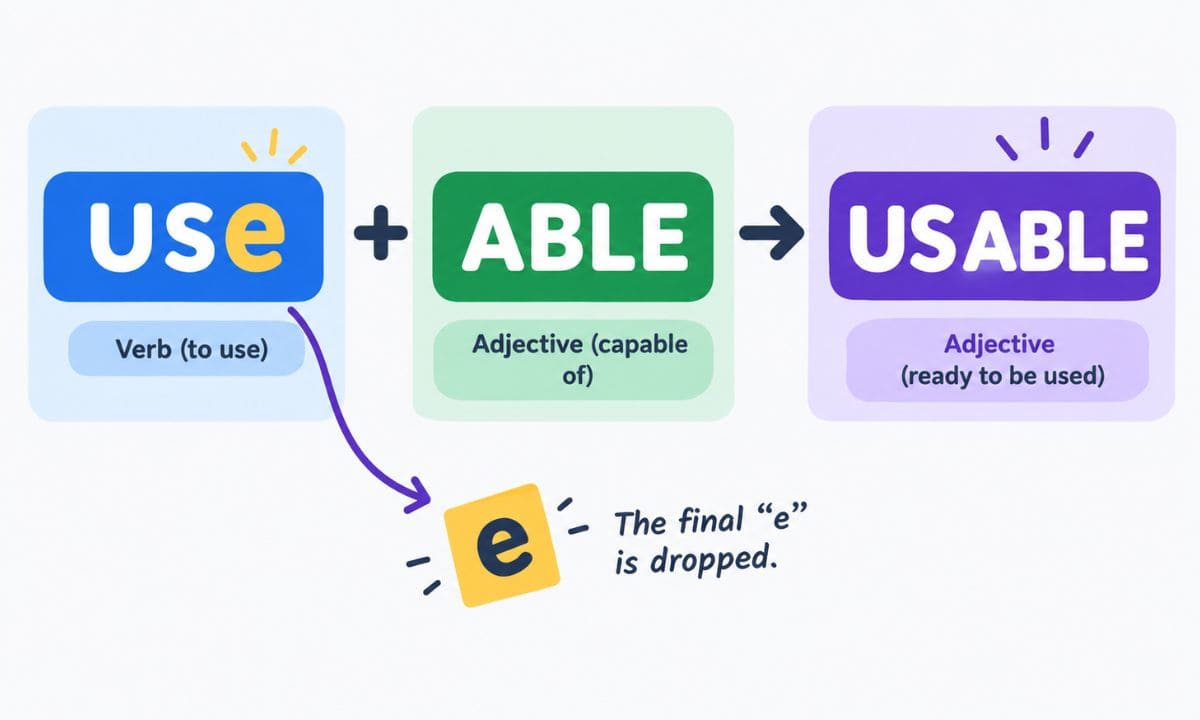
Grammatically, usable is an adjective formed from the verb “use” with the suffix “-able.”
The final “e” is removed before the suffix is added, following a common English spelling pattern.
Simple Examples of Usable
- The old laptop is still usable for basic tasks.
- Is this coupon usable at every store location?
- The report contains usable data for the marketing team.
What Does Useable Mean?
Is Useable a Correct Word?
Useable has the same meaning as usable.
The main difference is spelling and frequency. Some dictionaries recognize it as an alternative form, while it is much less common in modern writing.
Why Do People Write “Useable”?
The extra “e” can seem natural because the base word is “use.
” Writers may assume the original spelling should remain when “-able” is added.
English spelling, however, often follows established patterns rather than what seems most logical.
Usable vs Useable in Modern English
Usable vs Useable: What’s the Difference?
The two forms do not differ in meaning. The main distinction is how commonly they are used. Usable is much more frequent in books, news, professional writing, and everyday English.
Usable Spelling and Meaning
Usable removes the silent “e” before adding the suffix, similar to the spelling pattern found in words such as “movable” and “sizable.”
Useable Spelling and Meaning
Useable keeps the final “e.” This form follows a less common spelling pattern.
Words such as “changeable” and “noticeable” also retain an “e,” although those spellings have different reasons for doing so.
Why “Usable” Is Usually Preferred
Usable is shorter and is the dominant form in edited English. It is therefore the safer option for professional, academic, and general writing.
Usable vs Useable Comparison Table
| Word | Correct? | Meaning | Common Usage |
| Usable | Yes (preferred) | Capable of being used or fit for use | Business, academic, everyday, digital writing |
| Useable | Yes (variant, rare) | Same as usable | Occasional informal or older texts |
How to Remember Usable vs Useable
Easy Spelling Trick for Usable
Think of usable as the shorter and more common form. Removing the extra letter makes the spelling easier to remember.
Remember: Use + Able = Usable
Take use, drop the silent “e,” and add able:
Use + able = usable
A Simple Memory Tip
Try this phrase: “Usable is the usual choice.” The similar beginning can help you connect the preferred spelling with the word “usual.”
Which One Should You Use: Usable or Useable?
When to Use “Usable”
Use usable in emails, essays, resumes, articles, product descriptions, and casual messages. It is the standard choice for most situations.
When “Useable” May Appear
You may encounter useable in older books, informal writing, or other texts that use the variant spelling. Most readers will still understand it, but it is less common today.
Usable in Formal and Academic Writing
Academic papers, business reports, legal documents, and other formal writing are generally usable for consistency with standard dictionaries and style practices.
Common Mistakes People Make With Usable
Writing “Useable” in Formal Writing
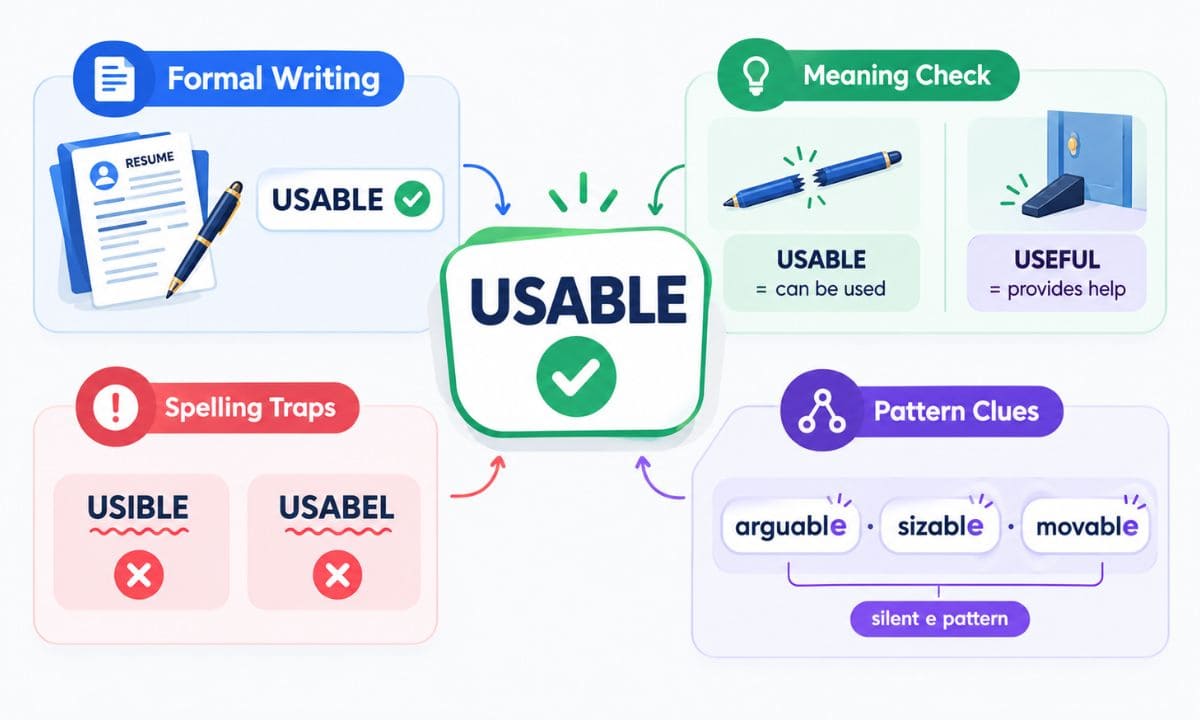
Although “useable” is a recognized variant, using usable in resumes, reports, and academic work usually gives the writing a more familiar and current appearance.
Confusing Usable With Useful
These words are not interchangeable. Usable means something can be used, while useful means something provides help or serves a valuable purpose. For example, a broken pen may be usable for holding a door open but not useful for writing.
Adding Extra Letters to Usable
Some writers create incorrect forms such as “usible” or “usabel.” These are not standard English spellings.
Other Common Spelling Mistakes
Words such as arguable, sizable, and movable can also help learners understand spelling patterns involving a silent final “e.”
Explore More Grammar Guides
Stutter vs Studder: Correct Spelling and Meaning Guide in 2026
Friend vs Freind: Common Mistake and Correct Usage Explained
Really vs Realy? A Quick Guide to Correct English Spelling (2026)
Barrel vs Barrell: Correct Spelling, Meaning, and Sentence Examples
Keep vs Kept: Which One Is Correct? Rules, Examples & Tips
Customize vs Customise: Which One Should You Use? Complete Guide
Usable in Everyday Real-Life Examples
Usable in Everyday Conversation
“This umbrella is barely usable after the storm broke two ribs.”
Usable in School and Academic Writing
“The survey provided usable results for the research paper.”
Usable in Business and Professional Writing
“Our team needs usable feedback before the next product release.”
Usable in Technology and Product Descriptions
“The app was redesigned to be more usable on smaller screens.”
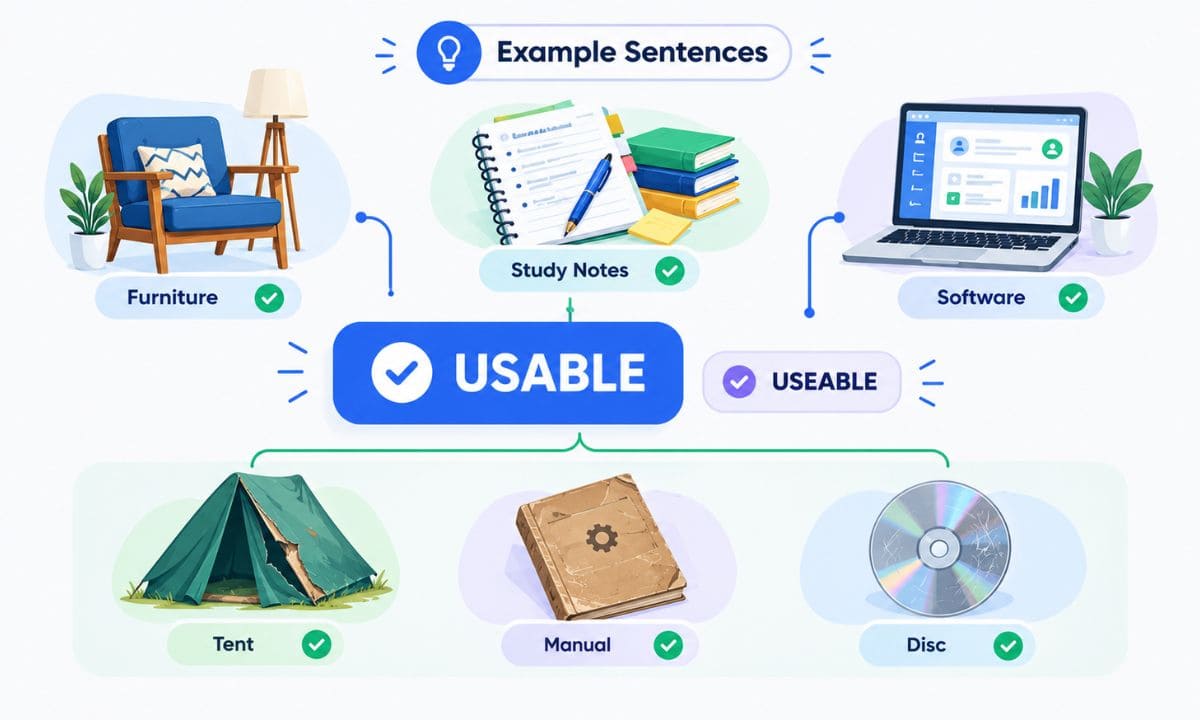
Usable vs Useable Example Sentences
Examples With “Usable”
The furniture is old but still usable.
Make sure your notes are usable for the final exam.
The software update made the dashboard far more usable.
Examples With “Useable”
The tent is torn, but it’s still useable for a short camping trip.
He found a useable copy of the old manual in the attic.
Despite the scratches, the disc remained useable.
Usable or Useable: American vs British English
Usable in American English
American English strongly favors usable in news writing, textbooks, business communication, and general usage.
Usable in British English
British English is also commonly used usable. The preference does not change in the way some other spelling differences do between British and American English.
Does British English Prefer “Useable”?
Not generally. This is not a major British-vs-American spelling difference like “flavour” and “flavor.” Both varieties are commonly used usable.
What Do Major Dictionaries Say About Usable and Useable?
Cambridge Dictionary
Cambridge lists usable as the standard entry, with little to no separate emphasis on “useable” as the preferred form.
Merriam-Webster
Merriam-Webster recognizes usable as the main spelling and treats “useable” as a valid secondary variant.
Oxford Languages
Oxford treats usable as the primary spelling in both American and British reference entries, with “useable” appearing as a less-used alternative.
Collins Dictionary
Collins includes both forms and shows usable as the more frequent spelling in real-world language use.
Usable or Useable Practice Questions
Choose the Correct Spelling
- The chair is old but still (usable/useable).
- Is this ticket (usable/useable) for tomorrow’s show?
Fill in the Blank
- The data collected was ______ for the final report.
Correct the Spelling
- “This useable code needs to be updated.” → Fix the spelling.
Answers and Explanations
Usable the standard spelling in general English.
Usable appropriate for both formal and casual writing.
Usable it fits naturally in a report or academic context.
“This usable code needs to be updated.“Usable” is the preferred spelling.
Frequently Asked Questions
Is useable a real word?
Yes. Useable is a recognized variant of usable, although it is much less common.
Which spelling do dictionaries prefer?
Major dictionaries generally give usable primary status, while some recognize “useable” as a secondary variant.
Do usable and useable mean different things?
No. Both forms have the same meaning. The difference is mainly spelling and frequency of use.
Is useable British English?
No. Both American and British English commonly favor usable.
Why does “usable” drop the “e”?
English often removes a silent final “e” before adding certain suffixes. This pattern can also be seen in words such as movable and sizable.
Is it wrong to write “useable”?
It is not generally treated as a simple spelling error because it is a recognized variant. However, usable is the more standard and widely preferred form.
Which spelling should students use in exams?
Students should normally use usable unless their teacher, textbook, or specific style guide says otherwise.
Are usable and useful interchangeable?
No. Usable means something can be used, while useful means it provides help or serves a useful purpose.
How can I remember the correct spelling?
Remember the simple pattern:
Use + able = usable
Drop the silent e before adding -able.
Does the spell check flag “useable”?
Some spell checkers recognize it as a valid variant, while others may suggest usable as the preferred form.
Conclusion: Usable or Useable?
Both usable and useable exist, and both can be found in English. However, usable is the more common and preferred spelling in modern dictionaries, professional writing, and everyday communication.
Keep the rule simple: use + able = usable.
Drop the silent e, and you’ll have the spelling most commonly preferred in modern English.
