

Meantime vs mean time is a common spelling problem. The two look alike and sound alike. So many people ask, “Is it meantime or mean time?”
The difference between meantime and mean time is easy to learn. Meantime is one word. Its meantime meaning is “the time between two events,” as in “in the meantime.” This is the form you need in most everyday writing, so meantime vs mean time is simple once you know the rule.
Mean time is two words. Its mean time meaning is “average time,” as in Greenwich Mean Time. In this guide on meantime vs mean time, you will learn the meaning, the spelling rule, and clear examples. You will also see is meantime one word or two.
At a Glance: Meantime vs Mean Time
| Word | Meaning | Correct Usage |
| Meantime (one word) | The time between two events; also “meanwhile” | In the meantime, we can use the old printer. |
| Mean time (two words) | Time based on the average (“mean”) sun, or an average length of time | Greenwich Mean Time; mean time between failures |
Quick Answer: Is It “Meantime” or “Mean Time”
Use meantime (one word) most of the time.
Meantime = the time between two events.
Example: In the meantime, please wait here.
Mean time = average time.
Example: Greenwich Mean Time.
Easy tip: If you can say “meanwhile,” write meantime. If you can say “average time,” write mean time.
📖 The Grammar Rule: Why “Meantime” Is One Word but “Mean Time” Is Two
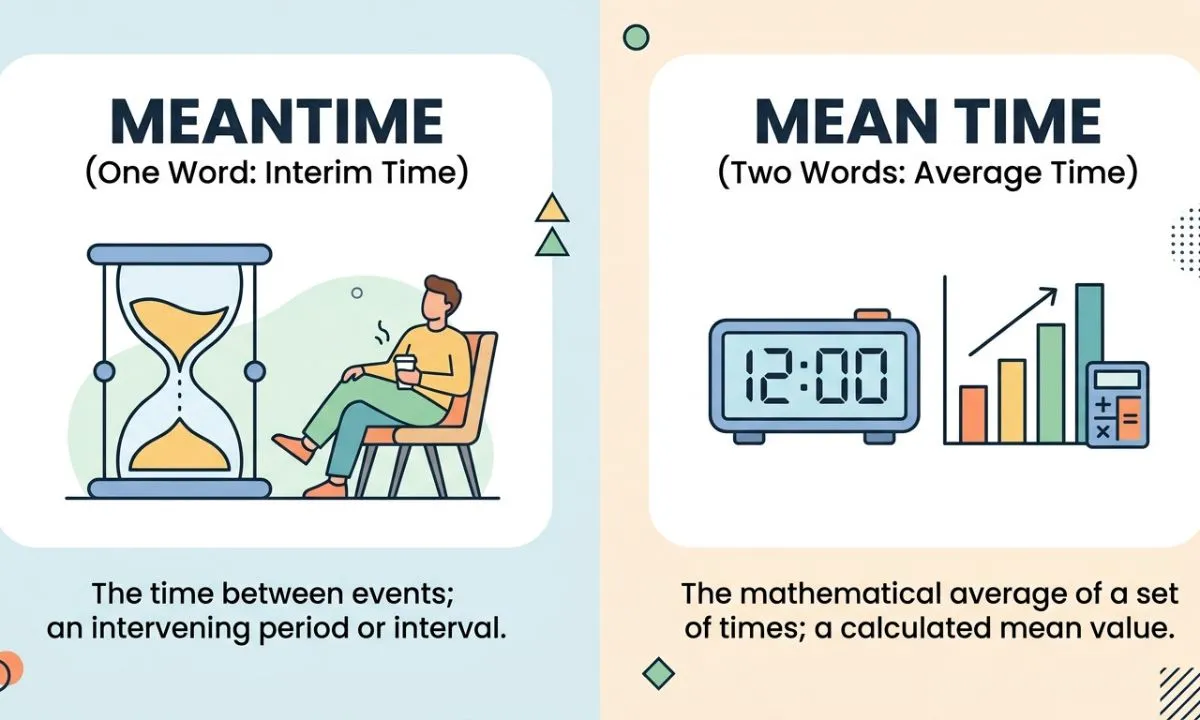
The two spellings are different kinds of words. One is a single fixed word. The other is two words that work together.
- Meantime is one word. It names the time between two events. Mean here means “in the middle.”
- Mean time is two words. Mean is an adjective that means “average.” Time is the noun it describes.
Good to know: Meantime started as two words. Over time, the one-word spelling became the standard for this meaning.
The One-Word vs Two-Word Spelling Rule
Try this quick test:
| If you can replace it with… | Write | Example |
| “the time between two events” or “meanwhile” | Meantime | In the meantime, please wait. |
| “average time” | Mean time | The mean time was 12 minutes. |
Common Examples of One-Word and Two-Word Expressions
Many English words follow the same pattern. The one-word form and the two-word form have different jobs.
| One word | Two words |
| everyday (adjective): everyday shoes | every day (adverb phrase): I walk every day. |
| sometime (adverb): Visit us sometime. | some time (noun phrase): It took some time. |
| awhile (adverb): Rest awhile. | a while (noun phrase): Rest for a while. |
| meantime: In the meantime, relax. | mean time: Greenwich Mean Time |
Meaning and Definition of Meantime and Mean Time
What Does “Meantime” Mean? (One Word)
Meantime means the time between now and a later event.
It has two jobs:
- Noun: in the meantime
- Adverb: Meantime, the kids looked for beach toys. Here it means the same as meanwhile.
Examples of “meantime” in sentences:
- The new printer arrives on Friday, so we will use the old one in the meantime.
- Dinner won’t be ready for an hour. In the meantime, let’s set the table.
- Meantime, the engineers kept working on the repair.
- I will send the full report tomorrow. In the meantime, here is a short summary.
Easy tip: If you are waiting for something, you probably need meantime.
What Does “Mean Time” Mean? (Two Words)
Mean time means average time, or time based on the “mean sun.”
It is mostly used in two areas:
- Timekeeping: Time based on the average motion of the sun. This is also called mean solar time. The best-known example is Greenwich Mean Time (GMT).
- Engineering and IT: An average length of time, such as mean time between failures or mean time to repair.
Examples of “mean time” in sentences:
- Greenwich Mean Time is the solar mean time at Greenwich in London.
- Local mean time depends on how far east or west you are.
- The server’s mean time between failures is 5,000 hours.
- The students’ mean time on the quiz was 18 minutes.
Easy tip: If the sentence is about averages, clocks, or time zones, you need mean time.
Pronunciation: Meantime vs Mean Time
They sound very similar, so spelling and context show the difference.
| Word | Pronunciation |
| Meantime (Merriam-Webster) | ˈmēn-ˌtīm |
| Meantime (US, Vocabulary.com) | /ˌminˈtaɪm/ |
| Meantime (UK, Vocabulary.com) | /ˈmintaɪm/ |
The stress may shift a little between US and UK accents.
Listeners rely on context to understand which one you mean:
- “Let’s wait in the meantime” is clearly about waiting.
- “The mean time between failures” is clearly technical.
Meantime vs Mean Time: Key Differences
| Feature | Meantime | Mean time |
| Spelling | One word | Two words |
| Core meaning | Time between two events | Average time or mean solar time |
| Part of speech | Noun and adverb | Adjective + noun |
| Typical context | Everyday speech, emails, stories | Science, timekeeping, engineering |
| Common phrase | in the meantime | Greenwich Mean Time |
| Example | In the meantime, please wait here. | The mean time to repair was two hours. |
Meantime vs Mean Time: Grammar and Parts of Speech
Meantime is a noun or an adverb. Mean time is an adjective plus a noun.
| Word | Part of speech | Example |
| Meantime | Noun | In the meantime, please wait. |
| Meantime | Adverb | Meantime, I’ll clean the kitchen. |
| Mean time | Adjective + noun | The mean time was 12 minutes. |
Meantime as a Noun
- It usually comes after a preposition, like in or for.
- Common patterns: in the meantime and for the meantime.
- Here, it is the object of the preposition.
Example: We can use the old printer in the meantime.
Meantime as an Adverb
- It can stand alone at the start of a sentence.
- Add a comma after it.
- Using meantime by itself is fine. It has been common since at least the 16th century.
Example: Meantime, I’ll start cleaning the kitchen.
Mean Time as a Phrase
- Mean is an adjective. It means “average.”
- Time is the noun it describes.
- So you can often read it as average time.
- This is why it works in technical terms like mean time between failures.
Example: The server’s mean time between failures is 5,000 hours.
How to Use “Meantime” and “Mean Time” in Everyday Sentences
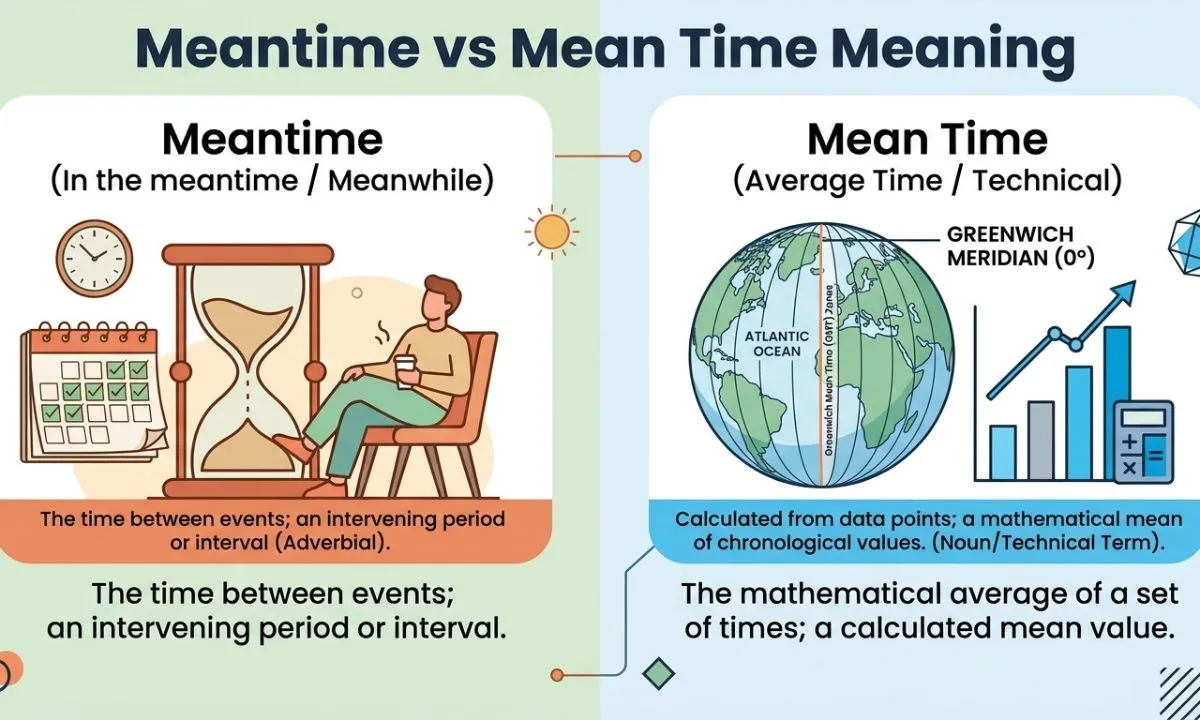
Use meantime for everyday writing. Use mean time only for time zones, science, and tech terms.
When to Use “Meantime” (One Word)
You will use meantime far more often. It fits emails, chats, schoolwork, and stories.
| Where | Example |
| The contract is with legal. In the meantime, I have attached the draft. | |
| Conversation | The bus is late. Meantime, let’s grab a coffee. |
| Schoolwork | The experiment needs 24 hours. In the meantime, record your notes. |
When to Use “Mean Time” (Two Words)
Use mean time when the topic is time zones, astronomy, or reliability.
| Where | Example |
| Time zones | The meeting is at 15:00 Greenwich Mean Time. |
| IT and engineering | We reduced the mean time to detection after upgrading our tools. |
Easy tip: Waiting for something? Write meantime. Talking about averages or clocks? Write mean time.
Explore More Grammar Guides
Stutter vs Studder: Correct Spelling and Meaning Guide in 2026
Anise vs Aniseed: Are They the Same? Find Out the Real Difference
Friend vs Freind: Common Mistake and Correct Usage Explained
Really vs Realy? A Quick Guide to Correct English Spelling (2026)
Volume vs Volumn: 1 Common Mistakes and Correct Usage Explained
Habit vs Habbit: Common Error, Meaning, and Usage Guide
Using vs Useing: Which Spelling Is Correct? Find Out Now
Divide vs Devide: Meaning, Examples, and Spelling Made Easy
Outing vs Outting: Common Mistakes and the Correct Usage Explained
Common Phrases and Alternatives for Meantime and Mean Time
Phrases and Alternatives for “Meantime”
| Phrase | Note |
| in the meantime | The standard phrase |
| for the meantime | Used and understood. For the time being is more common. |
| meanwhile | Very close in meaning |
| in the interim | More formal |
| for now | Short and casual |
| until then | Simple and clear |
Related Terms for “Mean Time”
| Term | Meaning |
| Greenwich Mean Time (GMT) | A well-known time standard |
| mean solar time | Another name for time based on the mean sun |
| mean time between failures (MTBF) | Average time a system works before it fails |
| mean time to repair (MTTR) | Average time needed to fix a problem |
| average time | The plain-English version |
An Easy Trick to Remember the Correct Spelling
Think: one gap, one word.
| If you mean… | Think | Write |
| The time between two events | One gap | Meantime |
| An average | Two ideas: mean + time | Mean time |
Common Mistakes and Memory Tricks for Meantime vs Mean Time
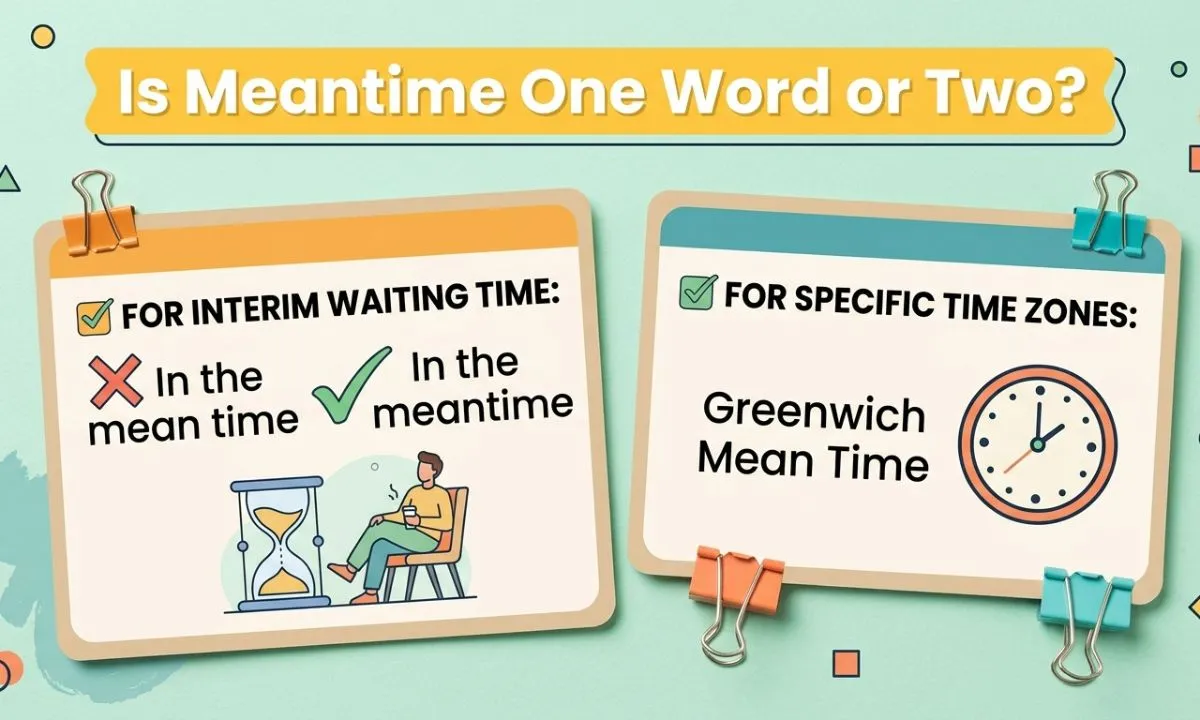
These are spelling mistakes, not grammar errors. Both spellings are real words, but each has its own meaning.
3 Common Mistakes
Mistake 1: Splitting “meantime” in a common phrase
- ❌ Incorrect: The files arrive Monday. In the mean time, please review the draft.
- ✅ Correct: The files arrive Monday. In the meantime, please review the draft.
- Why: The phrase “in the meantime” uses the one-word form.
Mistake 2: Joining “mean time” in a fixed term
- ❌ Incorrect: The clock is set to Greenwich Meantime.
- ✅ Correct: The clock is set to Greenwich Mean Time.
- Why: Greenwich Mean Time is a fixed technical term. It is written as three words.
Mistake 3: Joining “mean time” in a technical phrase
- ❌ Incorrect: The machine’s meantime between failures is very low.
- ✅ Correct: The machine’s mean time between failures is very low.
- Why: Here, mean means “average.” So it stays a separate word.
Why Do People Write “Mean Time” Instead of “Meantime”?
There are two main reasons:
- It looks familiar. Meantime began as two words, so the older form still looks right to many people.
- Spell-checkers don’t catch it. Both spellings are real words. And they sound almost the same.
Remember: Only the meaning tells you which spelling to choose.
Meantime vs Mean Time in American and British English
There is no spelling difference. American and British writers spell both the same way.
| Word | American English | British English |
| Meantime (the time between) | meantime | meantime |
| Mean time (average or solar time) | mean time | mean time |
- The only difference in dictionary notation is a small pronunciation shift. The US and UK stress patterns are listed in the pronunciation section above.
- Greenwich Mean Time is named after Greenwich in London. It is used worldwide as a time reference.
Remember: You do not need to change your spelling for US or UK readers.
What Major Dictionaries Say About Meantime and Mean Time
Dictionaries treat meantime and mean time as two separate entries with different meanings.
Merriam-Webster
| Entry | What it says |
| Meantime (noun) | The time before something happens or before a specified period ends |
| Meantime (adverb) | Means the same as meanwhile |
| Mean time (noun) | Time based on the motion of the theoretical mean sun. Also called mean solar time |
- It gives the first known use of meantime as the 14th century.
- Its usage note says meantime and meanwhile have been interchangeable for most of their history.
- It adds that meantime is usually the noun in “in the meantime” and “for the meantime.”
Vocabulary.com
- Gives the same two parts of speech: noun and adverb.
- Lists interim, lag, and meanwhile as synonyms.
- Notes that the word was originally two separate words.
Wiktionary
- Traces meantime to Middle English menetime.
- Says the adverb comes from “in the meantime.”
Remember: All three sources agree. Meantime is one word for the time between events. Mean time is a separate term for average or solar time.
Quick Test I Created
Meantime vs Mean Time Quiz: Test Your Understanding
Fill in each blank with meantime or mean time.
- Dinner isn’t ready yet. In the ______, please read the menu.
- GMT stands for Greenwich ______ Time.
- Engineers measure the ______ between failures to judge reliability.
- We are waiting for the plumber. ______, I will mop the floor.
- The students’ ______ on the quiz was 18 minutes.
- Which sentence is correct? (A) I’ll call you tomorrow; in the mean time, send me the file. (B) I’ll call you tomorrow; in the meantime, send me the file.
Answer key
- meantime — “in the meantime” uses the one-word spelling.
- Mean — the full term is Greenwich Mean Time, so only Mean is missing from the blank.
- mean time — it is an average time between failures.
- Meantime — it means “in the time between”; Meanwhile would also work.
- mean time — here mean means “average.”
- B — “in the meantime” is the standard spelling.
Frequently Asked Questions
Is it meantime or mean time?
Both are real, but they have different meanings. Use meantime (one word) for “the time between two events” and mean time (two words) for average time or mean solar time, as in Greenwich Mean Time.
Is meantime one word or two?
Meantime is one word when it means the time between events. It is written as two words only in the technical term mean time. Example: “In the meantime, please review the notes.”
What does “in the meantime” mean?
“In the meantime” means “during the time between now and a later event.” It is often used to suggest what to do while waiting. Example: “The doctor will see you soon. In the meantime, please fill out this form.”
What does mean time mean?
Mean time means time based on the average, or “mean,” sun, or an average length of time. Greenwich Mean Time is one example. In engineering, mean time between failures is another.
Is “in the mean time” correct?
In modern standard writing, “in the mean time” is considered a spelling mistake. Write “in the meantime” as one word. You may see the two-word form in older texts, because the word started as two words.
Is “for the meantime” grammatically correct?
Yes, “for the meantime” is grammatically correct and appears in dictionary usage notes alongside “in the meantime.” However, “in the meantime” is more common, and “for the time being” is a popular alternative.
What is the meaning of average time?
Average time (mean time) is the total of several times divided by how many there are. For example, runs of 10, 12, and 14 minutes add up to 36 minutes, and 36 ÷ 3 gives a mean time of 12 minutes.
What is the difference between meantime and meanwhile?
Meantime and meanwhile are close in meaning, and both can mean “during the time in between.” Meantime is usually the noun in “in the meantime,” while meanwhile is the usual standalone adverb. Meanwhile can also mean “at the same time,” as in “You set the table; meanwhile, I’ll start cooking.”
Is “meantime” a noun or an adverb?
Meantime can be both. It is a noun in “in the meantime” and an adverb when it begins a sentence, as in “Meantime, the team kept working.”
Conclusion
The meantime vs mean time question comes down to meaning. Use meantime (one word) for the time between two events, especially in the phrase “in the meantime.” Use mean time (two words) for average time and terms like Greenwich Mean Time or mean time between failures. When in doubt, ask yourself: Do I mean “meanwhile” or “average time”? That one question will pick the right spelling every time.
“Keep sharpening your writing with more grammar guides on Gramar Nesty.”
