

Ever paused mid-email, unsure whether to type “inquire” or “enquire”? You’re not alone. This is one of the most common spelling mix-ups in English.
Both words mean “to ask for information.” The real difference comes down to where you live and who you’re writing for.
Let’s break down inquire vs enquire so you never second-guess yourself again.
Quick Answer: Inquire vs EnquireWhat’s the Difference?
Here’s the deal in one breath:
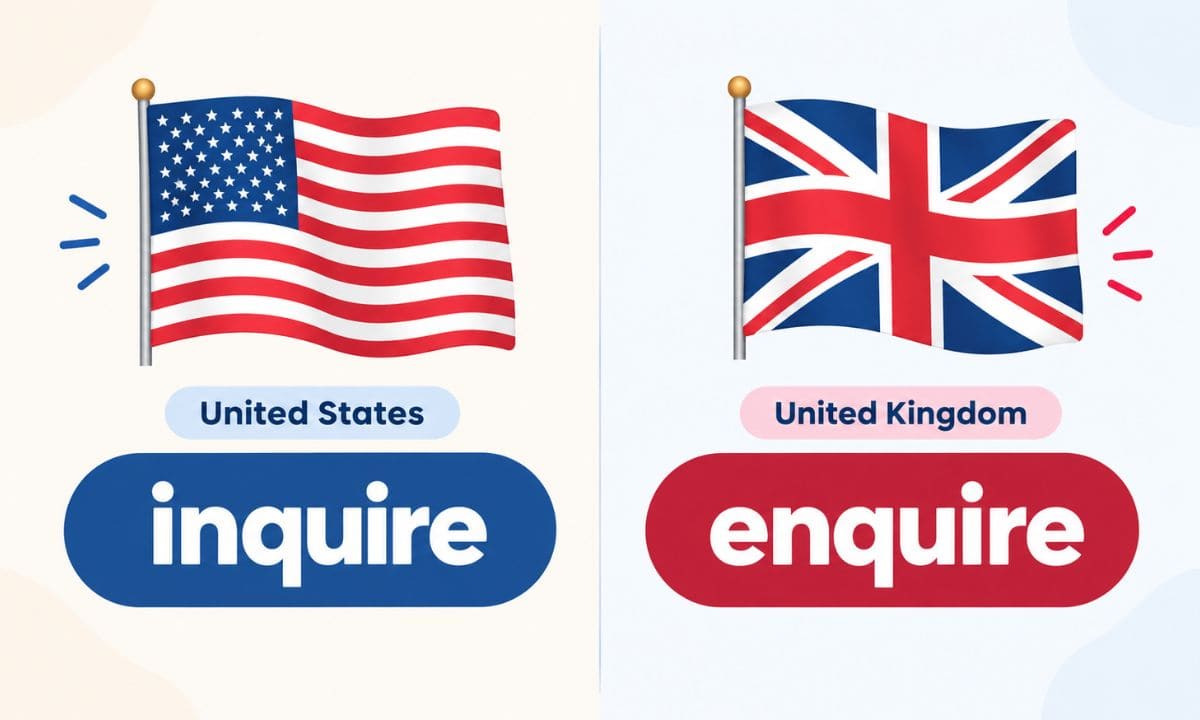
Inquire is the standard spelling in American English.
Enquire is the preferred spelling in British English.
Both words mean the same thing: to ask a question or seek information.
In British English, some writers still split the meaning: “enquire” for casual questions, “inquire” for formal investigations.
In American English, only “inquire” is used for everything.
Inquire vs Enquire: The Simple Difference Explained
Think of inquire and enquire as spelling cousins, not separate words.
Both trace back to the Latin root quaerere, meaning “to seek.” Over centuries, British and American English drifted apart on spelling, and this pair got caught in the split.
Write for a US audience? Use inquire.
Write for a UK, Australian, or Irish audience? Enquire feels more natural.
That’s the whole rule.
What Does “Inquire” Mean?
Meaning of Inquire
Inquire is a verb that means to ask for information, often in a formal or official way.
It’s the word you’ll see in legal documents, business emails, and news reports.
Examples of Inquire
- She inquired about the job opening.
- The detective began to inquire into the missing files.
- Please inquire at the front desk for directions.
When to Use Inquire
Use inquire when you’re writing for American readers, drafting formal or business content, or referring to an official investigation.
What Does “Enquire” Mean?
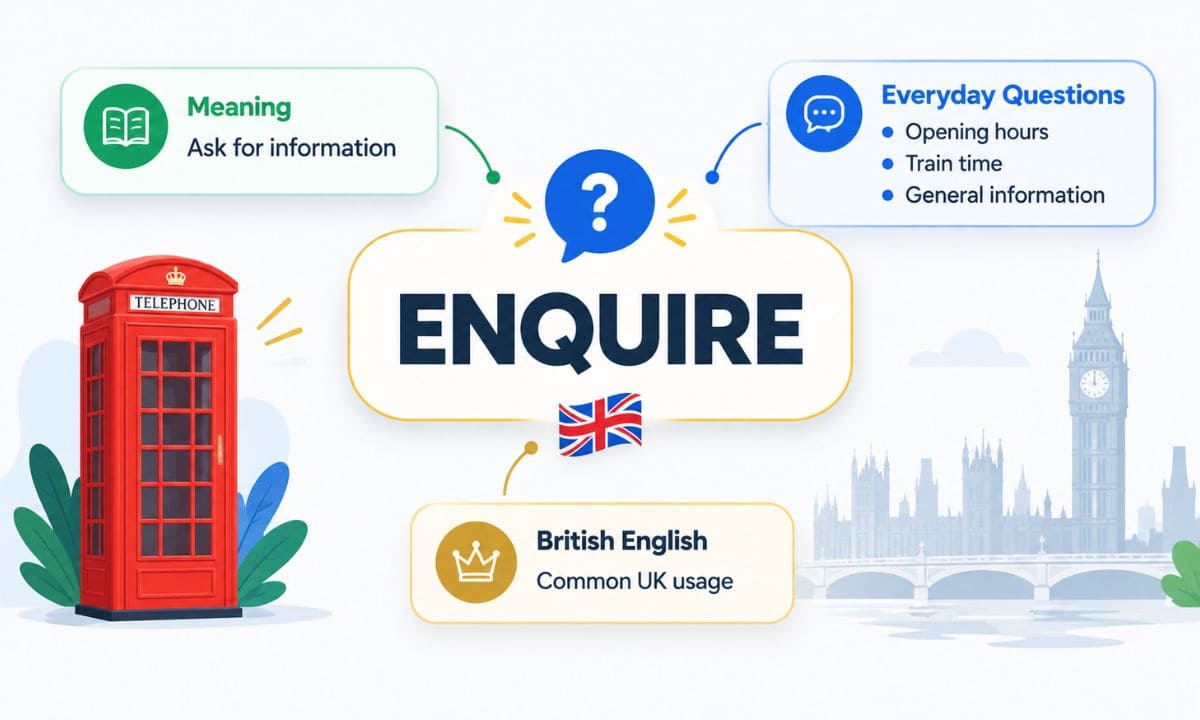
Meaning of Enquire
Enquire also means to ask for information, but it leans toward everyday, general questions. In British English, it’s the go-to spelling for most situations, formal or not.
Examples of Enquire
- I’d like to enquire about your opening hours.
- He enquired whether the train was on time.
- Feel free to enquire within.
When to Use Enquire
Use enquire when writing for a British, Australian, or Irish audience, or when asking a casual, everyday question in a UK context.
Are Inquire and Enquire the Same Word?
Yes and no.
They share the same root, the same pronunciation, and roughly the same meaning.
The main difference is regional spelling, plus a fading British tradition of using “inquire” for formal investigations and “enquire” for general questions. Most style guides now treat them as interchangeable spellings of one word.
Inquire vs Enquire: Pronunciation Guide
How to Pronounce “Inquire”
Inquire is pronounced in-KWY-er
(three syllables, stress on the second).
How to Pronounce “Enquire”
Enquire is pronounced en-KWY-er, following the same pattern.
Are They Pronounced the Same?
Practically, yes.
The only difference is the opening sound: a short “in” versus a short “en.” Say them out loud and you’ll barely notice a gap.
Inquire vs Enquire: British vs American English
Is “Inquire” American or British English?
Inquire is the dominant spelling in American English.
It’s also used in British English, but mainly for formal investigations rather than casual questions.
Is “Enquire” American or British English?
Enquire belongs to British English.
American readers rarely use it, and US style guides like the Chicago Manual of Style and AP Stylebook don’t recognize it as standard.
Why Do British and American English Spell Them Differently?
The split traces back to spelling reforms in the 1700s and 1800s.
American English, shaped heavily by Noah Webster’s dictionaries, favored simpler or more standardized spellings, while British English kept older French-influenced forms. The same pattern shows up in color/colour and organize/organise.
Inquire vs Enquire Comparison Table
| Feature | Inquire | Enquire |
| Meaning | To ask for information, often formally | To ask for information, often casually |
| Common in | Business, legal, and official writing | Everyday speech and general writing |
| English variety | American English (and formal British English) | British, Australian, and Irish English |
| Formality | Formal to neutral | Neutral to informal |
| Example | The board will inquire into the budget shortfall. | She enquired about the price of the tickets. |
When Should You Use “Inquire”?
Use “Inquire” in American English
If your audience is in the US, always choose to inquire. It’s the only accepted spelling in American publications.
Use “Inquire” for Formal Questions
Inquire fits official contexts: investigations, audits, legal proceedings, and government matters.
Use “Inquire” in Professional Writing
Business emails, cover letters, and reports read more polished with inquire, especially for a global or US-based audience.
Examples of “Inquire” in Sentences
The auditors plan to inquire into last quarter’s expenses.
Our team will inquire further before signing the contract.
I’m writing to inquire about the status of my application.
When Should You Use “Enquire”?
Use “Enquire” in British English
If you’re writing for UK, Australian, or Irish readers, enquire will feel more familiar and expected.
Use “Enquire” for General Questions
Enquire works best for everyday, low-stakes questions rather than formal investigations.
Use “Enquire” in Everyday British Writing
Signs, customer service scripts, and casual UK business writing often lean on enquire.
Examples of “Enquire” in Sentences
- Please enquire at reception for your room key.
- I enquired about the return policy before buying.
- She enquired if the museum was open on Sundays.
Inquire vs Enquire in Real-Life Situations
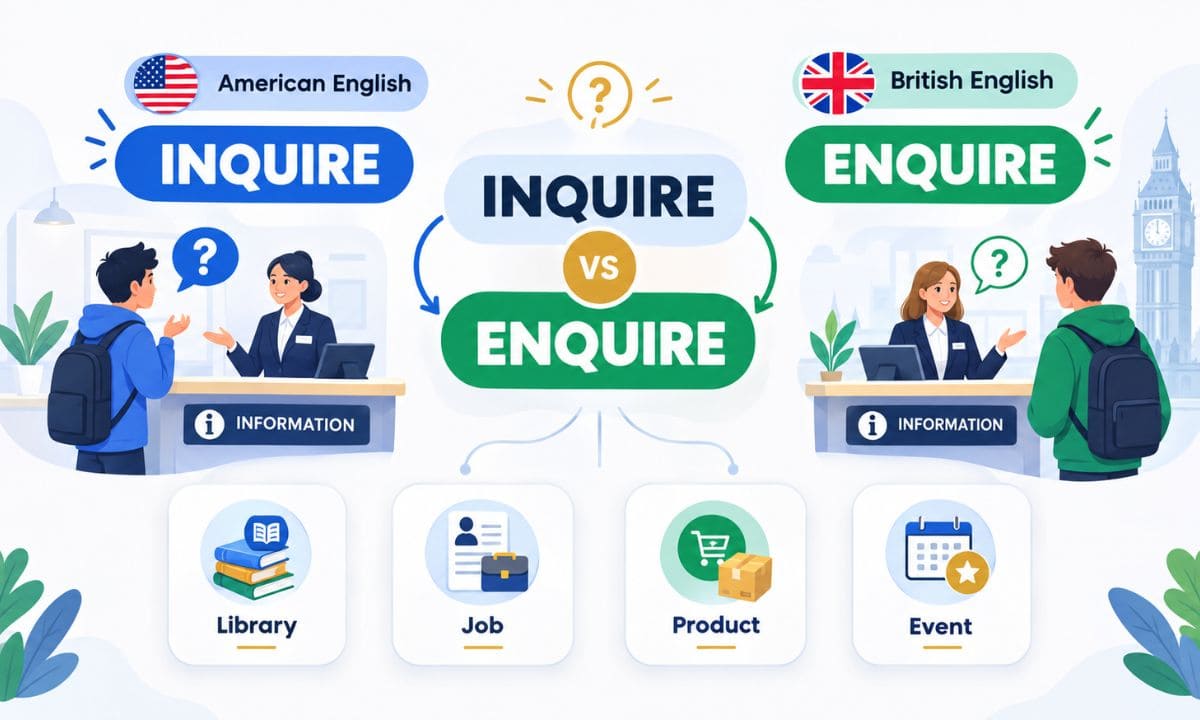
Inquire vs Enquire in Emails
American emails: “I’m writing to inquire about the position.”
British emails: “I’m writing to enquire about the position.”
Inquire vs Enquire at Work
In US offices, HR and legal teams use inquire almost exclusively.
In UK offices, enquire shows up more in day-to-day correspondence.
Inquire vs Enquire in Customer Service
British companies often say “Enquire Now” on their websites.
American companies use “Inquire Now” or simply “Ask a Question.”
Inquire vs Enquire When Asking for Information
Both work the same way grammatically: inquire/enquire + about, into, whether, or if. Pick the spelling that matches your audience’s English variety.
Inquire vs Enquire in Everyday Conversation
Honestly, most people just say “ask” out loud.
Inquire and enquire show up far more in writing than in casual speech.
Inquire vs Enquire: Which Spelling Is Correct?
Is “Inquire” Correct?
Yes, always. It’s correct in American English and accepted in British English too.
Is “Enquire” Correct?
Yes, it’s correct in British, Australian, and Irish English. It’s simply uncommon in American writing.
Can You Use Both in English?
You can, but consistency matters more than the choice itself. Pick one spelling and stick with it throughout a single document.
Common Mistakes With Inquire and Enquire
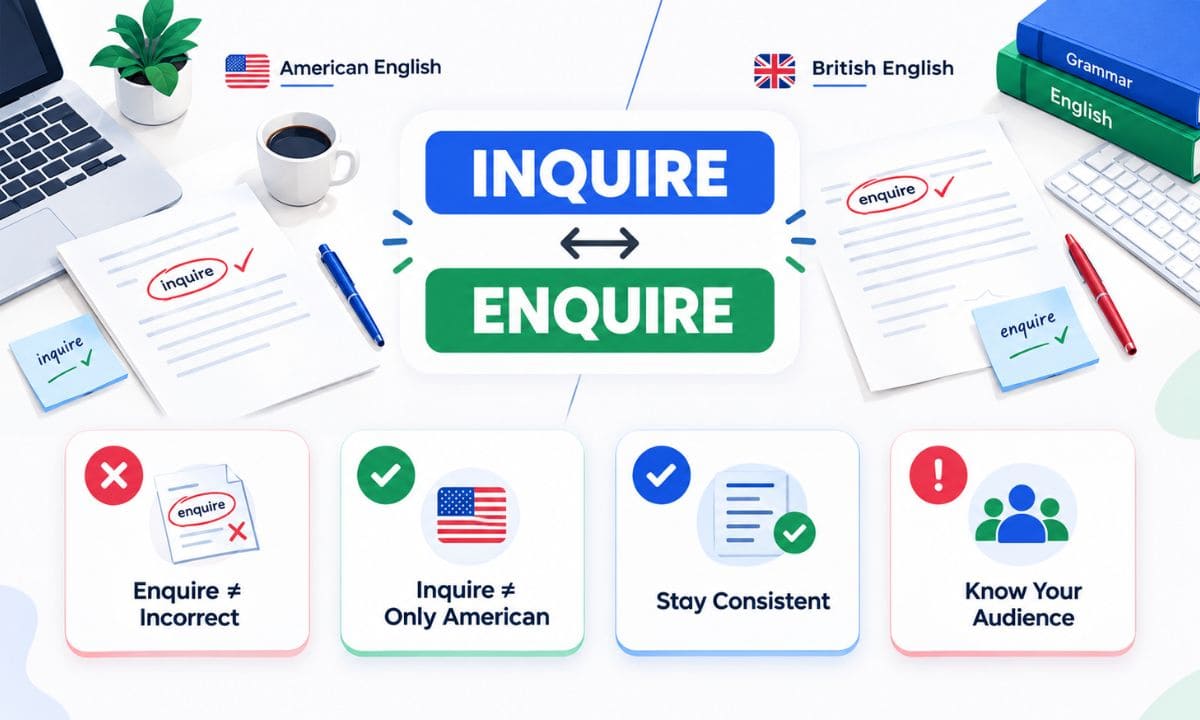
Mistake 1: Thinking “Enquire” Is Incorrect
Some American writers assume enquire is a typo. It isn’t; it’s simply the British spelling.
Mistake 2: Assuming “Inquire” Is Only American
Inquire is used in British English too, particularly for formal investigations like a public inquiry.
Mistake 3: Mixing British and American Spelling
Switching between inquire and enquire within the same document looks inconsistent and unpolished. Choose one and stay with it.
Mistake 4: Choosing a Spelling Without Considering Your Audience
Writing “enquire” for a US audience, or “inquire” for a strictly British audience, can feel slightly off, even if it’s not technically wrong.
Explore More Grammar Guides
Stutter vs Studder: Correct Spelling and Meaning Guide in 2026
Anise vs Aniseed: Are They the Same? Find Out the Real Difference
Friend vs Freind: Common Mistake and Correct Usage Explained
Really vs Realy? A Quick Guide to Correct English Spelling (2026)
Barrel vs Barrell: Correct Spelling, Meaning, and Sentence Examples
Customize vs Customise: Which One Should You Use? Complete Guide
Monkeys vs Monkies: Which One Should You Use in Formal English Writing?
How to Remember Inquire vs Enquire
Easy Memory Trick for “Inquire”
Think: “I” for inquire, “I” for the USA (as in the American “I” sound). If you’re American, use inquire.
Easy Memory Trick for “Enquire”
Think: “E” for enquire, “E” for England. If you’re British, use enquire.
British vs American Spelling Tip
When in doubt, check other spelling pairs in your document. If you’re already using “colour,” “organise,” or “favourite,” go with enquire. If you’re using “color,” “organize,” or “favorite,” go with inquire.
Inquire vs Enquire Examples for Students and Beginners
Example 1: Asking for Information
American: “I want to inquire about the library hours.”
British: “I want to enquire about the library hours.”
Example 2: Asking About a Job
American: “She inquired about the marketing role.”
British: “She enquired about the marketing role.”
Example 3: Asking About a Product
American: “He inquired if the item was in stock.”
British: “He enquired if the item was in stock.”
Example 4: Asking About an Event
American: “They inquired about ticket prices.”
British: “They enquired about ticket prices.”.
What Do Major Dictionaries Say About Inquire and Enquire?
Oxford English Dictionary
The Oxford English Dictionary lists both spellings, noting enquire as more common in general British usage and inquire as favored for formal inquiries.
Cambridge Dictionary
Cambridge treats the two as variants, with enquire marked as the primary British form and inquire as the primary American form.
Merriam-Webster
Merriam-Webster, a US-based dictionary, lists inquire as the main entry and enquire as a lesser-used variant.
Collins Dictionary
Collins, a British dictionary, includes both spellings and confirms the regional split between American and British preference.
Quick Test I Created
QQuick Practice: Inquire or Enquire?
Choose the Correct Word
- I’d like to _______ about the refund policy. (US audience)
- The council launched an _______ into the incident. (UK, formal)
- She _______ about the bus schedule. (UK, casual)
- We will _______ further before making a decision. (US audience)
Check Your Answers
- Inquire
- Inquiry (formal investigation, British spelling)
- Enquired
- Inquire
Easy Rule to Remember
The American audience always inquires.
British audience, enquire for everyday questions and inquire for formal investigations.
Frequently Asked Questions
Is inquire or enquire correct?
Both are correct. Inquire is standard in American English, and enquire is standard in British English.
Is enquire British or American?
Enquire is British English. It’s rarely used in American writing.
Is inquire American English?
Yes, inquire is the standard American English spelling, though it’s also used in formal British English.
What is the difference between inquiry and enquiry?
They follow the same rule as inquire vs enquire: inquiry is American, and enquiry is British, with enquiry sometimes reserved for general questions in the UK.
Can I use enquire in American English?
You can, but it will look unusual to American readers. Stick with inquiry for US audiences.
Can I use inquire in British English?
Yes, especially for formal investigations. Many British writers still use inquire in that specific sense.
Which spelling should I use in formal writing?
Match your audience: inquire for American readers, enquire for British readers, and inquire for any formal investigation.
Are inquire and enquire pronounced the same?
Almost. Both are pronounced similarly, with only a slight difference in the opening vowel sound.
Conclusion
Inquire and enquire aren’t really rivals; they’re regional siblings with the same job: asking for information. If you’re writing for American readers, inquire is your safe, correct choice every time.
If you’re writing for British, Australian, or Irish readers, enquire fits naturally, especially for everyday questions.
The real key isn’t memorizing rules forever. It’s picking one spelling based on your audience and staying consistent throughout your writing. Do that, and you’ll never trip over inquire vs enquire again.

1 thought on “Inquire vs Enquire: Meaning, Differences, British vs American English”