

You finish a solid email, your cursor lands on the last line, and you type “Warm regards” again. Fourth time today. Nothing wrong with it, but it starts to feel like a rubber stamp.
That’s why a good list of warm regards synonyms is handy. Below you’ll find 70 alternatives to warm regards, each with a meaning, a ready-to-use example and a quick tip on when it fits. Some are formal. Some are chatty. A couple you should probably skip.
Pick the one that matches your reader, not the one that sounds fanciest. That’s the whole idea behind these warm regards synonyms.
Quick Answer: What Are the Best Warm Regards Synonyms?
The best warm regards synonyms are “Kind regards,” “Warmest regards,” “Best regards,” “Warm wishes” and “Warmly.” Each one keeps the friendly tone and changes the temperature just a little.
Here’s the short version of which synonyms for warm regards to grab:
For most work emails: Kind regards or Best regards.
When you want a bit more warmth: Warmest regards, Warmly or Warm wishes.
For thanking someone: With appreciation, With gratitude or Many thanks.
For formal or first-contact emails: Sincerely, Respectfully or Cordially.
For people you know well: All the best, Take care or Sending my best.
Every other one of the warm regards synonyms in this guide is a variation on those. Keep reading if you want the reasoning behind each choice.
What Does “Warm Regards” Mean?
“Warm regards” is a closing phrase that sends good wishes to the reader.
The word “regards” here is a plural noun.
Merriam-Webster defines it as friendly greetings that carry a feeling of respect and affection .
Oxford Learner’s Dictionaries describes it as a way to send good wishes at the end of an email or letter, and it lists “warm” next to “best” and “kind” as a common partner word.
So “warm” simply turns the volume up. Best regards is neutral.
Warm regards says you actually like the person.
Scribbr puts it in the middle of the formality scale: familiar, but still a little formal.
It suits colleagues you work with often, plus friends and family. It’s a weaker fit for someone you’ve never met .
That middle position is exactly why people look for warm regards synonyms. Sometimes it’s too warm. Sometimes it’s not warm enough.
70 Warm Regards Synonyms, Grouped by Tone
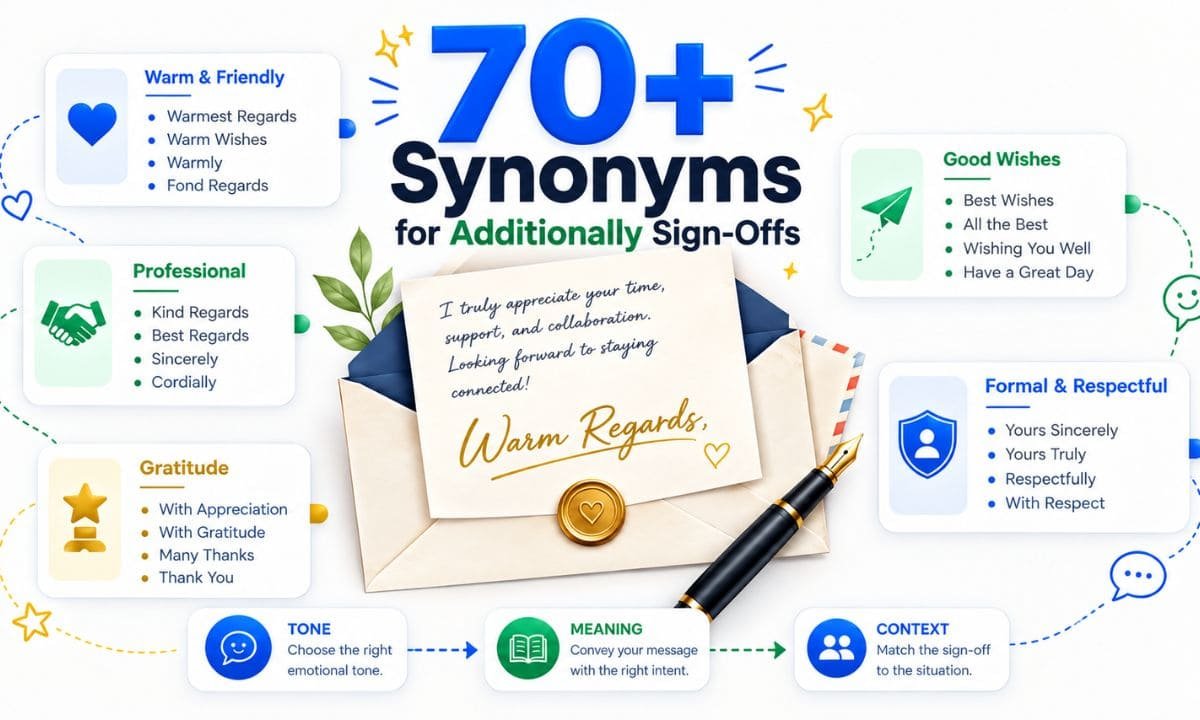
Every one of these warm regards synonyms follows the same pattern: what it means, how it looks in a real email, and when to use it (or when not to). The first stretch stays close to the original phrase. Later groups move toward gratitude, respect and casual goodbyes.
Warmest Regards
Meaning:
A stronger version of warm regards. The superlative tells the reader you feel real goodwill toward them.
Example:
“Thanks for making time on Tuesday, Priya. I’ll send the notes tomorrow morning.
Warmest regards,
Sam”
Usage Tip:
Save it for people you’ve already exchanged a few emails with. On a first message it can feel like you’re trying too hard.
Kind Regards
Meaning:
A polite, friendly closing that wishes the reader well without getting personal.
Example:
“Please find the updated invoice attached. Let me know if anything looks off.
Kind regards,
Marcus”
Usage Tip:
This is the safest swap for warm regards. It works with clients, managers, vendors and strangers alike, especially in the UK and Commonwealth countries.
Best Regards
Meaning:
A neutral, professional close. Friendly enough, but it doesn’t claim any closeness.
Example:
“I’ve attached the draft agreement for your review.
Best regards,
Elena”
Usage Tip:
Think of it as the default setting. Use it when you’re not sure how warm to be. Just don’t write “best regard” without the S. That’s a common typo.
Warm Wishes
Meaning:
A friendly closing that sends good feelings rather than formal respect.
Example:
“Congratulations on the new role! I hope the first week goes smoothly.
Warm wishes,
Jordan”
Usage Tip:
Works best around good news, holidays and celebrations. In a routine status update it can sound a little greeting-card.
Best Wishes
Meaning:
A polite close that hopes good things for the reader, often for the future.
Example:
“It was a pleasure working with you on the launch. Best wishes on the next chapter.
Best wishes,
Amara”
Usage Tip:
Good for goodbyes, farewells, job changes and end-of-project emails. Less natural for everyday back-and-forth.
Kindest Regards
Meaning:
Kind regards, one notch warmer. Still professional.
Example:
“Thank you for being so patient while we sorted this out.
Kindest regards,
Daniel”
Usage Tip:
Use it after a problem was solved or when someone did you a favor. Overusing the superlatives will dilute them, so don’t attach it to every email.
With Warm Regards
Meaning:
The same phrase as warm regards with “with” in front. It reads a little more like a traditional letter.
Example:
“I look forward to seeing you at the conference.
With warm regards,
Nadia”
Usage Tip:
Honestly, this isn’t really a new option, just a slightly more formal wrapper. Use it if you want to stay near the original while sounding less clipped.
With Best Regards
Meaning:
A formal-leaning version of best regards.
Example:
“Enclosed is the signed contract for your records.
With best regards,
Thomas”
Usage Tip:
Fits printed letters and formal PDFs better than quick emails. In a chat-style thread it can feel stiff.
With Kind Regards
Meaning:
A polished, courteous ending that leans formal.
Example:
“Thank you for your inquiry. Our team will reply within two business days.
With kind regards,
Ravi”
Usage Tip:
A common choice for customer service replies and official correspondence, where a slightly ceremonial tone helps.
Warmly
Meaning:
A one-word close that feels personal and relaxed. It carries the warmth of warm regards with fewer words.
Example:
“I loved catching up today. Let’s do it again next month.
Warmly,
Hannah”
Usage Tip:
A favorite in coaching, education and nonprofit work. It’s a little too soft for legal, finance or first-contact emails.
Sincerely
Meaning:
A classic formal close that signals honesty and good faith.
Example:
“I’m writing to apply for the operations coordinator position.
Sincerely,
Miguel Torres”
Usage Tip:
Best for cover letters, formal requests and complaints. In casual threads it feels like you’re wearing a suit to a picnic.
Yours Sincerely
Meaning:
The traditional British ending for a letter that opens with the recipient’s name.
Example:
“Dear Ms. Patel, I’m following up on our meeting last week.
Yours sincerely,
Oliver Grant”
Usage Tip:
Classic rule: “Dear Ms. Patel” pairs with “Yours sincerely,” while “Dear Sir or Madam” pairs with “Yours faithfully.” Many people ignore this now, but it’s still safe in formal UK settings.
Yours Truly
Meaning:
An old-fashioned formal closing, also used jokingly to mean “me.”
Example:
“Thank you for your prompt attention to this matter.
Yours truly,
Laura Chen”
Usage Tip:
It can come across as dated, so most modern business emails skip it. Fine for formal letters or when you want a slightly vintage tone.
With Appreciation
Meaning:
A close that puts thanks first. It says you noticed what the person did.
Example:
“Your feedback on the proposal made it much stronger.
With appreciation,
Kevin”
Usage Tip:
Best after someone helped, reviewed something or gave up their time. Don’t use it if you haven’t actually mentioned what you’re thankful for.
With Gratitude
Meaning:
A deeper, more personal way to say thanks in a closing.
Example:
“I can’t tell you how much your support meant during this project.
With gratitude,
Sofia”
Usage Tip:
Keep it for genuine, bigger favors. Used on routine emails, it sounds inflated.
Many Thanks
Meaning:
A warm, quick thank-you that doubles as a sign-off.
Example:
“Could you send the slides by Thursday? Many thanks,
Ben”
Usage Tip:
Common in the UK, and handy when you’re asking for something. It nudges the reader to act while staying polite.
Thanks Again
Meaning:
A friendly closing that circles back to a thank-you you already gave earlier in the message.
Example:
“That intro to the design team helped a lot. Thanks again,
Chris”
Usage Tip:
Only works if you’ve already said thanks in the body. Otherwise “again” makes no sense.
Thank You
Meaning:
A simple, direct close that expresses appreciation in two words.
Example:
“Please review the attached and reply by Friday. Thank you,
Grace”
Usage Tip:
Works well when you’re making a request. Some readers find it slightly presumptuous when you’re asking for something big, so soften it with “Thank you in advance for your help” if needed.
All the Best
Meaning:
A friendly, open-ended good wish covering the reader’s life in general.
Example:
“It was great hearing from you. All the best,
Dan”
Usage Tip:
Feels natural with former coworkers, contacts you keep in touch with and people you like but don’t email weekly.
Best
Meaning:
The shortest polite sign-off, a trimmed-down best regards.
Example:
“Sounds good. I’ll book the room for 3 pm.
Best,
Ana”
Usage Tip:
The default in a lot of modern offices. Great for quick replies, a bit thin for a formal letter or a sensitive message.
Take Care
Meaning:
A caring, informal goodbye that wishes the reader safety and wellbeing.
Example:
“Sorry to hear you’ve been unwell. Rest up and don’t worry about the report.
Take care,
Leah”
Usage Tip:
Perfect after bad news or when someone’s going through something. Skip it in a cold pitch. It sounds oddly intimate.
Have a Wonderful Day
Meaning:
A cheerful farewell that wishes the reader a good day rather than just good things in general.
Example:
“Your order is on its way and should arrive Wednesday. Have a wonderful day!
Nina”
Usage Tip:
Popular in customer service and hospitality. It’s warm and upbeat, but it can feel scripted if used in every message.
Have a Great Day
Meaning:
The more casual sibling of “Have a wonderful day.”
Example:
“Thanks for the quick turnaround. Have a great day!
Tom”
Usage Tip:
Fine between colleagues and in friendly client threads. Leave it out of formal legal or executive communication.
Wishing You Well
Meaning:
A gentle close that hopes the reader is doing okay and will continue to.
Example:
“I heard about the move and hope it’s going smoothly. Wishing you well,
Iris”
Usage Tip:
Especially kind when the reader is dealing with change or difficulty. It’s sincere without being heavy.
Wishing You All the Best
Meaning:
A fuller, more generous version of “All the best.”
Example:
“Thank you for everything over the past three years. Wishing you all the best in your new role.
Michael”
Usage Tip:
Made for farewells, retirements and departures. On a normal Tuesday email it’s a bit much.
With Best Wishes
Meaning:
A slightly formal version of best wishes, often written in cards and letters.
Example:
“We’re delighted to welcome you to the team. With best wishes,
Rebecca”
Usage Tip:
Solid for welcome notes, congratulations and formal greetings.
With Warm Wishes
Meaning:
A kind, affectionate close with a little formality.
Example:
“Thank you for hosting us last week. With warm wishes,
Sara and Joel”
Usage Tip:
Nice for thank-you notes and event follow-ups where you want to sound gracious.
Sending Warm Wishes
Meaning:
A softer, more personal way to say you’re thinking of the reader.
Example:
“Hoping you and the family have a lovely holiday. Sending warm wishes,
Priyanka”
Usage Tip:
Best around holidays and for personal contacts. In a hard-nosed business exchange it can feel out of place.
Sending My Best
Meaning:
A casual, sincere close that hands over your good wishes like a small gift.
Example:
“Congrats again on the promotion. Sending my best,
Luke”
Usage Tip:
Work with people you know decently well. It’s friendly without being sappy.
Sending You Warm Wishes
Meaning:
A slightly longer, more personal cousin of “Sending warm wishes.”
Example:
“Thinking of you during this busy season. Sending you warm wishes,
Claire”
Usage Tip:
Best for personal or heartfelt notes. Not for invoices.
With Sincere Thanks
Meaning:
A polite, slightly formal thank-you close that stresses honesty.
Example:
“Your team’s quick response saved us a lot of trouble. With sincere thanks,
Andrew”
Usage Tip:
Excellent for thanking clients or partners in a professional but genuine way.
With Much Appreciation
Meaning:
A warm, formal-leaning way to say you’re deeply grateful.
Example:
“Thank you for stepping in on such short notice. With much appreciation,
Yasmin”
Usage Tip:
Use it for big favors, not small ones. It carries weight, so let it.
With Gratitude and Best Wishes
Meaning:
A two-part close that combines thanks and good will in one line.
Example:
“It’s been a privilege to work with you. With gratitude and best wishes,
Harold”
Usage Tip:
Ideal for farewell emails and thank-you letters. It’s long, so use it only when the moment deserves that length.
With Warmest Wishes
Meaning:
A heightened, more ceremonial version of “With warm wishes.”
Example:
“Wishing you a joyful season and a peaceful new year. With warmest wishes,
Elizabeth”
Usage Tip:
Perfect for holiday cards and celebration emails. Keep it away from routine messages.
Warm Wishes to You
Meaning:
A directly addressed version of “Warm wishes.” The “to you” makes it feel more personal.
Example:
“Enjoy the long weekend! Warm wishes to you and your family,
Kayla”
Usage Tip:
Good with people whose families or lives you know a little. Skip it if you’ve never met.
Best Wishes to You
Meaning:
A personal, polite way to hope for good things for the reader.
Example:
“Thanks for your help with the application. Best wishes to you as you move forward.
Omar”
Usage Tip:
Handy at the end of interviews, mentoring conversations and follow-ups where the outcome is still open.
Kind Wishes
Meaning:
A gentle, formal-leaning phrase similar to kind regards but softer.
Example:
“I’ll be in touch once the report is finalized. Kind wishes,
Beatrice”
Usage Tip:
Less common than “kind regards,” so it can stand out. That’s good if you want a fresh feel, less good if your reader expects convention.
Warmest Wishes
Meaning:
The top-warm version of warm wishes.
Example:
“Happy birthday, and thank you for being such a great mentor. Warmest wishes,
Diego”
Usage Tip:
Reserve it for personal, celebratory or affectionate notes.
Cordially
Meaning:
A polite, slightly formal closing that suggests courtesy and friendliness.
Example:
“We would be honored to have you join us at the dinner.
Cordially,
Margaret Ellis”
Usage Tip:
Excellent for invitations and formal announcements. It can feel stiff in everyday email.
Respectfully
Meaning:
A formal closing that signals deference and professionalism.
Example:
“I request a review of the decision dated March 3.
Respectfully,
Robert Hayes”
Usage Tip:
Common in legal, government, military and academic settings. It’s not warm, and it’s not meant to be.
With Respect
Meaning:
A formal, serious closing that stresses regard for the reader.
Example:
“I understand the reasons for the decision, though I see it differently. With respect,
Aisha”
Usage Tip:
Useful when you’re disagreeing politely. Be careful, because it can also sound like a polite warning shot.
With Sincere Regards
Meaning:
A polished, formal blend of sincerity and regard.
Example:
“Thank you for your continued trust in our firm. With sincere regards,
Jonathan Pike”
Usage Tip:
Good in formal correspondence where “best regards” feels too breezy.
With Kindest Regards
Meaning:
A formal, generous version of kind regards.
Example:
“It was a pleasure meeting you at the summit. With kindest regards,
Vanessa”
Usage Tip:
Fits senior-level or ceremonial messages. Overkill for a scheduling email.
With Warmest Regards
Meaning:
The most emphatic take on warm regards, dressed up in formal wording.
Example:
“Thank you again for your hospitality during our visit. With warmest regards,
Henry”
Usage Tip:
Best for thank-you letters after a special visit or event. In daily work email it’s a bit theatrical.
With Every Good Wish
Meaning:
A traditional, slightly literary way to send good wishes.
Example:
“Congratulations on your retirement. With every good wish for what comes next,
Patricia”
Usage Tip:
Charming for cards and formal letters. It sounds a little old-world, which is often the point.
With Good Wishes
Meaning:
A modest, polite close that sends goodwill without gushing.
Example:
“Thank you for the update on the schedule. With good wishes,
Felix”
Usage Tip:
A quiet alternative to best wishes. Works well in cross-cultural business writing because it’s easy to understand.
Wishing You the Best
Meaning:
A friendly, supportive close that hopes everything goes well.
Example:
“Good luck with the interview tomorrow. Wishing you the best,
Chloe”
Usage Tip:
Great before a big event, a test or a launch. It’s encouraging and human.
Wishing You Continued Success
Meaning:
A professional closing that congratulates and encourages at the same time.
Example:
“Thanks for the great partnership this year. Wishing you continued success,
Martin”
Usage Tip:
Made for business relationships that are already going well. Weak for a first email, since there’s nothing “continued” yet.
Wishing You a Wonderful Week
Meaning:
A friendly, forward-looking close, often used early in the week.
Example:
“I’ll have the mockups ready by Wednesday. Wishing you a wonderful week,
Zoe”
Usage Tip:
Sends well on Monday and Tuesday. Sent on Friday afternoon it feels off.
Wishing You a Great Week
Meaning:
The relaxed version of “Wishing you a wonderful week.”
Example:
“Talk soon. Wishing you a great week,
Ethan”
Usage Tip:
A good fit for regular contacts and ongoing projects.
Have a Lovely Day
Meaning:
A gentle, slightly British-sounding way to end a message on a warm note.
Example:
“Thanks again for the recommendation. Have a lovely day,
Isla”
Usage Tip:
Friendly and soft. Great for clients you’re on comfortable terms with.
Have a Wonderful Week
Meaning:
A cheerful farewell that looks ahead to the coming days.
Example:
“See you at Thursday’s meeting. Have a wonderful week,
Ryan”
Usage Tip:
Best sent at the start of the week. It pairs well with a friendly tone in the body of the email.
Take Good Care
Meaning:
A slightly warmer version of “Take care,” often used with people you care about.
Example:
“I’m thinking of you and your family. Take good care,
Monica”
Usage Tip:
Good in sensitive moments, such as illness or loss. Avoid it in transactional emails.
Until Next Time
Meaning:
A light closing that hints you’ll be in touch again.
Example:
“Great chatting with you at the workshop. Until next time,
Jamal”
Usage Tip:
Best for relationships that continue naturally, like networking contacts and regular partners. If there’s no next time, don’t use it.
Looking Forward to Hearing From You
Meaning:
A closing that welcomes a reply and quietly asks for one.
Example:
“I’ve attached my portfolio for your review. Looking forward to hearing from you.
Bianca”
Usage Tip:
Good in job applications and sales follow-ups. Used everywhere it turns into filler, so save it for when you truly want a response.
Looking Forward to Staying in Touch
Meaning:
A relationship-building close that shows you’d like to keep the connection alive.
Example:
“It was great to meet you at the event. Looking forward to staying in touch.
Tariq”
Usage Tip:
Ideal after networking events and introductions. It sounds warm without demanding an immediate answer.
Thank You for Your Time
Meaning:
A polite close that acknowledges the reader gave up minutes they could have spent elsewhere.
Example:
“I appreciated our conversation about the role. Thank you for your time.
Emily”
Usage Tip:
A staple after interviews, meetings and calls. It shows respect for the other person’s schedule.
Thank You for Your Consideration
Meaning:
A formal thank-you used when you’re asking for a decision, opportunity or review.
Example:
“I’ve attached my application and references. Thank you for your consideration.
Anthony”
Usage Tip:
Made for job applications, grant requests and proposals. It doesn’t fit casual chats.
Many Warm Wishes
Meaning:
A generous, affectionate close that piles on the good will.
Example:
“Thank you for the lovely card. Many warm wishes to you both,
Felicity”
Usage Tip:
Best for personal notes. In a workplace email, it tends to raise eyebrows.
Warmest Wishes to You
Meaning:
A direct, personal, high-warm closing.
Example:
“Congratulations on the wedding! Warmest wishes to you and Sam,
Rosa”
Usage Tip:
Use it for celebrations and close relationships.
With Heartfelt Thanks
Meaning:
An emotional, sincere way to close a thank-you message.
Example:
“You went far beyond what I expected. With heartfelt thanks,
Lucas”
Usage Tip:
Better when the help mattered personally. Avoid it in routine business replies.
With Heartfelt Appreciation
Meaning:
A warm, formal-leaning phrase that puts appreciation in the spotlight.
Example:
“Your guidance made a real difference to our team. With heartfelt appreciation,
Naomi”
Usage Tip:
Excellent in letters to mentors, donors and long-term clients.
With Sincere Appreciation
Meaning:
A professional, honest-sounding way to say thank you.
Example:
“Thank you for the introduction and the thoughtful advice. With sincere appreciation,
Peter”
Usage Tip:
Good in professional thank-you notes where “with appreciation” feels a bit thin.
Gratefully
Meaning:
A one-word close that expresses thanks and humility.
Example:
“I’m so glad you were able to help with the filing.
Gratefully,
Wendy”
Usage Tip:
Common in fundraising and nonprofit writing. Slightly formal, slightly emotional, so make sure it matches the moment.
Appreciatively
Meaning:
A rare one-word close that means “in a spirit of appreciation.”
Example:
“Your notes on chapter three were invaluable.
Appreciatively,
Edwin”
Usage Tip:
It’s unusual enough that some readers will pause on it. Fine if your voice is a bit literary, awkward if not.
Thankfully
Meaning:
Intended as “with thanks,” though the word usually means “luckily.”
Example:
“Thanks for handling that so smoothly.
Thankfully,
Gina”
Usage Tip:
Probably the trickiest one on this list. Readers may take it as relief (“thankfully, it’s done”) rather than gratitude. “Gratefully” is a safer pick.
Fond Regards
Meaning:
A close that adds affection to the traditional regards.
Example:
“Miss seeing you around the office. Fond regards,
Alistair”
Usage Tip:
Best for people you genuinely like and have known for a while. In a work setting it can seem too tender.
Friendly Regards
Meaning:
A relaxed take on regards that puts friendliness at the front.
Example:
“Just checking that the files arrived okay. Friendly regards,
Tess”
Usage Tip:
Works for casual business contacts, though a few readers think it sounds like a template. “Kind regards” usually reads more natural.
Best and Warmest
Meaning:
A compact blend of “best wishes” and “warmest wishes,” often shortened by writers who like a distinctive close.
Example:
“Thanks for the great collaboration this quarter.
Best and warmest,
Julian”
Usage Tip:
It’s uncommon, which is both the appeal and the risk. Stick to people who know your style.
Warmly Yours
Meaning:
An affectionate, personal ending that leans toward intimacy.
Example:
“Thinking of you all this week.
Warmly yours,
Marisol”
Usage Tip:
Better for personal letters than business. In a professional email it can come across as romantic or overly familiar.
Warm Regards Synonyms by Context
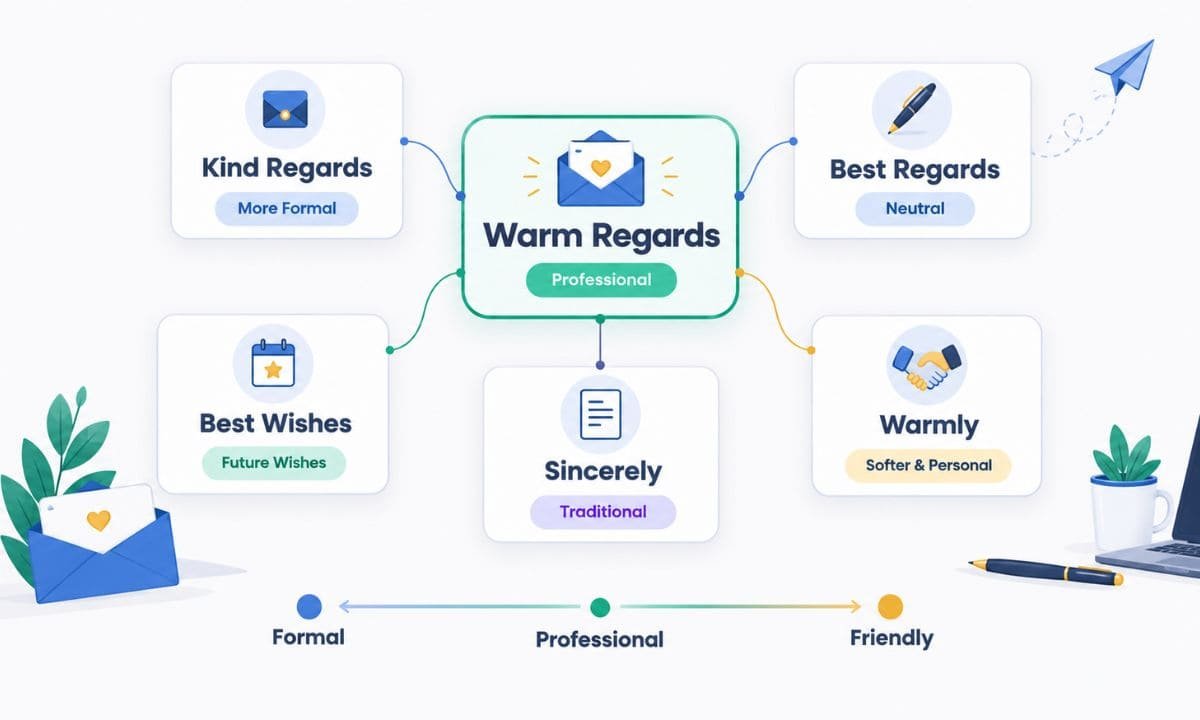
The same phrase can be perfect in one email and awkward in another. Here’s how warm regards synonyms tend to work across the situations people write about most.
Warm Regards Synonyms for Professional Emails
In professional emails, you want warmth that doesn’t cross into familiarity. The best warm regards synonyms for professional emails are Kind regards, Best regards, Best and Sincerely. All of them do the job. If you’ve built rapport with the person, Warmly or Warmest regards adds a human touch.
Avoid anything that sounds like a greeting card. “Sending warm wishes” belongs in a birthday note, not a project update.
Warm Regards Synonyms for Business Emails
For business emails, and especially anything with money, contracts or deadlines, stay with the reliable options. The most dependable warm regards synonyms for business emails, such as Kind regards, Best regards and With appreciation, keep the tone courteous and clean.
When you’re thanking a client, “With appreciation” or “Thank you for your time” gives you warmth and purpose in one line.
Warm Regards Synonyms for Formal Emails
Formal emails call for restraint. The formal warm regards synonyms Sincerely, Respectfully, Cordially and Yours sincerely all signal respect without adding emotion.
If you’re writing to a government office, a court or a senior executive you’ve never met, choose one of these and leave “Warmly” for later.
Warm Regards Synonyms for Friendly Emails
Friendly emails give you room to relax, so the friendly warm regards synonyms can be chattier. Try All the best, Take care, Send my best or Have a great day. They sound like something a person would actually say.
A good test: would you say it out loud to this person? If not, pick something plainer.
Warm Regards Synonyms for Thank-You Emails
Thank-you emails should end in gratitude. The best warm regards synonyms here are With appreciation, With gratitude, With sincere thanks and Many thanks. They all tie the closing to the message itself.
Match the size of the thanks to the size of the favor. Someone who forwarded a file gets “Many thanks.” Someone who changed your year gets “With heartfelt appreciation.”
Warm Regards Synonyms for Client Emails
Clients like warmth that’s also professional. Kind regards is the workhorse among warm regards synonyms for clients. As the relationship grows, move to Warm wishes, Warmly or Wishing you continued success.
Thank-you-style closes such as “Thank you for your time” also help, because they show you value the client’s schedule.
Warm Regards Synonyms for Coworkers
With coworkers, shorter warm regards synonyms are better. Best, Thanks or Have a great day is fine for most messages. Warmly and All the best fit people you’re close to.
Avoid closes that feel like you’re performing friendliness. Coworkers notice.
Warm Regards Synonyms by Tone
Another way to shop for warm synonyms is by tone. Here’s a quick sorter, since you might know how you want to sound before you know which phrase to use.
Formal Warm Regards Alternatives
The formal picks among warm regards synonyms: Sincerely, Yours sincerely, Respectfully, Cordially, With respect and With sincere regards. These keep emotion low and courtesy high.
Professional Warm Regards Alternatives
Professional warm regards synonyms: Kind regards, Best regards, Best, With appreciation and Thank you for your time. They’re courteous, clear and hard to get wrong.
Friendly Warm Regards Alternatives
Friendly warm regards synonyms: Warmly, Warm wishes, All the best, Wishing you well and Sending my best. They add warmth without needing a long history.
Casual Warm Regards Alternatives
Casual warm regards synonyms: Take care, Have a great day, Until next time and Best. Light, short and low-pressure.
Warm and Appreciative Alternatives
With gratitude, With heartfelt thanks, With sincere appreciation, Gratefully and Many thanks. Choose these warm regards synonyms when the point of the email is to say thank you.
Warm Regards vs. Its Closest Alternatives
Several warm regards synonyms look almost identical to the original. Here’s how they actually differ.
Warm Regards vs. Kind Regards
Kind regards is a little more formal. Scribbr places it above warm regards on the formality scale, calling it a way to wish someone well without being overly familiar. Warm regards suggests you have some rapport already.
If you’re unsure, kind regards are the safer of the two.
Warm Regards vs. Best Regards
Best regards is neutral. Warm regards are friendlier. Best regards can go to anyone, while warm regards works better with people you know.
Warm Regards vs. Best Wishes
“Regards” sends greetings. Among warm regards synonyms, the “wishes” family hopes for something good, often in the future. So best wishes fits a farewell, a celebration or an upcoming event better than an ordinary email.
Warm Regards vs. Sincerely
Sincerely is formal and traditional. Warm regards are softer and more personal. Use Sincerely in cover letters and formal requests. Use warm regards when you’d like the reader to feel some friendliness.
Warm Regards vs. Warmly
Of all the warm regards synonyms, this one means nearly the same thing. Warmly is shorter, softer and a bit more personal. Warm regards keeps a slightly more professional edge. If you’re on first-name terms, Warmly works fine.
Formal vs. Casual Warm Regards Synonyms
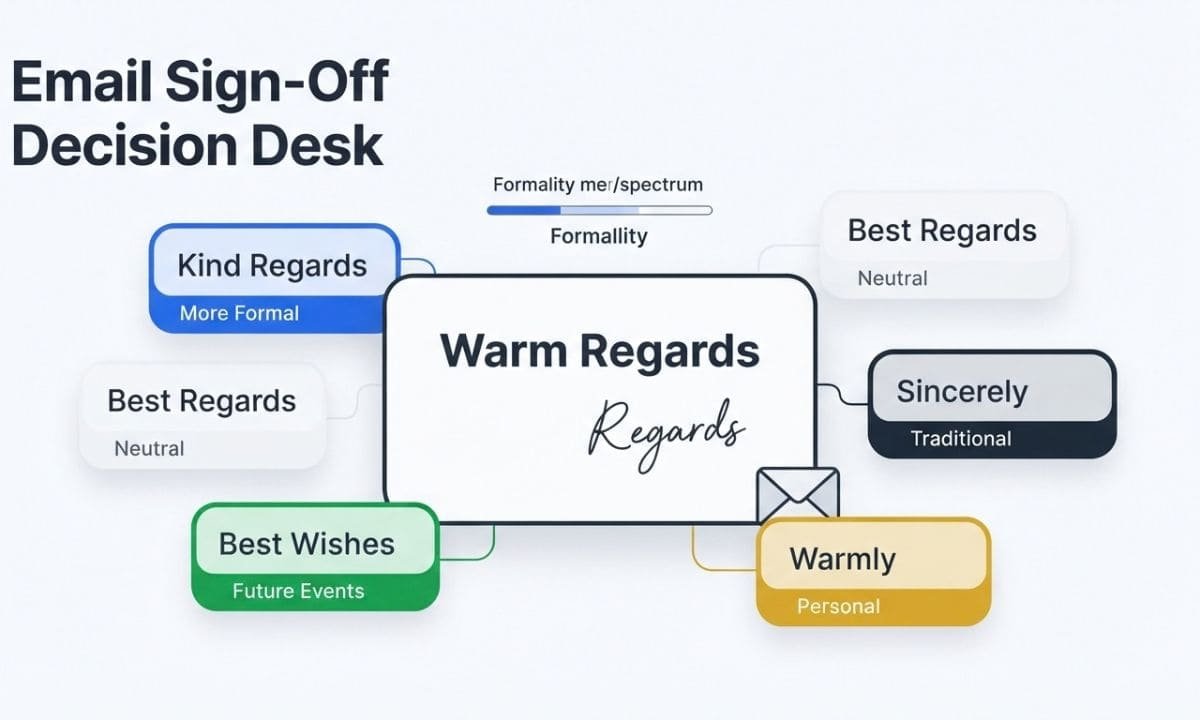
Think of your sign-off options as a dial rather than a list. Here’s where the main warm regards synonyms fall.
Formal Email Sign-Offs
The formal warm regards synonyms: Sincerely, Yours sincerely, Yours truly, Respectfully, Cordially, With respect, With sincere regards. Use them for legal notices, job applications, official letters and anything going to someone senior.
Neutral Email Sign-Offs
Best regards, Kind regards, Best, Thank you, With appreciation. These warm regards synonyms are the daily drivers. They sound professional and don’t ask anything of the reader.
Friendly Email Sign-Offs
Warm regards, Warmest regards, Warmly, Warm wishes, Best wishes, Wishing you well. Good for regular contacts, satisfied clients and colleagues you like.
Casual Email Sign-Offs
The casual warm regards synonyms: All the best, Take care, Have a great day, Sending my best, Until next time. Ideal for friends, close teammates and long-running threads.
How to Choose the Right Warm Regards Synonym
Choosing between warm regards synonyms doesn’t need a formula. But four quick questions get you to the right phrase almost every time.
Choose Based on Your Relationship
Someone you’ve never met gets a neutral close: Kind regards or Best regards. A colleague you trade jokes with gets Best or Cheers. A long-time client is somewhere in between, which is exactly where warm regards synonyms like Warmly and Warmest regards live.
Choose Based on Email Tone
Match the last line to the first line. If your opening is “Hi Jess, hope your week’s going well,” ending with “Respectfully” will feel like a jump cut. If you opened with “Dear Dr. Whitfield,” don’t close with “Take care.”
Choose Based on Your Purpose
Asking for something? Thank you, Many thanks or Looking forward to hearing from you. Thanking someone? With appreciation or With gratitude. Saying goodbye? Best wishes or Wishing you all the best. Staying in touch? Until next time or Looking forward to staying in touch.
Choose Based on Formality
When in doubt, go slightly more formal than you think you need. It’s much easier to warm up later than to cool down after an over-friendly first email. Of all the warm regards synonyms, Kind regards handles almost every “I’m not sure” moment.
Common Mistakes When Using Warm Regards Synonyms
Even good warm regards synonyms go wrong when used carelessly. These are the slip-ups that show up most often.
Using a Too-Casual Sign-Off in a Formal Email
“Cheers” or “Take care” at the bottom of a cover letter can undercut the whole message. Formal situations deserve Sincerely, Respectfully or Kind regards.
Using the Same Sign-Off in Every Email
If your signature line never changes, your reader’s eyes will slide right over it. Rotate between two or three phrases that suit different contexts. That’s the real purpose of having a list of warm regards synonyms in your back pocket.
Mixing Formal and Casual Language
“Dear Mr. Alvarez, … Have a good one!” doesn’t quite land. Keep the opening, body and your chosen warm regards synonym in the same register.
Using a Thank-You Sign-Off Without Context
“With gratitude” at the end of a message that never mentioned anything you’re grateful for sounds strange. Say what you’re thankful for in the body, then let the sign-off echo it.
Adding Unnecessary Words Before Your Sign-Off
Lines like “Hoping this email finds you well as always and wishing you all the best” before “Best regards” add nothing. One clean closing line is enough. If you want a sentence before the sign-off, make it useful, such as a next step or a date.
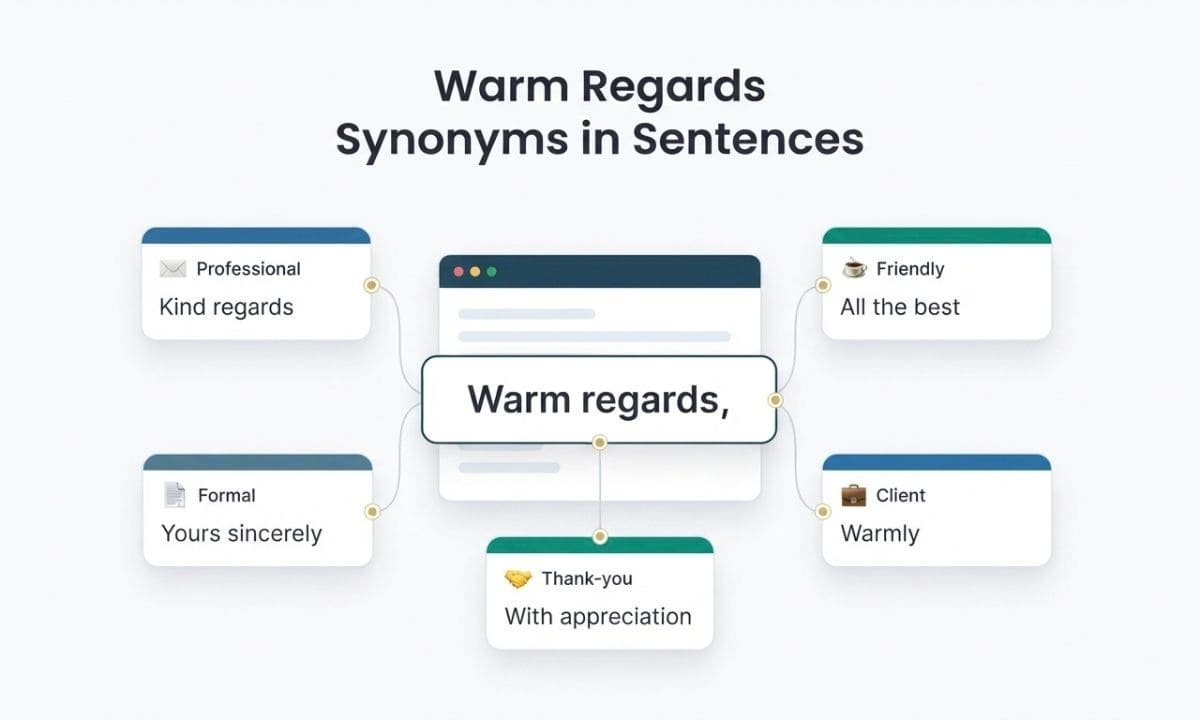
Warm Regards Synonyms in Sentences
Seeing these warm regards synonyms inside actual messages makes the differences clearer. Here are short samples for the situations you’ll meet most.
Professional Email Examples
Two warm regards synonyms in a professional setting:
“Hi Dana, the revised timeline is attached. I’ve marked the two dates that changed.
Kind regards,
Alex”
“Thanks for joining the call today. I’ll circulate the action items by the end of day.
Best,
Morgan”
Friendly Email Examples
Two friendly warm regards synonyms in action:
“Hey Lena! I loved your photos from the trip. Let’s grab coffee when you’re back.
All the best,
Nick”
“Hope the move went smoothly. Shout if you need anything.
Take care,
Jo”
Formal Email Examples
Two formal warm regards synonyms in action:
“Dear Dr. Ramirez, I am writing to request an extension on the submission deadline.
Respectfully,
Elena Ortiz”
“Dear Ms. Clarke, thank you for your letter of 12 June.
Yours sincerely,
Peter Vaughan”
Thank-You Email Examples
Two thank-you warm regards synonyms in action:
“Thank you for meeting me on such short notice. Your advice on the budget made all the difference.
With appreciation,
Rachel”
“The team is thrilled with the result. We couldn’t have done it without you.
With gratitude,
Marcus”
Client Email Examples
Two client-friendly warm regards synonyms in action:
“Hi Mr. Osei, your design files are ready for review. Happy to walk through them whenever suits you.
Warm regards,
Alina”
“It’s been a pleasure working on the rebrand together. Wishing you continued success with the launch.
Warmly,
Tobias”
What Major Dictionaries Say About “Warm Regards”
Dictionaries don’t usually list “warm regards” as its own entry. They define “regards” and show “warm,” “kind” and “best” as the words that most often come before it. Here’s what the main ones say about the word behind all these warm regards synonyms.
Cambridge Dictionary
Cambridge Dictionary treats “regards” as a plural noun used to send good wishes to someone, most often at the end of a letter or message. It’s the same core idea you’ll see everywhere else: a courteous greeting rather than a heavy emotional statement. Check the live entry for its latest wording and examples.
Merriam-Webster
Merriam-Webster lists “regards” (plural) as friendly greetings that imply respect and affection, with the everyday example of asking someone to pass on your regards. That’s a useful definition for our purposes, because it explains why warm regards feel friendly but not intimate.
Oxford Languages
Oxford’s learner entry describes “regards” as a plural form used to send good wishes at the end of an email or letter, or to pass greetings to a third person. It gives “best,” “kind” and “warm” among the typical partner words, which backs up why warm regards and kind regards are such close relatives.
Collins Dictionary
Collins covers “regards” in the same territory: greetings or good wishes, usually in letters and messages, often paired with adjectives like kind, best or warm. As with the others, the dictionary treats these as everyday courtesy rather than a fixed formula, so you have plenty of freedom to vary your close.
Explore More Synonyms Guide
25+ Struggle Synonyms: Better Ways to Say Struggle (With Examples)
25+ Policy Synonyms: Useful Alternatives, Meanings & Examples
Kindness Synonyms: 25+ Words, Meanings, Examples & How to Use Them
20+ Primary Synonyms: Other Ways to Say “Primary” With Meaning & Examples
25+ Share Synonyms: Meanings, Examples & When to Use Each
Frequently Asked Questions
What is another way to say “warm regards”?
The most common warm regards synonyms, or other ways to say warm regards, are Kind regards, Warmest regards, Best regards, Warm wishes and Warmly. For a more formal feel, try Sincerely or Respectfully. For a lighter one, All the best or Take care.
What is a more professional alternative to “warm regards”?
Kind regards and Best regards are the most professional warm regards synonyms. Both are polite, neutral and widely accepted in business email. Sincerely works when the message is very formal.
Is “warm regards” formal or informal?
It sits in the middle. It’s friendlier than “best regards” but still a bit more polished than “cheers” or “take care.” Use it with people you already have some rapport with, not with someone you’re contacting for the first time.
Can I use “warm regards” in a business email?
Yes. Warm regards is perfectly acceptable in business email, especially with colleagues, clients and partners you know. For cold outreach or very formal contexts, one of the more reserved warm regards synonyms, like Kind regards or Sincerely, is safer.
Is “kind regards” better than “warm regards”?
Neither is better in general. Kind regards are more formal and safer for new contacts. Warm regards is friendlier and fits established relationships. If you can’t decide, choose kind regards.
What is the difference between “warm regards” and “best regards”?
Best regards is neutral and works with almost anyone. Warm regards adds a note of friendliness and suggests you have some connection to the person. Both are professional; the difference is the temperature.
Can I use “warmly” instead of “warm regards”?
Yes. Warmly is one of the shortest warm regards synonyms, and it keeps the same friendly feeling. It’s best with people you’re on first-name terms with, and less suitable for formal or legal messages.
What is the best email sign-off for a professional message?
For most professional messages, Kind regards or Best regards is the best pick. Both are polite, clear and hard to misread. Add warmth with Warmly or Warm wishes when the relationship allows it. Of all the warm regards synonyms, those two are the easiest upgrade.
Conclusion: Choosing the Right Warm Regards Synonym
You now have 70 warm regards synonyms, but you’ll probably only use five or six. Good. Most people settle on a small set: one formal, one neutral, one friendly, one for thank-yous and one for goodbyes.
Try this. Pick your five, save them somewhere handy, and rotate. When you hit an unusual situation, come back to the tone and context sections of this guide to warm regards synonyms.
And if you’re stuck at the bottom of an email right now, type “Kind regards” and hit send. Nobody has ever been offended by it.

1 thought on “Warm Regards Synonyms: 70 Natural Ways to End Your Email Politely”