

Looking for other ways to say perspective? You are not alone. The word is useful, but repeating it can make your writing feel flat and dull.
Here, you will find 90 other ways to say perspective in simple words. Each one helps you share your view, opinion, or outlook more clearly. You can use them in emails, essays, reports, and daily chats.
These other ways to say perspective also give your ideas a fresh tone. Some sound formal, while others feel warm and casual. Let’s explore the best perspective synonyms and pick the right one for your next sentence.
🔵 At a Glance: Which Perspective Synonym Should You Use?
| Situation | Best choices | Why they work |
| General use | viewpoint, point of view | Clear and neutral in almost any setting |
| Professional emails and meetings | standpoint, position, stance | Sound measured and businesslike |
| Academic writing | frame of reference, framework, interpretation | Fit analysis and argument |
| Casual talk | take, view, angle | Short and relaxed |
| Beliefs and values | worldview, mindset, philosophy, conviction | Point to deeper, longer-lasting thinking |
| Art and visuals | vantage point, bird’s-eye view, panorama, field of view | Describe what the eye literally sees |
| Seeing things in proportion | big picture, context, overview | Match the “keep things in perspective” sense |
💡 Four things decide the right choice: meaning (opinion, attitude, or proportion?), tone (casual or formal?), audience (friend, boss, or reader?), and strength (a soft “feeling” or a firm “stance”?).
🔵 Quick Answer: What Are the Best Alternatives to “Perspective”?
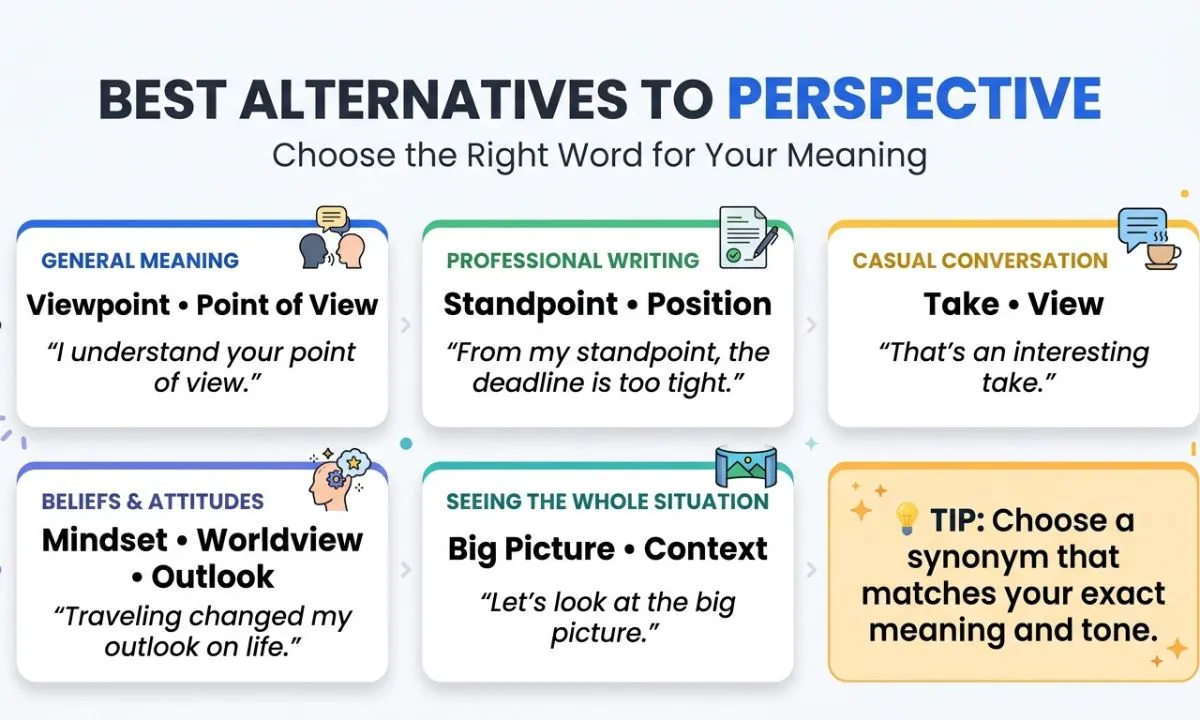
The best alternative to “perspective” depends on what you mean. Use viewpoint or point of view for a general way of seeing something, standpoint or position in formal writing, take or view in casual talk, mindset or worldview for deeper beliefs, and big picture or context when you mean proportion.
Check tone, audience, and meaning before you swap.
🟣 Examples of How to Express Your Perspective in Different Situations
Another word for perspective can change your meaning a little, so it helps to see real before-and-after sentences.
📘 Professional email
🔴 Original: From my perspective, the deadline is too tight.
🟢 Improved: In my view, the deadline leaves too little time for a proper review.
💡 Why it works: “In my view” is direct but polite, and the added reason makes the point easier to accept.
📘 Team meeting
🔴 Original: I’d like to share my perspective on the budget.
🟢 Improved: I’d like to explain my position on the budget.
💡 Why it works: “Position” signals that you have a clear view and are ready to defend it.
📘 Academic writing
🔴 Original: The author writes from a feminist perspective.
🟢 Improved: The author reads the novel through a feminist framework.
💡 Why it works: “Framework” shows a structured set of ideas, not just a personal opinion.
📘 Everyday conversation
🔴 Original: That’s an interesting perspective.
🟢 Improved: That’s an interesting take.
💡 Why it works: “Take” is shorter and sounds natural in relaxed speech.
📘 Social message
🔴 Original: Traveling gave me a new perspective.
🟢 Improved: Traveling changed my outlook on life.
💡 Why it works: “Outlook” points to a lasting attitude, which is what the sentence really means.
📘 Creative writing
🔴 Original: The story is told from a child’s perspective.
🟢 Improved: The story is told from a child’s point of view.
💡 Why it works: “Point of view” is the standard term for who is telling a story.
📘 Keeping things in proportion
🔴 Original: Talking to her helped me keep things in perspective.
🟢 Improved: Talking to her helped me see the big picture.
💡 Why it works: The original means “proportion,” not “opinion,” so “viewpoint” would not fit here.
🔵 Linguistic Breakdown of “Perspective”
🟣 Connotative Meaning of “Perspective”
“Perspective” feels thoughtful, balanced, and calm.
Even when it does not describe a drawing or a view, it suggests a way of seeing that depends on where you stand.
It sounds softer than “opinion” or “belief,” so it works well when you want to stay polite.
📝 Examples:
- “A fresh perspective”: a new way of looking at a problem.
- “Keep things in perspective”: see something in its proper proportion.
🟣 Etymology of “Perspective”
“Perspective” comes from Medieval Latin perspectiva (ars), meaning “the science of optics,” through Old French.
It goes back to Latin perspicere, “to look through” or “to look closely at.”
That verb joins per- (“through”) and specere (“to look at”).
Etymonline notes the art sense, drawing depth on a flat surface, in the 1590s, and records the mental sense, a way of viewing a subject, in 1762.
🟣 Pronunciation of “Perspective”
- Pronunciation: per-SPEK-tiv
- IPA: US /pərˈspektɪv/ | UK /pəˈspektɪv/
🟣 Syllables and Affixation Pattern of “Perspective”
- Prefix: per- (“through”)
- Root: spect (from Latin specere, “to look”)
- Suffix: -ive
- Word formation: per- + spect + -ive = perspective (a Latin pattern; English uses it as one word)
- Part of speech: Noun (also an adjective, as in “perspective drawing”)
- Syllables: Three
- Stress: The second syllable is stressed.
- Syllable division: per-spec-tive
🔵 Is It Professional and Polite to Use the Word “Perspective”?
Yes. “Perspective” is polite, neutral, and widely accepted in business, school, and everyday speech. “Could I offer another perspective?” is a courteous way to disagree. Still, “from my perspective” can sound repetitive in long emails.
💡 For professional ways to say perspective, try in my view, from my standpoint, or my position is. For formal synonyms for perspective in academic writing, frame of reference, framework, and interpretation are strong choices. Cambridge Dictionary labels the figurative use of vantage point as formal.
In professional emails, choosing the right expression can make your message clearer and more polished. You can also explore these synonyms for regarding when you need a suitable alternative for formal correspondence.
🔵 Why You Need Alternatives to “Perspective”
Precision. “Perspective” covers opinion, attitude, proportion, and visual depth. A more specific word removes doubt.
Variety. Using one word again and again makes writing feel flat.
Tone. “Take” suits a chat, while “standpoint” suits a report.
Strength. You can choose a soft word (“impression”) or a firm one (“conviction”).
Search and clarity. Readers often look for a word that fits one exact situation, not a general synonym.
🔵 Advantages and Disadvantages of Using Alternatives to “Perspective”
🟢 Advantages
- Your meaning becomes more exact.
- Your writing sounds less repetitive.
- You can adjust formality for each audience.
- You show a wider vocabulary without sounding forced.
🔴 Disadvantages
- Near-synonyms are not perfectly interchangeable, so a wrong choice can change your meaning.
- Some alternatives sound stiff or too casual in the wrong setting.
- Too many swaps in one text can feel unnatural.
- Some phrases, like “put things into perspective,” are fixed expressions and cannot be replaced word for word.
🔵 List of 90 Alternative Words for “Perspective”
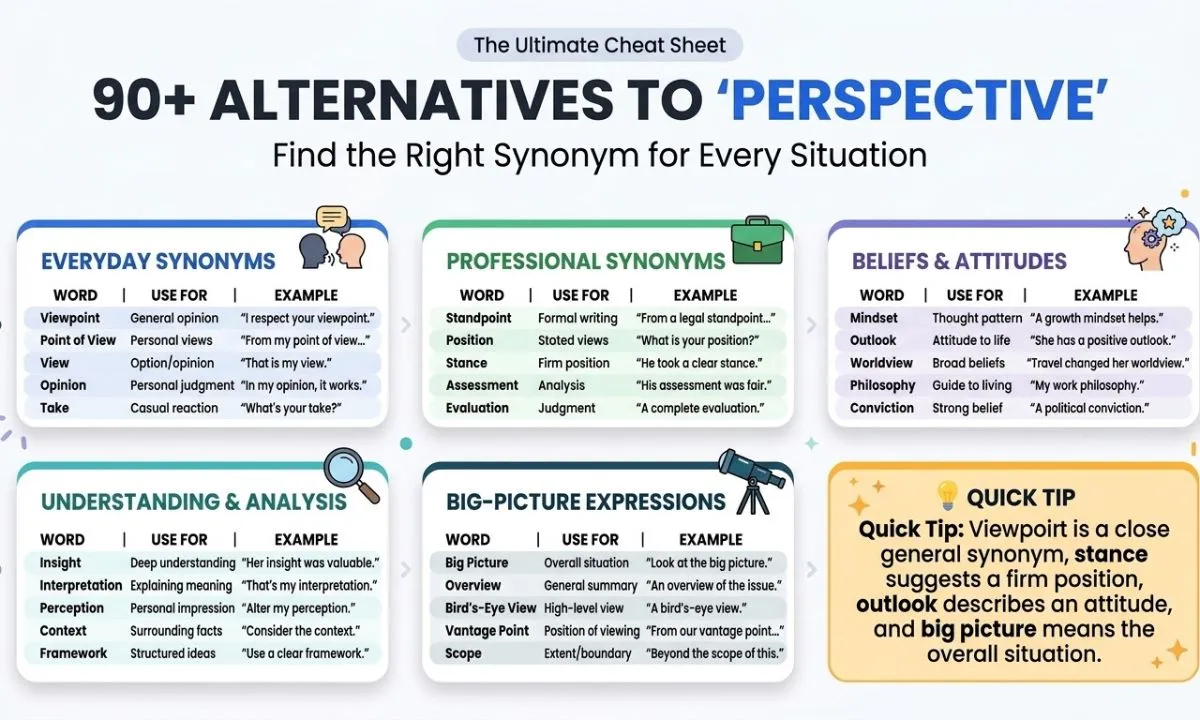
The first entries are the closest synonyms. Later entries are phrases, narrower terms, or looser matches, and each meaning notes where the word works best.
🟣 1. Viewpoint
Pronunciation: US /ˈvjuːˌpɔɪnt/ | UK /ˈvjuːpɔɪnt/
Meaning: A person’s way of looking at an issue. It is one of the closest and most neutral replacements for “perspective.”
📝 Examples:
- Her viewpoint changed after she read the full report.
- Every viewpoint in the debate deserves a fair hearing.
🟣 2. Point of view
Pronunciation: US /ˌpɔɪnt əv ˈvjuː/ | UK /ˌpɔɪnt əv ˈvjuː/
Meaning: The position from which someone sees a matter. It is also the standard term for a narrator’s position in a story.
📝 Examples:
- From a customer’s point of view, the new app is confusing.
- The novel changes point of view in every chapter.
🟣 3. Outlook
Pronunciation: US /ˈaʊtlʊk/ | UK /ˈaʊtlʊk/
Meaning: A general attitude toward life or a situation. It often hints at how hopeful or realistic someone is.
📝 Examples:
- His cheerful outlook kept the team calm during the move.
- A more realistic outlook helped her plan the budget.
🟣 4. Standpoint
Pronunciation: US /ˈstændpɔɪnt/ | UK /ˈstændpɔɪnt/
Meaning: The position from which you judge something, often tied to a role or field. Common in formal and business writing.
📝 Examples:
- From a legal standpoint, the contract is still valid.
- Teachers and parents often see the same rule from different standpoints.
🟣 5. Angle
Pronunciation: US /ˈæŋɡəl/ | UK /ˈæŋɡəl/
Meaning: A particular way of approaching or presenting a topic. Informal and flexible, so it suits stories and ideas.
📝 Examples:
- The reporter found a fresh angle on the housing story.
- Try looking at the problem from another angle.
🟣 6. Stance
Pronunciation: US /stæns/ | UK /stɑːns/
Meaning: A clearly stated position on an issue. It is firmer than “perspective” because it suggests you have taken a side.
📝 Examples:
- The mayor took a firm stance against the new tax.
- Her stance on remote work has not changed.
🟣 7. Position
Pronunciation: US /pəˈzɪʃən/ | UK /pəˈzɪʃən/
Meaning: Your stated view or official standing on a matter. Works well in meetings, politics, and negotiations.
📝 Examples:
- What is the company’s position on overtime pay?
- He explained his position calmly and clearly.
🟣 8. Opinion
Pronunciation: US /əˈpɪnjən/ | UK /əˈpɪnjən/
Meaning: A personal judgment that may not rest on proof. It is more personal than “perspective,” so it can sound less balanced.
📝 Examples:
- In my opinion, the second draft reads better.
- She asked for an honest opinion about the design.
🟣 9. View
Pronunciation: US /vjuː/ | UK /vjuː/
Meaning: A short, flexible word for what someone thinks or how they see something. Works in speech and writing.
📝 Examples:
- In my view, the plan needs more testing.
- Their views on education differ sharply.
🟣 10. Take
Pronunciation: US /teɪk/ | UK /teɪk/
Meaning: An informal word for someone’s reading of or reaction to something. Common in conversation and media, but too casual for formal reports.
📝 Examples:
- What’s your take on the new policy?
- Her take on the movie surprised everyone.
🟣 11. Attitude
Pronunciation: US /ˈætɪtuːd/ | UK /ˈætɪtjuːd/
Meaning: A settled way of thinking or feeling about something. Use it with an adjective, because “attitude” alone can sound negative.
📝 Examples:
- A positive attitude helped him through the interview.
- Her attitude toward deadlines is very relaxed.
🟣 12. Approach
Pronunciation: US /əˈproʊtʃ/ | UK /əˈprəʊtʃ/
Meaning: A method of dealing with a problem. Choose it when you mean how someone handles something, not how they see it.
📝 Examples:
- The school uses a hands-on approach to science.
- We need a different approach to customer complaints.
🟣 13. Belief
Pronunciation: US /bɪˈliːf/ | UK /bɪˈliːf/
Meaning: Something a person accepts as true, often tied to values. It is heavier than “perspective.”
📝 Examples:
- It is her belief that every child can learn to read.
- Belief in fair play guided every decision the coach made.
🟣 14. Mindset
Pronunciation: US /ˈmaɪndset/ | UK /ˈmaɪndset/
Meaning: A set of attitudes that shapes how someone responds to situations. Popular in business, sports, and self-improvement writing.
📝 Examples:
- A growth mindset makes mistakes feel like lessons.
- The team needs a winning mindset before the final.
🟣 15. Frame of mind
Pronunciation: US /ˌfreɪm əv ˈmaɪnd/ | UK /ˌfreɪm əv ˈmaɪnd/
Meaning: A person’s mood or mental state at a given moment. It is temporary, so it is not a match for a lasting perspective.
📝 Examples:
- I was in a better frame of mind after a good night’s sleep.
- He is not in the right frame of mind to make big decisions.
🟣 16. Worldview
Pronunciation: US /ˈwɜːrldvjuː/ | UK /ˈwɜːldvjuː/
Meaning: The broad set of beliefs through which a person understands life and the world. Deeper and longer-lasting than “perspective.”
📝 Examples:
- Growing up in three countries gave her a wide worldview.
- The book challenges a purely scientific worldview.
🟣 17. Vantage point
Pronunciation: US /ˈvæntɪdʒ pɔɪnt/ | UK /ˈvɑːntɪdʒ pɔɪnt/
Meaning: A place that gives a good view, or, figuratively, a position from which you judge something. The figurative use sounds formal.
📝 Examples:
- From the hilltop vantage point, we could see the whole valley.
- From her vantage point as a nurse, she saw where the system failed patients.
🟣 18. Slant
Pronunciation: US /slænt/ | UK /slɑːnt/
Meaning: A particular bias or angle given to a story or report. It often hints that the view is not fully neutral.
📝 Examples:
- The editorial had a clear political slant.
- Try giving the report a more positive slant.
🟣 19. Lens
Pronunciation: US /lenz/ | UK /lenz/
Meaning: A figurative filter through which something is seen or understood. Common in academic and policy writing.
📝 Examples:
- The essay views the novel through a historical lens.
- Look at the budget through the lens of long-term growth.
🟣 20. Context
Pronunciation: US /ˈkɑːntekst/ | UK /ˈkɒntekst/
Meaning: The surrounding facts that give something its meaning. A looser match: use it for the “keep things in perspective” sense, not for personal opinion.
📝 Examples:
- Without context, the numbers look worse than they are.
- Giving readers historical context helps them understand the conflict.
🟣 21. Insight
Pronunciation: US /ˈɪnsaɪt/ | UK /ˈɪnsaɪt/
Meaning: A clear, deep understanding of a person or problem. It describes understanding gained, not simply a view held.
📝 Examples:
- The interview offered real insight into her working style.
- His insight into the market saved the company money.
🟣 22. Understanding
Pronunciation: US /ˌʌndərˈstændɪŋ/ | UK /ˌʌndəˈstændɪŋ/
Meaning: Someone’s grasp or reading of a matter. Useful for polite phrasing such as “my understanding is.”
📝 Examples:
- My understanding is that the meeting moved to Friday.
- Her understanding of the issue grew after the workshop.
🟣 23. Interpretation
Pronunciation: US /ɪnˌtɜːrprɪˈteɪʃən/ | UK /ɪnˌtɜːprɪˈteɪʃən/
Meaning: A personal explanation of what something means. Good for texts, data, art, and law.
📝 Examples:
- Each critic offers a different interpretation of the poem.
- My interpretation of the results is more cautious.
When interpreting research or explaining how a viewpoint influences an outcome, selecting precise vocabulary matters. See our guide to synonyms for effects for alternatives that describe results and consequences more accurately.
🟣 24. Judgment
Pronunciation: US /ˈdʒʌdʒmənt/ | UK /ˈdʒʌdʒmənt/
Meaning: An opinion formed after weighing the evidence. It can sound critical, so use it with care. Spelled “judgment” in US English; “judgement” is also common in British English.
📝 Examples:
- In my judgment, the safer route is worth the extra hour.
- She trusted her team’s judgment on the final design.
🟣 25. Sentiment
Pronunciation: US /ˈsentɪmənt/ | UK /ˈsentɪmənt/
Meaning: A view shaped by feeling, often shared by a group. Best when emotion matters as much as logic.
📝 Examples:
- Public sentiment turned against the project.
- I share your sentiment about the late changes.
🟣 26. Thinking
Pronunciation: US /ˈθɪŋkɪŋ/ | UK /ˈθɪŋkɪŋ/
Meaning: Someone’s reasoning or current opinion on a matter. Friendly but still suitable for work.
📝 Examples:
- Our current thinking is to launch in spring.
- I’d like to understand your thinking behind the change.
🟣 27. Feeling
Pronunciation: US /ˈfiːlɪŋ/ | UK /ˈfiːlɪŋ/
Meaning: An opinion based more on instinct than evidence. It softens a statement when you are not fully sure.
📝 Examples:
- My feeling is that the client wants a simpler design.
- Her feelings about the move were mixed.
🟣 28. Impression
Pronunciation: US /ɪmˈpreʃən/ | UK /ɪmˈpreʃən/
Meaning: A general, often quick opinion formed from limited information. Fits first meetings and early reviews.
📝 Examples:
- My impression is that the new manager listens well.
- The report gives the impression that sales are recovering.
🟣 29. Reading
Pronunciation: US /ˈriːdɪŋ/ | UK /ˈriːdɪŋ/
Meaning: A particular way of understanding a situation or text. A looser match, used mostly in “my reading of.”
📝 Examples:
- My reading of the contract is that either side can cancel.
- Critics offered a darker reading of the ending.
🟣 30. Perception
Pronunciation: US /pərˈsepʃən/ | UK /pəˈsepʃən/
Meaning: The way something is noticed or understood, often by the public. Choose it when appearance may differ from reality.
📝 Examples:
- Public perception of the brand improved after the apology.
- Her perception of risk changed after the accident.
🟣 31. Awareness
Pronunciation: US /əˈwernəs/ | UK /əˈweənəs/
Meaning: Knowledge or consciousness of a situation. It is not a match for “opinion”; use it for understanding that comes from paying attention.
📝 Examples:
- Travel raised her awareness of how other people live.
- Awareness of the budget limits shaped every choice.
🟣 32. Orientation
Pronunciation: US /ˌɔːriənˈteɪʃən/ | UK /ˌɔːriənˈteɪʃən/
Meaning: A person’s basic direction of interest or thinking. Formal, and it needs context, because “orientation” has other meanings too.
📝 Examples:
- The magazine has a strongly practical orientation.
- Her political orientation shows in the way she frames issues.
🟣 33. Philosophy
Pronunciation: US /fəˈlɑːsəfi/ | UK /fəˈlɒsəfi/
Meaning: A person’s guiding set of principles for life or work. Much heavier than “perspective.”
📝 Examples:
- Her philosophy of teaching puts curiosity first.
- The company’s philosophy is to fix problems at the source.
🟣 34. Ideology
Pronunciation: US /ˌaɪdiˈɑːlədʒi/ | UK /ˌaɪdiˈɒlədʒi/
Meaning: A system of ideas, especially political or economic, that shapes how people see the world. It can sound critical, so avoid it for neutral personal views.
📝 Examples:
- The party’s ideology shaped its approach to housing.
- He accused his critics of letting ideology cloud the facts.
🟣 35. Conviction
Pronunciation: US /kənˈvɪkʃən/ | UK /kənˈvɪkʃən/
Meaning: A firmly held belief. It is stronger than “perspective” and shows certainty.
📝 Examples:
- She spoke with conviction about protecting the river.
- It is his conviction that honesty matters more than speed.
🟣 36. Persuasion
Pronunciation: US /pərˈsweɪʒən/ | UK /pəˈsweɪʒən/
Meaning: A set of beliefs, or the group that holds them, usually political or religious. A loose match that works mainly in fixed phrases such as “of every persuasion.”
📝 Examples:
- People of every political persuasion attended the town meeting.
- The club welcomes members of any persuasion.
🟣 37. Frame of reference
Pronunciation: US /ˌfreɪm əv ˈrefərəns/ | UK /ˌfreɪm əv ˈrefərəns/
Meaning: The set of ideas, experiences, or standards you use to judge things. Common in academic and professional writing.
📝 Examples:
- A child’s frame of reference is very different from an adult’s.
- Her frame of reference as an engineer shaped her questions.
🟣 38. Way of thinking
Pronunciation: US /ˌweɪ əv ˈθɪŋkɪŋ/ | UK /ˌweɪ əv ˈθɪŋkɪŋ/
Meaning: A habitual style of reasoning. Plain and friendly, and clear to every reader.
📝 Examples:
- Studying philosophy changed his way of thinking about risk.
- Each generation brings a new way of thinking to the workplace.
🟣 39. Line of thought
Pronunciation: US /ˌlaɪn əv ˈθɔːt/ | UK /ˌlaɪn əv ˈθɔːt/
Meaning: A connected series of ideas. Use it when you follow someone’s reasoning, not when you state a position.
📝 Examples:
- I lost your line of thought halfway through the sentence.
- Her line of thought led to a surprising conclusion.
🟣 40. School of thought
Pronunciation: US /ˌskuːl əv ˈθɔːt/ | UK /ˌskuːl əv ˈθɔːt/
Meaning: A shared approach or set of ideas followed by a group in a field. It describes a group view rather than a personal one.
📝 Examples:
- One school of thought says exercise matters more than diet.
- Economists follow different schools of thought on inflation.
🟣 41. Mental outlook
Pronunciation: US /ˌmentl ˈaʊtlʊk/ | UK /ˌmentl ˈaʊtlʊk/
Meaning: A person’s general mental attitude. A little wordy, so “outlook” alone is often better.
📝 Examples:
- Regular walks improved her mental outlook.
- A calm mental outlook helps during exams.
🟣 42. Disposition
Pronunciation: US /ˌdɪspəˈzɪʃən/ | UK /ˌdɪspəˈzɪʃən/
Meaning: A person’s natural tendency or mood. It describes temperament more than a specific view.
📝 Examples:
- Her sunny disposition made the long trip easier.
- He has a cautious disposition when it comes to money.
🟣 43. Vision
Pronunciation: US /ˈvɪʒən/ | UK /ˈvɪʒən/
Meaning: A mental picture of how things could or should be. Forward-looking, so it fits leadership and planning.
📝 Examples:
- The founder’s vision for the school was clear from day one.
- She shared her vision of a greener city.
🟣 44. Scope
Pronunciation: US /skoʊp/ | UK /skəʊp/
Meaning: The range of what you consider or cover. A looser match, best when the width of someone’s view is the point.
📝 Examples:
- The study’s narrow scope limits what we can conclude.
- Widen the scope of your thinking before you choose.
🟣 45. Prospect
Pronunciation: US /ˈprɑːspekt/ | UK /ˈprɒspekt/
Meaning: A view of something expected in the future, or a wide scenic view. Formal in tone.
📝 Examples:
- The prospect of a new job excited him.
- The terrace offers a lovely prospect of the harbor.
🟣 46. Aspect
Pronunciation: US /ˈæspekt/ | UK /ˈæspekt/
Meaning: One part or side of a situation. Use it when you mean a piece of the picture, not the whole outlook.
📝 Examples:
- Cost is only one aspect of the decision.
- Every aspect of the plan was reviewed.
🟣 47. Side
Pronunciation: US /saɪd/ | UK /saɪd/
Meaning: One of the opposing views in a discussion. Casual and common in conversation.
📝 Examples:
- I’d like to hear your side of the story.
- There is another side to this argument.
🟣 48. Facet
Pronunciation: US /ˈfæsɪt/ | UK /ˈfæsɪt/
Meaning: One of the many sides of a topic. Slightly formal and descriptive.
📝 Examples:
- Each facet of the issue needs careful study.
- Her work explores a new facet of city life.
🟣 49. Light
Pronunciation: US /laɪt/ | UK /laɪt/
Meaning: The way an issue is seen or presented. A loose match that works mainly in set phrases such as “in a new light.”
📝 Examples:
- The documentary shows the mayor in a new light.
- Try to see the problem in a different light.
🟣 50. Framework
Pronunciation: US /ˈfreɪmwɜːrk/ | UK /ˈfreɪmwɜːk/
Meaning: A structured set of ideas that guides thinking. Formal, and stronger than a personal view.
📝 Examples:
- The study uses a social psychology framework.
- We need a clear framework for making these decisions.
🟣 51. Paradigm
Pronunciation: US /ˈpærədaɪm/ | UK /ˈpærədaɪm/
Meaning: A widely accepted model or pattern of thought in a field. Academic, so avoid it for casual personal opinions.
📝 Examples:
- The discovery challenged the existing paradigm in physics.
- Remote work shifted the paradigm of office life.
🟣 52. Notion
Pronunciation: US /ˈnoʊʃən/ | UK /ˈnəʊʃən/
Meaning: A general idea or belief, sometimes vague or doubtful. It can hint that the idea is questionable.
📝 Examples:
- He rejected the notion that failure is final.
- She has a clear notion of what she wants.
🟣 53. Idea
Pronunciation: US /aɪˈdiːə/ | UK /aɪˈdɪə/
Meaning: A thought or suggestion. Broader and more casual; use it for a suggestion rather than a complete stance.
📝 Examples:
- What is your idea of a perfect weekend?
- I have a different idea about how to start.
🟣 54. Thought
Pronunciation: US /θɔːt/ | UK /θɔːt/
Meaning: An opinion or reflection, often used in the plural. Casual enough for chat, polite enough for email.
📝 Examples:
- Share your thoughts on the draft before Monday.
- His thoughts on city planning are worth reading.
🟣 55. Reflection
Pronunciation: US /rɪˈflekʃən/ | UK /rɪˈflekʃən/
Meaning: A considered thought formed after careful thinking. Thoughtful and slightly literary.
📝 Examples:
- His reflection on the year was honest and humble.
- The essay is a quiet reflection on growing up.
🟣 56. Observation
Pronunciation: US /ˌɑːbzərˈveɪʃən/ | UK /ˌɒbzəˈveɪʃən/
Meaning: A comment based on something you noticed. Use it when your view rests on what you saw.
📝 Examples:
- One observation from the pilot test: users skip the tutorial.
- Her observation about the data led to a quick fix.
🟣 57. Assessment
Pronunciation: US /əˈsesmənt/ | UK /əˈsesmənt/
Meaning: A careful judgment of quality or risk. A professional word that suggests the view rests on analysis.
📝 Examples:
- Our assessment is that the risk is low.
- The manager gave an honest assessment of the project.
🟣 58. Evaluation
Pronunciation: US /ɪˌvæljuˈeɪʃən/ | UK /ɪˌvæljuˈeɪʃən/
Meaning: A formal judgment of value, quality, or progress. Fits reports and reviews more than conversation.
📝 Examples:
- Her evaluation of the program showed strong results.
- Each evaluation was written after a site visit.
🟣 59. Verdict
Pronunciation: US /ˈvɜːrdɪkt/ | UK /ˈvɜːdɪkt/
Meaning: A final opinion or decision on a question. Strong and often conclusive, so it is not a gentle way to share a view.
📝 Examples:
- The critics’ verdict on the film was warm.
- My verdict: the cheaper option works fine.
🟣 60. Appraisal
Pronunciation: US /əˈpreɪzəl/ | UK /əˈpreɪzəl/
Meaning: An expert judgment of value or quality. Formal and often used in business and performance settings.
📝 Examples:
- The report offers a fair appraisal of the plan’s weaknesses.
- Her appraisal of the market was blunt.
🟣 61. Estimation
Pronunciation: US /ˌestɪˈmeɪʃən/ | UK /ˌestɪˈmeɪʃən/
Meaning: A rough judgment of value, size, or worth. “In my estimation” is a polite, slightly formal way to give a view.
📝 Examples:
- In my estimation, the plan needs another month.
- He rose in her estimation after the speech.
🟣 62. Outlook on life
Pronunciation: US /ˈaʊtlʊk ɑːn ˈlaɪf/ | UK /ˈaʊtlʊk ɒn ˈlaɪf/
Meaning: A person’s overall attitude toward life. Use it in personal writing, reflections, and interviews.
📝 Examples:
- Her outlook on life became calmer after she moved to the coast.
- A grateful outlook on life makes small problems feel lighter.
🟣 63. Way of seeing
Pronunciation: US /ˌweɪ əv ˈsiːɪŋ/ | UK /ˌweɪ əv ˈsiːɪŋ/
Meaning: A plain, slightly poetic phrase for how someone views something. Good in creative and reflective writing.
📝 Examples:
- Photography changed her way of seeing ordinary streets.
- Each culture has its own way of seeing time.
🟣 64. Way of looking at things
Pronunciation: US /ˌweɪ əv ˈlʊkɪŋ æt ˈθɪŋz/ | UK /ˌweɪ əv ˈlʊkɪŋ æt ˈθɪŋz/
Meaning: A casual phrase for someone’s personal viewpoint. Friendly in speech, but a bit long for formal writing.
📝 Examples:
- Her way of looking at things always makes me smile.
- We have a very different way of looking at things.
🟣 65. Point of reference
Pronunciation: US /ˌpɔɪnt əv ˈrefərəns/ | UK /ˌpɔɪnt əv ˈrefərəns/
Meaning: A fixed standard used for comparing or judging. It is not an opinion, so use it in analysis rather than debate.
📝 Examples:
- Last year’s sales are our point of reference.
- A map gave the hikers a clear point of reference.
🟣 66. Personal take
Pronunciation: US /ˌpɜːrsənəl ˈteɪk/ | UK /ˌpɜːsənəl ˈteɪk/
Meaning: One person’s own reaction or reading, in casual language. It signals that the view is yours alone.
📝 Examples:
- Here is my personal take on the season finale.
- Her personal take on the issue felt refreshing.
🟣 67. Personal view
Pronunciation: US /ˌpɜːrsənəl ˈvjuː/ | UK /ˌpɜːsənəl ˈvjuː/
Meaning: An individual’s own opinion. A neutral, polite way to say a view is not an official one.
📝 Examples:
- This is my personal view, not the company’s.
- His personal view is that tests should be shorter.
🟣 68. Personal stance
Pronunciation: US /ˌpɜːrsənəl ˈstæns/ | UK /ˌpɜːsənəl ˈstɑːns/
Meaning: An individual’s chosen position on an issue. Firmer than “personal view.”
📝 Examples:
- Her personal stance on recycling is strict.
- I respect your personal stance, even if I disagree.
🟣 69. Hot take
Pronunciation: US /ˈhɑːt teɪk/ | UK /ˈhɒt teɪk/
Meaning: A bold, quick opinion, often meant to start a debate. Slang from media and social media; avoid it in formal writing.
📝 Examples:
- Here is my hot take: pineapple belongs on pizza.
- The talk show was full of hot takes about the trade.
🟣 70. Big picture
Pronunciation: US /ˌbɪɡ ˈpɪktʃər/ | UK /ˌbɪɡ ˈpɪktʃə/
Meaning: The overall situation, with small details set aside. Choose it for the “keep things in perspective” sense.
📝 Examples:
- Let’s step back and look at the big picture.
- She keeps the big picture in mind during small tasks.
🟣 71. Overview
Pronunciation: US /ˈoʊvərvjuː/ | UK /ˈəʊvəvjuː/
Meaning: A short, general summary that gives a broad view. It informs rather than argues, so it is not a match for opinion.
📝 Examples:
- The first chapter gives an overview of the project.
- Start with an overview before you dive into the details.
🟣 72. Panorama
Pronunciation: US /ˌpænəˈræmə/ | UK /ˌpænəˈrɑːmə/
Meaning: A wide view of a whole scene or subject. Works for landscapes and for broad surveys of a topic.
📝 Examples:
- The tower offers a panorama of the whole city.
- The book presents a panorama of twentieth-century music.
🟣 73. Bird’s-eye view
Pronunciation: US /ˈbɜːrdz aɪ vjuː/ | UK /ˈbɜːdz aɪ vjuː/
Meaning: A view from high above, or a broad general view of something. Friendly and easy to picture.
📝 Examples:
- From the plane we got a bird’s-eye view of the coastline.
- The dashboard offers a bird’s-eye view of company spending.
🟣 74. Discernment
Pronunciation: US /dɪˈsɜːrnmənt/ | UK /dɪˈsɜːnmənt/
Meaning: The ability to judge well. It describes the quality of someone’s judgment, not a particular stance.
📝 Examples:
- She chose her words with great discernment.
- Good discernment helps editors spot a weak argument.
🟣 75. Sense
Pronunciation: US /sens/ | UK /sens/
Meaning: A practical feeling or awareness of something. A loose match that works best in phrases such as “a sense of proportion.”
📝 Examples:
- She kept a good sense of proportion during the crisis.
- He has a strong sense of what readers want.
🟣 76. Views
Pronunciation: US /vjuːz/ | UK /vjuːz/
Meaning: The plural form, used for several opinions, often on public issues.
📝 Examples:
- The candidates shared their views on housing.
- My views have changed since college.
When discussing how people in a group think about an event, it helps to choose words that match the situation. For more vocabulary related to social gatherings and groups, explore our party synonyms guide.
🟣 77. Beliefs
Pronunciation: US /ˈbɪliːfs/ | UK /ˈbɪliːfs/
Meaning: The ideas someone holds to be true, often connected to values or faith. Serious in tone.
📝 Examples:
- Respect for different beliefs is part of the school’s code.
- Her beliefs about fairness guide her management style.
🟣 78. Position on the matter
Pronunciation: US /pəˈzɪʃən ɑːn ðə ˈmætər/ | UK /pəˈzɪʃən ɒn ðə ˈmætə/
Meaning: A formal phrase for someone’s stated view on a specific issue. Good in official or business messages.
📝 Examples:
- Please state your position on the matter in writing.
- The board has not yet shared its position on the matter.
🟣 79. Take on it
Pronunciation: US /ˈteɪk ɑːn ɪt/ | UK /ˈteɪk ɒn ɪt/
Meaning: A casual phrase for asking about or giving a reaction. Suits chats and informal team messages.
📝 Examples:
- I’m curious about your take on it.
- Whatever the team’s take on it, we still need a plan.
🟣 80. Angle of view
Pronunciation: US /ˌæŋɡəl əv ˈvjuː/ | UK /ˌæŋɡəl əv ˈvjuː/
Meaning: The width of the scene a lens or an eye can take in. Best in photography and optics, and only figuratively elsewhere.
📝 Examples:
- A wide lens gives a bigger angle of view.
- The film’s angle of view feels like a child’s.
🟣 81. Field of view
Pronunciation: US /ˌfiːld əv ˈvjuː/ | UK /ˌfiːld əv ˈvjuː/
Meaning: The area you can see at one time. A looser match: literal in driving and optics, figurative when it means how much someone takes in.
📝 Examples:
- The camera’s field of view covers the whole room.
- Stress narrowed his field of view during the exam.
🟣 82. Mental picture
Pronunciation: US /ˌmentl ˈpɪktʃər/ | UK /ˌmentl ˈpɪktʃə/
Meaning: An image in the mind. Use it when you describe how someone imagines or understands something.
📝 Examples:
- His words gave me a clear mental picture of the farm.
- She had a mental picture of how the room should look.
🟣 83. Frame
Pronunciation: US /freɪm/ | UK /freɪm/
Meaning: The way an issue is set up or described, as in “the frame of the debate.” A short form of “frame of reference.”
📝 Examples:
- The article’s frame is economic, not moral.
- A different frame changes how the story reads.
🟣 84. Way of understanding
Pronunciation: US /ˌweɪ əv ˌʌndərˈstændɪŋ/ | UK /ˌweɪ əv ˌʌndəˈstændɪŋ/
Meaning: A plain phrase for how someone makes sense of something. Clear and easy to read.
📝 Examples:
- Stories became her way of understanding history.
- Each student brings a different way of understanding the lesson.
🟣 85. Mental lens
Pronunciation: US /ˌmentl ˈlenz/ | UK /ˌmentl ˈlenz/
Meaning: A figurative filter shaped by experience that colors how someone sees things. Reflective and slightly informal.
📝 Examples:
- Years of teaching gave him a mental lens for spotting confusion.
- Adjust your mental lens before you judge their choice.
🟣 86. Point of observation
Pronunciation: US /ˌpɔɪnt əv ˌɑːbzərˈveɪʃən/ | UK /ˌpɔɪnt əv ˌɒbzəˈveɪʃən/
Meaning: The spot from which something is watched or studied. Formal and technical, so it suits science and fieldwork.
📝 Examples:
- The cliff served as a point of observation for the bird count.
- From that point of observation, the traffic pattern was easy to see.
🟣 87. Standing
Pronunciation: US /ˈstændɪŋ/ | UK /ˈstændɪŋ/
Meaning: Rank, status, or reputation. A loose match for “perspective”; use it for status, not for opinion.
📝 Examples:
- Her standing in the community grew after the fundraiser.
- The firm’s standing in the market is strong.
🟣 88. Inclination
Pronunciation: US /ˌɪnklɪˈneɪʃən/ | UK /ˌɪnklɪˈneɪʃən/
Meaning: A natural tendency or leaning toward a view. Formal and gentle, so it softens a statement.
📝 Examples:
- My inclination is to wait for more data.
- He has an inclination toward cautious plans.
🟣 89. Leaning
Pronunciation: US /ˈliːnɪŋ/ | UK /ˈliːnɪŋ/
Meaning: A tendency toward a view or choice. Softer than “stance” because it admits you are not fully committed.
📝 Examples:
- His leaning is toward the simpler design.
- The poll shows a leaning toward early voting.
🟣 90. Take on the situation
Pronunciation: US /ˈteɪk ɑːn ðə ˌsɪtʃuˈeɪʃən/ | UK /ˈteɪk ɒn ðə ˌsɪtʃuˈeɪʃən/
Meaning: A casual-professional phrase for someone’s reaction to a current event or problem. Natural in team chats and quick updates.
📝 Examples:
Her take on the situation was calm and fair.
Can you send me your take on the situation before the call?
🔵 Comparison Table of the 10 Best Perspective Synonyms
This table compares perspective synonyms that readers use most often. The last column says “No clear difference” where reliable sources do not show a real US–UK split.
| Phrase | Meaning | Best Use | Worst Use | Tone | US vs. UK Usage |
| Viewpoint | A person’s way of looking at an issue | Essays, debates, general writing | Quick chats where “take” sounds more natural | Neutral | No clear difference |
| Point of view | The position someone sees or narrates from | School work, fiction, everyday use | Statements that need a firm tone | Neutral | No clear difference |
| Outlook | A general attitude toward life or the future | Personal writing, forecasts | One-off opinions on a single topic | Hopeful or realistic | No clear difference |
| Standpoint | A position tied to a role or field | Business and formal writing | Casual conversation | Formal, measured | No clear difference |
| Stance | A clearly stated position | Politics, policy, debate | When you are still unsure | Firm | No clear difference |
| Vantage point | A place with a good view, or a role-based position | Analysis, descriptive writing | Everyday chat | Formal, polished | No clear difference |
| Mindset | The attitudes that shape how someone responds | Coaching, workplace, self-improvement | Formal academic theory | Motivational | No clear difference |
| Worldview | Broad beliefs about life and the world | Philosophy, culture, literature | Small, everyday choices | Serious, deep | No clear difference |
| Take | Someone’s reaction or reading | Conversation, media, chats | Formal reports | Informal | No clear difference |
| Judgment | An opinion formed after weighing evidence | Reviews, reports, evaluations | Gentle, friendly talk, because it can sound critical | Firm, analytical | US: judgment. UK: judgement is common, though judgment is also used |
🔵 Tips for Choosing the Right Perspective Synonym
💡 Start with the meaning. Ask whether you mean an opinion, an attitude, a position, or a sense of proportion.
💡 Match the formality. Use “standpoint” in a report and “take” in a chat.
💡 Think about the reader. A boss, a teacher, and a friend each expect different wording.
Understanding what matters to your audience can also help you choose words that connect with readers. For more vocabulary options, explore these synonyms for interest and learn how to express different kinds of curiosity and engagement.
💡 Check the strength. “Feeling” and “leaning” are soft. “Conviction” and “stance” are firm.
💡 Read the sentence aloud. If it sounds forced, choose a simpler word.
💡 Do not swap every time. “Perspective” is often the clearest word, so replace it only when another word is more precise.
💡 Watch fixed phrases. Expressions like “put things into perspective” need a rewrite, not a single-word swap.
🔴 Common Mistakes to Avoid When Using Perspective Synonyms
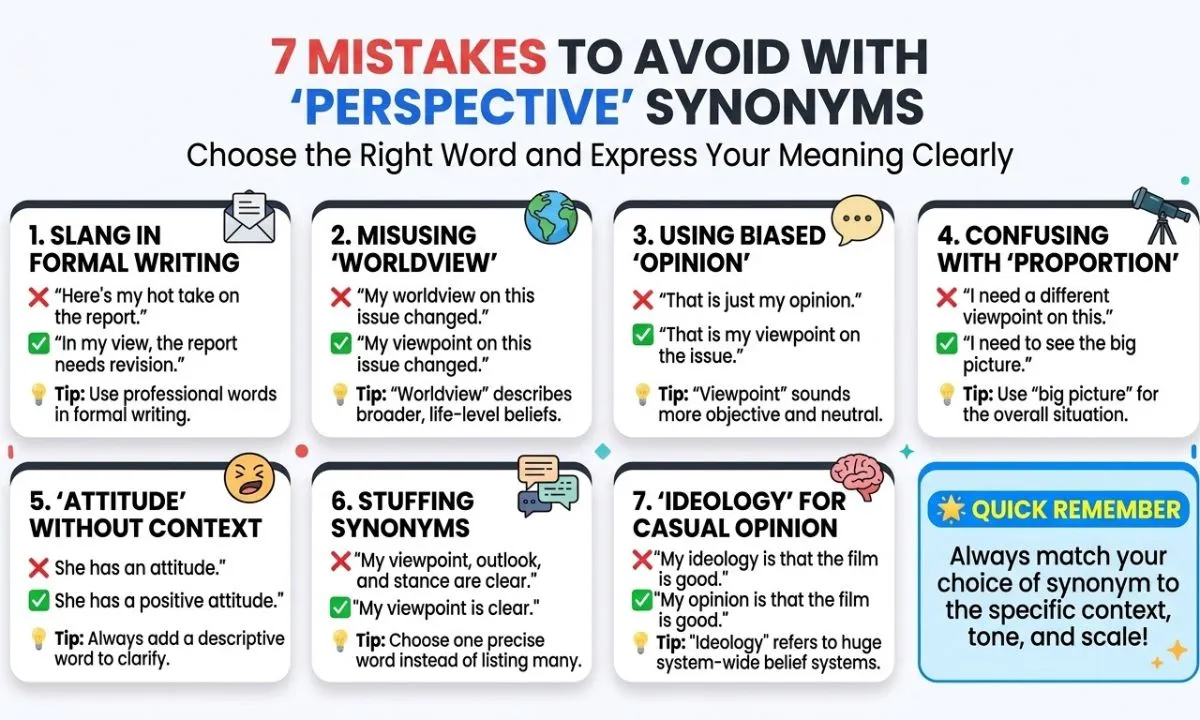
🔴 Using slang in formal writing.
“Hot take” can sound unprofessional in an email. Try “in my view” instead.
🔴 Treating every synonym as identical.
“Worldview” describes a broad outlook, not a one-time opinion. Use “viewpoint” for a single issue.
🔴 Choosing “opinion” when you want a balanced tone.
“Opinion” can sound less considered. “Viewpoint” or “perspective” feels more open.
🔴 Replacing the “proportion” sense with “viewpoint.
” “Keeping things in perspective” means seeing things in proportion, so say “seeing the big picture” or “putting it in context.”
🔴 Using “attitude” alone.
It can sound negative. Add an adjective, such as “a positive attitude,” or use “outlook.”
🔴 Stuffing synonyms into one paragraph.
Pick one or two precise words and repeat the plain one when needed.
🔴 Using “ideology” for ordinary opinions.
It suggests a political system of ideas. Use “beliefs” or “views” instead.
What Major Dictionaries Say About “Perspective”
Cambridge Dictionary
Cambridge lists words like attitude, outlook, frame of mind, approach, viewpoint, point of view, vantage point, angle, slant, stance, and standpoint as close synonyms, showing how broad the word’s family really is.
Merriam-Webster
Merriam-Webster groups perspective with viewpoint, outlook, opinion, standpoint, angle, view, and vantage point, treating it as a way of thinking about or looking at something.
Oxford Languages / Oxford English Dictionary
Oxford defines perspective as a particular attitude toward, or way of regarding, something essentially a point of view and separately covers its meaning in art as the technique for showing depth on a flat surface.
Collins Dictionary
Collins connects perspective to outlook, attitude, context, frame of reference, and proportion, plus visual terms like prospect and panorama when the word describes an actual view.
Perspective Synonyms in Sentences
Everyday English Examples
“I get where you’re coming from, but that’s not my take.”
“Try seeing it from her viewpoint.”
“His outlook on life is refreshingly upbeat.”
“We each captured a different angle of the story.”
Professional English Examples
“From a business standpoint, the merger makes sense.”
“The report offers a client-focused perspective.” → “The report offers a client-focused viewpoint.”
“Our stance on data privacy remains unchanged.”
“Consider this from a legal frame of reference.”
Example Transformations
“In my perspective, we should wait.” → “In my opinion, we should wait.”
“The article shows a biased perspective.” → “The article shows a biased slant.”
“She has a positive perspective on aging.” → “She has a positive outlook on aging.
🔵 Quiz: Test Your Knowledge of Perspective Synonyms
1. Which word best fits a formal business email?
a) Hot take b) Standpoint c) Feeling
2. Which term names the position a narrator tells a story from?
a) Point of view b) Slant c) Persuasion
3. Which word means a general attitude toward life or the future? a)
Verdict b) Outlook c) Facet
4. Which word is the most casual?
a) Framework b) Appraisal c) Take
5. Which word describes the broad beliefs someone uses to understand the world?
a) Worldview b) Aspect c) Overview
🟢 Answer key: 1) b. 2) a. 3) b. 4) c. 5) a.
Explore More Synonyms Guide
Opportunity Synonyms: 30+ Words, Alternatives, Meanings & Examples
25+ Share Synonyms: Meanings, Examples & When to Use Each
Additionally Synonyms: 20+ Words, Meanings, Examples & How to Use Them
Kindness Synonyms: 25+ Words, Meanings, Examples & How to Use Them
History Synonyms: 22+ Words, Meanings, Examples & How to Use Them
25+ Crazy Synonyms: Meanings, Examples, and How to Use Them
Frequently Asked Questions About Perspective Synonyms
What Is a Good Synonym for Perspective in an Essay?
Viewpoint, standpoint, and point of view work well in essays. For analysis, try “frame of reference.”
How Do You Say “My Perspective” in a Professional Way?
Say “in my view,” “from my standpoint,” or “my position is.” For a softer tone, try “my understanding is.”
What Is the Difference Between Perspective and Point of View?
They overlap, but “point of view” names the exact position someone looks from, while “perspective” is broader.
What Is a Casual Way to Say “Different Perspective”?
Try “another take,” “a different angle,” or “a different way of looking at things.”
What Is a Formal Word for Perspective?
Standpoint, vantage point, and frame of reference are the most formal choices.
Can I Use “Opinion” Instead of “Perspective”?
Yes, for a personal judgment, but “opinion” sounds less balanced than “viewpoint.”
What Are Alternative Words for “Perspective” Commonly Used in Discussions?
Viewpoint, standpoint, outlook, angle, and position are common. Use “stance” for a firm side.
What Is a Synonym for “Perspective” in Artistic Contexts?
Vantage point, field of view, and panorama suit visual descriptions. Keep “perspective” for the drawing technique.
In Literature, How Can You Substitute the Word “Perspective”?
Use “point of view” for the narrator’s position and “viewpoint” for a character’s way of seeing.
What Is Another Way to Say “Gaining Perspective”?
Try “seeing the big picture” or “putting things in context,” since “viewpoint” would not fit here.
What Terms Closely Match “Viewpoint” in Meaning?
Point of view, standpoint, outlook, position, and view are the closest matches.
Conclusion: Choose the Best Perspective Synonym for Every Situation
There is no single best word among these other ways to say perspective. The right choice depends on four things: what you mean, how formal you need to be, who is reading, and how firmly you want to state your view.
Start with the close matches, such as viewpoint, standpoint, and outlook, and move to narrower words only when they say something more exact. When “perspective” is already the clearest word, keep it.
