

Say “effects” five times on one page and the reader stops noticing it. The word goes flat.
This guide gives you 70+ synonyms for effects, what each one means, a sample sentence, and a note on where it fits. Essay, work email, group chat: there’s a word for each.
Research note: I checked meanings against Dictionary.com and Collins, and looked at how thesaurus pages group these words. Every example sentence is original.
Quick Answer: What Are the Best Synonyms for Effects?
The best synonyms for effects are results, consequences, impacts, outcomes, and repercussions. Which one you pick depends on what you mean and how formal you want to sound.
The Most Common Alternatives to “Effects”
- Results: neutral, safe almost anywhere
- Consequences: what follows an action, usually bad or serious
- Impacts: a strong, noticeable change
- Outcomes: where things end up after a process
- Repercussions: serious reactions that last
Effects vs. Results
Results are neutral. Effects point back to a cause.
Effects vs. Consequences
Consequences lean toward the bad or the serious. Effects can be good, bad, or nothing much.
Effects vs. Impacts
Impacts sound bigger and louder. An effect can be tiny.
What Does “Effects” Mean?
Effects Meaning in Simple English
An effect is a change that happens because of something else. The cause comes first. The effect comes second.
Effects as a Noun
As a noun, an effect is what a cause or an agent produces. A result, in other words.
The new schedule had positive effects on our team.
The plural has two side meanings too. “Personal effects” are belongings. “Special effects” are the tricks used in film.
Effects as a Verb
As a verb, “effect” means to bring something about. It’s formal and fairly rare.
The company effected major changes.
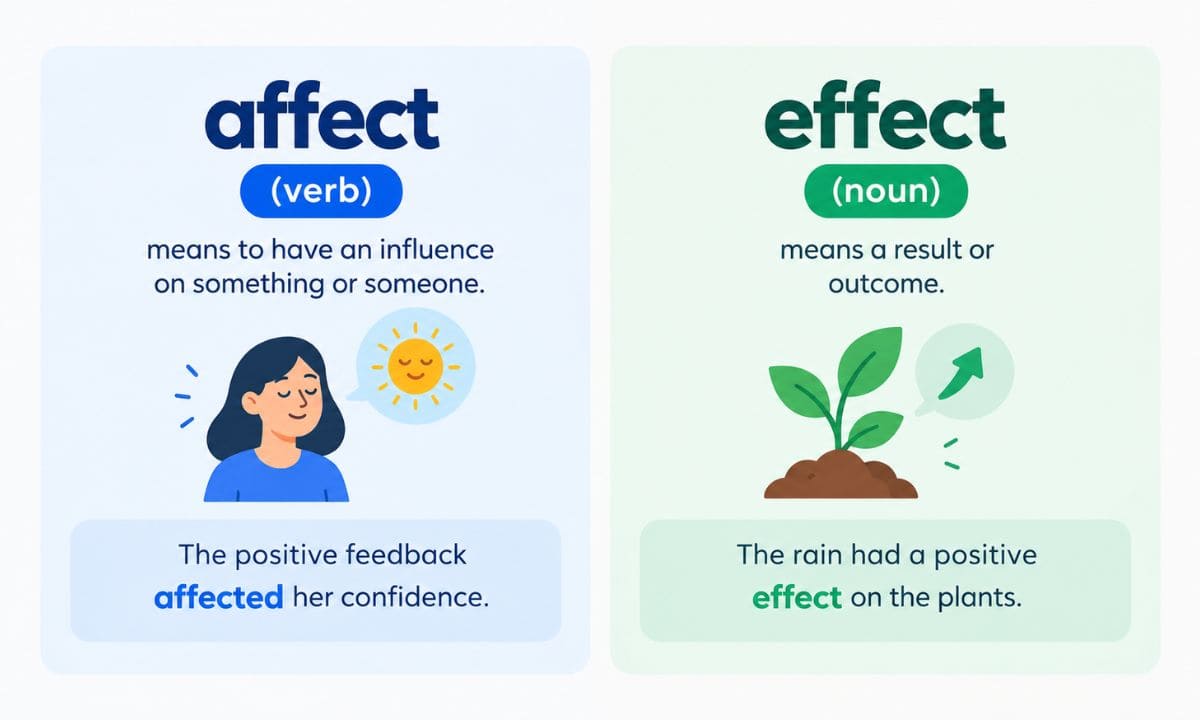
Effect vs. Affect: What Is the Difference?
Almost everyone mixes these up at some point. The rule is short.
When to Use “Effect”
Use effect as a noun. A quick test: can you put “the” or “an” in front of it? Then it’s effect.
The effect was immediate.
When to Use “Affect”
Use affect as a verb meaning “to influence.”
Stress can affect your sleep.
Memory trick: affect is the action, effect is the end result.
70+ Synonyms for Effects and Their Meanings
Cause and Result Synonyms
1. Results
Meaning
what happens because of an action or event.
Example
The results of the new diet showed up within a month.
Usage tip
Plain and neutral. It works nearly everywhere.
2. Consequences
Meaning
outcomes that follow an action, often negative or serious.
Example
Skipping sleep has real consequences for your health.
Usage tip
Best for warnings and serious situations.
3. Outcomes
Meaning
the final result of a process or situation.
Example
Both treatments led to similar outcomes.
Usage tip
Common in research, business, and medical writing.
4. Impacts
Meaning
strong effects that change a situation.
Example
Social media has major impacts on teenagers.
Usage tip
Save it for big, noticeable changes.
5. Repercussions
Meaning
unintended, usually unpleasant results that arrive later.
Example
The decision had financial repercussions for the whole company.
Usage tip
Fits negative, long-lasting outcomes.
6. Ramifications
Meaning
complicated results that branch out from a decision.
Example
The law has legal ramifications for small businesses.
Usage tip
Formal. Good for law and policy.
7. Aftermath
Meaning
the situation left behind by a major event.
Example
The town rebuilt slowly in the aftermath of the flood.
Usage tip
Disasters and big events. Usually singular.
8. Upshot
Meaning
the final result or point of something.
Example
The upshot of the meeting was a new deadline.
Usage tip
Informal, conversational.
9. Fallout
Meaning
negative side results of an event or decision.
Example
The company faced public fallout after the data leak.
Usage tip
Ideal for news and crisis writing.
10. Implications
Meaning
possible future effects, or meanings that are suggested but not stated.
Example
The findings have implications for future research.
Usage tip
Use it when you’re talking about what might come next.
11. Byproducts
Meaning
secondary results produced alongside the main one.
Example
Stress is a common byproduct of long working hours.
Usage tip
Good for unplanned but related results.
12. Side Effects
Meaning
extra, often unwanted effects of a treatment or action.
Example
Drowsiness is a known side effect of this medicine.
Usage tip
Health first, but it works figuratively too.
13. Aftereffects
Meaning
effects that show up after the main event is over.
Example
He still feels the aftereffects of the injury.
Usage tip
Delayed effects, especially health-related ones.
14. Backlash
Meaning
a strong negative reaction from people.
Example
The price hike caused a customer backlash.
Usage tip
Public or group reactions only, not natural effects.
15. Ripple Effects
Meaning
effects that spread outward step by step.
Example
One resignation had ripple effects across the team.
Usage tip
Great for indirect, spreading consequences.
16. Knock-on Effects
Meaning
chain reactions where one thing causes the next.
Example
Fuel prices have knock-on effects on food costs.
Usage tip
Popular in economics and business.
17. Domino Effect
Meaning
a chain of events set off by one event.
Example
The bank’s collapse created a domino effect.
Usage tip
Use it when events tip over one after another.
18. Aftershocks
Meaning
smaller, later effects following a major event.
Example
The economy felt the aftershocks of the crisis for years.
Usage tip
Works well as a metaphor for lingering effects.
19. Reverberations
Meaning
long-lasting effects that echo widely.
Example
The speech had reverberations across the country.
Usage tip
Large-scale, far-reaching effects.
20. Spin-offs
Meaning
secondary benefits or products that come out of something else.
Example
Space research has produced many useful spin-offs.
Usage tip
Usually positive and practical.
21. Offshoots
Meaning
things that grow out of a main source.
Example
The new policy was an offshoot of earlier reforms.
Usage tip
For developments that branch off from something original.
22. Fruits
Meaning
the positive results of hard work.
Example
She enjoyed the fruits of her labor.
Usage tip
Almost always positive, and usually in “fruits of labor.”
23. Payoff
Meaning
the reward at the end of an effort.
Example
The long training finally had a payoff.
Usage tip
When effort leads to a clear benefit.
24. End Result
Meaning
the final outcome once everything is done.
Example
The end result was better than expected.
Usage tip
It stresses finality.
25. Corollary
Meaning
a natural consequence that follows from something.
Example
Higher demand is a corollary of lower prices.
Usage tip
Formal. Suits logical or academic writing.
26. Culmination
Meaning
the final high point of a process.
Example
The award was the culmination of years of effort.
Usage tip
Best for a positive peak.
27. Conclusion
Meaning
the ending or final result of a process.
Example
The dispute reached a peaceful conclusion.
Usage tip
Neutral and flexible.
28. Issue
Meaning
a result or outcome, in formal writing.
Example
We await the issue of the negotiations.
Usage tip
Old-fashioned in this sense. Use it sparingly.
29. Wake
Meaning
what trails behind an event.
Example
The storm left destruction in its wake.
Usage tip
Nearly always in the phrase “in the wake of.”
30. Legacy
Meaning
a lasting effect left behind over time.
Example
The leader’s legacy still shapes the nation.
Usage tip
For long-term effects that last years.
Influence and Power Synonyms
31. Influence
Meaning
the power to change someone or something.
Example
Friends have a strong influence on our habits.
Usage tip
Works for people, ideas, and events.
32. Sway
Meaning
influence or control over others.
Example
The media holds great sway over public opinion.
Usage tip
Often paired with “hold sway.”
33. Bearing
Meaning
relevance to, or effect on, a matter.
Example
This has no bearing on the final decision.
Usage tip
Lives in the phrase “have a bearing on.”
34. Force
Meaning
the raw strength of an effect.
Example
The force of the argument changed his mind.
Usage tip
Strong, direct effects.
35. Power
Meaning
the ability to produce a strong effect.
Example
Words have the power to heal.
Usage tip
Good for abstract things like words and ideas.
36. Weight
Meaning
importance or influence given to something.
Example
Her opinion carries great weight.
Usage tip
Pairs well with “carry” and “give.”
37. Significance
Meaning
the importance of an effect or event.
Example
The discovery has global significance.
Usage tip
Formal. Good for stressing importance.
38. Efficacy
Meaning
the ability to produce the desired effect.
Example
Doctors tested the efficacy of the vaccine.
Usage tip
Common in science and medicine.
39. Effectiveness
Meaning
how well something produces the intended result.
Example
The team measured the effectiveness of the campaign.
Usage tip
Use it when you’re judging performance.
40. Potency
Meaning
the strength of an effect.
Example
The potency of the drug drops over time.
Usage tip
Medicine, chemicals, and arguments.
41. Clout
Meaning
influence or power, especially in society.
Example
The company has real political clout.
Usage tip
Informal. About influence in business or politics.
Reaction and Sign Synonyms
42. Reactions
Meaning
responses to an action or event.
Example
Reactions to the news were mixed.
Usage tip
Feelings or actions after something happens.
43. Responses
Meaning
replies or reactions to something.
Example
Patients showed positive responses to the therapy.
Usage tip
Common in science and surveys.
44. Symptoms
Meaning
signs that show the effect of a condition.
Example
Fatigue is a symptom of stress.
Usage tip
Health first, or figuratively for deeper problems.
45. Manifestations
Meaning
visible signs or forms of something.
Example
Anxiety has many physical manifestations.
Usage tip
Formal. Shows how something appears.
46. Signs
Meaning
visible evidence of an effect.
Example
There are signs of improvement.
Usage tip
Simple, easy, everyday.
47. Imprint
Meaning
a lasting effect left on something.
Example
The experience left an imprint on his personality.
Usage tip
Deep, lasting effects.
48. Impression
Meaning
the effect something has on the mind.
Example
She made a strong impression on the interviewer.
Usage tip
Perfect for first meetings and gut feelings.
49. Mark
Meaning
a noticeable effect left behind.
Example
The teacher left her mark on every student.
Usage tip
Usually in “leave a mark.”
50. Footprint
Meaning
the total effect something leaves on an area.
Example
The factory has a large environmental footprint.
Usage tip
Popular in environmental writing (“carbon footprint”).
Sensory and Creative Synonyms
51. Sensations
Meaning
physical feelings caused by something.
Example
The medicine caused a tingling sensation.
Usage tip
Body-related effects.
52. Feelings
Meaning
emotional effects on a person.
Example
The film left me with mixed feelings.
Usage tip
Simple and emotional.
53. Atmosphere
Meaning
the overall effect or mood of a place.
Example
Soft lighting created a relaxing atmosphere.
Usage tip
Good for spaces and events.
54. Ambience
Meaning
the character or mood of an environment.
Example
The cafe’s warm ambience draws students in.
Usage tip
Common in hospitality and reviews.
55. Mood
Meaning
the feeling created by a setting or scene.
Example
Dark colors set a serious mood.
Usage tip
Handy in film, art, and design.
56. Illusions
Meaning
effects that trick the eyes or mind.
Example
The magician performed amazing illusions.
Usage tip
Tricks and false appearances.
57. Visuals
Meaning
visual effects or images in media.
Example
The movie has stunning visuals.
Usage tip
Film, games, and presentations.
58. Special Effects
Meaning
artificial effects made for film or stage.
Example
The film won an award for its special effects.
Usage tip
The technical term for movies. You’ll also see “SFX” and “VFX.”
59. Sound Effects
Meaning
artificial sounds used in media.
Example
The horror film leaned hard on eerie sound effects.
Usage tip
Audio in film, games, and podcasts.
60. Tricks
Meaning
clever effects made to surprise.
Example
The camera tricks made him look like he was flying.
Usage tip
Informal. Playful or clever effects.
Belongings (“Personal Effects”) Synonyms
61. Belongings
Meaning
things a person owns.
Example
He packed his belongings and left.
Usage tip
The most natural everyday word for this meaning.
62. Possessions
Meaning
items someone owns.
Example
She lost most of her possessions in the fire.
Usage tip
A touch more formal than belongings.
63. Property
Meaning
things owned, including land or items.
Example
Please do not leave personal property in the room.
Usage tip
Common in legal and official notices.
64. Goods
Meaning
items owned or sold.
Example
The police returned the stolen goods.
Usage tip
Items that can be sold or moved.
65. Personal Items
Meaning
small things that belong to one person.
Example
Keep your personal items in the locker.
Usage tip
Clear and simple. Good for signs and rules.
66. Assets
Meaning
valuable things owned by a person or company.
Example
The company sold several assets.
Usage tip
Business and finance.
67. Gear
Meaning
equipment or belongings for a purpose.
Example
He carried all his camping gear.
Usage tip
Informal. Tools and equipment.
68. Baggage
Meaning
luggage or belongings carried while traveling.
Example
Passengers must collect their baggage.
Usage tip
Also figurative, as in “emotional baggage.”
69. Things
Meaning
a general word for objects someone owns.
Example
Pack your things before we go.
Usage tip
Very casual, very everyday.
70. Paraphernalia
Meaning
assorted items needed for an activity.
Example
The room was full of art paraphernalia.
Usage tip
Collections of small items.
71. Chattels
Meaning
movable personal property (a legal term).
Example
The contract lists all household chattels.
Usage tip
Legal or very formal writing only.
72. Holdings
Meaning
property or investments a person owns.
Example
His holdings include land and shares.
Usage tip
Finance and law.
Synonyms for Effects: Formal vs. Casual
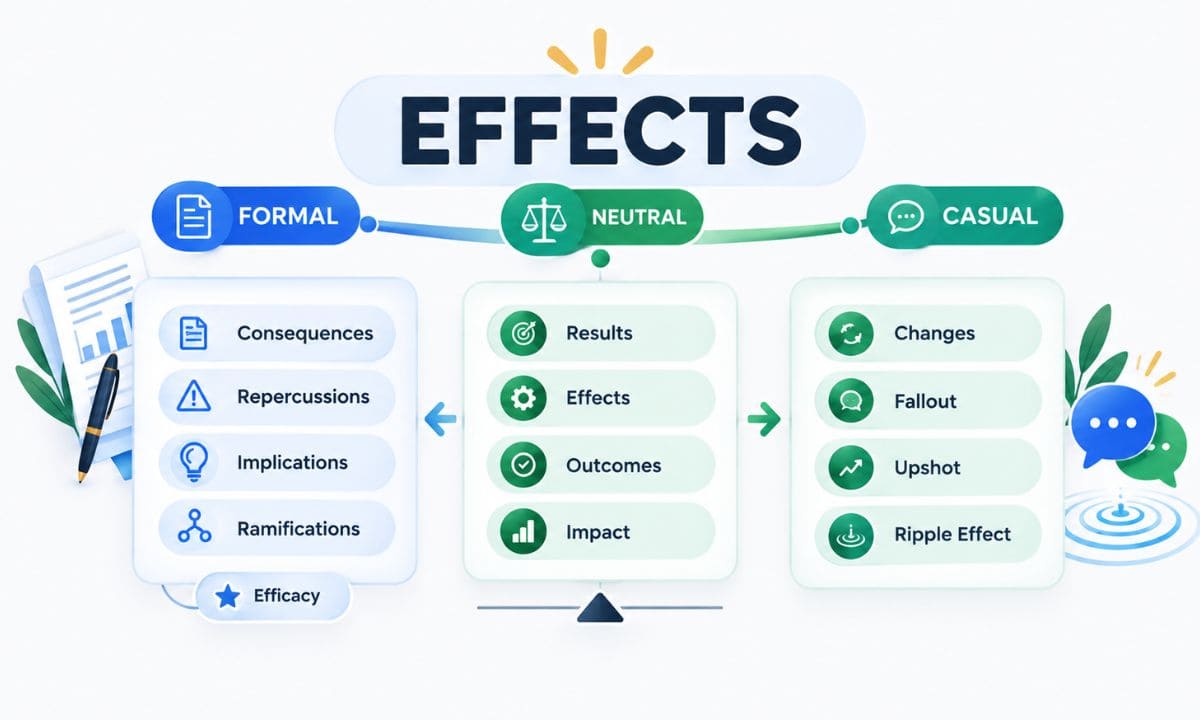
Formal: consequences, repercussions, implications, ramifications, efficacy. Reports, essays, legal and policy writing.
Casual: changes, upshot, ripple effect, payoff, fallout. Blogs, chats, social posts.
| Formal | Neutral | Casual |
| Consequences | Results | Changes |
| Repercussions | Effects | Fallout |
| Implications | Outcomes | Upshot |
| Ramifications | Impact | Ripple effect |
Effects vs. Its Closest Synonyms
Effects vs. Results
Results are what you measure. Effects are what a cause produces.
The results were clear: sales rose. The effects showed up in every store.
Effects vs. Consequences
Consequences carry a sense of responsibility or risk.
Late fees are a consequence of missed payments.
Effects vs. Impacts
Impacts are stronger and easier to see.
The storm’s impacts reached three states.
Effects vs. Outcomes
Outcomes describe the end point. Effects can show up along the way.
The final outcome was a win-win.
Effects vs. Repercussions
Repercussions come later, and they bring trouble.
He faced repercussions for leaking the memo.
What Major Dictionaries Say About “Effects”
Dictionary.com and Collins both define an effect as something produced by a cause: a result or consequence.
Cambridge, Merriam-Webster, and Oxford Languages say nearly the same thing, a change caused by an action or event.
They also list side meanings. Being in force (“the law is in effect”). An impression made on someone. Special effects in film. Check which meaning you need before you swap the word out.
How to Choose the Right Synonym for Effects
By meaning
- Results and outcomes: neutral, measurable
- Consequences and repercussions: serious, often negative
- Impacts and influence: the strength of the change
By tone
- Formal: implications, ramifications
- Neutral: results, outcomes
- Casual: upshot, payoff
By context
Conversation: changes, fallout
Academic: findings, implications
Business: impact, results
Common Mistakes When Using Effects Synonyms
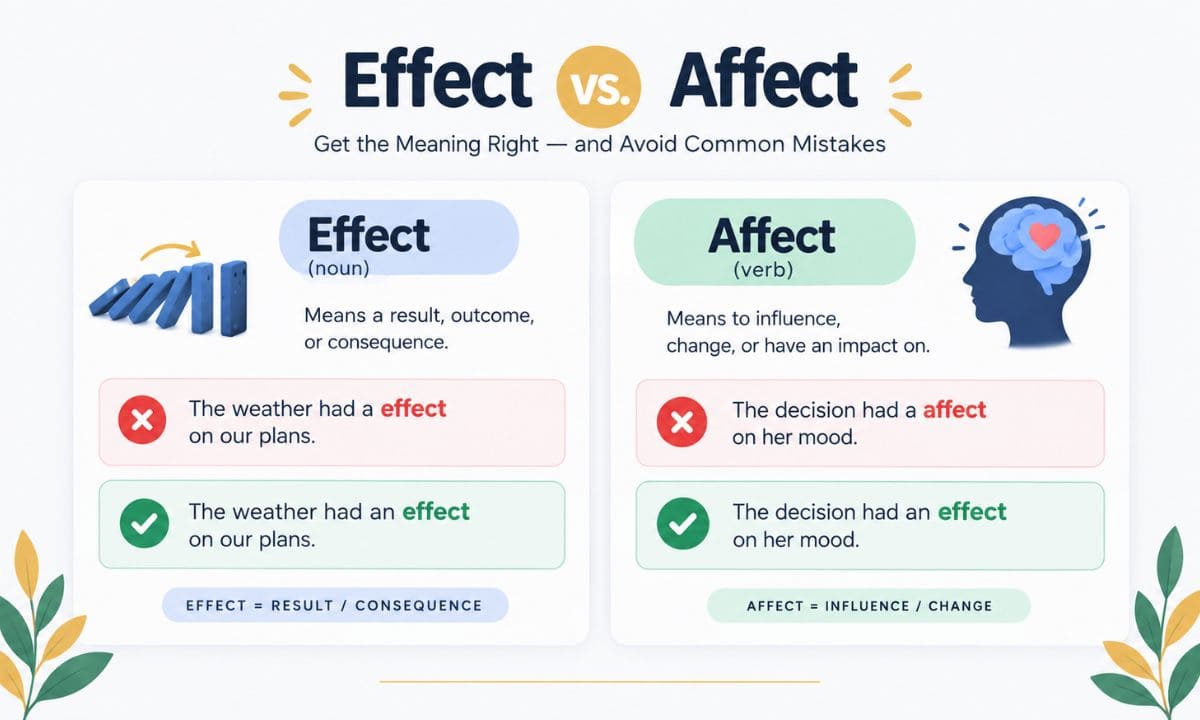
Confusing Effect With Affect
The top error by a mile. The effect is the action. Effect is the end result.
Using “Consequences” for Every Effect
Only use it when the result follows a choice or a risk. “The consequences of a sunny day” sounds off.
Using “Impact” for a Simple Result
Not every result has an impact. A small tweak has a result. A policy shake-up has an impact.
Choosing the Wrong Tone
“Ramifications” in a text to a friend sounds stiff. “Fallout” in a legal brief sounds sloppy.
Changing the Meaning
“Personal effects” means belongings. Swap it for “personal results” and the sentence breaks. Read the whole sentence before you replace anything.
Synonyms for Effects in Sentences
Results: The results of the test came back today.
Consequences: Ignoring the rules led to harsh consequences.
Impacts: Remote work has big impacts on city life.
Outcomes: Better sleep improves learning outcomes.
Repercussions: The scandal had lasting repercussions.
Academic: The findings suggest strong implications for teachers.
Professional: The price change had a measurable impact on sales.
Conversational: The upshot is we’re all going home early.
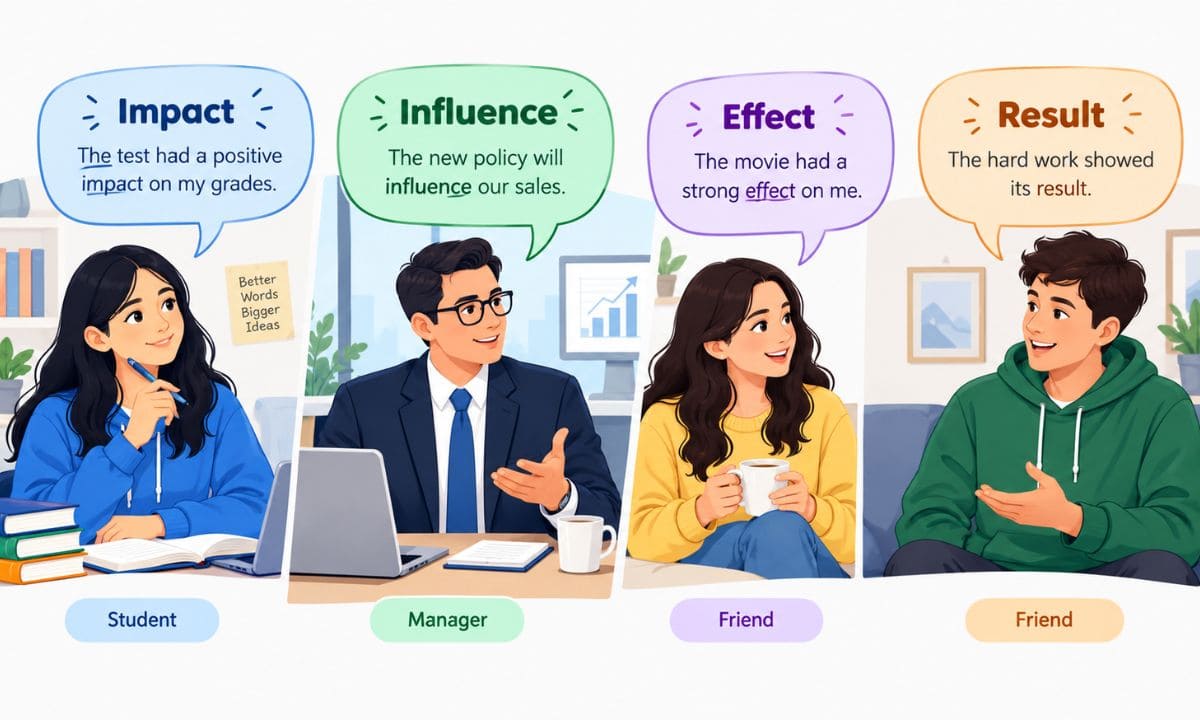
Image prompt 5: Split image of a student, a manager, and two friends chatting, each with a speech bubble using a different synonym for “effects.”
Explore More Synonyms Guide
25+ Struggle Synonyms: Better Ways to Say Struggle (With Examples)
25+ Policy Synonyms: Useful Alternatives, Meanings & Examples
Kindness Synonyms: 25+ Words, Meanings, Examples & How to Use Them
20+ Primary Synonyms: Other Ways to Say “Primary” With Meaning & Examples
25+ Share Synonyms: Meanings, Examples & When to Use Each
Frequently Asked Questions
What Is Another Word for Effects?
Results, consequences, impacts, and outcomes are the most common.
What Is a Better Word for Effects?
“Results” for a neutral tone, “impacts” for strong change, “outcomes” for final states.
What Is a Synonym for Positive Effects?
Benefits, gains, and payoff.
What Is a Synonym for Negative Effects?
Consequences, fallout, backlash, and damage.
What Is a Formal Word for Effects?
Implications, ramifications, and repercussions.
Are “Effects” and “Consequences” Synonyms?
Yes, but consequences usually imply something serious or negative.
Are “Effects” and “Results” the Same?
They overlap. Results are what you measure. Effects trace back to a cause.
What Is the Difference Between Effects and Impacts?
Impacts are stronger and more noticeable. Effects can be small.
What Is the Difference Between Effect and Affect?
Five to start: results, consequences, impacts, outcomes, and repercussions.
Conclusion: Choose the Right Synonym for Effects
You now have more than 70 synonyms for effects and a fast way to choose between them.
Ask yourself three things. What do I mean? Who’s reading? What tone fits?
Start with results, consequences, and impacts. Pick up the rest as you write.
