

If you’ve used the word “activities” more than twice in the same paragraph, you already know the problem. It’s a safe word. It’s also a boring one. Whether you’re writing a resume, a school newsletter, a business report, or just a text to a friend, repeating “activities” makes your writing feel flat and generic.
The good news: English gives you plenty of room to work with. This guide breaks down 22+ activities synonyms, what each one actually means, when to use it, and how it sounds in a real sentence.
By the end, you’ll know exactly which word fits your tone: formal, casual, academic, or professional.
Quick Answer
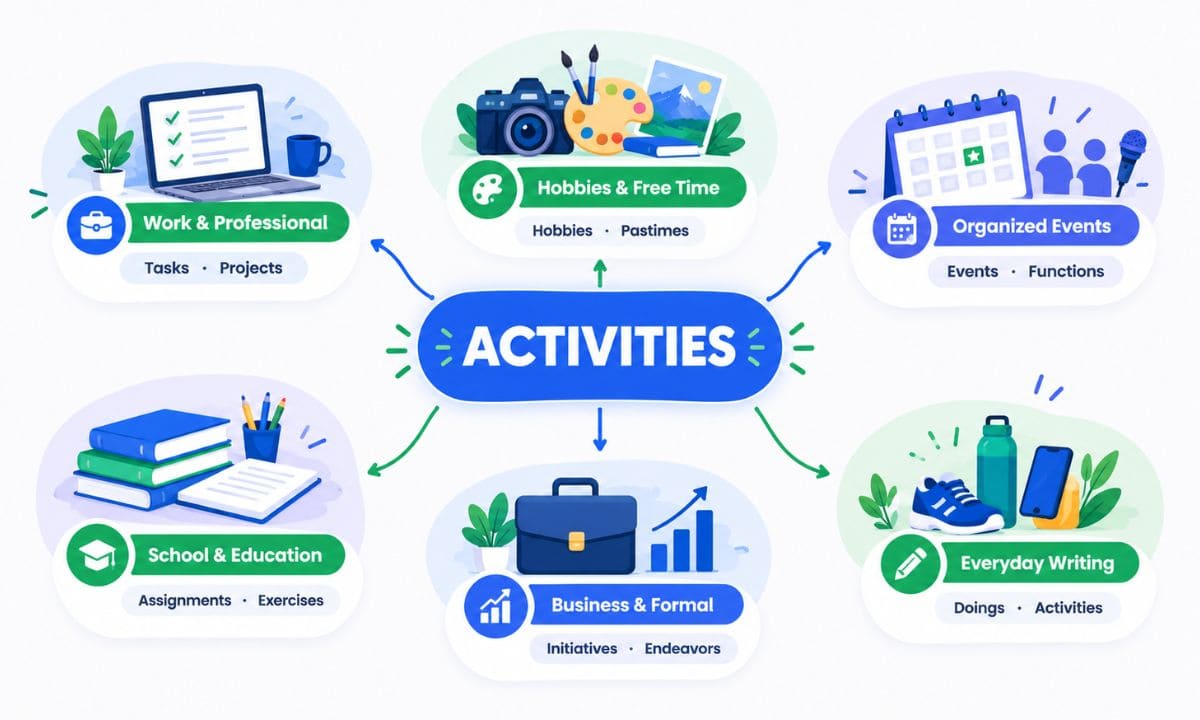
The best synonyms for activities depend on context. For work, use tasks or projects. For hobbies, use pastimes or pursuits. For scheduled occasions, use events or functions. For formal or business writing, use endeavors, undertakings, or initiatives. There’s no single “best” activities synonym: the right word matches the tone and setting of your sentence.
What Does “Activities” Mean?
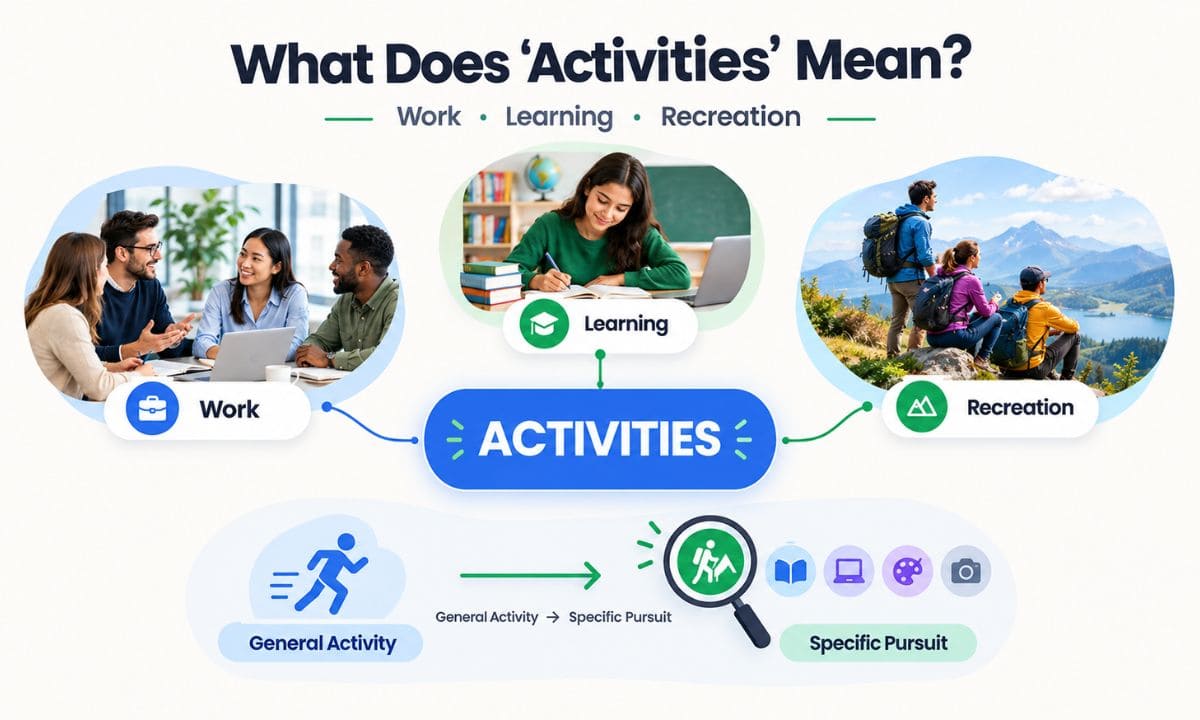
At its core, “activities” refers to things people do, especially planned or purposeful actions, whether for work, learning, or fun.
Dictionaries generally describe it two ways: as the general state of being active (physical activity, economic activity), and as a specific pursuit or organized event (school activities, weekend activities, recreational activities).
That second meaning is the one most writers reach for, and it’s also the vaguest. “Activities” can mean a business meeting, a hiking trip, a school assignment, or a wedding reception all at once. That’s exactly why picking a more precise synonym for activities makes your writing clearer and more interesting.
Best Synonyms for Activities at a Glance
| Synonym | Best Used For | Tone |
| Tasks | Work duties, to-do lists | Neutral |
| Pursuits | Hobbies, personal interests | Formal |
| Pastimes | Free-time hobbies | Casual |
| Events | Scheduled occasions | Neutral-formal |
| Hobbies | Leisure interests | Casual |
| Endeavors | Big efforts, projects | Formal |
| Programs | Structured, ongoing plans | Neutral |
| Engagements | Professional commitments | Formal |
| Projects | Work or school assignments | Neutral |
| Practices | Repeated routines or drills | Neutral |
22+ Activities Synonyms and Their Meanings
Here are 22+ solid alternatives to “activities,” each with a clear meaning, best use case, and example sentences so you always know which one fits.
1. Tasks
Meaning
A task is a specific piece of work with a clear goal, usually assigned by someone or set by yourself.
Best For
Job duties, chores, and structured to-do lists.
Introduction
Use “tasks” when “activities” feels too vague for a checklist or work plan tasks have a defined start and end point.
Examples
- “Finish your tasks before the deadline.”
- “The manager assigned new tasks to the team.”
- “She completed all her weekly tasks early.”
Usage Tip
Swap “activities” for “tasks” whenever each item on your list has a clear owner and outcome.
2. Pursuits
Meaning
Pursuits are things a person actively works toward or enjoys, often over a long period.
Best For
Hobbies, personal interests, and long-term goals.
Introduction
“Pursuits” sounds more polished than “activities,” which makes it a natural fit for bios, profiles, and formal introductions.
Examples
- “Painting is one of her creative pursuits.”
- “He balances work with outdoor pursuits.”
- “Their leisure pursuits include hiking and reading.”
Usage Tip
Use “pursuits” for interests someone actively chooses not for assigned duties.
3. Pastimes
Meaning
A pastime is a casual, enjoyable way to pass free time.
Best For
Hobbies and relaxed, low-stakes leisure activities.
Introduction
“Pastimes” works well in casual or lifestyle writing about how someone spends their downtime.
Examples
- “Fishing is his favorite pastime.”
- “Board games were our weekend pastime.”
- “Gardening became her go-to pastime.”
Usage Tip
Avoid “pastimes” in work or school contexts; it reads too relaxed for anything formal.
4. Endeavors
Meaning
An endeavor is a serious, often ambitious effort or attempt at something.
Best For
Business projects, creative work, or major personal goals.
Introduction
“Endeavors” adds weight to your sentence, useful when “activities” feels too light for the effort involved.
Examples
- “The company’s new endeavors include clean energy projects.”
- “She poured herself into her creative endeavors.”
- “Their charitable endeavors raised thousands of dollars.”
Usage Tip
Save “endeavors” for meaningful, effortful undertakings not routine, everyday tasks.
5. Undertakings
Meaning
An undertaking is a task or project someone formally commits to, often large in scope.
Best For
Formal business, legal, or official writing.
Introduction
“Undertakings” fits naturally into contracts, proposals, and official statements where responsibility matters.
Examples
- “The merger is a complex undertaking.”
- “Building the bridge was a massive undertaking.”
- “Their new undertaking requires careful planning.”
Usage Tip
Use “undertakings” when the activity comes with real accountability attached.
6. Exercises
Meaning
Exercises are practices or drills done repeatedly to build skill, strength, or understanding.
Best For
Fitness routines and classroom practice.
Introduction
“Exercises” fits activities that repeat for improvement, not one-off events.
Examples
- “The gym class practiced breathing exercises.”
- “Students completed grammar exercises in class.”
- “Daily stretching exercises improve flexibility.”
Usage Tip
Reserve “exercises” specifically for repeated, skill-building activities.
7. Events
Meaning
An event is a planned occasion, usually with a set date, time, and purpose.
Best For
Conferences, celebrations, and scheduled programs.
Introduction
“Events” works when the activity is a single occasion, not an ongoing routine.
Examples
- “The school hosts several events each semester.”
- “Charity events raised funds for local shelters.”
- “The conference includes networking events.”
Usage Tip
Don’t use “events” for daily or repeated routines save it for one-time occasions.
8. Programs
Meaning
A program is a structured set of activities organized around a shared goal, usually running over time.
Best For
Education, wellness, and community organizing.
Introduction
“Programs” implies structure and sequence, more than a single, standalone activity.
Examples
- “The after-school program offers art and music.”
- “She joined a fitness program at the gym.”
- “The nonprofit runs mentorship programs for teens.”
Usage Tip
Use “programs” when several related activities are grouped under one plan.
9. Engagements
Meaning
Engagements are commitments to attend or take part in something, often professional or social.
Best For
Meetings, appointments, and professional obligations.
Introduction
“Engagements” fits calendars and formal schedules better than the generic “activities.”
Examples
- “Her calendar is full of speaking engagements.”
- “He has several client engagements this week.”
- “The diplomat’s public engagements include two summits.”
Usage Tip
Use “engagements” for scheduled commitments, not casual hobbies.
10. Projects
Meaning
A project is a planned piece of work with a specific goal and timeline.
Best For
Work assignments, school work, and creative tasks.
Introduction
“Projects” reads more concrete than “activities” when there’s a clear, expected output.
Examples
- “The team finished the project ahead of schedule.”
- “Students presented their science projects.”
- “Home renovation projects can take months.”
Usage Tip
Choose “projects” when the activity has a defined deliverable at the end.
11. Assignments
Meaning
An assignment is a task given to someone, typically by a teacher, editor, or supervisor.
Best For
School work and delegated job duties.
Introduction
“Assignments” works better than “activities” when someone else set the task, not you.
Examples
- “Turn in your reading assignments by Friday.”
- “The editor gave her a new assignment.”
- “Weekly assignments help students track progress.”
Usage Tip
Use “assignments” only for tasks handed down by an authority figure.
12. Ventures
Meaning
A venture is a new or risky undertaking, often in a business context.
Best For
Startups, investments, and entrepreneurial activities.
Introduction
“Ventures” adds a sense of risk and opportunity that “activities” simply doesn’t carry.
Examples
- “Their new venture launched last spring.”
- “He invested in several business ventures.”
- “The joint venture expanded into three countries.”
Usage Tip
Use “ventures” for activities involving financial or entrepreneurial risk.
13. Hobbies
Meaning
A hobby is something done regularly for personal enjoyment, outside of work.
Best For
Personal interests and free time.
Introduction
“Hobbies” is the most natural, everyday replacement for leisure activities.
Examples
- “Knitting and hiking are her main hobbies.”
- “What hobbies do you enjoy on weekends?”
- “He picked up photography as a new hobby.”
Usage Tip
Use “hobbies” only for personal, unpaid interests, never for job duties.
14. Recreations
Meaning
Recreations are activities pursued specifically for relaxation and enjoyment.
Best For
Leisure time and community or parks programs.
Introduction
“Recreations” suits community centers, parks departments, and wellness content especially well.
Examples
- “The city’s parks and recreation department plans summer events.”
- “Swimming is a popular summer recreation.”
- “Outdoor recreations include camping and cycling.”
Usage Tip
This word appears more in official names and program titles than in casual speech.
15. Functions
Meaning
A function is a formal social or organizational event.
Best For
Corporate events, ceremonies, and official gatherings.
Introduction
“Functions” adds a level of formality that plain “activities” can’t offer.
Examples
- “The hotel hosts wedding functions every weekend.”
- “Employees attended the annual company function.”
- “The charity function raised significant donations.”
Usage Tip
Use “functions” for formal, often invitation-based events not casual meetups.
16. Operations
Meaning
Operations are organized actions carried out to achieve a business or organizational goal.
Best For
Business processes and logistics.
Introduction
“Operations” fits company activities far better than the generic word “activities” does.
Examples
- “The factory’s daily operations run around the clock.”
- “Military operations require careful coordination.”
- “The company streamlined its shipping operations.”
Usage Tip
Use “operations” for systemized, ongoing business activities, not one-time tasks.
17. Proceedings
Meaning
Proceedings are formal actions or events that follow a set process, often official.
Best For
Legal, academic, or formal meeting contexts.
Introduction
“Proceedings” suits formal writing about meetings, trials, or conferences.
Examples
- “The court proceedings lasted three days.”
- “Conference proceedings were published online.”
- “The meeting proceedings were recorded for reference.”
Usage Tip
Reserve “proceedings” for official, documented activities.
18. Occupations
Meaning
Occupations describe the ways someone spends their time, including work and regular pursuits.
Best For
Formal descriptions of how time is spent or work is structured.
Introduction
“Occupations” can replace “activities” when describing how a person fills their time or earns a living.
Examples
- “Farming remains a common occupation in the region.”
- “Her daily occupations include writing and teaching.”
- “Various occupations kept the volunteers busy all day.”
Usage Tip
This word leans formal, even slightly old-fashioned use it sparingly in casual writing.
19. Doings
Meaning
Doings is an informal term for the things people do, often day-to-day.
Best For
Casual conversation and storytelling.
Introduction
“Doings” feels chatty and personal, great for blogs, letters, or informal updates.
Examples
- “Catch me up on your doings this week.”
- “The newsletter covers the club’s recent doings.”
- “Nobody knew about his secret doings.”
Usage Tip
Skip “doings” in formal or professional writing; it’s strictly a casual word.
20. Happenings
Meaning
Happenings are events or occurrences, especially ones considered notable or interesting.
Best For
News updates, social recaps, and casual event coverage.
Introduction
“Happenings” works for describing a loose mix of activities and events at once.
Examples
- “Local happenings are listed in the weekend guide.”
- “Strange happenings occurred at the old house.”
- “The blog covers city happenings every Friday.”
Usage Tip
Use “happenings” for a casual roundup not for a formal report.
21. Initiatives
Meaning
An initiative is a planned action intended to solve a problem or reach a specific goal.
Best For
Business, government, and nonprofit programs.
Introduction
“Initiatives” signals purpose-driven activities, which makes it a strong fit for strategic or mission-based writing.
Examples
- “The company launched a sustainability initiative.”
- “New initiatives aim to reduce food waste.”
- “The school started a reading initiative for kids.”
Usage Tip
Use “initiatives” when the activity is clearly tied to a specific goal or mission.
22. Practices
Meaning
Practices are activities repeated regularly to build a skill or maintain a habit.
Best For
Sports, music, professional routines, and religious observance.
Introduction
“Practices” fits repeated, skill-based activities better than the generic term “activities” does.
Examples
- “Soccer practices happen twice a week.”
- “Meditation is part of her morning practices.”
- “The firm reviewed its hiring practices.”
Usage Tip
Use “practices” for repeated routines, not single, standalone events.
A few more worth knowing: chores (routine household tasks), amusements (light entertainment), and diversions (activities that pull attention away from something else) round out the list if you need even more variety.
Activities Synonyms by Context
Different settings call for different words. Here’s a quick breakdown of the best activities synonyms by situation.
Activities Synonyms for Work
- Tasks
- Projects
- Duties
- Operations
- Assignments
Activities Synonyms for School and Education
- Assignments
- Exercises
- Projects
- Programs
- Practices
Activities Synonyms for Free Time
- Hobbies
- Pastimes
- Pursuits
- Recreations
- Amusements
Activities Synonyms for Events
- Events
- Functions
- Proceedings
- Programs
- Engagements
Activities Synonyms for Professional Writing
- Endeavors
- Undertakings
- Initiatives
- Engagements
- Operations
Activities Synonyms: Formal vs. Casual
Formal Synonyms for Activities
Endeavors, undertakings, engagements, proceedings, initiatives, and functions all carry a professional or official tone.
Casual Synonyms for Activities
Hobbies, pastimes, doings, happenings, and amusements work best in everyday, relaxed writing.
| Word | Tone | Best Context |
| Endeavors | Formal | Business writing |
| Undertakings | Formal | Legal or official documents |
| Engagements | Formal | Calendars, schedules |
| Proceedings | Formal | Meetings, legal reports |
| Initiatives | Formal | Strategy, nonprofit work |
| Functions | Formal | Corporate events |
| Hobbies | Casual | Everyday conversation |
| Pastimes | Casual | Lifestyle and leisure writing |
| Doings | Casual | Storytelling, personal updates |
| Happenings | Casual | Social recaps |
| Pursuits | Neutral-formal | Bios and profiles |
| Tasks | Neutral | Work and to-do lists |
Activities Synonyms for Professional Writing
Best Formal Alternatives to Activities
For polished, professional writing, lean on endeavors, undertakings, initiatives, and engagements. Each signals purpose and structure without sounding stiff.
Activities in Business Writing
Business writing favors words like operations and initiatives because they describe organized, goal-driven work. For example: “The board reviewed the company’s core operations and approved two new initiatives.”
Activities in Academic Writing
Academic contexts often call for exercises, practices, or proceedings words tied to structured learning or formal documentation. For example: “The proceedings from the symposium included summaries of classroom exercises used in the study.”
What Major Dictionaries Say About “Activities”
Cambridge Dictionary
Cambridge frames activities broadly as things people do, especially for enjoyment, or as a planned part of work, school, or an organization’s schedule.
Merriam-Webster
Merriam-Webster covers several senses: the general state of being active, a pursuit someone is actively engaged in, and a form of organized, supervised recreation, think school or camp activities.
Oxford Languages / Oxford English Dictionary
Oxford’s definition centers on “a thing that a person or group does,” often for leisure, learning, or as part of an organization’s regular work.
Collins Dictionary
Collins describes activity as both the state of being active and any specific deed, pursuit, or recreational activity, a definition broad enough to justify why more precise synonyms are so useful.
How to Choose the Right Synonym for Activities
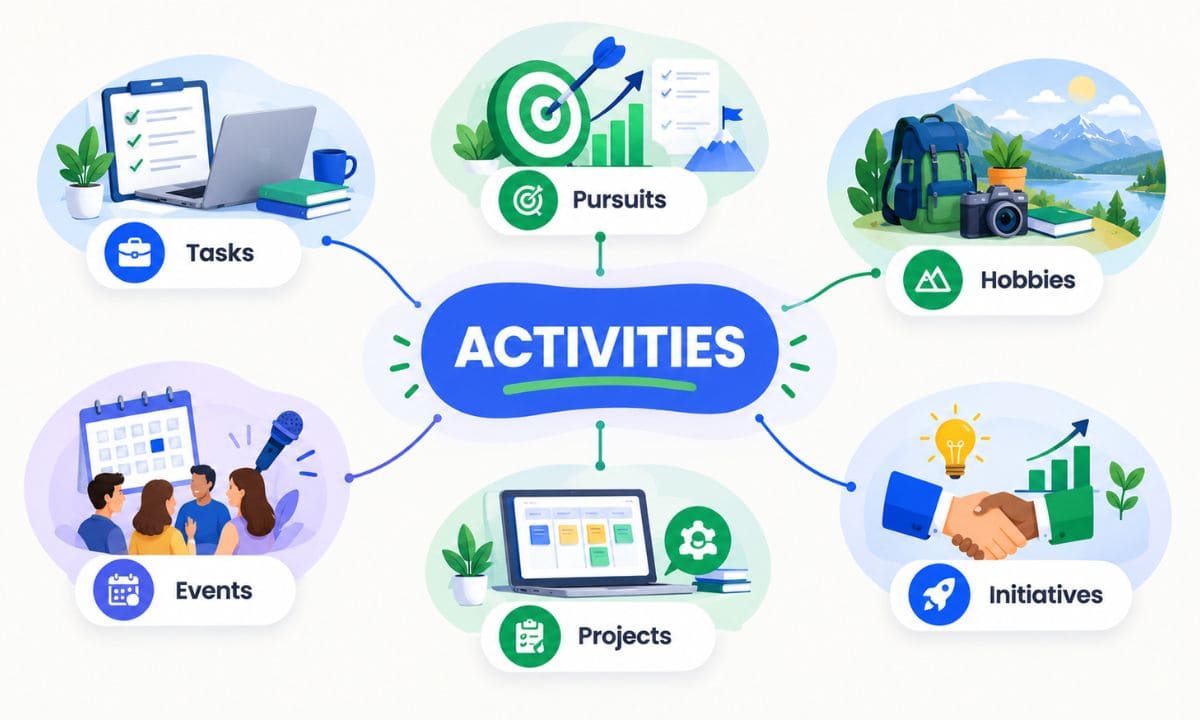
For Work and Professional Tasks
Use tasks, projects, or operations words that point to clear duties and outcomes.
For Hobbies and Free Time
Use hobbies, pastimes, or pursuits to describe how someone spends personal time.
For Organized Events
Use events, functions, or proceedings when describing a scheduled occasion.
For School and Education
Use assignments, exercises, or programs for anything tied to structured learning.
For Business and Formal Writing
Use endeavors, undertakings, or initiatives to sound polished and purposeful.
For General Everyday Writing
Use doings, happenings, or simply activities when precision matters less than tone.
Activities vs. Its Closest Synonyms
Activities vs. Actions
Actions are single instances of doing something; activities suggest ongoing or repeated involvement.
Activities vs. Tasks
Tasks come with a specific goal and often an assigner; activities can be open-ended or purely recreational.
Activities vs. Events
Events are single, scheduled occasions; activities can happen daily or without a fixed schedule.
Activities vs. Exercises
Exercises exist to build skill or fitness through repetition; activities cover a much broader range of pursuits.
Activities vs. Pursuits
Pursuits imply personal passion or a long-term interest; activities are more neutral and general.
Activities vs. Hobbies
Hobbies are personal, unpaid interests; activities can include both work-related and leisure pursuits.
Common Mistakes When Using Activities Synonyms
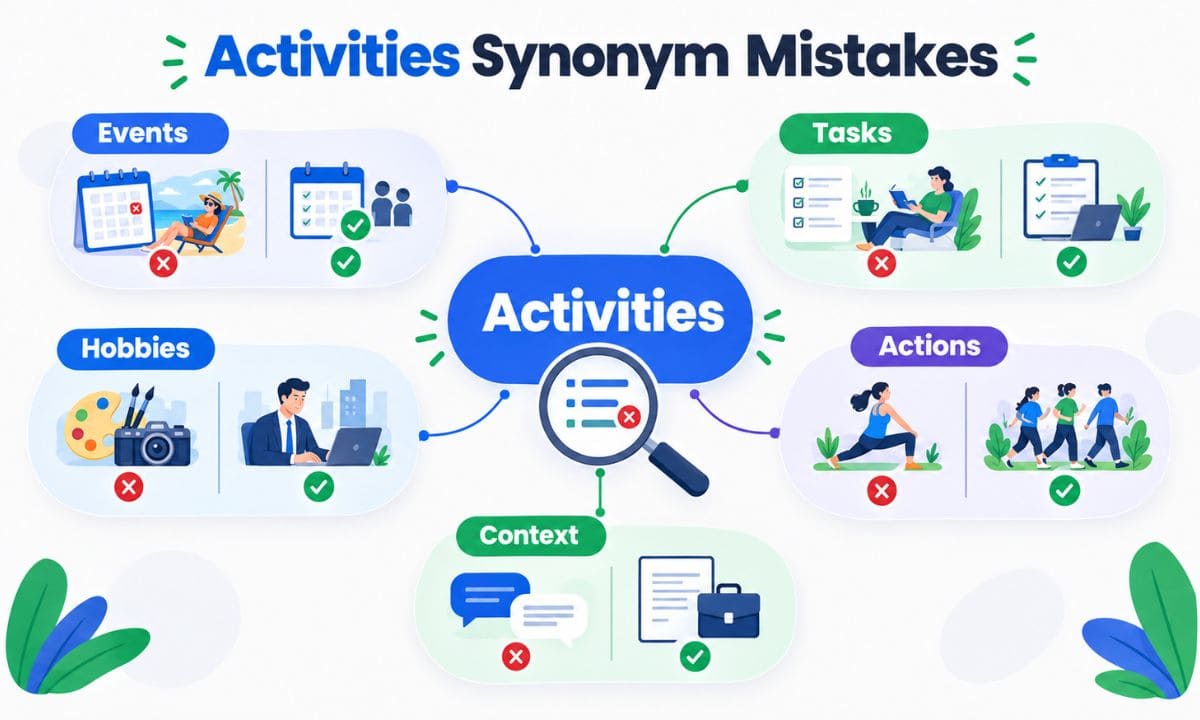
Using “Events” for Every Type of Activity
Not every activity is an event. A daily habit or ongoing hobby isn’t a scheduled occasion, so “events” doesn’t fit.
Using “Tasks” for Leisure Activities
Calling a hobby a “task” makes it sound like an obligation instead of something enjoyable.
Using “Hobbies” for Professional Work
Job duties aren’t hobbies, even when someone enjoys them. Keep “hobbies” for unpaid personal interests.
Confusing “Actions” With Organized Activities
An action is a single act; an organized activity usually involves planning, structure, or repetition.
Choosing a Synonym That Does Not Match the Context
A formal word like “undertakings” in a casual text message feels out of place, just as “doings” sounds too loose in a business report.
Best Activities Synonyms at a Glance
| Synonym | Best Meaning | Tone |
| Tasks | Assigned work with a clear goal | Neutral |
| Pursuits | Personal interests, long-term goals | Formal |
| Pastimes | Casual, enjoyable free-time activity | Casual |
| Endeavors | Serious, ambitious effort | Formal |
| Undertakings | Formal commitment or project | Formal |
| Exercises | Repeated skill-building practice | Neutral |
| Events | Planned, scheduled occasion | Neutral-formal |
| Programs | Structured set of activities | Neutral |
| Engagements | Scheduled professional commitment | Formal |
| Projects | Work with a defined deliverable | Neutral |
| Assignments | Task given by an authority figure | Neutral-formal |
| Ventures | Risky or entrepreneurial undertaking | Formal |
| Hobbies | Unpaid personal interest | Casual |
| Recreations | Leisure pursued for relaxation | Neutral-casual |
| Functions | Formal social or organizational event | Formal |
| Operations | Organized, ongoing business action | Formal |
| Proceedings | Official, documented activity | Formal |
| Occupations | How time or work is spent | Formal |
| Doings | Everyday things people do | Casual |
| Happenings | Notable events or occurrences | Casual |
| Initiatives | Goal-driven planned action | Formal |
| Practices | Repeated routine or habit | Neutral |
Activities Synonyms in Sentences
Activities in Everyday Sentences
“We had a full weekend of activities, from a farmers market to a picnic in the park.”
Activities in Professional Sentences
“Please review the quarterly report on the department’s key operations and initiatives.”
Activities in Academic Sentences
“The syllabus includes weekly exercises and a final group project.”
Activities in Formal Writing
“The organization’s proceedings and undertakings are detailed in the annual report.”
Activities in Casual Conversation
“So, what are you doing this weekend? Any fun pastimes planned?”
What Is the Best Synonym for Activities?
Quick Answer
There’s no single best synonym for activities; it depends on tone and context. For everyday writing, hobbies or pastimes work well. For work and business, choose tasks, projects, or operations. For formal or strategic writing, endeavors and initiatives sound the most polished.
Explore More Synonyms Guide
25+ Struggle Synonyms: Better Ways to Say Struggle (With Examples)
25+ Share Synonyms: Meanings, Examples & When to Use Each
Additionally Synonyms: 20+ Words, Meanings, Examples & How to Use Them
Kindness Synonyms: 25+ Words, Meanings, Examples & How to Use Them
25+ Share Synonyms: Meanings, Examples & When to Use Each
History Synonyms: 22+ Words, Meanings, Examples & How to Use Them
25+ Crazy Synonyms: Meanings, Examples, and How to Use Them
Frequently Asked Questions
What is another word for activities?
Common alternatives include tasks, pursuits, pastimes, events, and hobbies, depending on the context.
What is a formal synonym for activities?
Endeavors, undertakings, and initiatives all work well in formal or professional writing.
What is a professional word for activities?
Operations, engagements, and initiatives are common professional substitutes for activities.
What is a synonym for activities in school?
Assignments, exercises, programs, and practices are the most natural fits for school contexts.
What is another word for fun activities?
Pastimes, hobbies, recreations, and amusements all describe fun, leisure-based activities.
What is another word for daily activities?
Routines, tasks, and practices are common ways to describe daily activities.
What is the difference between activities and tasks?
Tasks are specific, assigned duties with a clear goal, while activities can be broader and more open-ended.
What is the difference between activities and events?
Events are single, scheduled occasions, while activities can be ongoing, repeated, or unscheduled.
Conclusion
“Activities” isn’t wrong, it’s just overused. Once you know the difference between a task, a pursuit, an event, and an endeavor, your writing gets sharper without any extra effort. Pick the word that matches your setting: casual for hobbies, structured for work, formal for business and strategy.
Bookmark this list of activities synonyms and reach for a more precise word next time “activities” shows up in your draft. Small word choices like this are often what separates flat writing from writing that actually holds attention.
