

Every day, thousands of people type a sentence, pause, and wonder: is it really or realy? This tiny mix-up shows up in texts, emails, and even school essays. The Really vs Realy question feels small, but it changes how professional your writing looks.
Search engines, teachers, and grammar checkers all agree on one thing. Only one of these spellings is a real word in standard English. Understanding Really vs Realy properly can save you from awkward typos in resumes, social posts, and business emails.
This guide breaks the Really vs Realy debate down in plain language. You’ll get definitions, rules, pronunciation tips, tables, and a quiz at the end. By the time you finish, you’ll never second-guess this spelling again.
Quick Answer: Really vs Realy
Really is the only correct spelling.
Realy is simply a common misspelling with no accepted meaning in standard English dictionaries.
Really is an adverb formed by adding “-ly” to the adjective “real.”
It means “in truth,” “actually,” or “to a great extent.
” Realy shows up often in fast typing or texting, but no major dictionary Merriam-Webster, Oxford, or Cambridge lists it as a valid word.
Definitions with Examples
Really:
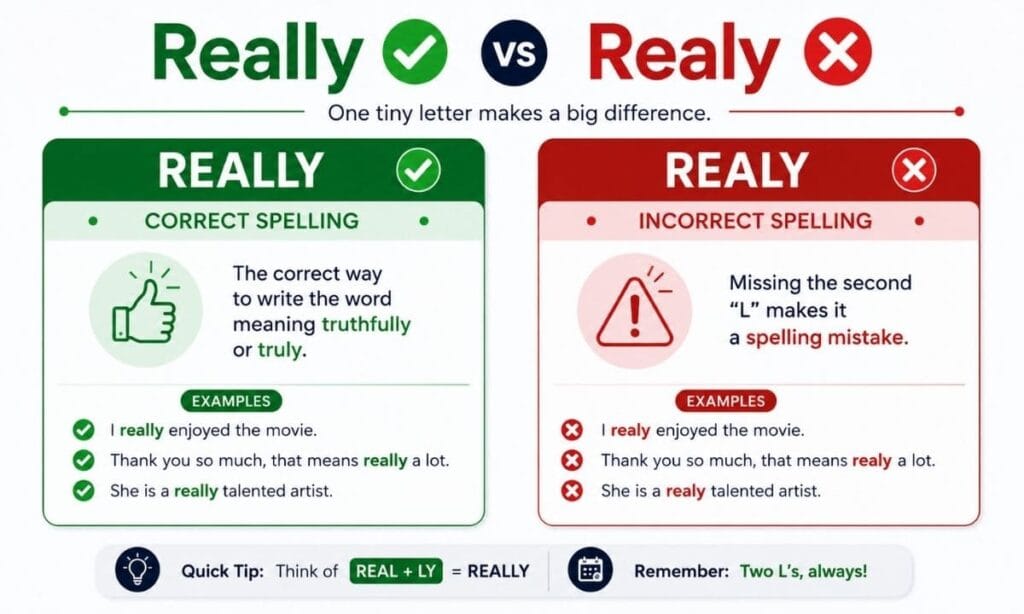
Really is an adverb that emphasizes truth, degree, or genuine feeling. It modifies verbs, adjectives, and other adverbs.
Examples:
✅I really enjoyed the movie last night.
✅Is that really true?
✅She was really tired after the long trip.
✅This coffee tastes really good.
Realy:
Realy has no standard definition. It’s a spelling error caused by dropping one “l” from really.
Examples:
❌ I am realy happy for you. (Incorrect)
❌ That’s realy funny. (Incorrect)
✅ I am really happy for you. (Correct)
✅ That’s really funny. (Correct)
Why People Confuse Them
The confusion mostly comes down to speed and sound. When people type quickly on phones, autocorrect sometimes lets small errors slip through, especially with doubled letters.
A few reasons this mistake happens so often:
Fast typing double letters get skipped during quick texting.
Sound similarity really is often pronounced with a soft, quick “l” sound.
Visual confusion with “rely” the word rely (meaning to depend on) looks and sounds close to realy.
Habit from informal writing once someone types realy once, it sticks as a habit.
The Grammar Rule Behind Really
Rule
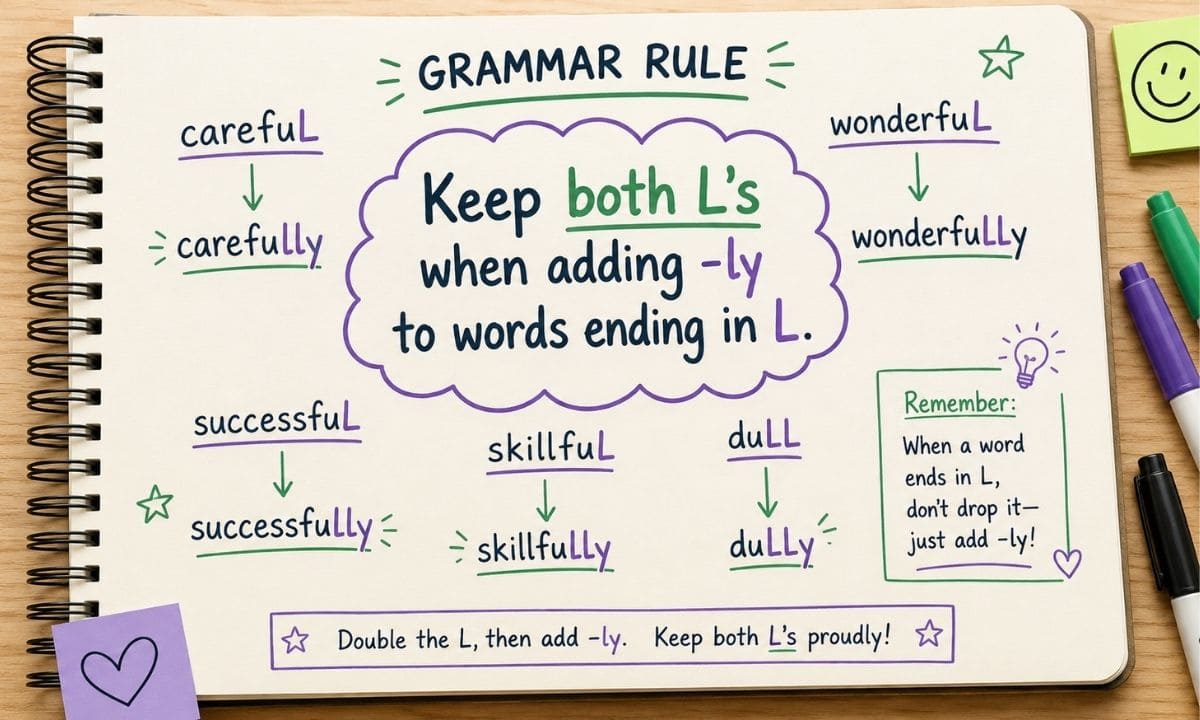
Really follows a simple English spelling pattern: when an adjective ends in a single “l,” and you add the “-ly” suffix to turn it into an adverb, you keep both L’sone from the root word and one from the suffix.
Real + ly = Really (two L’s, not one)
Examples
| Adjective | + ly | Adverb |
| Real | + ly | Really |
| Final | + ly | Finally |
| Usual | + ly | Usually |
| Casual | + ly | Casually |
This pattern is exactly why Really vs Realy has such a clear answer: the grammar rule doesn’t leave room for a single “l.”
Pronunciation of Really
Really is typically pronounced as REE-uh-lee or, in fast speech, REE-lee.
It has two or three syllables depending on the accent and speaking speed.
Pronunciation Tip
Say the word slowly first: REE-al-ly.
Then speed it up naturally.
If you’re writing it down, remember the sound doesn’t change the spelling, it still needs both L’s.
Tone, Context, and Formality
Really works in almost every tonecasual chats, formal essays, business emails, and creative writing. Its flexibility is part of why it’s used so often across spoken and written English.
The Origin of Really
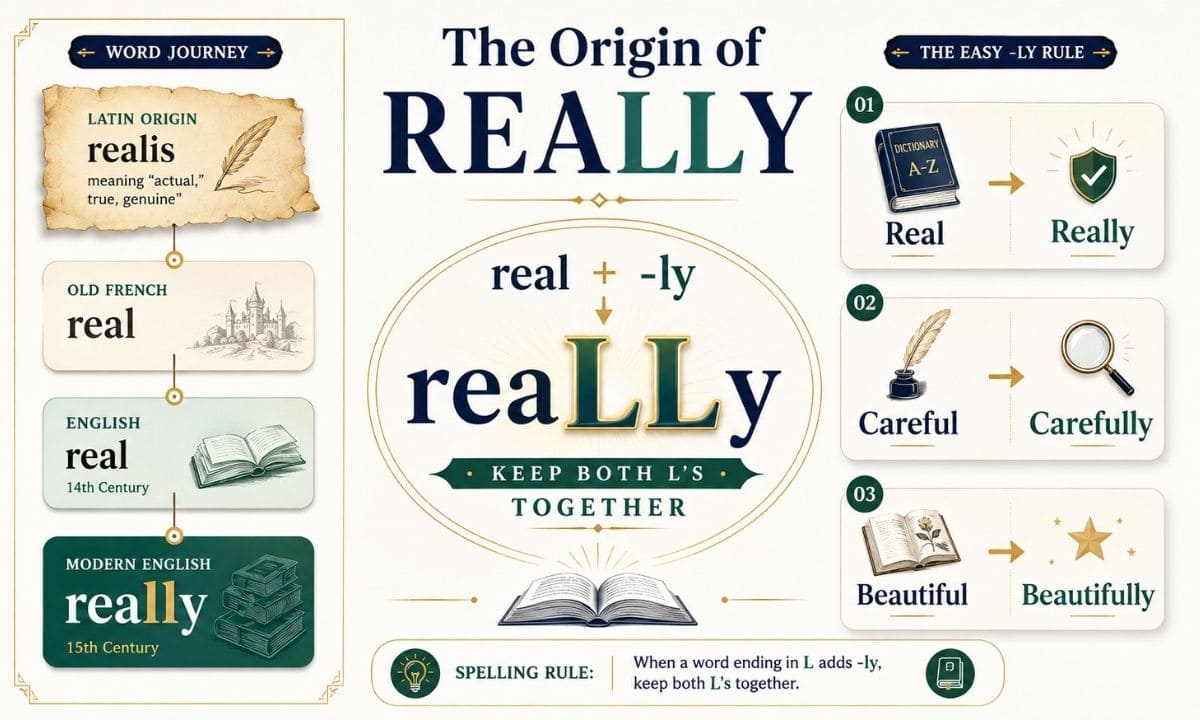
The word traces back to “real,” from Late Latin “realis,” meaning “actual” or “relating to things.
” Adding the adverb suffix “-ly “ creates really ” to express degree or truth in Middle English usage, and it has stayed consistent in spelling ever since.
Easy Rule
If the base word ends in “l” and you’re adding “-ly,” don’t drop a letter. Keep both L’s together.
Examples
Beautiful → Beautifully
Real → Really
Careful → Carefully
Really vs Realy at a Glance
| Feature | Really | Realy |
| Valid word? | Yes | No |
| Part of speech | Adverb | None |
| Dictionary listed? | Yes (all major dictionaries) | No |
| Used in formal writing? | Yes | Never |
| Common in texting errors? | No | Yes |
Formal vs. Informal Writing
In formal writing, emails, reports, essays, articles really should always be spelled correctly.
Spell checkers and grammar tools like Grammarly will flag realy instantly.
In informal texting, people sometimes type realy by mistake, but it’s still considered a typo, not an accepted casual spelling.
Unlike words such as “gonna” or “kinda,” realy has never earned informal acceptance.
When One Choice Sounds Wrong
Correct
✅ I really appreciate your help.
✅ He really wants this job.
✅ That was really unexpected.
Incorrect
❌I realy appreciate your help.
❌He realy wants this job.
❌That was realy unexpected.
Common Situations Where Really Is Used
Always Use:
✅ To emphasize the truth: “This is really happening.”
✅ To express the degree: “She’s really smart.”
✅ In questions expressing surprise: “Really? You’re kidding!”
✅ In formal and academic writing.
Never Use:
❌Realy in any professional document.
❌Realy in resumes or cover letters.
❌Realy in school or college assignments.
Easy Tip
Before hitting send, do a quick “double-L check.” If the word has one L, fix it before posting or submitting.
Really vs Realy in Everyday Sentences
Text message:
“I’m really sorry I’m late!”
Email:
“We really appreciate your patience during this delay.”
Conversation:
“Are you really moving to another city?”
Review:
“This restaurant really exceeded my expectations.”
Common Mistakes and Quick Fixes
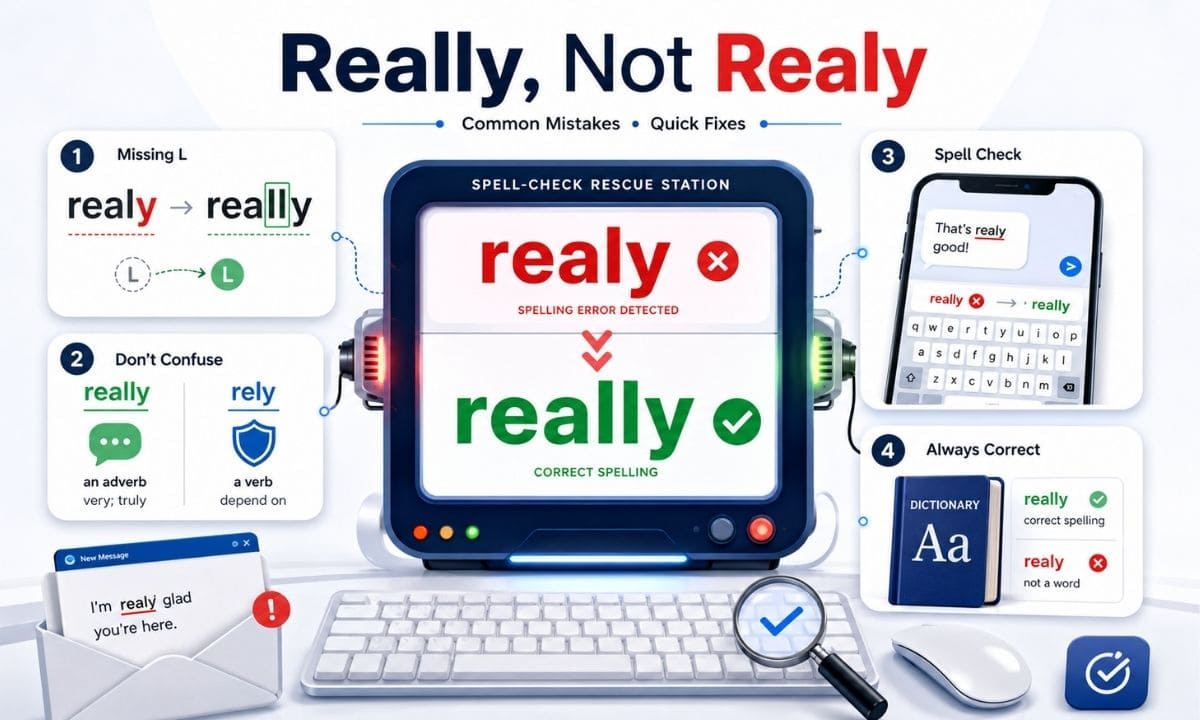
Mistake 1:
Writing “realy” instead of “really” in emails.
Fix: Always run a spell check before sending.
Mistake 2:
Confusing “realy” with “rely.”
Fix: Remember rely means to depend on someone or something; it’s a completely different word.
Mistake 3:
Dropping the second L when typing fast on mobile.
Fix: Slow down or turn on autocorrect for common words.
Mistake 4:
Assuming realy is an informal, acceptable version.
Fix: No dictionary supports thistreat it strictly as an error.
Explore More Grammar Guides
Authorized vs Authorised: The Complete Spelling Difference Guide
Anise vs Aniseed: Are They the Same? Find Out the Real Difference
Friend vs Freind: Common Mistake and Correct Usage Explained
Today’s vs Todays: The Easy Way to Remember the Correct Spelling
Gauge Vs Guage: Quick Grammar Guide With Easy Examples
Habit vs Habbit: Common Error, Meaning, and Usage Guide
Why Do People Misspell Really vs Realy
Most misspellings come from muscle memory and speed rather than a lack of grammar knowledge. Mobile keyboards, autocomplete suggestions, and quick messaging apps all contribute to the Really vs Realy confusion becoming a repeated habit for some writers.
Common Phrases
- Really good
- Really bad
- Really appreciate
- Really sorry
- Really excited
- Not really
Autocorrect’s Role in Fixing This Error
Most smartphone keyboards now correct realy to really automatically.
However, this isn’t guaranteed across every app or device, which is why understanding the rule yourself still matters.
Memory Tricks To Remember The Correct Spelling

Think: “Real” needs its own “ly” friendtwo L’s, always together.
Picture the word “hall”one word, double L, just like really.
Say it in two parts: REAL + LY.
Compare it to “finally”nobody drops a letter there, so don’t drop one here either.
Use the phrase “Really? Really!” to reinforce the double L visually.
Different Parts of Speech
Really primarily functions as an adverb, but it’s worth understanding how it behaves in a sentence.
Really as an Intensifier
When used before an adjective, it really acts as an intensifier, boosting the meaning:
“really cold,” “really fast,” “really kind.”
Really as an Interjection
In casual speech, “Really?” stands alone as an interjection expressing surprise or disbelief: “Really? That’s amazing news.”
Synonyms And Alternatives For Really
Synonyms
Truly
Genuinely
Actually
Honestly
Indeed
Very
Extremely
Examples
I truly appreciate your effort. (instead of really)
She’s genuinely talented. (instead of really)
That was actually surprising. (instead of really)
Antonyms And Opposite Ideas
Words that express doubt or falseness work as loose opposites in meaning, though not exact antonyms:
Supposedly
Allegedly
Falsely
Apparently (in a doubtful sense)
American vs British English Differences
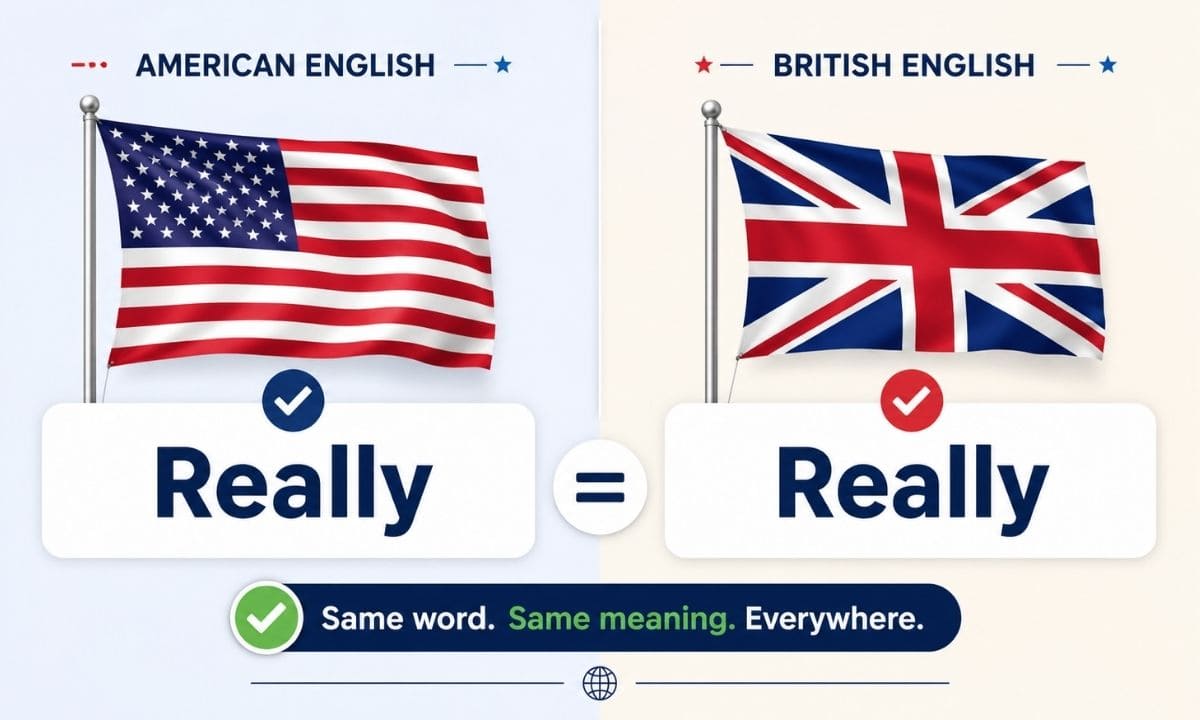
United States
American English really uses the same way in both speech and writing, with no spelling variation. It’s common in casual conversation and appears frequently in American media and dialogue.
United Kingdom
British English also spells the word “really,” with identical grammar rules. The only difference tends to be in pronunciation, where the British accent may soften the middle syllable slightly.
Comparison Table
| Region | Spelling | Pronunciation Style |
| United States | Really | REE-lee (flatter tone) |
| United Kingdom | Really | REE-uh-lee (softer middle syllable) |
Key Point
Regardless of region, Really vs Realy always resolves the same way really is correct everywhere English is spoken.
Dictionary-Style Word Details
Verb
Really is not a verb. It cannot take verb forms like tense or conjugation.
Noun
Really is not a noun and cannot be pluralized or used as a subject.
Synonyms
Truly, genuinely, actually, indeed, honestly.
Example Sentences
- I really need to finish this project today.
- Do you really think that’s a good idea?
- She really loves gardening on weekends.
Word History
It developed from the adjective “real,” rooted in Late Latin “realis.” English speakers added the adverb-forming suffix “-ly” centuries ago, and the spelling has remained stable since.
Phrases Containing “Really”
Really and truly
Not really
Really now
Really though
Expert Opinions and Dictionary Evidence I Found
Major dictionaries, including Merriam-Webster, Cambridge, and Oxford, list only “really” as the correct spelling of this adverb. None recognize “realy” in any context, formal or informal.
Why Dictionaries Reject “Realy”
Dictionaries base entries on documented, widespread usage across published and edited text. Since realy appears almost exclusively in typos, it never met the threshold for inclusion.
What Grammar Checkers Confirm
Tools like Grammarly and ProWritingAid consistently flag realy as an error, reinforcing that this isn’t a regional or stylistic variantit’s simply incorrect.
What ESL Teachers Recommend
Many ESL instructors teach the “double L” rule early, specifically because Really vs Realy is one of the most common beginner mistakes in written English.
What Style Guides Say
Style guides such as AP and Chicago don’t list realy as an alternate form, further confirming that really is the only publication-ready spelling.
Comparison Table: Really vs Realy
| Category | Really | Realy |
| Dictionary status | Recognized | Not recognized |
| Grammar checker flag | None | Always flagged |
| Formal writing use | Correct | Never correct |
| Common cause | N/A | Typing speed error |
Pro Tip I Learned
When in doubt, break the word into “real” + “ly” before typing the full word. This trick alone prevents most Really vs Realy mistakes.
In list:
Always double-check double letters.
Read your sentence aloud before submitting.
Use grammar tools as a backup, not a replacement for learning the rules.
Quick Test I Created
Really vs Realy Quiz
Fill in the blanks with the correct spelling (really or realy):
I am ______ excited about the trip.
Is this ______ happening right now?
She ______ wants to learn Spanish.
That movie was ______ boring.
We ______ appreciate your feedback.
He’s ______ good at chess.
I ______ don’t know the answer.
This cake tastes ______ amazing.
Are you ______ leaving tomorrow?
They were ______ surprised by the news.
I ______ hope you feel better soon.
That joke was ______ funny.
She’s ______ talented at painting.
He ______ needs some rest.
It was ______ nice meeting you.
I ______ can’t wait for the weekend.
That test was ______ difficult.
We’re ______ proud of you.
This place is ______ beautiful.
I ______ mean what I said.
(Answer key: all blanks should be filled with “really.”)
Frequently Asked Questions
Is “realy” ever correct in English?
No. Realy is always a misspelling of really and isn’t listed in any standard dictionary.
Why does “realy” show up so often in texting?
It usually happens from fast typing or skipping a letter, especially on mobile keyboards.
Is “really” an adjective or an adverb?
Really is an adverb. The adjective form is “real.”
Does British English spell it differently?
No. Both American and British English use the same spelling: really.
What’s the difference between “really” and “rely”?
Really means “truly” or “actually,” while rely means to depend on someone or something.
Can I use “really” in formal writing?
Yes, really is appropriate in formal, academic, and professional writing.
How do I remember the correct spelling?
Break it into two parts: “real” + “ly,” and always keep both L’s together.
Does autocorrect fix “realy” automatically?
Often yes, but not always, so it’s best to learn the correct spelling yourself.
Is “really” used the same way in speech and writing?
Yes, its meaning and spelling stay consistent whether spoken or written.
What part of speech is “really” when it stands alone as a question?
When used alone, like “Really?”, it functions as an interjection expressing surprise.
Conclusion
Getting Really vs Realy right is a small detail that makes a big difference in how your writing comes across. Really is the only correct, dictionary-approved spelling, while realy remains nothing more than a common typing slip.
Once you understand the simple “real + ly” rule, the Really vs Realy confusion disappears for good. Whether you’re writing a text, an email, or a formal report, this rule holds true every single time.
Keep this guide handy the next time you pause mid-sentence and wonder about Really vs Realy. With the tips, tables, and quiz above, you now have everything needed to spell it correctly, confidently, and consistently.

2 thoughts on “Really vs Realy? A Quick Guide to Correct English Spelling (2026)”