


“Partner” can mean a spouse, a co-owner of a law firm, a doubles teammate, or the classmate you were paired with in a lab. That range is useful, but it is also why people look for synonyms for partners. The word is often too vague, or simply wrong for the sentence.
The right replacement depends on the relationship, the context, and the tone. “Spouse” belongs on a form, “mate” in a chat, and “associate” in a business letter. Some words change the meaning completely if you pick carelessly.
Below you will find 70 alternatives with a meaning, an example, and a usage tip for each. After that come quick guides by context and tone, a comparison table, tips for choosing, common mistakes, dictionary notes, and FAQs.
Quick Answer: What Are the Best Synonyms for a Partner?
The best alternatives to “partner” are spouse, significant other, companion, associate, colleague, collaborator, teammate, and co-founder.
The right one depends on the relationship, and no single synonym works in every situation.
Best Everyday Alternatives to Partner
Spouse: a husband or wife; neutral and gender-free.
Significant other: a committed romantic partner, married or not.
Companion: someone who shares your time, often warmly.
Mate: casual; a friend in British, Australian, and Irish English.
Friend: the plain choice when the bond is not romantic or professional.
Best Professional Alternatives to Partner
Associate: a professional connection without shared ownership.
Colleague: someone you work with in the same organization or field.
Collaborator: someone working with you on a shared piece of work.
Co-founder: someone who started a venture with you.
Business partner: the closest match when you really share a business.
What Does “Partner” Mean?
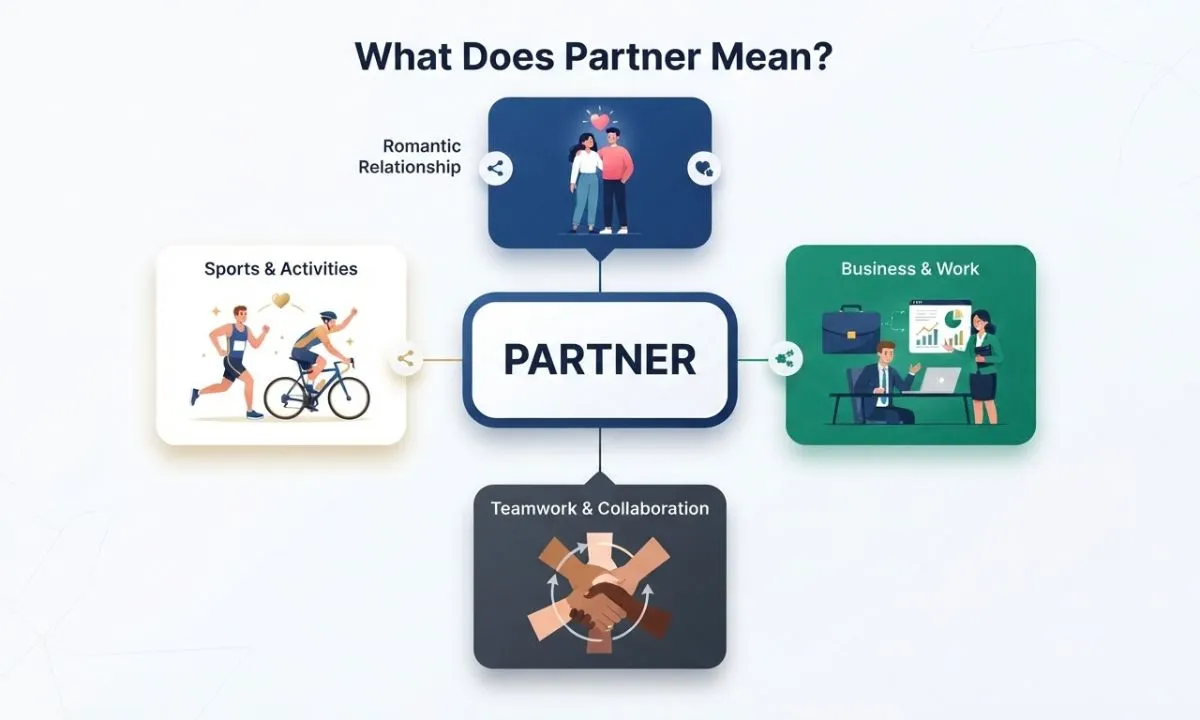
A partner is a person, group, or organization that shares a relationship, an activity, or ownership with another.
The word comes from Middle English partener, an alteration of parcener (“joint heir”), so the idea of sharing has always been part of it.
Partner as a Relationship Term
In everyday speech, “partner” often means one member of a couple.
It is popular because it does not reveal marital status or gender. The trade-off is clarity: listeners may not know whether you mean a romantic or a business partner.
Partner in Business and Work
In business, a partner is usually an owner of a firm, as in a law or accounting practice (junior partner, managing partner). It can also mean another company you work closely with. Avoid using it loosely when ownership is not shared.
Partner in Teamwork and Collaboration
Outside ownership, a partner can simply be someone you work alongside, such as a co-researcher or a classmate on a group task. The stress is on working jointly.
Partner in Sports and Activities
In tennis doubles, ballroom dancing, or bridge, a partner is the person on your side. The verb works too: you can partner someone in a match.
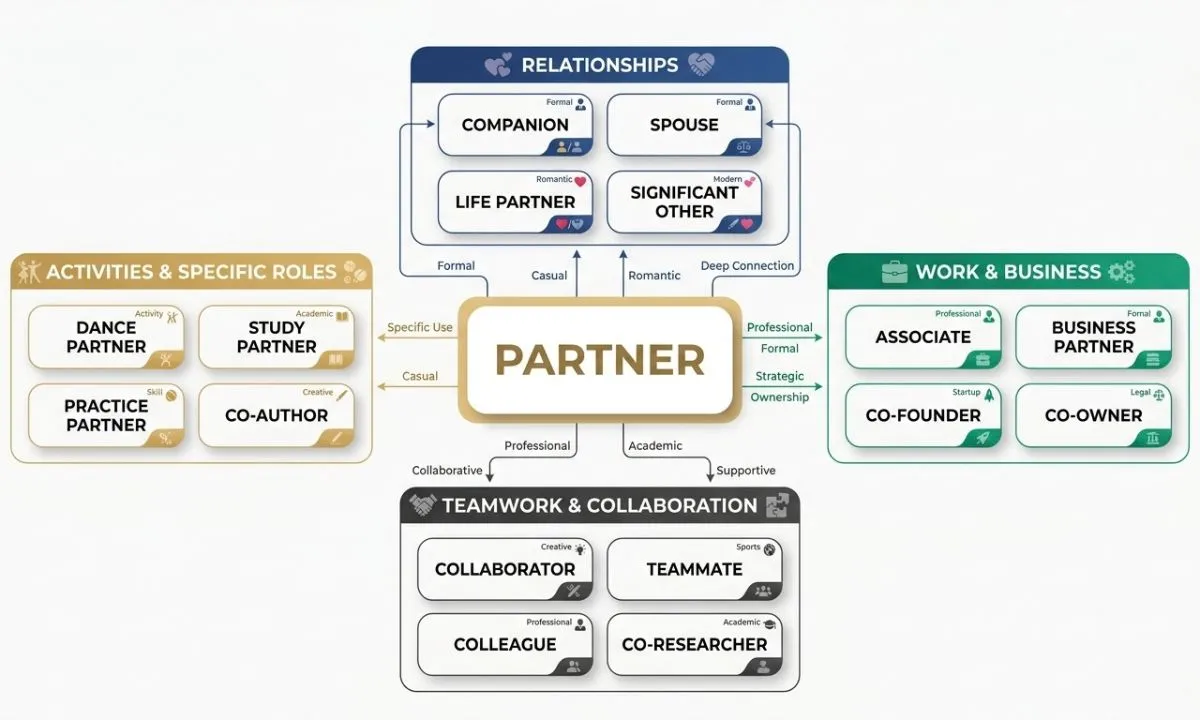
70 Partner Synonyms, Grouped by Tone
Not every word below is a true synonym. Some are exact matches in one sense only, such as “spouse” for a married partner. Others are contextual alternatives that fit a particular setting, and a few are related words that only work in narrow situations. Each usage tip says which kind of word you are looking at.
1. Companion
Meaning:
A person who spends time with you or travels through life beside you, usually by choice and often over a long period.
Example:
After her husband passed away, the dog became her closest companion on those long evening walks.
Usage Tip:
The companion is warm and a little old-fashioned. It works for a romantic partner, a friend, or a travel buddy, but it does not suggest shared ownership, so avoid it as a replacement for “business partner.”
2. Associate
Meaning:
Someone connected to you through work, business, or a shared activity, without necessarily being a close friend or co-owner.
Example:
I’ll forward your proposal to an associate who handles supplier contracts.
Usage Tip:
Associate is a safe professional choice when “partner” would overstate the relationship. In law and accounting firms it can also mean someone junior to a partner, so check the setting.
3. Collaborator
Meaning:
A person who works with you on a specific piece of work, such as a paper, an album, or a design.
Example:
The novelist thanked her longtime collaborator for reshaping the second act.
Usage Tip:
The collaborator puts the focus on the work, not on the relationship. In some historical contexts the word also carries a negative meaning, so give it context when it could be misread.
4. Teammate
Meaning:
A member of the same team, whether in sport, school, or the workplace.
Example:
My teammate caught the error in the budget a day before the review.
Usage Tip:
Teammate works when two or more people share a team and a goal. It is a loose alternative to “partner” and should not replace it where ownership or a romantic bond is involved.
5. Colleague
Meaning:
Someone who works in the same organization, profession, or field as you.
Example:
A colleague from the Madrid office will join the call.
Usage Tip:
My colleague is neutral and respectful, which makes it good for emails. It says nothing about shared ownership, so it is a related word rather than an exact synonym of business partner.
6. Business Associate
Meaning:
A person you deal with in business, often on repeated deals but without co-owning the company.
Example:
He introduced me to a business associate who imports specialty tea.
Usage Tip:
This is a formal, slightly distant phrase. It suits letters and contracts, and it quietly signals that the person is not a co-owner.
7. Co-worker
Meaning:
A person who works alongside you in the same workplace.
Example:
My co-worker covered my shift so I could make the flight.
Usage Tip:
Co-worker is casual and common in everyday speech. It describes where you work together, not how close you are, so it is weaker than “partner” in most business senses.
8. Co-founder
Meaning:
One of two or more people who started a company, project, or organization together.
Example:
The two co-founders built the first version of the app in a rented garage.
Usage Tip:
Co-founder is a strong, specific fit for a business partner who was there at the start. It does not apply to someone who joined later.
9. Co-owner
Meaning:
A person who owns something jointly with someone else, such as a business, a house, or a property.
Example:
As co-owner of the bakery, she signs off on every menu change.
Usage Tip:
Choose a co-owner when the legal or financial share is the key point. It is accurate and plain, but it leaves out any sense of working together.
10. Spouse
Meaning:
A husband or wife; a person you are married to.
Example:
Employees may bring a spouse to the annual dinner.
Usage Tip:
Spouse is neutral and gender-free, and it is the standard choice on forms and in official writing. It only applies to married couples, so it does not cover an unmarried partner.
11. Mate
Meaning:
A friend or companion in casual British, Australian, and Irish English; also a romantic or breeding partner in other uses.
Example:
He’s off to the pub with his mates after work.
Usage Tip:
In casual speech, mate is a friendly word for a friend. For a romantic partner it can sound odd outside certain regions or in nature writing, so use it with care in formal text.
12. Soulmate
Meaning:
A person with whom you feel a deep and natural connection, often a romantic partner.
Example:
They met at a bookshop and spent the next forty years finishing each other’s sentences.
Usage Tip:
Soulmate is emotional and personal, so it suits wedding speeches and heartfelt writing. It sounds out of place in anything professional.
13. Significant Other
Meaning:
A person with whom you have a serious romantic relationship, whether or not you are married.
Example:
Please let us know if your significant other will attend the reception.
Usage Tip:
Significant other is a polite, inclusive phrase for invitations and forms. It can sound a bit stiff in warm, personal conversation.
14. Life Partner
Meaning:
A romantic partner with whom someone shares a long-term commitment, with or without marriage.
Example:
They never married, but she has called him her life partner for two decades.
Usage Tip:
Life partner signals commitment and equality at once. It works in speech and writing, and it avoids the question of marital status.
15. Boyfriend
Meaning:
A man in a romantic relationship with someone, usually when they are not married.
Example:
Her boyfriend drove six hours to surprise her at graduation.
Usage Tip:
Boyfriend is specific about gender and informality. Many adults avoid it because it sounds youthful, which is one reason “partner” became popular.
16. Girlfriend
Meaning:
A woman in a romantic relationship with someone, usually when they are not married.
Example:
He brought his girlfriend to meet his parents over the holidays.
Usage Tip:
Girlfriend is clear and casual. Be aware that it can also mean a female friend in some conversations, particularly among women, so context matters.
17. Husband
Meaning:
A married man, in relation to his spouse.
Example:
My husband and I are renovating the kitchen this spring.
Usage Tip:
Husband is the right word when you mean a married man, and only then. It is warm, clear, and fits every level of formality.
18. Wife
Meaning:
A married woman, in relation to her spouse.
Example:
His wife runs the family clinic on the east side of town.
Usage Tip:
A wife is accurate and universal for a married woman. Use it when marriage is the point; if you want to leave marital status open, choose a different term.
19. Fiancé
Meaning:
A man who is engaged to be married.
Example:
Her fiancé has already booked the venue for next June.
Usage Tip:
Fiancé is the masculine form, with a single e at the end. It is a temporary status that ends with the wedding, so it is not a long-term replacement for “partner.”
20. Fiancée
Meaning:
A woman who is engaged to be married.
Example:
He proposed on the pier, and his fiancée said yes before he finished the question.
Usage Tip:
Fiancée is the feminine form, with a double e. Many writers mix the two spellings up, so check which one you need. Both are tied to the engagement period only.
21. Lover
Meaning:
A person with whom someone has a romantic or sexual relationship, often outside marriage; also someone who loves a thing, as in “a lover of art.”
Example:
The biography reveals that the poet kept a lover in Paris for years.
Usage Tip:
Lover carries a strong, private, sometimes secretive tone. It is rarely right for an everyday introduction, and it does not suit professional writing at all.
22. Beloved
Meaning:
A person who is dearly loved; used as a noun for a very cherished partner.
Example:
In his letters from the front, he called her his beloved.
Usage Tip:
Beloved is literary and formal in feeling. It belongs in poetry, vows, and old-style letters, not in conversation.
23. Sweetheart
Meaning:
A loved one, especially a romantic partner; also a term of affection.
Example:
They had been childhood sweethearts and married at nineteen.
Usage Tip:
Sweetheart is affectionate and slightly nostalgic. It works in warm settings, but some people hear it as patronizing when used toward a stranger or colleague.
24. Romantic Companion
Meaning:
A partner in a romantic relationship, described in a deliberately soft or descriptive way.
Example:
The guest list allows each speaker to bring a romantic companion.
Usage Tip:
This phrase is useful when you need to stress the romantic side and keep the tone polite. It can sound wordy, so a short word is often better in casual text.
25. Domestic Partner
Meaning:
A person who lives with you in a committed relationship and may be recognized by a company, city, or law as having partner status, without being married.
Example:
The insurance plan covers employees, spouses, and registered domestic partners.
Usage Tip:
Domestic partner is a legal and administrative term. It belongs in HR documents and benefit forms, and it sounds cold in a personal story.
26. Workmate
Meaning:
A person you work with, especially in a friendly, day-to-day way.
Example:
A workmate lent me her charger when my laptop died.
Usage Tip:
Workmate is common in British English and sounds relaxed. It is a good casual alternative to co-worker, but it is not suited to formal reports.
27. Fellow Worker
Meaning:
Someone doing the same kind of work as you, often in the same place or trade.
Example:
The union leader thanked every fellow worker who stood outside in the rain.
Usage Tip:
Fellow workers have a slightly old, collective flavor, close to labor and union language. It is a stretch as a replacement for “business partner.”
28. Business Colleague
Meaning:
A person you know through professional work, usually in the same field or industry.
Example:
I met a business colleague at the trade fair who was looking for a distributor.
Usage Tip:
This phrase is polite and a little vague, which is useful when you do not want to define the relationship. It does not imply any shared ownership.
29. Co-worker in Business
Meaning:
A person who works with you inside a business, in a shared role or team.
Example:
Every co-worker in business operations received the new reporting template.
Usage Tip:
This is an awkward phrase in most writing, and “co-worker” or “colleague” usually reads better. It is only useful when you need to separate business staff from, say, technical staff.
30. Co-entrepreneur
Meaning:
A person who starts and runs a venture with you, sharing the risk and the effort.
Example:
She and her co-entrepreneur split the early workload down the middle.
Usage Tip:
Co-entrepreneur is a niche term that you may see in startup writing. “Co-founder” is more common, so use this one when you want to stress the entrepreneurial side.
31. Co-investigator
Meaning:
A researcher who shares the lead on a study or investigation with another researcher.
Example:
Dr. Alvarez is the co-investigator on the three-year sleep study.
Usage Tip:
Co-investigator belongs in research grants, trials, and academic papers. It also appears in police or detective contexts, but that is a different setting entirely.
32. Co-conspirator
Meaning:
A person who secretly plans or carries out a wrongful act together with another person.
Example:
Prosecutors named two co-conspirators in the fraud case.
Usage Tip:
Co-conspirator always implies wrongdoing. Never use it as a neutral synonym for a work partner, except as a deliberate joke among friends.
33. Fellow Traveler
Meaning:
A person who travels with you, either literally or in sharing a path or belief.
Example:
On the night train to Kraków, a fellow traveler offered me half her sandwich.
Usage Tip:
Fellow travelers can be warm and literal. Be careful: in political history it also meant a sympathizer of a movement, which may not be what you intend.
34. Confidante
Meaning:
A woman or girl with whom you share private thoughts and secrets.
Example:
For years, her aunt was her only confidante.
Usage Tip:
Confidante is the feminine form and Confidant is the masculine one, though many writers use “confidant” for anyone. It describes trust, not a shared role, so it is only loosely related to “partner.”
35. Friend
Meaning:
A person you know well and like, outside of family and romance.
Example:
We started the project as friends and only later called it a company.
Usage Tip:
Friends are plain and honest when the relationship is not romantic or contractual. Keep in mind that in some settings “friend” can sound like a dodge when someone really means a romantic partner.
36. Ally
Meaning:
A person, group, or country that supports you and works toward the same goal.
Example:
The mayor found an ally in the local business council.
Usage Tip:
Ally suits causes, campaigns, politics, and tough situations. It suggests support, not a day-to-day working relationship.
37. Confidant
Meaning:
A person you trust enough to share private matters with.
Example:
The captain’s closest confidant was his second-in-command.
Usage Tip:
Confidant is usually the masculine or general form, and it stresses trust and secrets. It does not describe working together or romance, so it is a related word at best.
38. Supporter
Meaning:
Someone who backs you, helps you, or believes in what you are doing.
Example:
Her loudest supporter in the audience was her old coach.
Usage Tip:
A supporter works when the person helps without necessarily sharing the work or the credit. It is not a stand-in for “partner” in a business setting.
39. Cohort
Meaning:
A companion or follower, or a group of people who share a common trait or timeframe.
Example:
The crime boss and his cohort were arrested at the border.
Usage Tip:
In casual use, cohorts can sound slightly negative, like a sidekick. In research and education, it means a group, such as a class year, so it can easily confuse readers.
40. Fellow
Meaning:
A person who shares a situation, activity, or position with another; also a member of an academic or professional body.
Example:
A fellow student shared her notes before the exam.
Usage Tip:
Fellow almost always needs another word with it, as in fellow worker or fellow member. On its own it feels dated, and in universities it may mean a research position.
41. Accomplice
Meaning:
A person who helps another commit a crime or a mischievous act.
Example:
The driver of the getaway car was charged as an accomplice.
Usage Tip:
Accomplice is negative in a legal sense. In playful speech, “partner in crime” works as a joke, but accomplice itself is better kept for real wrongdoing.
42. Accompanist
Meaning:
A musician, usually a pianist, who plays along with a singer or another instrumentalist.
Example:
The young violinist thanked her accompanist at the end of the recital.
Usage Tip:
Accompanist is music-specific. It is an accurate stand-in for “partner” only on a stage, not anywhere else.
43. Counterpart
Meaning:
A person or thing that holds an equivalent position or role in another group, organization, or country.
Example:
The finance minister met her counterpart in Berlin to discuss trade rules.
Usage Tip:
Counterpart signals a matching role on the other side, such as another company’s sales director. It does not mean the two of you work together on the same side.
44. Cooperator
Meaning:
A person who works with others toward a common aim, or who simply goes along helpfully.
Example:
Every cooperator in the farm group agreed to share the cost of the new truck.
Usage Tip:
Cooperator is uncommon in modern speech, and “collaborator” sounds more natural. It appears in farming, social enterprise, and older texts.
45. Joint Venturer
Meaning:
A party that enters a joint venture, which is a business arrangement formed to complete a specific project.
Example:
Each joint venturer contributed equipment and staff to the pipeline project.
Usage Tip:
Joint venturer is a technical business term, often found in contracts and finance. It describes a fixed-purpose deal, not a lasting business partnership.
46. Co-investor
Meaning:
A person or firm that puts money into the same deal or company as another investor.
Example:
The fund brought in a co-investor to share the risk on the new hotel.
Usage Tip:
The co-investor speaks only about money. It is precise in finance and venture capital, but it says nothing about daily involvement.
47. Co-signer
Meaning:
A person who signs a loan, lease, or contract along with another and takes on shared responsibility for it.
Example:
Her father agreed to be the co-signer on her first apartment lease.
Usage Tip:
Co-signer is purely legal. It is a very narrow match for “partner,” useful only when responsibility for a document is the topic.
48. Co-author
Meaning:
A person who writes a book, article, or paper together with someone else.
Example:
My co-author drafted the methods section while I wrote the discussion.
Usage Tip:
The co-author is exact and widely understood. It is a perfect fit for writing partnerships, and it is not useful for any other kind of work.
49. Co-producer
Meaning:
A person who shares responsibility for producing a film, show, album, or event.
Example:
The documentary’s co-producer secured funding from two regional broadcasters.
Usage Tip:
Co-producer is common in film, television, and music credits. Use it when the title is real, not as a loose alternative to “helper.”
50. Co-creator
Meaning:
A person who helps create something, such as a show, a game, a product, or a character.
Example:
The series’ co-creator explained how the idea first appeared on a napkin.
Usage Tip:
Co-creator stresses shared invention. It is friendly and broad, and it fits creative work more than managerial or financial roles.
51. Co-developer
Meaning:
A person who builds software, a product, or a property together with someone else.
Example:
Her co-developer pushed the fix to the main branch just before midnight.
Usage Tip:
Co-developer fits technology and, less often, real estate. Make sure the reader knows which one you mean, because the two fields use the word differently.
52. Co-planner
Meaning:
A person who plans something jointly with you, such as an event, trip, or strategy.
Example:
My co-planner booked the venue while I handled the guest list.
Usage Tip:
Co-planner is plain and descriptive, though it rarely appears in dictionaries. It works in informal and project writing, but “co-organizer” is more common for events.
53. Co-organizer
Meaning:
A person who helps arrange and run an event, meeting, or campaign.
Example:
As co-organizer of the charity run, he recruited sixty volunteers.
Usage Tip:
Co-organizer suits events, conferences, and community projects. It is clear and professional, but it only covers the period of the event itself.
54. Co-implementer
Meaning:
A person or organization that helps carry out a plan or program after it has been designed.
Example:
The health ministry named three NGOs as co-implementers of the vaccination drive.
Usage Tip:
Co-implementer is jargon from development, aid, and project management. Outside those fields, readers may not know it, so consider a plainer phrase.
55. Co-researcher
Meaning:
A person who researches a topic together with you.
Example:
Each co-researcher interviewed twenty participants for the study.
Usage Tip:
Co-researcher is straightforward in academic and scientific writing. It is a closer match than “colleague” when the shared task is a study.
56. Co-presenter
Meaning:
A person who presents a talk, lecture, or show together with someone else.
Example:
My co-presenter will take the questions after the demo.
Usage Tip:
The co-presenter is exact and professional. Use it for webinars, conferences, and training sessions.
57. Co-performer
Meaning:
A person who performs on stage or on screen together with another.
Example:
The singer praised her co-performer for covering a missed cue without anyone noticing.
Usage Tip:
Co-performer applies to theatre, music, and dance. It is a neutral label for people sharing a stage, with no hint of friendship or romance.
58. Co-player
Meaning:
A person who plays a game or sport alongside you, either on your side or in the same match.
Example:
Her co-player in the doubles final kept calling the lines out loud.
Usage Tip:
Co-player can mean teammate or fellow participant, so check whether the person is on your side. “Partner” is stronger for a doubles pair.
59. Teammate-in-arms
Meaning:
A teammate who stands with you in a shared struggle, in a figurative echo of “comrade in arms.”
Example:
After the merger, she looked for a teammate-in-arms who also wanted the old process gone.
Usage Tip:
Teammate-in-arms is an unusual, hyphenated phrase that reads as stylized. Use it rarely and only in lively, informal writing, because most readers will expect “comrade in arms.”
60. Fellow Member
Meaning:
A person who belongs to the same group, club, committee, or organization as you.
Example:
Each fellow member of the choir received a copy of the new schedule.
Usage Tip:
Fellow members signal shared membership rather than shared work. It is polite and a little formal, which suits association newsletters and minutes.
61. Business Partner
Meaning:
A person who co-owns or co-runs a business with you, or a company that has a formal commercial relationship with yours.
Example:
My business partner and I are opening a second studio in the spring.
Usage Tip:
Business partner is the clearest alternative when you mean the commercial sense of “partner.” It makes the context obvious, which helps readers who might otherwise think of a romantic partner.
62. Strategic Partner
Meaning:
An organization or person whose cooperation helps you reach long-term goals, often through an agreement.
Example:
The airline signed a strategic partner deal to share loyalty programs.
Usage Tip:
Strategic partners are corporate and often found in press releases. It suggests importance, so do not apply it to every vendor.
63. Trading Partner
Meaning:
A country or company that you regularly buy from or sell to.
Example:
Canada remains the largest trading partner for several US states.
Usage Tip:
Trading partner is a standard term in economics and international trade. It says nothing about friendship, only about regular exchange.
64. Corporate Associate
Meaning:
A person or entity connected with a corporation through employment, contract, or business dealings.
Example:
The report listed several corporate associates who had received the early draft.
Usage Tip:
Corporate associates are stiff and mostly appear in formal or legal prose. In ordinary writing, “associate” is easier to read.
65. Professional Associate
Meaning:
Someone you know and work with through your profession.
Example:
Please share the lecture invitation with any professional associate who may be interested.
Usage Tip:
A professional associate is polite, generic, and safe for letters and bios. It stays general on purpose, so it never means a co-owner.
66. Project Partner
Meaning:
A person or organization that shares the work and responsibility on a specific project.
Example:
Each project partner had a named lead and a monthly reporting date.
Usage Tip:
Project partner is common in grants, research, and consulting. It is accurate while the project lasts and a little temporary in feel.
67. Research Partner
Meaning:
A person or institution you work with to investigate a question or run a study.
Example:
The university found a research partner in a regional hospital.
Usage Tip:
The research partner is clear in science and education. It is slightly less formal than “co-investigator,” which refers to a defined role on a grant.
68. Study Partner
Meaning:
A classmate or friend you review lessons or prepare for exams with.
Example:
My study partner quizzes me on vocabulary every Thursday night.
Usage Tip:
The study partner is informal and school-focused. It is a good choice for students and tutors, but it sounds childish in a business report.
69. Practice Partner
Meaning:
A person you rehearse, train, or drill with in order to improve a skill.
Example:
Her practice partner in the language class corrected her accent without making a fuss.
Usage Tip:
Practice partner suits sport, music, language learning, and interview preparation. It is clear and friendly, and it ends when the training does.
70. Dance Partner
Meaning:
The person who dances with you, in a pair or in a competition.
Example:
His dance partner twisted her ankle two days before the final.
Usage Tip:
The dance partner is exact and widely understood. It only refers to dancing and should not be stretched into other kinds of relationships.
Partner Synonyms by Context
Partner Synonyms for Romantic Relationships
The closest options are spouse, husband, wife, significant other, life partner, domestic partner, boyfriend, girlfriend, fiancé, and fiancée.
Softer choices such as soulmate, sweetheart, beloved, and romantic companion suit speeches and cards.
Love is private and strong, so it rarely fits a public introduction.
Partner Synonyms for Business
For ownership, use a business partner, co-owner, co-founder, or co-entrepreneur.
For looser ties, use associate, business associate, or professional associate.
Between companies, strategic partner, trading partner, and joint venturer are standard.
Partner Synonyms for Work and Projects
For daily work, choose colleagues, co-worker, or workmates.
For a defined task, project partner, collaborator, co-organizer, and co-planner are more precise.
Research and writing use a research partner, co-researcher, and co-author.
Partner Synonyms for Teamwork
Teammate, collaborator, ally, and fellow member fit shared goals. Teammate is plainest, collaborator stresses joint output, and ally suits a cause or conflict.
Partner Synonyms for Sports
Teammate, co-player, dance partner, and practice partner cover most sports and activities. In doubles tennis or bridge, “partner” itself is often still best.
Partner Synonyms for Friendship and Companionship
Friend, companion, confidant, confidante, and supporter work for personal, non-romantic bonds. A word like “companion” can suit a personal context well and still fail as a replacement for “business partner,” because it carries no sense of shared ownership.
Partner Synonyms for Formal Writing
Prefer spouse, associate, colleague, business associate, counterpart, and co-signer where each is accurate. Official forms favor spouse, domestic partner, and significant other. Avoid “mate” and “sweetheart” in legal, academic, or corporate writing.
Partner Synonyms by Tone
Casual Partner Synonyms
Mate, friend, workmate, study partner, and practice partner.
Example: “She’s my study partner for the chemistry final.”
Neutral Partner Synonyms
Associate, colleague, teammate, collaborator, and companion.
Example: “A colleague will send the numbers.”
Formal Partner Synonyms
Spouse, business associate, professional associate, and counterpart.
Example: “The counterpart at the Berlin ministry confirmed the schedule.”
Professional Partner Synonyms
Business partner, strategic partner, co-founder, co-owner, and project partner.
Example: “Our strategic partner will manage regional distribution.”
Friendly Partner Synonyms
Friend, companion, ally, supporter, and co-creator.
Example: “She has been a steady supporter since day one.”
Partner vs. Its Closest Alternatives
None of these is a perfect swap for “partner.” Each fits one slice of its meaning.
| Word | Best Used For | Tone |
| Partner | Couples, business ownership, dance or sport pairs | Neutral |
| Spouse | A married husband or wife | Formal, neutral |
| Significant Other | A committed romantic partner, married or not | Polite, slightly formal |
| Companion | Someone who shares your time or journey | Warm |
| Mate | A friend, in British, Australian, or Irish English | Casual |
| Associate | A professional contact without shared ownership | Professional |
| Colleague | A person in the same workplace or field | Neutral, respectful |
| Collaborator | Someone working with you on a specific piece of work | Neutral |
| Teammate | A member of your sports or work team | Friendly |
| Co-founder | A person who started a venture with you | Professional |
| Business Partner | A co-owner or formal commercial relationship | Professional |
| Ally | A supporter in a cause or conflict | Serious, supportive |
| Counterpart | A person in an equivalent role on the other side | Formal |
How to Choose the Right Synonym for Partner
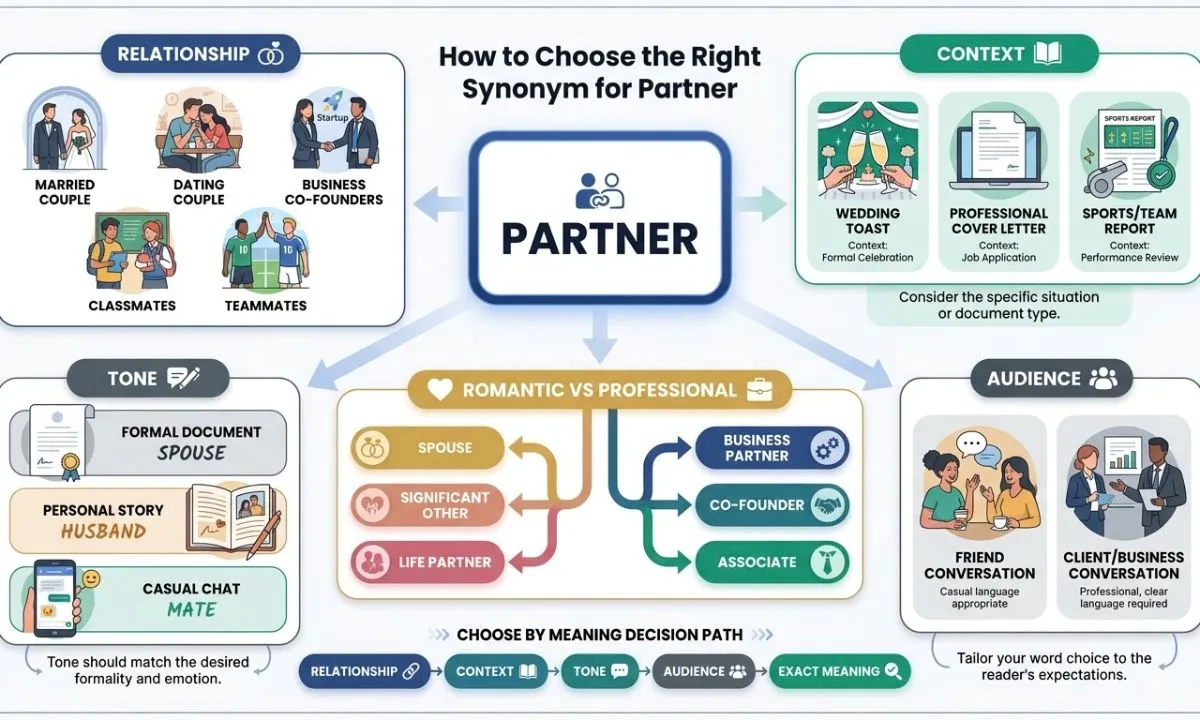
Consider the Relationship
Start with what actually connects the two people: marriage, dating, ownership, a class, or a team. Do not choose a word that implies ownership if nothing is shared.
Consider the Context
A wedding toast, a cover letter, and a sports report each call for different words. Ask whether the word would look strange next to its neighbors on the page.
Consider the Tone
“Spouse” is safer in a form, “husband” is better in a story, and “mate” is better in a chat. When unsure, pick a neutral word such as “colleague” or “companion.”
Consider Your Audience
A word that works with friends may confuse a client. International readers may not know “mate” as a word for a friend.
Consider Whether You Mean Romantic or Professional Partner
This causes the most trouble. For romance, use spouse, significant other, or life partner. For business, use associates, co-founder, or business partners. If both could apply, add a label: “my business partner” or “my life partner.”
Common Mistakes When Using Partner Synonyms
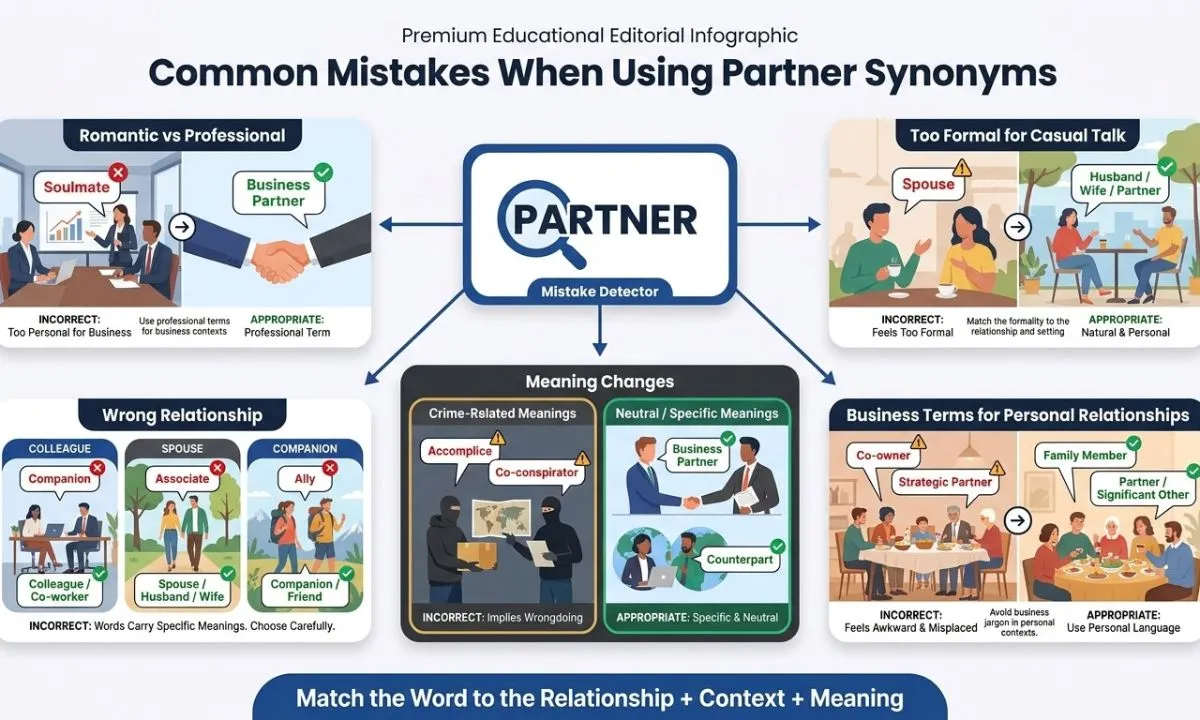
Using a Romantic Synonym in a Professional Context
“My soulmate will join the investor call” raises eyebrows. “My business partner will join the investor call” does not.
Using a Formal Word in Casual Conversation
“I’m going out with my spouse” is fine on a form but stiff to a friend. “My husband” or “my partner” sounds more natural.
Choosing a Synonym That Changes the Meaning
“Accomplice” and “co-conspirator” imply a crime. “Counterpart” means someone on the other side. “Cohort” can sound like a sidekick.
Ignoring the Relationship Between the People
Calling a colleague a “companion” or a spouse an “associate” misreads the situation. Relationship words carry assumptions about closeness, trust, and ownership.
Using a Business Term for a Personal Relationship
Saying “my co-owner” about a girlfriend only works if you own something together. “I’d like you to meet my strategic partner,” said at a family dinner, which sounds like a joke.
Partner Synonyms in Sentences
Partner Synonyms for Romantic Relationships
- “They celebrated ten years as life partners with a quiet dinner.”
- “Her fiancé is flying in from Lisbon on Friday.”
- “Please add your significant other’s name to the guest form.”
Partner Synonyms for Business
- “She became a co-owner after funding the cafe’s expansion.”
- “The two co-founders disagreed about the first hire.”
- “Our business partner in Singapore handles customs paperwork.”
Partner Synonyms for Work
- “My colleague in procurement flagged the delay.”
- “The project partner will review the draft by Monday.”
- “Her collaborator on the report lives in Nairobi.”
Partner Synonyms for Teamwork
- “Each teammate took one section of the presentation.”
- “We needed an ally on the committee to move the vote.”
- “The relay team trusted its anchor teammate.”
Partner Synonyms for Everyday Conversation
“I need a practice partner for the interview next week.”
“I’m having lunch with a mate from college.”
“My companion for the hike will bring the map.”
What Major Dictionaries Say About “Partner”
All four dictionaries tie “partner” to a shared activity, relationship, or stake. The summaries below are in my own words, so check each dictionary for its current wording.
Cambridge Dictionary
Cambridge lists a husband, wife, or sexual partner; someone who owns a business with another person; a country or organization with an agreement with another; and a person you dance or play a sport or game with. It also covers the verb, as in partnering with a company.
Merriam-Webster
Merriam-Webster starts with someone associated with another in an action (linked to “associate” and “colleague”). It then lists an intimate partner, a dance or game partner, and a member of a business partnership, plus a nautical and an archaic sense.
Oxford Languages
Oxford’s dictionary content covers either of a pair engaged in the same activity, a business partner who shares profits and losses, and either member of a married or established unmarried couple. It also notes a dated North American friendly address and the word’s origin in “joint heir.”
Collins Dictionary
Collins treats “partner” as either member of a couple, an ally or companion (“partner in crime”), a business partner such as one in a law firm, and a country or group with a supporting agreement. Its thesaurus groups synonyms by these senses.
Shared core: a stake or activity held with someone else.
Main differences: the order of senses and the extra dated, regional, or specialized notes.
Explore More Synonyms Guide
25+ Struggle Synonyms: Better Ways to Say Struggle (With Examples)
25+ Policy Synonyms: Useful Alternatives, Meanings & Examples
Kindness Synonyms: 25+ Words, Meanings, Examples & How to Use Them
20+ Primary Synonyms: Other Ways to Say “Primary” With Meaning & Examples
25+ Share Synonyms: Meanings, Examples & When to Use Each
Frequently Asked Questions
What is another word for partner?
Common alternatives include companion, associate, collaborator, colleague, teammate, spouse, and ally. Spouses and significant others suit romantic ties. Associate, colleague, and co-founder suit work. Teammate fits sports and group projects. No single word replaces “partner” everywhere. Pick the one that matches the real bond between the two people.
What is a professional synonym for partner?
Additional, extra, further, another, added, greater, higher and increased. For “moreover,” try furthermore or what’s more.
What is a formal word for more?
Associate, colleague, collaborator, and business associate are strong professional choices. If the person shares ownership, use co-owner, co-founder, or business partner. For another company, use a strategic partner or trading partner. Choose the term that matches the exact working relationship, not just the idea of cooperation.
What is a better word for a business partner?
Use co-founder when the person started the business with you and co-owner when the ownership share is the point. Associates and business associates work when nothing is shared. “Business partner” itself is fine when you want a plain, clear term. Pick the one that matches the real legal and working relationship.
What is another word for romantic partner?
Spouses, husband, wife, significant other, life partner, boyfriend, and girlfriend are the usual choices. Soulmates, sweetheart, and beloved are more emotional. Domestic partner is a legal term. Choose by marital status and formality. Add a short label if your reader might still be unsure.
What is a casual word for partner?
Mate, friend, and workmate are casual options, depending on the relationship and region. “Mate” is common in British, Australian, and Irish English. Boyfriend and girlfriend are casual for couples, and study partner suits school. Pick the one your listener will read the way you mean it.
What is a formal word for partner?
Spouse is the standard formal word for a married partner, and significant other is a polite choice for a committed one. In business, use associate, business associate, or professional associate. Counterpart suits an equal role elsewhere. Avoid slang and affectionate terms in formal writing.
Can teammate be a synonym for partner?
Sometimes. Teammate works when people share a team and a goal, such as a sports squad or work group. It does not fit a romantic partner or a co-owner. In a doubles match, “partner” is usually more exact. It is a loose, context-based match rather than an exact one.
What is the best synonym for partner in writing?
There is no single best one. Use “colleague” or “associate” for general work writing, “collaborator” for joint projects, and “spouse” for official documents. When unsure, add a label such as “business partner” instead of replacing the word. Clarity matters more than variety.
What is another word for partner in a relationship?
The most common are significant others, spouse, life partner, boyfriend, and girlfriend. Companion and soulmate are warmer. For a word that reveals neither gender nor marital status, significant other and life partner work well. Both are easy for a general audience to read.
Conclusion: Choosing the Right Synonym for Partner
The right alternative does more than avoid repetition. It tells the reader what kind of relationship you mean, which “partner” often fails to do.
Romantic, professional, business, teamwork, and casual settings each have their own vocabulary. “Spouse” and “life partner” belong to relationships, “associate” and “co-founder” to work, and “teammate” and “dance partner” to shared activities.
Tone and audience matter just as much. A formal letter needs different words than a text message, and when a word could be misread, a short label like “business” or “life” is the safest fix.
Ask who the two people are and who will read the sentence. Choose the word that fits both, and keep “partner” when nothing says it better.

1 thought on “Synonyms for Partner: 70 Natural Words to Replace “Partner” Easily”