

If you’ve typed the word “primary” three times in one paragraph, you already know the problem. It’s a useful word, but it repeats fast, and repetition flattens good writing.
This guide breaks down more than 20 primary synonyms, explains what each one actually means, and shows you exactly when to use it.
You’ll also see how top dictionaries define the word, how the meaning shifts by context, and which alternative fits formal, casual, academic, or professional writing.
Quick Answer
The best all-purpose synonym for primary is main, since it works in almost any sentence without sounding too formal or too casual.
For more formal writing, principal or chief are stronger choices. When you mean “necessary,” use essential. When you mean “basic,” use fundamental.
What Does Primary Mean?
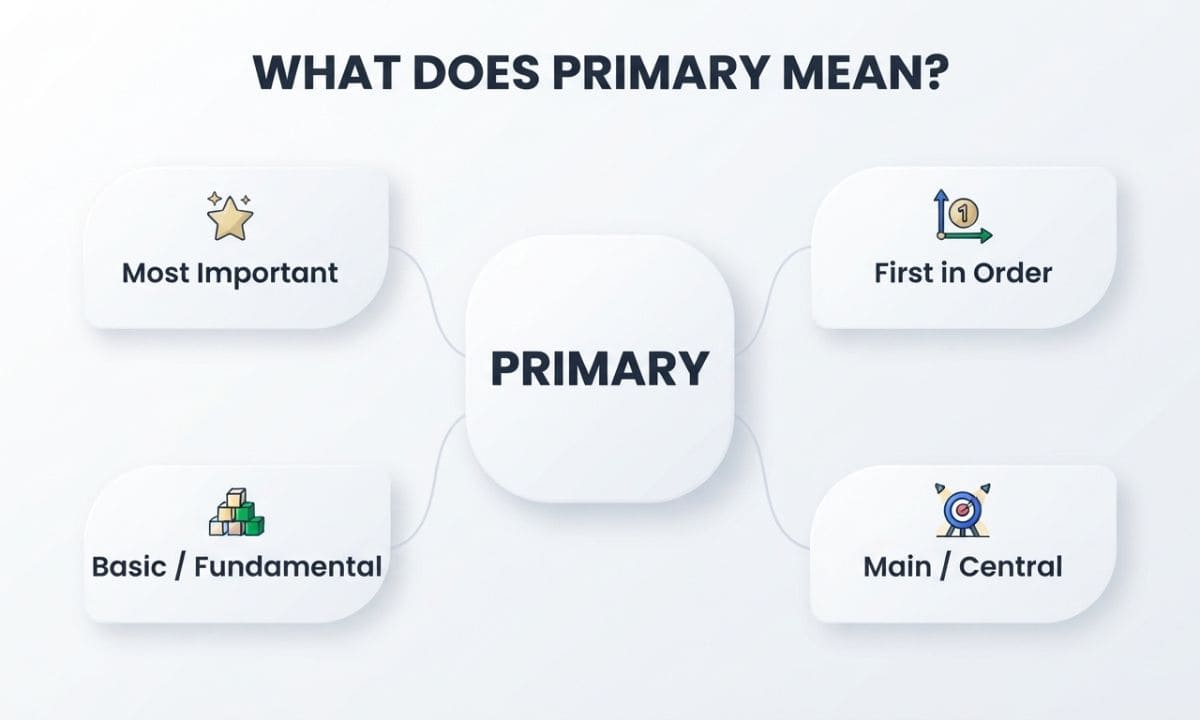
Primary is an adjective that changes shade depending on what it’s paired with. It can point to importance, order, structure, or basic nature, so the right synonym depends on which sense you’re using.
Primary Meaning “Most Important”
Here, primary highlights rank or priority above everything else in a group.
Example: “Customer satisfaction is our primary goal this year.”
Primary Meaning “First in Order”
This sense refers to the sequence that comes before everything else in time or steps.
Example: “The primary stage of the project involves research and planning.”
Primary Meaning “Basic or Fundamental”
Here, primary describes something that forms the base or root of a system, without being derived from anything else.
Example: “Reading and writing are primary skills taught in early education.”
Primary Meaning “Main or Central”
This use points to the central idea or focus around which other things revolve.
Example: “The primary theme of the novel is resilience.”
Best Synonyms for Primary at a Glance
| Synonym | Best Used For | Tone |
| Main | General, everyday use | Neutral |
| Principal | Formal documents, roles | Formal |
| Chief | Leadership, rank | Formal |
| Key | Important factors | Neutral |
| Essential | Necessity | Neutral |
| Fundamental | Basic principles | Formal |
| Central | Focus or theme | Neutral |
| Leading | Position or status | Formal |
| Foremost | Top rank or reputation | Formal |
| Major | Size or significance | Neutral |
20+ Primary Synonyms and Their Meanings
Below are more than 20 alternatives to primary, each with its own shade of meaning. Some overlap closely with primary; others fit only in specific situations.
Main
Meaning
The most important or largest part of something.
Best For
Everyday, general writing.
Introduction
Main is the simplest, most natural swap for primary in casual and semi-formal sentences.
Examples
- “Turn off the main water valve before repairs.”
- “Her main concern was the budget.”
- “The main character drives the whole story.”
Usage Tip
Use main when you want a plain, neutral tone without sounding overly formal.
Principal
Meaning
First in rank, authority, or importance.
Best For
Formal, legal, or academic writing.
Introduction
Principal carries a more official tone than main and often appears in business or legal contexts.
Examples
- “The principal reason for the delay was funding.”
- “She is the principal investigator on the study.”
- “Loan payments include both principal and interest.”
Usage Tip
Don’t confuse this with “principle,” which means a rule or belief.
Chief
Meaning
Highest in rank or most important.
Best For
Leadership roles and formal statements.
Introduction
Chief works well when describing someone or something at the top of a hierarchy.
Examples
- “The chief complaint was noise from construction.”
- “He serves as chief advisor to the board.”
- “Their chief export is coffee.”
Usage Tip
Chief fits titles and rankings better than abstract ideas.
Key
Meaning
Crucial or central to a result.
Best For
Highlighting important factors or people.
Introduction
Key suggests something that unlocks or drives an outcome, making it useful in business and analysis.
Examples
- “Trust is a key factor in any partnership.”
- “She played a key role in the negotiation.”
- “This chart shows the key findings.”
Usage Tip
Use key when something is influential, not simply first or biggest.
Essential
Meaning
Absolutely necessary; cannot be removed.
Best For
Describing necessity, not just importance.
Introduction
Essential goes a step further than primary by implying something is required, not optional.
Examples
- “Water is essential for survival.”
- “Clear communication is essential in remote teams.”
- “This document lists the essential requirements.”
Usage Tip
Only using essentials when removing the thing would break the whole system.
Fundamental
Meaning
Forming a necessary base or core part.
Best For
Basic principles, education, and theory.
Introduction
Fundamental describes something foundational that everything else is built on.
Examples
- “Honesty is a fundamental value in journalism.”
- “These are the fundamental rules of grammar.”
- “The theory rests on a fundamental assumption.”
Usage Tip
Reserve fundamentals for ideas, principles, or systems, not people or objects.
Central
Meaning
Located at or forming the main focus.
Best For
Themes, arguments, or ideas.
Introduction
Central works well when something sits at the middle of attention or discussion.
Examples
- “Trust is central to any relationship.”
- “The central argument of the essay is clear.”
- “Her role became central to the project’s success.”
Usage Tip
Central fits ideas and themes better than rankings or hierarchies.
Leading
Meaning
Holding a top or most prominent position.
Best For
Status, industry position, or influence.
Introduction
Leading signals prominence, often in comparison to competitors or peers.
Examples
- “She is a leading expert in cybersecurity.”
- “The company is a leading name in retail.”
- “This is the leading theory on the topic.”
Usage Tip
Leading needs a comparison point; it only works when something stands above others.
Foremost
Meaning
First in importance, rank, or reputation.
Best For
Formal praise or top-tier status.
Introduction
Foremost is a strong, slightly literary choice for describing top rank.
Examples
- “He is among the foremost scholars in his field.”
- “Safety remains our foremost priority.”
- “She is first and foremost a teacher.”
Usage Tip
Foremost suits formal or written contexts more than everyday speech.
Major
Meaning
Significant in size, importance, or effect.
Best For
General significance, not necessarily rank.
Introduction
Major works when something is large in scale or impact rather than strictly “first.”
Examples
- “A major update is coming next month.”
- “This was a major turning point in history.”
- “She made a major contribution to the field.”
Usage Tip
Major doesn’t always mean “first” it just means “big” or “significant.”
Dominant
Meaning
Having the most power, control, or influence.
Best For
Comparisons involving strength or control.
Introduction
Dominant fits when one thing clearly outranks others in influence or presence.
Examples
- “English is the dominant language in business.”
- “The team took a dominant lead in the second half.”
- “This gene is dominant over the recessive one.”
Usage Tip
Use dominant only when there’s a clear comparison to something weaker.
Prime
Meaning
Of the best or highest quality; first in importance.
Best For
Quality, timing, or top condition.
Introduction
Prime suggests peak condition or top priority, often with a slightly formal tone.
Examples
- “This is prime real estate.”
- “Their prime concern was employee safety.”
- “He’s in his prime working years.”
Usage Tip
Prime works well with nouns related to quality, timing, or condition.
Initial
Meaning
Occurring at the beginning; first in a sequence.
Best For
Order and sequence, not importance.
Introduction
Initial focuses purely on timing what happens first not on rank.
Examples
- “The initial results were promising.”
- “Our initial meeting covered the basics.”
- “She had an initial reaction of surprise.”
Usage Tip
Never use initial when you mean “most important” ; it only describes order.
First
Meaning
Coming before all others in time or order.
Best For
Sequence, everyday speech.
Introduction
First is the simplest word for order and works in nearly any tone.
Examples
- “This was her first job out of college.”
- “First, gather all the materials.”
- “He came in first place.”
Usage Tip
Use first for sequence, only swap to “main” or “key” if you mean importance.
Original
Meaning
Existing from the beginning; not a copy or derivative.
Best For
Source material, history, or authenticity.
Introduction
Original points back to where something started rather than its rank.
Examples
- “This is the original recipe from 1952.”
- “The original plan changed after feedback.”
- “She kept the original document for records.”
Usage Tip
Original works for source and authenticity, not for describing “most important.”
Basic
Meaning
Forming the necessary foundation; simple.
Best For
Everyday explanations and foundational skills.
Introduction
Basic is a casual, plain-spoken alternative to fundamental.
Examples
- “These are the basic steps to set up the account.”
- “Basic training comes before advanced courses.”
- “It’s a basic requirement for the role.”
Usage Tip
Basic can sound informal, so switch to fundamental in formal writing.
Cardinal
Meaning
Of the greatest importance; central.
Best For
Rules, principles, and formal writing.
Introduction
Cardinal is a formal, less common word that emphasizes core importance.
Examples
- “Honesty is a cardinal rule in this office.”
- “This was a cardinal error in judgment.”
- “Patience is a cardinal virtue in teaching.”
Usage Tip
Cardinal fits rules and virtues better than people or objects.
Paramount
Meaning
More important than anything else; supreme.
Best For
Emphasizing top priority strongly.
Introduction
Paramount is a powerful word for when something outranks every other concern.
Examples
- “Safety is of paramount importance here.”
- “Their paramount concern was data privacy.”
- “This issue is paramount to the negotiation.”
Usage Tip
Use paramount sparingly; it carries strong emphasis and can sound dramatic if overused.
Predominant
Meaning
More frequent, common, or influential than others.
Best For
Trends, patterns, and comparisons.
Introduction
Predominant highlights what stands out most within a group or pattern.
Examples
- “Blue is the predominant color in the design.”
- “The predominant view among experts has shifted.”
- “Farming was the predominant occupation in the region.”
Usage Tip
Predominant compares frequency or presence, not rank or necessity.
Core
Meaning
The central or most essential part of something.
Best For
Business, values, and skill sets.
Introduction
Core is a modern, widely used alternative common in business writing.
Examples
- “Integrity is one of our core values.”
- “This is a core feature of the app.”
- “The core team handled the launch.”
Usage Tip
Core works well with values, skills, and business terms.
Premier
Meaning
First in status or importance; top-ranked.
Best For
Branding, marketing, and formal recognition.
Introduction
Premier suggests top-tier quality or ranking, often used in promotional language.
Examples
- “It’s the premier event of the year.”
- “They offer premier customer support.”
- “She holds the premier position in her department.”
Usage Tip
Premier fits marketing and formal titles more than casual writing.
Primary Synonyms by Context
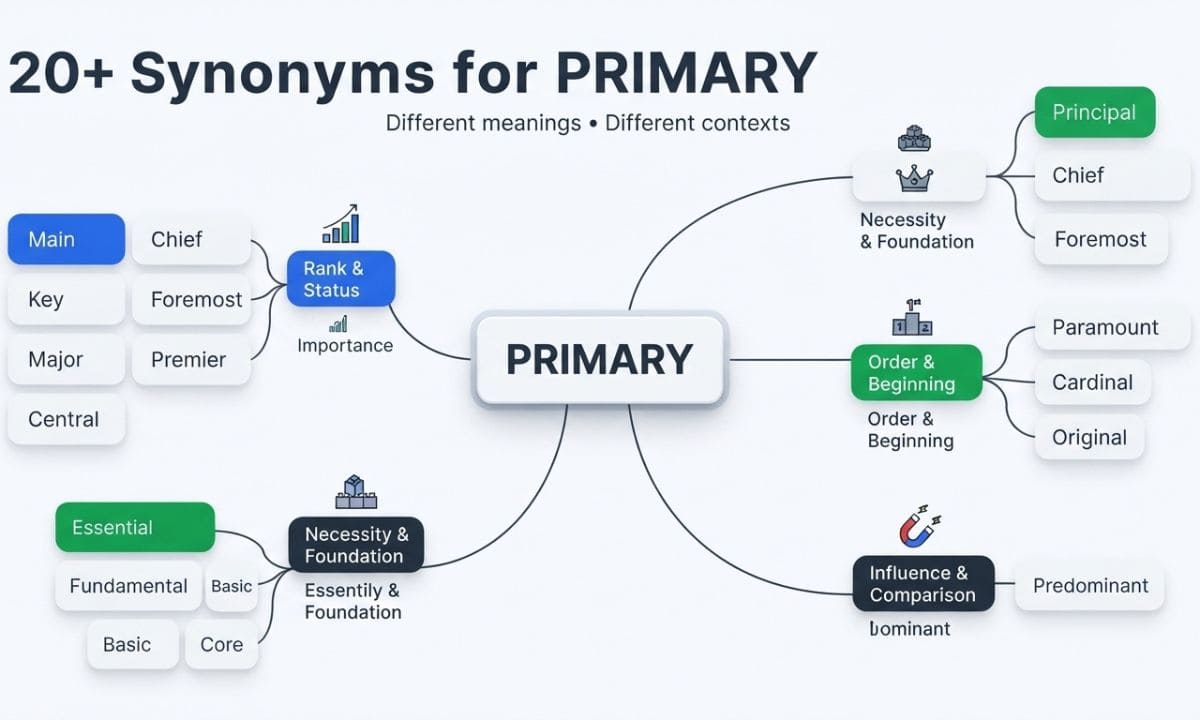
The right word for primary changes depending on what part of its meaning you’re using importance, necessity, focus, or order.
When Primary Means “Most Important”
Use: main, chief, principal, foremost, paramount
When Primary Means “Essential or Necessary”
Use: essential, fundamental, core, cardinal
When Primary Means “Central or Main Focus”
Use: central, key, dominant, leading
When Primary Means “First or Earliest”
Use: initial, first, original, prime
Primary Synonyms: Formal vs Casual
| Word | Tone | Best Context |
| Main | Casual/Neutral | Everyday writing |
| Key | Neutral | Business, general |
| Essential | Neutral | Instructions, guides |
| Principal | Formal | Legal, academic |
| Chief | Formal | Leadership, titles |
| Foremost | Formal | Literary, formal praise |
| Paramount | Formal | Emphasis, policy |
| Basic | Casual | Simple explanations |
Primary Synonyms for Professional Writing
Workplace writing needs precision without sounding stiff. The right synonym should sound confident, not repetitive.
Best Professional Alternatives
Principal: Fits titles and formal reports.
Example: “She is the principal architect of the strategy.”
Key: Fits performance reviews and summaries.
Example: “This was a key milestone for the quarter.”
Core: Fits company values and product features.
Example: “Transparency is a core part of our culture.”
Leading: Fits competitive positioning.
Example: “We remain the leading provider in this segment.”
Essential: Fits requirements and onboarding docs.
Example: “This training is essential before your start date.”
What Major Dictionaries Say About “Primary”
Major dictionaries define primarily around ideas such as being first in importance, order, or development. Comparing dictionary definitions helps clarify why some synonyms fit certain contexts better than others.
Cambridge Dictionary
Cambridge frames primary as something of the greatest importance, or relating to the earliest stage of something, which supports both the “most important” and “first” meanings.
Merriam-Webster
Merriam-Webster’s thesaurus groups primary with words like main and chief when it means immediate or direct, and with words tied to preparation when it means preliminary.
Oxford Languages / Oxford English Dictionary
Oxford ties primary to being “of the first importance” and also connects it to its root, the Latin word for “first,” which explains why so many synonyms revolve around order and rank.
Collins Dictionary
Collins lists prime and main as close synonyms while also covering primary’s technical senses, such as primary colors and primary sources, showing how context-dependent the word really is.
How to Choose the Right Synonym for Primary
Choose “Main”
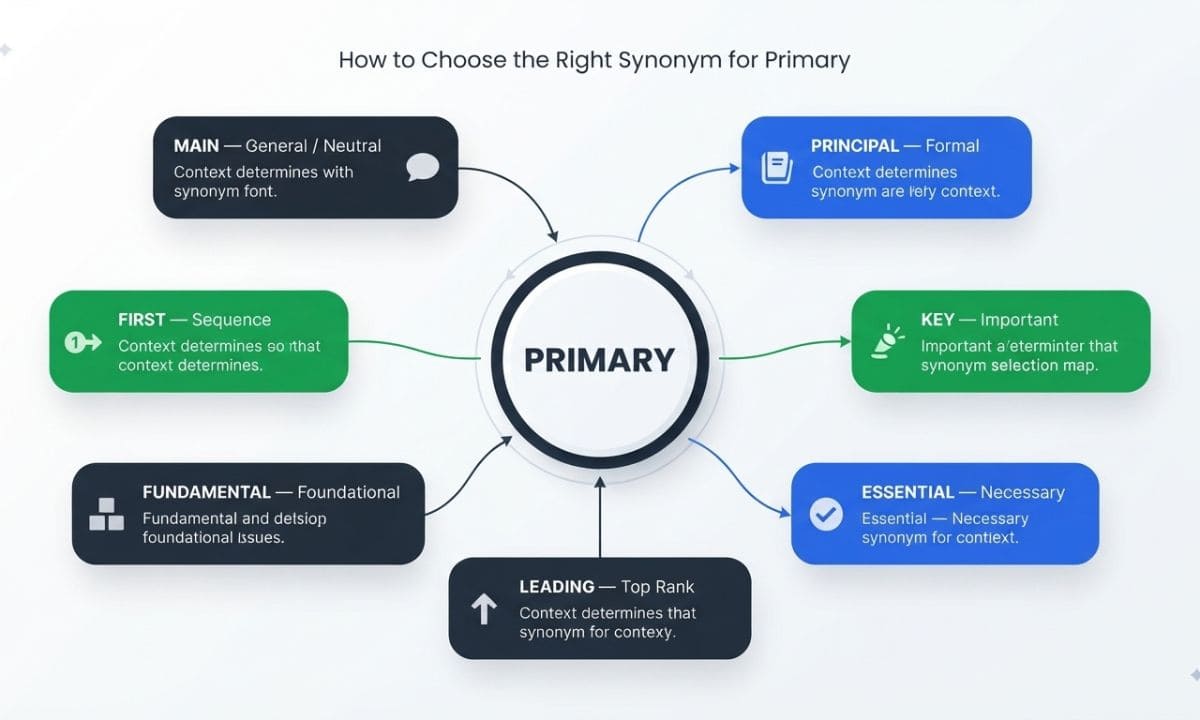
For general writing that needs a neutral, easy tone.
Choose “Principal”
For formal writing, legal text, or job titles.
Choose “Key”
When highlighting important factors or people.
Choose “Essential”
When something is truly necessary, not just important.
Choose “Leading”
For top position, rank, or industry status.
Choose “Fundamental”
For basic principles or foundational ideas.
Choose “First”
When the point is order or sequence, not importance.
Primary vs Its Closest Synonyms
Some synonyms sit so close to primary that swapping them feels automatic. But small differences in meaning still matter.
Primary vs. Main
Primary can suggest rank, order, or origin. Main is simpler and only points to size or importance. “Main entrance” works; “primary entrance” sounds oddly technical.
Primary vs. Principal
Principal leans formal and often applies to people or money (as in loan principal). Primary is broader and fits both abstract and concrete ideas equally.
Primary vs. Chief
Chief usually attaches to a role or title chief officer, chief concern. Primary works more generally across goals, causes, and sources.
Primary vs. Major
Major implies scale or significance, not necessarily rank. A “major update” isn’t always the “primary update” , it just means a big one.
Primary vs. Essential
Primary means first or most important. Essential means necessary something the system cannot function without. Not everything primary is essential, and not everything essential is primary.
Primary vs. Fundamental
Primary often relates to order or rank. Fundamentals relate to structure of the base layer everything else depends on. A fundamental rule isn’t always the primary rule in a list.
Common Mistakes When Using Primary Synonyms
Small mix-ups here can confuse readers or weaken your point. Here’s what to watch for.
Using “Essential” When You Only Mean “Main”
Mistake: “Coffee is my essential morning drink.”
Correction: “Coffee is my main morning drink.” Essential implies you can’t function without it and use it carefully.
Using “First” When You Mean “Most Important”
Mistake: “Safety is our first concern.”
Correction: “Safety is our main concern.” First refers to order, not rank.
Treating “Principal” and “Principle” as the Same Word
Mistake: “Our principal goal is growth.”
Correction: “Our principal goal is growth.” Principle is a noun meaning a rule or belief; principal is the adjective meaning “main.”
Using “Leading” Without a Sense of Position or Prominence
Mistake: “This is a leading ingredient in the recipe.”
Correction: “This is the main ingredient in the recipe.” Leading needs a competitive or ranked context to make sense.
Assuming Every Synonym Works in Every Sentence
Mistake: Swapping “primary” for “cardinal” in casual writing: “That’s my cardinal reason for calling.”
Correction: “That’s my main reason for calling.” Formal words like cardinal or paramount can sound out of place in casual sentences.
Best Primary Synonyms at a Glance
| Synonym | Best Meaning | Tone |
| Main | Most important, general | Neutral |
| Principal | First in rank, formal | Formal |
| Essential | Necessary | Neutral |
| Fundamental | Basic, foundational | Formal |
| Leading | Top position | Formal |
| Key | Crucial factor | Neutral |
| First | Order, sequence | Neutral |
| Core | Central part | Neutral |
Primary Synonyms in Sentences
Seeing these words in real sentences makes the differences easier to remember than definitions alone.
Everyday Examples
- “Her main worry is finding parking downtown.”
- “The basic idea behind the app is simplicity.”
- “First, check if the store is open.”
Academic Examples
- “The primary source for this claim is a 1998 study.”
- “This is the fundamental principle behind the theory.”
- “The initial hypothesis was later revised.”
Professional Examples
- “Our key priority this quarter is customer retention.”
- “She is the principal contact for this account.”
- “This remains a core value across all departments.”
Formal Examples
- “Safety is of paramount importance to this organization.”
- “He was recognized as the foremost authority on the subject.”
- “The cardinal rule of this agreement is confidentiality.”
What Is the Best Synonym for Primary?
Quick Answer
There isn’t one single “best” synonym for primary because the right word depends on tone and meaning. For general writing, main works almost everywhere. For formal writing, principal or chief fit better. If your sentence is about necessity, use essential instead it changes the meaning slightly but often communicates your point more clearly than primary itself.
Explore More Synonyms Guide
25+ Struggle Synonyms: Better Ways to Say Struggle (With Examples)
25+ Share Synonyms: Meanings, Examples & When to Use Each
Additionally Synonyms: 20+ Words, Meanings, Examples & How to Use Them
25+ Share Synonyms: Meanings, Examples & When to Use Each
70 Synonyms for Regarding: Choose the Right Alternative With Examples
30+ Enjoy Synonyms: Meaning, Examples & When to Use Each
Synonyms for Effects: 70 Words to Replace “Effects” With Confidence
Frequently Asked Questions
What is the best synonym for primary?
Main is the most flexible synonym for primary and fits nearly any tone or context.
What is another word for primary?
Common alternatives include main, chief, principal, key, and essential, depending on the meaning you need.
What is a formal synonym for primary?
Principal, chief, foremost, and paramount all work well in formal or professional writing.
Is main a synonym for primary?
Yes, main is one of the closest and most commonly used synonyms for primary in everyday writing.
Is principal the same as primary?
They’re close, but principal leans more formal and often applies to titles, roles, or financial terms like loan principal.
What is the opposite of primary?
The most common opposite of primary is secondary, which refers to something less important or coming after the main thing.
What is a synonym for primary in professional writing?
Key, core, and leading work well in business reports, performance reviews, and workplace communication.
What is a synonym for primary in academic writing?
Fundamental, principal, and initial are common choices in academic and research writing.
Can “essential” always replace “primary”?
No. Essential means necessary, while primary means first or most important the two overlap but aren’t identical.
Does “leading” work as a synonym for primary in every sentence?
No. Leading only fits when there’s a sense of rank or comparison, such as industry position or expertise.
Conclusion
Primary is a solid word, but leaning on it too often makes writing feel repetitive. Once you understand its different shades of importance, order, necessity, and focus, choosing the right synonym becomes much easier. Keep this list handy, match the word to your tone, and your writing will read sharper without losing meaning.
