

“Policy synonyms” is one of those words we use constantly in offices, schools, government offices, and even insurance paperwork but it starts to feel repetitive the moment you write more than a paragraph about it. That’s usually why people go looking for a policy synonym in the first place: to keep writing fresh, sound more precise, or match a specific tone.
Here’s the catch, though. Not every synonym for policy means exactly the same thing. A “rule” is stricter than a “guideline.” A “regulation” carries legal weight that a “practice” doesn’t. Pick the wrong one, and your sentence quietly changes meaning.
This guide breaks down 25+ real alternatives to policy, what each one actually means, how it’s used, and when it fits best so you can choose with confidence instead of guessing.
Quick Answer: What Are the Best Synonyms for Policy?
If you’re in a hurry, here’s the short version.
The best synonym for policy depends entirely on context: workplace, government, or general writing all call for different words.
| Synonym | Quick Example |
| Rule | “It’s against company rules to eat at your desk.” |
| Guideline | “Follow the style guideline for all reports.” |
| Regulation | “New safety regulations start next month.” |
| Procedure | “The return procedure takes five steps.” |
| Protocol | “Hospital protocol requires double-checking dosages.” |
| Strategy | “Our marketing strategy focuses on video.” |
| Standard | “The product meets industry standards.” |
| Principle | “Honesty is a core principle here.” |
| Directive | “A new directive limits overtime hours.” |
| Practice | “It’s standard practice to confirm by email.” |
Keep scrolling for the full list, meanings, and how each one behaves differently in a sentence.
What Does “Policy” Mean?
Policy Definition
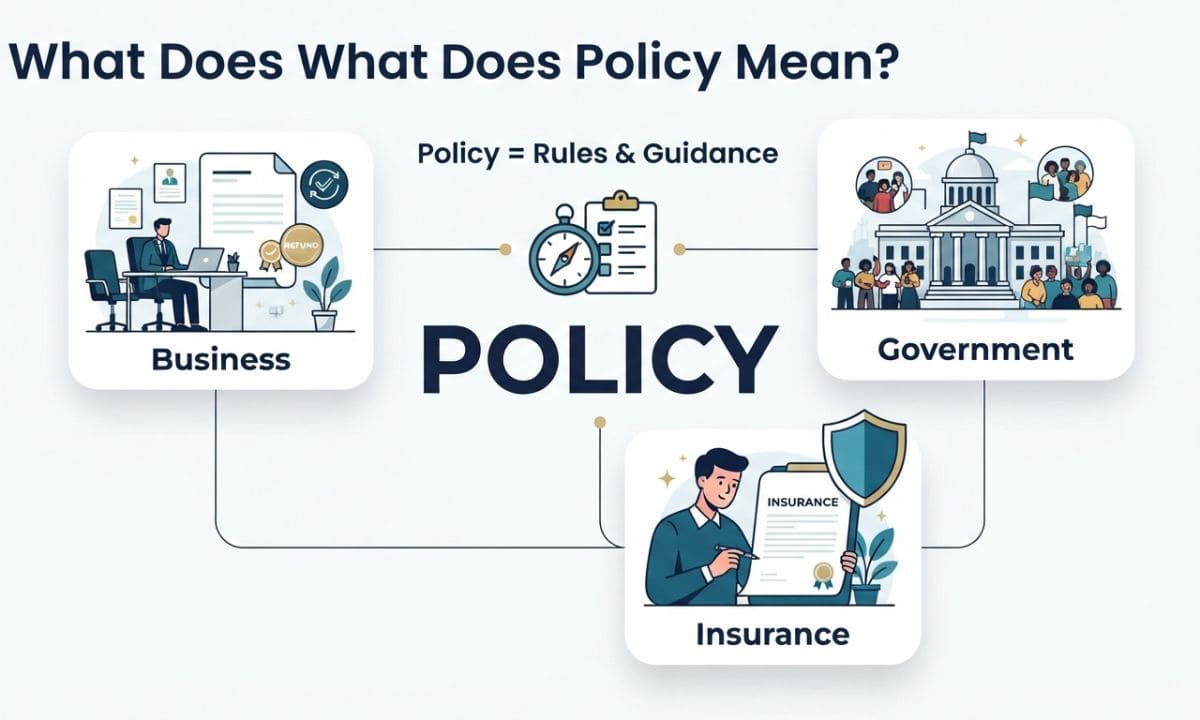
In simple terms, a policy is a course of action, plan, or set of principles adopted by a person, company, or government to guide decisions.
Policy in Different Contexts
The word shifts slightly depending on where it shows up:
Business: “Our refund policy allows returns within 30 days.”
Government: “The new housing policy aims to lower rent prices.”
Personal/insurance: “She updated her life insurance policy last year.”
Notice that the last example already looks a little different from the others.
25+ Useful Synonyms for Policy
Below are 25+ alternatives to policy, grouped loosely by how close they sit to the original meaning. For each one, you’ll find a plain-language meaning, an example, and where it fits best.
Rule
The rule emphasizes a specific, enforceable directive that leaves little room for interpretation.
Examples:
- No phones during meetings is a firm rule.
- Breaking the dress code rule led to a warning.
- The referee reviewed the new rule before kickoff.
Best for:
workplace or classroom conduct.
Guideline
Guideline emphasizes a recommended approach that offers direction without being strictly mandatory.
Examples:
- These are guidelines, not requirements.
- The style guideline suggests short paragraphs and simple words.
- Staff followed the safety guideline when handling chemicals.
Best for:
advice-based writing.
Regulation
Regulation emphasizes a rule set by a governing authority, often carrying legal weight.
Examples:
- Environmental regulations tightened this year.
- The factory must comply with fire safety regulations.
- New banking regulations changed how loans are approved.
Best for:
government or industry compliance.
Procedure
Procedure emphasizes the exact steps required to complete a task or process.
Examples:
- The onboarding procedure takes two days.
- Follow the correct procedure when filing a complaint.
- The hospital updated its admission procedure last month.
Best for:
process documentation.
Protocol
Protocol emphasizes a formal, often technical set of steps or conduct expected in a specific setting.
Examples:
- Security protocol requires ID badges at every entrance.
- Surgeons follow strict protocol before every operation.
- Diplomatic protocol dictates how officials greet each other.
Best for:
technical, medical, or diplomatic settings.
Strategy
Strategy emphasizes a plan of action designed to reach a specific goal.
Examples:
- Their pricing strategy attracts new customers.
- The team built a content strategy to boost engagement.
- A long-term growth strategy shaped every major decision.
Best for:
business or competitive planning.
Practice
Practice emphasizes a customary or habitual way of doing something.
Examples:
- It’s common practice to tip 15 percent.
- Best practice suggests backing up files daily.
- The clinic changed its practice for scheduling appointments.
Best for:
everyday or cultural norms.
Principle
Principle emphasizes a core belief or standard that guides behavior and decisions.
Examples:
- Fairness is a guiding principle here.
- The company operates on a principle of transparency.
- Honesty remained a key principle throughout the negotiations.
Best for:
values-based writing.
Code (of Conduct)
Code emphasizes a formal set of standards that define acceptable behavior.
Examples:
- Employees must follow the code of conduct.
- The athletes’ code bans the use of banned substances.
- Violating the ethics code can lead to dismissal.
Best for:
ethics and behavior standards.
Standard
Standard emphasizes a required or expected level of quality or performance.
Examples:
- The factory follows strict safety standards.
- Every product must meet quality standards before shipping.
- Teachers assess work against a clear academic standard.
Best for:
quality or compliance topics.
Approach
Approach emphasizes a general method or way of handling a situation.
Examples:
- We use a hands-on approach to training.
- Her approach to conflict resolution stays calm and direct.
- The school adopted a new approach to teaching math.
Best for:
methods and style.
Plan
Plan emphasizes an outlined intention or scheme designed to reach a future goal.
Examples:
- The city’s growth plan spans ten years.
- Management shared a five-year plan with investors.
- The evacuation plan was tested during the drill.
Best for:
long-term goals.
Directive
Directive emphasizes an official instruction issued by an authority that must be followed.
Examples:
- A new directive bans single-use plastics.
- The manager issued a directive to cut spending.
- Employees received a directive to work remotely during the outage.
Best for:
formal, top-down orders.
Mandate
Mandate emphasizes an authoritative command or requirement that leaves little choice.
Examples:
- Vaccination became a workplace mandate.
- The government issued a mandate on emissions reporting.
- Under the new mandate, all staff must complete training.
Best for:
legal or organizational requirements.
Statute
Statute emphasizes a formal law passed by a legislative body.
Examples:
- The statute was passed last session.
- Under state statute, the fine cannot exceed $500.
- The court referred to an old statute during the case.
Best for:
legal documents.
Ordinance
Ordinance emphasizes a rule enacted by a local government or municipal authority.
Examples:
- The city ordinance restricts noise after 10 p.m.
- A new ordinance requires permits for street vendors.
- Residents protested the proposed zoning ordinance.
Best for:
municipal law.
Doctrine
Doctrine emphasizes a formally stated set of beliefs or principles, often political, religious, or military.
Examples:
- Foreign doctrine shifted after the election.
- The party’s economic doctrine favors lower taxes.
- Military doctrine outlines how forces should respond to threats.
Best for:
ideology or belief systems.
Convention
Convention emphasizes an accepted, traditional way of behaving within a group or society.
Examples:
- It’s a convention to knock before entering.
- Business convention calls for a firm handshake.
- The writer broke from convention with an unusual format.
Best for:
social or professional norms.
Custom
Custom emphasizes a traditional practice passed down within a culture or group.
Examples:
- Tipping isn’t customary everywhere.
- It’s a local custom to remove shoes before entering a home.
- Wedding customs vary widely between countries.
Best for:
cultural context.
Course of Action
Course of action emphasizes a specific path chosen to handle a situation.
Examples:
- They agreed on a cautious course of action.
- Doctors recommended a different course of action.
- The board debated the best course of action for the merger.
Best for:
decision-making language.
Framework
Framework emphasizes a structural set of guiding rules or principles that support a system.
Examples:
- The compliance framework covers three areas.
- Developers built the app using a new coding framework.
- The legal framework governs how contracts are enforced.
Best for:
structured systems.
Charter
Charter emphasizes a formal document that outlines rights, rules, or founding principles.
Examples:
- The team charter defines each role.
- The organization’s charter was signed in 1990.
- The charter school follows a unique curriculum.
Best for:
founding or governing documents.
Bylaw
Bylaw emphasizes an internal rule adopted by an organization or association to govern its own affairs.
Examples:
- The HOA bylaw limits fence height.
- Club bylaws require an annual election.
- The company updated its bylaws after the merger.
Best for:
associations and local bodies.
Stance
Stance emphasizes a publicly held opinion or attitude toward an issue.
Examples:
- The company took a stance on remote work.
- Her stance on climate policy hasn’t changed.
- The politician’s stance drew criticism from both sides.
Best for:
opinions, not formal rules.
Position
Position emphasizes a formal viewpoint or stance taken on a particular issue.
Examples:
- Our official position hasn’t changed.
- The union stated its position on wage increases.
- The committee reviewed the company’s position on layoffs.
Best for:
public statements.
Tactic
Tactic emphasizes a specific action used to achieve a short-term goal within a larger plan.
Examples:
- Discounting is a common sales tactic.
- The team used a defensive tactic to protect their lead.
- Negotiators tried a new tactic to close the deal.
Best for:
short-term methods.
Scheme
Scheme emphasizes a systematic plan, often used in British English for formal programs.
Examples:
- The pension scheme covers all staff.
- The government launched a new housing scheme.
- Employees can join the company’s bonus scheme.
Best for:
UK-style formal writing.
Policy Synonyms by Context
Choosing the right word gets much easier once you sort options by setting.
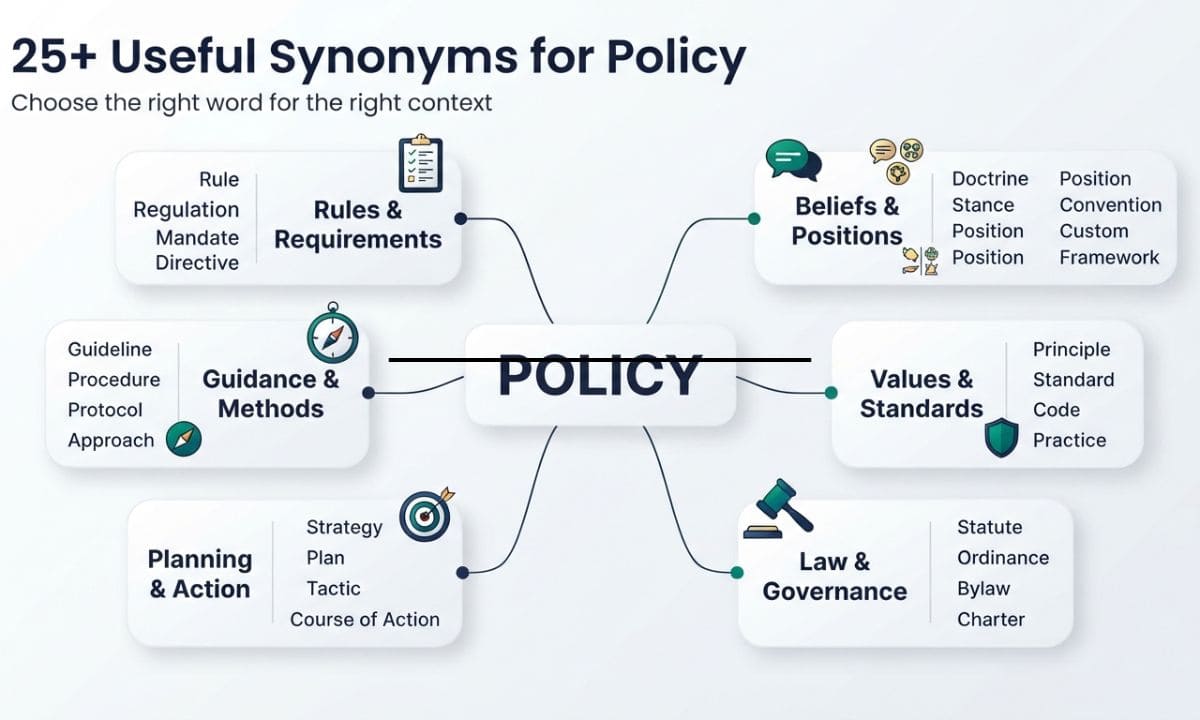
Here’s how policy synonyms cluster by context.
Company & Workplace
These words describe internal expectations rather than external law.
Rule
Guideline
Procedure
Protocol
Code of Conduct
Standard
Practice
Government & Law
Regulation
Statute
Ordinance
Directive
Mandate
Bylaw
Opinions & Positions
Stance
Position
Doctrine
Principle
Methods & Processes
Strategy
Approach
Plan
Framework
Tactic
Scheme
Formal and Informal Alternatives to Policy
Tone matters as much as meaning. Here’s a quick breakdown.
Formal
Statute
Ordinance
Regulation
Directive
Mandate
Doctrine
Neutral
Rule
Guideline
Procedure
Standard
Practice
Approach
More Context-Specific
Insurance policy, privacy policy, and company handbook aren’t generic synonyms; they’re fixed terms tied to a specific document or product, so swapping words here can confuse readers.
Policy vs. Rule vs. Guideline vs. Regulation
This comparison trips people up the most, so it deserves its own breakdown.
| Word | Main Idea | Strength | Explanation |
| Policy | Overall plan or intent | Usually mandatory | States what an organization does and why, at a broad level. |
| Rule | Specific directive | Mandatory | A narrow, enforceable instruction with little flexibility. |
| Guideline | Recommended advice | Advisory | Suggests a best approach but allows judgment and exceptions. |
| Regulation | Government-issued requirement | Legally binding | Created and enforced by an authority, often with penalties. |
A policy is the umbrella. Rules and regulations sit underneath it as enforcement tools, while guidelines offer flexible advice on how to meet it.
How to Choose the Right Synonym for Policy
Picking the best word doesn’t need to be complicated. Run through these three quick checks.
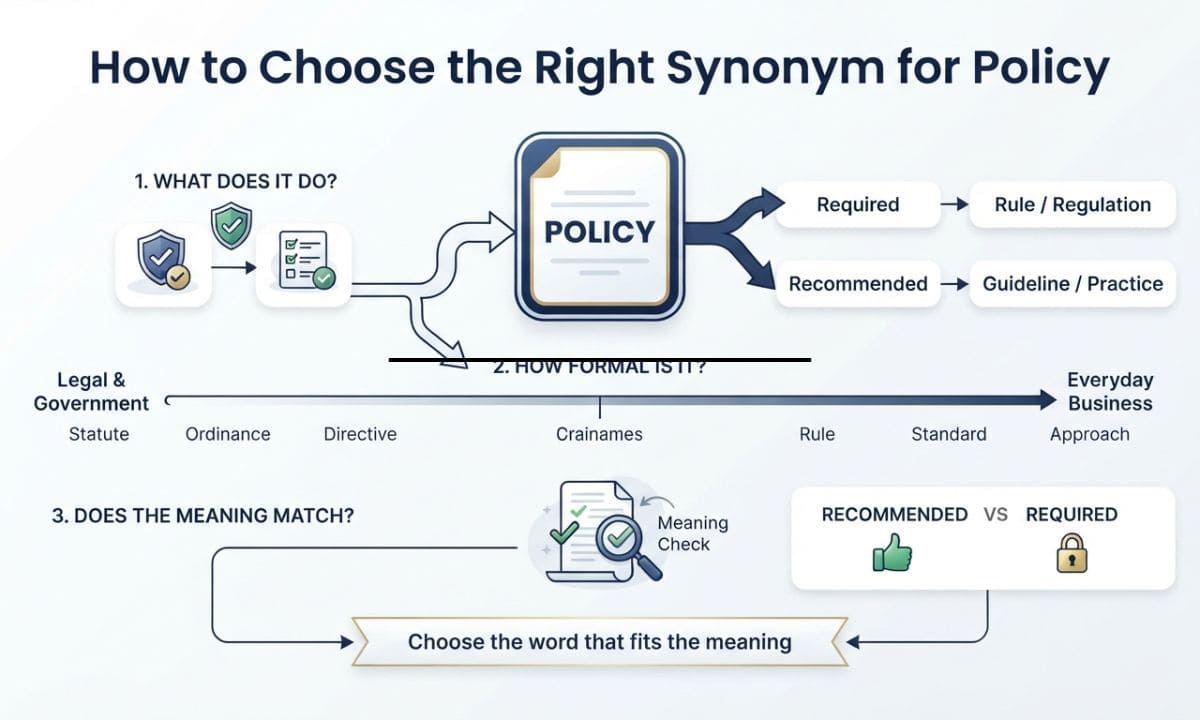
Step 1: Ask What the Policy Does
Is it mandatory (rule, regulation) or advisory (guideline, practice)? That single question eliminates half the list immediately.
Step 2: Consider Formality
Legal or government writing calls for statute, ordinance, or directive. Everyday business writing works better with rules, standard, or approach.
Step 3: Check the Sentence Meaning
Read the sentence back with your chosen synonym in place. If the meaning shifts from “recommended” to “required” it’s the wrong word.
Examples of “Policy” in Sentences
Seeing “policy” used across different settings makes the distinctions clearer.
Workplace Policy
“The company’s remote work policy allows two days from home each week.”
School Policy
“Under the school’s attendance policy, students need a note after three absences.”
Government Policy
“The new tax policy takes effect at the start of the fiscal year.”
Privacy Policy
“Our privacy policy explains exactly how customer data gets stored and used.”
Insurance Policy
“Her car insurance policy covers accidents up to $50,000.”
Here’s the part people often miss: in insurance, “policy” doesn’t mean a rule at all. It refers to the actual contract or document between the insurer and the policyholder. That’s why “rule” or “guideline” can’t replace “policy” in this sentence. The meaning is completely different. This is a good reminder that context always comes before vocabulary.
Common Mistakes When Using Policy Synonyms
A few habits quietly weaken otherwise solid writing. Watch for these.
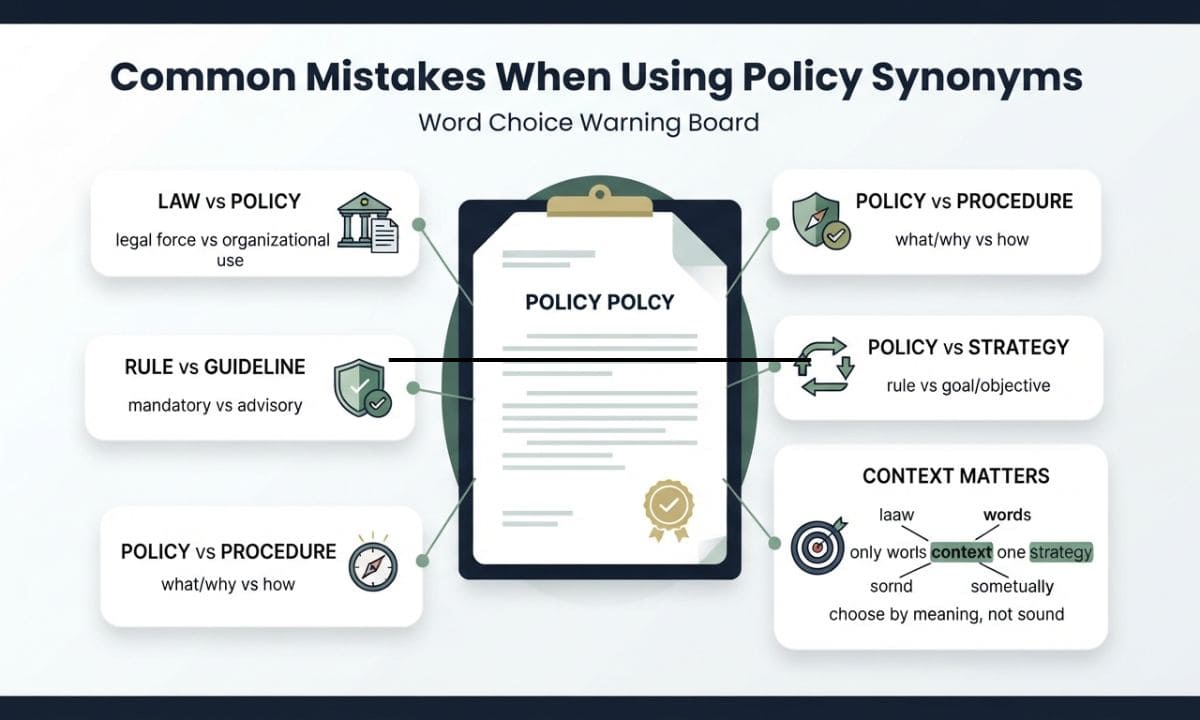
Mistake 1: Using “Law” for Every Policy
Policy and law aren’t the same thing. A company policy has no legal force outside the organization, while a law applies broadly and carries government enforcement.
Mistake 2: Treating “Rule” and “Guideline” as Identical
A rule is generally mandatory. A guideline is advisory. Mixing them up can make a strict requirement sound optional, or vice versa.
Mistake 3: Using “Procedure” for a General Policy
Policy explains the what and why. The procedure explains how. Swapping them muddies instructions that should stay separate.
Mistake 4: Using “Strategy” When No Goal Is Involved
Strategy implies a specific objective. A policy that simply states a rule, with no target outcome attached, isn’t really a strategy.
Mistake 5: Ignoring Context
The single biggest error is picking a synonym based on sound rather than meaning. Always match the word to what the sentence is actually describing.
What Major Dictionaries Say About “Policy”
Standard dictionary sources generally agree on the core definition, with small variations in emphasis.
| Dictionary | Core Meaning |
| Merriam-Webster | A definite course or method of action selected to guide decisions. |
| Cambridge Dictionary | A set of ideas or a plan for action, followed by a government, business, or individual. |
| Oxford Dictionary | A course of action adopted by a government, party, or organization. |
| Collins Dictionary | A plan of action, or the insurance-specific meaning as a written contract. |
Across these sources, the pattern holds: policy means a guiding plan or principle except in insurance, where it refers to a physical contract.
Explore More Grammar Rules
Stutter vs Studder: Correct Spelling and Meaning Guide in 2026
Anise vs Aniseed: Are They the Same? Find Out the Real Difference
Opportunity Synonyms: 30+ Words, Alternatives, Meanings & Examples
70+ Quietly Synonyms: Other Ways to Say Quietly in English
25+ Share Synonyms: Meanings, Examples & When to Use Each
65+ Complexity Synonyms: Other Ways to Say “Complexity” (With Examples)
Frequently Asked Questions
What is the best synonym for policy?
There isn’t one single best word; it depends on context. “Guideline” works for advisory content, “rule” fits mandatory workplace conduct, and “regulation” suits legal or government contexts.
What is another word for company policy?
“Company procedure,” “workplace guideline,” or “internal rule” all work, depending on how strict the requirement is.
What is a formal synonym for policy?
“Statute,” “ordinance,” and “directive” all read as more formal alternatives, especially in legal or government writing.
Are rule and policy synonyms?
They’re related but not identical. A policy is broader and explains intent, while a rule is a specific, enforceable instruction under that policy.
Is guideline another word for policy?
Not exactly. A guideline is advisory and flexible, while a policy is typically treated as a firm expectation within an organization.
What is the difference between policy and procedure?
Policy explains what should happen and why. Procedure explains the exact steps for how to make it happen.
What is the difference between policy and regulation?
A policy is usually internal and organization-specific, while a regulation is issued and enforced by a governing or legal authority.
What is the opposite of policy?
There’s no exact single-word opposite, but “chaos,” “disorder,” or “randomness” capture the absence of any guiding plan.
Can “practice” replace “policy” in a sentence?
Sometimes, but only when describing a customary habit rather than a formal, written rule.
Why do so many policy synonyms exist?
English borrows words from law, business, and government, each with slightly different shades of formality and enforceability which is exactly why picking the right synonym for policy matters.
Conclusion
“Policy” has more than 25 usable alternatives, but none of them are truly interchangeable. Rule means something stricter. Guidelines means something softer. Regulation carries legal weight. Insurance policy means something else entirely.
Before swapping in any policy synonym, check the context, the formality level, and whether the sentence still means what you intended. Get that right, and your writing stays accurate, natural, and easy to trust.
