

Sometimes “quietly” just doesn’t hit the way you want it to. You write the word, read it back, and it feels flat.
Maybe you’re describing someone tiptoeing past a sleeping baby. Maybe it’s a whispered secret, or a calm afternoon by the window. One word can’t carry all of that weight.
That’s exactly why writers, students, and professionals go looking for quiet synonyms. English gives you dozens of options, each with its own shade of meaning.
This guide breaks down 70+ alternatives, shows you exactly when to use each one, and helps you pick the right word every single time.
Quick Answer: The Best Synonym for Quietly in Every Context
There’s no single “best” synonym for quietly; it depends on what you’re actually describing. The right word changes based on sound, movement, secrecy, or tone.
Best Quietly Synonyms at a Glance
Context | Best Synonym |
| Speaking softly | Softly, in a low voice |
| Moving without noise | Silently, stealthily |
| Doing something secretly | Secretly, covertly |
| Formal writing | Discreetly, unobtrusively |
Which Synonym Should You Use?
For Speaking Softly: Use “softly,” “in a hushed voice,” or “under one’s breath” when someone lowers their volume while talking.
For Moving Without Noise: Choose “silently,” “soundlessly,” or “on tiptoe” when the focus is physical movement and sound.
For Doing Something Secretly: Go with “secretly,” “covertly,” or “surreptitiously” when hiding is the main idea.
For Writing and Formal English: Pick “discreetly,” “unobtrusively,” or “tactfully” for a polished, professional tone.
What Does “Quietly” Really Mean?
Before swapping the word out, it helps to understand what it’s actually doing in a sentence.
Quietly Meaning and Definition
“Quietly” is an adverb describing an action done with little or no noise, disturbance, or attention. It can describe sound, behavior, or emotional calm.
How “Quietly” Is Used in a Sentence
- She closed the door quietly so the baby wouldn’t wake up.
- He quietly left the meeting without saying goodbye.
- The town sat quietly under the evening sky.
Quietly vs. Quiet: What Is the Difference?
“Quiet” is an adjective describing a state or thing (a quiet room). “Quietly” is an adverb describing how an action happens (she spoke quietly). One describes a noun, the other describes a verb.
70+ Quietly Synonyms at a Glance
Here’s the full list, organized so you can scan it fast and find what fits.
Quick Comparison Table of Quietly Synonyms
| Category | Example Synonyms |
| Formal | Discreetly, unobtrusively, confidentially |
| Casual | Softly, on tiptoe, hush-hush |
| Literary | Soundlessly, hushedly, tranquilly |
Formal Quietly Synonyms
Discreetly, privately, unobtrusively, subtly, confidentially, tactfully, diplomatically, inconspicuously, without publicity, without drawing attention.
Casual Quietly Synonyms
Softly, on tiptoe, under one’s breath, in a whisper, low-key, hush-hush, on the sly, without a peep.
Literary and Descriptive Synonyms
Soundlessly, hushedly, tranquilly, faintly, gently, stealthily, peacefully, wordlessly, mutely, in silence.
Deep Dive: Top 8 Core Synonyms for Quietly
These eight synonyms cover the most common ways people actually use “quietly.” Learn these first.
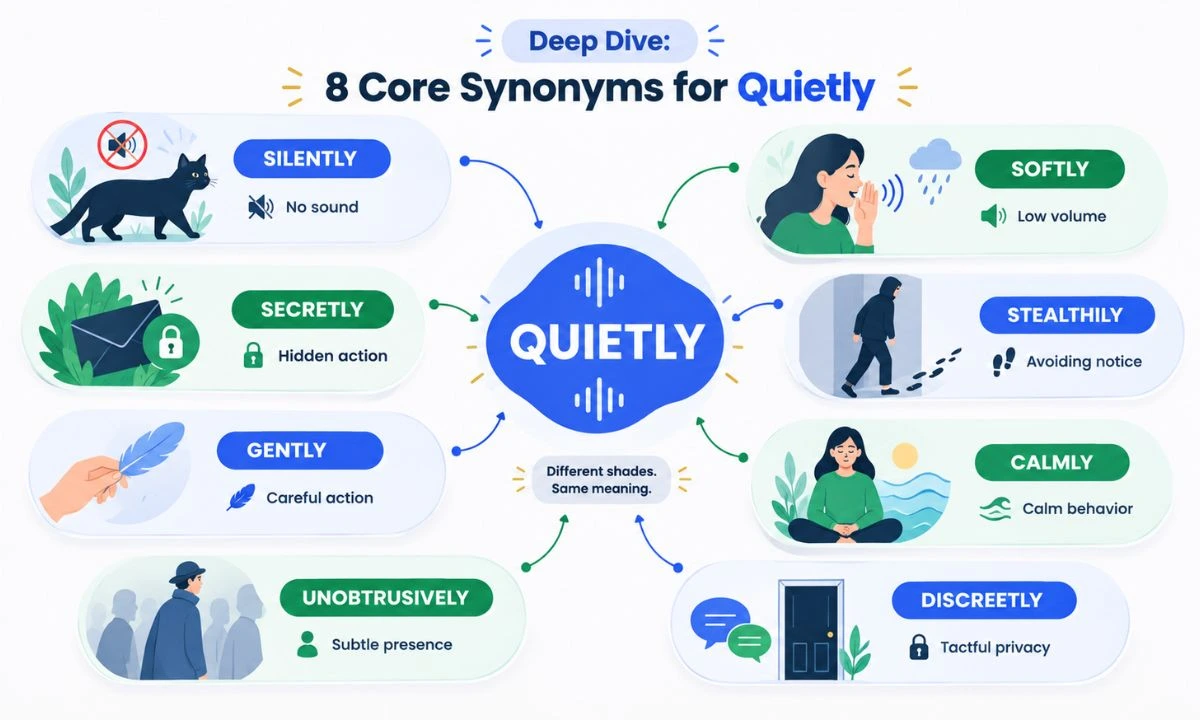
Silently
Meaning:
Without making any sound at all.
Examples:
She cried silently, not wanting anyone to notice.
The cat moved silently across the floor.
Softly
Meaning:
With a gentle, low volume, usually about voice or sound.
Examples:
The rain fell softly against the window.
He spoke softly to calm the crying child.
Secretly
Meaning:
Doing something while hiding it from others.
Examples:
She secretly hoped he’d stay longer.
They secretly planned the surprise party.
Stealthily
Meaning:
Moving carefully to avoid being seen or heard.
Examples:
The cat stalked stealthily toward the bird.
The thief moved stealthily through the hallway.
Gently
Meaning:
In a soft, careful, non-forceful way.
Examples:
He gently woke his brother for school.
She gently closed the drawer.
Calmly
Meaning:
In a relaxed, composed, unhurried manner.
Examples:
He calmly waited for the results.
She calmly explained the situation to her boss.
Unobtrusively
Meaning:
Without drawing attention to oneself.
Examples:
She unobtrusively fixed the mistake before anyone noticed.exaggerated.
He unobtrusively slipped out of the room.
Discreetly
Meaning:
Careful and tactful, especially about sensitive matters.
Examples:
She discreetly mentioned the issue in private.
The manager discreetly addressed the complaint.
70+ Quietly Synonyms Categorized by Context
A. Speaking and Communication Synonyms
Softly
Meaning
Speaking with a gentle, low volume.
Examples
- She spoke softly to the crying baby.
- “Don’t worry,” he said softly.
Usage Tip
Use this when volume, not secrecy, is the point.
In a Low Voice
Meaning
Talking with reduced volume, often to avoid being overheard.
Examples
- He answered in a low voice during the meeting.
- She asked the question in a low voice.
Usage Tip
Works well in dialogue and casual narration.
Under One’s Breath
Meaning
Muttering quietly, usually in frustration or secrecy.
Examples
- He cursed under his breath.
- She muttered a complaint under her breath.
Usage Tip
Best for showing hidden irritation or private reaction.
In a Whisper
Meaning
Speaking with barely audible breathy sound.
Examples
- She told the secret in a whisper.
- “Follow me,” he said in a whisper.
Usage Tip
Ideal for secrets or intimate, hushed conversations.
Murmuringly
Meaning
Speaking in a soft, continuous, unclear tone.
Examples
- The crowd responded murmuringly.
- He answered murmuringly, half asleep.
Usage Tip
Fits literary or descriptive writing more than everyday speech.
In a Soft Voice
Meaning
Using gentle vocal tones, often comforting.
Examples
- She read the story in a soft voice.
- He reassured her in a soft voice.
Usage Tip
Great for warm, caring, or bedtime-story tones.
In a Quiet Tone
Meaning
Speaking with reduced volume and calm delivery.
Examples
- He delivered the news in a quiet tone.
- She replied in a quiet tone.
Usage Tip
Useful in formal or emotionally serious contexts.
In a Hushed Voice
Meaning
Speaking softly, often with secrecy or reverence.
Examples
- They spoke in a hushed voice at the funeral.
- She warned him in a hushed voice.
Usage Tip
Pairs well with solemn or secretive scenes.
Faintly
Meaning
Barely audible or noticeable in sound.
Examples
- His voice sounded faintly through the wall.
- She smiled faintly and nodded.
Usage Tip
Good for describing distant or weak sounds.
Lowly
Meaning
In a subdued, quiet manner (less common, slightly archaic).
Examples
- He spoke slowly to avoid attention.
- She answered slowly, almost inaudible.
Usage Tip
Using this word sparingly can feel outdated in modern writing.
B. Moving Without Noise
Silently
Meaning
Without making any sound while moving.
Examples
- The thief moved silently down the hall.
- She silently closed the door.
Usage Tip
Best choice when total absence of sound matters most.
Stealthily
Meaning:
Moving carefully to avoid being seen or heard.
Examples:
The cat stalked stealthily toward the bird.
The thief moved stealthily through the hallway.
Usage Tip
Use for suspense, action, or sneaking scenes.
Soundlessly
Meaning
Making no sound at all while moving or acting.
Examples
- She soundlessly slipped out of bed.
- The door opened soundlessly.
Usage Tip
Great for literary or dramatic descriptions.
Quietly
Meaning
With minimal sound or disturbance.
Examples
- He quietly walked into the room.
- She quietly closed the window.
Usage Tip
The base word uses synonyms above for more variety.
On Tiptoe
Meaning
Walking carefully on the toes to avoid noise.
Examples
- She walked on tiptoe past the nursery.
- He tiptoed to avoid waking his parents.
Usage Tip
Perfect for casual, everyday storytelling.
Secretly
Meaning
Doing something while hiding it from others.
Examples
- He secretly left through the back door.
- She secretly watched from the window.
Usage Tip
Use when hiding intent matters more than sound.
Noise-free
Meaning
Completely without sound or disturbance.
Examples
- The engine ran noise-free all night.
- Their noise-free entry surprised everyone.
Usage Tip
Works better in technical or descriptive writing.
Without a Sound
Meaning
Making zero noise during an action.
Examples
- He left without a sound.
- She slid the drawer shut without a sound.
Usage Tip
A natural, conversational alternative to “silently.”
Without Making a Noise
Meaning
Carefully avoiding any sound while acting.
Examples
- He closed the gate without making a noise.
- She tiptoed without making a noise.
Usage Tip
Simple and clear, good for everyday writing.
Soundlessly Moving
Meaning
The act of moving with zero audible noise.
Examples
- The soundlessly moving shadow startled her.
- Soundlessly moving through the house, he checked every room.
Usage Tip
Best for descriptive or narrative-heavy passages.
C. Doing Something Without Attracting Attention
Discreetly
Meaning
Acting carefully and tactfully to avoid drawing notice.
Examples
- She discreetly left the party early.
- He discreetly handled the payment.
Usage Tip
Ideal for formal, professional, or sensitive situations.
Unobtrusively
Meaning
Away from public view or knowledge.
Examples
- They discussed the issue privately.
- She privately apologized to her friend.
Usage Tip
Use when the setting itself is private, not just the action.
Subtly
Meaning
In a way that is not obvious or noticeable.
Examples
- He subtly changed the subject.
- She subtly hinted at the surprise.
Usage Tip
Best for indirect actions or hints.
Inconspicuously
Meaning
Not attracting attention; blending in.
Examples
- He sat inconspicuously in the corner.
- She inconspicuously slipped the note across the table.
Usage Tip
Use in formal writing or spy/thriller narratives.
Unnoticed
Meaning
Without being seen or observed.
Examples
- He left the room unnoticed.
- She slipped past the guards unnoticed.
Usage Tip
Works well when the outcome (not being seen) matters most.
Softly
Meaning
Doing something without anyone realizing it happened.
Examples
- He resigned without notice.
- She left the country without notice.
Usage Tip
Common in formal or workplace contexts.
Without Attention
Meaning
Acting so nobody focuses on you.
Examples
- He completed the task without attention.
- She moved through the crowd without attention.
Usage Tip
Less common phrases use “unnoticed” as a smoother alternative.
Without Being Seen
Meaning
Avoiding visibility while acting.
Examples
- He escaped without being seen.
- She entered the building without being seen.
Usage Tip
Direct and clear for action or suspense writing.
Without Drawing Attention
Meaning
Acting in a way that avoids notice or curiosity.
Examples
- She left without drawing attention.
- He handled it without drawing attention.
Usage Tip
Great for formal or professional summaries.
D. Calm and Peaceful Actions
Calmly
Meaning
In a composed, relaxed, unhurried way.
Examples
- She calmly answered every question.
- He calmly waited for his turn.
Usage Tip
Use for emotional composure, not physical sound.
Gently
Meaning
Softly and carefully, without force.
Examples
- He gently placed the baby in the crib.
- She gently closed the book.
Usage Tip
Perfect for tender, careful physical actions.
Peacefully
Meaning
In a calm, undisturbed, tranquil manner.
Examples
- The baby slept peacefully all night.
- They lived peacefully in the countryside.
Usage Tip
Best for describing rest, sleep, or harmony.
Serenely
Meaning
Calmly and without visible worry or agitation.
Examples
- She smiled serenely despite the chaos.
- The lake sat serenely under the stars.
Usage Tip
Use in descriptive or literary passages for calm imagery.
Mildly
Meaning
In a gentle, moderate way, without intensity.
Examples
- He mildly disagreed with the plan.
- She reacted mildly to the news.
Usage Tip
Good for describing understated emotional reactions.
Quietly
Meaning
Calmly and without disturbance or noise.
Examples
- She quietly accepted the decision.
- He quietly nodded in agreement.
Usage Tip
Use this version when calmness and silence overlap.
Tranquilly
Meaning
In a peaceful, untroubled, quiet state.
Examples
- The village rested tranquilly by the river.
- She sat tranquilly, watching the sunset.
Usage Tip
Best suited for literary and descriptive writing.
Composedly
Meaning
In a controlled, unshaken, calm manner.
Examples
- He composedly handled the criticism.
- She composedly walked to the stage.
Usage Tip
Use for formal or emotionally controlled situations.
Placidly
Meaning
Calmly and without excitement or disturbance.
Examples
- The cat sat placidly in the sun.
- He placidly accepted the outcome.
Usage Tip
Good for slow-paced, calm descriptive scenes.
Restfully
Meaning
In a relaxed, peaceful, rest-like manner.
Examples
- She slept restfully through the storm.
- The town sat restfully in the afternoon heat.
Usage Tip
Best for describing rest, sleep, or stillness.
E. Secret or Hidden Actions
Secretly
Meaning
Hidden from others’ knowledge.
Examples
- He secretly funded the project.
- She secretly agreed with the plan.
Usage Tip
The most common and versatile word for hidden actions.
Covertly
Meaning
Done in a hidden, disguised, or secret manner.
Examples
- The agency covertly monitored the suspect.
- He covertly passed the documents.
Usage Tip
Common in professional, legal, or spy-related writing.
Privately
Meaning
In a personal, non-public setting or manner.
Examples
- They spoke privately after the meeting.
- She privately disagreed with the decision.
Usage Tip
Use when the setting is closed off, not necessarily sneaky.
Surreptitiously
Meaning
Done secretly and quickly to avoid being caught.
Examples
- He surreptitiously checked his phone.
- She surreptitiously slipped the note to him.
Usage Tip
Great for tense or sneaky moments in fiction.
Confidentially
Meaning
Shared privately, meant to stay secret.
Examples
- He confidentially shared the report.
- She spoke to him confidentially about the layoffs.
Usage Tip
Best for formal or workplace communication.
Discreetly
Meaning
Carefully and tactfully, avoiding notice.
Examples
- She discreetly handled the complaint.
- He discreetly informed his manager.
Usage Tip
Use for professional situations needing tact.
Stealthily
Meaning
Secretly and carefully, avoiding detection.
Examples
- He stealthily entered the building.
- She stealthily watched the exchange.
Usage Tip
Fits action, thriller, or suspenseful writing.
Clandestinely
Meaning
Done secretly, often implying something illicit.
Examples
- They met clandestinely at midnight.
- The group clandestinely planned the operation.
Usage Tip
Best for formal or dramatic contexts involving secrecy.
Incognito
Meaning
Disguising one’s identity to avoid recognition.
Examples
- The celebrity traveled incognito.
- He entered the event incognito.
Usage Tip
Use specifically for hidden identity, not just quiet action.
In Secret
Meaning
Done without others knowing.
Examples
- They planned the party in secret.
- She kept the diary a secret.
Usage Tip
A simple, conversational way to say “secretly.”
F. Formal and Professional Alternatives
Discreetly
Meaning
Handling something with tact and care.
Examples
- The HR team discreetly resolved the issue.
- He discreetly addressed the client’s concern.
Usage Tip
A go-to word for workplace and formal writing.
Privately
Meaning
In a non-public, personal setting.
Examples
- The CEO privately met with investors.
- She privately reviewed the contract.
Usage Tip
Use when confidentiality of setting matters.
Unobtrusively
Meaning
Without drawing notice or interrupting.
Examples
- He unobtrusively joined the call late.
- She unobtrusively corrected the slide.
Usage Tip
Great for describing careful, low-profile professional conduct.
Subtly
Meaning
In a way that isn’t obvious or direct.
Examples
- She subtly raised the concern in the meeting.
- He subtly redirected the conversation.
Usage Tip
Best for diplomatic or indirect communication.
Without Drawing Attention
Meaning
Acting in a way that avoids scrutiny or curiosity.
Examples
- He left the meeting without drawing attention.
- She handled the mistake without drawing attention.
Usage Tip
Useful in reports, summaries, and formal narration.
Confidentially
Meaning
Shared or done with an expectation of privacy.
Examples
- He confidentially reviewed the salary data.
- She spoke confidentially with legal counsel.
Usage Tip
Best for HR, legal, or sensitive business writing.
Tactfully
Meaning
Handling a sensitive matter with care and diplomacy.
Examples
- She tactfully declined the offer.
- He tactfully raised the performance issue.
Usage Tip
Use when sensitivity, not silence, is the focus.
Diplomatically
Meaning
Managing a situation carefully to avoid conflict.
Examples
- She diplomatically settled the dispute.
- He diplomatically handled the client’s complaint.
Usage Tip
Best for negotiation or conflict-resolution contexts.
Inconspicuously
Meaning
Without standing out or being noticeable.
Examples
- He inconspicuously left the conference room.
- She inconspicuously reviewed the numbers.
Usage Tip
Works well in formal, descriptive business writing.
Without Publicity
Meaning
Done quietly, without public announcement.
Examples
- The company handled the layoffs without publicity.
- He resolved the issue without publicity.
Usage Tip
Common in corporate or PR-related writing.
G. Literary and Descriptive Alternatives
Soundlessly
Meaning
Making absolutely no sound.
Examples
- She moved soundlessly through the mist.
- The door opened soundlessly.
Usage Tip
Adds atmosphere to fiction and poetry.
Softly
Meaning
Gently, in a low, soothing way.
Examples
- The snow fell softly on the rooftops.
- She whispered softly into his ear.
Usage Tip
Great for sensory, emotional descriptions.
Stealthily
Meaning
Sneakily, avoiding detection.
Examples
- He moved stealthily through the shadows.
- The fox crept stealthily toward the henhouse.
Usage Tip
Fits suspense, thriller, or adventure genres.
Peacefully
Meaning
Calmly, without disturbance.
Examples
- The valley rested peacefully at dawn.
- She drifted peacefully into sleep.
Usage Tip
Best for tranquil, scenic descriptions.
Silently
Meaning
Without any sound.
Examples
- The ship sailed silently into the harbor.
- He silently watched the fire burn.
Usage Tip
A classic literary choice for stillness.
Hushedly
Meaning
In a soft, subdued, secretive tone.
Examples
- They spoke hushedly in the library.
- She whispered hushedly to her sister.
Usage Tip
Use for intimate or secretive literary moments.
Gently
Meaning
Softly and carefully.
Examples
- The breeze moved gently through the trees.
- He gently touched her shoulder.
Usage Tip
Ideal for tender, sensory literary imagery.
Quietly
Meaning
With little or no noise.
Examples
- The house sat quietly in the fog.
- She quietly turned the page.
Usage Tip
The base descriptive word varies with the others above.
Faintly
Meaning
Weakly or barely perceptible.
Examples
- A light glowed faintly in the distance.
- Her voice trailed off faintly.
Usage Tip
Great for fading sounds or dim imagery.
Tranquilly
Meaning
Calmly and peacefully.
Examples
- The lake lay tranquilly under the moon.
- She smiled tranquilly at the view.
Usage Tip
Best for scenic, atmospheric literary writing.
H. Additional Useful Alternatives for Quietly
Wordlessly
Meaning
Without speaking at all.
Examples
- He wordlessly handed her the letter.
- She nodded wordlessly in agreement.
Usage Tip
Use when silence replaces speech entirely.
Mutely
Meaning
Silently, without speaking or reacting vocally.
Examples
- She stared mutely at the wall.
- He mutely accepted the criticism.
Usage Tip
Good for emotional, wordless reactions.
Stilly
Meaning
In a still, quiet manner (poetic, rarely used).
Examples
- The stilly night wrapped around the village.
- She waited stilly by the window.
Usage Tip
Reserve this for poetry or highly stylized writing.
Calmly
Meaning
In a relaxed, unhurried state.
Examples
- He calmly closed his laptop.
- She calmly walked away from the argument.
Usage Tip
Best for emotional composure, not sound.
Unassumingly
Meaning
Modestly, without seeking attention.
Examples
- He unassumingly took a seat in the back.
- She unassumingly declined the credit.
Usage Tip
Great for describing humble or modest behavior.
Unnoticeably
Meaning
In a way that escapes notice.
Examples
- The change happened unnoticeably over time.
- He unnoticeably slipped out of the frame.
Usage Tip
Use for gradual or subtle shifts.
Secretively
Meaning
In a hidden, guarded, cautious manner.
Examples
- He secretively checked his messages.
- She secretively planned the trip.
Usage Tip
Best when hinting at suspicious or private behavior.
Whisperingly
Meaning
Speaking in a hushed, whisper-like tone.
Examples
- She answered whisperingly in the dark.
- He whisperingly shared the news.
Usage Tip
Rare words used mainly in creative or poetic writing.
Barely Audible
Meaning
So quiet it’s almost impossible to hear.
Examples
- His reply was barely audible.
- The music was barely audible from outside.
Usage Tip
Use when describing extremely low sound levels.
In Silence
Meaning
Without any sound or speech.
Examples
- They ate dinner in silence.
- She waited in silence for the results.
Usage Tip
A clean, versatile phrase for both action and mood.
Quietly vs. Similar Words: Key Distinctions
These pairs get confused often. Here’s the exact difference between each one.
Quietly vs. Silently: Quietly allows a little sound; silently means none at all.
Quietly vs. Softly: Softly is about volume; quietly is broader, covering behavior too.
Quietly vs. Secretly: Secretly involves hiding information; quietly just means without noise or fuss.
Quietly vs. Stealthily: Stealthily implies deliberate effort to avoid detection; quietly doesn’t.
Quietly vs. Discreetly: Discreetly is about tact and judgment; quietly is about noise or attention.
Quietly vs. Calmly: Calmly describes emotional state; quietly describes sound or attention level.
Quietly vs. Gently: Gently focuses on softness of touch or force; quietly focuses on sound.
Quietly vs. Peacefully: Peacefully adds a sense of calm and contentment; quietly is more neutral.
How to Choose the Right Synonym for Quietly
Picking the perfect word gets easy once you ask yourself a few quick questions.
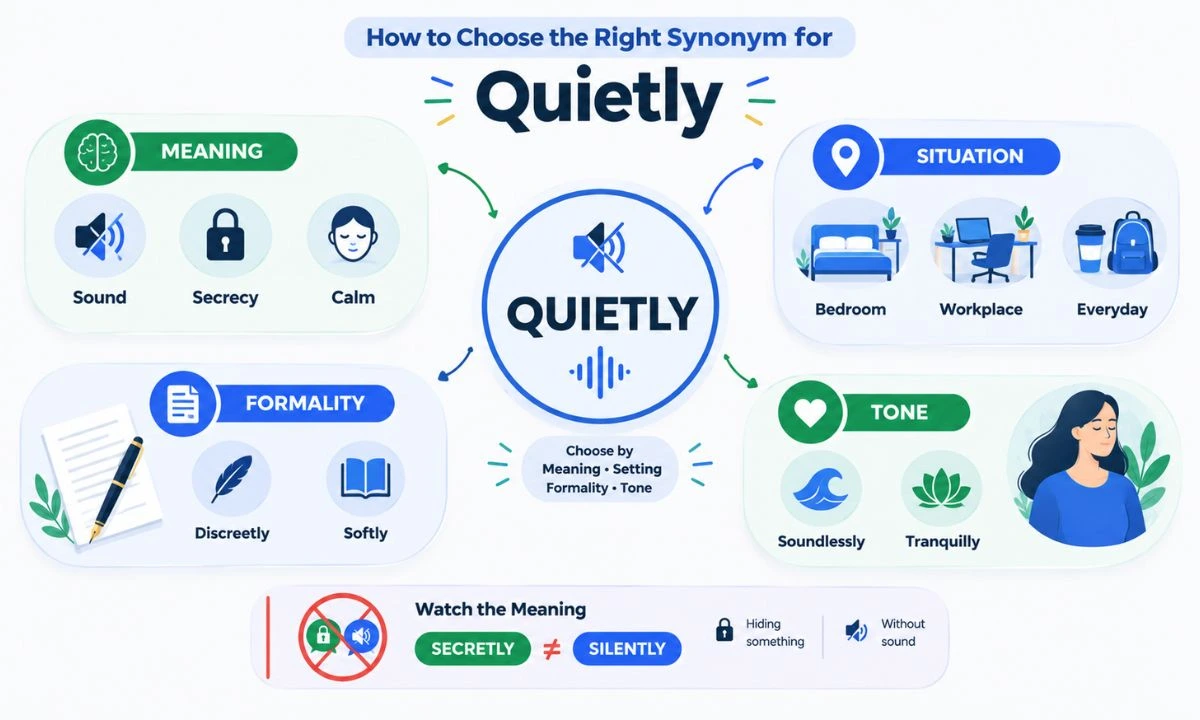
Choose Based on the Meaning
Ask what’s really happening, is it about sound, secrecy, or calm behavior? That answer narrows your choice fast.
Choose Based on the Situation
A bedroom scene needs different words than a business email. Match the synonym to the setting.
Choose Based on Formality
Formal writing wants words like “discreetly” or “unobtrusively.” Casual writing can use “softly” or “on tiptoe.”
Choose Based on Tone
Literary writing benefits from richer words like “soundlessly” or “tranquilly” for mood and rhythm.
Avoiding the Wrong Synonym
Don’t use “secretly” when you mean “silently” . One implies hiding, the other just means no sound.
Quietly Synonyms in Example Sentences
Seeing these words in real sentences makes them easier to remember and use correctly.
Everyday Examples
- She quietly made coffee before anyone woke up.
- He tiptoed quietly past his sleeping roommate.
Workplace Examples
- The manager discreetly handled the complaint.
- She quietly finished the report ahead of the deadline.
Academic Examples
- Students worked quietly during the exam.
- He silently reviewed his notes before class.
Conversation Examples
- “Keep it down,” she whispered softly.
- He murmured something under his breath.
Creative Writing Examples
She moved soundlessly through the old house.
The forest sat tranquilly under the moonlight.
Common Mistakes When Using Quietly Synonyms
Small word-choice errors can change your entire meaning. Watch for these.
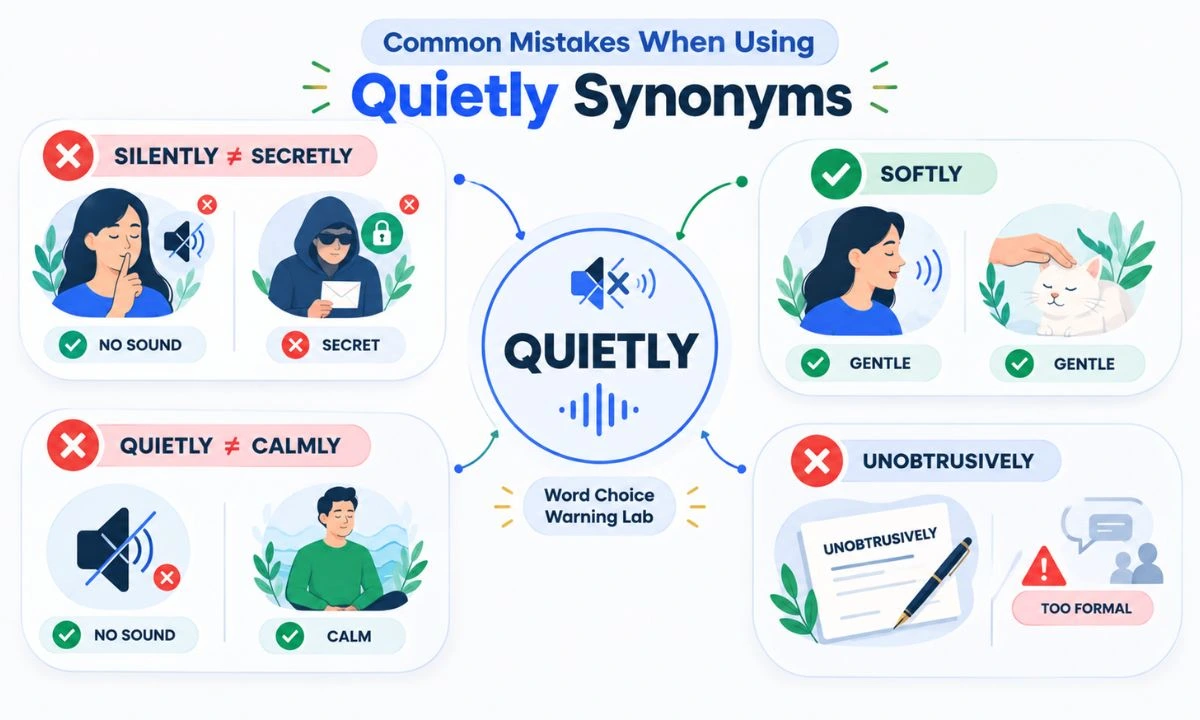
Using “Silently” When “Secretly” Is Intended
Silently means no sound. If you mean hidden intentions, use “secretly” instead.
Using “Softly” for Actions That Are Not About Sound
Softly relates to volume or touch, not to avoiding attention or secrecy.
Confusing “Quietly” With “Calmly”
Quietly is about noise. Calmly is about emotional composure. They aren’t interchangeable.
Choosing a Synonym That Sounds Too Formal
Don’t use “unobtrusively” in casual conversation; it reads stiff and unnatural.
Explore More Synonyms Guide
25+ Struggle Synonyms: Better Ways to Say Struggle (With Examples)
25+ Policy Synonyms: Useful Alternatives, Meanings & Examples
Kindness Synonyms: 25+ Words, Meanings, Examples & How to Use Them
25+ Share Synonyms: Meanings, Examples & When to Use Each
Frequently Asked Questions
What is the best synonym for quietly?
There’s no single best word “softly,” “silently,” and “discreetly” each fit different situations.
What is another word for quietly?
“Softly” and “silently” are the two most common alternatives to quietly.
What is a formal word for quietly?
“Discreetly” or “unobtrusively” work well in formal or professional writing.
What is a better word than quietly?
“Depends on context “stealthily” for movement, “discreetly” for tact, or “softly” for sound.
What is a synonym for quietly speaking?
“Success” or “good fortune” both work well in casual conversation.
What is a synonym for quietly doing something?
“Discreetly” or “unobtrusively” fit best for quiet, low-key actions.
What is another word for quietly and secretly?
“Covertly” or “surreptitiously” combine both quiet and secretive meanings.
What is a synonym for quietly without making noise?
“Silently” or “soundlessly” both mean without any noise at all.
Conclusion: Choose the Right Word Instead of Quietly
“Quietly” works fine in everyday writing, but it can’t capture every mood or moment on its own. The right synonym adds precision, emotion, and personality to your sentence.
Use “silently” for total lack of sound, “secretly” for hidden actions, and “discreetly” for formal, tactful situations. Match the word to the scene, and your writing instantly feels sharper.
Next time you type “quietly,” pause for a second. Pick from this list, and watch your sentence come alive.
