

Struggling to describe a tangled problem without repeating the word “complexity” for the fifth time in one paragraph? You’re not alone, and it’s an easy fix once you know the right words.
This guide breaks down over 65 synonyms for complexity, sorted by tone, context, and real-world use. Whether you’re writing an academic paper, a business report, or a casual email, you’ll find the exact word that fits.
We’ll also cover the subtle differences between similar terms, like complexity vs. complication, so you never pick the wrong word again. Every entry comes with a plain-English meaning and a usage example.
By the end, you’ll have a ready reference for another word for complexity in any situation, plus quick answers to the most common questions people ask about this topic.
Quick Answer: The Best Complexity Synonym for Every Context
If you only have ten seconds, here’s the shortcut. Use intricacy for detailed systems, complication for problems, difficulty for everyday hardships, and sophistication for advanced designs.
| Context | Best Synonym |
| Academic writing | Intricacy |
| Business reports | Complication |
| Casual conversation | Difficulty |
| Technology and systems | Sophistication |
| Confusing situations | Convolution |
What Does “Complexity” Really Mean?
Complexity Definition and Meaning
Complexity refers to the state of having many interconnected, interdependent parts that make something hard to understand, explain, or solve. It’s a noun form of “complex.”
Simple Meaning of Complexity
In plain terms, complexity just means “a lot going on at once.” If a topic, system, or problem has multiple layers that all affect each other, it has complexity.
Image prompt: A minimalist flat illustration of a tangled thread untangling into a straight line, symbolizing simplifying complexity, in soft blue and white tones.
Complexity Synonyms at a Glance: Quick Comparison Table
| Synonym | Best Used For | Tone |
| Complication | Difficult problems | Neutral |
| Difficulty | Something hard to do or understand | Neutral |
| Intricacy | Many detailed parts | Formal |
| Complicatedness | A complicated state | Neutral |
| Sophistication | Advanced or refined systems | Formal |
| Convolution | Excessive complexity | Formal |
| Elaborateness | Detailed structure or design | Formal |
Deep Dive: Top 8 Core Complexity Synonyms
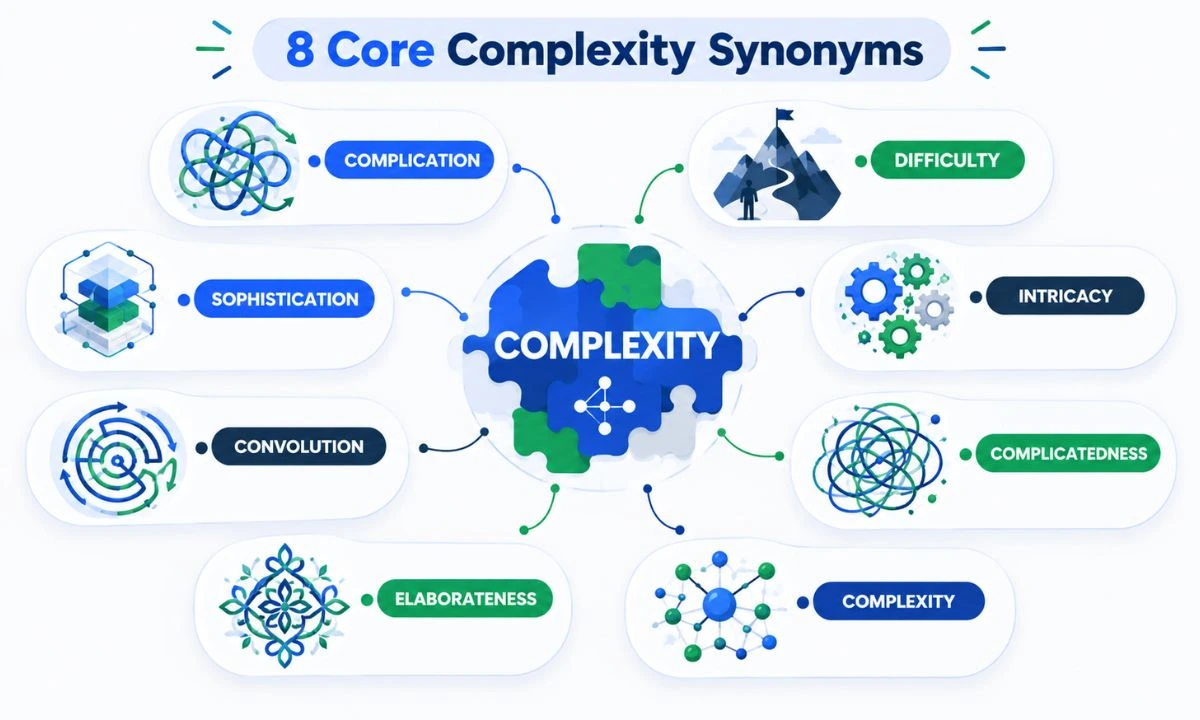
Complication
Meaning
An added difficulty that makes a situation harder to manage.
Example
“The merger created a legal complication nobody anticipated.”
Difficulty
Meaning
The quality of being hard to do, solve, or understand.
Example
“She explained the difficulty of coordinating three time zones.”
Intricacy
Meaning
The state of having many finely detailed, interconnected parts.
Example
“The watchmaker admired the intricacy of the tiny gears.”
Complicatedness
Meaning
A less common but valid noun form describing a tangled, hard-to-follow state.
Example
“The complicatedness of the contract worried the new hire.”
Sophistication
Meaning
An advanced, refined level of design or thinking, often used positively.
Example
“The app’s sophistication impressed even veteran developers.”
Convolution
Meaning
An excessive, twisting complexity that makes something hard to follow.
Example
“The convolution of the plot lost half the audience by act two.”
Elaborateness
Meaning
A high level of detail or decoration in design or planning.
Example
“Guests marveled at the elaborateness of the wedding décor.”
Complexity
Meaning
The base word itself, describing many interdependent parts that resist easy explanation.
Example
“The complexity of the immune system still puzzles researchers.”
65+ Complexity Synonyms Categorized by Context
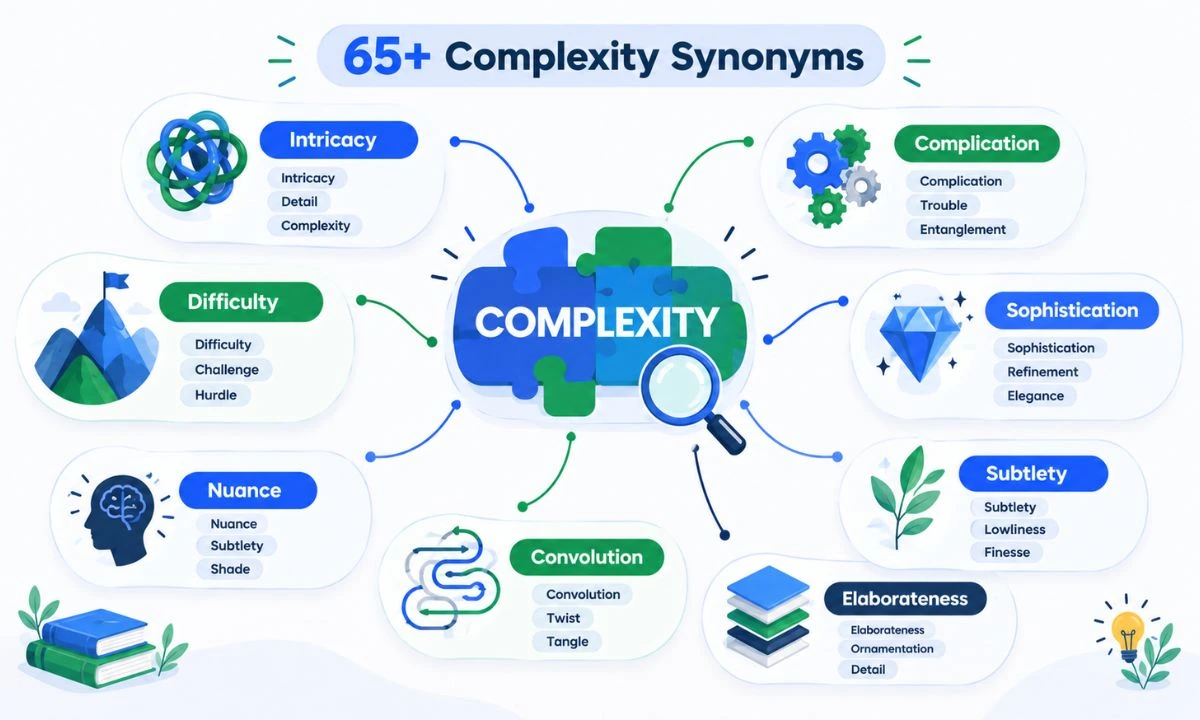
A. General Synonyms for Complexity
1. Complication
Meaning
An added difficulty that makes a situation harder to handle.
Examples
- “The delayed shipment was one more complication in an already tight schedule.”
- “Her illness added a complication to the travel plans.”
Usage Tip
Use it when something specific gets in the way of an otherwise clear plan, not for general structure.
2. Difficulty
Meaning
The quality of being hard to do, solve, or understand.
Examples
- “He underestimated the difficulty of learning a new language as an adult.”
- “The difficulty of the exam surprised most students.”
Usage Tip
Pick this word when you’re describing effort or struggle rather than the number of parts involved.
3. Complicatedness
Meaning
The state of being confusing or hard to follow.
Examples
- “The complicatedness of the insurance policy frustrated new customers.”
- “Nobody warned her about the complicatedness of the visa process.”
Usage Tip
It’s a formal, slightly rare word. Save it for writing where “complication” feels too casual.
4. Complexness
Meaning
An older, less common noun form of complexity, meaning the state of having many parts.
Examples
- “The complexness of the machine required a trained technician.”
- “Few people grasp the complexness of global trade agreements.”
Usage Tip
Most style guides now favor “complexity” instead. Use complexness only in older or literary text.
5. Involvement
Meaning
The degree to which something is tangled up with other factors.
Examples
- “The case’s involvement with three different agencies slowed everything down.”
- “The project’s involvement across departments made scheduling hard.”
Usage Tip
Best for describing how many parties or systems are connected, not the difficulty itself.
6. Confusion
Meaning
A state of unclear understanding caused by too much happening at once.
Examples
- “The new software update caused confusion among the entire team.”
- “There was confusion over who owned the final decision.”
Usage Tip
Use it for the human reaction to complexity, not the structure that caused it.
7. Challenge
Meaning
A demanding situation or task that requires effort to overcome.
Examples
- “Balancing three projects at once became a real challenge.”
- “The biggest challenge was integrating old data with the new system.”
Usage Tip
This word sounds motivating rather than negative. Good for business and leadership writing.
8. Multiplicity
Meaning
The existence of many different elements or variations within one thing.
Examples
- “The multiplicity of opinions in the meeting made consensus difficult.”
- “A multiplicity of factors contributed to the market shift.”
Usage Tip
Use it when you want to emphasize quantity and variety, not just difficulty.
9. Elaboration
Meaning
The act of adding detail that increases depth or thoroughness.
Examples
- “The report needed further elaboration before submission.”
- “Her elaboration on the theory helped the class understand it fully.”
Usage Tip
It leans positive. Use it when detail improves clarity rather than causing confusion.
10. Compoundedness
Meaning
The state of being made from several combined parts.
Examples
- “The compoundedness of the chemical made it hard to isolate.”
- “Analysts studied the compoundedness of the financial instrument.”
Usage Tip
A niche, technical-sounding word. Best reserved for scientific or highly formal writing.
B. Complexity Synonyms for Difficult Problems
11. Obstacle
Meaning
A specific barrier that blocks progress toward a goal.
Examples
- “Funding was the biggest obstacle to launching the product.”
- “They removed every obstacle standing between the team and the deadline.”
Usage Tip
Use it for a single, identifiable blocker rather than an overall tangled situation.
12. Hardship
Meaning
Ongoing difficulty or suffering caused by a tough situation.
Examples
- “The family faced financial hardship after the factory closed.”
- “Years of hardship shaped her determination to succeed.”
Usage Tip
This word carries emotional weight. Use it for real struggle, not abstract system design.
13. Problem
Meaning
A matter or situation that needs to be resolved.
Examples
- “The main problem was a shortage of skilled workers.”
- “They identified the root problem before proposing a fix.”
Usage Tip
It’s the simplest, most direct choice. Great for plain, everyday writing.
14. Trouble
Meaning
A difficulty or source of worry in a situation.
Examples
- “The old engine gave them constant trouble on long drives.”
- “She ran into trouble halfway through the presentation.”
Usage Tip
Keep this one casual. It sounds natural in speech but too informal for academic writing.
15. Predicament
Meaning
A difficult, often unpleasant situation with no easy way out.
Examples
- “Missing the last train left him in an awkward predicament.”
- “The company faced a financial predicament after the lawsuit.”
Usage Tip
Use it for a specific bind someone is stuck in, not a general description of complexity.
16. Dilemma
Meaning
A situation requiring a choice between two difficult options.
Examples
- “She faced a dilemma: keep the job or move closer to family.”
- “The ethical dilemma divided the entire board.”
Usage Tip
Reserve this for genuine either-or decisions, not just general difficulty.
17. Quandary
Meaning
A state of uncertainty over what to do next.
Examples
- “He was in a quandary about which offer to accept.”
- “The team’s quandary over budgeting delayed the launch.”
Usage Tip
It sounds slightly more literary than “dilemma.” Good for narrative or reflective writing.
18. Snag
Meaning
A small, unexpected problem that interrupts progress.
Examples
- “They hit a snag when the permit got denied.”
- “A last-minute snag pushed the release back a week.”
Usage Tip
Use it for minor, fixable issues, not deep structural complexity.
19. Setback
Meaning
An event that delays or reverses progress.
Examples
- “The recall was a major setback for the company’s reputation.”
- “Despite the setback, the team hit their goal a month later.”
Usage Tip
Best for describing something that happened, not an ongoing state of complication.
20. Impediment
Meaning
Something that slows down or obstructs progress.
Examples
- “Language was the biggest impediment to closing the deal.”
- “Bureaucracy proved to be a lasting impediment to reform.”
Usage Tip
It sounds formal. Well-suited to legal, policy, or academic writing.
C. Complexity Synonyms for Detailed Systems
21. Intricacy
Meaning
The state of having many finely connected parts.
Examples
- “The intricacy of the embroidery took months to finish.”
- “Engineers admired the intricacy of the bridge’s support system.”
Usage Tip
Use it whenever detail deserves admiration, not criticism. It rarely sounds negative.
22. Sophistication
Meaning
An advanced, refined level of design, thought, or method.
Examples
- “The sophistication of the algorithm surprised the review panel.”
- “Her argument showed real sophistication for a first-year student.”
Usage Tip
This is one of the few positive synonyms for complexity. Use it as a compliment.
23. Elaborateness
Meaning
A high level of detail, decoration, or planning.
Examples
- “Guests were stunned by the elaborateness of the set design.”
- “The elaborateness of the ceremony reflected its cultural importance.”
Usage Tip
Great for describing visible detail, such as design, events, or craftsmanship.
24. Detail
Meaning
A small, specific part of a larger whole.
Examples
- “Every detail of the itinerary was planned in advance.”
- “She noticed a small detail everyone else had missed.”
Usage Tip
Use it to point to one specific piece of complexity, not the whole picture.
25. Fineness
Meaning
A high degree of precision or delicacy in construction.
Examples
- “The fineness of the fabric made it perfect for formal wear.”
- “Watchmakers are known for the fineness of their craftsmanship.”
Usage Tip
Best suited for physical craftsmanship rather than abstract ideas or systems.
26. Subtlety
Meaning
A nuance or fine distinction that’s easy to overlook.
Examples
- “The subtlety of her humor took a few readings to notice.”
- “There’s a subtlety in the contract that changes its meaning.”
Usage Tip
Use it for meaning that’s hidden in detail, not for visible structural complexity.
27. Nuance
Meaning
A slight but meaningful difference in meaning or expression.
Examples
- “Translators must capture every nuance of the original text.”
- “The policy has a nuance most people never read closely.”
Usage Tip
Ideal for writing, language, and tone. Less useful for physical systems.
28. Refinement
Meaning
The process or result of making something more precise or advanced.
Examples
- “Years of refinement turned the prototype into a reliable product.”
- “The recipe went through several rounds of refinement.”
Usage Tip
Use it when complexity comes from improvement over time, not from confusion.
29. Craftsmanship
Meaning
Skill and detail applied to making something well.
Examples
- “The furniture’s craftsmanship reflected decades of experience.”
- “Buyers paid extra for the craftsmanship of hand-built guitars.”
Usage Tip
Use it specifically for skilled, detailed work, not for abstract or negative complexity.
30. Meticulousness
Meaning
Extreme care and attention to detail.
Examples
- “Her meticulousness caught errors the whole team had missed.”
- “The audit demanded a level of meticulousness few could sustain.”
Usage Tip
Use this for the behavior behind detailed work, not the detail itself.
D. Complexity Synonyms for Confusing Situations
31. Convolution
Meaning
An excessive, twisting complexity that’s hard to follow.
Examples
- “The convolution of the plot lost half the audience.”
- “Legal convolution made the contract nearly unreadable.”
Usage Tip
Use it when complexity has become a genuine flaw, not just detail.
32. Entanglement
Meaning
A state of being caught up or mixed together in a confusing way.
Examples
- “The company’s entanglement in the lawsuit dragged on for years.”
- “Emotional entanglement made the breakup harder than expected.”
Usage Tip
Strong for describing relationships, legal issues, or emotionally tangled situations.
33. Disorder
Meaning
A lack of order or organized structure.
Examples
- “The files were in complete disorder after the move.”
- “Political disorder slowed the reform process for months.”
Usage Tip
Use it for messiness or chaos, not for detailed-but-organized systems.
34. Ambiguity
Meaning
The quality of having more than one possible meaning.
Examples
- “The ambiguity in the instructions led to two different results.”
- “Lawyers flagged the ambiguity in the clause immediately.”
Usage Tip
Reserve it for unclear meaning, not for physical or structural complexity.
35. Uncertainty
Meaning
A state of not knowing what’s true or what will happen next.
Examples
- “Market uncertainty made investors cautious all quarter.”
- “The uncertainty of the diagnosis worried the whole family.”
Usage Tip
Use it when the difficulty comes from not knowing, not from too many parts.
36. Muddle
Meaning
A confused or disorganized state of things.
Examples
- “The schedule turned into a muddle after three last-minute changes.”
- “He tried to explain, but only added to the muddle.”
Usage Tip
It’s casual and a little informal. It fits conversational writing well.
37. Tangle
Meaning
A confused, twisted mass of things or issues.
Examples
- “The wires behind the desk were a total tangle.”
- “Negotiations turned into a tangle of competing demands.”
Usage Tip
Good for both literal messes and figurative, complicated disputes.
38. Chaos
Meaning
Complete disorder and confusion.
Examples
- “The office descended into chaos during the server outage.”
- “Chaos broke out when the flight was suddenly canceled.”
Usage Tip
Use it for extreme, dramatic disorder. It’s too strong for mild complexity.
39. Jumble
Meaning
A confused, untidy mix of things.
Examples
- “Her notes were a jumble of ideas with no clear order.”
- “The garage was a jumble of tools and old furniture.”
Usage Tip
Best for physical or written disorganization, less suited to abstract concepts.
40. Bewilderment
Meaning
A feeling of confusion caused by something complicated.
Examples
- “New employees often feel bewilderment during their first week.”
- “She stared at the form in complete bewilderment.”
Usage Tip
Use it to describe how a person feels, not the complexity itself.
E. Complexity Synonyms for Academic and Formal Writing
41. Multifacetedness
Meaning
The quality of having many different sides or dimensions.
Examples
- “The study highlighted the multifacetedness of urban poverty.”
- “Her thesis explores the multifacetedness of cultural identity.”
Usage Tip
Keep it strictly formal. It reads as clunky in everyday conversation.
42. Interdependence
Meaning
A state where parts rely on one another to function.
Examples
- “The interdependence of global supply chains became clear during the crisis.”
- “Ecologists study the interdependence of species within an ecosystem.”
Usage Tip
Perfect for systems, economics, and science writing where parts affect each other.
43. Heterogeneity
Meaning
The state of being made up of diverse, dissimilar elements.
Examples
- “The heterogeneity of the sample group affected the results.”
- “Researchers noted the heterogeneity of opinions across regions.”
Usage Tip
It’s a research-paper word. Avoid it outside academic or scientific contexts.
44. Abstruseness
Meaning
The quality of being difficult to understand due to depth or obscurity.
Examples
- “Critics complained about the abstruseness of his later essays.”
- “The lecture’s abstruseness left most first-year students confused.”
Usage Tip
Use sparingly. It can sound pretentious outside serious academic writing.
45. Convolutedness
Meaning
The state of being excessively complicated or twisted in structure.
Examples
- “The convolutedness of the tax code frustrates even accountants.”
- “Editors flagged the convolutedness of the second chapter.”
Usage Tip
Use it to critique overly complex writing or systems, not to praise detail.
46. Ramification
Meaning
A complex consequence or effect that branches out from a decision.
Examples
- “The policy’s ramifications reached far beyond the original department.”
- “Nobody anticipated the ramifications of the merger.”
Usage Tip
Use it in plural form most of the time. “Ramifications” is far more common.
47. Multidimensionality
Meaning
The quality of having several layers or dimensions of meaning.
Examples
- “The novel’s multidimensionality rewards more than one reading.”
- “Analysts praised the multidimensionality of the data model.”
Usage Tip
It fits literary criticism and data science equally well.
48. Nonlinearity
Meaning
A structure or process that doesn’t follow a simple, straight path.
Examples
- “The nonlinearity of the storyline confused some viewers.”
- “Scientists modeled the system’s nonlinearity using new software.”
Usage Tip
Use it for systems or narratives that don’t move in a predictable, straight order.
49. Intricateness
Meaning
A formal variant of intricacy, describing detailed complexity.
Examples
- “The intricateness of the mural amazed every visitor.”
- “Reviewers noted the intricateness of the legal argument.”
Usage Tip
“Intricacy” is more common. Use intricateness only for variety in longer pieces.
50. Labyrinthine Structure
Meaning
A structure so complicated it resembles a maze.
Examples
- “The labyrinthine structure of the old building confused every new tenant.”
- “Her novel has a labyrinthine structure that rewards careful reading.”
Usage Tip
Use this phrase, not just “labyrinthine” alone, for smoother, more natural sentences.
F. Complexity Synonyms for Business and Professional Writing
51. Bureaucracy
Meaning
A complex system of rules and procedures within an organization.
Examples
- “Bureaucracy slowed the approval process by several months.”
- “Employees complained about the company’s growing bureaucracy.”
Usage Tip
Use it specifically for administrative or procedural complexity, not general detail.
52. Administrative Burden
Meaning
The extra time and effort required to manage rules and paperwork.
Examples
- “Small businesses face a heavy administrative burden during tax season.”
- “The new policy added an administrative burden nobody expected.”
Usage Tip
This phrase works well in business and policy writing but rarely in casual speech.
53. Overlap
Meaning
A situation where responsibilities or systems duplicate one another.
Examples
- “There was too much overlap between the two departments’ roles.”
- “The audit revealed overlap in three separate budgets.”
Usage Tip
Use it when complexity comes from duplication, not from difficulty itself.
54. Redundancy
Meaning
Unnecessary repetition within a system or process.
Examples
- “The report identified redundancy across five different teams.”
- “Cutting redundancy simplified the entire workflow.”
Usage Tip
Best for operational or technical writing, especially when describing inefficiency.
55. Interlinkage
Meaning
The state of being connected across multiple systems or parts.
Examples
- “The interlinkage of departments made a single change ripple everywhere.”
- “Analysts mapped the interlinkage between markets before the crash.”
Usage Tip
Use it when you want to stress connection between systems, not confusion.
56. Procedural Complexity
Meaning
Difficulty caused by too many steps or rules in a process.
Examples
- “Procedural complexity delayed the permit by six weeks.”
- “The team simplified the form to reduce procedural complexity.”
Usage Tip
Use this exact phrase in reports and audits. It reads clearly and precisely.
57. Cross-Functionality
Meaning
Complexity that arises from multiple teams or functions working together.
Examples
- “The project’s cross-functionality required weekly coordination meetings.”
- “Cross-functionality slowed decisions but improved the final result.”
Usage Tip
Use it in project management and team-structure writing specifically.
58. Layered Process
Meaning
A process made complex by having multiple stages or approval levels.
Examples
- “The layered process for approval frustrated the marketing team.”
- “They simplified the layered process into three clear steps.”
Usage Tip
Use this phrase when describing workflows, not abstract ideas.
G. Complexity Synonyms for Technology and Systems
59. System Complexity
Meaning
The overall difficulty of a technical system caused by its many components.
Examples
- “System complexity increased after three new services were added.”
- “Engineers reduced system complexity by removing outdated code.”
Usage Tip
Use this exact two-word phrase in technical documentation for clarity.
60. Layering
Meaning
The stacking of multiple levels or components within a system.
Examples
- “The app’s layering made debugging one small feature difficult.”
- “Too much layering slowed down the entire platform.”
Usage Tip
Common in software and design writing. Pairs well with “architecture.”
61. Architecture
Meaning
The overall structural design of a system.
Examples
- “The database architecture couldn’t handle the new traffic load.”
- “They redesigned the architecture to simplify future updates.”
Usage Tip
Use it to describe structure specifically, not general confusion or difficulty.
62. Interoperability
Meaning
The complexity involved in making different systems work together.
Examples
- “Interoperability between the two platforms took months to achieve.”
- “Poor interoperability caused constant syncing errors.”
Usage Tip
Use it specifically for software, hardware, or cross-platform system writing.
63. Technical Debt
Meaning
Complexity created by quick fixes that need to be corrected later.
Examples
- “Technical debt slowed every new feature the team tried to build.”
- “They paused development to pay down technical debt.”
Usage Tip
Use this term only in software or engineering contexts. It won’t translate elsewhere.
64. Computational Complexity
Meaning
The amount of resources or steps needed to solve a problem computationally.
Examples
- “The algorithm’s computational complexity made it too slow for real-time use.”
- “Researchers reduced computational complexity by simplifying the model.”
Usage Tip
Reserve this for computer science, math, or highly technical writing.
65. Scalability Challenge
Meaning
Complexity that appears when a system grows and struggles to keep up.
Examples
- “The scalability challenge became obvious once user numbers tripled.”
- “They redesigned the backend to solve the scalability challenge.”
Usage Tip
Use it when complexity is tied specifically to growth, not to the system’s original design.
Complexity vs. Similar Words: Key Distinctions
Complexity vs. Complication
When to use complexity:
Describing a structure or system with many parts.
When to use complication:
Describing a specific problem that arises.
Example: “The complexity of the code led to an unexpected complication during testing.”
Complexity vs. Difficulty
Key difference: Complexity describes structure; difficulty describes effort required.
Example: “The complexity of the tax code adds to the difficulty of filing alone.”
Complexity vs. Intricacy
Key difference: Intricacy is almost always neutral or positive; complexity can lean negative.
Example: “The intricacy of the lace design showed the tailor’s skill, not complexity for its own sake.”
Complexity vs. Confusion
Key difference: Complexity is about structure; confusion is about understanding (or the lack of it).
Example: “The plan’s complexity caused confusion among new team members.”
Complexity vs. Sophistication
Key difference: Sophistication is a positive synonym for complexity, implying skillful design rather than a burden.
Example: “Critics praised the sophistication of the algorithm, not its complexity.”
How to Choose the Right Synonym for Complexity
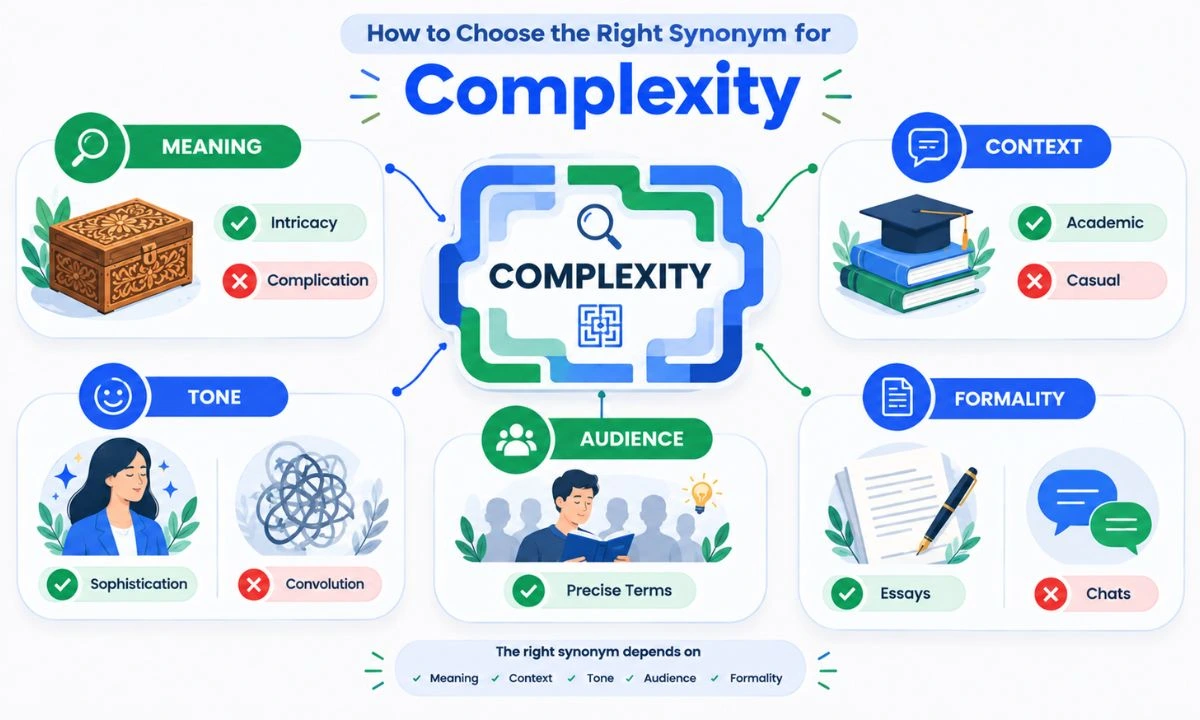
Choose based on meaning: Pick intricacy for detail, complication for problems.
Choose based on context: Academic writing needs formal words; texts need casual ones.
Choose based on tone: Sophistication sounds positive; convolution sounds negative.
Choose based on your audience: Technical readers expect precise terms like interdependence.
Choose based on formality: Save “complicatedness” and “multifacetedness” for essays, not chats.
Complexity Synonyms in Sentences
Everyday: “This form is way more complicated than it needs to be.”
Academic: “The intricacy of the argument required careful, layered analysis.”
Business: “Cross-department involvement added complication to the rollout timeline.”
Technical: “The system’s interdependence made a single failure cascade quickly.”
Creative writing: “Her mind was a convolution of memory and fear she couldn’t untangle.”
Common Mistakes When Using Complexity Synonyms
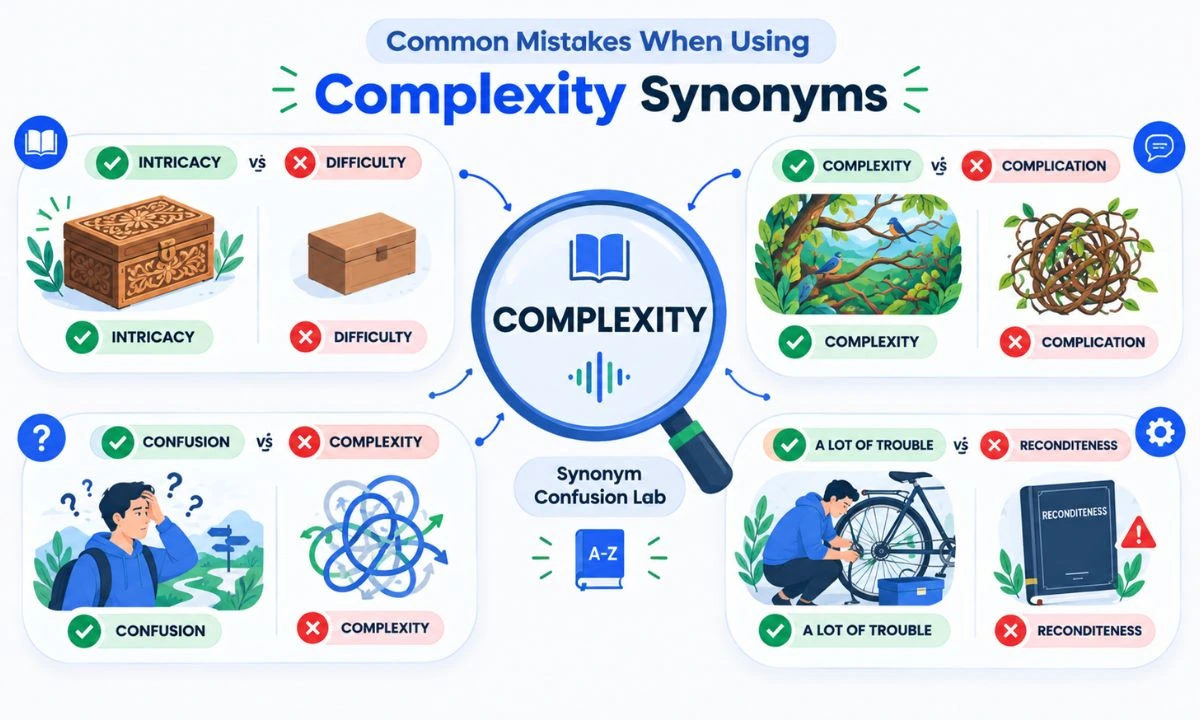
- Using Difficulty When You Mean Intricacy
❌ Wrong: “Look at the difficulty of this hand-carved wooden box.”
✅ Right: “Look at the intricacy of this hand-carved wooden box.”
- Using Complication for Neutral Descriptions
❌ Wrong: “The complication of nature is wonderful.”
✅ Right: “The complexity of nature is wonderful.”
- Confusing Complexity With Confusion
❌ Wrong: “The complexity in his eyes showed he lost his way.”
✅ Right: “The confusion in his eyes showed he lost his way.”
- Using Formal Words in Casual Writing
❌ Awkward: “I had a real reconditeness trying to fix my bicycle chain.”
✅ Natural: “I had a lot of trouble fixing my bicycle chain.”
Explore More Synonyms Guide
25+ Struggle Synonyms: Better Ways to Say Struggle (With Examples)
25+ Policy Synonyms: Useful Alternatives, Meanings & Examples
Kindness Synonyms: 25+ Words, Meanings, Examples & How to Use Them
25+ Share Synonyms: Meanings, Examples & When to Use Each
Frequently Asked Questions
What is another word for complexity?
Intricacy, complication, and difficulty are common, well-fitting alternatives depending on context.
What is a synonym for complex?
Complicated, intricate, involved, and convoluted are the most widely used synonyms for “complex.”
What is a simple word for complexity?
“Discreetly” or “unobtrusively” work well in formal or professional writing.
What is a good synonym for complexity in writing?
Intricacy works well for most formal or descriptive writing.
What is the opposite of complexity?
Simplicity is the direct opposite of complexity.
What is the difference between complexity and complication?
Complexity describes structure with many parts; complication describes a specific added problem.
What is the difference between complexity and difficulty?
Complexity refers to structure, while difficulty refers to the effort needed to handle it.
What is the difference between complexity and intricacy?
Intricacy usually carries a more neutral or positive tone than complexity.
What are formal synonyms for complexity?
Intricacy, sophistication, multifacetedness, and interdependence suit formal or academic writing.
What are positive synonyms for complexity?
Sophistication and elaborateness are the most positive-sounding alternatives.
Conclusion: Choose the Right Complexity Synonym
Picking the right word isn’t about sounding smart Example it’s about being clear. A well-chosen synonym tells your reader exactly what kind of complexity you mean, structural, emotional, or technical.
Keep this guide handy any time you catch yourself repeating “complex” or “complexity” too often in a piece of writing. A quick swap to intricacy, complication, or sophistication instantly sharpens your tone.
Remember that context decides the word, not personal preference. Academic papers, business reports, and casual chats each call for a different shade of meaning, and now you know which one fits where.
Use this list as a working reference, not a memory test. Bookmark it, and the next time you need other ways to say complexity, the right word will already be one scroll away.
