

Bellow vs below confuses many readers because the two words look almost the same. Only one letter is different. That one letter changes the whole meaning.
Here is the quick difference in bellow vs below. Bellow means to shout or roar loudly. Below means lower than something else.
This guide makes bellow vs below easy to understand. You will learn the meanings, simple examples, and a memory trick. You will also avoid common spelling mistakes in your writing.
Quick Answer: Bellow vs Below
| Word | Meaning | Correct Usage |
| Bellow | To shout in a deep, loud voice; a loud roar (noun) | The coach bellowed instructions from the sideline. |
| Below | At a lower level, position, rank, or amount | The temperature dropped below zero. |
Bellow means to shout or roar loudly, and it can also name the roar itself.
Below means lower than something else, in position, level, rank, or amount.
If you mean a position, use below with one L.
If you mean a loud shout or roar, use bellow with two Ls.
What Does Bellow Mean?
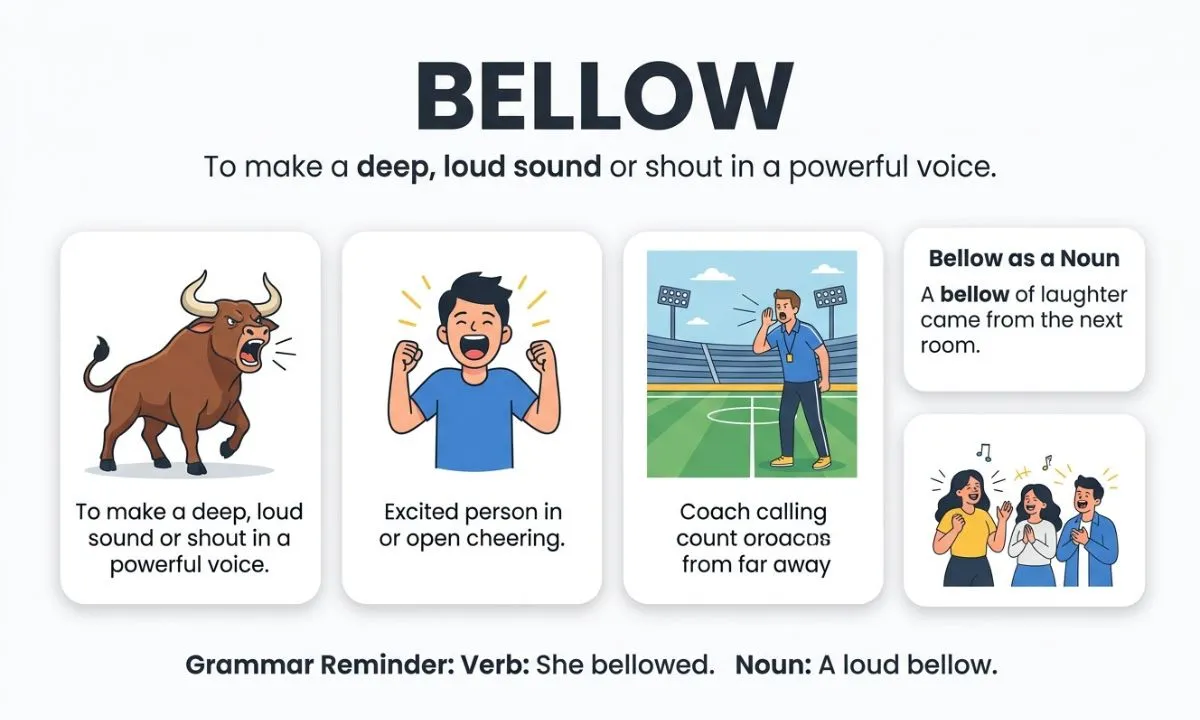
Bellow is mainly a verb. It means to make a deep, loud sound. It can also mean to shout in a powerful voice.
People bellow when they are:
- Angry
- Excited
- Trying to be heard from far away
As a noun, a bellow is the loud roar or shout itself.
Bellows is a separate noun. It is a tool that pumps air into a fire.
Examples of Bellow in Sentences
- The bull bellowed as the gate swung open.
- “Everybody out!” the fire marshal bellowed.
- A bellow of laughter came from the next room.
- She bellowed across the field to get her brother’s attention.
- The old man let out a bellow of rage when he saw the broken window.
What Does Below Mean?
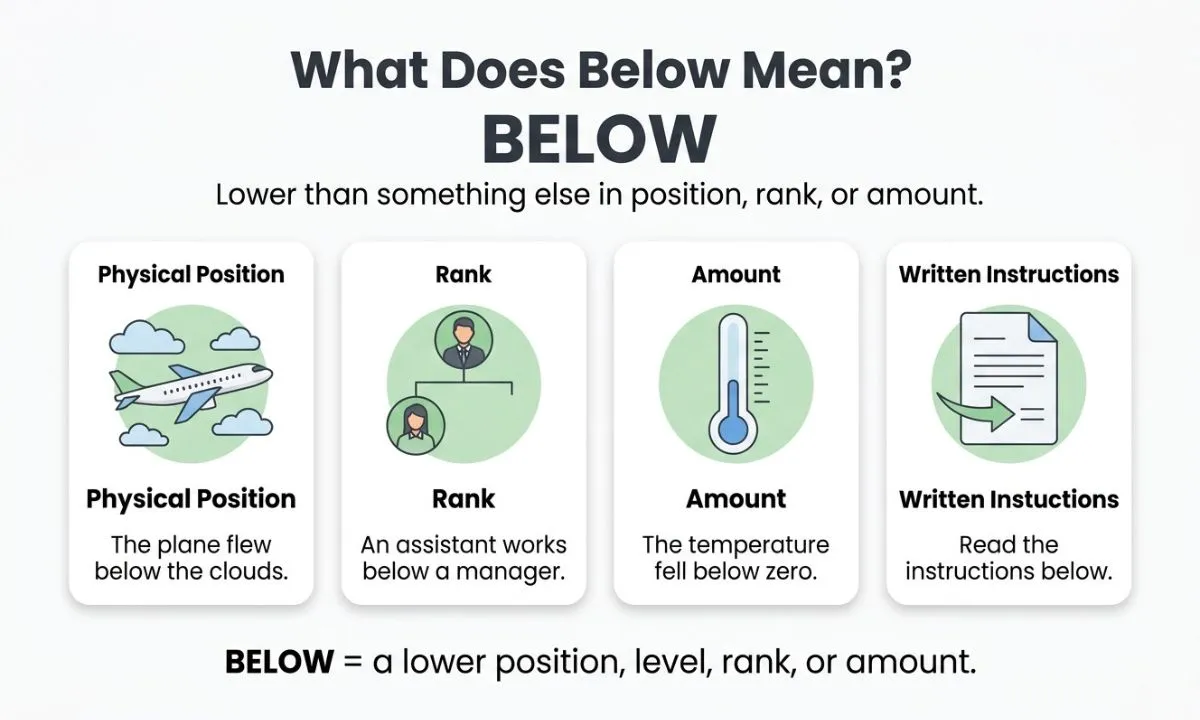
Below describes something that is lower than something else.
It can refer to:
- Physical position: below the bridge
- Rank: below a manager
- Amount: below average
Below is a small, everyday word. You will see it in:
- Schoolwork
- Reports
- Instructions
- Weather updates
Examples of Below in Sentences
The temperature fell to ten degrees below zero.
The sun slipped below the horizon.
My neighbor lives in the apartment below mine.
Scores below 50 will need to be retaken.
Please read the instructions below before you start.
Bellow vs Below: Key Differences
| Feature | Bellow | Below |
| Meaning | To shout or roar loudly; a loud roar | Lower than something else |
| Main part of speech | Verb (also a noun) | Preposition or adverb |
| Spelling | Double L: bel-low | Single L: be-low |
| Pronunciation | BEL-oh | bih-LOW |
| Typical context | Anger, animals, shouting, orders | Position, rank, amount, instructions |
| Example | The captain bellowed orders. | The boat sank below the surface. |
Bellow vs Below: Grammar and Parts of Speech
Bellow
Bellow works as a verb.
Verb forms: bellow, bellows, bellowed, bellowing
It can take an object or stand alone:
- With an object: She bellowed a warning.
- Without an object: The bull bellowed.
It also works as a noun:
- A bellow of anger
Below
Below has more than one job.
- Preposition (with an object): The key is below the mat.
- Adverb (without an object): The valley lies below.
- Adverb after a noun: the apartment below
- Adjective (in some dictionaries): the below list
Merriam-Webster includes the adjective use. Many editors still prefer “the list below” in formal writing. This is an editorial recommendation, not a hard rule.
How to Pronounce Bellow and Below
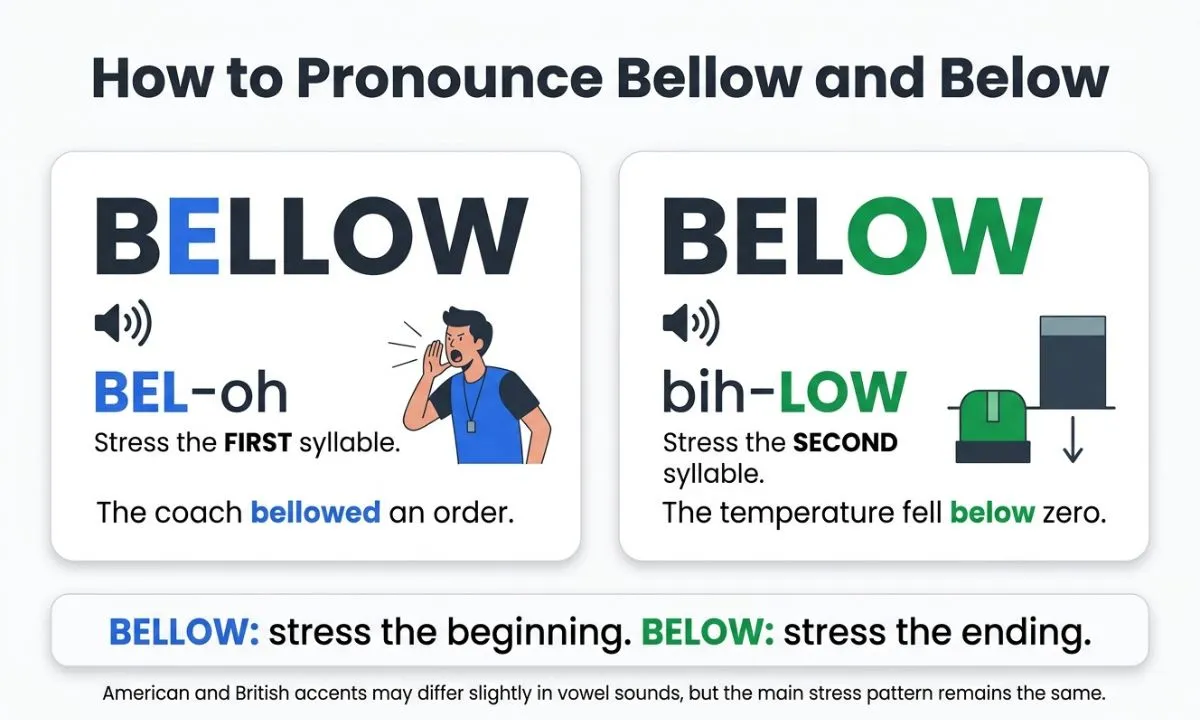
The two words are not pronounced the same. The stress falls on different syllables.
| Word | Pronunciation | Stress |
| Bellow | BEL-oh | First syllable |
| Below | bih-LOW | Second syllable |
American and British speakers say the final vowel slightly differently. The stress pattern stays the same. Check an audio dictionary for exact IPA in your preferred variety.
How to Remember the Spelling Difference
Use these memory aids:
Bellow has a double L, like a bull. It is a handy picture, but treat it as a memory trick, not a rule.
Bellow starts with “bell.” A bell makes a loud sound, and so does a bellow.
Bellow and yell both contain “ell.” They are close in meaning too.
Below ends in “low.” If something is below, it is low.
Common Mistakes: Bellow vs Below
Incorrect: The temperature fell below zero overnight.
Correct: The temperature fell below zero overnight.
Why: The sentence describes a lower level, not a shout. This is a spelling mistake.
Incorrect: The sergeant let out a loud below.
Correct: The sergeant let out a loud bellow.
Why: “A loud roar” needs the noun bellow. Below cannot be a noun here.
Incorrect: Please see the bellow table.
Correct: Please see the table below.
Why: Below indicates position. “The below table” is also less natural, so putting below after the noun is the safer choice.
Incorrect: The crowd below at the stadium.
Correct: The crowd bellowed at the stadium.
Why: A verb is needed. Below is not a verb.
Below vs Under: What’s the Difference?
Below and under both describe a lower position, and they often overlap. Here is the usual distinction:
| Word | Typical Meaning | Example |
| Below | At a lower level, not necessarily touching or covering | The plane flew below the clouds. |
| Under | Directly beneath, often covered by or in contact with something | The cat hid under the blanket. |
Use under when something covers or sits directly beneath another thing.
Use below for lower levels, ranks, scales, or amounts: “below average,” “below the surface,” “below a manager.”
Both can work in some cases (“under 18” and “below 18”), so choose the one that sounds more natural in context.
Bellow vs Below in Everyday Writing
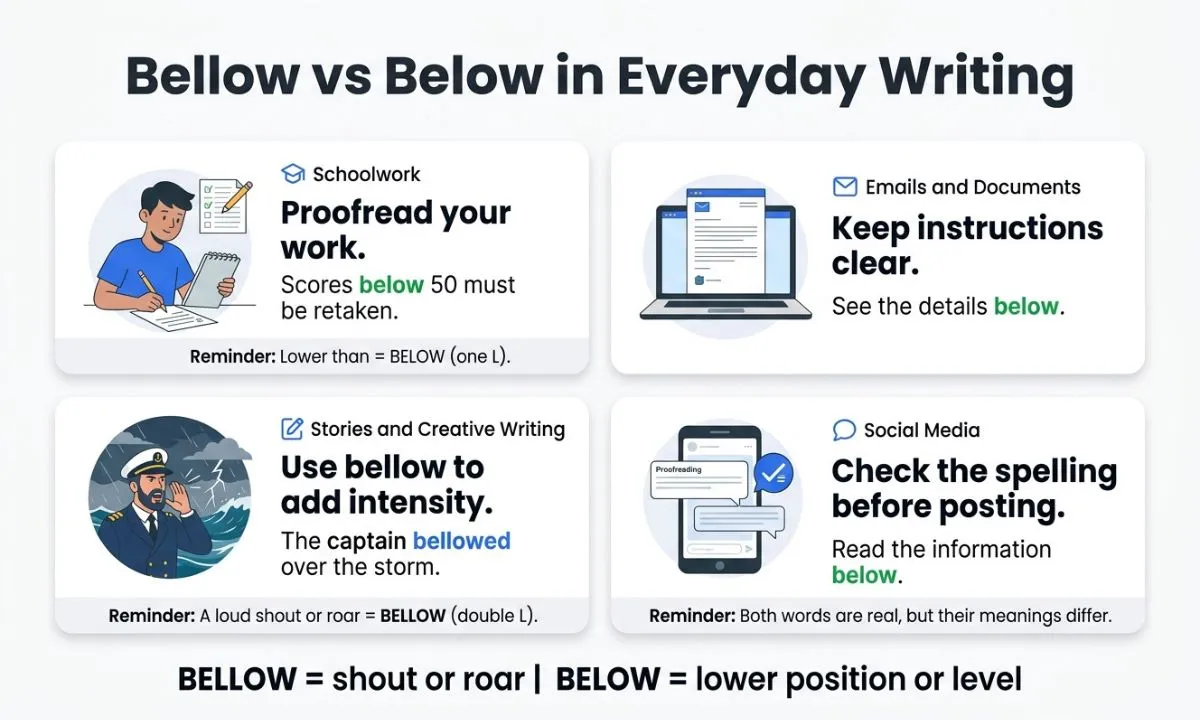
Schoolwork
Students often type bellow when they mean below. Proofread any “lower than” sentence for the extra L.
Emails and Documents
“See the details below” is clear and professional. Use it near the end of a message.
“‘See the details below’ is a polite closer. For other friendly sign-offs, try these other ways to say take care.”
Stories and Creative Writing
Bellow brings energy to a scene.
Example: The captain bellowed over the storm.
“Strong verbs like bellow make a scene vivid, and so do better words for golden when you describe light or color.”
Social Media
Autocorrect rarely catches this swap. Both spellings are real words.
“Short captions need precise words, so check these other ways to say good morning for quick post ideas.”
Below vs Under: What’s the Difference?
Below and under both describe a lower position, and they often overlap. Here is the usual distinction:
| Word | Typical Meaning | Example |
| Below | At a lower level, not necessarily touching or covering | The plane flew below the clouds. |
| Under | Directly beneath, often covered by or in contact with something | The cat hid under the blanket. |
Use under when something covers or sits directly beneath another thing. Use below for lower levels, ranks, scales, or amounts: “below average,” “below the surface,” “below a manager.” Both can work in some cases (“under 18” and “below 18”), so choose the one that sounds more natural in context.
Common Phrases and Synonyms
Phrases with Bellow
- Bellow like a bull
- Let out a bellow
- Bellow with rage
- Bellow orders
- Bellow out
Phrases with Below
- Below zero
- Below average
- Below the surface
- Below deck
- Down below
- See below
Synonyms for Bellow
- Roar
- Shout
- Holler
- Yell
- Thunder
- Boom
Synonyms for Below
- Beneath
- Under
- Underneath
- Lower than
“Want more ways to say it? Browse our synonym guides for fresh word choices.”
Explore More Grammar Guides
Stutter vs Studder: Correct Spelling and Meaning Guide in 2026
Anise vs Aniseed: Are They the Same? Find Out the Real Difference
Friend vs Freind: Common Mistake and Correct Usage Explained
Really vs Realy? A Quick Guide to Correct English Spelling (2026)
Volume vs Volumn: 1 Common Mistakes and Correct Usage Explained
Habit vs Habbit: Common Error, Meaning, and Usage Guide
Using vs Useing: Which Spelling Is Correct? Find Out Now
Divide vs Devide: Meaning, Examples, and Spelling Made Easy
Outing vs Outting: Common Mistakes and the Correct Usage Explained
American vs British English
There is no spelling difference. Both words are spelled bellow and below in American and British English.
The only difference is how the final vowel sounds in each accent.
| Word | American English | British English |
| Bellow | Same spelling | Same spelling |
| Below | Same spelling | Same spelling |
What Major Dictionaries Say
Below
Merriam-Webster lists below as:
- An adverb
- A preposition
- An adjective (as in “the below list”)
It traces the word to Middle English, formed from “by” plus “low.”
The entry gives examples such as “below zero” and “below average.”
Bellow
Check a current dictionary entry to confirm the meaning that suits your sentence.
The standard meanings are:
Noun: the roar itself
Verb: to shout or roar
Bellow vs Below at a Glance
| Feature | Bellow | Below |
| Meaning | Loud shout or roar | Lower position or level |
| Word Class | Verb / Noun | Preposition / Adverb |
| Spelling | Double L | Single L |
| Pronunciation | BEL-oh | bih-LOH |
| Opposite of | Whisper | Above |
Bellow vs Below: Quick Proofreading Tip
Check the Meaning First
Ask yourself: does this sentence involve a loud sound, or a lower position?
Remember the Double L in “Bellow”
Two L’s for a loud, booming sound.
Think “Lower Level” for “Below”
One L, and it literally spells “be low.”
Quick Test I Created
Bellow vs Below Quiz
Choose bellow or below.
- The cave was hundreds of feet ______ the surface.
- The drill sergeant began to ______ orders.
- Prices have fallen ______ last year’s level.
- The bull let out a deep ______.
- The answers are listed ______ the diagram.
- “Quiet!” the teacher ______ across the room.
- The temperature was five degrees ______ freezing.
Answer key
- below. It shows a lower position.
- bellow. It is a verb for shouting.
- below. It shows a lower amount.
- bellow. It is a noun for the roar.
- below. It shows position on the page.
- bellowed. The past tense of bellow fits the shouting.
- below. It shows a lower temperature.
Frequently Asked Questions
What is the difference between bellow and below?
Bellow means to shout or roar loudly, and below means lower than something else. They are different words with different spellings, meanings, and pronunciations.
Is bellow a real word?
Yes, bellow is a real word. It is a verb meaning to shout or roar loudly, and it can also be a noun meaning the roar itself.
When should I use bellow instead of below?
Use bellow when you mean a loud shout or roar. Use below when you mean a lower position, rank, or amount.
What does bellow mean in a sentence?
In a sentence, bellow means to shout in a deep, loud voice. For example: “The coach bellowed instructions from the sideline.”
How do you use below correctly in a sentence?
Use below as a preposition before a noun (“below the bridge”) or as an adverb after a noun (“the room below”). Example: “The valley lies below the mountain.”
What is the difference between below and under?
Below refers to a lower level, rank, or amount. Under usually means directly beneath, often covering or touching something. Example: “The cat is under the table,” but “Sales fell below target.”
Are bellow and below pronounced differently?
Yes. Bellow is BEL-oh, with stress on the first syllable. Below is bih-LOW, with stress on the second.
Why do people confuse bellow and below?
They look nearly identical and differ by only one letter, so they are easy to mistype. Autocorrect will not flag the mistake, because both words are real.
What is an easy trick to remember the difference between bellow and below?
Think “bell” for bellow, since bells are loud, and “low” for below, since it means a lower position. Bellow and yell also share “ell.”
Conclusion
Bellow vs below is easy once you know the meanings. Bellow is a loud shout or roar. Below means lower than something else.
Use bellow for sound and below for position. Think “bell” for loud and “low” for lower. This simple trick keeps your spelling correct every time.
“Keep sharpening your writing with more grammar guides on Gramar Nesty.”
