

Looking for other ways to say rest in peace? You’re in the right place. Here are 70 heartfelt phrases, from faith-based to formal and personal. Each one helps you share your sympathy with the right words.
“Rest in peace” is kind, but it doesn’t always fit. Some families are religious, and some are not. These rest in peace synonyms are sorted by tone and situation, so you can pick the right one.
This guide shows other ways to say RIP for cards, texts, and social media. You will also learn what to say instead of resting in peace, and what to avoid. Every phrase has a meaning, an example, and a usage tip.
At a Glance: Which Rest in Peace Alternative Should You Use?
| If you need… | Try |
| A safe all-purpose choice | Rest easy or Rest well |
| A faith-based tribute | May they rest in eternal peace |
| A non-religious message | Gone but never forgotten |
| A formal or workplace message | Please accept my deepest condolences |
| A close, personal message | I’ll carry you with me |
| A short text or social post | Rest easy or Forever in our hearts |
How to choose: match the phrase to the person’s beliefs, your relationship, and the setting. When unsure, keep it simple and sincere.
Quick Answer: What Are the Best Alternatives to “Rest in Peace”?
The best alternative depends on who is grieving and what they believe. Here is a simple guide:
- Casual or non-religious: “Rest easy”
- Faith-based: “May they rest in eternal peace”
- Formal or professional: “Please accept my deepest condolences”
- Close friend or family: “Thank you for everything”
Not sure what to pick? Keep it short and sincere.
Examples of How to Say “Rest in Peace” in Different Situations
| Situation | Example |
| Sympathy card | “With deepest sympathy. May your mother rest in eternal peace.” |
| Social media post | “Rest easy, Coach. Thank you for everything.” |
| Text to a friend | “I’m so sorry for your loss. I’m here whenever you need me.” |
| Workplace email | “We are deeply saddened by the passing of Mr. Khan.” |
| Funeral guest book | “A life well lived. You will be missed.” |
| Message about a child | “Fly free, little one.” |
| Non-religious family | “Your memory lives on in all of us.” |
| A friend’s father | “Your dad was a kind man. I’ll remember his laugh.” |
What Does “Rest in Peace” Mean? Meaning, Origin, and Significance
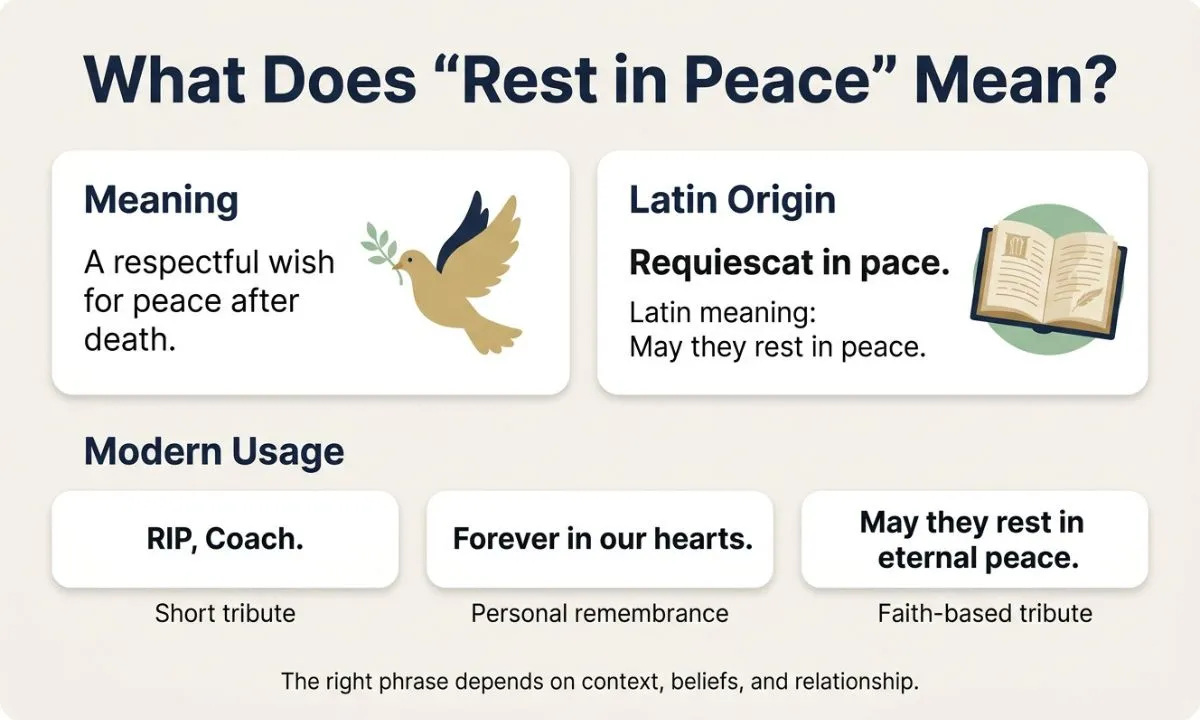
Rest in peace is a wish that a person who has died is at peace. It is often written as RIP on gravestones, in obituaries, and online.
Connotative Meaning of “Rest in Peace”
- “Rest in peace” feels respectful, calm, and gentle.
- Literally, it describes rest. Emotionally, it shows respect and hope that the person’s suffering is over.
- Its religious roots remain, but many people now use it in a secular way too.
Examples:
- “Rest in peace, Grandpa”: a loving farewell to a family member.
- “RIP, Coach”: a short tribute online.
Etymology of “Rest in Peace”
- “Rest” comes from Old English rest, meaning “repose” or “ease.”
- “Peace” came into English through Old French pais from Latin pax, meaning “peace.”
- The phrase comes from the Latin requiescat in pace, meaning “may he/she rest in peace.”
- Requiescat is a form of the Latin verb requiescere, “to rest.”
- Dictionary.com says the Latin phrase appeared on Christian gravestones in the 8th century and was widespread by the 1700s.
- The same source records “R.I.P.” from 1613 for the Latin phrase and from 1681 for the English one.
- It began as a prayer for the soul’s peace.
Pronunciation of “Rest in Peace”
- Pronunciation: REST in PEESS
- IPA: /rɛst ɪn piːs/
- RIP is spoken as the letters “R-I-P” (/ɑːr aɪ piː/). It can be written with or without periods.
Syllables and Affixation Pattern of “Rest in Peace”
Stress: “Rest” and “peace” carry the main stress. “In” is unstressed.
Syllable division: rest | in | peace
Syllables: Three (one in each word)
Base words: Rest + In + Peace
Affixes: None. All three words are base forms with no prefix or suffix.
Word formation: Rest (verb) + in (preposition) + peace (noun) = a fixed phrase
Part of speech: Verb phrase used as a wish or epitaph
When to Use “Rest in Peace”: Choosing the Right Words for Every Loss
Choose your words by checking four things:
Belief: Does the family share a faith? If you don’t know, avoid heaven or God references.
Closeness: A close friend can hear “I’ll miss you.” A colleague’s family may prefer “deepest condolences”.
Setting: A text can be short. A card or eulogy can say more.
Cause of loss: After a sudden or young death, avoid “peace at last” and similar phrases.
Pros and Cons of Saying “Rest in Peace”
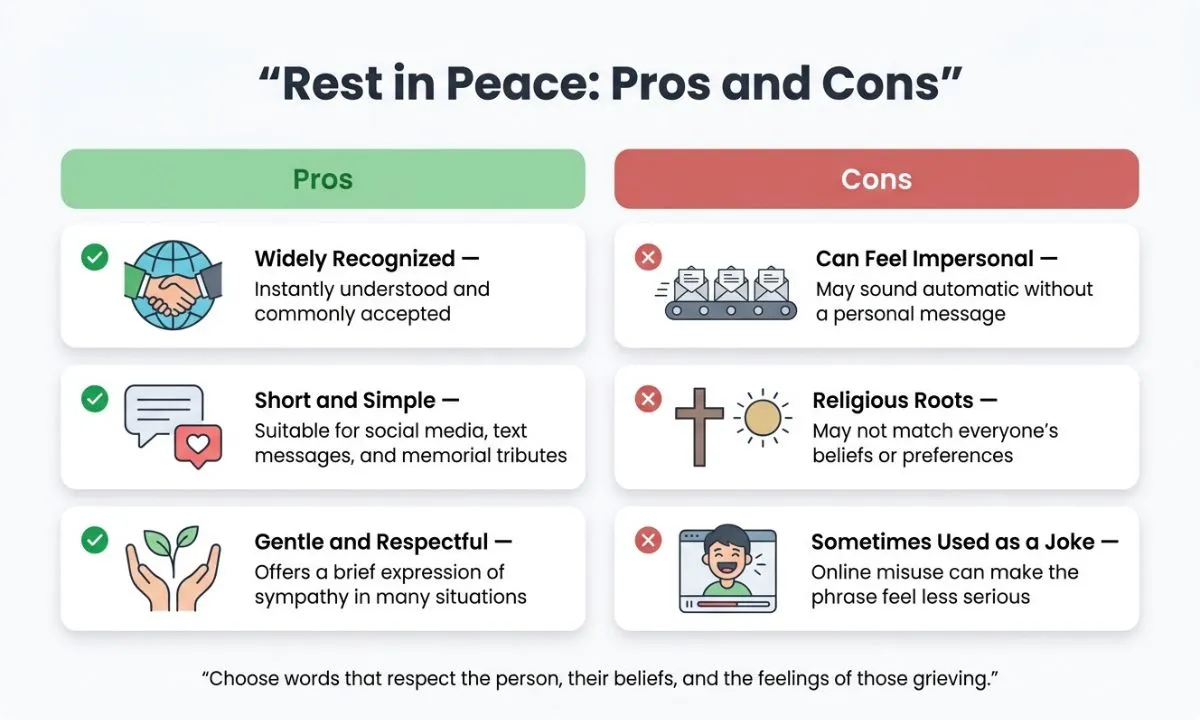
Pros
- Instantly recognized and widely accepted.
- Short enough for any platform.
- Gentle and respectful in most situations.
Cons
- Can feel automatic or impersonal.
- Carries religious roots that may not suit everyone.
- Sometimes used jokingly online, which can undercut a serious message.
70 Alternatives to “Rest in Peace”: Heartfelt Phrases for Every Loss
Each phrase below has a meaning, an example, and a usage tip. Replace “[Name]” with the person’s name, and adjust pronouns as needed.
Religious and Faith-Based Alternatives to “Rest in Peace”
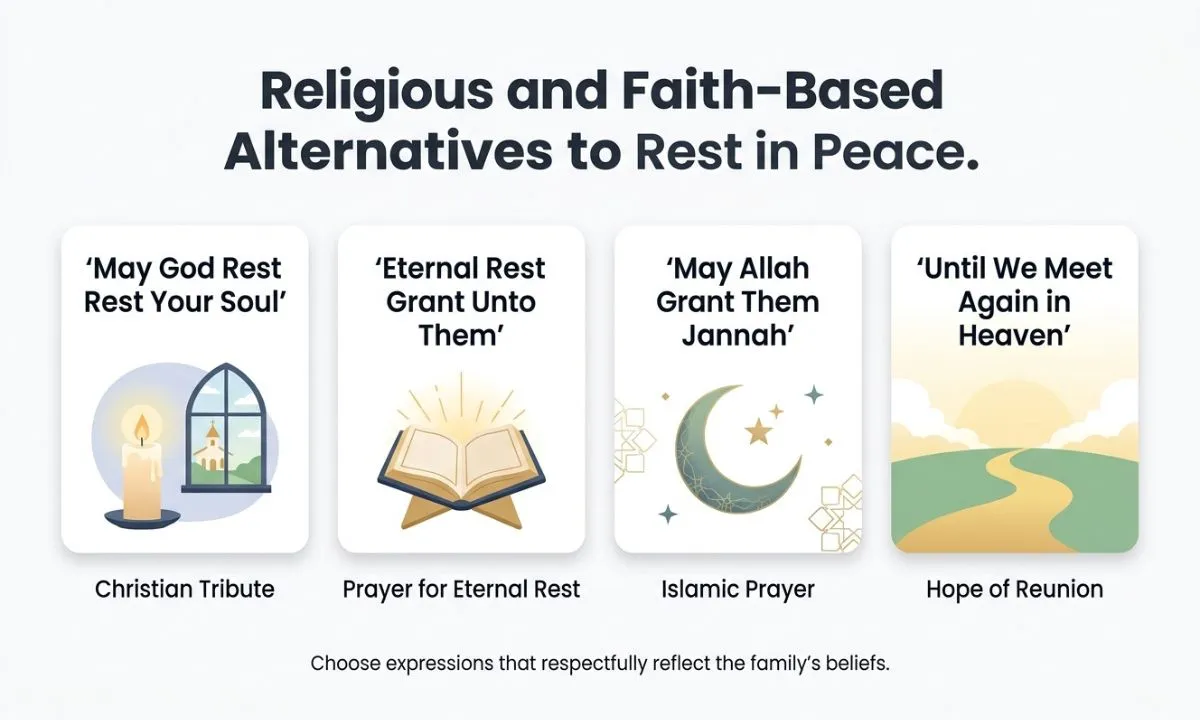
1. May God Rest Your Soul
Pronunciation: /meɪ ɡɑːd rɛst jʊr soʊl/ | /meɪ ɡɒd rɛst jɔː səʊl/
Meaning: A prayer asking God to grant the departed eternal rest.
Examples:
- May God rest your soul, Uncle Tom. You were loved by all.
- She prayed, “May God rest your soul,” as the casket was lowered.
2. Eternal Rest Grant Unto Them
Pronunciation: /ɪˈtɜːrnəl rɛst ɡrænt ˈʌntuː ðɛm/ | /ɪˈtɜːnəl rɛst ɡrɑːnt ˈʌntuː ðem/
Meaning: A traditional Christian prayer asking that the dead receive lasting rest.
Examples:
- Eternal rest grant unto them, O Lord.
- The priest closed the service with “Eternal rest granted unto them.”
3. Rest in God’s Loving Arms
Pronunciation: /rɛst ɪn ɡɑːdz ˈlʌvɪŋ ɑːrmz/ | /rest ɪn ɡɒdz ˈlʌvɪŋ ɑːmz/
Meaning: Wishes that the person is held and comforted by God after death.
Examples:
- Rest in God’s loving arms, Grandma.
- We take comfort knowing he rests in God’s loving arms.
4. May Perpetual Light Shine Upon Them
Pronunciation: /meɪ pərˈpɛtʃuəl laɪt ʃaɪn əˈpɑːn ðɛm/ | /meɪ pəˈpetʃuəl laɪt ʃaɪn əˈpɒn ðem/
Meaning: A liturgical blessing asking that divine light surround the departed.
Examples:
- May perpetual light shine upon them.
- The choir sang as the family whispered, “May perpetual light shine upon them.”
5. Gone Home to the Lord
Pronunciation: /ɡɔːn hoʊm tuː ðə lɔːrd/ | /ɡɒn həʊm tuː ðə lɔːd/
Meaning: Describes death as a return to God.
Examples:
- Our dear sister has gone home to the Lord.
- He has gone home to the Lord, free from pain.
6. May Allah Grant Them Jannah
Pronunciation: /meɪ ˈɑːlɑː ɡrænt ðɛm ˈdʒɑːnə/ | /meɪ ˈælə ɡrɑːnt ðem ˈdʒʌnə/
Meaning: An Islamic prayer asking that the departed be admitted to Paradise.
Examples:
- May Allah grant him Jannah and ease his family’s grief.
- We pray that Allah grants her the highest place in Jannah.
7. To God We Belong and To Him We Return
Pronunciation: /tuː ɡɑːd wi bɪˈlɔːŋ ænd tuː hɪm wi rɪˈtɜːrn/ | /tuː ɡɒd wiː bɪˈlɒŋ ænd tuː hɪm wiː rɪˈtɜːn/
Meaning: An English rendering of the Islamic words said on hearing of a death.
Examples:
- To God we belong and to Him we return. We are praying for your family.
- He whispered the words as the news came in.
8. May Their Soul Find Peace in Heaven
Pronunciation: /meɪ ðɛr soʊl faɪnd piːs ɪn ˈhɛvən/ | /meɪ ðeə səʊl faɪnd piːs ɪn ˈhevən/
Meaning: Hopes the departed soul has reached peace in the afterlife.
Examples:
- May her soul find peace in Heaven.
- We hope his soul finds peace in Heaven after such a long illness.
9. With the Angels Now
Pronunciation: /wɪð ði ˈeɪndʒəlz naʊ/ | /wɪð ði ˈeɪndʒəlz naʊ/
Meaning: Pictures of the departed as now living among the angels.
Examples:
- Our little girl is with the angels now.
- He is with the angels now, watching over us.
10. Safe in the Hands of God
Pronunciation: /seɪf ɪn ðə hændz əv ɡɑːd/ | /seɪf ɪn ðə hændz əv ɡɒd/
Meaning: Offers comfort that the person is protected beyond this life.
Examples:
- He is safe in the hands of God.
- Rest assured she is safe in the hands of God.
11. May the Lord Welcome You Home
Pronunciation: /meɪ ðə lɔːrd ˈwɛlkəm juː hoʊm/ | /meɪ ðə lɔːd ˈwelkəm juː həʊm/
Meaning: A blessing that the departed be received warmly into the afterlife.
Examples:
- May the Lord welcome you home, faithful servant.
- Goodbye, Pastor John. May the Lord welcome you home.
12. Resting in the Lord’s Care
Pronunciation: /ˈrɛstɪŋ ɪn ðə lɔːrdz kɛr/ | /ˈrestɪŋ ɪn ðə lɔːdz keə/
Meaning: States that the departed now rests under God’s protection.
Examples:
- Our father is resting in the Lord’s care.
- She is resting in the Lord’s care, free of pain.
13. God Has Called Them Home
Pronunciation: /ɡɑːd hæz kɔːld ðɛm hoʊm/ | /ɡɒd hæz kɔːld ðem həʊm/
Meaning: Describes death as God summoning a person to their eternal home.
Examples:
- God has called her home after ninety beautiful years.
- We trust that God has called him home.
14. May They Dwell in the House of the Lord Forever
Pronunciation: /meɪ ðeɪ dwɛl ɪn ðə haʊs əv ðə lɔːrd fɔːrˈɛvər/ | /meɪ ðeɪ dwel ɪn ðə haʊs əv ðə lɔːd fərˈevə/
Meaning: A scripture-inspired wish for everlasting life with God.
Examples:
- May they dwell in the house of the Lord forever.
- The pastor read the line aloud at the graveside.
15. Until We Meet Again in Heaven
Pronunciation: /ənˈtɪl wi miːt əˈɡɛn ɪn ˈhɛvən/ | /ənˈtɪl wiː miːt əˈɡen ɪn ˈhevən/
Meaning: Expresses the hope of reunion in the afterlife.
Examples:
- Until we meet again in Heaven, Dad.
- We part with sorrow, but until we meet again in Heaven.
16. Gone to Their Eternal Reward
Pronunciation: /ɡɔːn tuː ðɛr ɪˈtɜːrnəl rɪˈwɔːrd/ | /ɡɒn tuː ðeə ɪˈtɜːnəl rɪˈwɔːd/
Meaning: Suggests the person has received the spiritual reward of a faithful life.
Examples:
- He has gone to his eternal reward.
- After a life of service, she has gone to her eternal reward.
17. Peace Be Upon Their Soul
Pronunciation: /piːs bi əˈpɑːn ðɛr soʊl/ | /piːs biː əˈpɒn ðeə səʊl/
Meaning: A blessing that invokes peace for the departed’s soul.
Examples:
- Peace be upon his soul.
- She wrote, “Peace be upon their souls,” beneath the memorial photo.
18. May They Rest in God’s Grace
Pronunciation: /meɪ ðeɪ rɛst ɪn ɡɑːdz ɡreɪs/ | /meɪ ðeɪ rest ɪn ɡɒdz ɡreɪs/
Meaning: Hopes the departed are held in God’s mercy and favor.
Examples:
- May she rest in God’s grace.
- We pray he rests in God’s grace and wants for nothing.
Non-Religious Ways of Saying “Rest in Peace”
19. Rest Easy
Pronunciation: /rɛst ˈiːzi/ | /rest ˈiːzi/
Meaning: A relaxed wish that the person now be free of worry and pain.
Examples:
- Rest easy, Coach. You taught us well.
- Rest easy, you earned it.
20. Forever in Our Hearts
Pronunciation: /fɔːrˈɛvər ɪn aʊr hɑːrts/ | /fərˈevər ɪn aʊə hɑːts/
Meaning: Says the person will always be loved and kept in memory.
Examples:
- Forever in our hearts, Sarah.
- He will be forever in our hearts.
21. Gone but Never Forgotten
Pronunciation: /ɡɔːn bʌt ˈnɛvər fərˈɡɑːtn/ | /ɡɒn bʌt ˈnevə fəˈɡɒtn/
Meaning: Acknowledges the loss while promising lasting remembrance.
Examples:
- Gone but never forgotten, our dear friend.
- The banner read, “Gone but never forgotten.”
22. Sleep Peacefully
Pronunciation: /sliːp ˈpiːsfəli/ | /sliːp ˈpiːsfəli/
Meaning: Uses sleep as a gentle image of lasting calm.
Examples:
- Sleep peacefully, dear Grandpa.
- Sleep peacefully. Your work here is done.
23. Fly Free
Pronunciation: /flaɪ friː/ | /flaɪ friː/
Meaning: Pictures the person as released from suffering or limits.
Examples:
- Fly free, my friend.
- After years of illness, she can finally fly free.
24. Finally at Peace
Pronunciation: /ˈfaɪnəli æt piːs/ | /ˈfaɪnəli æt piːs/
Meaning: Notes that the person’s struggles are over.
Examples:
- After a long fight, he is finally at peace.
- She is finally at peace and no longer in pain.
25. Their Legacy Lives On
Pronunciation: /ðɛr ˈlɛɡəsi lɪvz ɑːn/ | /ðeə ˈleɡəsi lɪvz ɒn/
Meaning: Emphasizes that the person’s impact continues through others.
Examples:
- Her legacy lives on in every student she taught.
- His legacy lives on through the charity he founded.
26. Until We Meet Again
Pronunciation: /ənˈtɪl wi miːt əˈɡɛn/ | /ənˈtɪl wiː miːt əˈɡen/
Meaning: A hopeful farewell that leaves room for reunion.
Examples:
- Until we meet again, my friend.
- Goodbye for now. Until we meet again.
27. Missed Beyond Words
Pronunciation: /mɪst bɪˈjɑːnd wɜːrdz/ | /mɪst bɪˈjɒnd wɜːdz/
Meaning: Conveys grief too deep to describe.
Examples:
- You are missed beyond words.
- Missed beyond words, loved beyond measure.
28. Rest Now
Pronunciation: /rɛst naʊ/ | /rest naʊ/
Meaning: A short, quiet release from effort and pain.
Examples:
- Rest now. You’ve carried enough.
- Rest now, dear Mama. We’ll be okay.
29. Journey Well
Pronunciation: /ˈdʒɜːrni wɛl/ | /ˈdʒɜːni wel/
Meaning: Treats death as a passage and wishes the person well on it.
Examples:
- Journey well, wherever you go next.
- Journey well, old friend.
30. Shine On
Pronunciation: /ʃaɪn ɑːn/ | /ʃaɪn ɒn/
Meaning: Encourages the person’s light to continue in memory.
Examples:
- Shine on, you brilliant soul.
- Shine on, wherever you are.
31. Gone Too Soon
Pronunciation: /ɡɔːn tuː suːn/ | /ɡɒn tuː suːn/
Meaning: Mourns a life that ended earlier than it should have.
Examples:
- Gone too soon, but never forgotten.
- He was gone too soon, and we still feel the gap.
32. Forever Remembered
Pronunciation: /fɔːrˈɛvər rɪˈmɛmbərd/ | /fərˈevə rɪˈmembəd/
Meaning: A simple pledge to keep the person’s memory alive.
Examples:
- Forever remembered, forever loved.
- Their names will be forever remembered.
33. Lives On in Our Memories
Pronunciation: /lɪvz ɑːn ɪn aʊr ˈmɛməriz/ | /lɪvz ɒn ɪn aʊə ˈmeməriz/
Meaning: Says the person remains present through the memories of others.
Examples:
- She lives on in our memories.
- He lives on in our memories and every story we tell.
34. No More Pain
Pronunciation: /noʊ mɔːr peɪn/ | /nəʊ mɔː peɪn/
Meaning: Offers comfort that suffering has ended.
Examples:
- No more pain, no more fear. Rest.
- After months of illness, she knows no more pain.
35. Rest in Power
Pronunciation: /rɛst ɪn ˈpaʊər/ | /rest ɪn ˈpaʊə/
Meaning: A modern tribute that honors strength and impact, often for activists and leaders.
Examples:
- Rest in power, you changed so many lives.
- Fans posted “Rest in power” beneath her final interview.
Formal and Professional Alternatives to “Rest in Peace”
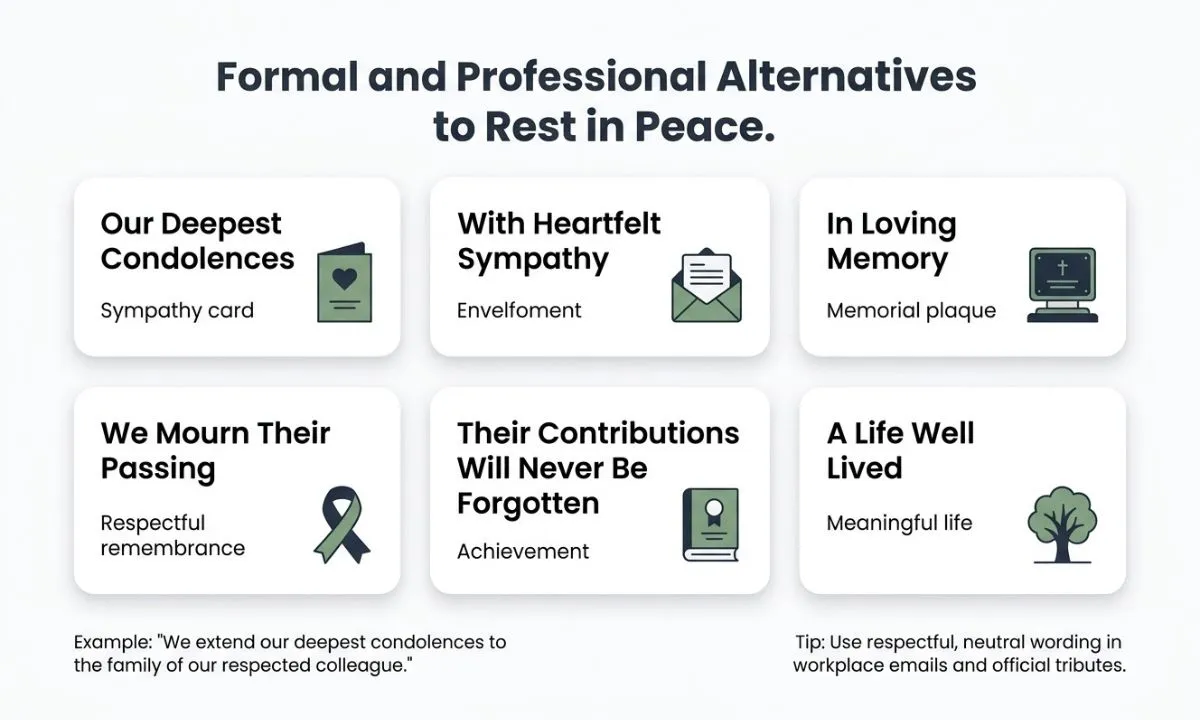
36. Our Deepest Condolences
Pronunciation: /aʊr ˈdiːpɪst kənˈdoʊlənsɪz/ | /aʊə ˈdiːpɪst kənˈdəʊlənsɪz/
Meaning: A formal expression of sympathy to the bereaved.
Examples:
- Our deepest condolences to the family on their loss.
- Please accept our deepest condolences.
37. In Loving Memory
Pronunciation: /ɪn ˈlʌvɪŋ ˈmɛməri/ | /ɪn ˈlʌvɪŋ ˈmeməri/
Meaning: A traditional phrase used on memorials, programs, and tributes.
Examples:
- The plaque reads, “In loving memory of Dr. Ellis.”
- This scholarship is given in loving memory of our founder.
38. With Heartfelt Sympathy
Pronunciation: /wɪð ˈhɑːrtfɛlt ˈsɪmpəθi/ | /wɪð ˈhɑːtfelt ˈsɪmpəθi/
Meaning: A sincere but formal way to close a condolence message.
When writing a condolence message, keep your closing gentle and sincere. You can explore other ways to sign off a message to find a warm and appropriate way to end your words.
Examples:
- With heartfelt sympathy, the entire staff.
- We send you our love with heartfelt sympathy.
39. Honoring Their Memory
Pronunciation: /ˈɑːnərɪŋ ðɛr ˈmɛməri/ | /ˈɒnərɪŋ ðeə ˈmeməri/
Meaning: Signals respect and a commitment to remember.
Examples:
- We are honoring their memory with a moment of silence.
- The company is honoring his memory by naming the lab after him.
40. Remembered With Respect
Pronunciation: /rɪˈmɛmbərd wɪð rɪˈspɛkt/ | /rɪˈmembəd wɪð rɪˈspekt/
Meaning: Stresses admiration for the person’s character or conduct.
Examples:
- He will be remembered with respect by all who served alongside him.
- She is remembered with respect across the industry.
41. May They Be at Peace
Pronunciation: /meɪ ðeɪ bi æt piːs/ | /meɪ ðeɪ biː æt piːs/
Meaning: A neutral, respectful wish for peace.
Examples:
- May they be at peace.
- May he be at peace after a life of hard work.
42. Their Contributions Will Never Be Forgotten
Pronunciation: /ðɛr ˌkɑːntrɪˈbjuːʃənz wɪl ˈnɛvər bi fərˈɡɑːtn/ | /ðeə ˌkɒntrɪˈbjuːʃənz wɪl ˈnevə biː fəˈɡɒtn/
Meaning: Recognizes a person’s work or service in a professional setting.
Examples:
- Dr. Rao’s contributions will never be forgotten.
- Her contributions to our team will never be forgotten.
43. May Their Memory Endure
Pronunciation: /meɪ ðɛr ˈmɛməri ɪnˈdʊr/ | /meɪ ðeə ˈmeməri ɪnˈdjʊə/
Meaning: A dignified wish that remembrance lasts for generations.
Examples:
- May his memory endure for generations.
- May their memory endure through the work they began.
44. We Mourn Their Passing
Pronunciation: /wi mɔːrn ðɛr ˈpæsɪŋ/ | /wiː mɔːn ðeə ˈpɑːsɪŋ/
Meaning: A formal announcement of shared grief.
Examples:
- We mourn the passing of our chairman.
- The university mourns his passing.
45. Our Thoughts Are With Your Family
Pronunciation: /aʊr θɔːts ɑːr wɪð jʊr ˈfæməli/ | /aʊə θɔːts ɑː wɪð jɔː ˈfæməli/
Meaning: Offers support to the bereaved without religious wording.
Examples:
- Our thoughts are with your family during this time.
- Our thoughts are with you and your loved ones.
46. In Respectful Remembrance
Pronunciation: /ɪn rɪˈspɛktfəl rɪˈmɛmbrəns/ | /ɪn rɪˈspektfəl rɪˈmembrəns/
Meaning: A formal phrase for official tributes and notices.
Examples:
- In respectful remembrance of those we lost.
- The statement was issued in respectful remembrance of the late mayor.
47. A Life Well Lived
Pronunciation: /ə laɪf wɛl lɪvd/ | /ə laɪf wel lɪvd/
Meaning: Celebrates the person’s life rather than mourning only the loss.
Examples:
- Hers was a life well lived.
- We honor a life well lived and a career of integrity.
48. Gratefully Remembered
Pronunciation: /ˈɡreɪtfəli rɪˈmɛmbərd/ | /ˈɡreɪtfəli rɪˈmembəd/
Meaning: Thanks the person for what they gave to others.
Examples:
- Gratefully remembered by all who knew him.
- Our mentor will be gratefully remembered.
49. May They Find Eternal Peace
Pronunciation: /meɪ ðeɪ faɪnd ɪˈtɜːrnəl piːs/ | /meɪ ðeɪ faɪnd ɪˈtɜːnəl piːs/
Meaning: A formal wish for lasting peace that suits mixed audiences.
Examples:
- May they find eternal peace.
- May he find eternal peace after his long service.
50. With Deepest Respect
Pronunciation: /wɪð ˈdiːpɪst rɪˈspɛkt/ | /wɪð ˈdiːpɪst rɪˈspekt/
Meaning: Closes a tribute with honor and regard.
Examples:
- With deepest respect, we say goodbye to our colleague.
- With deepest respect, the board remembers her leadership.
51. Their Service Will Not Be Forgotten
Pronunciation: /ðɛr ˈsɜːrvɪs wɪl nɑːt bi fərˈɡɑːtn/ | /ðeə ˈsɜːvɪs wɪl nɒt biː fəˈɡɒtn/
Meaning: Honors dedication, often to a community, country, or organization.
Examples:
- His service to this town will not be forgotten.
- Their service will not be forgotten.
52. May Their Legacy Endure
Pronunciation: /meɪ ðɛr ˈlɛɡəsi ɪnˈdʊr/ | /meɪ ðeə ˈleɡəsi ɪnˈdjʊə/
Meaning: Wishes that the person’s lasting impact continues.
Examples:
- May her legacy endure through the foundation she built.
- May his legacy endure in those he mentored.
Warm and Personal Alternatives to “Rest in Peace” for Close Relationships
53. Rest Easy, My Friend
Pronunciation: /rɛst ˈiːzi maɪ frɛnd/ | /rest ˈiːzi maɪ frend/
Meaning: A tender goodbye to a close friend.
Examples:
- Rest easy, my friend. I’ll carry on.
- Rest easy, my friend. You were the best of us.
54. I’ll Miss You Every Day
Pronunciation: /aɪl mɪs juː ˈɛvri deɪ/ | /aɪl mɪs juː ˈevri deɪ/
Meaning: States honest, ongoing grief.
Examples:
- I’ll miss you every day, Dad.
- I’ll miss you every day, but I’ll keep your memory close.
55. Save Me a Seat Up There
Pronunciation: /seɪv mi ə siːt ʌp ðɛr/ | /seɪv miː ə siːt ʌp ðeə/
Meaning: A loving, slightly playful wish to reunite someday.
Examples:
- Save me a seat up there, Grandpa.
- Save me a seat, and keep the coffee warm.
56. Love You Always
Pronunciation: /lʌv juː ˈɔːlweɪz/ | /lʌv juː ˈɔːlweɪz/
Meaning: Affirms that love continues after death.
Examples:
- Love you always, Mom.
- Love you always and forever.
57. You’ll Always Be in My Heart
Pronunciation: /jʊl ˈɔːlweɪz bi ɪn maɪ hɑːrt/ | /juːl ˈɔːlweɪz biː ɪn maɪ hɑːt/
Meaning: Promises to carry the person’s memory with love.
Examples:
- You’ll always be in my heart, sweet girl.
- You’ll always be in my heart, no matter how long it’s been.
58. Fly High, Sweet Soul
Pronunciation: /flaɪ haɪ swiːt soʊl/ | /flaɪ haɪ swiːt səʊl/
Meaning: Imagine the person soaring freely.
Examples:
- Fly high, sweet soul.
- Fly high, sweet soul. We love you.
59. Sleep Well, My Love
Pronunciation: /sliːp wɛl maɪ lʌv/ | /sliːp wel maɪ lʌv/
Meaning: An intimate goodnight, often said to a partner or child.
Examples:
- Sleep well, my love. I’m here.
- Sleep well, my love, until we meet again.
60. Thank You for Everything
Pronunciation: /θæŋk juː fɔːr ˈɛvriθɪŋ/ | /θæŋk juː fɔː ˈevriθɪŋ/
Meaning: Expresses gratitude for what the person gave.
Examples:
- Thank you for everything, Grandma.
- Thank you for everything you taught me.
61. Forever My Hero
Pronunciation: /fɔːrˈɛvər maɪ ˈhɪroʊ/ | /fərˈevə maɪ ˈhɪərəʊ/
Meaning: Honors someone admired deeply, such as a parent or mentor.
Examples:
- Forever my hero, Dad.
- You’ll be my hero forever, Coach.
62. Keep Dancing Up There
Pronunciation: /kiːp ˈdænsɪŋ ʌp ðɛr/ | /kiːp ˈdɑːnsɪŋ ʌp ðeə/
Meaning: A joyful send-off for someone who loved music or lively moments.
Examples:
- Keep dancing up there, Nana.
- Keep dancing up there. We’ll play your song.
63. Watch Over Us
Pronunciation: /wɑːtʃ ˈoʊvər ʌs/ | /wɒtʃ ˈəʊvər ʌs/
Meaning: Asks the person to remain a guiding presence.
Examples:
- Watch over us, Grandpa.
- Watch over us, and guide us through this.
64. Gone From My Sight, Never From My Heart
Pronunciation: /ɡɔːn frʌm maɪ saɪt ˈnɛvər frʌm maɪ hɑːrt/ | /ɡɒn frɒm maɪ saɪt ˈnevə frɒm maɪ hɑːt/
Meaning: Separates physical absence from emotional closeness.
Examples:
- Gone from my sight, never from my heart.
- She wrote it beneath his photo: gone from my sight, never from my heart.
65. You Made Our World Brighter
Pronunciation: /juː meɪd aʊr wɜːrld ˈbraɪtər/ | /juː meɪd aʊə wɜːld ˈbraɪtə/
Meaning: Celebrates the joy the person brought to others.
Examples:
- You made our world brighter, Aunt Lina.
- You made our world brighter just by being in it.
66. Rest Peacefully, Grandma
Pronunciation: /rɛst ˈpiːsfəli ˈɡrænmɑː/ | /rest ˈpiːsfəli ˈɡrænmɑː/
Meaning: A tender goodbye to a grandparent, easily adapted to Grandpa.
Examples:
- Rest peacefully, Grandma. We’ll take care of each other.
- Rest peacefully, Grandpa. We love you.
67. Forever Our Angel
Pronunciation: /fɔːrˈɛvər aʊr ˈeɪndʒəl/ | /fərˈevər aʊə ˈeɪndʒəl/
Meaning: Often used for a child or young person who died.
Examples:
- Forever our angel.
- Forever our angel, our little star.
68. I Carry You With Me
Pronunciation: /aɪ ˈkæri juː wɪð mi/ | /aɪ ˈkæri juː wɪð miː/
Meaning: Says the person remains part of the speaker’s life and choices.
Examples:
- I carry you with me every day.
- Wherever I go, I carry you with me.
69. Be at Peace, My Dear Friend
Pronunciation: /bi æt piːs maɪ dɪr frɛnd/ | /biː æt piːs maɪ dɪə frend/
Meaning: A gentle wish for peace addressed to a close friend.
Examples:
- Be at peace, my dear friend.
- Be at peace, my dear friend. You gave us so much.
70. Go Gently, Dear One
Pronunciation: /ɡoʊ ˈdʒɛntli dɪr wʌn/ | /ɡəʊ ˈdʒentli dɪə wʌn/
Meaning: A soft farewell for someone in their final moments or just passed.
Examples:
Go gently, dear one, and rest.
Go gently, dear one. We’re all here.
Quick Comparison of the Best Alternatives
| Phrase | Meaning | Best Use | Avoid When | Tone |
| Rest easy | Wish for ease | Friends, tributes | Formal letters | Casual |
| May they rest in eternal peace | Prayer for lasting peace | Faith-based cards | Beliefs unknown | Reverent |
| Gone but never forgotten | Remembered despite loss | Posts, memorials | Overused situations | Familiar |
| Please accept my deepest condolences | Formal sympathy | Work, first contact | Close friends | Formal |
| Rest in power | Honors strength | Leaders, activists | Not a fit for the person | Respectful |
| Thank you for everything | Gratitude | Mentors, teachers | Strained relationships | Warm |
| A life well lived | Celebrates a full life | Older adults | Young or sudden loss | Reflective |
| Forever in our hearts | Lasting love | Groups, families | Needing detail | Gentle |
| Peace at last | Relief from suffering | Long illness | Sudden loss | Soft |
| I’ll carry you with me | Keeps memory alive | Close loss | Distant relationships | Intimate |
Rest Easy vs. Rest in Peace: What’s the Difference?
Rest in peace is the traditional wish. It carries religious roots and a more solemn tone.
Rest easy is lighter and more casual, and many people use it for friends, teammates, and public figures.
Use “rest in peace” for obituaries, formal notes, and traditional or faith-based settings.
Use “rest easy” for friends, informal posts, and secular tributes.
Example: “Rest in peace, Mr. Wilson” feels formal. “Rest easy, Coach” feels personal.
Short Alternatives to “Rest in Peace” for Social Media and Text Messages
These work well when space is tight:
- Rest easy
- Rest well
- Fly high
- Forever in our hearts
- Gone but never forgotten
- You will be missed
- Thinking of you all
- Love you always
Tip: one personal line, such as “Thank you for teaching me to drive,” beats a long generic one. For a public tribute, check the family’s wishes first.
How to Say “Rest in Peace” in Other Languages
| Language | Phrase |
| Latin | Requiescat in pace |
| Spanish | Descanse en paz |
| French | Repose en paix |
| Italian | Riposa in pace |
| German | Ruhe in Frieden |
| Portuguese | Descanse em paz |
| Dutch | Rust in vrede |
| Hebrew | Zichrono livracha (may his memory be a blessing) |
| Arabic | Allah yarhamu (may God have mercy on him) |
For formal or religious contexts, check the phrasing with a native speaker or the family.
What NOT to Say When Someone Dies: Phrases That Can Cause Unintentional Harm
Well-meant phrases can hurt. Here is what to avoid and what to say instead:
“He’s in a better place.” Avoid it unless you know the family shares that belief.
Try: “I’m so sorry. I’m thinking of you.”
“At least she lived a long life.” It can minimize grief.
Try: “She was such an important person.”
“Everything happens for a reason.” It can feel dismissive.
Try: “This is so painful, and I’m here.”
“I know how you feel.” Grief is individual.
Try: “I can’t imagine, but I’m here.”
“Be strong.” It pressures people to hide emotion.
Try: “Take all the time you need.”
“Let me know if you need anything.” It puts the work on the mourner.
Try: “I’ll bring dinner on Thursday.”
How to Write a Heartfelt Condolence Message That Actually Comforts
Start with sympathy. “I’m so sorry for your loss.”
Name the person. Using their name shows you care.
Add a memory or quality. “I’ll always remember her kindness.”
Offer specific help. “I can pick up the kids on Friday.”
Close simply. “Thinking of you,” or “With love.”
Example: “I’m so sorry about Rahim. He always made our team laugh, and I’ll miss that. I’m thinking of you and your family. If it helps, I can cover your shifts next week.”
Keep it short. A sincere few lines matter more than a perfect paragraph.
Explore More Synonyms Guide
Above Average Synonyms: 70 Better Ways to Say “Above Average” Clearly
Synonyms for Legislature: 70 Clear Words for Better Communication
20+ Primary Synonyms: Other Ways to Say “Primary” With Meaning & Examples
History Synonyms: 22+ Words, Meanings, Examples & How to Use Them
70+ Important Synonyms: Other Ways to Say “Important” With Meaning & Examples
Frequently Asked Questions About Good Morning Greetings
What Is the Best RIP Message?
The best RIP message is a short, sincere one that fits the person and relationship. “Rest easy, [Name]. Thank you for everything” works for many situations, and a personal detail makes it stronger.
How Do You Shorten “Rest in Peace”?
Write it as “RIP” or “R.I.P.” For a less abbreviated feel, use “rest easy” or “rest well.”
What’s a Nice Way to Say Someone Has Passed Away?
Say “passed away”, “passed”, or “is no longer with us” for a gentle tone. In formal writing, “died” is clear and respectful.
Can I Say “Rest Well” Instead of “Rest in Peace”?
Yes, “rest well” is a gentle, non-religious alternative. It works best for adults and in personal messages.
What Is a Non-Religious Way of Saying “Rest in Peace”?
Try “rest easy”, “gone but never forgotten”, or “your memory lives on.” These focus on rest and remembrance, not an afterlife.
What Are the Most Respectful Alternatives to RIP?
“Please accept my deepest condolences” and “with deepest sympathy” are the most widely respected. “Forever in our hearts” is warm without being religious.
What Should I Say to Someone Non-Religious When They Lose Someone?
Focus on the person and the mourner: “I’m so sorry. [Name] was wonderful, and I’m here for you.” Avoid heaven or God references unless they raise them.
Can I Use Rest in Peace Alternatives on Social Media?
Yes, short phrases like “rest easy” and “forever in our hearts” work well. Check the family’s wishes first for public tributes.
What Can I Say Instead of “Rest in Peace”?
Choose by context: “rest easy” for casual tributes, “may they rest in eternal peace” for faith-based ones, and “deepest condolences” for formal ones. Add a personal line whenever you can.
Conclusion: Choosing the Right Words to Honor Someone’s Memory
The best other ways to say rest in peace depend on who the person was, what the family believes, and how well you knew them. Faith-based phrases comfort believers, simple phrases like “rest easy” suit casual tributes, and formal wording protects professional relationships. When in doubt, be brief and kind, and add one true detail about the person.
Choosing the right words can make your message more thoughtful and meaningful. Explore our more synonym guides to discover better word choices for different situations.
