

Looking for other ways to say good vibes?
This guide gives you 70 alternatives, sorted by mood and meaning, so you can describe positivity, happiness, calm energy, and welcoming atmospheres more precisely.
Each word comes with a short meaning, a natural example, and a tip on when to use it. Whether you are writing a caption, a work email, or a thank-you note, you will find a better fit here.
Quick Answer: What Is the Best Synonym for Good Vibes?
“Positive energy” is the most versatile alternative to “good vibes.” However, the best word depends on the feeling you want to express.
🟩 Positive energy: A happy and uplifting atmosphere.
🟩 Joy: A feeling of happiness.
🟩 Serenity: A sense of peace and calm.
🟩 Warmth: Friendliness and kindness.
🟩 Motivation: The drive to take action or achieve goals.
🟩 Chill vibes: For casual conversations and social media.
🟩 Positive atmosphere: For professional settings.
🟩 Optimistic outlook: To express hope and confidence.
🟩 Supportive environment: To describe a place where people feel encouraged and valued.
✨ Examples
🟢 “The team welcomed us with warmth.”
🟢 “The workshop had positive energy.”
🟢 “The garden felt full of serenity.”
🔵 Linguistic Breakdown of “Good Vibes”
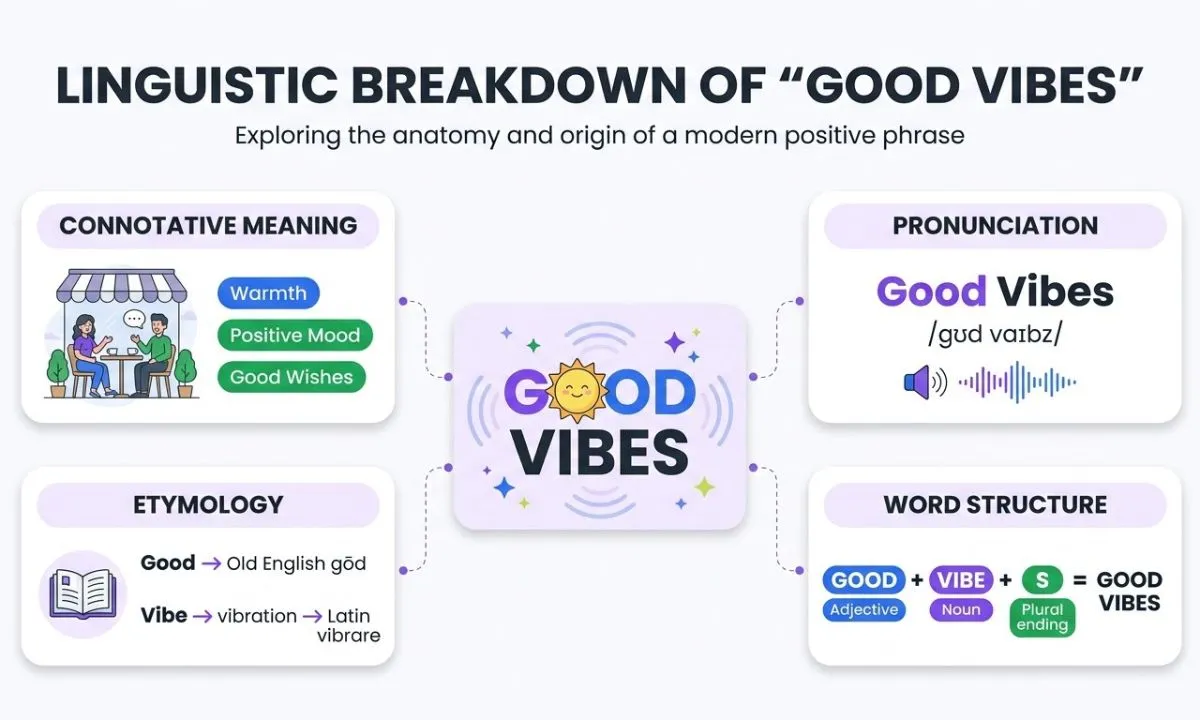
🟣 Connotative Meaning of Good Vibes
- “Good vibes” feels warm, relaxed, and uplifting.
- It can describe the mood of a person, a place, or a moment, and it can also mean good wishes.
Examples:
- “This café has good vibes”: the place feels welcoming and pleasant.
- “Sending you good vibes”: wishing someone luck or comfort.
🟣 Etymology of Good Vibes
- “Good” comes from Old English gōd, meaning “fitting” or “of high quality.”
- “Vibes” is a clipped form of “vibrations.”
- “Vibration” traces back to Latin vibrare, meaning “to shake” or “to move quickly.”
- The slang use of “vibe” for an emotional atmosphere became common in the 1960s and later spread into everyday English.
- 📖 Dictionary.com lists “vibe” as informal for a feeling or atmosphere that someone or something gives off.
🟣 Pronunciation of Good Vibes
- Pronunciation: GUUD VYBZ
- IPA: /ɡʊd vaɪbz/
🟣 Syllables and Affixation Pattern of Good Vibes
Syllable division: good | vibes
Base words: Good + Vibe
Suffix: -s (plural)
Word formation: Good + vibe (clipped from vibration) + -s = Good vibes
Part of speech: Noun phrase (adjective + plural noun)
Syllables: Two (one in each word)
Stress: The second word, “vibes,” carries the main stress.
🔵 Is It Professional and Polite to Say “Good Vibes”?
“Good vibes” is polite and friendly, but it is casual. It suits chats, messages to friends, and relaxed team talk. In reports, client emails, and formal feedback, a more precise phrase usually sounds clearer and more credible.
📊 Casual Expression vs. Professional Alternative
| 🟦 Casual Expression | 🟩 Professional Alternative |
| “The meeting had good vibes.” | “The meeting had a positive and collaborative atmosphere.” |
| “Sending you good vibes.” | “Wishing you every success.” |
| “Great vibes from the client.” | “The client seemed receptive and engaged.” |
| “Good vibes only at work.” | “Let’s keep our discussion constructive.” |
| “This office has good vibes.” | “This office has a supportive environment.” |
🔵 Pros and Cons of Using “Good Vibes” in Writing and Conversation
🟢 Pros
✓ Friendly, warm, and easy to understand.
✓ Short and natural in speech and captions.
✓ Broad enough to fit many situations.
✓ Helps a message sound relaxed and approachable.
🔴 Cons
✗ Informal, so it can feel out of place in formal writing.
✗ Vague: it does not say whether the feeling is calm, happy, or motivating.
✗ Easy to overuse, which weakens its impact.
✗ Can sound dismissive when someone is going through a hard time.
✨ 70 Other Ways to Say Good Vibes (Compact Format)
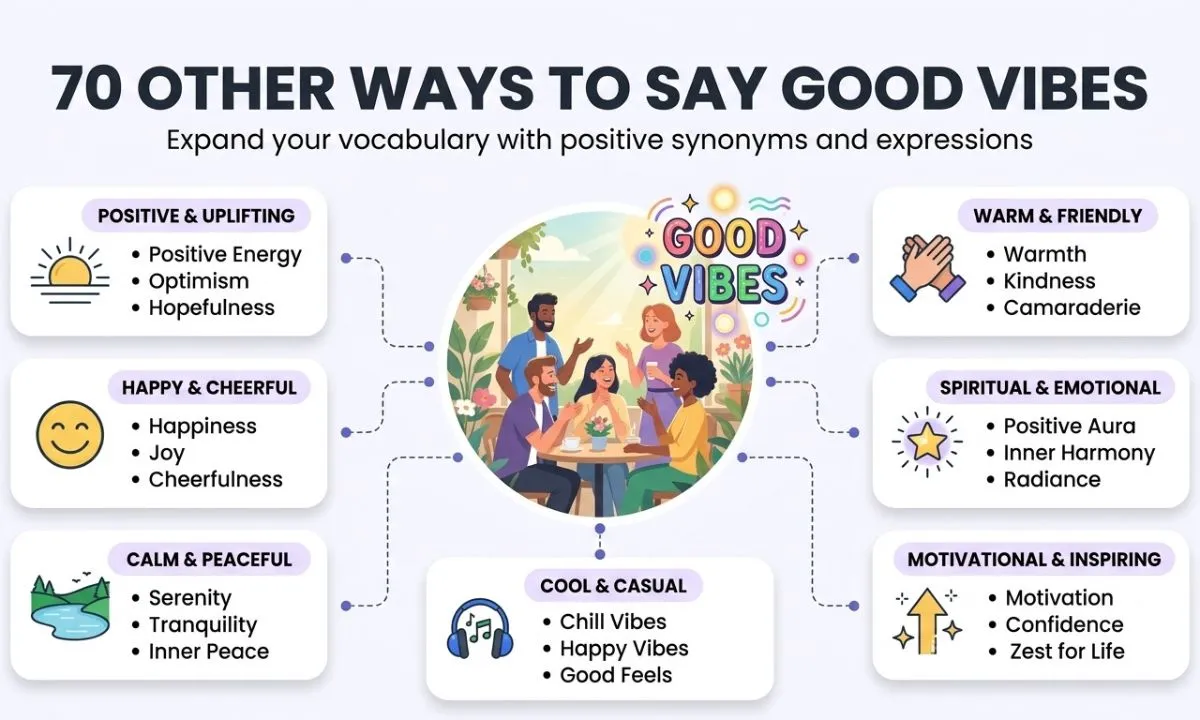
🟦 1. Positive and Uplifting Alternatives to Good Vibes
🟩 1. Positive Energy
Pronunciation: US /ˈpɑːzətɪv ˈenərdʒi/ | UK /ˈpɒzətɪv ˈenədʒi/
Meaning: Positive energy is an uplifting feeling that a person, place, or group gives off.
Examples:
- 🟢 Her positive energy made the whole study group feel more hopeful about the exam.
- 🟢 The new coach brought positive energy to the practice field.
🟩 2. Positivity
Pronunciation: US /ˌpɑːzəˈtɪvəti/ | UK /ˌpɒzəˈtɪvəti/
Meaning: Positivity is the habit of focusing on what is good, and it describes an attitude more than an atmosphere.
Examples:
- 🟢 The team’s positivity kept everyone steady during the product launch.
- 🟢 Her daily posts are full of positivity and kind advice.
🟩 3. Optimism
Pronunciation: US /ˈɑːptɪmɪzəm/ | UK /ˈɒptɪmɪzəm/
Meaning: Optimism is the expectation that things will turn out well.
Examples:
- 🟢 His optimism about the new job calmed his nervous parents.
- 🟢 The founders spoke with optimism about next year’s plans.
🟩 4. Good Energy
Pronunciation: US /ɡʊd ˈenərdʒi/ | UK /ɡʊd ˈenədʒi/
Meaning: Good energy is a lively, pleasant feeling around someone or something, slightly less slangy than “good vibes.”
Examples:
- 🟢 The café has good energy on Saturday mornings.
- 🟢 I always leave her workshops with good energy.
🟩 5. Uplifting Spirit
Pronunciation: US /ʌpˈlɪftɪŋ ˈspɪrɪt/ | UK /ʌpˈlɪftɪŋ ˈspɪrɪt/
Meaning: An uplifting spirit is a mood that lifts the feelings of the people around it.
Examples:
- 🟢 The choir’s uplifting spirit turned a rainy evening into a celebration.
- 🟢 The festival ended with an uplifting spirit that lasted all week.
🟩 6. Positive Outlook
Pronunciation: US /ˈpɑːzətɪv ˈaʊtlʊk/ | UK /ˈpɒzətɪv ˈaʊtlʊk/
Meaning: A positive outlook is a hopeful way of seeing a situation, and it describes mindset rather than atmosphere.
Examples:
- 🟢 She kept a positive outlook even when her flight was cancelled.
- 🟢 His manager praised his positive outlook during the busy season.
🟩 7. Bright Side
Pronunciation: US /braɪt saɪd/ | UK /braɪt saɪd/
Meaning: The bright side is the good part of a difficult situation, and it is a related phrase rather than a direct synonym.
Examples:
- 🟢 Looking on the bright side, the delay gave us extra time to rehearse.
- 🟢 She always finds the bright side of a bad day.
🟩 8. Hopefulness
Pronunciation: US /ˈhoʊpfəlnəs/ | UK /ˈhəʊpfəlnəs/
Meaning: Hopefulness is a quiet feeling that good things are possible.
Examples:
- 🟢 A quiet hopefulness filled the room after the manager shared the new plan.
- 🟢 The students spoke with hopefulness about their future.
🟩 9. Encouragement
Pronunciation: US /ɪnˈkɜːrɪdʒmənt/ | UK /ɪnˈkʌrɪdʒmənt/
Meaning: Encouragement is support that gives someone courage, matching the “sending good vibes” sense of the phrase.
Examples:
- 🟢 Your encouragement before my interview meant a lot.
- 🟢 A short note of encouragement made her day.
🟩 10. Inspiration
Pronunciation: US /ˌɪnspəˈreɪʃn/ | UK /ˌɪnspəˈreɪʃn/
Meaning: Inspiration is something that stirs people to feel, create, or act.
Examples:
- 🟢 The new mural filled the neighborhood with inspiration.
- 🟢 Her story became an inspiration for young writers.
🟦 2. Happy and Cheerful Words for Good Vibes
🟩 11. Happiness
Pronunciation: US /ˈhæpinəs/ | UK /ˈhæpinəs/
Meaning: Happiness is a general feeling of pleasure and wellbeing.
Examples:
- 🟢 Happiness filled the kitchen as the family cooked together.
- 🟢 Simple moments often bring the most happiness.
🟩 12. Joy
Pronunciation: US /dʒɔɪ/ | UK /dʒɔɪ/
Meaning: Joy is deep, active happiness that often shows outwardly.
Examples:
- 🟢 The children’s joy at the beach was impossible to miss.
- 🟢 She shared the news with joy in her voice.
🟩 13. Cheerfulness
Pronunciation: US /ˈtʃɪrfəlnəs/ | UK /ˈtʃɪəfəlnəs/
Meaning: Cheerfulness is a bright, friendly good humor that others can feel.
Examples:
- 🟢 The receptionist’s cheerfulness made the waiting room feel lighter.
- 🟢 His cheerfulness at six in the morning surprised everyone.
🟩 14. Delight
Pronunciation: US /dɪˈlaɪt/ | UK /dɪˈlaɪt/
Meaning: Delight is a strong, pleased reaction, usually tied to a specific moment.
Examples:
- 🟢 The surprise party drew gasps of delight.
- 🟢 She opened the gift with delight.
🟩 15. Bliss
Pronunciation: US /blɪs/ | UK /blɪs/
Meaning: Bliss is very great happiness that feels complete and calm.
Examples:
- 🟢 A slow morning with coffee and a book was pure bliss.
- 🟢 The holiday week was bliss after months of hard work.
🟩 16. High Spirits
Pronunciation: US /haɪ ˈspɪrɪts/ | UK /haɪ ˈspɪrɪts/
Meaning: High spirits is a lively, cheerful mood, often shared by a group.
Examples:
- 🟢 The team was in high spirits after winning the semifinal.
- 🟢 The class stayed in high spirits on the last day of school.
🟩 17. Good Cheer
Pronunciation: US /ɡʊd ˈtʃɪr/ | UK /ɡʊd ˈtʃɪə/
Meaning: Good cheer is friendly, shared happiness, often linked to gatherings and holidays.
Examples:
- 🟢 The office was full of good cheer before the winter break.
- 🟢 The neighbors spread good cheer with homemade treats.
🟩 18. Lightheartedness
Pronunciation: US /ˌlaɪtˈhɑːrtɪdnəs/ | UK /ˌlaɪtˈhɑːtɪdnəs/
Meaning: Lightheartedness is a relaxed, playful mood without heaviness or worry.
Examples:
- 🟢 A little lightheartedness helped the tense meeting end on a friendly note.
- 🟢 The comedy night brought welcome lightheartedness to the week.
🟩 19. Merriment
Pronunciation: US /ˈmerɪmənt/ | UK /ˈmerɪmənt/
Meaning: Merriment is lively, noisy fun and laughter.
Examples:
- 🟢 Laughter and merriment carried across the garden party.
- 🟢 The village square was alive with music and merriment.
Celebrations often feel more enjoyable when people share laughter, music, and happiness. If you want to describe different types of celebrations and social gatherings, explore our guide to party synonyms for more useful vocabulary.
🟩 20. Contentment
Pronunciation: US /kənˈtentmənt/ | UK /kənˈtentmənt/
Meaning: Contentment is quiet satisfaction with how things are.
Examples:
- 🟢 He felt deep contentment sitting on the porch after a long week.
- 🟢 The cat purred with contentment in the sun.
🟦 3. Calm, Peaceful, and Relaxing Alternatives
🟩 21. Peaceful Energy
Pronunciation: US /ˈpiːsfl ˈenərdʒi/ | UK /ˈpiːsfl ˈenədʒi/
Meaning: Peaceful energy is a calming feeling in a place or person.
Examples:
- 🟢 The yoga studio has a peaceful energy that helps people unwind.
- 🟢 Her home has a peaceful energy, even on busy days.
🟩 22. Serenity
Pronunciation: US /səˈrenəti/ | UK /səˈrenəti/
Meaning: Serenity is a calm, untroubled state, often connected to quiet surroundings.
Examples:
- 🟢 The lake at dawn had a rare serenity.
- 🟢 She spoke with serenity despite the noise around her.
🟩 23. Tranquility
Pronunciation: US /træŋˈkwɪləti/ | UK /træŋˈkwɪləti/
Meaning: Tranquility is quiet peace with little noise or disturbance.
Examples:
- 🟢 Guests come to the mountain cabin for its tranquility.
- 🟢 The garden offered a moment of tranquility.
🟩 24. Calmness
Pronunciation: US /ˈkɑːmnəs/ | UK /ˈkɑːmnəs/
Meaning: Calmness is the state of being calm and steady, especially under pressure.
Examples:
- 🟢 Her calmness kept the group steady during the long delay.
- 🟢 The pilot’s calmness reassured the passengers.
🟩 25. Inner Peace
Pronunciation: US /ˈɪnər piːs/ | UK /ˈɪnə piːs/
Meaning: Inner peace is a personal sense of calm within yourself.
Examples:
- 🟢 Daily walks gave him a sense of inner peace.
- 🟢 She found inner peace by slowing down her mornings.
🟩 26. Harmony
Pronunciation: US /ˈhɑːrməni/ | UK /ˈhɑːməni/
Meaning: Harmony is people or things getting along smoothly.
Examples:
- 🟢 The roommates lived in harmony for three years.
- 🟢 The two departments work in harmony on every project.
🟩 27. Relaxed Atmosphere
Pronunciation: US /rɪˈlækst ˈætməsfɪr/ | UK /rɪˈlækst ˈætməsfɪə/
Meaning: A relaxed atmosphere is an easy, unhurried feeling in a place or event.
Examples:
- 🟢 The bookstore has a relaxed atmosphere, so people stay for hours.
- 🟢 The team lunch had a relaxed atmosphere with no agenda.
🟩 28. Peaceful Aura
Pronunciation: US /ˈpiːsfl ˈɔːrə/ | UK /ˈpiːsfl ˈɔːrə/
Meaning: A peaceful aura is a calm quality that someone seems to give off, based on perception rather than anything measurable.
Examples:
- 🟢 The elderly gardener had a peaceful aura that put visitors at ease.
- 🟢 Her peaceful aura made the busy clinic feel softer.
🟩 29. Ease
Pronunciation: US /iːz/ | UK /iːz/
Meaning: Ease is a comfortable feeling without strain or tension, often used as “a sense of ease.”
Examples:
- 🟢 A sense of ease settled over the room once the host introduced everyone.
- 🟢 He answered the questions with ease and a smile.
🟩 30. Stillness
Pronunciation: US /ˈstɪlnəs/ | UK /ˈstɪlnəs/
Meaning: Stillness is a quiet pause, free from noise or movement.
Examples:
- 🟢 The stillness of the early morning made the walk feel restful.
- 🟢 A rare stillness settled over the village at dusk.
🟦 4. Warm, Friendly, and Welcoming Expressions
🟩 31. Warmth
Pronunciation: US /wɔːrmθ/ | UK /wɔːmθ/
Meaning: Warmth is a friendly, caring quality in a person or place.
Examples:
- 🟢 The host greeted every guest with warmth.
- 🟢 The shop’s warmth keeps customers coming back.
🟩 32. Friendliness
Pronunciation: US /ˈfrendlinəs/ | UK /ˈfrendlinəs/
Meaning: Friendliness is a kind, approachable attitude toward others.
Examples:
- 🟢 The neighbors’ friendliness made moving to the new city much easier.
- 🟢 The staff’s friendliness stood out in every review.
🟩 33. Goodwill
Pronunciation: US /ˌɡʊdˈwɪl/ | UK /ˌɡʊdˈwɪl/
Meaning: Goodwill is a kind, cooperative attitude toward other people, and it is more formal than “good vibes.”
Examples:
- 🟢 The two companies began their talks in a spirit of goodwill.
- 🟢 The charity event built goodwill in the community.
🟩 34. Kindness
Pronunciation: US /ˈkaɪndnəs/ | UK /ˈkaɪndnəs/
Meaning: Kindness is gentle, caring behavior, and it describes actions more than atmosphere.
Examples:
- 🟢 A stranger’s kindness brightened a rough day.
- 🟢 The nurse treated everyone with kindness.
🟩 35. Welcoming Energy
Pronunciation: US /ˈwelkəmɪŋ ˈenərdʒi/ | UK /ˈwelkəmɪŋ ˈenədʒi/
Meaning: Welcoming energy is a feeling that makes newcomers comfortable and included.
Examples:
- 🟢 The community studio has a welcoming energy that makes beginners feel at home.
- 🟢 The book club’s welcoming energy helped me make friends quickly.
🟩 36. Positive Atmosphere
Pronunciation: US /ˈpɑːzətɪv ˈætməsfɪr/ | UK /ˈpɒzətɪv ˈætməsfɪə/
Meaning: A positive atmosphere is an encouraging, pleasant overall feeling in a place, team, or event.
Examples:
- 🟢 The manager worked hard to build a positive atmosphere on the team.
- 🟢 The school’s positive atmosphere helps new students settle in.
🟩 37. Friendly Vibes
Pronunciation: US /ˈfrendli vaɪbz/ | UK /ˈfrendli vaɪbz/
Meaning: Friendly vibes are a relaxed, approachable feeling around a person or place.
Examples:
- 🟢 The hostel had friendly vibes, so strangers were chatting by the first evening.
- 🟢 The new coworker gave off friendly vibes right away.
🟩 38. Heartwarming Feeling
Pronunciation: US /ˈhɑːrtwɔːrmɪŋ ˈfiːlɪŋ/ | UK /ˈhɑːtwɔːmɪŋ ˈfiːlɪŋ/
Meaning: A heartwarming feeling is a tender, happy feeling caused by kindness or connection.
Examples:
- 🟢 Watching the neighbors rebuild the fence together gave me a heartwarming feeling.
- 🟢 The reunion video left everyone with a heartwarming feeling.
🟩 39. Affection
Pronunciation: US /əˈfekʃn/ | UK /əˈfekʃn/
Meaning: Affection is a fond, caring feeling toward someone.
Examples:
- 🟢 Their affection for each other showed in small, everyday gestures.
- 🟢 He spoke of his old teacher with great affection.
🟩 40. Camaraderie
Pronunciation: US /ˌkɑːmˈrɑːdəri/ | UK /ˌkæməˈrɑːdəri/
Meaning: Camaraderie is friendly trust and good humor among people who share an activity or goal.
Examples:
- 🟢 The camaraderie among the volunteers kept morale high all weekend.
- 🟢 Late-night study sessions built real camaraderie in the class.
🟦 5. Cool, Casual, and Trendy Ways to Say Good Vibes
🟩 41. Good Feels
Pronunciation: US /ɡʊd fiːlz/ | UK /ɡʊd fiːlz/
Meaning: Good feels is an informal phrase for a pleasant emotional feeling.
Examples:
- 🟢 That playlist is giving me all the good feelings.
- 🟢 The old photos brought back nothing but good feelings.
🟩 42. Chill Vibes
Pronunciation: US /tʃɪl vaɪbz/ | UK /tʃɪl vaɪbz/
Meaning: Chill vibes are a relaxed, laid-back atmosphere.
Examples:
- 🟢 Sunday at the park had chill vibes, with music and no schedule.
- 🟢 The rooftop cafe is all chill vibes after sunset.
🟩 43. Happy Vibes
Pronunciation: US /ˈhæpi vaɪbz/ | UK /ˈhæpi vaɪbz/
Meaning: Happy vibes are a cheerful, upbeat feeling around someone or something.
Examples:
- 🟢 Her bright yellow kitchen gives off happy vibes.
- 🟢 The puppies at the shelter bring happy vibes to every visitor.
🟩 44. Great Energy
Pronunciation: US /ɡreɪt ˈenərdʒi/ | UK /ɡreɪt ˈenədʒi/
Meaning: Great energy is a stronger version of “good energy,” often linked to crowds and performances.
Examples:
- 🟢 The crowd had great energy from the first song.
- 🟢 The new class has great energy this semester.
🟩 45. Feel-Good Energy
Pronunciation: US /ˌfiːl ˈɡʊd ˈenərdʒi/ | UK /ˌfiːl ˈɡʊd ˈenədʒi/
Meaning: Feel-good energy is an atmosphere that leaves people in a better mood.
Examples:
- 🟢 The film has a feel-good energy that makes you smile on the way out.
- 🟢 The summer concert series is full of feel-good energy.
🟩 46. Happy Place
Pronunciation: US /ˈhæpi pleɪs/ | UK /ˈhæpi pleɪs/
Meaning: A happy place is a real or imagined place where a person feels calm and content.
Examples:
- 🟢 The lakeside is my happy place after a stressful week.
- 🟢 Her workshop is her happy place on weekends.
🟩 47. Positive Mood
Pronunciation: US /ˈpɑːzətɪv muːd/ | UK /ˈpɒzətɪv muːd/
Meaning: A positive mood is a good emotional state at a particular time.
Examples:
- 🟢 The good weather put everyone in a positive mood.
- 🟢 A short walk can put you in a positive mood before work.
🟩 48. Feel-Good Atmosphere
Pronunciation: US /ˌfiːl ˈɡʊd ˈætməsfɪr/ | UK /ˌfiːl ˈɡʊd ˈætməsfɪə/
Meaning: A feel-good atmosphere is a pleasant setting that makes people comfortable and cheerful.
Examples:
- 🟢 The weekend market has a feel-good atmosphere, with live music and friendly vendors.
- 🟢 The restaurant’s feel-good atmosphere makes it perfect for family dinners.
🟩 49. Good Juju
Pronunciation: US /ɡʊd ˈdʒuːdʒuː/ | UK /ɡʊd ˈdʒuːdʒuː/
Meaning: Good juju is an informal phrase for lucky or positive energy.
Examples:
- 🟢 Wear your lucky jersey for good juju.
- 🟢 We lit a candle for a little good juju before the exam.
🟩 50. Sunny Disposition
Pronunciation: US /ˈsʌni ˌdɪspəˈʃɪʃn/ | UK /ˈsʌni ˌdɪspəˈʃɪʃn/
Meaning: A sunny disposition is a naturally cheerful, optimistic personality.
Examples:
- 🟢 His sunny disposition makes him easy to work with.
- 🟢 The new teacher’s sunny disposition won over the class.
🟦 6. Spiritual and Emotional Alternatives to Good Vibes
🟩 51. Positive Aura
Pronunciation: US /ˈpɑːzətɪv ˈɔːrə/ | UK /ˈpɒzətɪv ˈɔːrə/
Meaning: A positive aura is a good feeling someone seems to give off, based on perception rather than anything measurable.
Examples:
- 🟢 She has a positive aura that makes people want to talk to her.
- 🟢 The old bookshop owner has a positive aura.
🟩 52. Radiant Energy
Pronunciation: US /ˈreɪdiənt ˈenərdʒi/ | UK /ˈreɪdiənt ˈenədʒi/
Meaning: Radiant energy is a glowing, happy energy that is easy to notice.
Examples:
- 🟢 The bride’s radiant energy lit up the whole room.
- 🟢 The dancer moved with radiant energy.
🟩 53. Healing Energy
Pronunciation: US /ˈhiːlɪŋ ˈenərdʒi/ | UK /ˈhiːlɪŋ ˈenədʒi/
Meaning: Healing energy is a comforting, restoring feeling, not a medical treatment.
Examples:
- 🟢 Many visitors say the garden has healing energy.
- 🟢 Her gentle voice carries a healing energy.
🟩 54. Soulful Energy
Pronunciation: US /ˈsoʊlfl ˈenərdʒi/ | UK /ˈsəʊlfl ˈenədʒi/
Meaning: Soulful energy is a deep, emotionally rich feeling, often found in music or art.
Examples:
- 🟢 The singer’s soulful energy silenced the whole café.
- 🟢 The painting has a soulful energy that pulls you in.
🟩 55. Vibrant Energy
Pronunciation: US /ˈvaɪbrənt ˈenərdʒi/ | UK /ˈvaɪbrənt ˈenədʒi/
Meaning: Vibrant energy is lively, colorful, full-of-life energy.
Examples:
- 🟢 The street market has a vibrant energy that draws people in.
- 🟢 The festival’s vibrant energy filled the whole city.
🟩 56. Inner Harmony
Pronunciation: US /ˈɪnər ˈhɑːrməni/ | UK /ˈɪnə ˈhɑːməni/
Meaning: Inner harmony is a balanced, settled feeling within yourself.
Examples:
- 🟢 Journaling helps her find inner harmony.
- 🟢 He practices breathing exercises to keep his inner harmony.
🟩 57. Emotional Balance
Pronunciation: US /ɪˈmoʊʃənl ˈbæləns/ | UK /ɪˈməʊʃənl ˈbæləns/
Meaning: Emotional balance is a steady, healthy handling of feelings, and it is a related idea rather than a direct synonym.
Examples:
- 🟢 Regular sleep and quiet evenings help me keep my emotional balance.
- 🟢 The workshop teaches simple ways to protect emotional balance.
🟩 58. Spiritual Positivity
Pronunciation: US /ˈspɪrɪtʃuəl ˌpɑːzəˈtɪvəti/ | UK /ˈspɪrɪtʃuəl ˌpɒzəˈtɪvəti/
Meaning: Spiritual positivity is a positive feeling linked to faith, meditation, or spiritual practice.
Examples:
- 🟢 The retreat focused on gratitude and spiritual positivity.
- 🟢 Her morning prayers fill her day with spiritual positivity.
🟩 59. Radiance
Pronunciation: US /ˈreɪdiəns/ | UK /ˈreɪdiəns/
Meaning: Radiance is a glowing look or feeling of happiness and wellbeing.
Examples:
- 🟢 A quiet radiance followed her after the graduation ceremony.
- 🟢 The mother’s radiance showed in every photo.
🟩 60. Enthusiasm
Pronunciation: US /ɪnˈθuːziæzəm/ | UK /ɪnˈθjuːziæzəm/
Meaning: Enthusiasm is eager interest and excitement that tends to spread to others.
Examples:
- 🟢 Her enthusiasm for the project spread to the whole team.
- 🟢 The students showed great enthusiasm on field trip day.
🟦 7. Powerful, Motivational, and Inspiring Expressions
🟩 61. Motivation
Pronunciation: US /ˌmoʊtɪˈveɪʃn/ | UK /ˌməʊtɪˈveɪʃn/
Meaning: Motivation is the drive to act or keep going.
Examples:
- 🟢 The coach’s speech gave the players fresh motivation.
- 🟢 A clear goal gave him the motivation to study every evening.
🟩 62. Empowerment
Pronunciation: US /ɪmˈpaʊərmənt/ | UK /ɪmˈpaʊəmənt/
Meaning: Empowerment is a sense of strength and control over your own choices.
Examples:
- 🟢 The workshop gave young founders a real sense of empowerment.
- 🟢 Learning to code brought her a new feeling of empowerment.
🟩 63. Confidence
Pronunciation: US /ˈkɑːnfɪdəns/ | UK /ˈkɒnfɪdəns/
Meaning: Confidence is belief in your own abilities.
Examples:
- 🟢 He walked into the interview with calm confidence.
- 🟢 Practice gave the speaker confidence on stage.
🟩 64. Excitement
Pronunciation: US /ɪkˈsaɪtmənt/ | UK /ɪkˈsaɪtmənt/
Meaning: Excitement is strong, energetic anticipation or happiness.
Examples:
- 🟢 Excitement built as the doors to the arena finally opened.
- 🟢 The kids could not hide their excitement on the first day of summer.
🟩 65. Passion
Pronunciation: US /ˈpæʃn/ | UK /ˈpæʃn/
Meaning: Passion is a strong feeling and commitment toward something.
Examples:
- 🟢 Her passion for teaching was clear in every lesson.
- 🟢 He cooks with real passion for local ingredients.
🟩 66. Zest for Life
Pronunciation: US /ˌzest fɔːr ˈlaɪf/ | UK /ˌzest fɔː ˈlaɪf/
Meaning: Zest for life is a lively enjoyment of everyday living.
Examples:
- 🟢 At eighty, he still has a zest for life and tries a new hobby every year.
- 🟢 Her zest for life makes every trip an adventure.
🟩 67. Winning Mindset
Pronunciation: US /ˈwɪnɪŋ ˈmaɪndset/ | UK /ˈwɪnɪŋ ˈmaɪndset/
Meaning: A winning mindset is a determined, confident way of thinking aimed at success, and it is a related idea rather than a synonym.
Examples:
- 🟢 The squad brought a winning mindset to the final week of the season.
- 🟢 She built a winning mindset through steady daily practice.
🟩 68. Enthusiastic Spirit
Pronunciation: US /ɪnˌθuːziˈæstɪk ˈspɪrɪt/ | UK /ɪnˌθjuːziˈæstɪk ˈspɪrɪt/
Meaning: An enthusiastic spirit is an eager, energetic attitude shown by a person or group.
Examples:
- 🟢 The volunteers’ enthusiastic spirit made the setup feel like a party.
- 🟢 The fans’ enthusiastic spirit carried the team through the rain.
Enthusiasm can show that someone is genuinely interested in an activity, idea, or conversation. To describe interest and attention more precisely, read our guide to attention synonyms for alternative words and examples.
🟩 69. Infectious Joy
Pronunciation: US /ɪnˈfekʃəs dʒɔɪ/ | UK /ɪnˈfekʃəs dʒɔɪ/
Meaning: Infectious joy is happiness that spreads to the people nearby.
Examples:
- 🟢 The toddler’s infectious joy had the whole bus smiling.
- 🟢 The band played with infectious joy all night.
🟩 70. Positive Momentum
Pronunciation: US /ˈpɑːzətɪv moʊˈmentəm/ | UK /ˈpɒzətɪv məʊˈmentəm/
Meaning: Positive momentum is a sense of good progress that keeps building, and it is a related idea rather than a synonym.
Examples:
🟢 The new routine gave her positive momentum for the whole month.
🟢 After two strong sales weeks, the team had positive momentum.
🔵 Meaning and Categorization of “Good Vibes”: Positive Energy, Mood, and Atmosphere
“Good vibes” can describe several different experiences.
The seven categories above reflect the main ones:
🟦 Positive attitude and outlook: optimism, positive outlook, hopefulness.
🟨 Happiness and cheerful emotions: joy, cheerfulness, contentment.
🟩 Peaceful feelings and relaxation: serenity, tranquility, calmness.
🟪 Friendly people and welcoming places: warmth, goodwill, camaraderie.
🟧 Casual enjoyment and social atmosphere: chill vibes, good feels, feel-good atmosphere.
🟣 Spiritual or emotional interpretations: positive aura, inner harmony, healing energy.
🔵 Motivation, enthusiasm, and confidence: motivation, enthusiasm, empowerment.
🔵 Good Vibes vs. Similar Words: What Is the Difference?
| Comparison | Key Difference | Quick Example |
| Good vibes vs. positive energy | “Positive energy” is a bit more neutral and works in more formal settings. | “The seminar had positive energy.” |
| Good vibes vs. happiness | Happiness is an emotion; good vibes is a felt atmosphere or mood. | “Happiness filled her; the party had good vibes.” |
| Good vibes vs. good mood | A good mood belongs to one person at one time; good vibes can spread to a place or group. | “He is in a good mood today.” |
| Good vibes vs. peaceful atmosphere | A peaceful atmosphere is specifically calm; good vibes could be loud and cheerful. | “The library had a peaceful atmosphere.” |
| Good vibes vs. positive aura | “Aura” is a spiritual idea about a person’s presence; good vibes are broader and more casual. | “She has a positive aura.” |
| Good vibes vs. optimism | Optimism is an expectation of good outcomes; good vibes is a current feeling. | “His optimism helped him apply again.” |
| Good vibes vs. good energy | Nearly the same. “Good energy” is slightly less slangy. | “The room had good energy.” |
🔵 How to Choose the Right Synonym for Good Vibes
Start with the meaning you want to express, then adjust for audience and tone.
🟦 Intended meaning: Decide whether you mean calm, happy, friendly, motivating, or generally positive.
🟦 Audience and relationship: Friends welcome “chill vibes.” Clients and managers usually prefer a “positive atmosphere.”
🟦 Formality and tone: “Goodwill” and “tranquility” sound polished. “Good feels” and “good juju” sound playful.
🟦 Sentence context: Check that the phrase fits the grammar. “Joy” works in “She spreads joy,” but “feel-good atmosphere” works better in “The market has a feel-good atmosphere.”
🟦 Emotional intensity: “Contentment” is gentle, “joy” is stronger, and “bliss” is very strong.
Choosing precise words helps make your writing clearer and more effective. The same principle applies when you want to emphasize the value of an idea or situation. Explore our guide to important synonyms to discover alternatives for different writing contexts.
🟦 What it describes: People get “warmth” or “a sunny disposition.” Places get “tranquility” or “a relaxed atmosphere.” Events get “merriment” or “great energy.”
✨ Before and After Examples
🔴 Before: “Everyone brought good vibes to the meeting.”
🟢 After: “Everyone contributed a positive and supportive atmosphere to the meeting.”
🔴 Before: “This beach has good vibes.”
🟢 After: “This beach has a quiet serenity that makes it easy to relax.”
🔴 Before: “Sending you good vibes for your interview.”
🟢 After: “Sending you encouragement for your interview. You are well prepared.”
🔴 Before: “I love the good vibes at this café.”
🟢 After: “I love the welcoming energy at this café.”
⭐ Final tip: The best alternative is the one that communicates your meaning most accurately.
🔵 Common Mistakes to Avoid When Using Good Vibes Synonyms
Choosing the right synonym for “good vibes” makes your writing clear and natural. Avoid these common mistakes to use the right words in different situations.
🔴 1. Using “Good Vibes” in Formal Writing
“Good vibes” sounds casual in professional emails and reports.
🟢 Better alternatives:
- Positive atmosphere
- Supportive environment
- Constructive tone
Example:
- 🔴 ❌ The team has good vibes.
- 🟢 ✅ The team has a positive atmosphere.
🔴 2. Confusing Positive Energy with Happiness or Excitement
Positive energy, happiness, and excitement have different meanings. Choose a word that matches the feeling you want to describe.
Examples:
- 🟦 Joy: A feeling of happiness.
- 🟦 Excitement: A feeling of enthusiasm or anticipation.
- 🟦 Positive energy: A general feeling of optimism and encouragement.
🔴 3. Choosing a Synonym That Does Not Match the Context
Not every synonym for “good vibes” works in every situation. Consider whether you are describing a person, place, or event.
Examples:
- 🟢 Inner peace: Best for a calm and peaceful feeling.
- 🟢 Merriment: Best for a joyful celebration or lively gathering.
- 🟢 Warmth: Best for a friendly and welcoming atmosphere.
🔴 4. Using Informal Expressions in the Wrong Situation
Expressions such as “good juju” and “good feels” work well in casual conversations and social media posts. However, they may sound unprofessional in business communication.
🟢 Better alternatives:
- 🟨 Casual: Good juju, good feels
- 🟩 Professional: Goodwill, positive outlook
Example:
- 🔴 ❌ Our company has good juju with its clients.
- 🟢 ✅ Our company maintains goodwill with its clients.
🔴 5. Repeating the Same Positive Words Too Often
Using “positive energy” repeatedly can make your writing boring. Choose different synonyms that express your exact meaning.
✨ Try these alternatives:
- Warmth
- Cheerfulness
- Enthusiasm
- Optimism
- Friendliness
Example:
Instead of repeating “The event had positive energy,” try “The event felt warm, cheerful, and welcoming.”
🔴 6. Using “Good Vibes Only” When Empathy Is Needed
The phrase “good vibes only” may sound dismissive when someone is experiencing a difficult time. It can give the impression that negative emotions are unwelcome.
🟢 More thoughtful alternatives:
- “I’m here for you.”
- “Wishing you strength.”
- “Thinking of you.”
- “I hope things get better soon.”
💚 Tip: Choose words that show understanding and support when someone needs encouragement rather than simply positivity.
Explore More Synonyms Guide
Above Average Synonyms: 70 Better Ways to Say “Above Average” Clearly
Synonyms for Legislature: 70 Clear Words for Better Communication
20+ Primary Synonyms: Other Ways to Say “Primary” With Meaning & Examples
History Synonyms: 22+ Words, Meanings, Examples & How to Use Them
70+ Important Synonyms: Other Ways to Say “Important” With Meaning & Examples
Frequently Asked Questions
What Is the Simplest Alternative to “Good Vibes”?
“Good energy” is the simplest alternative. It is short, natural, and works in casual speech, captions, and friendly messages.
What Are the Most Common Synonyms for Good Vibes?
“Positive energy,” “good energy,” “positive atmosphere,” and “uplifting spirit” are widely used choices. They suit most situations without sounding forced.
What Is a Better Word for Positive Vibes?
“Positivity” or “positive energy” is usually a better, clearer word. For a specific feeling, choose “joy,” “serenity,” or “warmth.”
What Is a Formal Way to Say Good Vibes?
“Positive atmosphere” is a formal alternative. “Supportive environment,” “goodwill,” and “optimistic outlook” also suit professional writing.
What Do You Call a Person Who Gives Off Good Vibes?
You can call that person “uplifting,” “warm,” “upbeat,” or “radiant.” A phrase like “a positive presence” also works.
Which Phrase Is Best to Encourage Someone During a Challenge?
“Wishing you strength” or “sending encouragement” is a kind, direct choice. They show support without sounding casual or dismissive.
Are Alternatives to Good Vibes Suitable for Social Media Posts?
Yes, casual options such as “chill vibes,” “good feels,” and “feel-good energy” fit captions well. Softer words like “joy” and “serenity” also work.
What Are Other Ways to Say “Good Vibes Only”?
Try “positive energy only,” “keeping it positive,” or “bringing good energy.” In sensitive moments, “all are welcome here” or “sending support” is kinder.
🌟 Conclusion: Choose the Best Alternative to Good Vibes for Every Mood
The best alternative to “good vibes” depends on the feeling, the audience, and the setting.
Use “positive energy” for a general uplift, “joy” for happiness, “serenity” for calm, and “welcoming atmosphere” for friendly places.
Now that you know several other ways to say good vibes, choose precise language instead of repeating the same phrase.
