

Is it followup or follow up? It depends on how you use the word. Follow up (two words) is a verb. Follow-up (with a hyphen) is a noun or an adjective. The one-word form followup is the one to avoid in formal writing.
Many people search for followup or follow up because all three forms sound exactly the same. The difference only shows up on the page, which is why it causes so many slips in emails, reports, and school assignments.
This guide explains followup or follow up with a clear rule, real-life examples, a mistakes table, memory tricks, and a 10-question quiz, so you can choose the right form every time.
Quick Answer: Followup or Follow Up?
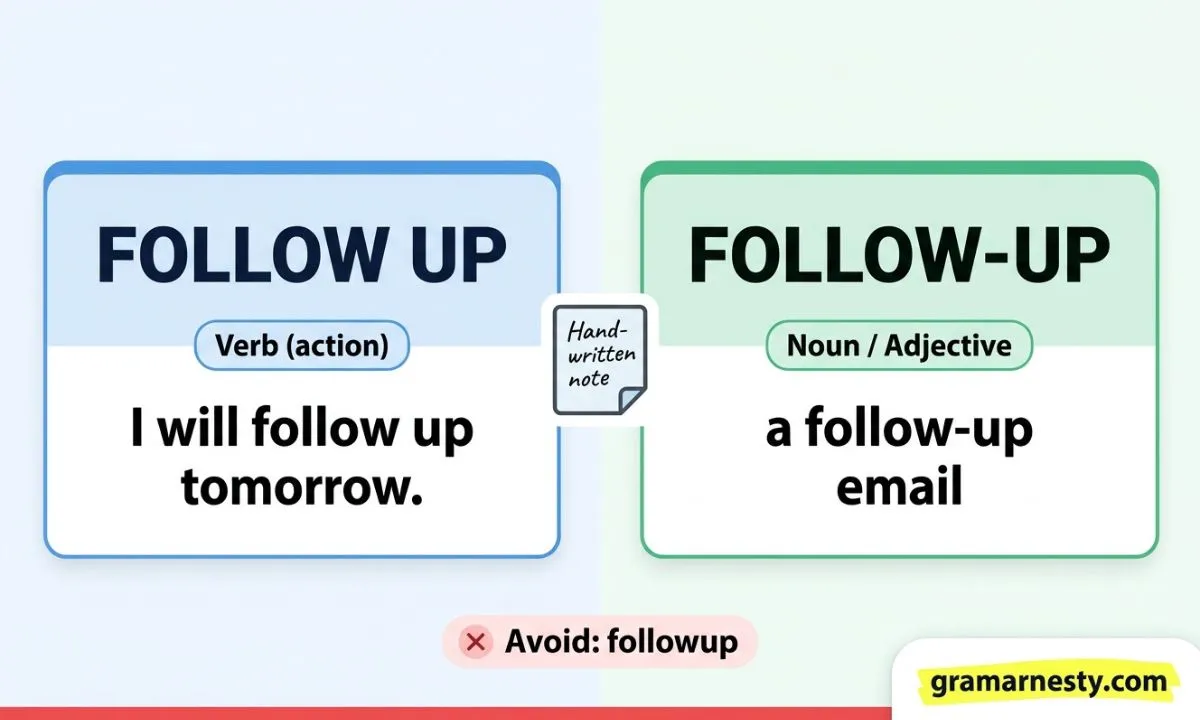
Use follow up (two words) when it is a verb: “I will follow up tomorrow.”
Use follow-up (hyphenated) when it is a noun or adjective: “a follow-up email.”
Major dictionaries list the hyphenated form, so avoid the one-word followup in formal writing.
Followup vs Follow Up vs Follow-Up at a Glance
| Form | Part of Speech | Hyphen? | Plural or Forms | Example | Safe in Formal Writing? |
| follow up | Verb (phrasal verb) | No | follows up, followed up, following up | I will follow up with her on Monday. | Yes |
| follow-up | Noun | Yes | follow-ups | She has a follow-up on Friday. | Yes |
| follow-up | Adjective (before a noun) | Yes | No plural | Please read the follow-up email. | Yes |
| followup | One-word variant | No | followups | I scheduled a followup. | No, avoid it |
ALSO READ THIS:Tomorrow vs Tommorow
The Rule Behind It: Phrasal Verb vs Compound Noun
English often builds a noun or adjective out of a verb phrase. Dictionary.com describes the noun and adjective follow-up as uses of the verb phrase follow up. The verb keeps its space because each word does its own job. The noun and adjective work as one unit, so they are joined.
Why the Verb Stays Two Words
Follow up is a phrasal verb: follow is the action and up is a particle that completes it. You change the first word like any other verb, and the space never turns into a hyphen.
- Correct: She followed up after the call.
- Incorrect: She followed-up after the call.
Why the Noun and Adjective Take a Hyphen
When you name a thing (“a follow-up”) or describe one (“a follow-up email”), the hyphen shows that the two words form a single idea. Merriam-Webster, Oxford Learner’s Dictionaries, and the Britannica Learner’s Dictionary all list the noun and adjective with a hyphen.
Same Pattern in Other Words
The verb is written as two words in each of these pairs. The noun or adjective is joined, but some are closed and some are hyphenated.
| Verb (two words) | Noun or Adjective | Example |
| log in | login | Please log in. / Enter your login details. |
| set up | setup | We set up the room. / The setup took an hour. |
| back up | backup | Back up your files. / Keep a backup. |
| check in | check-in | Check in at noon. / The check-in is easy. |
| sign up | sign-up | Sign up today. / The sign-up form is short. |
| follow up | follow-up | Follow up tomorrow. / A follow-up is planned. |
This is a pattern, not a law. Dictionaries differ on some of these compounds, so check a current dictionary instead of guessing. For follow-up, the hyphenated form is the standard one.
ALSO READ THIS: Leafs or Leaves
Follow Up (Verb): Meaning, Forms, and Prepositions
As a verb, follow up means to take further action on something that has already started or been said. Merriam-Webster gives two core senses: to follow something with something similar, related, or additional, and to seek more details about it.
Verb Forms: Follow Up, Follows Up, Followed Up, Following Up
| Form | Use | Example |
| follow up | Base form | I need to follow up. |
| follows up | He, she, it | She follows up with every client. |
| followed up | Past | He followed up by phone. |
| following up | -ing form | I’m following up on my last message. |
Follow Up On or Follow Up With?
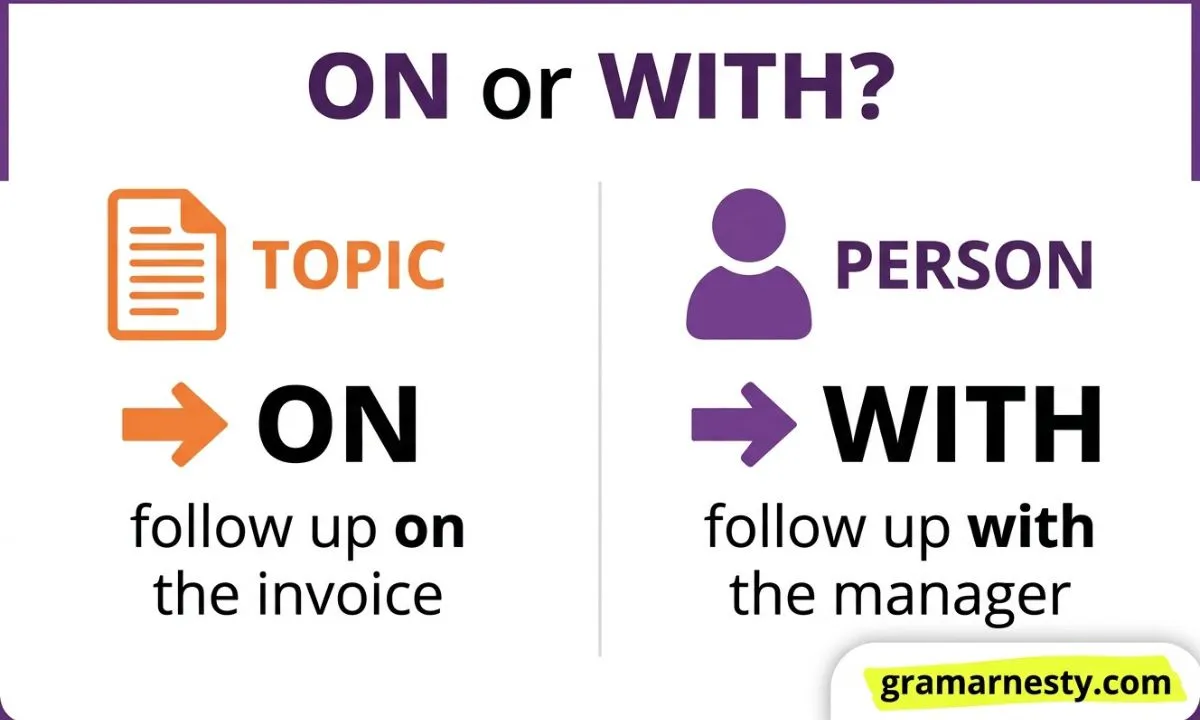
A simple test: a topic usually takes on, and a person takes with. You will also see about with a topic in casual speech, but on is the safer choice in formal writing.
- I will follow up on the invoice.
- I will follow up with the manager.
- Reporters are following up a new lead. (no preposition, because lead is the direct object)
Follow-Up (Noun and Adjective): Meaning and Usage
Follow-Up as a Noun (and the Plural: Follow-Ups)
A follow-up is a later action, meeting, message, or report that continues something earlier. It is countable, and the plural is follow-ups.
- The nurse booked a follow-up for next Tuesday.
- Neither of the two follow-ups got a reply.
Follow-Up as an Adjective Before a Noun
As an adjective, follow-up describes the noun that comes right after it. Oxford Learner’s Dictionaries and the Britannica Learner’s Dictionary both mark this use as appearing only before a noun.
- She asked a follow-up question.
- We scheduled a follow-up appointment.
After “Is” or “Was”: “The Email Was a Follow-Up”
In “The email was a follow-up,” the word is still a noun, because it follows the article a. The hyphen stays. Another example: “The new album is a follow-up to her 2022 debut.”
ALSO READ THIS: Verbage or Verbiage
Is “Followup” One Word Correct?
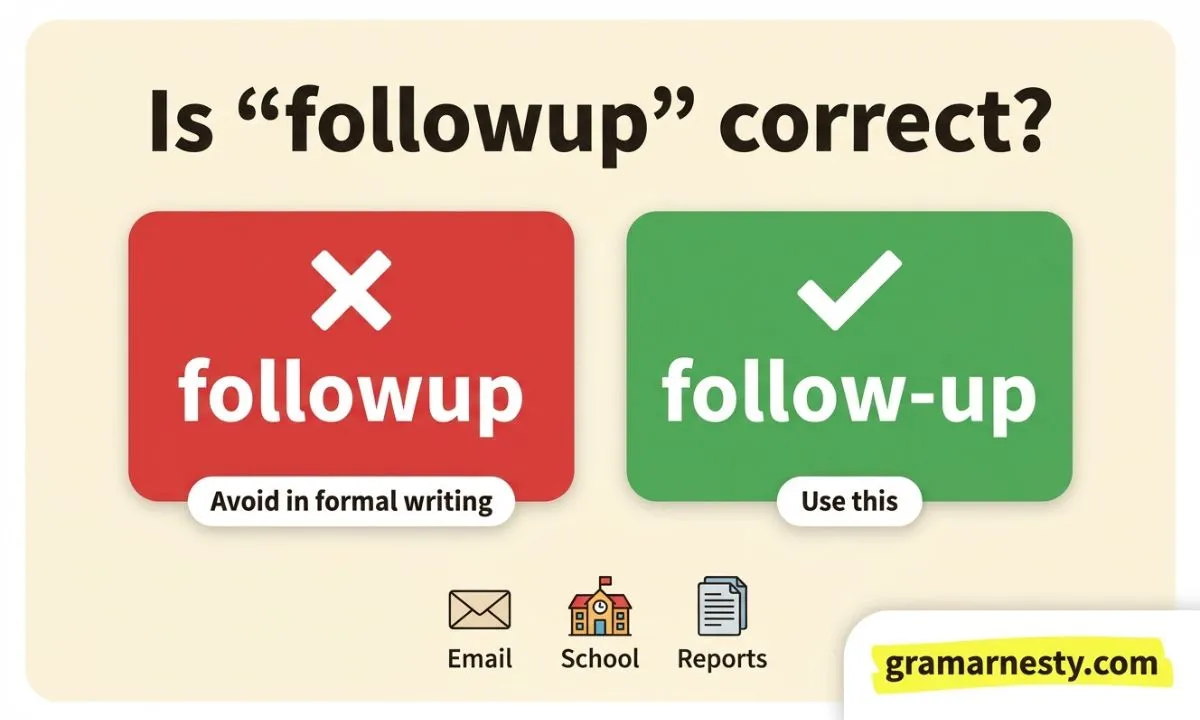
Usually not. Several style and grammar resources call followup a spelling error, and one comparison of dictionaries reports that Merriam-Webster and Oxford do not list it as a variant. However, a Grammarly article says the American Heritage Dictionary lists it as an alternative spelling, so the status is not completely uniform. The safe choice is follow-up.
When You May See “Followup”
You may notice the one-word form in headlines, product names, software labels, and informal messages. A company can choose it as a house style, but that does not make it the standard spelling.
Why to Avoid It in Formal Writing
Teachers, editors, and hiring managers usually expect follow-up. In school work, emails, reports, and job applications, the hyphenated form avoids any doubt.
How to Pronounce Follow Up and Follow-Up
The spelling changes, but the sounds do not, so you cannot hear the difference between a noun and a verb by the letters.
What changes is the stress. Merriam-Webster’s respellings put the main stress on the first syllable of the noun and on up in the verb.
| Form | Stress | US | UK |
| follow-up (noun, adjective) | FOL-oh-up | /ˈfɑːloʊˌʌp/ | /ˈfɒləʊ ʌp/ |
| follow up (verb) | fol-oh-UP | Stress moves to “up” | Stress moves to “up” |
ALSO READ THIS: Meantime vs Mean
Real-Life Example Sentences
These situations show how followup or follow up works in everyday life. In each pair, the first sentence uses the verb and the second uses the noun or adjective.
At Work and in Email
- I’ll follow up with finance about the budget approval.
- Thursday’s meeting is just a follow-up to Monday’s call.
Job Interviews and Hiring
- I plan to follow up with a thank-you email tomorrow morning.
- The panel asked a follow-up question about my last project.
Customer Service and Sales
- Our support team will follow up on your complaint today.
- You will receive a follow-up survey after your purchase.
Medical and School Situations
- Please follow up with your doctor if the pain continues.
- Our teacher gave us a follow-up worksheet on fractions.
Texting and Social Media
Her follow-up post cleared up the confusion.
Let me follow up with Sara and text you back.
ALSO READ THIS: Carmel vs Caramel
Follow-Up Email, Meeting, Call, or Question: Which Form Is Correct?
Before a noun, always use the hyphenated adjective. When you describe an action instead, switch to the two-word verb.
| Phrase | Adjective (hyphenated) | Verb version (two words) |
| follow-up email | She sent a follow-up email. | I will follow up by email. |
| follow-up meeting | We booked a follow-up meeting. | We need to follow up after the meeting. |
| follow-up call | The clinic made a follow-up call. | The clinic will follow up by phone. |
| follow-up question | He asked a follow-up question. | Can I follow up on that point? |
| follow-up appointment | She has a follow-up appointment. | Please follow up with your doctor. |
“Just Following Up”: Is It Polite? Better Alternatives
“Just following up” is grammatically correct, because following up is the -ing form of the verb. The hyphenated “following-up” is the mistake. The only real issue is tone: repeated again and again, it can sound impatient.
- Original: Just following-up on my last email.
- Corrected: Just following up on my last email.
- Softer option: I wanted to check whether you had a chance to review my proposal.
- Other options: “Checking in on…” or “Circling back on…”
Email Subject Lines and Openers
Subject line (noun or adjective):
“Follow-up: Marketing Coordinator Interview”
Subject line (verb phrase):
“Following up on Tuesday’s meeting”
Opener: “I’m following up on the report I sent last week.”
Before: Please send me a follow up. After: Please send me a follow-up.
In the title case, many style guides capitalize both parts of a hyphenated compound, so you will see “Follow-Up” in headings. In the sentence case, write “Follow-up.”
ALSO READ THIS: Other Ways to Say Take Care
ISynonyms and Related Words
Synonyms for Follow Up (Verb)
Check in, check back, circle back, revisit, pursue, look into. Example: “I’ll check back with you on Friday.”
Synonyms for Follow-Up (Noun)
Reminder, check-in, update, next step, continuation. For books and films, sequel or next installment also fits. Example: “The film is a sequel, not a remake.”
Follow Up vs Follow Through vs Follow-On
- Follow up: take further action on something already started or said.
- Follow through: carry something all the way to completion. The noun form is follow-through.
- Follow-on: the Britannica Learner’s Dictionary defines it as something that happens or is done to continue or add to something previous.
Example: “She followed up with the client, then followed through on her promise.”
ALSO READ THIS: 25+ Policy Synonyms
Common Mistakes (and Why People Make Them)
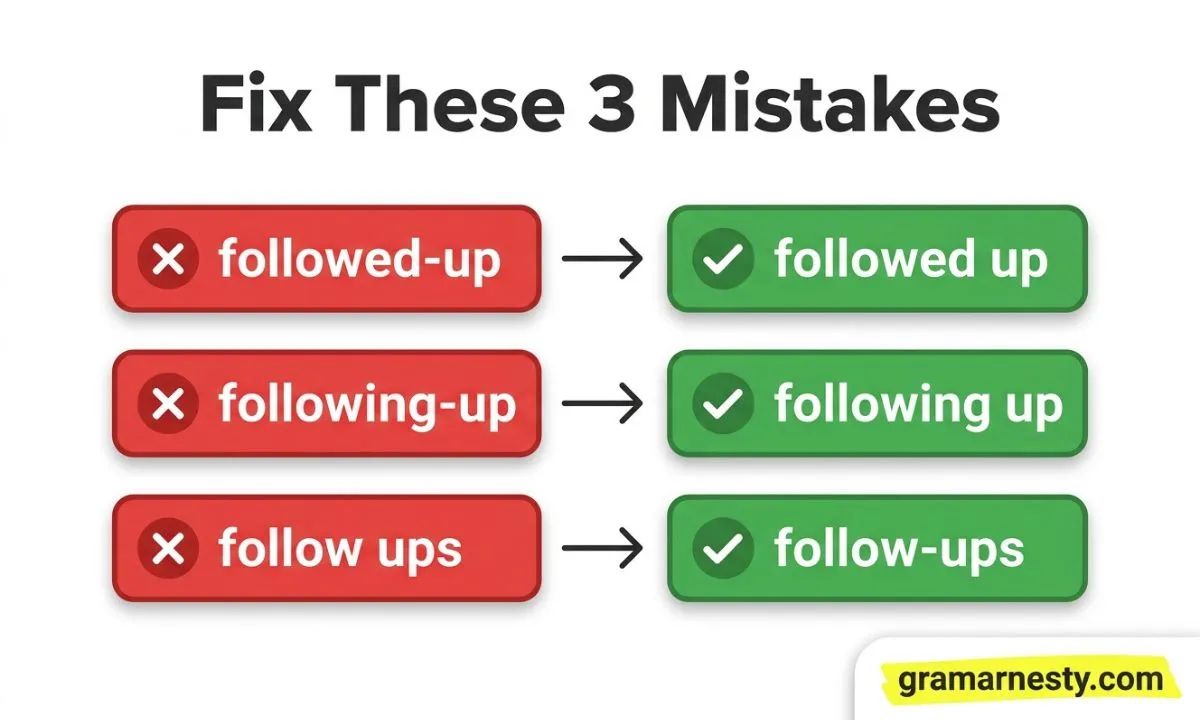
Most followup or follow up errors fall into three groups: spelling errors, grammar errors, and consistency slips. The “Why” column shows what usually causes each one.
| Mistake | Type | Why It Happens | Fix |
| Please follow-up with me. | Grammar | The noun form is copied onto the verb. | Please follow up with me. |
| She followed-up on it. | Grammar | A hyphen is added to look professional. | She followed up on it. |
| I’m following-up on my email. | Grammar | The hyphen is carried into the -ing form. | I’m following up on my email. |
| I will followup tomorrow. | Spelling | The word is treated like “backup.” | I will follow up tomorrow. |
| Send a follow up email. | Spelling | The hyphen is forgotten before a noun. | Send a follow-up email. |
| We had three follow ups. | Spelling | The plural is added to the verb form. | We had three follow-ups. |
| Here are my follow-up’s. | Spelling | An apostrophe is added to a plural. | Here are my follow-ups. |
| Mixing followup and follow-up in one document | Consistency | Autocorrect or a quick edit changes one instance. | Pick one standard form and use it throughout. |
Memory Tricks to Remember the Difference
Use these four quick tests whenever followup or follow up trips you up.
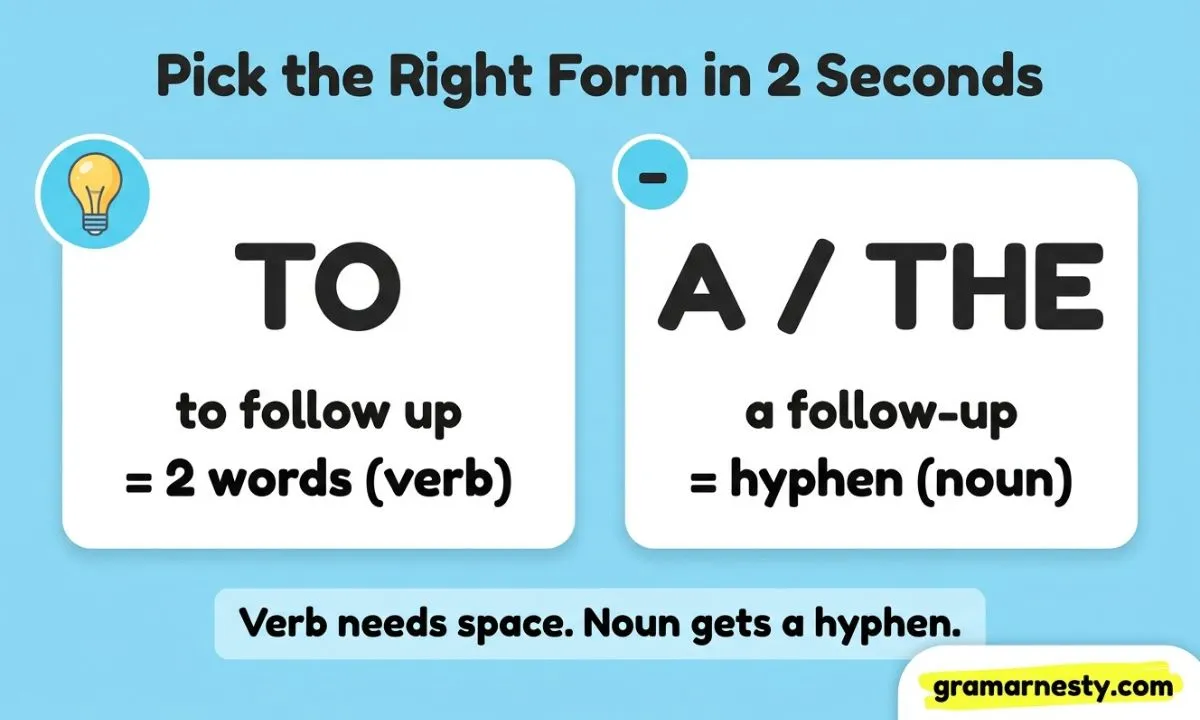
Action vs Thing
If you do it, keep two words. If you name it or use it to describe something, add the hyphen.
The -ED / -ING / Plural Test
Can the word take -ed or -ing (followed up, following up)? Then it is a verb, so keep the space. Can it take an -s at the very end (follow-ups)? Then it is a noun, so use the hyphen.
The “To” vs “A/The” Test
If it fits in front (“to follow up”), use two words. If a or the fits in front (“a follow-up”), use the hyphen.
The Hyphen-as-Glue Rhyme
A verb needs space to move. A noun gets a hyphen to hold it together.
ALSO READ THIS: Anise vs Aniseed
American vs British English
For followup or follow up, I found no regional spelling difference. Merriam-Webster (American), Oxford Learner’s Dictionaries (British), and the Britannica Learner’s Dictionary all spell the noun and adjective with a hyphen and the verb as two words. The difference is in pronunciation: the first vowel sounds like “fah” in American English and like “fol” in British English.
What Major Dictionaries and Style Guides Say
Here is what reference sources say about followup or follow up.
Merriam-Webster lists follow-up as a noun and an adjective, and follow up as a separate verb.
Oxford Learner’s Dictionaries: lists follow-up as a noun (countable and uncountable) and as an adjective used only before a noun.
Britannica Learner’s Dictionary: lists follow-up with the plural follow-ups and marks the adjective as always used before a noun.
Dictionary.com: treats the noun and adjective as uses of the verb phrase follow up, first recorded in 1920–25.
American Heritage (reported by Grammarly): a Grammarly article says this dictionary lists followup as an alternative, so check the current entry if your style guide depends on it.
ALSO READ THIS: Organizing vs Organising
Quick Cheat Sheet
One word: followup. Avoid it in formal writing.
Verb: follow up (two words), as in “I will follow up.”
Noun: follow-up (hyphen), as in “She has a follow-up.”
Adjective: follow-up (hyphen), as in “a follow-up email.”
Plural: follow-ups.
Quick Test I Created
Practice Quiz: Test Yourself
Check what you have learned about followup or follow up with these ten questions. The answer key is below.
I will ____ with the customer on Monday. (follow up / follow-up)
She sent a ____ email after the interview. (follow up / follow-up)
The dentist booked my ____ for next month. (follow up / follow-up)
Correct the error: “Thanks for following-up so quickly.”
Correct the error: “We sent three followups last week.”
Is “follow-up” a noun, verb, or adjective here? “The follow-up was helpful.”
Please ____ with me after the meeting. (follow up / follow-up)
Remember to ____ your files. (back up / backup)
True or false: the hyphenated “follow-up” can be used as a verb.
Correct the error: “Here is a follow up question.”
Answer Key
“Here is a follow-up question.” It is an adjective before a noun.
follow up. A verb takes two words.
follow-up. It describes the noun email.
follow-up. It is a noun here.
“Thanks for following up so quickly.” The verb form never takes a hyphen.
“We sent three follow-ups last week.” Hyphenate the noun and add -s.
Noun. It names the thing that was helpful.
follow up. It is an action.
back up. The verb is two words, while the noun is “backup.”
False. The verb is “follow up.”
ALSO READ THIS: 70 Synonyms for “Join Us
Frequently Asked Questions
Is “followup” one word correct?
Usually not. Most style and grammar resources treat “followup” as a spelling error, although at least one dictionary is reported to list it as an alternative. Use “follow-up” instead.
Is it follow up or follow-up in an email?
It depends on the job the word does. Use “follow up” as a verb (“I will follow up tomorrow”) and “follow-up” as a noun or adjective (“a follow-up email”).
Is “follow-up” a verb?
No. The verb is “follow up” (two words), as in “Please follow up with the client.” The hyphenated form is a noun or an adjective.
What is the plural of follow-up?
The plural is “follow-ups.” Write “We sent two follow-ups,” not “follow ups” or “follow-up’s.”
Is it “a follow up” or “a follow-up”?
Write “a follow-up.” Dictionaries list the noun with a hyphen, and you may see “a follow up” in casual writing, but the hyphenated form is the safe choice.
Should I hyphenate “follow up” in a heading or title?
Hyphenate it only when it is a noun or adjective, such as “Follow-Up Email Tips.” Keep a verb phrase open, as in “How to Follow Up After an Interview.”
Is “just following up” rude?
The grammar is correct, but the tone can feel impatient if you repeat it. Try “checking in on” or “circling back on” for a softer opener.
What is the difference between follow up and follow through?
“Follow up” means to take further action on something already started or said. “Follow through” means to carry something to completion, and its noun form is “follow-through.”
How do you pronounce follow-up?
As a noun or adjective, stress the first syllable: FOL-oh-up. As a verb, stress “up”: fol-oh-UP.
Conclusion
The question of followup or follow up has a simple rule behind it. Use follow up for the action, use follow-up for the thing or the description, and skip the one-word followup in formal writing.
Keep the quick tests handy: “to follow up” for the verb, “a follow-up” for the noun. With a little practice, followup or follow up will stop being a guess and become automatic.
Explore More Grammar Guides
