

“Interest” is a small word that does a lot of work. It can mean curiosity, a hobby, a concern, or money paid on a loan. Swap in the wrong word and your sentence shifts meaning or sounds off.
This guide gives you synonyms for interest sorted by tone, with a plain explanation, a real-sounding example, and a usage tip for each one.
You’ll also learn how to pick the right word for your context.
Quick Answer: What Are the Best Synonyms for Interest?
The best synonyms for interest are curiosity, attention, enthusiasm, fascination, engagement, and concern.
Which one fits depends on what you mean:
Wanting to know more,
Paying attention,
Feeling excited,
Taking part,
Caring about an outcome.
Best Everyday Synonyms for Interest
Curiosity, enthusiasm, fascination, enjoyment, liking, and passion. These sound natural in speech and personal writing.
Best Formal Synonyms for Interest
Regard, appreciation, consideration, inclination, and attention. They suit essays, letters, and official statements.
Best Professional Synonyms for Interest
Engagement, involvement, focus, awareness, and concern. Use them in emails, reports, resumes, and meetings.
What Does “Interest” Mean?
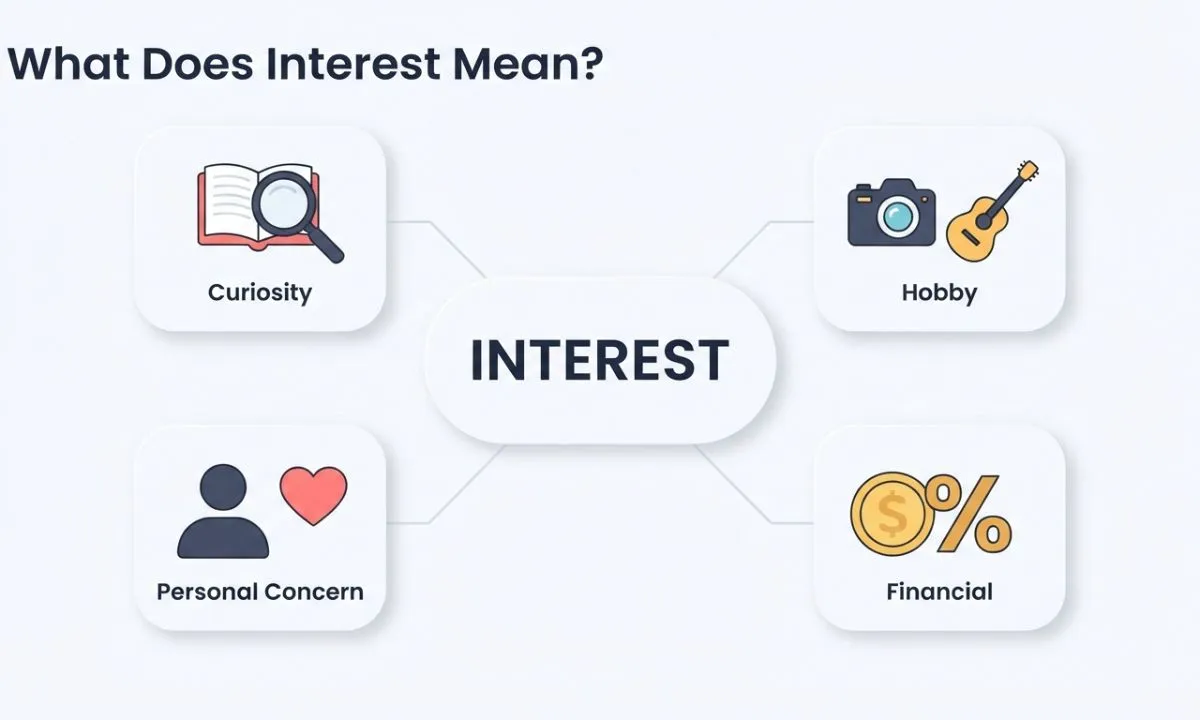
The word has four main senses.
Knowing which one you need is half the job, because most interesting synonyms only match one of them.
Interest as Curiosity or Attention
This is the feeling of wanting to know more or keep watching.
Good matches: curiosity, attention, fascination, intrigue.
Interest as a Hobby or Activity
Here “interest” means something you enjoy doing, as in “my interests include hiking.”
Good matches: hobby, pastime, passion.
Interest as Financial Interest
This sense means money charged on a loan, or a share in a business. Personal-feeling words like curiosity do not work here.
Use words such as “stake,” “share,” or “return” instead.
Interest as a Personal Concern
This means something that matters to you or affects you, as in “it’s in your interest to apply early.”
Good matches: concern, stake, regard.
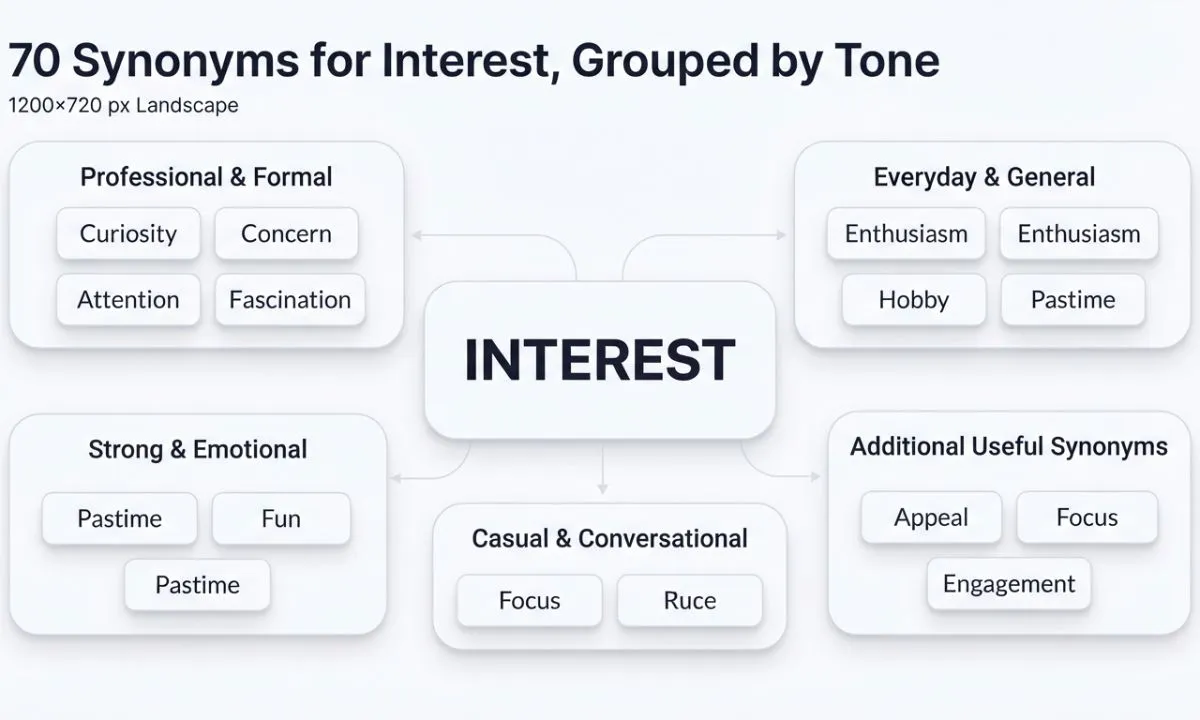
70 Synonyms for Interest, Grouped by Tone
Some words below are close matches. Others work for only one sense of interest, and the tips say so. A few words appear in more than one group because their feel changes with context.
Professional and Formal Synonyms
1. Curiosity
Meaning:
A wish to learn or find out more about something.
Example:
Her curiosity about marine biology began with a school trip to the aquarium.
Usage Tip:
Choose it when the interest is about wanting to know. It is lighter than “interest in” and says little about long-term commitment.
2. Concern
Meaning:
Something that matters to you because it affects you or people you care about.
Example:
Water quality is a major concern for residents near the river.
Usage Tip:
This is a partial synonym. It matches “interest” as a stake or worry, not as a hobby. You can’t swap it into “an interest in painting.”
3. Attention
Meaning:
Focus directed at something.
Example:
The report drew attention from several department heads.
Usage Tip:
It replaces “interest” in phrases like “catch someone’s interest.” It describes focus, not lasting liking.
4. Fascination
Meaning:
A strong interest that holds your mind.
Example:
His fascination with old maps filled an entire bookshelf.
Usage Tip:
Stronger than plain interest. Say “fascination with” rather than “fascination in.”
5. Enthusiasm
Meaning:
Energetic, visible interest in something.
Example:
The interviewer noticed her enthusiasm for the role right away.
Usage Tip:
It stresses energy and eagerness, not just attention. A solid pick for cover letters and recommendations.
6. Engagement
Meaning:
Active involvement and attention.
Example:
Student engagement rose after the class moved to group projects.
Usage Tip:
A professional word for people who participate, not just watch. It sounds stiff for private hobbies.
7. Involvement
Meaning:
Taking part in something.
Example:
The charity thanked him for his involvement in the food drive.
Usage Tip:
It measures what someone does, not what they feel. Use it when interest shows up as action.
8. Regard
Meaning:
Respect or careful attention given to a person or matter.
Example:
The board showed genuine regard for employee wellbeing.
Usage Tip:
It matches the “personal concern” sense only. It means respect, not curiosity. Keep it for formal writing.
9. Appreciation
Meaning:
Valuing something and understanding its worth.
Example:
Years of travel gave him a deep appreciation of regional food.
Usage Tip:
Best when interest has grown through learning. It doesn’t suit a passing spark of curiosity.
10. Consideration
Meaning:
Careful thought given to something or someone.
Example:
The committee took the tenants’ interests into consideration before voting.
Usage Tip:
A partial match. It works in the “interests” plural sense of what matters to people, not for enthusiasm.
11. Awareness
Meaning:
Knowing that something exists and noticing it.
Example:
Awareness of the problem came first; action followed months later.
Usage Tip:
Awareness is knowing. Interest is caring. Use it as an early stage of interest, not a replacement.
12. Focus
Meaning:
The main thing your attention or effort goes toward.
Example:
Her research focus is soil health in dry regions.
Usage Tip:
“Main interest” often becomes “focus” in a resume or proposal. It implies narrowing down, not casual browsing.
13. Notice
Meaning:
Attention paid to something, often briefly.
Example:
The new café has started to attract notice from local food critics.
Usage Tip:
Light and slightly formal. Common in “take notice” and “attract notice.” It is only a partial synonym.
14. Recognition
Meaning:
Acknowledging that something has value or importance.
Example:
The idea is finally gaining recognition among city planners.
Usage Tip:
Limited use. It signals acknowledgment, not a desire to learn more.
15. Enthrallment
Meaning:
Being completely held by something.
Example:
A hush of enthrallment settled over the audience during the final act.
Usage Tip:
Rare and literary. In plain writing, “fascination” reads more naturally.
16. Absorption
Meaning:
Deep mental engagement in a task or subject.
Example:
Her absorption in the crossword made her miss lunch.
Usage Tip:
It describes depth, not enthusiasm. Say “absorption in.”
17. Preoccupation
Meaning:
A subject that keeps occupying your thoughts.
Example:
His preoccupation with ratings had him checking the app hourly.
Usage Tip:
It often carries a negative edge. Don’t use it as a neutral swap for “interest.”
18. Inclination
Meaning:
A natural leaning toward something.
Example:
She has always shown an inclination toward design.
Usage Tip:
Mild and slightly formal. It points to a tendency, not deep involvement.
19. Preference
Meaning:
Choosing one option over another.
Example:
Applicants with a preference for fieldwork may enjoy this role.
Usage Tip:
A partial synonym. Interest is liking something; preference is ranking it above alternatives.
20. Attraction
Meaning:
A pull toward something that draws you in.
Example:
The main attraction of the job is its flexible schedule.
Usage Tip:
Works when something draws interest. Between people, it implies romance, so check the context.
Everyday and General Synonyms
21. Fascination
Meaning:
Interest is strong enough that you keep coming back to the subject.
Example:
Kids often have a natural fascination with dinosaurs.
Usage Tip:
Fine in daily speech. Skip it for mild liking, since it signals something stronger.
22. Curiosity
Meaning:
A small itch to know the answer.
Example:
Just out of curiosity, what time does the market open?
Usage Tip:
In casual talk it often frames harmless questions. It sounds less committed than “interest.”
23. Excitement
Meaning:
An eager, energetic feeling about something.
Example:
The new season has built real excitement among fans.
Usage Tip:
Excitement spikes and fades. Interest is steadier, so this is a partial match.
24. Appeal
Meaning:
The quality that makes something attractive to someone.
Example:
Trail running holds little appeal for me.
Usage Tip:
It describes what the thing offers, not what you feel. “Lost its appeal” is close to “lost interest.”
25. Liking
Meaning:
Mild fondness for something.
Example:
He developed a liking for jazz in college.
Usage Tip:
Gentler than interesting. “Take a liking to” is a handy phrase.
26. Enjoyment
Meaning:
Pleasure you get from doing or experiencing something.
Example:
Her enjoyment of gardening grows every spring.
Usage Tip:
It stresses pleasure. A subject can interest you without being enjoyable, such as war history.
27. Pleasure
Meaning:
Delight in an activity or subject.
Example:
He takes pleasure in repairing old radios.
Usage Tip:
Warm and a little formal. “Take pleasure in” is close to “take an interest in.”
28. Passion
Meaning:
Strong, lasting enthusiasm for something you care about deeply.
Example:
Photography started as a hobby, but now it’s her passion.
Usage Tip:
Stronger than a hobby. Overuse makes ordinary likes sound inflated.
29. Love
Meaning:
Deep fondness for a subject or activity.
Example:
His love of astronomy began with a cheap secondhand telescope.
Usage Tip:
Use “love of” for long-lasting interests. It can feel dramatic for casual ones.
30. Admiration
Meaning:
Respect and approval for someone’s work or qualities.
Example:
She spoke with admiration about her first coach.
Usage Tip:
Only a partial match. It fits when interest comes with respect, mostly toward people or achievements.
31. Attraction
Meaning:
A feeling of being drawn toward an idea or place.
Example:
I felt an instant attraction to the idea of living by the sea.
Usage Tip:
In everyday speech it can hint at romance. Add detail so the meaning is clear.
32. Appeal
Meaning:
Wide attractiveness to many people.
Example:
The app’s simple design has broad appeal.
Usage Tip:
“Wide appeal” is similar to “wide interest.” Common in product and marketing talk.
33. Draw
Meaning:
A feature that pulls people in.
Example:
Free coffee is a big draw for new members.
Usage Tip:
Casual noun for what attracts interest. It names the cause, not the feeling.
34. Pull
Meaning:
A strong force that attracts you.
Example:
She still felt the pull of her hometown.
Usage Tip:
Emotional and slightly poetic. It suggests the attraction is hard to resist.
35. Allure
Meaning:
A tempting, attractive quality.
Example:
The allure of remote work is hard to ignore.
Usage Tip:
A little literary. It suggests glamour or temptation more than plain interest.
Strong and Emotional Synonyms
36. Passion
Meaning:
Intense commitment to a subject or cause.
Example:
Her passion for wildlife conservation shapes every career choice she makes.
Usage Tip:
Save it for deep, long-term interest. It carries more weight than “hobby” or “liking.”
37. Obsession
Meaning:
A fixation that dominates your thoughts.
Example:
His obsession with perfect espresso started to worry his friends.
Usage Tip:
Usually negative. Use it only when you mean unhealthy or excessive focus.
38. Fascination
Meaning:
Being mentally gripped by a subject.
Example:
A fascination with deep-sea creatures pushed her toward oceanography.
Usage Tip:
In the strong register, it suggests the subject holds your mind, not just that you like it.
39. Enthusiasm
Meaning:
High, visible energy about something.
Example:
His enthusiasm for the project lifted the whole team.
Usage Tip:
It can spread to others, which makes it useful when describing group energy.
40. Excitement
Meaning:
A strong rush of anticipation.
Example:
Excitement about the launch kept her awake all night.
Usage Tip:
Best for short bursts tied to an event, not long-term interest.
41. Eagerness
Meaning:
A keen wish to do or get something.
Example:
The intern’s eagerness to learn showed in the questions he asked.
Usage Tip:
I look forward to it. It implies readiness to act, not just curiosity.
42. Zeal
Meaning:
Great energy for a cause or goal.
Example:
The volunteers cleaned the beach with real zeal.
Usage Tip:
Formal and slightly old-fashioned. Tied to causes or beliefs, and can sound fanatical.
43. Devotion
Meaning:
Deep loyalty and commitment to something.
Example:
Her devotion to classical piano meant practicing before dawn.
Usage Tip:
Heavier than passion. It signals long-term commitment and sacrifice.
44. Dedication
Meaning:
Giving your time and effort to something.
Example:
His dedication to the craft shows in every chair he builds.
Usage Tip:
It describes effort, not feeling. A partial synonym, but strong for work-related interests.
45. Ardor
Meaning:
Intense warmth of feeling.
Example:
He argued his case with ardor.
Usage Tip:
Literary and rare. In British English, it’s spelled “ardour.”
46. Excitement
Meaning:
A shared, lively feeling in a group.
Example:
There was real excitement in the room when the results came in.
Usage Tip:
Works well for crowds and teams. It describes mood more than individual interest.
47. Thrill
Meaning:
A sudden, sharp burst of excitement.
Example:
The thrill of solving a hard puzzle keeps her coming back.
Usage Tip:
Short and intense, often tied to novelty or risk. Partial synonym.
48. Wonder
Meaning:
Curiosity mixed with awe.
Example:
Children often watch the night sky with wonder.
Usage Tip:
Gentle and emotional. It rarely fits business writing.
49. Intrigue
Meaning:
Curiosity sparked by something mysterious or unusual.
Example:
The unsigned letter filled him with intrigue.
Usage Tip:
It can also mean secret plotting, as in “political intrigue.” Check that the context is clear.
50. Captivation
Meaning:
The state of being charmed and held by something.
Example:
Captivation showed on every face as the magician began his final trick.
Usage Tip:
Rare as a noun. The verb “captivated” usually reads more naturally.
Casual and Conversational Synonyms
51. Hobby
Meaning:
An activity you do for pleasure in your spare time.
Example:
Birdwatching is my latest hobby.
Usage Tip:
It replaces “interest” only when you mean an activity. “Outside interests” often becomes “hobbies.”
52. Pastime
Meaning:
A pleasant way to spend free time.
Example:
Card games are a favorite pastime in our family.
Usage Tip:
Relaxed and a bit old-fashioned. It fits easygoing activities.
53. Thing
Meaning:
An informal word for something you’re into.
Example:
Vintage sneakers are kind of his thing.
Usage Tip:
Spoken English only. Avoid it in formal or professional writing.
54. Liking
Meaning:
A mild preference for something.
Example:
That show isn’t really to my liking.
Usage Tip:
“To my liking” is a polite way to say something doesn’t interest you.
55. Love
Meaning:
Real fondness for a subject.
Example:
I have a real love for old sci-fi movies.
Usage Tip:
Warm and relaxed in conversation. “Love for” works better than “love in.”
56. Enjoyment
Meaning:
The pleasure behind doing something.
Example:
I mostly read for enjoyment these days.
Usage Tip:
Handy when someone asks why you do something. It answers with pleasure, not curiosity.
57. Fun
Meaning:
Light, playful enjoyment.
Example:
Trivia night is great fun.
Usage Tip:
Very informal. It describes the experience, not a lasting interest, so it’s a partial match.
58. Excitement
Meaning:
A happy, eager feeling you can’t hide.
Example:
I can’t hide my excitement about the road trip.
Usage Tip:
Common in texts and chats. It signals a short-lived feeling.
59. Curiosity
Meaning:
A playful urge to find something out.
Example:
My curiosity got the better of me, so I peeked inside.
Usage Tip:
The phrase “pure curiosity” is a friendly way to say you’re asking without any agenda.
60. Fascination
Meaning:
A quirky, strong draw toward a topic.
Example:
I have a weird fascination with lighthouses.
Usage Tip:
Add “weird” or “odd” for humor. It makes the interest sound charming, not intense.
Additional Useful Synonyms
61. Regard
Meaning:
Respect or high opinion.
Example:
He holds the local library in high regard.
Usage Tip:
It means respect, not curiosity. “Hold in high regard” is the phrase to know.
62. Concern
Meaning:
Something that matters and needs attention.
Example:
Keeping the shop open is their shared concern.
Usage Tip:
Pick it when someone has a stake in the result. It also suggests worry, so watch the tone.
63. Appreciation
Meaning:
Understanding why something is good or valuable.
Example:
Her appreciation for modern art grew after the gallery tour.
Usage Tip:
Fits interest built through learning and exposure.
64. Awareness
Meaning:
Knowing something is there.
Example:
His awareness of the issue led him to volunteer.
Usage Tip:
It often comes before interest. On its own, it doesn’t show enthusiasm.
65. Engagement
Meaning:
How actively people respond to something.
Example:
Newsletter engagement is up this quarter.
Usage Tip:
In marketing, it usually means measurable actions like clicks and replies, not private feeling.
66. Involvement
Meaning:
Active participation in something.
Example:
Her involvement in local politics began with a neighborhood petition.
Usage Tip:
Use it when interest shows up as action.
67. Attention
Meaning:
Focus given to a subject.
Example:
The documentary brought fresh attention to the issue.
Usage Tip:
“Bring attention to” and “draw attention” often stand in for “generate interest.”
68. Focus
Meaning:
A main area of effort or priority.
Example:
Our focus this year is customer support.
Usage Tip:
Good for plans and priorities. It signals what comes first, not just what you like.
69. Attraction
Meaning:
A place or feature people want to visit.
Example:
The old fort is the town’s main attraction.
Usage Tip:
Matches the “point of interest” idea for places. It’s a noun for the thing, not the feeling.
70. Appeal
Meaning:
What makes something desirable?
Example:
The offer lost its appeal after the price went up.
Usage Tip:
You may need to flip the sentence. “It lost its appeal” is close to “I lost interest.”
Synonyms for Interest by Context
Synonyms for Interest in Conversation
Try curiosity, fascination, enthusiasm, or a casual phrase like “into.” They sound natural out loud.
Synonyms for Interest in Education
Curiosity, engagement, and focus fit classroom and academic settings. “Intellectual curiosity” is common in student statements.
Synonyms for Interest in Business
Engagement, involvement, and focus work well. Concern fits when someone has a stake in the result.
Synonyms for Interest in Professional Writing
Choose engagement, regard, or enthusiasm. Avoid slang like “thing.”
Synonyms for Interest in Hobbies and Activities
Hobby, pastime, passion, and enjoyment all point to activities. Choose passion only when the commitment is serious.
Synonyms for Interest in Personal Relationships
Attraction, affection, and regard show interest in a person. Be careful with “attraction,” which often reads as romantic.
Synonyms for Interest in Financial Contexts
None of the personal-feeling words above work here. For money, think “stake,” “share,” “return,” or “yield,” depending on the meaning.
Synonyms for Interest by Tone
Formal Synonyms for Interest
Regard, appreciation, inclination, consideration, zeal.
Professional Synonyms for Interest
Engagement, involvement, focus, awareness, concern.
Neutral Synonyms for Interest
Attention, curiosity, preference, appeal, awareness.
Casual Synonyms for Interest
Hobby, pastime, liking, love, fun, things.
Strong Synonyms for Interest
Passion, fascination, obsession, devotion, ardor.
Interest vs. Its Closest Alternatives
Interest vs. Curiosity
Curiosity wants an answer. Interest can last long after the questions are answered.
Interest vs. Attention
Attention is where your focus goes right now. Interest is why it goes there.
Interest vs. Concern
Concern suggests something matters to you or worries you. Interest is usually more positive and open.
Interest vs. Fascination
Fascination is interest turned up high. It grips the mind in a way plain interest doesn’t.
Interest vs. Enthusiasm
Enthusiasm adds visible energy. You can be interested and still be quiet about it.
Interest vs. Passion
Passion is deep and lasting. Many people have interests; far fewer have passions.
Interest vs. Attraction
Attraction is a pull toward something. Interest is the thinking, curious response to it.
Formal vs. Casual Synonyms for Interest
Formal Synonyms for Professional Writing
Choose regard, appreciation, engagement, or inclination. Keep the sentence structure clean and direct.
Neutral Synonyms for Everyday English
Curiosity, attention, liking, and enjoyment are safe almost anywhere.
Casual Synonyms for Conversations
Hobby, thing, fun, and love sound relaxed. They are best for friends, texts, and social posts.
How to Choose the Right Synonym for Interest
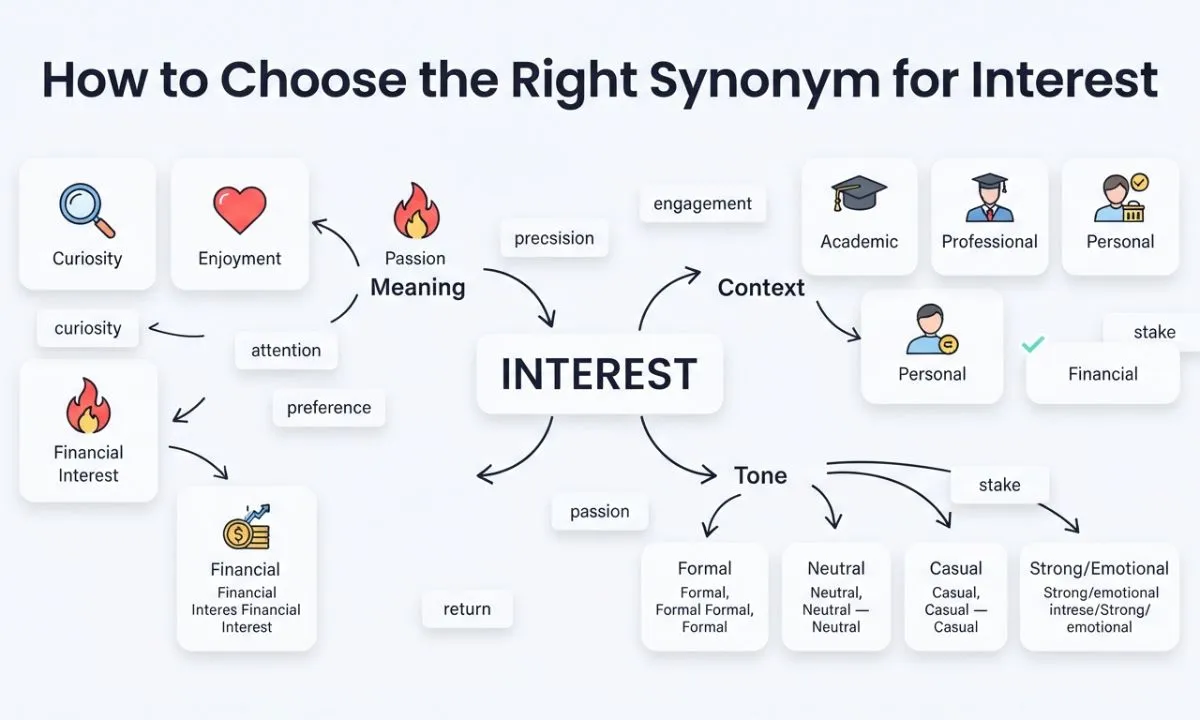
Consider the Meaning
Is It About Curiosity or Attention?
Use curiosity for wanting to know. Use attention for focus on something right now.
Is It About Enjoyment or Preference?
Pick enjoyment, liking, or pleasure when the feeling is fun. Pick preference when you mean choosing between options.
Is It About Strong Emotion?
Reach for passion, fascination, zeal, or devotion. Use obsession only if the focus is unhealthy.
Is It About Financial Interest?
Don’t use personal-feeling words. Use “stake,” “share,” or “return” depending on the sense.
Consider the Context
Academic and Educational Context
Curiosity, engagement, focus, and appreciation fit best.
Business and Professional Context
Engagement, involvement, awareness, and concern read clearly.
Personal and Social Context
Liking, love, hobby, and enthusiasm sound natural.
Financial Context
Choose money terms. “Stake” works for ownership, and “return” for earnings.
Consider the Tone
Formal Tone
Regard, appreciation, inclination.
Neutral Tone
Attention, curiosity, preference.
Casual Tone
Hobby, liking, love, fun.
Strong or Emotional Tone
Passion, fascination, devotion, ardor.
Common Mistakes When Using Interest Synonyms
Using a Synonym With the Wrong Meaning
“Her concern in painting” doesn’t work. Concern is about worry or stakes, not hobbies. Check the sense before you swap.
Confusing Interest With Curiosity
Curiosity is a wish to know. You can have an interest without any open questions.
Confusing Interest With Attention
Someone can pay attention without being interested, like a student in a boring lecture.
Using Strong Words Too Often
If everything is a passion or an obsession, the words lose their punch. Save them for the real thing.
Using Casual Words in Formal Writing
“Things” and “fun” are fine in a chat. In a report, they weaken your tone.
Ignoring the Context
A word that works in one sentence can fail in the next. Read the full sentence aloud before you decide.
Synonyms for Interest in Sentences
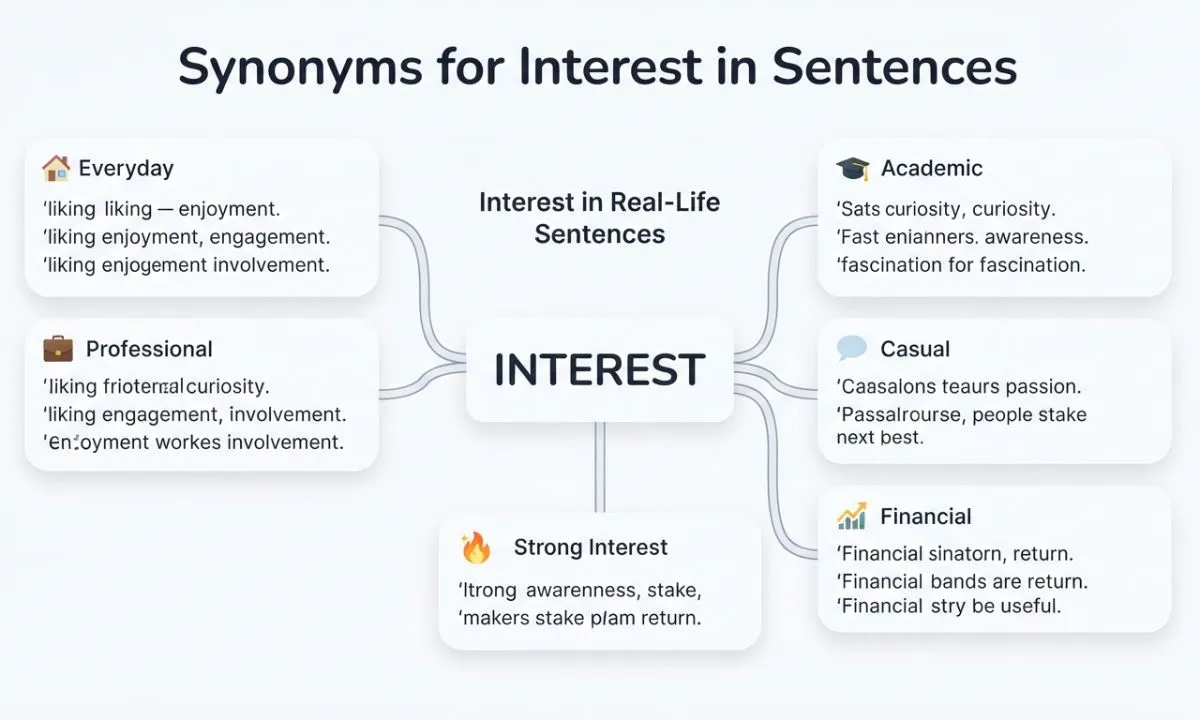
Everyday Sentence Examples
- She has a real liking for hand-drawn maps.
- His enjoyment of long walks keeps him cheerful.
- That bakery is a big draw for the whole street.
Professional Sentence Examples
- Customer engagement improved after the redesign.
- We appreciate your involvement in the pilot program.
- The team’s focus remains on onboarding.
Academic Sentence Examples
- The student’s curiosity about linguistics shaped her thesis.
- A growing awareness of climate data changed the course outline.
- His appreciation of early poetry deepened over the semester.
Casual Conversation Examples
- Honestly, vintage radios are my thing.
- I’m doing it just for fun.
- I’ve got a weird fascination with train timetables.
Strong Interest Examples
- Her passion for ocean research never faded.
- His devotion to the craft was obvious to everyone.
- The fans met the news with open excitement.
Financial Interest Examples
- The bank raised the interest rate on its savings accounts.
- She holds a minority stake in the family bakery.
- Investors expect a steady return this year.
What Major Dictionaries Say About “Interest”
Dictionaries agree that “interest” has several separate senses. Wording changes between editions, so check each live entry for the exact definition.
Cambridge Dictionary Definition of Interest
Cambridge covers the sense of wanting to know more about something, the idea of an activity you enjoy, and the money charged on a loan.
Merriam-Webster Definition of Interest
Merriam-Webster includes the feeling of curiosity, the sense of benefit or advantage, and the sense of a share or stake in something.
Oxford Languages Definition of Interest
Oxford Languages treats it as a feeling of wanting to know or learn, and also as a subject that engages someone’s attention, plus the financial meaning.
Collins Dictionary Definition of Interest
Collins describes interest as curiosity and attention toward something, with separate senses for hobbies and for money paid on borrowing.
Explore More Synonyms Guide
25+ Struggle Synonyms: Better Ways to Say Struggle (With Examples)
25+ Policy Synonyms: Useful Alternatives, Meanings & Examples
Kindness Synonyms: 25+ Words, Meanings, Examples & How to Use Them
20+ Primary Synonyms: Other Ways to Say “Primary” With Meaning & Examples
25+ Share Synonyms: Meanings, Examples & When to Use Each
Frequently Asked Questions
What Is the Best Synonym for Interest?
Curiosity is the most common match when you mean wanting to know more. For general use, enthusiasm and engagement are also strong choices.
What Is a Formal Word for Interest?
Regard, appreciation, and inclination are good formal options. Engagement works well in professional writing.
What Is a Stronger Word for Interest?
Fascination, passion, and zeal are stronger. Use obsession only for unhealthy focus.
What Is Another Word for Showing Interest?
Try engaging, paying attention, or showing enthusiasm. “Taking notice” also works in formal writing.
What Is a Casual Synonym for Interest?
Hobby, liking, and “thing” are casual. Fun and love also sound relaxed.
What Is Another Word for Having Interest in Something?
Say “being curious about,” “being drawn to,” or “being keen on.” Each gives a slightly different shade.
Is Curiosity a Synonym for Interest?
Yes, in one sense. Curiosity means wanting to know more, so it fits that meaning but not hobbies or finance.
Is Attention a Synonym for Interest?
Partly. Attention is focus, while interest is the reason you give it.
What Is the Difference Between Interest and Fascination?
Fascination is stronger and holds your mind. Interest can be mild and passing.
Conclusion: Choosing the Best Synonym for Interest
The best synonyms for interest depend on what you mean: curiosity for wanting to know, attention for focus, enthusiasm for energy, passion for depth.
Pick the sense first, then match the tone.
When in doubt, read your sentence out loud. If the new word changes the meaning, try another one.
