

“Regarding” does its job. But use it to open every email and every other sentence, and your writing starts to sound like a form letter.
You’ve got plenty of options. Which one fits depends on your tone, your reader, and what the sentence needs to do.
Below are 70 synonyms for regarding, grouped by tone, each with a copy-ready example. You’ll also find the mistakes people make most and quick answers to common questions.
Quick Answer: What Are the Best Synonyms for Regarding?
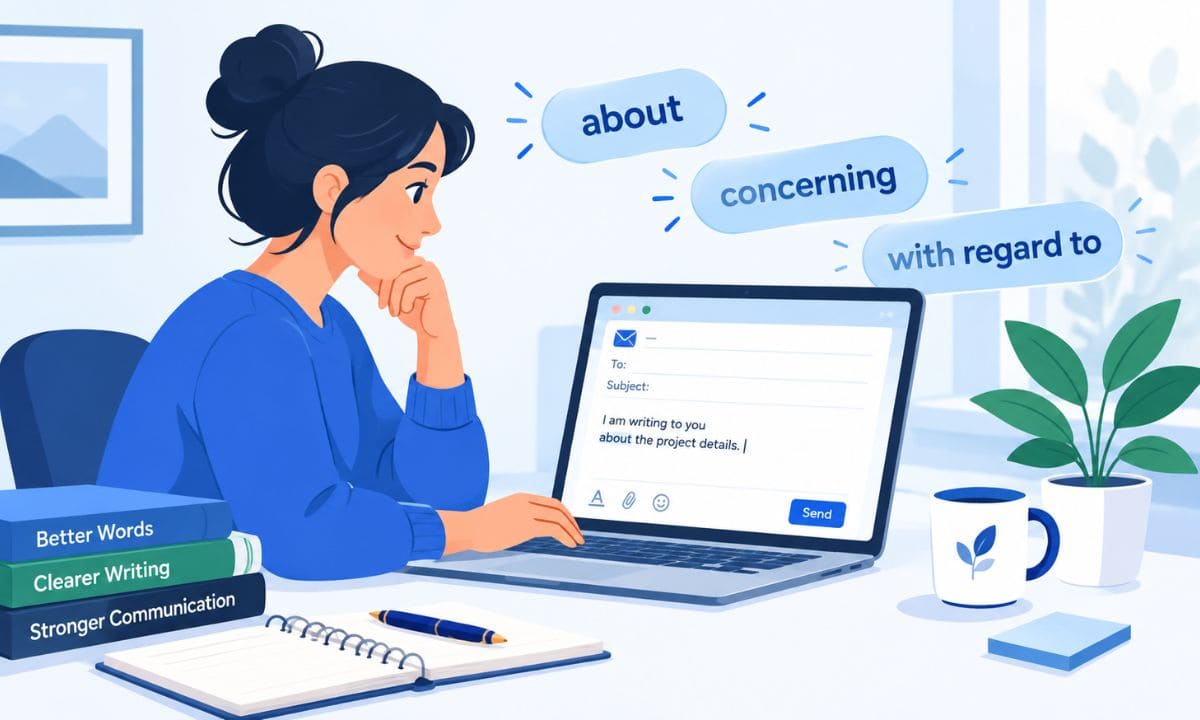
The best synonyms for regarding are about, concerning, in relation to, related to, with regard to, as for, and on the subject of.
Common Alternatives at a Glance
- About: simple and friendly
- Concerning: polished, works almost anywhere
- In relation to: shows a link between two things
- With regard to: formal and traditional
- As for: casual, good for switching topics
- On the subject of: clear and easy to read
Which Synonym for Regarding Should You Use?
Match the word to the setting.
Casual writing? “About” or “as for.”
Business? “Concerning” or “in reference to.”
Formal or academic work calls for “with respect to” or “pertaining to.”
What Does “Regarding” Mean?
Simple Meaning of Regarding
“Regarding” is a preposition. It means “about” or “on the topic of,” and it tells the reader what you’re talking about.
Dictionaries agree. Dictionary.com lists “with regard to,” “respecting,” and “concerning” as core meanings, while Collins gives “in respect of” and “on the subject of.”
How “Regarding” Is Used in a Sentence
- I have a question regarding the invoice.
- She called regarding your application.
- We need more details regarding the schedule.
Is “Regarding” Formal or Casual?
Somewhere between neutral and formal. You’ll find it in emails, letters, reports, and legal notes. Out loud, most people just say “about.”
70 Synonyms for Regarding, Grouped by Tone
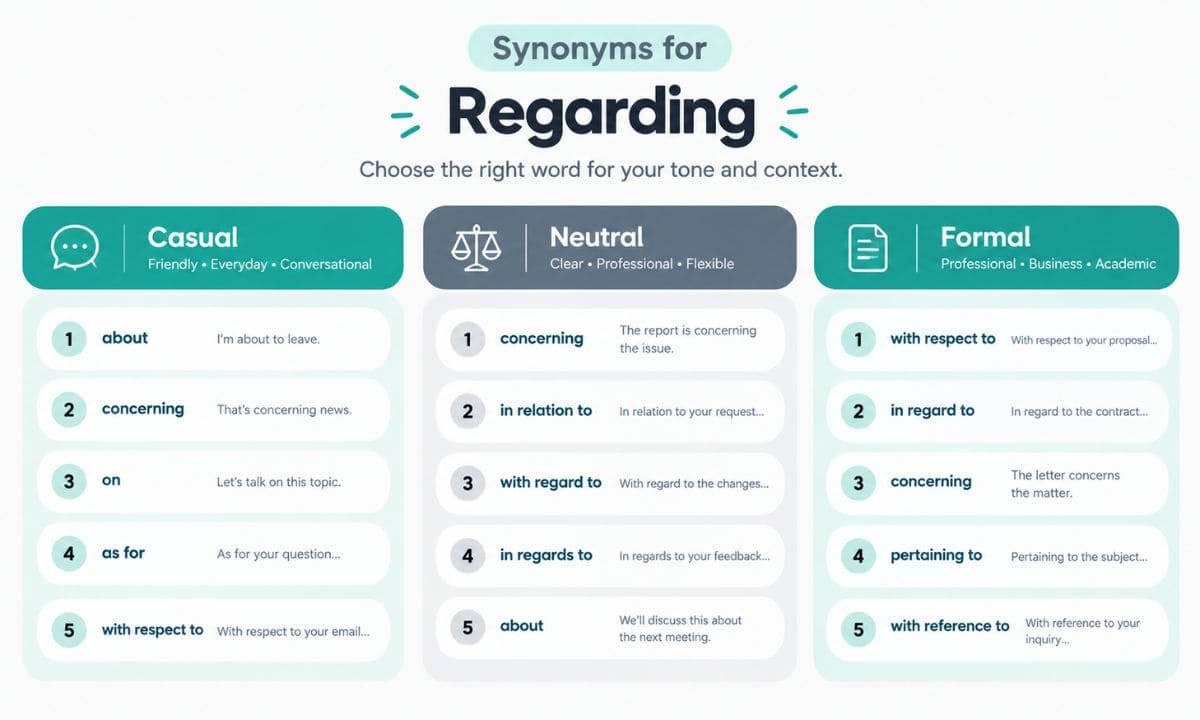
A flat list of 70 would get dull fast. Tone is what really drives the choice, so the entries below run roughly from everyday to formal to specialized.
1. About
Meaning:
On the topic of; concerning.
Example:
I wanted to talk to you about the project.
Usage Tip:
The simplest option, and the best one for everyday conversation and most emails.
2. Concerning
Meaning:
Relating to a particular subject.
Example:
I have a question concerning your invoice.
Usage Tip:
A dependable choice for semi-formal emails and reports.
3. Relating to
Meaning:
Connected with something.
Example:
All documents relating to the case were submitted.
Usage Tip:
Turns up a lot in legal and official writing.
4. With regard to
Meaning:
In connection with a matter.
Example:
With regard to your request, we approved it.
Usage Tip:
Keep “regard” singular. It makes a strong opener for a formal email.
5. In regard to
Meaning:
Concerning a specific issue.
Example:
In regard to the delay, we apologize.
Usage Tip:
Nearly the same as “with regard to,” with the same level of formality.
6. As regards
Meaning:
Concerning; as far as something is related.
Example:
As regards the budget, we need more time.
Usage Tip:
More at home in British English than American.
7. With respect to
Meaning:
In relation to a particular point.
Example:
With respect to safety, the rules are strict.
Usage Tip:
A natural fit for academic and technical writing.
8. In respect of
Meaning:
Concerning; about.
Example:
Payment is due in respect of the services provided.
Usage Tip:
Shows up in legal and financial documents.
9. Pertaining to
Meaning:
Belonging to or relevant to.
Example:
Please send all details pertaining to the order.
Usage Tip:
Very formal. Leave it out of casual chat.
10. Touching on
Meaning:
Briefly mentioning a topic.
Example:
The speaker was touching on climate change.
Usage Tip:
Use it when a topic gets only a light pass, not a full discussion.
11. On the subject of
Meaning:
Regarding a particular topic.
Example:
On the subject of budgets, we need to talk.
Usage Tip:
Great for steering a conversation to a new topic.
12. On the topic of
Meaning:
Concerning a particular theme.
Example:
On the topic of hiring, we have two openings.
Usage Tip:
Sounds natural in meetings and presentations.
13. In relation to
Meaning:
In connection with something.
Example:
Sales increased in relation to last year.
Usage Tip:
Best when you want to show a link or a comparison.
14. Relative to
Meaning:
In comparison with; concerning.
Example:
Costs are low relative to quality.
Usage Tip:
Reach for it with data and comparisons.
15. In connection with
Meaning:
Related to a matter or event.
Example:
Police are questioning him in connection with the theft.
Usage Tip:
Common in news reports and official statements.
16. As for
Meaning:
Turning attention to a new point.
Example:
As for dinner, I’ll cook tonight.
Usage Tip:
It goes at the start of a sentence and introduces a fresh point.
17. As to
Meaning:
Regarding; about.
Example:
There is no doubt as to his honesty.
Usage Tip:
Formal, and usually paired with words like “doubt” or “whether.”
18. Apropos of
Meaning:
With reference to; relevant to.
Example:
Apropos of nothing, he asked about lunch.
Usage Tip:
A bit literary. Use it now and then, not often.
19. Re
Meaning:
Regarding (used in headings).
Example:
Re: Meeting schedule
Usage Tip:
Keep it to email subject lines and letter headings. Never use it inside a sentence.
20. Anent
Meaning:
Concerning (old-fashioned).
Example:
He wrote the new law.
Usage Tip:
Very rare and dated. Skip it in modern writing.
21. Vis-à-vis
Meaning:
In relation to; compared with.
Example:
Our position vis-à-vis competitors is strong.
Usage Tip:
You’ll see it in business and political writing.
22. In terms of
Meaning:
With regard to a particular aspect.
Example:
In terms of cost, this option is cheaper.
Usage Tip:
Easy to overdo. Use it too often and your writing goes flat.
23. When it comes to
Meaning:
Regarding a specific area.
Example:
When it comes to cooking, she’s the expert.
Usage Tip:
Perfect for a conversational tone.
24. With reference to
Meaning:
Referring to something mentioned earlier.
Example:
With reference to your email of May 5th, we confirm.
Usage Tip:
A good match for formal letters and follow-up emails.
25. In reference to
Meaning:
Concerning something mentioned before.
Example:
I’m writing in reference to your application.
Usage Tip:
Common in job and business emails.
26. Referring to
Meaning:
Mentioning or pointing to something.
Example:
Referring to the attached file, please review page 3.
Usage Tip:
Handy when you’re pointing at an attachment or an earlier message.
27. Respecting
Meaning:
Concerning (formal).
Example:
Rules respecting privacy were updated.
Usage Tip:
Carries a legal tone that feels heavy in everyday writing.
28. Involving
Meaning:
Including or concerning.
Example:
A case involving fraud was reported.
Usage Tip:
Use it when a person or event is part of the matter.
29. Over
Meaning:
Concerning (usually a dispute).
Example:
They argued over the money.
Usage Tip:
Works for disagreements and conflicts.
30. On
Meaning:
About a subject.
Example:
She gave a talk on leadership.
Usage Tip:
Very common in titles of books, talks, and articles.
31. Bearing on
Meaning:
Having relevance to.
Example:
The evidence has no bearing on the case.
Usage Tip:
Usually appears as “has a bearing on” or “has no bearing on.”
32. In the matter of
Meaning:
Concerning a particular issue.
Example:
In the matter of the lease, we agree.
Usage Tip:
Suited to legal and official documents.
33. As far as … is concerned
Meaning:
Regarding a particular person or thing.
Example:
As far as I’m concerned, the deal is done.
Usage Tip:
A good way to state a personal opinion.
34. In the context of
Meaning:
Considering the circumstances of.
Example:
In the context of inflation, prices make sense.
Usage Tip:
Use it to explain the background or situation.
35. Where … is concerned
Meaning:
Regarding a specific person or thing.
Example:
Where money is concerned, he’s careful.
Usage Tip:
Drop a noun into the blank, as in “Where health is concerned.”
36. Speaking of
Meaning:
Reminded by something just mentioned.
Example:
Speaking of travel, have you been to Dubai?
Usage Tip:
A smooth way to shift topics in casual chat.
37. Talking about
Meaning:
Discussing a topic.
Example:
Talking about movies, did you see the new one?
Usage Tip:
Informal, so avoid it in formal writing.
38. On the question of
Meaning:
Regarding a debated issue.
Example:
On the question of pricing, opinions differ.
Usage Tip:
Best when the topic is debatable or undecided.
39. Having to do with
Meaning:
Related to.
Example:
It’s something having to do with taxes.
Usage Tip:
Informal and a little vague. Fine for casual talk.
40. Associated with
Meaning:
Connected in some way.
Example:
Risks associated with smoking are serious.
Usage Tip:
Common in health and research writing.
41. Linked to
Meaning:
Connected or related.
Example:
The illness is linked to poor diet.
Usage Tip:
Hints at cause and effect without claiming it outright.
42. Connected to
Meaning:
Related to something.
Example:
The issue is connected to server errors.
Usage Tip:
Works in both technical and general contexts.
43. Tied to
Meaning:
Closely connected with.
Example:
His bonus is tied to performance.
Usage Tip:
Signals a strong dependency.
44. Related to
Meaning:
Having a connection with.
Example:
Questions related to billing go here.
Usage Tip:
Simple, clear, and safe almost anywhere.
45. Germane to
Meaning:
Relevant and appropriate to the subject.
Example:
His comment wasn’t germane to the discussion.
Usage Tip:
Formal, and it mostly appears in negative sentences.
46. Relevant to
Meaning:
Closely connected to the matter.
Example:
Include only information relevant to the job.
Usage Tip:
Good for filtering or selecting what belongs.
47. Applying to
Meaning:
Relevant or valid for.
Example:
The rule applying to students changed.
Usage Tip:
Use it for rules and policies.
48. Affecting
Meaning:
Having an effect on.
Example:
Issues affecting customers were resolved.
Usage Tip:
Choose it when you want to show impact, not just a topic.
49. Dealing with
Meaning:
Concerned with a subject.
Example:
Chapter 4 is dealing with ethics.
Usage Tip:
Useful for describing sections of books, reports, and articles.
50. Addressing
Meaning:
Speaking to or tackling an issue.
Example:
This memo is addressing recent complaints.
Usage Tip:
Fits best when you’re offering a fix for a problem or concern.
51. Focusing on
Meaning:
Concentrating on a subject.
Example:
The study is focusing on sleep habits.
Usage Tip:
A natural match for research and presentations.
52. Centered on
Meaning:
Having something as the main point.
Example:
The debate centered on taxes.
Usage Tip:
Use it when one theme dominates.
53. Revolving around
Meaning:
Having something as the central theme.
Example:
The plot revolves around a missing child.
Usage Tip:
Works well for stories, movies, and discussions.
54. With an eye to
Meaning:
Considering a future goal.
Example:
We’re planning with an eye to growth.
Usage Tip:
Pair it with future planning.
55. In the case of
Meaning:
Regarding a particular situation.
Example:
In the case of rain, the event moves indoors.
Usage Tip:
Good for specific examples or conditions.
56. As it relates to
Meaning:
In connection with.
Example:
As it relates to safety, we’re improving.
Usage Tip:
A popular phrase in business meetings.
57. As it pertains to
Meaning:
Concerning.
Example:
As it pertains to hiring, nothing changed.
Usage Tip:
A notch more formal than “as it relates to.”
58. With relation to
Meaning:
Concerning; in connection with.
Example:
With relation to your query, please see below.
Usage Tip:
Less common. “In relation to” usually sounds more natural.
59. In the area of
Meaning:
Regarding a specific field.
Example:
She’s an expert in the area of finance.
Usage Tip:
Handy for describing skills and expertise.
60. In the realm of
Meaning:
In the field or domain of.
Example:
In the realm of technology, change is fast.
Usage Tip:
Has a slightly dramatic, descriptive feel.
61. On the matter of
Meaning:
Concerning a particular issue.
Example:
On the matter of salary, we’ll decide later.
Usage Tip:
A good fit for serious or sensitive topics.
62. In light of
Meaning:
Considering new information.
Example:
In light of the news, we changed plans.
Usage Tip:
Use it when new facts change a decision.
63. Considering
Meaning:
Taking something into account.
Example:
Considering the weather, we stayed home.
Usage Tip:
Good for giving a reason.
64. Given
Meaning:
In view of a fact.
Example:
Given the time, let’s finish now.
Usage Tip:
Short and crisp. “Given that” works too.
65. Following up on
Meaning:
Continuing a previous topic.
Example:
I’m following up on my last email.
Usage Tip:
The go-to phrase for reminders and follow-up emails.
66. Further to
Meaning:
In addition to a previous communication.
Example:
Further to our call, here are the details.
Usage Tip:
Very common in British business English.
67. With regards to
Meaning:
Informal variant of “with regard to.”
Example:
With regards to the trip, I’m in.
Usage Tip:
Fine in speech, but “with regard to” is the better choice in formal writing.
68. On the score of
Meaning:
On the grounds of; concerning.
Example:
No one complained about the noise.
Usage Tip:
Old and rare. Save it for literary style.
69. Insofar as
Meaning:
To the extent that (relating to).
Example:
Insofar as time allows, we’ll cover it.
Usage Tip:
A formal phrase for setting a condition or limit.
70. Speaking to
Meaning:
Addressing a particular point.
Example:
Speaking to your concern, we’ve added checks.
Usage Tip:
Ideal for answering someone’s concern directly.
Synonyms for Regarding by Context
Formal Writing
Best choices: concerning, with regard to, in relation to, with respect to, in reference to.
- The board reached a decision concerning the new policy.
- With respect to the audit, we found no errors.
Business Emails
Best choices: about, concerning, in reference to, with regard to.
- I’m writing about your proposal from Monday.
- In reference to our call, I’ve attached the contract.
- Concerning the delivery date, please confirm by Friday.
Academic Writing
Best choices: with respect to, pertaining to, in relation to, in the context of.
- The study looks at trends pertaining to student sleep.
- Results differ with respect to age group.
Academic style guides tend to favor precise, plain wording. Pick the phrase that names the exact relationship you mean, not just any link.
Casual Writing
Best choices: about, on, as for, related to.
As for dinner, I’ll cook.
What did she say about the trip?
Regarding Synonyms: Formal vs Casual
| Synonym | Tone | Best Used For | Example |
| About | Casual | Daily talk, chats | Tell me about your day. |
| As for | Casual | Changing topic | As for the budget, we’re fine. |
| Concerning | Neutral | Emails, notices | A note concerning your account. |
| Related to | Neutral | Explanations | Questions related to billing. |
| In relation to | Neutral to formal | Links between ideas | Sales in relation to ad spend. |
| With regard to | Formal | Letters, reports | With regard to your request, yes. |
| Pertaining to | Very formal | Legal, academic | Rules pertaining to safety. |
Regarding vs Its Closest Synonyms
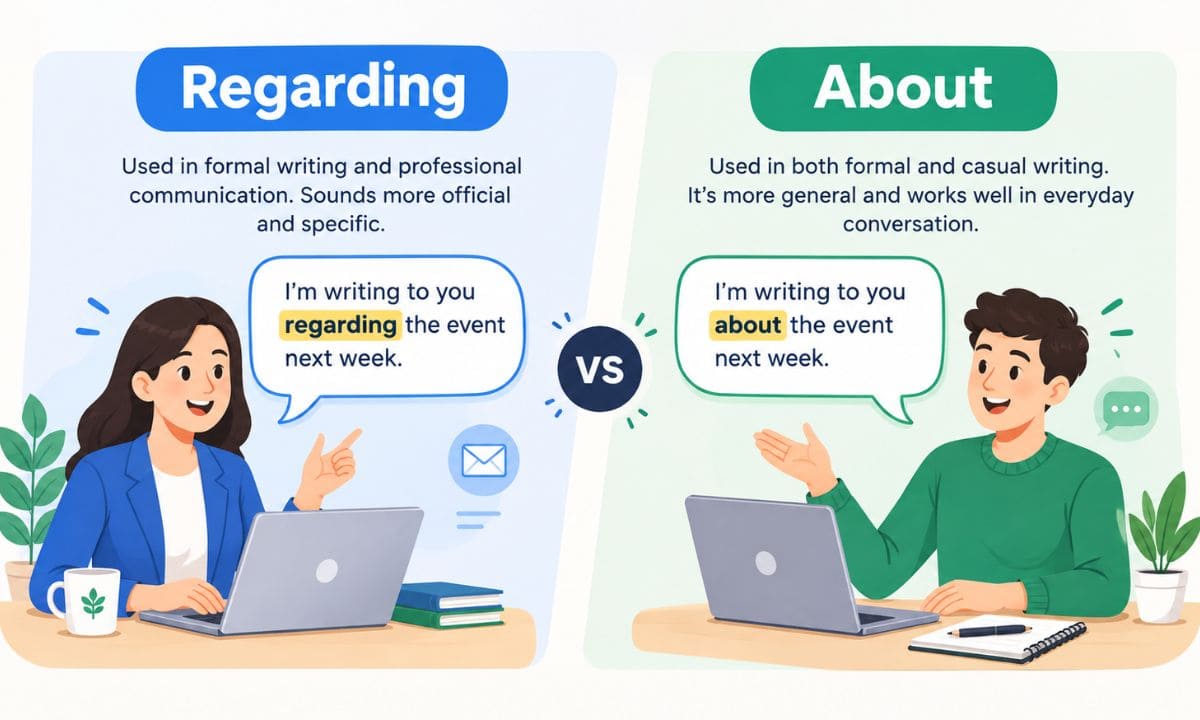
Regarding vs About
Main difference: “About” is warmer and more natural in speech. “Regarding” sounds more official.
- Casual: Can we talk about the schedule?
- Formal: I’m writing regarding the schedule.
Regarding vs Concerning
Main difference: They mean almost the same thing. But “concerning” can also mean “worrying,” so make sure your sentence can’t be read the wrong way.
- The report concerning sales is ready.
- The drop in sales is concerning. (worrying)
Regarding vs With Regard To
Main difference: “With regard to” is longer and more formal. It suits letters and policies.
- Regarding your refund, we’ve processed it.
- With regard to your refund, we’ve processed it.
Regarding vs In Relation To
Main difference: “In relation to” stresses a link or comparison between two things.
- Regarding costs, we’re on track.
- Costs in relation to revenue are rising.
Regarding vs As For
Main difference: “As for” kicks off a new point and sounds informal.
- As for the venue, we’ll decide later.
What Major Dictionaries Say About “Regarding”
Every major dictionary treats “regarding” as a preposition tied to a topic.
Cambridge: presents it as a way to say “about” in careful writing.
Merriam-Webster: covers the root word “regard,” including “to consider” and “to pay attention to.”
Oxford Languages: describes it as “concerning” or “in connection with.”
Collins: gives “in respect of” and “on the subject of.”
The wording shifts a little from source to source, but the core idea never does: “on the topic of.” That’s why “about” and “concerning” are such safe swaps. If you need an exact quote, check the current entry.
How to Choose the Right Synonym for Regarding
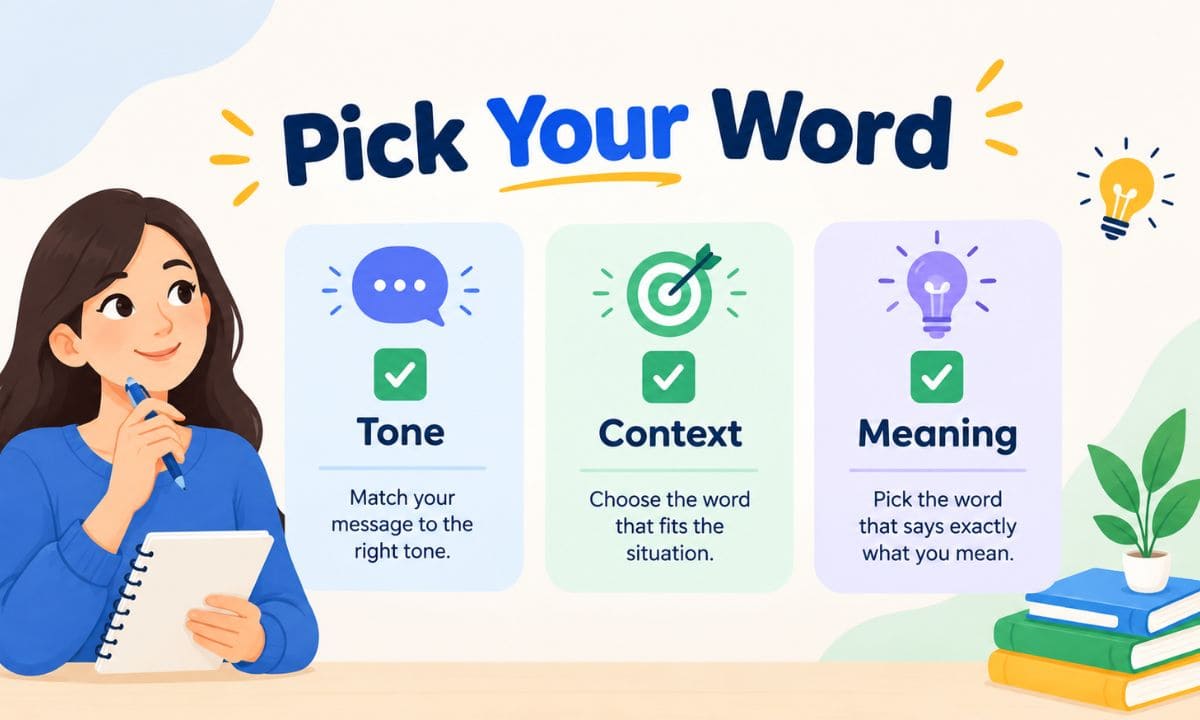
Choose Based on Tone
- Formal writing: with regard to, pertaining to, with respect to
- Casual writing: about, on, as for
Choose Based on Context
- Emails: about or concerning
- Academic writing: with respect to or in relation to
- Conversations: about, as for, when it comes to
- Business writing: concerning, in reference to
Choose Based on Sentence Meaning
Synonyms aren’t always interchangeable. “In relation to” compares. “In reference to” points back to a source, like an earlier email. “As for” changes the subject.
So ask what your sentence is actually doing. Then pick the word that does it.
Common Mistakes When Using Synonyms for Regarding
Formal words in casual writing. “Pertaining to your pizza order” sounds odd in a text.
Casual words in professional writing. A stray “re” in the body of a formal letter looks careless.
Assuming all synonyms match. “Concerning” can mean “worrying,” so watch for confusion.
Repeating “regarding.” Three in one email is tiring. Mix it up.
Unnatural choices. “Anent” is rare today. Skip it unless you have a reason.
| Incorrect | Better |
| Pertaining to lunch, what do you want? | What do you want for lunch? |
| Re your request, we hereby decline. | With regard to your request, we must decline. |
| Regarding your order, regarding the delay, regarding the refund… | About your order: the delay was ours, and your refund is on its way. |
Synonyms for Regarding in Sentences
Formal writing: With respect to safety, the rules are clear.
Business emails: I’m writing concerning the invoice due on the 5th.
Academic writing: Findings pertaining to sleep quality are limited.
Everyday conversation: As for the weekend, I’m free.
Professional communication: In reference to your last message, I’ve updated the file.
Explore More Synonyms Guide
25+ Struggle Synonyms: Better Ways to Say Struggle (With Examples)
25+ Policy Synonyms: Useful Alternatives, Meanings & Examples
Kindness Synonyms: 25+ Words, Meanings, Examples & How to Use Them
20+ Primary Synonyms: Other Ways to Say “Primary” With Meaning & Examples
25+ Share Synonyms: Meanings, Examples & When to Use Each
Frequently Asked Questions
What is the best synonym for regarding?
“About” is the most versatile. When you need something more polished, “concerning” works well.
What is a simple word for regarding?
“About.” It’s the simplest and most common.
Is “about” a synonym for “regarding”?
Yes. The meaning is the same, but “about” sounds more casual.
Is “concerning” the same as “regarding”?
Mostly. Just avoid it where a reader might take it as “worrying.”
What is a formal synonym for regarding?
“With regard to,” “with respect to,” and “pertaining to” are all formal.
What can I use instead of regarding in an email?
Try “about,” “concerning,” or “in reference to.”
Is “with regard to” correct?
Yes. It’s a standard, formal phrase.
Can “regarding” and “concerning” be used interchangeably?
In most sentences, yes. Check the context first.
What is the difference between “regarding” and “about”?
Same meaning, different feel. “Regarding” is more formal, and “about” is more natural in speech.
Is “in regards to” correct?
Style guides usually prefer “in regard to” or “with regard to.” “In regards to” is widely seen as nonstandard.
Conclusion: Choosing the Right Synonym for Regarding
Match the word to the moment. Casual synonyms regarding suit chats, neutral ones suit daily work, and formal ones belong in reports and legal notes.
Start with five you trust: about, concerning, with regard to, in relation to, and as for. Rotate them. Your writing will read smoother, and it’ll sound more like you.
