

If you’ve typed “I finaly finished my project” and then paused, wondering if that looks right you’re not alone. This mix-up shows up constantly in emails, school assignments, and social media captions.
The fix takes five seconds once you know the rule.
This guide settles the finaly vs finally debate for good, walks through the correct spelling of finally, its meaning, pronunciation, and gives you real sentence examples you can copy right now.
Quick Answer: Is It “Finaly” or “Finally”?
The Correct Spelling Is “Finally”
Finally with two L’s is the only correct spelling.
It’s a common adverb in English, and native speakers use it every day to talk about something happening after a wait, a delay, or a long process.
Why “Finaly” Is Incorrect
“Finaly” simply doesn’t exist in any English dictionary.
It’s a typo, usually caused by rushing while typing or forgetting that the base word “final” needs an extra L before adding “-ly.”
No dictionary, not Cambridge, not Merriam-Webster, not Oxford lists it as a word.
What Does “Finally” Mean?
Finally Meaning in Simple English
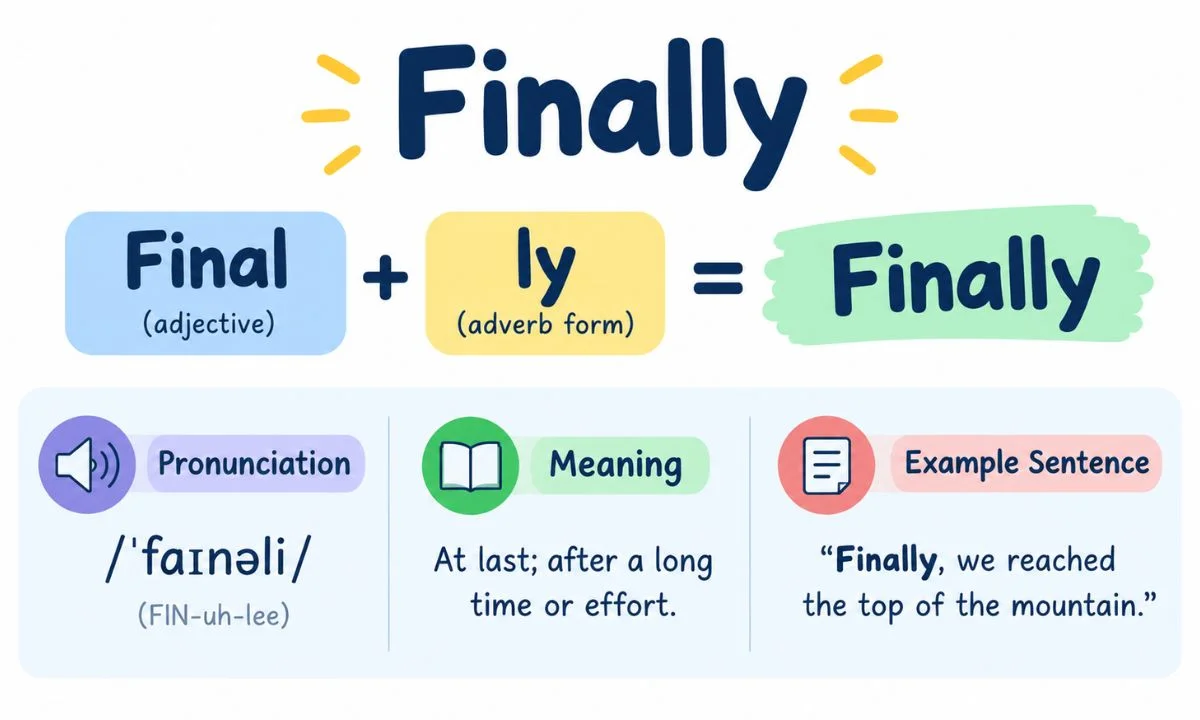
In plain terms, finally means “after a long time” or “at last.” You use it when something you were waiting for actually happens.
Finally as an Adverb
Grammatically, finally is an adverb. It describes when or how an action happens, and it often modifies a verb in the sentence, such as “arrived,” “finished,” or “agreed.”
Meaning of Finally
There are really two core meanings:
After a delay: something happens at last, often after difficulty or waiting.
Last in a sequence: it introduces the final point in a list or explanation.
When to Use Finally
Use finally when you want to show that time has passed, patience has been tested, or you’re wrapping up a list of points. It works in casual chat, formal essays, and professional emails alike.
How to Pronounce “Finally”
Finally Pronunciation
Finally is pronounced FY-nuh-lee (/ˈfaɪ.nəl.i/). The stress falls on the first syllable.
Syllables in Finally
The word breaks into three syllables: fi-nal-ly.
Common Pronunciation Mistake
Some learners say “fin-AL-ly,” putting stress on the second syllable. That’s off the emphasis should always land on “FY,” the very first sound.
Easy Memory Trick: Final + Ly = Finally
Remember the Double L
Here’s the simplest trick: take the word “final,” which already ends in one L, then add the suffix “-ly,” which starts with another L. Two L’s meet, and you get finally.
A 5-Second Spelling Check
Before you hit send, ask yourself: does it have two L’s in the middle? If yes, you’re good.
Final → Finally
| Base Word | Suffix | Result |
| Final | + ly | Finally |
Finaly vs Finally: What’s the Difference?
“Finally” Correct Spelling
This is the real, dictionary-approved word. Use it in any writing, from texts to term papers.
“Finaly” Incorrect Spelling
This is a spelling error. It has no meaning of its own and should never appear in finished writing.
Finaly vs Finally at a Glance
| Spelling | Correct? | Notes |
| Finally | ✅ Yes | Standard adverb, found in every major dictionary |
| Finaly | ❌ No | Common misspelling; missing one L |
Why Is “Finaly” Incorrect?
The Correct Spelling Pattern
English spelling rules often double a consonant when adding a suffix to certain root words. “Final” already carries one L, and the “-ly” suffix doesn’t remove it, it adds to it.
Why the Double “L” Matters
Drop one L, and you get a word that looks unfinished, almost like a rushed keystroke rather than an actual English word.
Final + ly = Finally
Think of it as a simple addition:
final (5 letters, ending in L) + ly (2 letters, starting with L) = finally (7 letters, with a double L in the middle).
When Should You Use “Finally”?
To Show the End of a Process
“After months of training, she finally ran her first marathon.”
To Describe Something Happening After a Long Time
“The rain finally stopped after three days.”
To Introduce the Last Point
“Finally, remember to save your work before closing the file.”
To Show Relief or Completion
“Finally! The package arrived.”
Explore More Grammar Guides
Stutter vs Studder: Correct Spelling and Meaning Guide in 2026
Friend vs Freind: Common Mistake and Correct Usage Explained
Really vs Realy? A Quick Guide to Correct English Spelling (2026)
Barrel vs Barrell: Correct Spelling, Meaning, and Sentence Examples
Keep vs Kept: Which One Is Correct? Rules, Examples & Tips
Customize vs Customise: Which One Should You Use? Complete Guide
Finally Meaning With Examples
Examples of Finally in Everyday Sentences
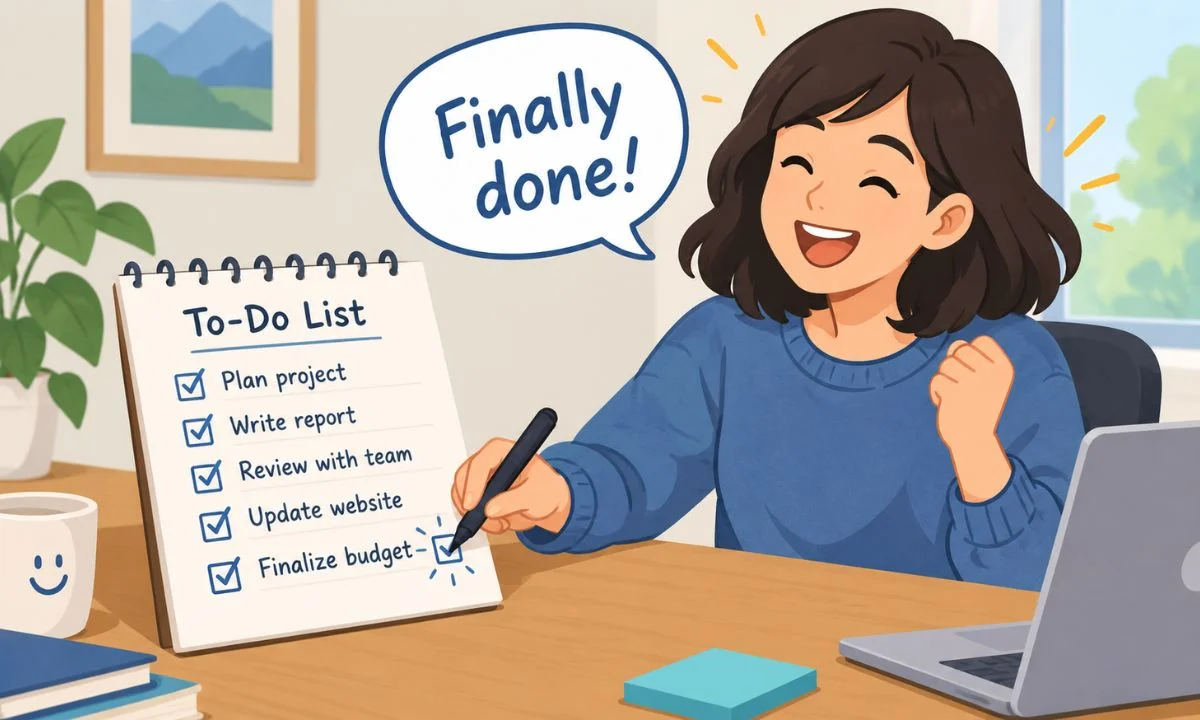
Short, real-life sentences make this word click faster than any rule ever could.
Finally for Completed Actions
- “I finally cleaned my room after putting it off all week.”
- “He finally passed his driving test on the third try.”
Finally for the Last Step
- “Whisk the eggs, add the flour, and finally, fold in the sugar.”
Finally for Relief
- “Finally, the meeting is over.”
- “We finally got Wi-Fi back.”
Finally for the Last Point
- “Finally, I want to thank everyone who supported this project.”
Finaly vs Finally: Common Spelling Mistakes
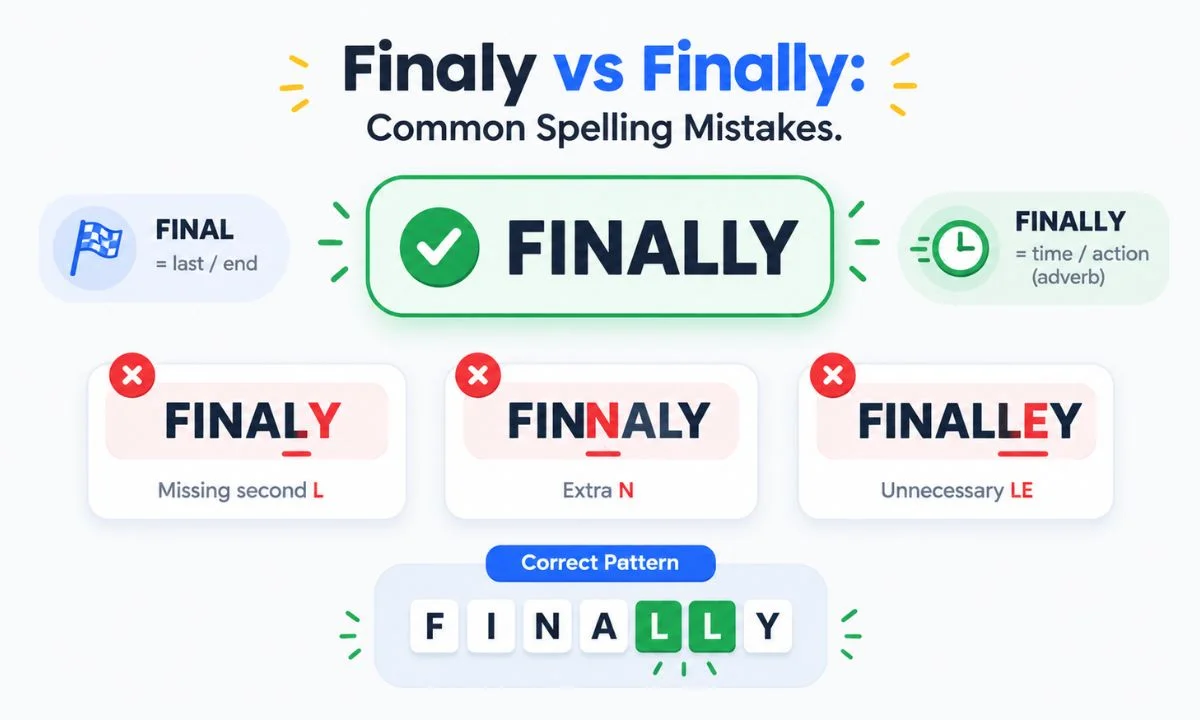
Writing “Finaly” With One L
This is the number one mistake dropping the second L out of habit or speed-typing.
Confusing “Final” and “Finally”
“Final” is an adjective describing the last item in a series. “Finally” is the adverb describing when something happens. Mixing them up changes the entire sentence structure.
Adding or Removing Letters Incorrectly
Some writers accidentally type “finnaly” or “finalley.” Stick to the standard seven letters: f-i-n-a-l-l-y.
Finaly or Finally in a Sentence
Correct Sentence Examples
- “She finally called back after two days.”
- “Finally, we reached the summit.”
Incorrect Sentence Examples
- “She finaly called back after two days.” ❌
- “Finaly, we reached the summit.” ❌
How to Check the Correct Spelling
Type the word into any spellchecker or search engine. If it underlines “finaly” in red, that confirms the mistake instantly.
Finally in Formal and Informal English
Finally in Formal Writing
In reports, essays, and business writing, finally often signals the last point in an argument: “Finally, the data suggests a clear trend.”
Finally in Everyday English
In casual conversation, it usually expresses relief: “Finally, Friday!”
Finally in Academic and Professional Writing
Academic writers use finally as a transition word to organize ideas clearly, especially in conclusions and multi-step explanations.
Everyday Examples of “Finally”
Examples at Home
“Dinner is finally ready.”
Examples at School
“Finally, write your name at the top of the paper.”
Examples at Work
“The client finally approved the proposal.”
Examples in Conversation
“Oh, you’re finally here!”
What Do Major Dictionaries Say About “Finally”?
Cambridge Dictionary
Cambridge defines finally as being used to describe something happening after a long time or some difficulty, and also to introduce the last point in a sentence.
Merriam-Webster
Merriam-Webster describes finally as meaning “after a prolonged time,” referring to the end of a period of waiting or effort.
Oxford Learner’s Dictionaries
Oxford lists finally as an adverb meaning “at last” or “in the end,” often used to show that something happened following a delay.
Dictionary Definition at a Glance
| Dictionary | Core Definition |
| Cambridge | After a long time or difficulty |
| Merriam-Webster | After a prolonged time |
| Oxford | At last, in the end |
Quick Test I Created
Finaly vs Finally: Quick Student Guide
Which Spelling Is Correct?
Finally, always with two L’s.
What Does Finally Mean?
It means something happens after a delay, or it marks the last point in a list.
How Do You Spell Finally?
F-I-N-A-L-L-Y seven letters, double L in the middle.
Finaly or Finally in a Sentence?
Always write “finally.” Example: “I finally understood the lesson.”
Frequently Asked Questions
Is “Finaly” a Correct Word?
No. “Finaly” is a misspelling and doesn’t appear in any English dictionary.
Is “Finally” Spelled With One L or Two?
Finally is spelled with two L’s f-i-n-a-l-l-y.
What Is the Correct Spelling of Finally?
The correct spelling is finally formed from “final” plus the suffix “-ly.”
What Does Finally Mean?
It means something happens after a long wait or delay, or it introduces the last point in a series.
How Do You Use Finally in a Sentence?
Place it at the start of a sentence for emphasis or before the verb, as in “She finally arrived” or “Finally, close the laptop.”
Is Finally an Adverb or Adjective?
Finally is an adverb. The related adjective is “final.”
Why Do People Misspell Finally as Finaly?
Fast typing and unfamiliarity with the double-L rule are the two biggest reasons for this common typo.
What Is a Simple Synonym for Finally?
No. Finally has exactly one accepted spelling in standard English. “Finaly,” “finnaly,” and “finalley” are all incorrect.
Conclusion:
The rule here is short and easy to keep: finally, not “finaly.” Two L’s, always. It comes straight from “final” plus “-ly,” it’s pronounced FY-nuh-lee, and it means something happens after a wait or it introduces your last point.
Next time you’re about to type this word, picture “final” with its extra L sitting right next to the “ly,” and you’ll never second-guess the spelling again.
