

If you’ve ever stopped mid-sentence and asked “wait, is it eying vs eyeing?” you’re not alone.
This is one of the most searched spelling questions in English, and the answer is simpler than most people think.
Both spellings exist. Both come from the verb “eye.”
But one of them is the version you should actually be typing in 2026, whether you’re writing an email, a blog post, or a school assignment. Let’s clear it up for good.
Quick Answer: Eying vs Eyeing Which Spelling Is Correct?
Eyeing is the correct and standard spelling in modern English.
Eying is a recognized variant, but it’s far less common and can look like a typo to most readers.
When you compare eying vs eyeing side by side, eyeing wins in almost every context: news writing, business emails, school papers, and everyday conversation.
Is “Eying” Correct?
Yes, technically. Dictionaries list “eying” as an accepted variant spelling of the verb “eye.” It’s not a grammar mistake, just an uncommon choice.
Is “Eyeing” Correct?
Yes, and it’s the preferred form. “Eyeing” is the spelling you’ll find in newspapers, style guides, and most dictionaries as the main entry.
Eying vs Eyeing: What Is the Difference?
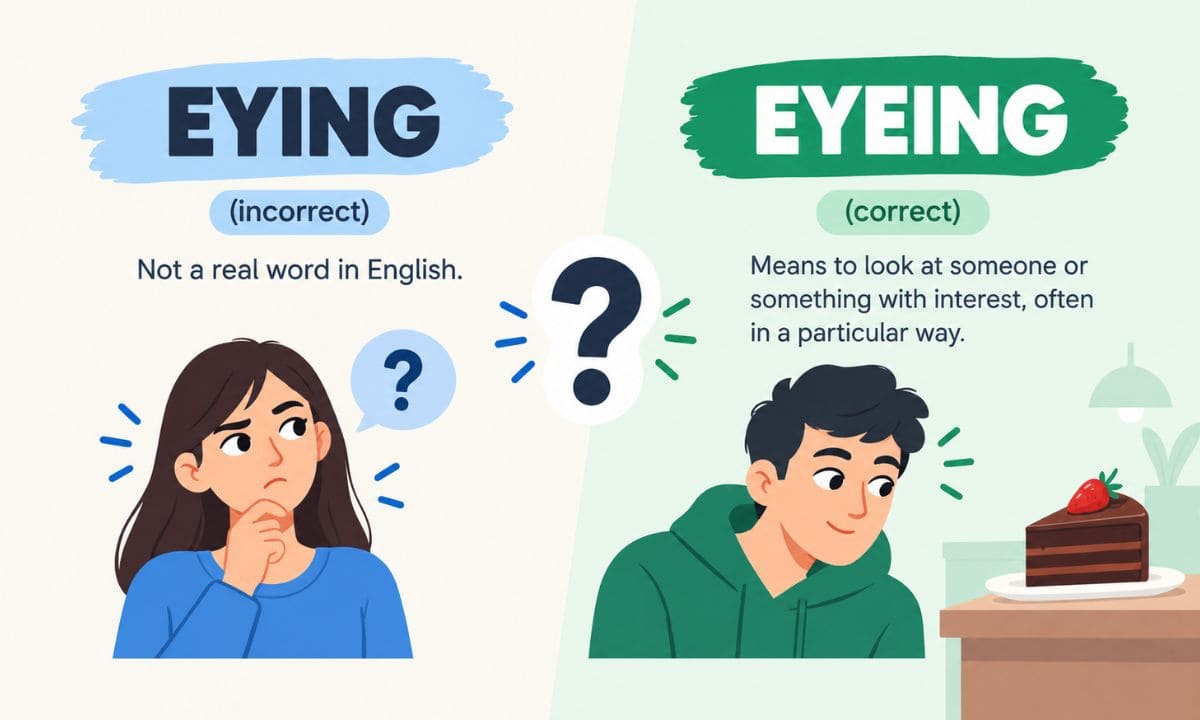
There is no difference in meaning.
The only difference is spelling. Both words describe the act of watching, observing, or considering something closely.
What Does “Eyeing” Mean?
“Eyeing” means looking at someone or something with focused attention, often because you want it, suspect it, or are curious about it.
Eyeing as a Verb
“Eyeing” is the present participle form of “eye,” used in continuous tenses like “is eyeing,” “was eyeing,” or “has been eyeing.”
Examples of “Eyeing”
- She was eyeing the last cookie on the plate.
- The company is eyeing new markets in Asia.
- He kept eyeing his phone during the meeting.
What Does “Eying” Mean?
“Eying” carries the exact same meaning as “eyeing.
” It simply drops one letter “e” before adding “-ing.”
Why “Eying” Can Still Appear in English
Many verbs ending in a silent “e” drop that “e” before “-ing” (like “make” → “making”).
Some writers apply that same rule to “eye,” which produces “eying.” It’s grammatically defensible, just less popular.
Examples of “Eying”
- She was eying the last cookie on the plate.
- The company is eying new markets in Asia.
- He kept eying his phone during the meeting.
Do “Eying” and “Eyeing” Have the Same Meaning?
Yes. Swap one for the other in any sentence, and the meaning stays identical. Only the spelling changes.
Eying vs Eyeing at a Glance
| Point | Details |
| Correct spelling | Eyeing (preferred), Eying (accepted variant) |
| Meaning | Looking at something with interest or attention |
| Word type | Present participle / gerund of the verb “eye” |
| More common in | Eyeing used worldwide, both US and UK |
| Best for formal writing | Eyeing |
| Difference in meaning | None both mean the same thing |
Why Are There Two Spellings of Eyeing?
The confusion comes from English’s inconsistent rule for adding “-ing” to verbs that end in “e.”
How the Base Word “Eye” Changes Before -ing
Most verbs drop the final silent “e” before “-ing” “hope” becomes “hoping,” “love” becomes “loving.
” But “eye” is unusual because its “e” isn’t silent in the way other verbs are; dropping it would blur the word’s identity.
The Spelling Rule Behind “Eyeing”
Keeping both letters “eye” + “ing” protects the word’s readability and keeps its connection to the noun “eye” obvious at a glance. That’s why eyeing is treated as the standard.
Why “Eying” Appears in Some Dictionaries and Texts
Dictionaries still list “eying” because it follows the general silent-e dropping rule and has appeared in print for centuries. Listing it doesn’t make it the recommended choice, just an accepted one.
Where Do “Eying” and “Eyeing” Come From?
The Origin of the Word “Eye”
“Eye” traces back to Old English “ēage,” referring to the organ of sight. The word has kept a similar form for over a thousand years.
How “Eye” Became a Verb
Over time, English speakers turned the noun “eye” into a verb meaning “to look at carefully,” much like “hand” became “to hand something over.”
How the -ing Form Developed
As verb forms developed, writers needed a present participle for “eye.”
Two spellings emerged side by side, one that kept the full base word, and one that followed the standard silent-e rule.
How to Spell Eyeing Correctly
Start With the Base Word “Eye”
Begin with the noun “eye” e-y-e.
Add “-ing” to Form the Present Participle
Attach “-ing” directly to the end: eye + ing.
Why “Eye + ing” Becomes “Eyeing”
Unlike most silent-e verbs, “eye” keeps its final letter to avoid an awkward or confusing spelling. The result is “eyeing” three vowels in a row, but easy to read once you know the pattern.
Common Spelling Variations to Avoid
“Eying” when writing for formal or professional audiences
“Eyeingg” (extra letter)
“Eyeng” (missing letter)
How to Remember the Correct Spelling of Eyeing
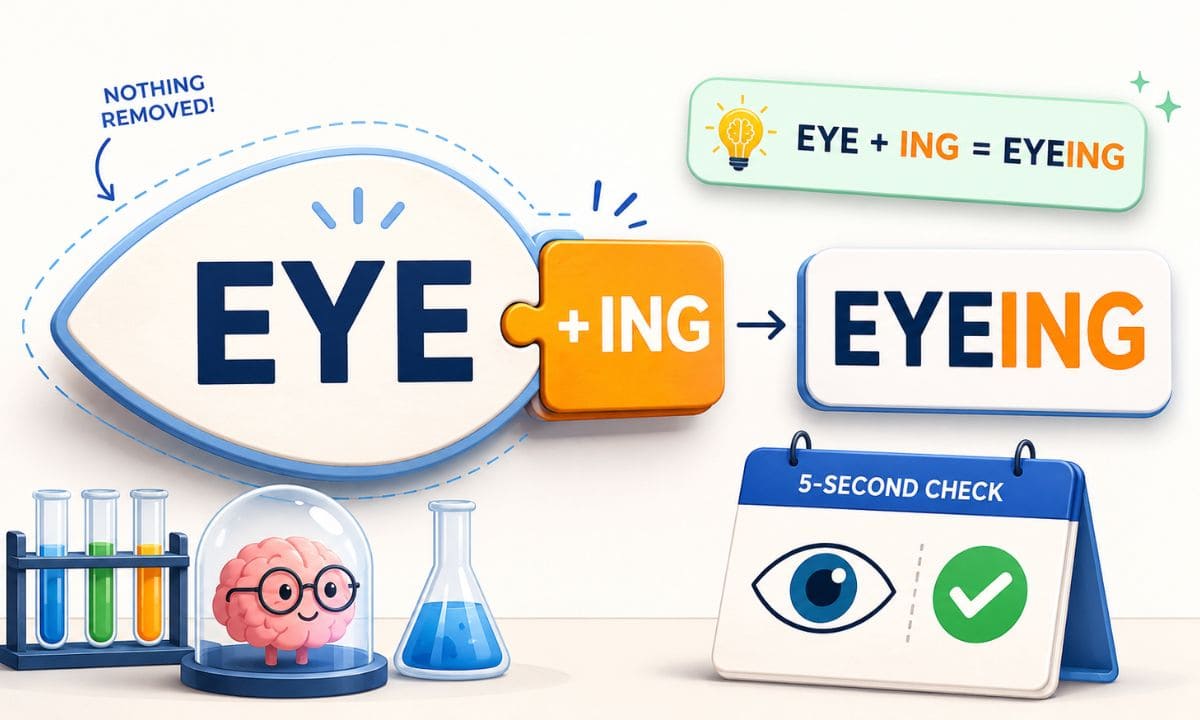
Step 1: Remember the Base Word “Eye”
Always start from the noun you already know how to spell.
Step 2: Add “-ing”
Attach it directly, no letters removed.
Step 3: Keep the “e” in Eyeing
Resist the urge to drop the final “e,” since “eye” doesn’t follow the usual silent-e rule.
Easy Memory Trick: “Eye + ing = Eyeing”
Picture the word “eye” wearing a little “-ing” hat on top. Nothing gets removed, it just gets longer.
5-Second Spelling Check
Ask yourself: “Does it still look like the word ‘eye’?” If yes, you’ve written eyeing correctly.
Image prompt 3: A minimalist illustration of an eye shape with the letters “-ing” attached to it like a puzzle piece, symbolizing the “eye + ing = eyeing” memory trick.
Explore More Grammar Guides
Stutter vs Studder: Correct Spelling and Meaning Guide in 2026
Friend vs Freind: Common Mistake and Correct Usage Explained
Really vs Realy? A Quick Guide to Correct English Spelling (2026)
Barrel vs Barrell: Correct Spelling, Meaning, and Sentence Examples
Keep vs Kept: Which One Is Correct? Rules, Examples & Tips
Customize vs Customise: Which One Should You Use? Complete Guide
Eying vs Eyeing in Everyday Sentences
Examples in Daily Conversations
- “Stop eyeing my fries!”
- “I’ve been eyeing that jacket for weeks.”
Examples in Emails and Professional Writing
- “We are currently eyeing a Q3 launch date.”
- “The team is eyeing additional funding options.”
Examples in News Headlines
- “Investors Eyeing Rate Cuts Ahead of Fed Meeting”
- “City Officials Eyeing New Transit Routes”
Examples on Social Media
- “Me eyeing my crush’s Instagram story for the tenth time today 👀”
Examples in Academic Writing
“Researchers have been eyeing this compound as a potential treatment option.”
Common Mistakes With Eying and Eyeing
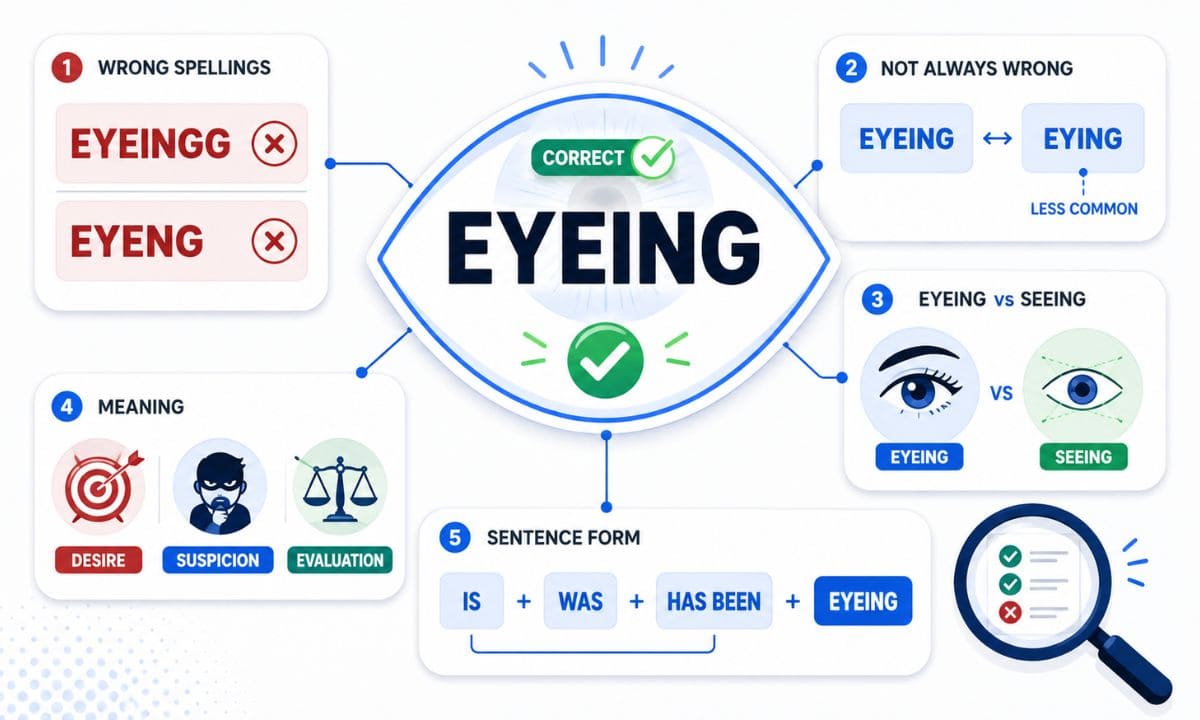
Mistake 1: Thinking One Spelling Must Be Wrong
Both spellings are technically valid. The mistake is assuming eying is always incorrect, it isn’t, it’s just less common.
Mistake 2: Writing “Eyeingg” or “Eyeng”
These are simple typos that come from typing too fast or being unsure of the correct letter count.
Mistake 3: Confusing “Eyeing” With “Seeing”
Both words involve vision, but “eyeing” implies focused, interested watching, while “seeing” just means perceiving something visually.
Mistake 4: Forgetting What “Eyeing” Means
“Eyeing” isn’t neutral; it usually suggests desire, suspicion, or careful evaluation, not just a casual glance.
Mistake 5: Using the Wrong Form in a Sentence
Remember that “eyeing” needs a helping verb (“is,” “was,” “has been”) . You can’t use it alone as a main verb in a sentence.
Which Spelling Should You Use: Eying or Eyeing?
What Should You Write?
Write “eyeing” unless you have a specific style guide telling you otherwise. It’s the safer, clearer, more professional choice.
In American English
American publications, from news sites to business blogs, use eyeing almost exclusively.
In British English
British English also favors eyeing, though eying shows up occasionally in older or literary texts.
In Academic or Professional Writing
Stick with eyeing. It matches what most style guides and editors expect, and it avoids any chance of looking like a spelling error.
What If You Are Not Sure Which Spelling to Use?
When in doubt, default to eyeing. It works in every context: casual, formal, academic, or professional.
Is “Eyeing” Safer for General Writing?
Yes. It’s the version readers expect, the version spell-checkers won’t flag, and the version that keeps your writing looking polished.
Eying vs Eyeing: Comparison Table
| Feature | Eying | Eyeing |
| Spelling style | Drops one “e” | Keeps both “e”s |
| Popularity | Rare | Very common |
| Dictionary status | Listed as variant | Listed as main entry |
| American English | Occasionally used | Strongly preferred |
| British English | Occasionally used | Strongly preferred |
| Formal writing | Avoid | Recommended |
| Reader familiarity | Can look like a typo | Instantly recognizable |
| SEO/search visibility | Low search volume | Higher search volume |
| Risk of misreading | Slightly higher | Very low |
| Best use case | Rarely necessary | Almost every situation |
What Do Major Dictionaries Say About Eying vs Eyeing?
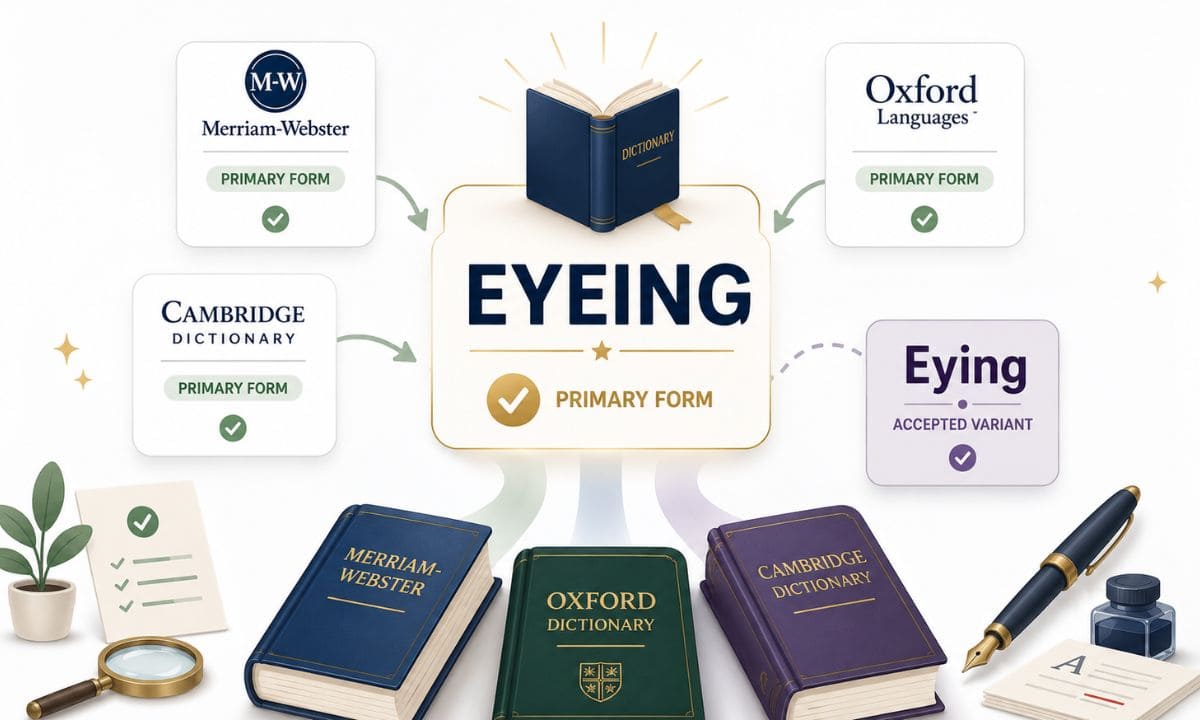
Leading dictionaries, including Merriam-Webster and Dictionary.com, list “eyeing” as the primary present participle of “eye,” with “eying” noted as an accepted secondary spelling.
This consistent pattern across major references is exactly why eyeing is treated as the standard choice in edited, professional writing.
Quick Test I Created
Practice Sentences: Eying vs Eyeing
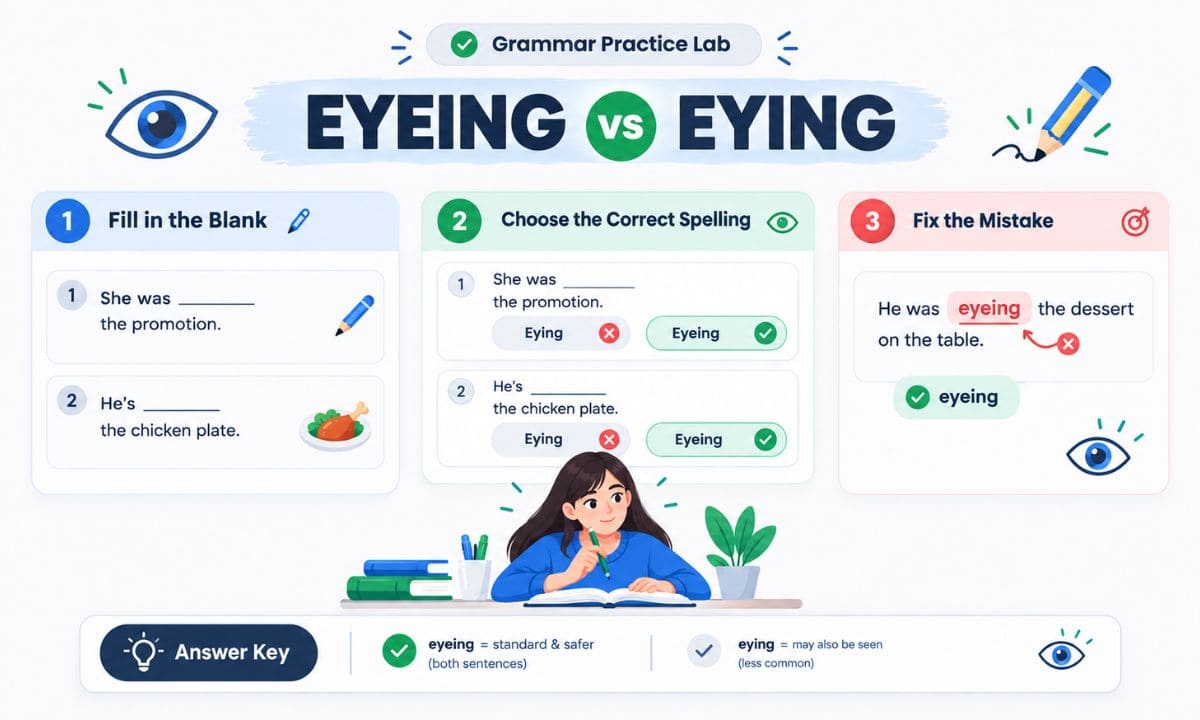
Fill-in-the-Blank Practice
- She is ______ a promotion at work.
- The dog kept ______ the plate of chicken.
Choose the Correct Spelling
- He was (eying / eyeing) the finish line.
- They are (eying / eyeing) a new office space.
Correct the Spelling Mistake
- “I’ve been eyeing that car for months.” Fix the typo.
Answers and Explanations
Correct spelling: “eyeing” (remove the extra “g”).
Eyeing standard form for professional context.
Eyeing standard form; “eying” would also be accepted but less common.
Both are correct; eyeing is the safer pick.
Both are correct; eyeing reads more naturally.
Frequently Asked Questions
Is “Eying” a Correct Spelling?
Yes, it’s a recognized variant spelling of “eye” plus “-ing,” though it’s used far less often than “eyeing.”
Is “Eyeing” the Correct Spelling?
Yes, “eyeing” is the standard, most widely accepted spelling in both American and British English.
What Is the Difference Between Eying and Eyeing?
There’s no difference in meaning, only in spelling style and how common each form is.
Does “Eying” Have the Same Meaning as “Eyeing”?
Yes, both mean to look at something closely, often with interest, suspicion, or desire.
How Do You Spell Eyeing in American English?
American English almost always uses “eyeing,” keeping both letters of the base word “eye.”
How Do You Spell Eyeing in British English?
British English also favors “eyeing,” with “eying” appearing only occasionally in older texts.
Why Does Eyeing Keep the Letter E?
It keeps the “e” to preserve the word’s connection to “eye” and avoid an awkward or confusing spelling.
Which Spelling Do Dictionaries Prefer?
Most major dictionaries list “eyeing” as the main entry and “eying” as a secondary, less common variant.
Is “Eyeing” Used in Formal Writing?
Yes, it’s the recommended spelling for academic papers, business writing, journalism, and professional communication.
What Is a Simple Trick to Remember the Spelling?
Think “eye + ing = eyeing” you’re just adding letters to the base word, not removing any.
Conclusion: Eying vs Eyeing?
When you’re stuck choosing between eying vs eyeing, go with eyeing. It’s the version dictionaries lead with, readers recognize instantly, and professional writing relies on.
Both spellings technically pass a grammar check, but only one makes your writing look effortless. Next time you write a sentence like “she was eyeing the promotion,” you’ll know exactly why that extra “e” belongs there; it’s simply “eye” plus “-ing,” nothing removed, nothing complicated.
Quick reminder: Eye + ing = Eyeing. Keep both letters, and you’ll never second-guess this spelling again.
