

Ever paused mid-sentence, unsure whether to write “Carmel” vs “Caramel”? You’re not alone. These two words look almost the same, sound similar in some accents, and trip up even careful writers.
Here’s the short version: Caramel is a sweet, cooked sugar used in food and drinks. Carmel is a proper name, usually a place or a person’s name. Once you know that, the confusion mostly
What Does Caramel Mean?
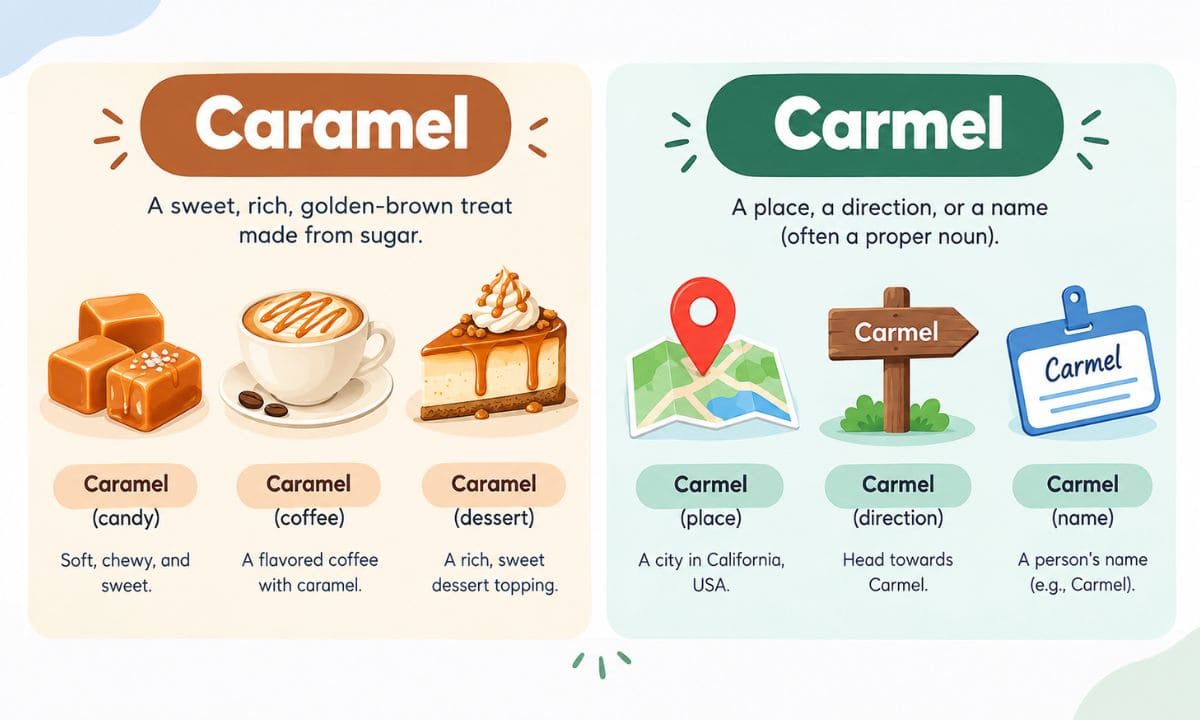
Caramel is a sugar-based product made by heating sugar slowly until it turns brown and develops a rich, slightly bitter-sweet flavor. It shows up everywhere in the food world.
As a food item, caramel is used in:
- Candy and toffee
- Sauces for desserts and ice cream
- Coffee syrups and flavored drinks
- Cake and pastry fillings
As a color, caramel describes a warm brownish shade, often used in fashion and interior design (think caramel-colored boots or a caramel leather sofa).
As a flavor descriptor, people say things like “this cookie has caramel notes” even without literal caramel in it.
Caramel in Sentences
- She poured caramel sauce over the vanilla ice cream.
- His new jacket comes in a caramel shade.
- I ordered a caramel macchiato this morning.
Caramel Pronunciation
One reason people misspell caramel is pronunciation.
Depending on the region, you’ll hear it said as “KAR-uh-mel,” “KAR-mel,” or even “CAR-a-mul.”
That last, compressed version sounds a lot like “Carmel,” which is exactly where the spelling mix-up starts.
What Does Carmel Mean?
Carmel is a proper noun. It doesn’t describe food, flavor, or color at all. Instead, it refers to:
Place names: Carmel-by-the-Sea in California, Mount Carmel in Israel, and towns named Carmel in states like Indiana and New York.
Personal names: Carmel is used as a first name in several cultures, particularly Irish and Hebrew traditions.
Business and organization names: Schools, churches, and companies sometimes carry the name Carmel, often tied to Mount Carmel’s religious history.
Since Carmel comes from a place name with religious and historical roots, it almost always starts with a capital letter.
Carmel in Sentences
- We spent our honeymoon in Carmel-by-the-Sea.
- Carmel is a common name for girls in Ireland.
- The convent follows the Carmelite tradition, named after Mount Carmel.
disappears.
This guide breaks down the meaning, spelling, pronunciation, and real-world use of both words so you never mix them up again.
How to Remember Carmel vs Caramel
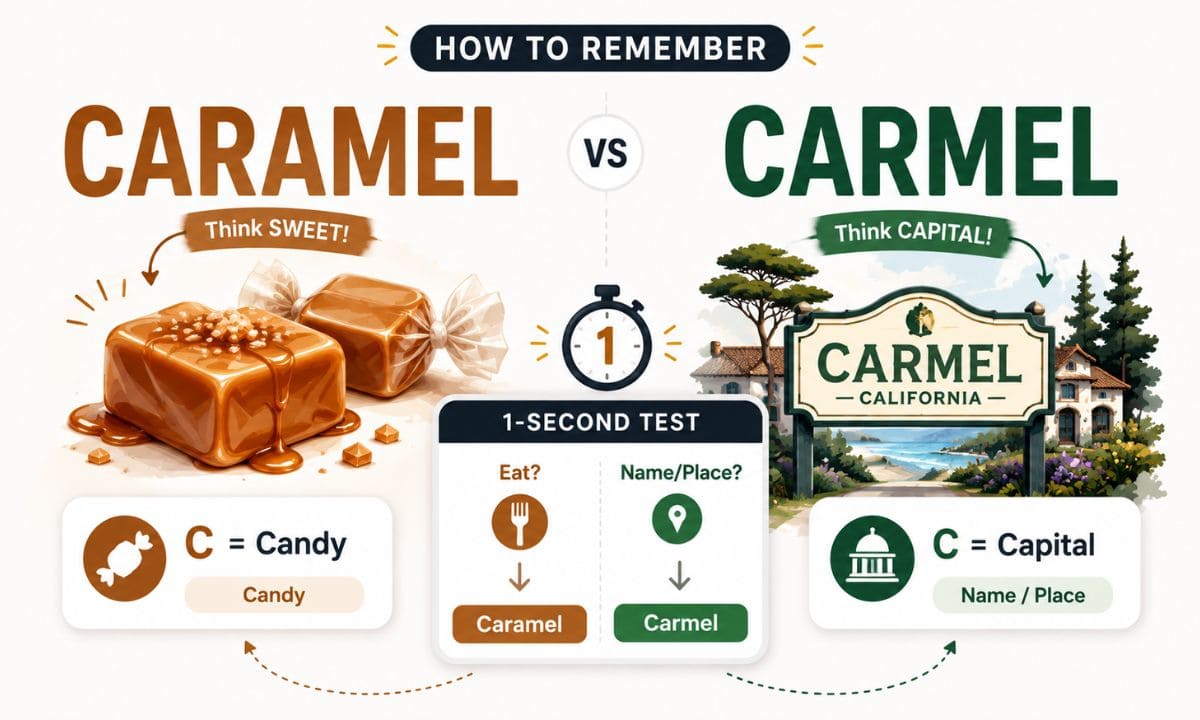
A couple of simple memory tricks make this permanent:
Caramel = Candy.
Both start with “Ca” and both are things you eat.
Carmel = Capital.
Carmel usually needs a capital letter because it’s a name or place.
One-second test:
Ask yourself, “Is it something you eat?” If yes, it’s caramel. “Is it a name or place?” If yes, it’s Carmel.
Carmel vs Caramel in Everyday Sentences
Coffee shop:
“Can I get a caramel latte, please?” correct because it’s a drink flavor.
Dessert menu:
“Warm caramel drizzle over apple pie” correct food usage.
Travel writing:
“We drove down the coast to Carmel, California” correct place name.
Social media:
“Caramel popcorn is my weakness” versus “Just landed in Carmel for the weekend” same words, completely different meanings based on context.
Common Carmel vs Caramel Mistakes
Even confident writers slip up here. Watch for these:
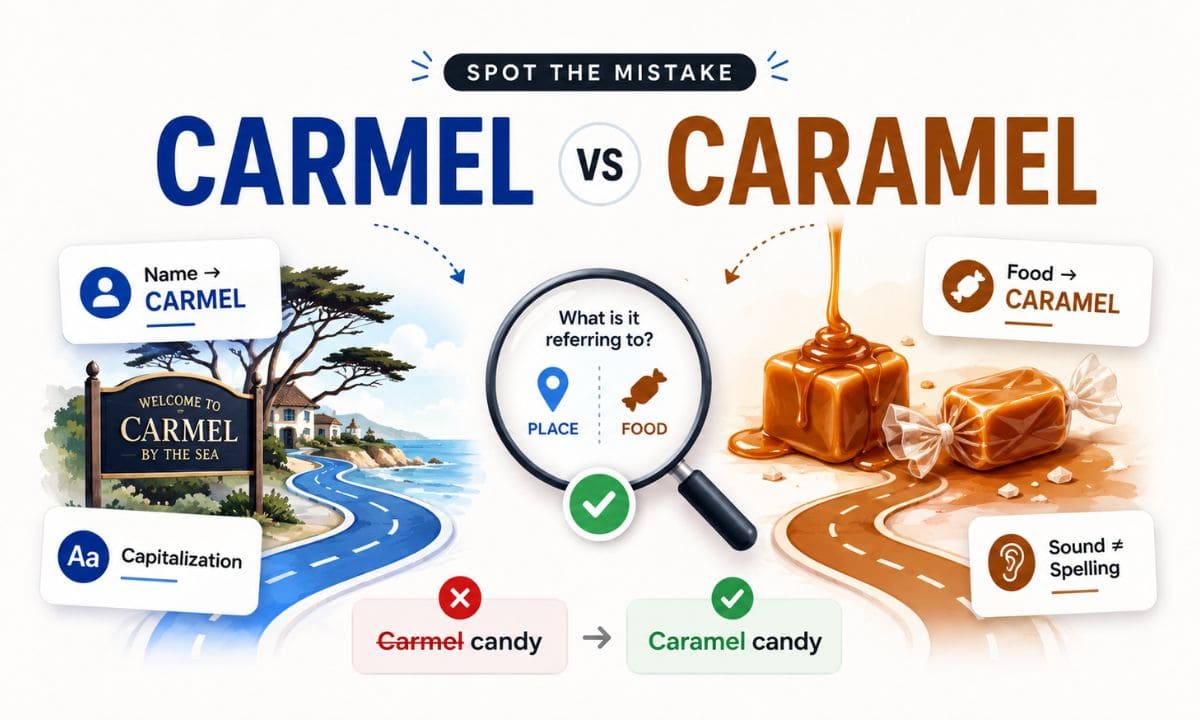
Writing “Carmel” for the sweet
“I love Carmel candy” should read “I love caramel candy.”
Treating them as synonyms
They aren’t interchangeable; one is a food term, the other a name.
Forgetting capitalization
Carmel needs a capital C since it’s a proper noun; caramel usually doesn’t.
Assuming sound decides spelling
Just because caramel sounds like “car-mel” in speech doesn’t mean it’s spelled that way in writing.
Reading your sentence back and asking “is this about food or a name?” solves most of these mistakes instantly.
Why Do People Confuse Carmel and Caramel?
This mix-up isn’t random. A few clear reasons explain it.
Similar spelling: Carmel is essentially caramel with the middle “a” dropped, making it easy to miss on a quick read or type.
Regional pronunciation: In fast, casual speech, caramel often gets shortened to sound like “car-mel,” blurring the line between the two words.
Autocorrect and typing speed: Phone keyboards sometimes “correct” caramel to Carmel or vice versa, especially in texts and quick emails.
Lack of context: Readers skimming a sentence may not notice which meaning is intended until it’s too late.
Knowing these triggers helps you slow down and double-check before hitting send.
Which One Should You Use And When?
Here’s a simple way to decide between Carmel and Caramel every time.
Use “Caramel” when talking about:
- Candy, toffee, or dessert sauces
- Coffee drinks and syrups
- A brownish color or shade
- A flavor profile in food or drink
Use “Carmel” when talking about:
- A city or town name
- A person’s first name
- A business, school, or organization
- Anything tied to Mount Carmel’s history
If you’re describing something you can eat or drink, it’s caramel. If you’re naming a place or a person, it’s Carmel.
Explore More Grammar Guides
Stutter vs Studder: Correct Spelling and Meaning Guide in 2026
Friend vs Freind: Common Mistake and Correct Usage Explained
Manuel or Manual: Fix This Common Spelling Mistake Easily
Barrel vs Barrell: Correct Spelling, Meaning, and Sentence Examples
Customize vs Customise: Which One Should You Use? Complete Guide
Divide vs Devide: Meaning, Examples, and Spelling Made Easy
Advise or Advice: What’s the Difference? Clear Guide With Examples
What Dictionaries Say
Standard dictionaries like Meriam Webster and oxford define caramel strictly as a food and color term, while Carmel appears only as a proper noun tied to geography or personal names.
This distinction confirms that the two words are not variant spellings of each other, despite how alike they look on the page.
Frequently Asked Questions
Is Carmel or Caramel the correct spelling for the sweet?
Caramel is correct for the food item; Carmel is never used for candy, sauce, or flavor.
Is Carmel a misspelling of caramel?
Only if you meant the food word otherwise Carmel is a valid, separate proper noun.
Why do some people pronounce caramel without the “a” sound?
Regional accents often shorten caramel to “car-mel,” which sounds like Carmel but is still spelled with the extra “a.”
Is Carmel a name or a place?
It’s both commonly used as a first name and as the name of several towns and cities.
Should Carmel always be capitalized?
Yes, since it’s a proper noun referring to a person or place.
How do you remember the spelling of caramel?
Link it to “candy” both start with “Ca” and both relate to something sweet.
Are Carmel and Caramel pronounced the same?
They can sound similar in casual speech, but they are spelled differently and mean different things.
What is the difference between Carmel and Caramel?
Caramel is a sweet food or color term; Carmel is a proper name for people or places.
Can Carmel ever refer to food?
No, standard English reserves Carmel strictly for names and places, not edible caramel.
Why do spell-checkers sometimes flag caramel?
Because “Carmel” is also a recognized word, some spell-checkers suggest it by mistake, so always confirm the context before accepting a correction.
Conclusion
The rule is simple once it clicks. Caramel belongs to the kitchen candy, sauce, flavor, and color. Carmel belongs to the map and the name registry towns, people, and organizations. Whenever you’re unsure, ask what the sentence is really about. If it’s edible, write caramel. If it’s a name, write Carmel.
Keep this one distinction in mind, and you’ll never confuse Carmel vs Caramel in your writing again.

1 thought on “Carmel vs Caramel: Simple Difference, Pronunciation & Memory Trick”