

If you’ve ever paused mid-sentence wondering whether to write “keep” vs “kept,” you’re dealing with one of English’s most common irregular-verb mix-ups.
It’s a small word, but getting it wrong stands out in emails, essays, and even casual texts.
This guide breaks down keep vs kept in plain language, with grammar rules, real examples, and quick memory tricks you can actually use no confusing jargon, just clear answers backed by standard dictionary rules.
Quick Answer
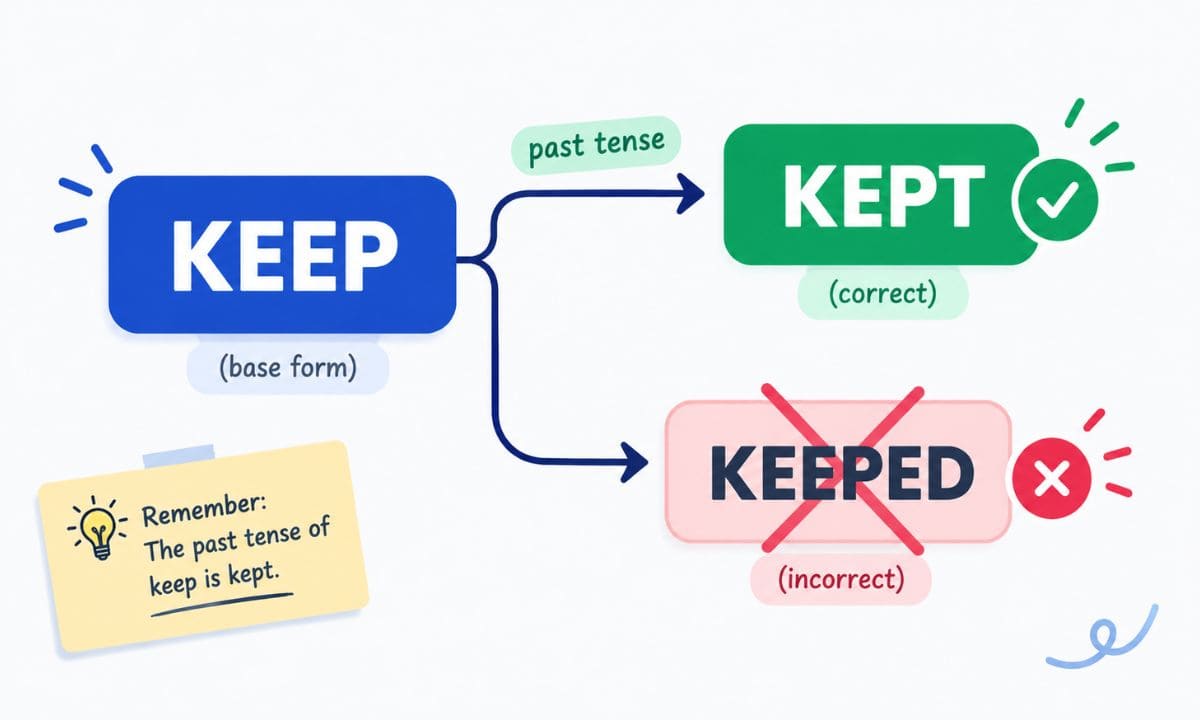
Keep is the present form.
Kept is the past tense and past participle.
Talking about now or in general? Use keep.
Talking about something already finished? Use kept.
And “keeped” is never correct because spelling doesn’t exist in English.
Keep vs Kept: The Main Difference
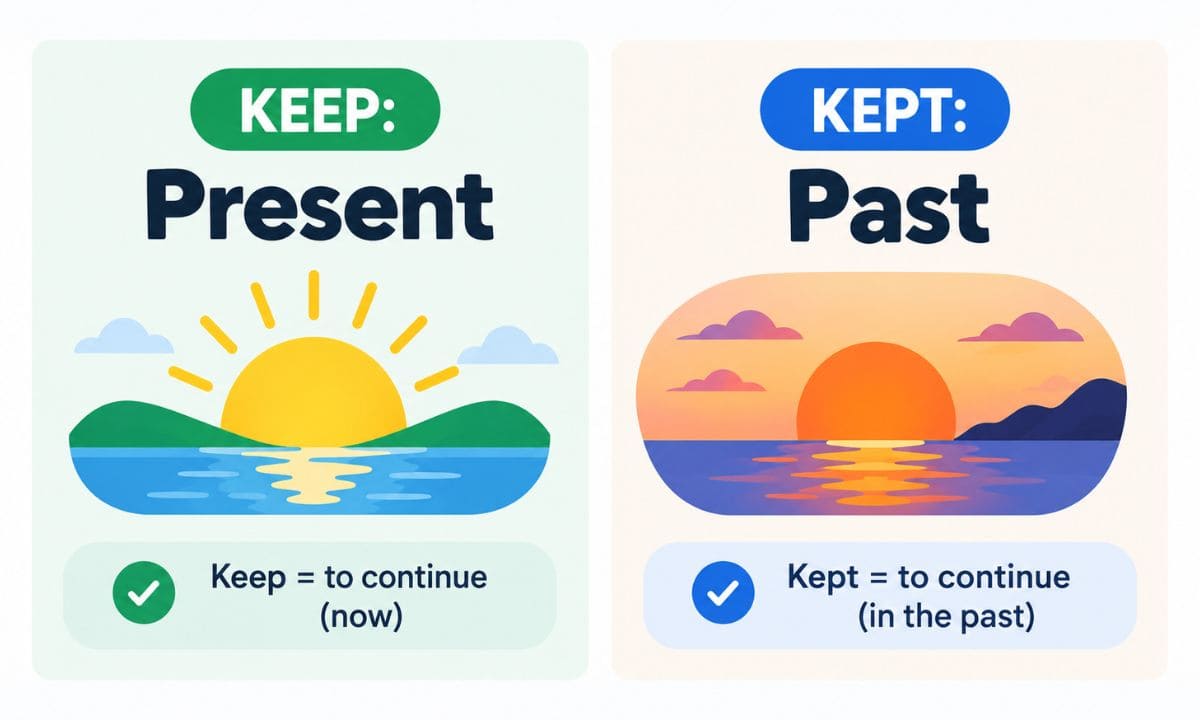
The real difference is timing.
Keep points to now, to habits, or to the future.
Kept points to something that already happened or finished.
A simple test: if you can swap in “do,” use keep; if you can swap in “did,” use kept.
What Is “Keep”?
Keep means to hold on to something, continue an action, or maintain a state.
When to use it: present habits, general truths, instructions, and after modal verbs (can, will, should).
Examples:
- I keep all my receipts in a folder.
- Please keep the noise down.
- She always keeps her word.
What Is “Kept”?
Kept means something was held, maintained, or finished in the past or completed up to now.
When to use it: finished past actions, and after have, has, or had.
Examples:
- I kept the ticket as a souvenir.
- She has kept the same job for ten years.
- They had kept quiet about the surprise.
Keep vs Kept at a Glance
| Word | Type | Tense | Example |
| Keep | Base verb | Present | I keep my keys in my bag. |
| Keeps | Present (he/she/it) | Present | She keeps a diary. |
| Kept | Simple past | Past | He kept his promise. |
| Kept | Past participle | Perfect/passive | They have kept in touch. |
| Keeping | -ing form | Continuous | I am keeping the receipt. |
Is “Keeped” Correct?
No. Keep is an irregular verb, so it skips the usual “add -ed” rule. Instead of “keeped,” English uses “kept.
This mix-up is one of the most common irregular-verb errors learners make, right alongside sleeped/slept and buyed/bought.
Keep vs Kept: Grammar Rules
Keep in the present tense pairs with I/you/we/they; add -s for he/she/it.
Keep after modal verbs always the base form: You should keep a copy.
Keep after “to”: I want to keep this photo.
Keep in commands Keep off the grass.
Kept for past actions: We kept the windows open all night.
Kept as a past participle The files were kept safe (passive voice).
Kept with have/has/had He has kept every card he’s received.
Keep vs Kept: Tense and Grammar
Tense is really the whole game here.
Present simple and present continuous both need keep.
Past simple, past perfect, present perfect, and passive sentences all need to be kept.
If your sentence has a time marker like “yesterday,” “last week,” or “already,” kept is almost always the safer bet.
Sentence Patterns
Keep + noun: I keep a notebook.
Keep + adjective: Keep calm.
Keep + verb-ing: Keep trying.
Keep + object + adjective: Keep the door open.
Kept + noun: She kept a journal.
Kept + verb-ing: He kept talking all night.
Example Sentences
I keep my phone on silent during meetings. (present)
Yesterday, I kept my phone on silent all day. (past)
She has kept the same hairstyle for years. (present perfect)
Will you keep this a secret? (modal)
The secret was kept for decades. (passive)
Real-Life Examples of Keep vs Kept
| Context | Keep (present) | Kept (past) |
| School | I keep my notes organized. | I kept my notes from last semester. |
| Daily life | We keep in touch every week. | We kept in touch for years. |
| Texting | Keep me posted! | I kept your message, so sweet. |
| Social media | Keep going, you’ve got this! | She kept pushing until she made it. |
A common student slip is writing “I keeped studying all night” instead of “I kept studying all night.”
Common Mistakes With Keep and Kept
1. Saying “keeped.
“ ❌ I keeped my promise. ✅ I kept my promise.
2. Using keep for finished actions.
❌ Yesterday, I keep the receipt. ✅ Yesterday, I kept the receipt.
3. Forgetting to keep is irregular.
Keep → kept → kept.
All three forms must be memorized on their own; there’s no formula.
4. Mixing up questions.
Present: Do you keep a journal?
Past: Did you keep the journal your mom gave you?
5. Confusing “keep on” with “kept on.
Present habit: I keep on forgetting his name.
Past habit: I kept on forgetting his name last year.
Explore More Grammar Guides
Stutter vs Studder: Correct Spelling and Meaning Guide in 2026
Friend vs Freind: Common Mistake and Correct Usage Explained
Really vs Realy? A Quick Guide to Correct English Spelling (2026)
Barrel vs Barrell: Correct Spelling, Meaning, and Sentence Examples
Customize vs Customise: Which One Should You Use? Complete Guide
Which One Should You Use?
Use keep for the present, general truths, and after modal verbs.
Use kept for anything finished, and with perfect tenses (have/has/had kept).
A quick trick:
Replace the verb with “do” (use keep) or “did” (use kept), and the right word usually reveals itself. Reading the full sentence out loud also helps your ear often catch the wrong tense before your eyes do.
Why “Keeped” Is Wrong
Keep doesn’t just add -ed its spelling changes entirely, dropping one “e” and adding a “t.” The same pattern shows up in sleep/slept and sweep/swept. There’s no shortcut here; you simply learn the exception.
Comparison Table: Keep vs Kept
| Feature | Keep | Kept |
| Tense | Present | Past / past participle |
| Verb type | Base form (irregular) | Irregular past form |
| Pairs with | Do, does, will, can | Did, have, has, had, was/were |
| Sample sentence | I keep, she keeps | I kept, it was kept |
| Common pattern | Keep + noun/adjective/-ing | Kept + noun/adjective/-ing |
What Do Major Dictionaries Say?
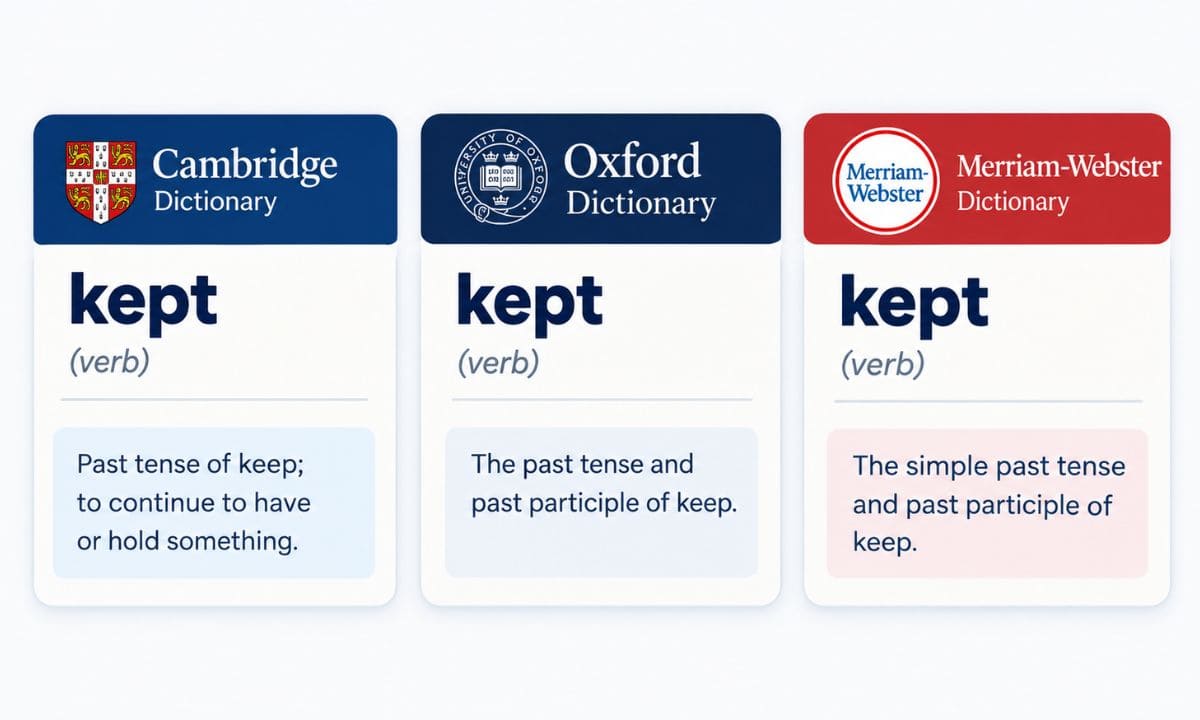
| Source | Summary |
| Cambridge Dictionary | Keep: to have or continue to have something; kept is its past form. |
| Oxford Dictionary | Keep: to retain or continue in a state; kept is the irregular past form. |
| Merriam-Webster | Keep: to maintain in a position or state; kept covers both past tense and past participle. |
All three agree: kept is the only accepted past form of keep, with no alternative spelling.
Quick Test I Created
Practice: Keep or Kept?
Fill in the blank:
- I ___ my umbrella in the car every day.
- She ___ the letter for twenty years.
- We have always ___ our doors locked.
- Please ___ this between us.
Answer key: 1. keep, 2. kept, 3. kept, 4. keep.
Correct the mistake: “She keep calling yesterday” → She kept calling yesterday.
Frequently Asked Questions
Is “keeped” a correct word?
No. “Keeped” is incorrect in every context. The correct past form of keep is kept.
Is kept the past tense of keep?
Yes. Kept works as both the simple past tense and the past participle of keep.
What are the three forms of keep?
Keep (present), kept (past), and kept (past participle).
Should I use keep or kept for past tense?
Use kept for anything that already happened or was completed.
Is “kept” a past participle?
Yes. It appears in perfect tenses and passive sentences, like “has kept” or “was kept.”
What is the difference between keep and kept?
Keep refers to the present or general truths; kept refers to the past or finished actions.
Can I say “I keeped it”?
No. The correct sentence is “I kept it.”
How can I easily remember keep and kept?
Tie keep to “now” and kept to “before.” If it’s already done, use kept.
Is keep a regular or irregular verb?
Irregular. It doesn’t follow the standard “add -ed” pattern for past tense.
What’s an easy trick to check which one to use?
Swap the verb for “do” (present, use keep) or “did” (past, use kept) and see which fits.
Conclusion
Keep belongs to the present habits, facts, and instructions happening now.
Kept belongs to the past and to perfect or passive sentences describing something already done.
When in doubt, ask: did this already happen? If yes, kept. If it’s true now or ongoing, keep.
Learn that one rule, and keep vs kept stops being confusing for good.

4 thoughts on “Keep vs Kept: Which One Is Correct? Rules, Examples & Tips”