

If you keep typing the word “history” and it’s starting to feel repetitive, you’re not alone. Writers, students, and content creators run into the same wall.
How do you talk about the past without saying “history” in every other sentence?
That’s exactly what this guide solves. Below, you’ll find 22+ history synonyms, broken down by meaning, tone, and real-world use, so you can pick the right word every time instead of guessing.
Quick Answer
The best history synonyms depend on context.
For everyday writing, use the past or background.
For formal or written accounts, use record, chronicle, or account.
For culture and identity, use heritage or legacy.
For gradual change over time, use evolution or development.
There’s no single “correct” replacement; the right synonym for history always depends on tone and context.
What Does History Mean?
Before swapping the word out, it helps to know exactly what “history” is doing in your sentence.
It’s not just one idea it covers several related but distinct meanings.
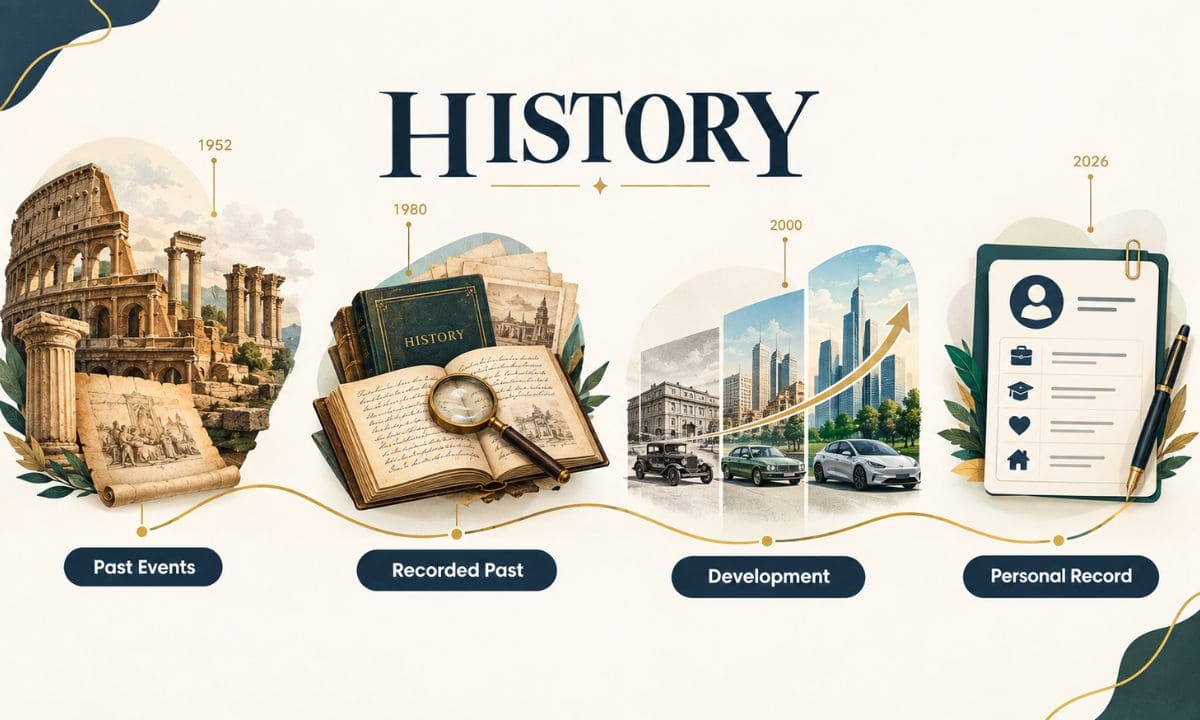
Main meanings of “history”:
Past events everything that has already happened, collectively (e.g., “history repeats itself”).
Recorded account of the past a written or spoken record of events, often organized and researched (e.g., “a history of the Roman Empire”).
Background or development how something has changed, grown, or come to be over time (e.g., “the history of jazz music”).
Personal record an individual’s past experiences, actions, or medical/credit background (e.g., “her employment history”).
Examples:
- “History shows that empires eventually decline.”
- “She wrote a detailed history of the civil rights movement.”
- “The company’s history goes back to 1952.”
- “He has a history of missed deadlines.”
History Pronunciation and Word Forms
History is pronounced /ˈhɪstri/ or /ˈhɪstəri/, depending on accent both are correct.
The three-syllable version is more common in formal speech, while the two-syllable version shows up in casual conversation.
Common word forms include:
Historic (adjective) important in history
Historical (adjective) relating to history
Historically (adverb) from a historical point of view
Historian (noun) a person who studies history
Historicity (noun) historical authenticity
Best Synonyms for History at a Glance
Here’s a quick-reference table before we go deeper into each word.
| Synonym | Best Used For | Tone |
| Past | General, everyday writing | Neutral |
| Record | Documented facts or data | Formal |
| Chronicle | Detailed, sequential accounts | Formal/Literary |
| Account | Written or spoken narration | Neutral |
| Heritage | Culture, tradition, identity | Formal |
| Legacy | Lasting impact or influence | Formal |
| Background | Context or origin | Neutral |
| Narrative | Storytelling style writing | Neutral/Literary |
| Annals | Official historical records | Formal |
| Archive | Stored historical documents | Formal |
22+ History Synonyms and Their Meanings
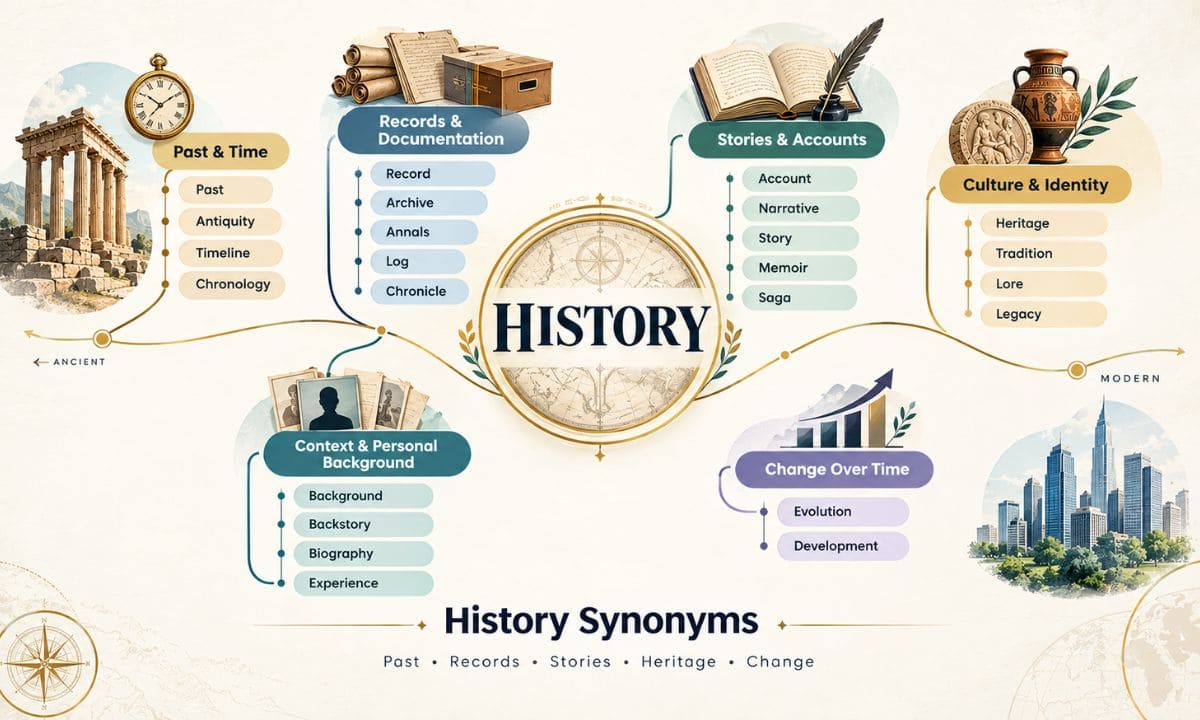
Below is the complete list of history synonyms. Each entry includes the meaning, when to use it, a short explanation, and real example sentences so you can see it in action.
1. Past
Meaning
Events or time that have already happened.
Best for
General, everyday writing.
Intro
The past is the simplest alternative to history when you’re talking generally about earlier time or events, without implying a formal record.
Examples
- “We should learn from the past.”
- “The building has a fascinating past.”
- “She rarely talks about her past.”
Usage tip
Use past when you mean previous time in general, not a documented historical account.
2. Record
Meaning
A factual, often official, account of events.
Best for
Formal, data-driven, or documented writing.
Intro
Record works well when you want to emphasize that something was written down or officially tracked, rather than just remembered.
Examples
- “The company keeps a record of every transaction.”
- “His driving record is spotless.”
- “The weather record shows this was the hottest summer on file.”
Usage tip
Use record when accuracy and documentation matter more than storytelling.
3. Account
Meaning
A spoken or written description of events.
Best for
Narratives, reports, and eyewitness retellings.
Intro
Account is ideal when someone is describing what happened, often from their own perspective or with a specific viewpoint.
Examples
- “He gave a detailed account of the accident.”
- “The book offers a personal account of the war.”
- “Her account of the meeting differed from his.”
Usage tip
Use account when the focus is on someone’s version or telling of events.
4. Chronicle
Meaning
A factual, chronological record of events as they happened.
Best for
Formal, journalistic, or literary writing.
Intro
Chronicle suggests a detailed, time-ordered record, often used for longer stretches of history.
Examples
- “The novel chronicles three generations of one family.”
- “This document is a chronicle of the town’s founding.”
- “Reporters chronicled the events of the revolution.”
Usage tip
Use chronicle when order and sequence matter as much as the facts themselves.
5. Narrative
Meaning
A connected, story-like account of events.
Best for
Creative, journalistic, or persuasive writing.
Intro
Narrative works well when history is being shaped into a story with structure, tone, and perspective.
Examples
- “The film follows the narrative of a small town’s decline.”
- “Historians often disagree on the narrative of a war.”
- “She crafted a compelling narrative around the brand’s origins.”
Usage tip
Use narrative when you want to highlight storytelling, not just facts.
6. Heritage
Meaning
Traditions, culture, and history passed down through generations.
Best for
Cultural, ancestral, or identity-based writing.
Intro
Heritage points to what’s inherited customs, values, and history tied to a group’s identity.
Examples
- “The festival celebrates the region’s cultural heritage.”
- “He’s proud of his Irish heritage.”
- “The museum preserves the town’s architectural heritage.”
Usage tip
Use heritage for identity and tradition, not just past events.
7. Legacy
Meaning
The lasting impact or influence left behind by someone or something.
Best for
Impact-focused, reflective, or tribute writing.
Intro
Legacy is less about what happened and more about what remains the effect that lingers after the fact.
Examples
- “Her legacy as a scientist continues to inspire researchers.”
- “The company’s legacy is built on innovation.”
- “He left behind a legacy of kindness.”
Usage tip
Use legacy when discussing lasting effects, not just past occurrences.
8. Background
Meaning
The circumstances or context leading up to a situation.
Best for
Explaining context before a main point.
Intro
Background is useful when you need to briefly set the stage before diving into details.
Examples
- “Let me give you some background before we continue.”
- “Her background in finance helped her land the role.”
- “The article provides background on the conflict.”
Usage tip
Use background for context-setting, not detailed retelling.
9. Annals
Meaning
Formal, year-by-year historical records.
Best for
Academic, official, or archival writing.
Intro
Annals carries a slightly old-fashioned, official tone often used for institutional or national records.
Examples
- “This victory will go down in the annals of sports history.”
- “The annals of the empire span centuries.”
- “Their achievements are recorded in the annals of science.”
Usage tip
Reserve annals for formal or dramatic contexts it sounds odd in casual speech.
10. Antiquity
Meaning
The distant past, especially ancient civilizations.
Best for
Historical, academic, or archaeological writing.
Intro
Antiquity specifically points to ancient times, not recent history.
Examples
- “The ruins date back to antiquity.”
- “Scholars study the art of classical antiquity.”
- “This myth originated in antiquity.”
Usage tip
Use antiquity only for ancient time periods, not general past events.
11. Story
Meaning
An account of events, often with a narrative arc.
Best for
Casual, conversational, or engaging writing.
Intro
Story is the most informal option great for making history feel approachable.
Examples
- “Every building in this city has a story.”
- “Tell me the story of how the company started.”
- “It’s a story worth remembering.”
Usage tip
Use story for a warm, relatable tone rather than a formal one.
12. Archive
Meaning
A collection of historical documents or records.
Best for
Research, libraries, and digital record-keeping.
Intro
Archive refers to where history is stored, not the events themselves.
Examples
- “The photos are kept in the museum’s archive.”
- “Researchers searched the archive for old newspapers.”
- “The website has an archive of past articles.”
Usage tip
Use archive when referring to stored materials, not the events directly.
13. Biography
Meaning
A written account of a person’s life.
Best for
Personal history writing.
Intro
Biography is specific to individual life stories, not broader historical events.
Examples
- “She’s writing a biography of the former president.”
- “His biography reveals a difficult childhood.”
- “The biography covers his entire career.”
Usage tip
Use biography only when discussing one person’s life history.
14. Chronology
Meaning
The arrangement of events in the order they occurred.
Best for
Timelines and sequential writing.
Intro
Chronology emphasizes order and sequence over storytelling.
Examples
- “The chronology of events is unclear.”
- “Investigators reconstructed a chronology of the crime.”
- “The exhibit follows a strict chronology.”
Usage tip
Use chronology when sequence matters more than narrative detail.
15. Evolution
Meaning
Gradual development or change over time.
Best for
Describing progress, trends, or growth.
Intro
Evolution works well for showing how something transformed over time.
Examples
- “The evolution of technology has been rapid.”
- “This book traces the evolution of jazz.”
- “We studied the evolution of language.”
Usage tip
Use evolution for gradual change, not a single documented past.
16. Development
Meaning
The process of growing or changing over time.
Best for
Business, technology, or personal growth writing.
Intro
Development highlights progress and improvement rather than static past events.
Examples
- “The development of the app took two years.”
- “Child development is influenced by early experiences.”
- “This is a key stage in the country’s development.”
Usage tip
Use development for progress-oriented context, not general past facts.
17. Tradition
Meaning
Customs or practices passed down over generations.
Best for
Cultural and family-related writing.
Intro
Tradition focuses on repeated practices rooted in the past, not events themselves.
Examples
- “It’s a family tradition to gather every December.”
- “The wedding followed local tradition.”
- “This dish has a long culinary tradition.”
Usage tip
Use tradition for customs, not chronological events.
18. Lore
Meaning
Traditional knowledge, stories, or beliefs.
Best for
Folklore, myths, and cultural storytelling.
Intro
Lore has an informal, almost magical quality often tied to legends rather than documented facts.
Examples
- “According to local lore, the lake is haunted.”
- “Fans love discussing the game’s lore.”
- “Family lore says our ancestors sailed from Ireland.”
Usage tip
Use lore for informal, story-based traditions, not factual records.
19. Memoir
Meaning
A personal, written account of one’s own experiences.
Best for
First-person, personal history writing.
Intro
Memoir is history told from a single, personal point of view.
Examples
- “She published a memoir about her years abroad.”
- “His memoir details his rise to fame.”
- “The memoir is both funny and heartbreaking.”
Usage tip
Use memoir only for first-person personal accounts.
20. Backstory
Meaning
The background events that explain a current situation.
Best for
Casual, creative, or explanatory writing.
Intro
Backstory is informal and often used in storytelling or character development.
Examples
- “What’s the backstory behind this photo?”
- “Every character needs a solid backstory.”
- “There’s an interesting backstory to this rule.”
Usage tip
Use backstory in casual or creative contexts, not formal writing.
21. Log
Meaning
A regularly updated record of events or activity.
Best for
Technical, operational, or daily records.
Intro
Log implies ongoing, often routine documentation rather than a broad historical account.
Examples
- “The captain kept a daily log of the voyage.”
- “Check the server log for errors.”
- “She logs her workouts every day.”
Usage tip
Use log for ongoing, itemized records, not general history.
22. Saga
Meaning
A long, often dramatic series of events.
Best for
Storytelling, entertainment, or dramatic writing.
Intro
Saga suggests an epic, drawn-out sequence of events, often with ups and downs.
Examples
- “The lawsuit turned into a years-long saga.”
- “Fans have followed the saga for a decade.”
- “It’s been a whole saga just getting the paperwork done.”
Usage tip
Use saga for dramatic or extended stories, not neutral facts.
23. Timeline
Meaning
A visual or written sequence of events in order.
Best for
Reports, presentations, and project tracking.
Intro
Timeline is a practical synonym when structure and dates matter most.
Examples
- “The timeline shows major events since 1990.”
- “We built a project timeline for the launch.”
- “The article includes a timeline of the investigation.”
Usage tip
Use timeline for structured, date-based content.
24. Experience
Meaning
Knowledge or skill gained through past involvement.
Best for
Resumes, professional bios, and personal writing.
Intro
Experience shifts focus from events themselves to what someone gained from them.
Examples
- “She has ten years of experience in marketing.”
- “His experience with startups gives him an edge.”
- “Life experience taught her more than school ever did.”
Usage tip
Use experience when highlighting skills or lessons, not just events.
History Synonyms by Context
Not every synonym fits every situation. Here’s how to group history synonyms by the context you’re writing in.
For General “History”
Past, background, record
For Written History
Chronicle, annals, account, archive
For Cultural History
Heritage, tradition, lore
For Ancient History
Antiquity, saga
For Personal History
Backstory, biography, memoir, experience
For Development Over Time
Evolution, development, chronology, timeline
History Synonyms: Formal vs Casual
Tone matters just as much as meaning. This table breaks down which history synonyms sound formal and which feel more casual.
| Word | Tone | Best Context |
| Annals | Formal | Academic or ceremonial writing |
| Chronicle | Formal | Journalism, literature |
| Heritage | Formal | Cultural or institutional writing |
| Record | Formal | Business, legal, official use |
| Account | Neutral | Reports, journalism |
| Background | Neutral | Everyday explanations |
| Past | Casual | Everyday conversation |
| Story | Casual | Conversational, blog-style writing |
| Backstory | Casual | Informal, creative writing |
| Lore | Casual | Pop culture, fandom, folklore |
History Synonyms for Professional Writing
In resumes, cover letters, and business emails, “history” can sound vague or even negative (as in “a history of problems”).
Swapping it for a sharper word makes your writing sound more polished and confident.
Example transformation:
- Basic: “I have a history of managing teams.”
- Professional: “I have a proven track record of managing cross-functional teams.”
Synonyms for resumes/emails:
Tenure
Track record
Experience
Background
Credentials
What Major Dictionaries Say About “History”
Different dictionaries frame “history” slightly differently. Here’s a quick comparison of how each one defines it.
Cambridge Dictionary
Cambridge frames history mainly as the study of past events, or a record of events from a particular period, country, or subject with an emphasis on how those events are studied and taught.
Merriam-Webster
Merriam-Webster lists several senses: a chronological record of significant events, a treatise on related phenomena, a patient’s medical background, an established record of behavior, and the branch of knowledge covering past events.
Oxford Languages / Oxford English Dictionary
Oxford defines history broadly as all events that happened in the past, the past events tied to a specific place or subject, the academic study of the past, a written or spoken account, and a record of something occurring repeatedly, such as a medical or credit history.
Collins Dictionary
Collins describes history as both the study of past events and a systematic, chronological account of those events, often tied to a particular nation, institution, or person.
How to Choose the Right Synonym for History
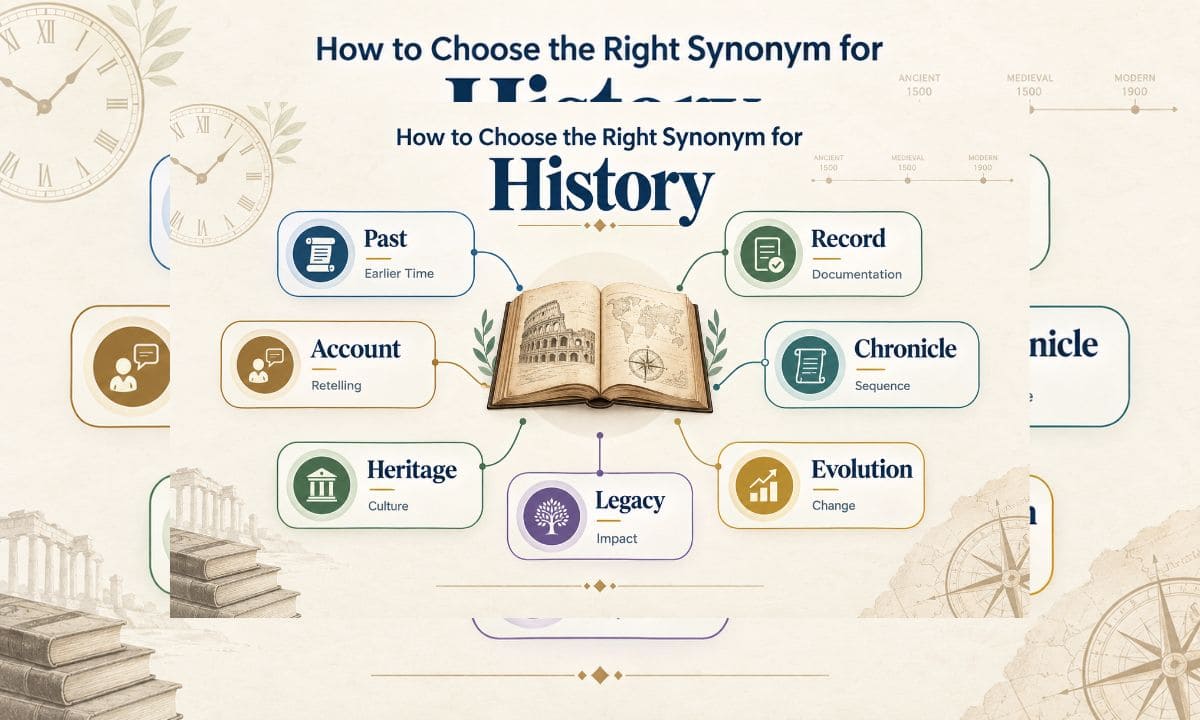
With so many options, picking the right word comes down to context and tone. Use this quick checklist:
Use Past when: you’re speaking generally and casually about earlier time.
Use Record when: accuracy, documentation, or data matters most.
Use Account when: you’re describing someone’s version or retelling of events.
Use Chronicle when: sequence and detail matter, especially in formal writing.
Use Heritage when: you’re discussing culture, tradition, or identity.
Use Legacy when: you want to highlight lasting impact, not just events.
Use Evolution when: you’re describing gradual change or progress over time.
Common Mistakes When Using History Synonyms
Synonyms aren’t always interchangeable. Using the wrong one can shift your meaning or tone in ways you didn’t intend. Here are the most common mistakes to avoid.
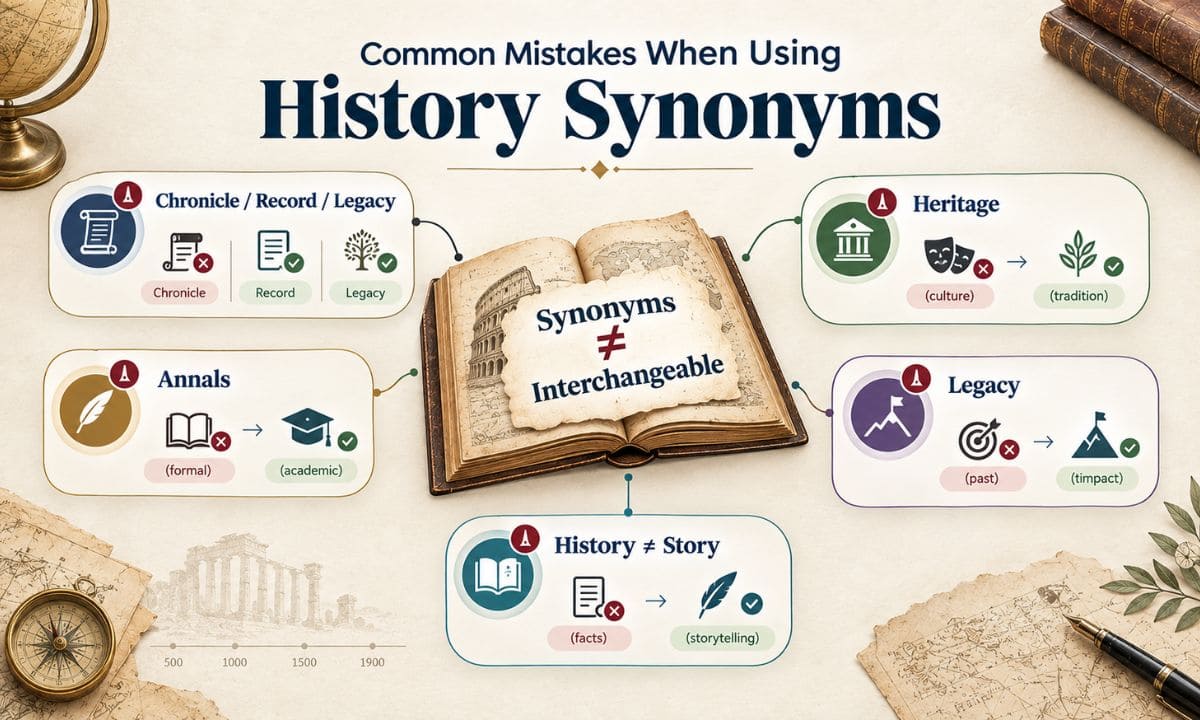
Treating Every Synonym as Interchangeable:
Words like chronicle, record, and legacy carry different connotations, swapping them blindly can confuse readers.
Using “Heritage” for Every Historical Event:
Heritage refers to inherited culture and tradition, not just any past occurrence.
Using “Legacy” When You Simply Mean the Past:
Legacy implies lasting impact, not just something that happened previously.
Using “Annals” in Casual Conversation:
Annals sound overly formal or even sarcastic outside academic or ceremonial writing.
Confusing “History” With “Story”:
History implies factual events; story can imply fiction or embellishment.
History vs Its Closest Synonyms
Some history synonyms are close in meaning but not identical. Here’s how they actually differ.
History vs Past
History often implies a structured or recorded account, while past simply refers to earlier time in general no documentation implied.
History vs Heritage
History covers events, while heritage covers what’s inherited culture, values, and traditions tied to identity.
History vs Legacy
History describes what happened, while legacy describes the lasting effect of what happened.
History vs Chronicle
History is the broad concept; a chronicle is a specific, detailed, and usually chronological written record of it.
History vs Narrative
History refers to actual events, while narrative refers to how those events are told or framed the same history can have multiple narratives.
Best History Synonyms at a Glance
A condensed recap of the strongest history synonyms and when to reach for them.
| Synonym | Best Meaning | Tone |
| Past | Earlier time in general | Casual |
| Record | Documented facts | Formal |
| Account | Retelling of events | Neutral |
| Chronicle | Detailed sequential record | Formal |
| Heritage | Inherited culture/tradition | Formal |
| Legacy | Lasting influence | Formal |
| Background | Context or origin | Neutral |
| Narrative | Story-style telling | Neutral |
| Evolution | Gradual change | Neutral |
| Experience | Gained knowledge/skill | Professional |
History Synonyms in Sentences
Seeing these words in full sentences makes it easier to pick the right one for your own writing.
“The past has a way of repeating itself.”
“Her medical record shows no prior surgeries.”
“He gave a firsthand account of the storm.”
“This book chronicles a century of change.”
“Their family heritage includes three generations of farmers.”
“The brand’s legacy is built on trust.”
“A quick background will help you follow the story.”
“The exhibit follows the evolution of modern art.”
“She has years of experience in public speaking.”
“It’s become part of local lore.”
What Is the Best Synonym for History?
Quick Answer:
For general writing, the past is the safest choice.
For formal or academic writing, record or chronicle work best.
For cultural or identity-focused writing, heritage is the strongest fit.
There’s no universal “best” ; it depends entirely on what you’re trying to say and how formal you want to sound.
Explore More Synonyms Guide
Opportunity Synonyms: 30+ Words, Alternatives, Meanings & Examples
25+ Share Synonyms: Meanings, Examples & When to Use Each
Additionally Synonyms: 20+ Words, Meanings, Examples & How to Use Them
Kindness Synonyms: 25+ Words, Meanings, Examples & How to Use Them
25+ Crazy Synonyms: Meanings, Examples, and How to Use Them
Frequently Asked Questions
What is the best synonym for history?
It depends on context, but past, record, and account are the most versatile options for everyday and formal writing.
What is a formal synonym for history?
Chronicle, annals, and record are strong formal alternatives to history.
What is a casual synonym for history?
Past, story, and backstory work well in casual, conversational writing.
Is “heritage” the same as “history”?
Not exactly heritage refers to inherited culture and traditions, while history refers to past events in general.
Is “legacy” the same as “history”?
No legacy refers to the lasting impact of past events, not the events themselves.
What is another word for “history” in resumes?
Track record, experience, and background all work well in professional writing.
What is the difference between history and chronicle?
History is the broad concept of past events; a chronicle is a detailed, chronological written record of them.
What is a one-word synonym for history?
Past is the simplest one-word synonym for history in most everyday contexts.
Can “past” always replace “history”?
Not always. Past works for general references, but formal or documented contexts usually need record, chronicle, or account instead.
What is the academic term for history?
In academic contexts, history is often referred to using terms like historiography, chronology, or historical record, depending on the focus.
Conclusion
“History” is a useful word, but it’s not the only one that fits. Once you know the difference between past, record, heritage, legacy, and the other synonyms covered here, you can match your word choice to your tone casual, formal, personal, or professional without repeating yourself.
Next time you’re writing and “history” feels overused, come back to this list. With 22+ alternatives to choose from, you’ll always have the right word on hand.
