

Looking for other words for integrate? This guide shares 70 synonyms for integration with simple meanings. You also integrate synonyms with examples, so each word is easy to use.
Integrate is a strong word, but it can sound stiff or repeat too often. The other words for integrate below give you fresh alternatives to integrate. Pick another word to integrate that fits work, school, tech, or daily talk.
Not sure what is another word for integrate? The right choice depends on your tone and audience. Use these other words for integrate to find formal synonyms for integrate, professional alternatives to integrate, and words similar to integrate.
Quick Answer: What Is the Best Synonym for Integrate?
The best alternative to “integrate” depends on context. Use combine or merge for everyday writing, incorporate for formal work, unify when parts must act as one whole, connect for systems and tools, and include or fit in for people and communities. Check your audience, tone, and intended meaning before you replace it.
Best Alternatives at a Glance
- Best general-purpose word: combine
- Best formal or professional words: incorporate, consolidate, synthesize
- Best casual words: mix, join, team up
- Best for tech and business: connect, link, sync, interface
- Best for people and communities: include, fit in, settle in
- Best for ideas and research: synthesize, reconcile, weave
- How to choose: ask what is being joined, how tightly, who will read it, and what tone you want
Examples of Integrate Synonyms in Sentences
Here is how some of the most useful synonyms sound in real sentences:
Fit in: She fit in quickly because her teammates welcomed her.
Combine: The new course combines grammar practice with real conversation.
Merge: The two teams merged into one department in June.
Incorporate: Please incorporate the editor’s comments into your final draft.
Unify: A single style guide unifies how every writer formats headings.
Connect: The plugin connects your online store to your accounting software.
Synthesize: Good researchers synthesize several studies into one clear argument.
Include: The club works hard to include new members from the first day.
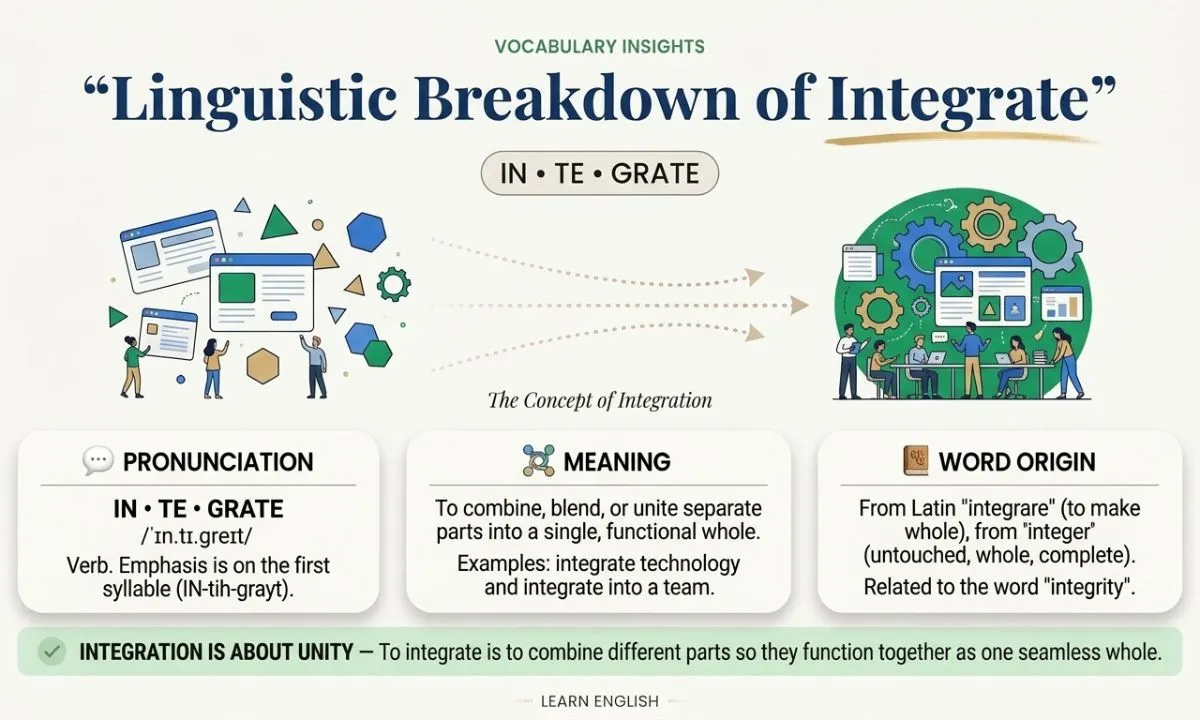
🔵 Linguistic Breakdown of “Integrate”
🟣 Connotative Meaning of Integrate
“Integrate” feels smooth, organized, and professional.
It suggests that separate parts are joined so well that they work as one whole, not just placed side by side.
In social settings, it can also mean helping people become a full part of a group or community.
Examples:
- “The team will integrate the payment system into the app”: the two systems will work together as one.
- “The school helps new students integrate into the community”: it helps them feel included and settled.
🟣 Etymology of Integrate
“Integrate” comes from Latin integratus, the past participle of integrare, meaning “to make whole” or “to renew.”
Integrare comes from integer, meaning “whole” or “untouched.”
Integer is built from in- (“not”) and tangere (“to touch”).
The verb entered English in the early 17th century with the sense of making something whole.
📖 Merriam-Webster describes “integrate” as bringing parts together into a unified, working whole.
🟣 Pronunciation of Integrate
Pronunciation: IN-tuh-grayt
IPA (US and UK): /ˈɪntɪɡreɪt/
🟣 Syllables and Affixation Pattern of Integrate
Syllable division: in | te | grate
Root: integr- (from Latin integer, “whole”)
Suffix: -ate (forms verbs)
Word formation: Integr- + -ate = Integrate
Part of speech: Verb (transitive and intransitive)
Syllables: Three
Stress: The first syllable, “IN,” carries the main stress.
Related forms: integrated, integrating, integration, integrative, integral, reintegrate, disintegrate
Is It Professional and Appropriate to Use “Integrate”?
Yes, “integrate” is a standard word in professional, academic, and technical writing. It is common in phrases like “integrate feedback,” “integrate systems,” and “integrate new employees.” In casual chat it can sound a little stiff, so a shorter word like “combine” or “mix” may feel more natural.
Be more careful when you use it with people. Depending on the audience, “integrate into a community” can suggest that newcomers are expected to adapt. Words like “include” or “settle in” may sound warmer in those situations.
Pros and Cons of Using “Integrate” in Writing and Conversation
Pros of Using Integrate
- Precise: It says that parts work together as one whole, not just side by side.
- Professional: It fits business, tech, education, and research writing.
- Versatile: It works for systems, ideas, teams, and communities.
- Widely understood: Most readers know it, and it has useful related forms such as “integration” and “integrated.”
Cons of Using Integrate
- Heavy in casual speech: Three syllables and a formal feel can seem stiff in friendly conversation.
- Jargon risk: It can sound like corporate or tech buzzwords when overused.
- Vague without an object: “We integrate” says little until you name what is being joined.
- Social nuance: About people, it may imply an expectation to conform.
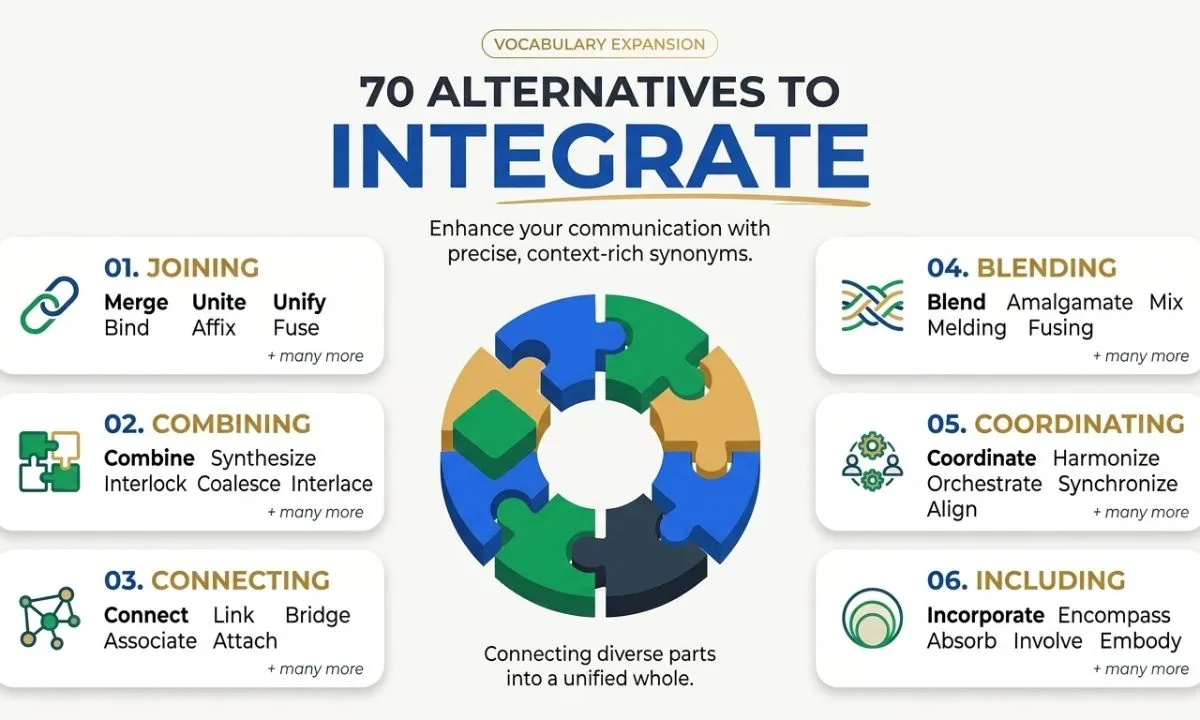
🔵 List of 70 Other Words for Integrate
🟩 1. Combine
Pronunciation: US /kəmˈbaɪn/ | UK /kəmˈbaɪn/
Meaning: Combine means to join two or more things so they act or exist together.
Examples:
🟢 The app combines your calendar and to-do list in one view.
🟢 She combined her notes from three lectures into a single study guide.
🟩 2. Merge
Pronunciation: US /mɝːdʒ/ | UK /mɜːdʒ/
Meaning: Merge means to join so completely that the parts become one.
Examples:
🟢 The two departments merged after the company restructured.
🟢 The editor merged both drafts into one clean version.
🟩 3. Unite
Pronunciation: US /juːˈnaɪt/ | UK /juːˈnaɪt/
Meaning: Unite means to bring people or things together for a shared purpose.
Examples:
🟢 The new project united designers and engineers around one goal.
🟢 A shared love of music united the neighbors.
🟩 4. Incorporate
Pronunciation: US /ɪnˈkɔːrpəreɪt/ | UK /ɪnˈkɔːpəreɪt/
Meaning: Incorporate means to include something as a part of a larger whole.
Examples:
🟢 We incorporated your feedback into the final report.
🟢 The recipe incorporates fresh herbs and lemon zest.
🟩 5. Blend
Pronunciation: US /blend/ | UK /blend/
Meaning: Blend means to mix things so smoothly that you cannot easily tell them apart.
Examples:
🟢 The artist blends traditional patterns with modern colors.
🟢 Her writing blends humor and honesty.
🟩 6. Fuse
Pronunciation: US /fjuːz/ | UK /fjuːz/
Meaning: Fuse means to join things so firmly that they become one, often with a sense of strong bonding.
Examples:
🟢 The band fuses jazz and electronic music.
🟢 The architect fused glass and steel into one striking façade.
🟩 7. Unify
Pronunciation: US /ˈjuːnɪfaɪ/ | UK /ˈjuːnɪfaɪ/
Meaning: Unify means to make separate parts consistent and work as a single whole.
Examples:
🟢 The new brand guide unifies the look of every product page.
🟢 The coach tried to unify the squad before the final.
🟩 8. Consolidate
Pronunciation: US /kənˈsɑːlɪdeɪt/ | UK /kənˈsɒlɪdeɪt/
Meaning: Consolidate means to combine several smaller things into one stronger, simpler unit.
Examples:
🟢 The bank consolidated its three call centers into one.
🟢 You can consolidate your reports into a single spreadsheet.
🟩 9. Mix
Pronunciation: US /mɪks/ | UK /mɪks/
Meaning: Mix is a simple, everyday word for putting different things together.
Examples:
🟢 The course mixes theory with hands-on practice.
🟢 Mix the two data sets before you run the analysis.
🟩 10. Join
Pronunciation: US /dʒɔɪn/ | UK /dʒɔɪn/
Meaning: Join means to connect or bring things or people together.
Examples:
🟢 The two roads join just outside the village.
🟢 She joined the research team in March.
🟩 11. Link
Pronunciation: US /lɪŋk/ | UK /lɪŋk/
Meaning: Link means to connect things so they are related or can work together.
Examples:
🟢 The software links your bank account to your budgeting app.
🟢 Researchers linked the two studies to see the bigger picture.
🟩 12. Connect
Pronunciation: US /kəˈnekt/ | UK /kəˈnekt/
Meaning: Connect means to join things so they can communicate or work together.
Examples:
🟢 The tool connects your email to your calendar.
🟢 The bridge connects the island to the mainland.
🟩 13. Weave
Pronunciation: US /wiːv/ | UK /wiːv/
Meaning: Weave means to bring different elements together skillfully, like threads in cloth.
Examples:
🟢 The author weaves history and fiction into one story.
🟢 The teacher wove vocabulary practice into every lesson.
🟩 14. Coordinate
Pronunciation: US /koʊˈɔːrdɪneɪt/ | UK /kəʊˈɔːdɪneɪt/
Meaning: Coordinate means to organize different parts so they work well together.
Examples:
🟢 The manager coordinated the sales and support teams.
🟢 We need to coordinate the design with the launch schedule.
🟩 15. Harmonize
Pronunciation: US /ˈhɑːrmənaɪz/ | UK /ˈhɑːmənaɪz/ (UK spelling: harmonise)
Meaning: Harmonize means to make different parts fit together without conflict.
Examples:
🟢 The new rules harmonize safety standards across the region.
🟢 Her design harmonizes old brick with modern glass.
🟩 16. Embed
Pronunciation: US /ɪmˈbed/ | UK /ɪmˈbed/
Meaning: Embed means to fix something firmly inside a larger whole.
Examples:
🟢 The company embedded a chat tool inside its website.
🟢 Good habits are easier when they are embedded in your daily routine.
🟩 17. Absorb
Pronunciation: US /əbˈzɔːrb/ | UK /əbˈzɔːb/
Meaning: Absorb means to take something in so it becomes part of the larger whole.
Examples:
🟢 The larger firm absorbed the smaller company last year.
🟢 The city has absorbed many new residents over the decade.
🟩 18. Synthesize
Pronunciation: US /ˈsɪnθəsaɪz/ | UK /ˈsɪnθəsaɪz/ (UK spelling: synthesise)
Meaning: Synthesize means to combine ideas or information into a new, coherent whole.
Examples:
🟢 The review synthesizes findings from twenty studies.
🟢 Students must synthesize several sources into one argument.
🟩 19. Amalgamate
Pronunciation: US /əˈmælɡəmeɪt/ | UK /əˈmælɡəmeɪt/
Meaning: Amalgamate is a formal word for combining organizations or groups into one.
Examples:
🟢 The two schools amalgamated to form a single academy.
🟢 Several small clubs amalgamated into one regional league.
🟩 20. Mesh
Pronunciation: US /meʃ/ | UK /meʃ/
Meaning: Mesh means to fit or work together smoothly, like gears.
Examples:
🟢 Her ideas mesh well with our current strategy.
🟢 The new tool meshes easily with our existing workflow.
🟩 21. Meld
Pronunciation: US /meld/ | UK /meld/
Meaning: Meld means to blend into one, often with a natural, gradual feel.
Examples:
🟢 The two cultures melded over the years.
🟢 The chef melds sweet and spicy flavors in every dish.
🟩 22. Assimilate
Pronunciation: US /əˈsɪməleɪt/ | UK /əˈsɪməleɪt/
Meaning: Assimilate means to take in and fully absorb ideas, or to become part of a group. In social contexts it can imply giving up one’s own identity, so use it carefully.
Examples:
🟢 It takes time to assimilate so much new information.
🟢 The newcomers slowly assimilated into the local community.
🟩 23. Include
Pronunciation: US /ɪnˈkluːd/ | UK /ɪnˈkluːd/
Meaning: Include means to make someone or something part of a group or whole.
Examples:
🟢 The program includes students of all ability levels.
🟢 Please include everyone in the planning process.
🟩 24. Bring Together
Pronunciation: US /brɪŋ təˈɡeðɚ/ | UK /brɪŋ təˈɡeðə/
Meaning: Bring together is a plain phrase for gathering separate people or things into one group.
Examples:
🟢 The festival brings together artists from many countries.
🟢 The report brings together data from five departments.
🟩 25. Fold In
Pronunciation: US /foʊld ɪn/ | UK /fəʊld ɪn/
Meaning: Fold in means to add something gently into a larger whole.
Examples:
🟢 We folded the new feature into the existing app.
🟢 Fold in the late-night ideas once the main plan is set.
🟩 26. Bundle
Pronunciation: US /ˈbʌndl/ | UK /ˈbʌndl/
Meaning: Bundle means to package separate items or services together as one offer.
Examples:
🟢 The company bundles internet, TV, and phone in one plan.
🟢 The course bundles lessons, quizzes, and a certificate.
🟩 27. Pool
Pronunciation: US /puːl/ | UK /puːl/
Meaning: Pool means to combine resources, money, or knowledge for shared use.
Examples:
🟢 The neighbors pooled their money to fix the garden.
🟢 Our teams pooled data to get a clearer picture.
When teams pool their knowledge and resources, they can work toward a common goal. If you want to describe how people exchange information more clearly, explore these other words for share and choose the phrase that best fits your context.
🟩 28. Interlock
Pronunciation: US /ˌɪntɚˈlɑːk/ | UK /ˌɪntəˈlɒk/
Meaning: Interlock means to fit parts together so firmly that they hold each other in place.
Examples:
🟢 The puzzle pieces interlock perfectly.
🟢 The two policies interlock to protect every customer.
🟩 29. Intertwine
Pronunciation: US /ˌɪntɚˈtwaɪn/ | UK /ˌɪntəˈtwaɪn/
Meaning: Intertwine means to twist or connect closely so the parts cannot be easily separated.
Examples:
🟢 Their careers became closely intertwined.
🟢 Language and culture are deeply intertwined.
🟩 30. Interweave
Pronunciation: US /ˌɪntɚˈwiːv/ | UK /ˌɪntəˈwiːv/
Meaning: Interweave means to blend different elements together in an interlaced way.
Examples:
🟢 The film interweaves three separate storylines.
🟢 The lessons interweave grammar with real conversation.
🟩 31. Knit Together
Pronunciation: US /nɪt təˈɡeðɚ/ | UK /nɪt təˈɡeðə/
Meaning: Knit together means to join people or parts into a close, strong whole.
Examples:
🟢 The shared project knit the new team together.
🟢 Small acts of kindness knit the neighborhood together.
🟩 32. Cement
Pronunciation: US /sɪˈment/ | UK /sɪˈment/
Meaning: Cement means to join things or relationships firmly and make them lasting.
Examples:
🟢 The partnership cemented the two companies’ shared goals.
🟢 Weekly meetings helped cement the group’s bond.
🟩 33. Team Up
Pronunciation: US /tiːm ʌp/ | UK /tiːm ʌp/
Meaning: Team up is a casual phrase for people joining forces to work together.
Examples:
🟢 The two schools teamed up for the science fair.
🟢 Let’s team up and finish the project together.
🟩 34. Sync
Pronunciation: US /sɪŋk/ | UK /sɪŋk/
Meaning: Sync means to make things match or work in time with each other, especially in tech.
Examples:
🟢 The app syncs your notes across all your devices.
🟢 We synced our schedules to find a free hour.
🟩 35. Align
Pronunciation: US /əˈlaɪn/ | UK /əˈlaɪn/
Meaning: Align means to bring things into agreement or proper order so they work together.
Examples:
🟢 The new plan aligns our budget with our goals.
🟢 Managers aligned the teams around a shared timeline.
🟩 36. Bind
Pronunciation: US /baɪnd/ | UK /baɪnd/
Meaning: Bind means to tie or hold things together firmly.
Examples:
🟢 A shared history binds the two communities.
🟢 Egg binds the ingredients in this recipe.
🟩 37. Couple
Pronunciation: US /ˈkʌpl/ | UK /ˈkʌpl/
Meaning: Couple means to link two things so they work or happen together.
Examples:
🟢 The lesson couples reading practice with short discussions.
🟢 Rising prices, coupled with low wages, hurt many families.
🟩 38. Marry
Pronunciation: US /ˈmeri/ | UK /ˈmæri/
Meaning: Marry, used figuratively, means to combine two qualities or ideas in a way that suits both.
Examples:
🟢 The design marries comfort with style.
🟢 The course marries science with storytelling.
🟩 39. Commingle
Pronunciation: US /kəˈmɪŋɡl/ | UK /kəˈmɪŋɡl/
Meaning: Commingle is a formal word for mixing things together so they become one blend.
Examples:
🟢 The scents of cedar and rain commingled in the air.
🟢 Accountants must not commingle business and personal funds.
🟩 40. Mingle
Pronunciation: US /ˈmɪŋɡl/ | UK /ˈmɪŋɡl/
Meaning: Mingle means to mix together, often used for people or feelings.
Examples:
🟢 Guests mingled over coffee before the talk.
🟢 Excitement and nerves mingled as the curtain rose.
🟩 41. Fit In
Pronunciation: US /fɪt ɪn/ | UK /fɪt ɪn/
Meaning: Fit in means to feel accepted and comfortable as part of a group.
Examples:
🟢 He quickly fit in with his new classmates.
🟢 The new hire fit in well with the team.
🟩 42. Blend In
Pronunciation: US /blend ɪn/ | UK /blend ɪn/
Meaning: Blend in means to become part of a group or setting without standing out.
Examples:
🟢 The new software blends in with our existing tools.
🟢 She wore neutral colors to blend in at the meeting.
🟩 43. Mainstream
Pronunciation: US /ˈmeɪnstriːm/ | UK /ˈmeɪnstriːm/
Meaning: Mainstream, as a verb, means to bring someone or something into the ordinary, standard system.
Examples:
🟢 The district mainstreams students with different learning needs.
🟢 The brand wants to mainstream its eco-friendly products.
🟩 44. Adapt
Pronunciation: US /əˈdæpt/ | UK /əˈdæpt/
Meaning: Adapt means to adjust to new conditions so you can fit into a new setting.
Examples:
🟢 The new students adapted to the school quickly.
🟢 We adapted our process to match the client’s system.
🟩 45. Settle In
Pronunciation: US /ˈsetl ɪn/ | UK /ˈsetl ɪn/
Meaning: Settle in means to become comfortable in a new place or role.
Examples:
🟢 The family settled in within a few weeks.
🟢 Give new employees time to settle in.
🟩 46. Interface
Pronunciation: US /ˈɪntɚfeɪs/ | UK /ˈɪntəfeɪs/
Meaning: Interface, as a verb, means to connect systems or people so they can work together.
Examples:
🟢 The new tool interfaces with our billing system.
🟢 She interfaces with clients every day.
🟩 47. Plug In
Pronunciation: US /plʌɡ ɪn/ | UK /plʌɡ ɪn/
Meaning: Plug in is an informal phrase for adding something so it works with an existing system.
Examples:
🟢 You can plug in any payment service you like.
🟢 We plugged the new tool into our workflow.
🟩 48. Interlink
Pronunciation: US /ˌɪntɚˈlɪŋk/ | UK /ˌɪntəˈlɪŋk/
Meaning: Interlink means to connect things with each other in both directions.
Examples:
🟢 The articles on the site are interlinked by topic.
🟢 The platform interlinks all your accounts.
🟩 49. Entwine
Pronunciation: US /ɪnˈtwaɪn/ | UK /ɪnˈtwaɪn/
Meaning: Entwine means to twist together or connect so closely that parts are hard to separate.
Examples:
🟢 Their stories became entwined over the years.
🟢 Trade and culture entwine in this old port city.
🟩 50. Wed
Pronunciation: US /wed/ | UK /wed/
Meaning: Wed, used figuratively, means to join two ideas or qualities closely.
Examples:
🟢 The theme park weds adventure and education.
🟢 The poem weds simple words to deep feeling.
🟩 51. Interconnect
Pronunciation: US /ˌɪntɚkəˈnekt/ | UK /ˌɪntəkəˈnekt/
Meaning: Interconnect means to link parts so each one affects the others.
Examples:
🟢 The city’s bus and train lines interconnect at the main station.
🟢 These issues are interconnected and cannot be solved separately.
🟩 52. Converge
Pronunciation: US /kənˈvɜːrdʒ/ | UK /kənˈvɜːdʒ/
Meaning: Converge means to come together from different directions and meet.
Examples:
🟢 Three rivers converge near the old town.
🟢 Technology and healthcare are converging fast.
🟩 53. Coalesce
Pronunciation: US /ˌkoʊəˈles/ | UK /ˌkəʊəˈles/
Meaning: Coalesce is a formal word for separate parts gradually coming together as one.
Examples:
🟢 Scattered ideas coalesced into a clear plan.
🟢 The volunteers coalesced into a strong team.
🟩 54. Conjoin
Pronunciation: US /kənˈdʒɔɪn/ | UK /kənˈdʒɔɪn/
Meaning: Conjoin is a formal word for joining things together, often in writing.
Examples:
🟢 The two ideas are conjoined in the author’s argument.
🟢 The agreement conjoins both companies’ goals.
🟩 55. Attach
Pronunciation: US /əˈtætʃ/ | UK /əˈtætʃ/
Meaning: Attach means to fasten or connect one thing to another.
Examples:
🟢 Please attach the report to your email.
🟢 The sensor attaches directly to the main unit.
🟩 56. Append
Pronunciation: US /əˈpend/ | UK /əˈpend/
Meaning: Append means to add something to the end of a document or file.
Examples:
🟢 The author appended a short glossary to the book.
🟢 Append the new rows to the existing table.
🟩 57. Graft
Pronunciation: US /ɡræft/ | UK /ɡrɑːft/
Meaning: Graft means to join something onto another thing so it grows or works as part of it.
Examples:
🟢 The team grafted a new module onto the old system.
🟢 The gardener grafted a branch onto the apple tree.
🟩 58. Insert
Pronunciation: US /ɪnˈsɜːrt/ | UK /ɪnˈsɜːt/
Meaning: Insert means to put something into a larger whole.
Examples:
🟢 Insert the new section after the introduction.
🟢 The editor inserted a table into the report.
🟩 59. Hybridize
Pronunciation: US /ˈhaɪbrɪdaɪz/ | UK /ˈhaɪbrɪdaɪz/ (UK spelling: hybridise)
Meaning: Hybridize means to combine two different types to create something new.
Examples:
🟢 The chef hybridizes two regional cooking styles.
🟢 The company hybridized its in-person and online services.
🟩 60. Tie In
Pronunciation: US /taɪ ɪn/ | UK /taɪ ɪn/
Meaning: Tie in means to connect one thing closely with another so they support each other.
Examples:
🟢 The lesson ties in nicely with last week’s reading.
🟢 We tied the campaign in with the product launch.
🟩 61. Work In
Pronunciation: US /wɜːrk ɪn/ | UK /wɜːk ɪn/
Meaning: Work means to fit something into a plan or piece of writing.
Examples:
🟢 She worked a few jokes into her speech.
🟢 Can we work this task into today’s schedule?
🟩 62. Build In
Pronunciation: US /bɪld ɪn/ | UK /bɪld ɪn/
Meaning: Build in means to make something a permanent part of a design or plan.
Examples:
🟢 The team built safety checks into every step.
🟢 The course builds in time for review each week.
🟩 63. Stitch Together
Pronunciation: US /stɪtʃ təˈɡeðɚ/ | UK /stɪtʃ təˈɡeðə/
Meaning: Stitch together means to join separate pieces into one finished whole.
Examples:
🟢 The editor stitched the clips together into one short film.
🟢 She stitched together a plan from many small ideas.
🟩 64. Piece Together
Pronunciation: US /piːs təˈɡeðɚ/ | UK /piːs təˈɡeðə/
Meaning: Piece together means to assemble a whole from separate parts or clues.
Examples:
🟢 Detectives pieced together the full story from small details.
🟢 He pieced together a report from several sources.
🟩 65. Join Up
Pronunciation: US /dʒɔɪn ʌp/ | UK /dʒɔɪn ʌp/
Meaning: Join up is a casual phrase for connecting people or things together.
Examples:
🟢 The two groups joined up for the weekend event.
🟢 The trails join up near the lake.
🟩 66. Reconcile
Pronunciation: US /ˈrekənsaɪl/ | UK /ˈrekənsaɪl/
Meaning: Reconcile means to bring different ideas or records into agreement so they fit together.
Examples:
🟢 The writer tried to reconcile both viewpoints in one essay.
🟢 Finance reconciled the two sets of accounts.
🟩 67. Aggregate
Pronunciation: US /ˈæɡrɪɡeɪt/ | UK /ˈæɡrɪɡeɪt/
Meaning: Aggregate, as a verb, means to gather separate items into one total or collection.
Examples:
🟢 The site aggregates news from hundreds of sources.
🟢 We aggregated the survey results by region.
🟩 68. Compile
Pronunciation: US /kəmˈpaɪl/ | UK /kəmˈpaɪl/
Meaning: Compile means to collect information from several places into one document or set.
Examples:
🟢 She compiled the data into a single report.
🟢 The team compiled feedback from every department.
🟩 69. Assemble
Pronunciation: US /əˈsembl/ | UK /əˈsembl/
Meaning: Assemble means to put parts together to form a finished whole.
Examples:
🟢 Engineers assembled the system from several smaller modules.
🟢 He assembled a strong argument from a range of sources.
🟩 70. Splice
Pronunciation: US /splaɪs/ | UK /splaɪs/
Meaning: Splice means to join two pieces together, such as film clips, ropes, or genes.
Examples:
🟢 The editor spliced two interviews into one scene.
🟢 He spliced the two cables together.
Comparison Table of the 10 Best Synonyms for Integrate
| Synonym | Meaning | Best Use | Worst Use | Tone |
| Combine | Join two or more things | Everyday and general writing | When parts must fully work as one system | Neutral |
| Merge | Join so completely that the parts become one | Companies, teams, files, data | When the parts should stay separate | Neutral |
| Incorporate | Include as part of a larger whole | Feedback, ideas, features | Joining two equal partners | Formal |
| Unify | Make separate parts consistent as one whole | Brands, teams, standards | Adding one small item | Formal to neutral |
| Consolidate | Combine many small units into one stronger unit | Accounts, offices, reports | Talking about people joining a group | Formal |
| Connect | Link things so they can communicate | Software, devices, systems | Ideas that must be deeply blended | Neutral |
| Synthesize | Combine ideas into a new, coherent whole | Research, essays, analysis | Physical objects or software | Formal, academic |
| Include | Make someone or something part of a group | People, groups, lists | Technical system integration | Neutral, warm |
| Assimilate | Take in ideas, or become part of a group | Learning and absorbing information | Sensitive conversations about people | Formal, can sound heavy |
| Fit In | Feel accepted in a group | Casual talk about people | Technical or formal writing | Casual |
US vs. UK Usage of Integrate and Its Synonyms
“Integrate” is spelled the same and means the same in US and UK English. The IPA is also the same: /ˈɪntɪɡreɪt/. The differences appear in a few of its synonyms:
| Word | US | UK |
| Harmonize | harmonize /ˈhɑːrmənaɪz/ | harmonise /ˈhɑːmənaɪz/ |
| Synthesize | synthesize | synthesise |
| Hybridize | hybridize | hybridise |
| Coordinate | /koʊˈɔːrdɪneɪt/ | /kəʊˈɔːdɪneɪt/ |
| Graft | /ɡræft/ | /ɡrɑːft/ |
| Marry | /ˈmeri/ | /ˈmæri/ |
Many British publishers also accept the -ize spelling (often called Oxford spelling), so choose one style and stay consistent. In American English, “integrate” can also refer to desegregation, as in “integrated schools.” Context usually makes the meaning clear.
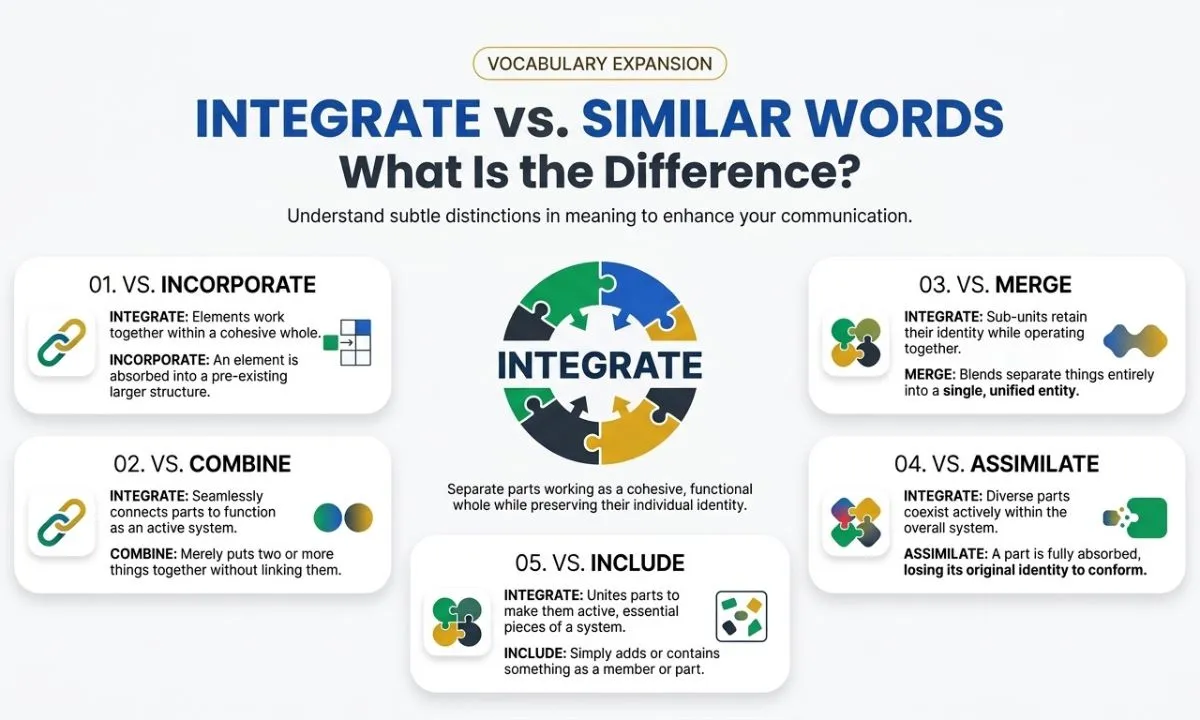
Integrate vs. Similar Words: What Is the Difference?
Several words sound close to “integrate,” but each one points to a slightly different action.
Integrate vs. Incorporate
Integrate means to join parts so they work together as one whole.
Incorporate means to take something in as part of a larger whole.
With “incorporate,” the main thing usually stays in charge.
With “integrate,” both sides often adjust to fit.
Example: The team incorporated the client’s feedback into the design, then integrated the design with the payment system.
Businesses often integrate their procedures and standards to keep different departments working consistently. When writing about workplace rules or organizational guidelines, these synonyms for policy can help you express the intended meaning more accurately.
Integrate vs. Combine
Combine means to put things together, and the parts may stay clearly separate.
Integrate goes deeper: the parts function as one connected whole.
Example: You can combine two spreadsheets by pasting them together, but you integrate them when the data updates automatically in both.
Integrate vs. Merge
Merge means the original parts become one, and their separate identities fade.
Integrate often keeps the parts recognizable while they work together.
Example: Two companies merge into one, while a company integrates the software of the business it just bought.
Integrate vs. Assimilate
Assimilate means to absorb fully, often until the difference disappears.
Integrate is often used for joining a group while keeping one’s own identity. Writers and readers do not always agree on how these words differ for people, so choose carefully and think about your audience.
Example: The school helps families integrate into the community, while a language textbook may ask you to assimilate a new rule.
Integrate vs. Include
Include means to make something part of a group or list. It does not say that the parts work together.
Integrate adds that sense of working as one.
Example: The list includes five tools, and the platform integrates all five.
How to Choose the Right Synonym for Integrate
Start with four quick questions: What is being joined? How closely do the parts connect? Who will read this? What tone do you want? Then match your answer to the context below.
Formal and professional: incorporate, consolidate, amalgamate. The board will consolidate the regional offices by spring.
Casual and everyday: mix, join, team up. Let’s team up on the group project.
Tech and business: connect, sync, interface, plug in. The tool syncs with your calendar.
Academic and research: synthesize, reconcile, incorporate. The paper synthesizes ten years of research.
People and communities: include, fit in, settle in, mainstream. The coach helped the new player settle in.
Creative and expressive: weave, blend, marry. The poem weaves memory and humor.
If two words seem to fit, pick the one that is more specific. A reader learns more from “sync” or “consolidate” than from a general word like “integrate.”
Before-and-After Examples Using Integrated Synonyms
1. Professional email
Original: We plan to integrate your feedback into the final version.
Improved: We plan to incorporate your feedback into the final version.
Why it works: “Incorporate” fits adding input to a larger document and sounds natural in formal email.
2. Tech update
Original: The app can integrate with your calendar.
Improved: The app can sync with your calendar.
Why it works: “Sync” tells the reader that the data updates automatically, which is more specific.
3. Business news
Original: The firm will integrate its three branches.
Improved: The firm will consolidate its three branches into one.
Why it works: “Consolidate” shows that many units become one, so the result is clearer.
4. Academic writing
Original: The essay integrates several theories.
Improved: The essay synthesizes several theories.
Why it works: “Synthesize” shows that the ideas are combined into a new argument.
5. School or community
Original: The club tries to integrate new members.
Improved: The club tries to include new members from day one.
Why it works: “Include” sounds warmer and less technical when the subject is people.
6. Everyday conversation
Original: Let’s integrate our study notes.
Improved: Let’s combine our study notes.
Why it works: “Combine” is shorter and feels more natural in a casual chat.
7. Creative writing
Original: Her music integrates jazz and pop.
Improved: Her music blends jazz and pop.
Why it works: “Blend” adds the feeling of smooth, natural mixing.
“Integrate” in Different Languages
Because “integrate” comes from Latin, many languages use a close relative of the word. These are common translations, and some languages also use other words for the social meaning.
| Language | Common translation |
| Spanish | integrar |
| French | intégrer |
| Italian | integrare |
| Portuguese | integrar |
| German | integrieren |
| Dutch | integreren |
| Russian | интегрировать (integrirovat’) |
| Turkish | entegre etmek |
| Arabic | دمج (damj) |
Common Mistakes to Avoid When Using Integrated Synonyms
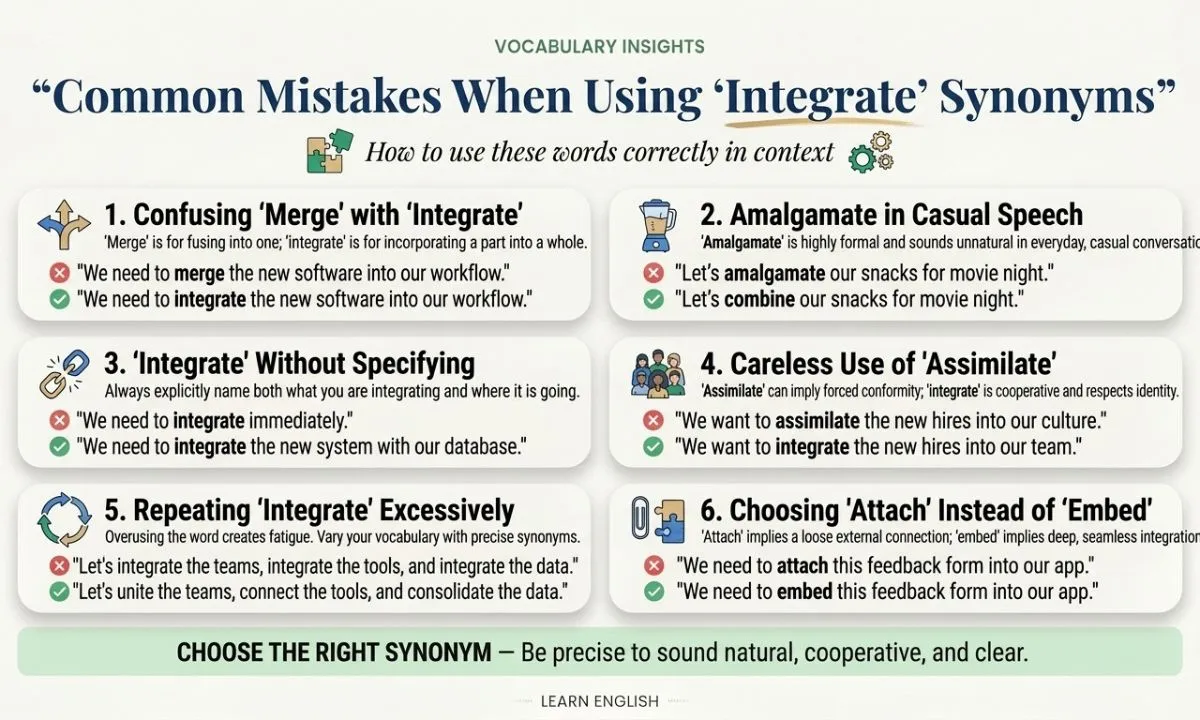
🔴 1. Treating every synonym as interchangeable.
“Merge” means the parts become one, while “integrate” lets them keep working side by side.
🟢 Better: use “merge” only when the originals disappear into one.
🔴 2. Using a formal word in casual speech.
❌ “Let’s amalgamate our snacks” sounds odd.
🟢 Better: “Let’s mix our snacks” or “Let’s combine our snacks.”
🔴 3. Using “integrate” without saying what.
❌ “We integrate” is vague.
🟢 Better: “We integrate payments with your online store.”
🔴 4. Using “assimilate” for people without thinking.
It can suggest that someone must give up their identity.
🟢 Better: “include,” “settle in,” or “fit in,” depending on the situation.
🔴 5. Repeating “integrate” again and again.
Three uses in one paragraph make writing feel stiff.
🟢 Better: vary it with “connect,” “incorporate,” or “combine.”
🔴 6. Choosing a word that changes the meaning.
“Attach” only suggests fastening something on.
🟢 Better: “embed” or “build in” when something becomes a real part of the design.
Explore More Synonyms Guide
Opportunity Synonyms: 30+ Words, Alternatives, Meanings & Examples
25+ Share Synonyms: Meanings, Examples & When to Use Each
Additionally Synonyms: 20+ Words, Meanings, Examples & How to Use Them
Kindness Synonyms: 25+ Words, Meanings, Examples & How to Use Them
25+ Crazy Synonyms: Meanings, Examples, and How to Use Them
Frequently Asked Questions
What Are the Best Synonyms for Integrate?
The best general synonyms are combine, merge, incorporate, unify, and connect. Choose based on whether you mean joining parts, adding something to a whole, or linking systems.
What Is Another Word for Integrate in Professional Writing?
Incorporate, consolidate, and synthesize are strong professional choices. Use incorporate for adding input, consolidate for reducing many units into one, and synthesize for ideas.
What Is a Simple Alternative to Integrate?
Combine and join are the simplest alternatives. Both work in everyday writing when you do not need the extra “working as one whole” meaning.
What Are Casual Alternatives to Integrate?
Mix, join, and team up are friendly, casual choices, and fit in works when you mean people. They sound more natural in conversation than “integrate.”
Is Integrate Formal or Informal?
Integrate is neutral to formal and is standard in business, tech, and academic writing. In relaxed conversation, a shorter word like “combine” may sound more natural.
Can I Use Integrate in Business Emails?
Yes, it is common and appropriate in business emails. For clarity, name exactly what is being integrated, such as “integrate the billing system with the CRM.”
Does Integrate Mean to Combine Two Things?
Yes, but it is more specific than “combine.” Integrate means to join parts so they work together as one whole, not just to put them next to each other.
Which Synonyms for Integrate Are Best for Academic Writing?
Synthesize, incorporate, and reconcile work well in academic writing. Use synthesize for combining sources, incorporate for adding evidence, and reconcile for resolving differences.
How Do I Express the Idea of Bringing People Together?
Use include, unite, bring together, team up, or knit together. Include is the most neutral, while knit together suggests a close, lasting bond.
Conclusion: Choosing the Best Synonym for Integrate
The best other words for integration depend on what you want to say. Ask what is being joined, how closely the parts connect, who is reading, and what tone fits.
Use combine for everyday writing, incorporate for formal work, connect or sync for tools, synthesize for ideas, and include or settle in for people. When two words seem close, choose the more specific one.
