

“Important” is one of those words we reach for without thinking. It shows up in emails, essays, meetings, and everyday chats so often that it starts to lose its punch.
If you’ve ever reread a paragraph and noticed the word “important” sitting in three different sentences, you already know the problem.
This guide rounds up 70+ important synonyms, sorted by tone, context, and strength. You’ll find the meaning behind each word, when to use it, and a few real example sentences so you can swap “important” for something sharper without changing what you’re trying to say.
Quick Answer: What Is the Best Synonym for “Important”?
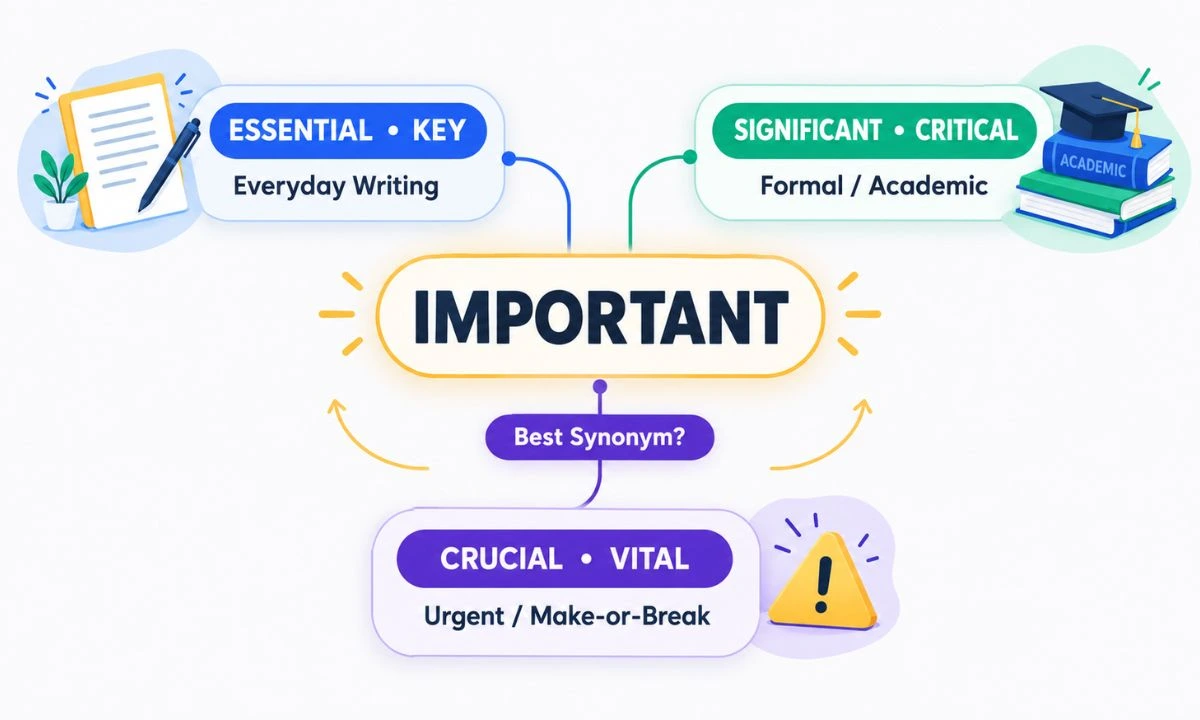
There’s no single “best” synonym for important; it depends on tone and context.
For everyday writing, essential or key work well.
For formal or academic writing, significant or critical fit better.
For something urgent or make-or-break, crucial or vital hit harder.
Best Synonyms for Important at a Glance
| Synonym | Meaning | Best For | Tone |
| Significant | Notable in effect or size | Reports, research, data | Formal |
| Essential | Absolutely needed | Instructions, requirements | Neutral |
| Crucial | Deciding factor in an outcome | Decisions, deadlines | Strong |
| Vital | Necessary for survival or success | Health, business, safety | Strong |
| Necessary | Required, can’t be skipped | Rules, steps, conditions | Neutral |
| Critical | Urgent and high-stakes | Emergencies, risk, errors | Strong |
| Key | A main or leading factor | Everyday writing, summaries | Casual |
| Major | Large in scale or effect | News, events, changes | Neutral |
| Paramount | More important than anything else | Legal, safety, policy | Formal |
| Relevant | Connected and useful to the matter | Business, meetings, research | Professional |
Important vs. Its Closest Alternatives
“Important” is the general, all-purpose word. “Significant” leans on measurable impact. “Essential” points to something you can’t do without. “Crucial” signals a turning point. Once you see the difference, picking the right one gets a lot easier.
What Does “Important” Mean?
Simple Meaning of Important
At its core, important describes something that carries real weight: it matters, it affects people or outcomes, and ignoring it has consequences. Dictionaries frame it a few different ways. Cambridge describes it as something necessary or of great value, or having a strong effect on people or things. Oxford Learner’s Dictionaries defines it as having a great effect on people or things, or being of great value. Merriam-Webster ties it to worth and consequence, something that carries real weight in content or relationship.
Put simply: if something is important, it’s worth your attention.
When to Use the Word Important
Use “important” (or a synonym) when you want to:
Flag a priority in a to-do list or project plan
Explain why a decision, rule, or step matters
Highlight a person’s influence or standing
Stress that something shouldn’t be skipped or ignored
Point out a fact or detail worth remembering
Important in Different Contexts
The word shifts meaning slightly depending on where it’s used:
At work, importance often means urgent or tied to results.
In school, importance usually means worth remembering for a test or report.
In relationships, important means valued or meaningful to someone.
In health, importance often means necessary for wellbeing.
In news, important usually means impactful on a large scale.
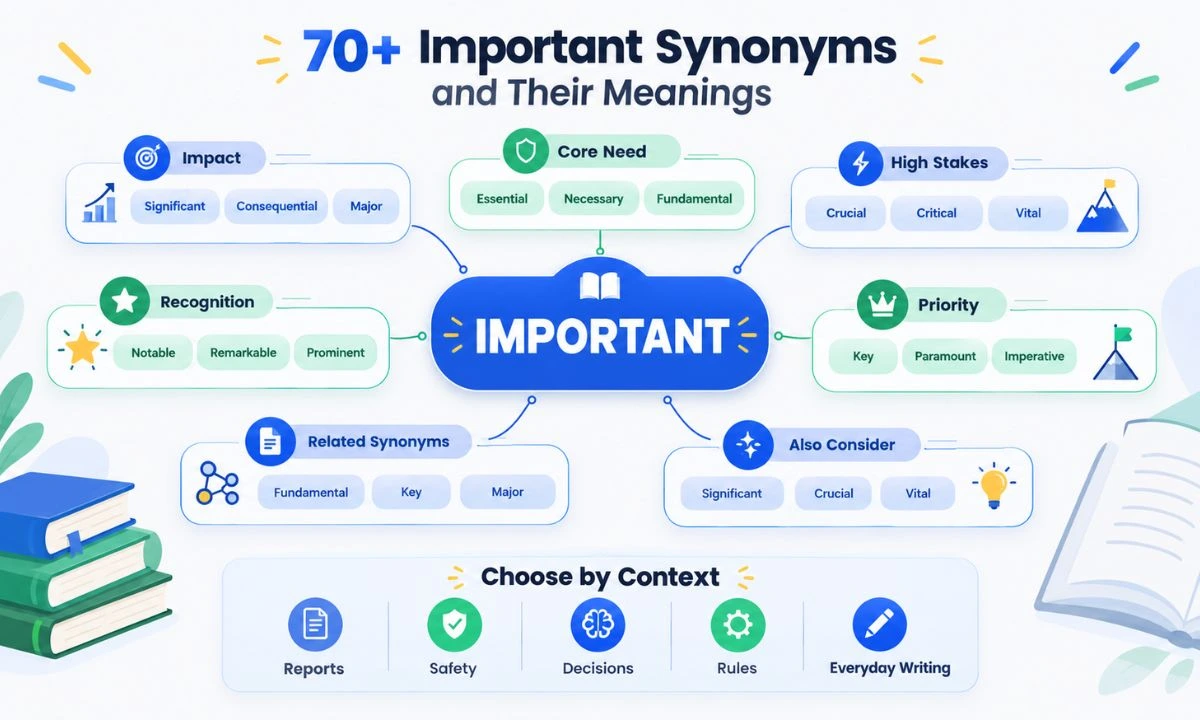
70+ Important Synonyms and Their Meanings
Here’s a quick-reference list of 70+ words you can use instead of “important,” grouped by feel. The sections below dig deeper into the ones people search for most.
| # | Synonym | # | Synonym | # | Synonym |
| 1 | Significant | 26 | Weighty | 51 | Core |
| 2 | Essential | 27 | Momentous | 52 | Basic |
| 3 | Crucial | 28 | Serious | 53 | Requisite |
| 4 | Vital | 29 | Decisive | 54 | Obligatory |
| 5 | Necessary | 30 | Urgent | 55 | Mandatory |
| 6 | Critical | 31 | Primary | 56 | Non-negotiable |
| 7 | Fundamental | 32 | Principal | 57 | High-priority |
| 8 | Key | 33 | Chief | 58 | Life-changing |
| 9 | Major | 34 | Leading | 59 | Game-changing |
| 10 | Notable | 35 | Foremost | 60 | Defining |
| 11 | Indispensable | 36 | Cardinal | 61 | Landmark |
| 12 | Imperative | 37 | Salient | 62 | Historic |
| 13 | Paramount | 38 | Material | 63 | Groundbreaking |
| 14 | Consequential | 39 | Telling | 64 | Instrumental |
| 15 | Substantial | 40 | Marked | 65 | Determining |
| 16 | Noteworthy | 41 | Big | 66 | Formative |
| 17 | Prominent | 42 | Great | 67 | Focal |
| 18 | Influential | 43 | Grave | 68 | Overriding |
| 19 | Meaningful | 44 | Sizable | 69 | Top-priority |
| 20 | Pivotal | 45 | Considerable | 70 | High-stakes |
| 21 | Relevant | 46 | Compelling | 71 | Mission-critical |
| 22 | Pertinent | 47 | Powerful | 72 | Front-and-center |
| 23 | Strategic | 48 | Outstanding | 73 | Eminent |
| 24 | Valuable | 49 | Remarkable | 74 | Distinguished |
| 25 | Central | 50 | Extraordinary | 75 | Priority (adj. use) |
Significant
Meaning
Notable in size, effect, or meaning something worth paying attention to because of its impact.
Best For
Reports, research findings, statistics, and formal writing.
Examples
- The study found a significant drop in customer complaints.
- Her promotion marked a significant step in her career.
Usage Tip
Use “significant” when you want to point at measurable impact, not just general worth.
Sincere
Meaning
Genuine in feeling; free from pretense.
Best For
Feelings, apologies, compliments.
Examples
- She gave him a sincere apology after realizing her mistake.
- His thanks felt sincere, not rehearsed.
- I have a sincere interest in this project.
Usage Tip
Use sincereness for emotion and intent, not for facts.
Essential
Meaning
Absolutely necessary the thing that makes everything else work or possible.
Best For
Instructions, requirements, and anything non-optional.
Examples
- Clean water is essential for survival.
- Good communication is essential in any team.
Usage Tip
Reserve “essential” for things that truly can’t be removed, not just things that help.
Frank
Meaning
Very direct and open, sometimes bluntly so.
Best For
Opinions, difficult conversations.
Examples
- Let’s be frank about the budget shortfall.
- He was frank about his concerns.
- Her frank response surprised the room.
Usage Tip
Frank leans slightly blunter than candid use when directness is the point.
Crucial
Meaning
So important that the outcome depends on it being a deciding factor.
Best For
Decisions, deadlines, turning points.
Examples
- Getting the timing right is crucial for this launch.
- That first meeting was crucial to closing the deal.
Usage Tip
“Crucial” works best when something else hinges directly on the outcome.
Vital
Meaning
Necessary for life, success, or proper function removing it causes real damage.
Best For
Health, safety, business operations.
Examples
- Sleep is vital for concentration and mood.
- Customer trust is vital to a small business.
Usage Tip
Use “vital” when the stakes feel almost physical like something breaking without it.
Outspoken
Meaning
Bold and direct in sharing opinions, sometimes without much filter.
Best For
Opinions, public statements, personality.
Examples
- She’s outspoken about workplace fairness.
- He’s known as the most outspoken member of the team.
Usage Tip
Outspoken can carry a slightly bolder, more public tone than candid.
Necessary
Meaning
Required in order for something to happen or be complete.
Best For
Rules, steps, conditions, checklists.
Examples
- A permit is necessary before you start construction.
- It’s necessary to double-check the figures before sending the report.
Usage Tip
“Necessary” is plain and clear, great for instructions where you don’t want ambiguity.
Critical
Meaning
Urgent and high-stakes, often tied to risk or a narrow window to act.
Best For
Emergencies, deadlines, error handling, safety issues.
Examples
- The server outage needs a critical fix within the hour.
- Early diagnosis is critical for treatment to work.
Usage Tip
Save “critical” for situations where delay or failure has real consequences.
Fundamental
Meaning
Forming the base or foundation that everything else is built on.
Best For
Principles, education, core values.
Examples
- Trust is fundamental to any good relationship.
- Understanding grammar is fundamental to writing well.
Usage Tip
Use “fundamental” for root-level ideas, not for one-off tasks or deadlines.
Key
Meaning
A main or leading factor that plays a central role in an outcome.
Best For
Everyday writing, summaries, casual business talk.
Examples
- Consistency is a key part of building good habits.
- She’s a key player on the marketing team.
Usage Tip
“Key” is short and versatile, a safe everyday swap almost anywhere.
Major
Meaning
Large in scale, size, or effect compared to what’s typical.
Best For
News, events, changes, milestones.
Examples
- The company announced a major shift in strategy.
- That was a major win for the whole team.
Usage Tip
Use “major” when scale matters more than urgency.
Notable
Meaning
Worth mentioning or remembering because it stands out in some way.
Best For
Highlights, achievements, summaries.
Examples
- There were a few notable exceptions to the new policy.
- It was a notable year for renewable energy.
Usage Tip
“Notable” is softer than “significant” , good for things worth flagging without overstating them.
Strong Synonyms for Important
Crucial
Meaning
Here, “crucial” points to a make-or-break moment in a process, not just a general priority.
Best For
Project milestones and negotiations.
Examples
- The final round of testing is crucial before release.
- Building rapport early is crucial in sales calls.
Usage Tip
Pair “crucial” with a clear reason why readers want to know what’s riding on it.conversation.
Vital
Meaning
In stronger contexts, “vital” stresses that without this, the whole system fails.
Best For
Organizational health, public messaging, safety campaigns.
Examples
- Employee feedback is vital to improving our process.
- Clean air is vital for public health.
Usage Tip
Avoid overusing “vital” save it for genuine dependencies, not small preferences.
Essential
Meaning
In stronger writing, “essential” signals a baseline requirement with no workaround.
Best For
Policy documents, onboarding guides, compliance writing.
Examples
- A signed contract is essential before work begins.
- Regular backups are essential for data safety.
Usage Tip
When you write “essential,” make sure you can defend that nothing else can substitute for it.
Imperative
Meaning
So necessary that it demands immediate action.
Best For
Warnings, urgent instructions, calls to action.
Examples
- It’s imperative that we fix this before launch.
- Quick action is imperative in a medical emergency.
Usage Tip
“Imperative” carries urgency; don’t use it for routine tasks.
Paramount
Meaning
More important than anything else in the situation.
Best For
Safety, legal writing, policy statements.
Examples
- Passenger safety is paramount on every flight.
- The child’s welfare is of paramount concern to the court.
Usage Tip
“Paramount” ranks something above everything else; use it only when it truly outweighs other priorities.
Consequential
Meaning
Having a real, lasting effect on what happens next.
Best For
History, policy, big decisions.
Examples
- It was one of the most consequential decisions of her career.
- The vote had consequential effects on the region’s economy.
Usage Tip
“Consequential” works well when you want to stress long-term impact, not just present-day urgency.
Formal Synonyms for Important
Significant
Meaning
In academic and formal writing, “significant” often implies measurable or statistical weight.
Best For
Research papers, data analysis, formal reports.
Examples
- Researchers observed a significant correlation between the two variables.
- The findings have significant implications for future policy.
Usage Tip
In formal writing, pair “significant” with evidence readers expect a reason behind the claim.
Substantial
Meaning
Large enough in amount or degree to matter.
Best For
Budgets, growth, measurable change.
Examples
- The company saw substantial growth this quarter.
- There’s a substantial difference between the two proposals.
Usage Tip
Use “substantial” when talking about size or amount, not urgency.
Noteworthy
Meaning
Deserving attention or mention, often because it’s unusual or impressive.
Best For
Summaries, highlights, formal reviews.
Examples
- The report includes several noteworthy findings.
- His contribution to the project was noteworthy.
Usage Tip
“Noteworthy” is a gentler way to say “important” without sounding urgent.
Prominent
Meaning
Standing out clearly, often referring to people, positions, or features.
Best For
Describing people, roles, or visible details.
Examples
- She’s a prominent figure in the tech industry.
- The issue played a prominent role in the debate.
Usage Tip
Use “prominent” for visibility and standing, not for urgency or necessity.
Influential
Meaning
Having the power to shape outcomes, opinions, or decisions.
Best For
Leadership, media, culture, relationships.
Examples
- He was an influential voice in the early days of the company.
- The book became influential in shaping public opinion.
Usage Tip
“Influential” is about impact on others, not urgency or necessity.
Meaningful
Meaning
Carrying real significance, especially in a personal or emotional sense.
Best For
Relationships, personal goals, values-driven writing.
Examples
- We had a meaningful conversation about the future.
- Volunteering gave her a meaningful sense of purpose.
Usage Tip
Save “meaningful” for personal or emotional weight rather than business urgency.
Pivotal
Meaning
Marking a turning point that everything else depends on.
Best For
Career moments, storytelling, history.
Examples
- That meeting was pivotal in shaping the company’s direction.
- The election marked a pivotal moment for the country.
Usage Tip
“Pivotal” works best with a clear before-and-after use of it at genuine turning points
Professional Synonyms for Important
Relevant
Meaning
Connected to the matter at hand and useful in context.
Best For
Meetings, emails, business documents.
Examples
- Please share any relevant data before the meeting.
- This point isn’t directly relevant to today’s agenda.
Usage Tip
“Relevant” answers “does this apply here?” rather than “is this a big deal?”
Pertinent
Meaning
Directly related and useful to the specific issue being discussed.
Best For
Formal correspondence, legal or technical writing.
Examples
- Attach any pertinent documents to your application.
- The lawyer asked only pertinent questions during cross-examination.
Usage Tip
“Pertinent” is a more formal cousin of “relevant” ; use it in a professional or legal tone.
Significant
Meaning
In a business setting, “significant” usually points to measurable outcomes like revenue, risk, or scale.
Best For
Business reviews, forecasts, performance updates.
Examples
- We saw a significant increase in conversions after the redesign.
- This client represents a significant share of our revenue.
Usage Tip
Back up “significant” with a number whenever you can, it builds credibility.
Strategic
Meaning
Important in a planned, long-term sense, tied to bigger goals.
Best For
Business planning, leadership communication.
Examples
- Expanding into new markets is a strategic priority this year.
- The hire was a strategic move for the company’s growth.
Usage Tip
Use “strategic” when something ties into a larger plan, not a one-off task.
Valuable
Meaning
Worth a lot in terms of use, benefit, or impact.
Best For
Feedback, resources, partnerships.
Examples
- Your feedback has been incredibly valuable.
- The partnership gave us valuable access to new customers.
Usage Tip
“Valuable” focuses on benefit gained, not urgency or risk.
Central
Meaning
Occupying the main or core position in a plan, idea, or system.
Best For
Strategy documents, project goals.
Examples
- Customer experience is central to our brand strategy.
- Trust is central to how we build client relationships.
Usage Tip
Use “central” when something anchors everything else around it.
Important Synonyms for Different Contexts
Important in Academic Writing
Best Synonyms
Significant, essential, fundamental, critical, noteworthy
Example Sentences
- The results are significant for future research in this field.
- Understanding the methodology is fundamental to interpreting the data.
Usage Tip
Academic writing favors precise, evidence-backed words over vague intensifiers.
Important in Business and Professional Writing
Best Synonyms
Strategic, relevant, key, critical, valuable
Example Sentences
- This is a key metric for measuring customer satisfaction.
- The update includes a few critical changes to our pricing model.
Usage Tip
Keep business writing directly, pick the synonym that matches the actual stakes involved.
Important in Everyday Conversation
Best Synonyms
Big, key, major, serious, a big deal
Example Sentences
- This is kind of a big deal for our family.
- That’s a key thing to remember before the trip.
Usage Tip
Casual synonyms sound natural in speech save formal ones for writing.
Important for Decisions and Priorities
Best Synonyms
Crucial, decisive, urgent, high-priority, paramount
Example Sentences
- Getting stakeholder buy-in is crucial before we move forward.
- This is a high-priority task on this week’s list.
Usage Tip
Match the synonym’s intensity to the actual urgency, don’t call every task “critical.”
Important for People and Relationships
Best Synonyms
Meaningful, valued, cherished, significant, close
Example Sentences
- She’s one of the most important people in my life.
- Their friendship has been meaningful to both of them for years.
Usage Tip
Relationship-based synonyms lean emotionally and choose words that reflect genuine closeness.
Different Meanings of “Important”
Important Meaning “Necessary”
Meaning
Something required in order for a process or outcome to work.
Example
It’s important to submit the form before the deadline.
Important Meaning “Significant”
Meaning
Something notable in scale, effect, or meaning.
Example
This was an important discovery in medical research.
Important Meaning “Influential”
Meaning
Someone or something with the power to shape outcomes.
Example
He’s an important figure in local politics.
Important Meaning “Valuable”
Meaning
Something worth a great deal in benefit or use.
Example
Her advice has always been important to my decisions.
Important Meaning “Urgent”
Meaning
Something that needs quick attention.
Example
This is an important email. Please reply today.
Formal vs. Casual Synonyms for Important
Formal Alternatives
Best Used For
Reports, official documents, academic papers.
Example Sentences
- The committee identified several significant risks in the proposal.
- Timely delivery is essential to meeting contractual obligations.
Casual Alternatives
Best Used For
Texts, conversations, informal writing.
Example Sentences
- Don’t forget, this meeting’s a big deal.
- That’s the key thing to sort out first.
Professional Alternatives
Best Used For
Emails, meetings, workplace communication.
Example Sentences
- This is a strategic priority for the next quarter.
- Please review the relevant sections before our call.
Important vs. Similar Words
Important vs. Significant
Key Difference
“Important” is general; “significant” usually implies a measurable or noticeable effect.
Examples
The meeting was important. The drop in sales was significant.
Important vs. Essential
Key Difference
“Essential” means something can’t be left out; “important” just means it matters.
Examples
Feedback is important. Oxygen is essential.
Important vs. Crucial
Key Difference
“Crucial” implies the outcome depends on it; “important” doesn’t always carry that weight.
Examples
Punctuality is important. That final exam is crucial for graduation.
Important vs. Vital
Key Difference
“Vital” suggests something almost life-or-death; “important” is milder.
Examples
Feedback is important. Water is vital.
Important vs. Necessary
Key Difference
“Necessary” is about requirement; “important” is about value or weight.
Examples
Honesty is important. A permit is necessary.
Important vs. Relevant
Key Difference
“Relevant” means connected to the topic; “important” means it carries weight on its own.
Examples
That’s an important point. That’s not relevant to this discussion.
Related Words That Are Not Exact Synonyms
Valuable
How It Differs
Focuses on worth or benefit, not necessity or urgency.
Example
Her mentorship has been valuable throughout my career.
Urgent
How It Differs
Focuses on timing, not overall significance.
Example
This is urgent. We need a response today.
Famous
How It Differs
Refers to being widely known, not necessarily impactful.
Example
He’s famous, but that doesn’t make his opinion important here.
Powerful
How It Differs
Refers to strength or influence, not necessity.
Example
It was a powerful speech, though not directly important to the vote.
Serious
How It Differs
Refers to gravity or tone, not always significance.
Example
She gave the topic a serious look, even though it wasn’t that important.
How to Choose the Right Synonym for Important
Choose Based on Meaning
Ask what kind of importance you mean necessity, influence, urgency, or scale and pick the word that matches.
Choose Based on Tone
Formal writing calls for words like “significant” or “essential.” Casual writing works better with “key” or “big.”
Choose Based on Context
Business writing leans toward “strategic” or “relevant.” Academic writing leans toward “significant” or “fundamental.”
Choose Based on Formality
Match the register of your document legal and medical writing need precise words like “imperative” or “paramount.”
Avoid Repeating the Same Synonym
Vary your word choice across a document. Repeating “crucial” five times in one page weakens its impact.
Common Mistakes When Using Synonyms for Important
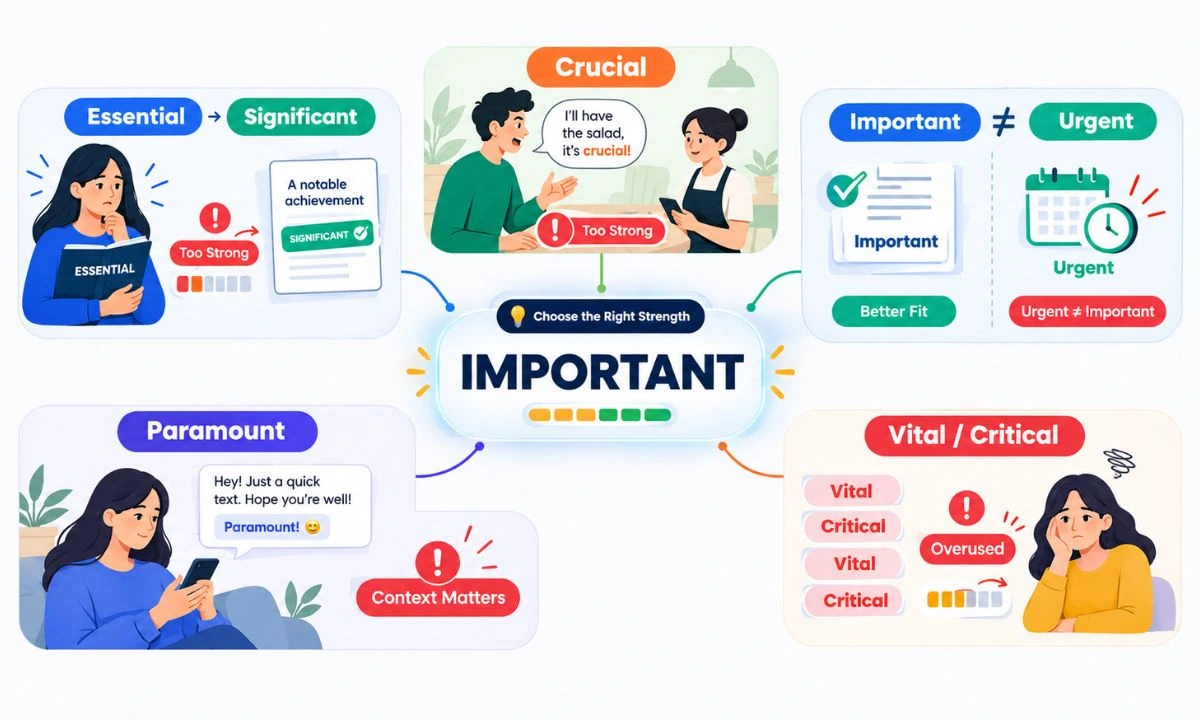
Using Essential When You Mean Significant
“Essential” implies something can’t be skipped. If it’s just notable, “significant” fits better.
Using Crucial in Casual Situations
Calling a lunch order “crucial” sounds exaggerated. Save it for real turning points.
Confusing Important With Urgent
Something can be important without needing action today, don’t mix up the two.
Choosing a Synonym That Does Not Fit the Context
“Paramount” sounds odd in a casual text message. Match the word to the setting.
Overusing Strong Synonyms
If everything is “vital” or “critical,” nothing stands out. Save strong words for genuinely high-stakes moments.
What Major Dictionaries Say About “Important”
Cambridge Dictionary
Definition
Cambridge describes importance as something necessary or of great value, or something that has a strong effect on people or things.
Usage
Cambridge’s examples lean toward everyday and academic use, covering both people and situations.
Merriam-Webster
Definition
Merriam-Webster ties “important” to the worth and consequence of something valuable in content or in how it relates to other things.
Usage
Merriam-Webster notes that “important” is typically used with “more” or “most” when comparing degrees of importance.
Oxford Learner’s Dictionaries
Definition
Oxford Learner’s defines important as having a great effect on people or things, or being of great value.
Usage
Oxford’s examples often pair “important” with roles, decisions, and issues showing its wide range across formal and everyday English.
Explore More Synonyms Guide
25+ Struggle Synonyms: Better Ways to Say Struggle (With Examples)
25+ Share Synonyms: Meanings, Examples & When to Use Each
Kindness Synonyms: 25+ Words, Meanings, Examples & How to Use Them
25+ Share Synonyms: Meanings, Examples & When to Use Each
Frequently Asked Questions
What is another word for important?
Common alternatives include significant, essential, key, and vital, depending on the context.
What is a stronger word for important?
Words like crucial, critical, paramount, and imperative carry more weight than “important.”
What is a professional word for important?
“Strategic,” “relevant,” and “significant” work well in business and workplace writing.
What is a formal synonym for important?
“Essential,” “substantial,” and “noteworthy” fit formal or academic writing.
What is the best synonym for important?
There’s no single best choice pick based on tone, context, and how strong the meaning needs to be.
What is a simple word for important?
“Key” or “big” work well for casual, everyday writing.
Is significant the same as important?
They’re close, but “significant” usually points to a measurable or noticeable effect, while “important” is more general.
What is the difference between important and essential?
“Essential” means something can’t be left out. “Important” just means it carries weight or value.
Conclusion: Choosing the Right Synonym for Important
“Important” works fine on its own, but swapping it out keeps your writing sharp and specific. Use “essential” for must-haves, “crucial” for turning points, “significant” for measurable impact, and “key” for everyday writing.
Before you use a synonym, ask yourself what kind of importance you actually mean necessary, urgent, influential, or valuable. The right word usually follows from there.
