

If you’ve ever paused mid-sentence wondering whether to type “piece” or “peice,” you’re not alone. The piece vs peice debate is one of the most common spelling mix-ups in English, and it trips up students, professionals, and even native speakers on a daily basis. The good news is that once you understand the rule behind it, you’ll never second-guess yourself again.
This confusion usually happens because the word doesn’t sound the way it looks. When people search for piece vs peice, they’re really asking a simple question: which spelling actually exists in the dictionary? Spoiler alert only one of them does, and we’ll show you exactly why.
By the end of this guide, the piece vs peice question will feel like old news. You’ll know the correct spelling, the meaning behind the word, real examples you can use right away, and a memory trick so simple you’ll never forget it again.
Quick Answer: Is It “Piece” or “Peice”?
The correct spelling is piece.
“Peice” is not a real word in English, it’s simply a common typo caused by mixing up the order of “i” and “e.”
Every major dictionary, including Merriam-Webster, Cambridge, and Oxford, lists only “piece” as the accepted spelling.
Piece vs Peice: What’s the Difference?
There isn’t really a “difference” in meaning, because peice has no meaning at all; it’s an error, not an alternate form.
Piece is the only valid version, used as both a noun and a verb.
Think of it this way: piece is the real word, and peice is just a fast-typing accident that happens to look almost right.
What Does “Piece” Mean?
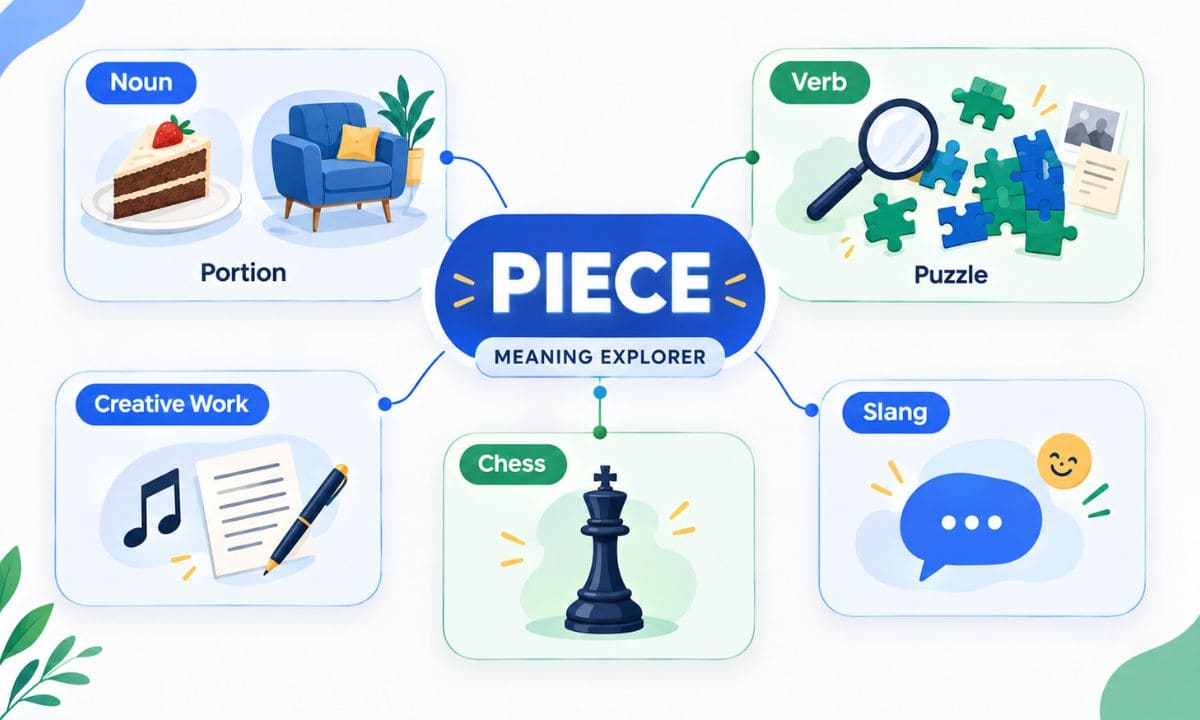
Piece as a Noun
As a noun, a piece refers to a part, portion, or single item taken from a larger whole.
It’s used across countless contexts: food, art, music, furniture, and everyday objects.
Piece as a Verb
As a verb, “to piece” means to assemble or put something together from separate parts, often used in the phrase “piece together,” like piecing together evidence or piecing together a broken vase.
Common Meanings of Piece
- A portion of food (a piece of cake)
- A single item in a set or collection (a piece of furniture)
- A creative work (a piece of music or writing)
- A game token (a chess piece)
- A firearm, informally (a piece in slang usage)
Examples of “Piece” in Sentences
Each piece of the puzzle fit perfectly.
She saved the last piece of pizza for later.
The detective slowly pieced together the timeline of events.
His new piece of writing received great reviews.
Piece Pronunciation and Word Forms
How to Pronounce “Piece”
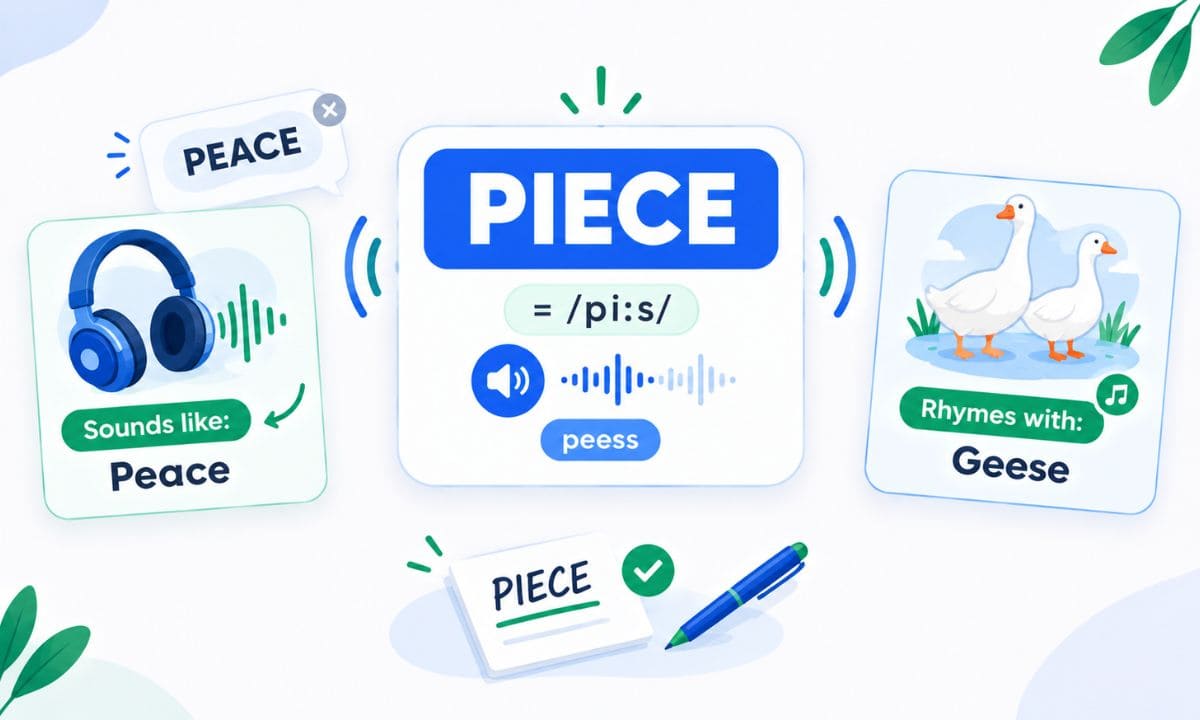
Piece is pronounced “peess” (rhymes with “geese” and, confusingly, sounds identical to “peace”).
Piece, Pieces, and Other Word Forms
- Piece (singular noun)
- Pieces (plural noun)
- Pieced (past tense verb)
- Piecing (present participle)
Why Pronunciation Does Not Help With This Spelling
Since “piece” and “peace” sound the same, relying on sound alone won’t tell you which spelling is correct; you have to memorize the letter pattern instead.
Is “Peice” a Correct Word?
Why “Peice” Is Usually a Spelling Mistake
“Peice” shows up so often because English pronunciation doesn’t always match spelling. The word is pronounced with a long “ee” sound, and many writers instinctively guess at the letter order instead of recalling the actual spelling rule.
The Correct Spelling: Piece
No dictionary recognizes “peice” as a standalone word or variant. If a spell-checker flags it, that’s your sign to fix it immediately; there’s no formal or informal context where it’s acceptable.
Examples of the Incorrect Spelling “Peice”
❌ Can I have a peice of that sandwich?
❌ The peice fell off the table.
❌ She wrote a peice about local news.
Every one of these should use “piece” instead.
Piece vs Peice: At-a-Glance Comparison
| Word | Correct? | Meaning | Usage |
| Piece | ✅ Yes | A part, portion, or item of something | Used in writing, speech, and formal documents |
| Peice | ❌ No | No meaning; it’s a spelling error | Never appears in dictionaries or accepted usage |
When Should You Use “Piece”?
Use “Piece” for a Part or Portion
Use it whenever you’re describing a fraction or section of something bigger, like a piece of bread or a piece of land.
Use “Piece” for an Item or Object
Piece also works for single items within a collection, such as a piece of jewelry or a piece of equipment.
Use “Piece” for a Work of Art or Writing
Writers, musicians, and artists often call their creations a “piece,” as in a piece of poetry or a musical piece.
Use “Piece” in Common Expressions
English has several idioms built around this word:
- Give someone a piece of your mind
- Say your piece
- A piece of cake (meaning something easy)
- Fall to pieces
How to Remember the Spelling of “Piece”
The Easy “I Before E” Memory Trick
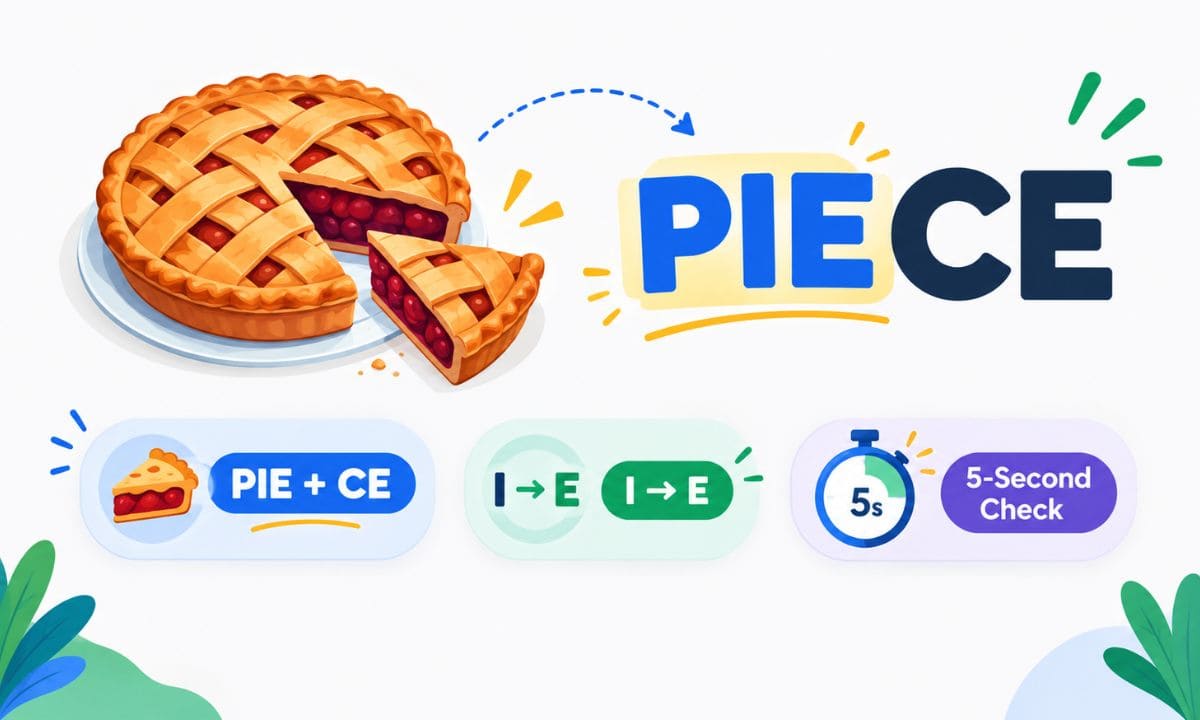
The classic rule “i before e, except after c” applies perfectly here. Since there’s no “c” right before the “ie,” the “i” comes first: p-i-e-c-e.
Remember “Piece” as a Piece of Pie
Here’s a fun visual trick: the word “pie” is hidden right inside “piece.” Just think, “I want a piece of pie,” and you’ll always place the i before the e.
Break the Word Into “Pie + ce”
Splitting the word into two chunks “pie” and “ce” makes it almost impossible to forget the correct order.
A 5-Second Spelling Check
Before hitting send on an email or post, quickly ask yourself: does it start with “pie”? If yes, you’ve spelled it right.
Piece in Everyday English: Real-Life Examples
Piece in Emails and Work Messages
“Please find attached the piece I completed for the quarterly report.”
Piece in Text Messages
“Want a piece of the leftover cake? 🍰”
Piece on Social Media
“Just published a new piece on my blog, check it out!”
Piece in School and Academic Writing
“Students were asked to submit a piece of creative writing for the contest.”
Piece in Everyday Conversation
“Can you hand me that piece of paper on the desk?”
Is “Piece” Used in Formal and Informal English?
Piece in Formal Writing
Formal writing, reports, and journalism regularly use “piece” to describe articles or written works, as in “an opinion piece.”
Piece in Casual English
In everyday chat, “piece” is used loosely for food, objects, and casual expressions like “piece of cake.”
Piece in Academic Writing
Students and researchers use “piece” when referring to essays, papers, or creative assignments.
Common “Peice” vs “Piece” Spelling Mistakes
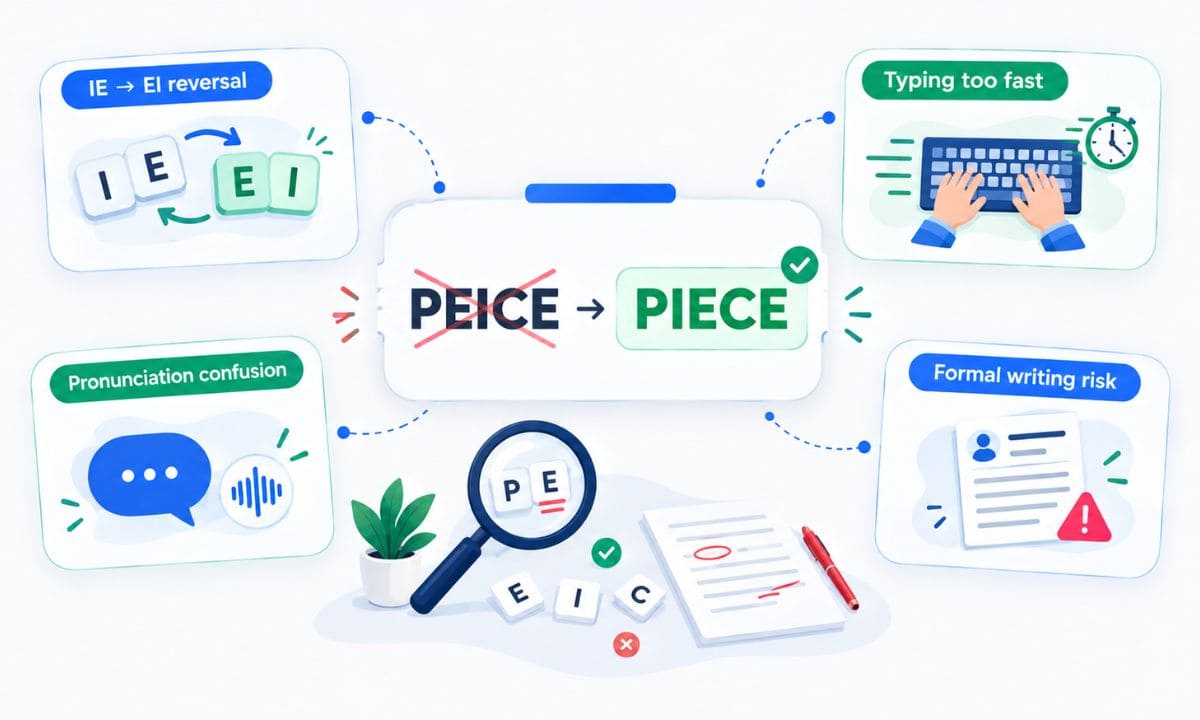
Mistake 1: Reversing “ie” to “ei”
This is the root cause of almost every “peice” typo swapping the vowel order out of habit.
Mistake 2: Typing “Peice” Too Quickly
Fast typing on phones and keyboards often causes the fingers to move faster than the brain, leading to reversed letters.
Mistake 3: Relying on Pronunciation
Because the word sounds like “peace,” writers sometimes borrow that spelling pattern by mistake.
Mistake 4: Using “Peice” in Formal Writing
In resumes, essays, or professional emails, this mistake can look careless and hurt your credibility.
Piece vs Peice: Examples You Can Learn From
Correct Examples With “Piece”
✅I found a piece of the missing puzzle.
✅He wrote a moving piece about his hometown.
✅The piece of furniture arrived damaged.
Incorrect Examples With “Peice”
❌ I found a peice of the missing puzzle.
❌ He wrote a moving peice about his hometown.
❌ The peice of furniture arrived damaged.
Correct the Sentence: Quick Practice
Try fixing these on your own:
- She gave me a peice of advice.
- The song is a beautiful peice of music.
- Can you cut me a peice of cake?
(All three should use “piece.”)
Explore More Grammar Guides
Stutter vs Studder: Correct Spelling and Meaning Guide in 2026
Anise vs Aniseed: Are They the Same? Find Out the Real Difference
Friend vs Freind: Common Mistake and Correct Usage Explained
Really vs Realy? A Quick Guide to Correct English Spelling (2026)
Barrel vs Barrell: Correct Spelling, Meaning, and Sentence Examples
Customize vs Customise: Which One Should You Use? Complete Guide
Authorized vs Authorised: The Complete Spelling Difference Guide
What Do Major Dictionaries Say About “Piece”?
Cambridge Dictionary
Cambridge defines “piece” as a part of something that has been separated or is considered separately from the rest.
Merriam-Webster
Merriam-Webster lists “piece” as a part of a whole, especially one that is separated from or a distinct part of a larger mass or class.
Oxford Learner’s Dictionaries
Oxford describes “piece” as a part of something that has been broken, cut, or torn from the whole, along with its many extended meanings.
Quick Test I Created
Quick Quiz: Can You Choose “Piece” Correctly?
- I ate the last _____ of pizza. (piece vs peice)
- He _____ together the story from old letters. (pieced vs peiced)
- She wrote a _____ about climate change. (piece vs peice)
If you picked “piece” for all three, you’ve mastered the piece vs peice rule.
Frequently Asked Questions
Is “Peice” ever correct?
No. “Peice” is always a misspelling and is never accepted in standard English.
Why do people spell “Piece” as “Peice”?
It usually happens because people rely on sound instead of memory, reversing the “i” and “e.”
What does “Piece” mean?
It refers to a part, portion, or single item of something larger, or the act of assembling something.
How do you spell Piece correctly?
It’s spelled P-I-E-C-E, with “i” coming before “e.”
Is “Piece” a noun or a verb?
It can be both a noun for a part of something, and a verb meaning to assemble.
Is “Piece” commonly misspelled?
Yes, it’s one of the most frequently misspelled words in English.
How can I remember the spelling of Piece?
Remember that “pie” is hidden inside the word “piece” containing “pie.”
Is “Piece” used in formal writing?
Yes, it’s common in journalism, academic writing, and professional communication.
What is the plural of Piece?
The plural is “pieces.”
Conclusion
The piece vs peice debate really comes down to one simple fact: only “piece” is a real word. “Peice” is a typo, plain and simple, no matter how often it shows up in quick messages or first drafts.
Once you lock in the “pie + ce” trick, you’ll spell it correctly every single time, whether you’re writing an email, a school assignment, or a social media caption. Keep this guide handy, and the piece vs peice confusion will never slow down your writing again.

1 thought on “Piece vs Peice: Learn the Correct Spelling, Usage & Memory Trick”