

If you’ve ever paused mid-sentence wondering whether to type “customize” vs “customise,” you’re not alone. It’s one of the most common spelling questions in English, and it trips up students, writers, and business owners alike.
The good news: the customize vs customise debate isn’t about right or wrong. It’s about geography. Both spellings mean exactly the same thing; they just belong to different versions of English.
In this guide, you’ll learn the meaning, grammar rule, pronunciation, and practical tips so you never second-guess yourself again when choosing between customize vs customise.
Quick Answer: Customize vs Customise
“Customize” and “customise” mean the same thing:
To change or adjust something so it fits a person’s specific needs or taste.
The only real difference is spelling, based on regional preference.
Which Spelling Is American English?
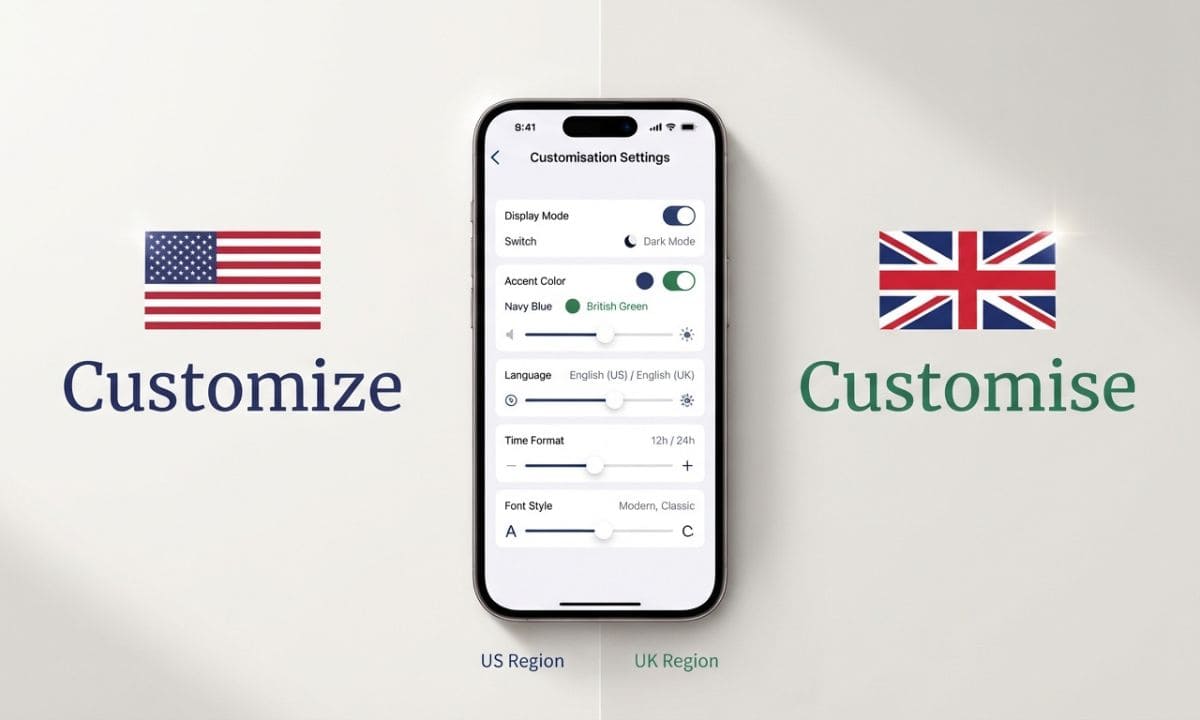
“Customize” with a z is the standard form in American and Canadian English, seen in most US apps, software, and marketing copy.
Which Spelling Is British English?
“Customise” with an s is the preferred form in British, Australian, and New Zealand English, favored by most Commonwealth style guides.
Definitions With Examples
What Does “Customize” Mean?
To customize something means to build, adjust, or personalize it to match individual requirements or preferences.
Customize as a Verb
It works as an action word describing the process of tailoring a product, service, or setting.
Examples of Customize in a Sentence
You can customize your phone’s home screen with any wallpaper.
Employees can customize their dashboard layout.
What Does “Customise” Mean?
“Customise” carries the identical meaning to adapt or personalize something just written with British spelling conventions.
Customise as a Verb
Like its American twin, it functions as a verb describing modification or personalization.
Examples of Customise in a Sentence
She wanted to customise her wedding invitations with gold foil.
The software lets users customise their notification settings.
Why Do People Confuse Customize and Customise?
The Difference Between -ize and -ise
The confusion comes down to one suffix.
English has two spelling families for verbs like this: words ending in -ize and words ending in -ise and both sound identical when spoken.
Why Both Spellings Look Correct
Neither spelling is a typo.
Dictionaries on both sides of the Atlantic list them as valid entries, so spell-checkers rarely flag either one.
How Regional English Causes Confusion
Streaming, social media, and global software mean people read American and British content side by side every day, making it harder to remember which spelling belongs where.
The Grammar Rule Behind Customize vs Customise
The -ize Spelling Pattern
American English generally favors -ize endings for verbs describing a process of becoming or making something.
Examples of -ize Words
Organize
Realize
Prioritize
Recognize
The -ise Spelling Pattern
British English typically swaps that ending for -ise, following spelling patterns that entered English centuries ago.
Examples of -ise Words
Organise
Realise
Prioritise
Recognise
Is -ize or -ise the Correct Suffix?
Both are grammatically correct;
They belong to different English varieties. Oxford English Dictionary actually recommends -ize as house style, though most everyday British writing still uses -ise.
Pronunciation of Customize and Customise
How to Pronounce Customize
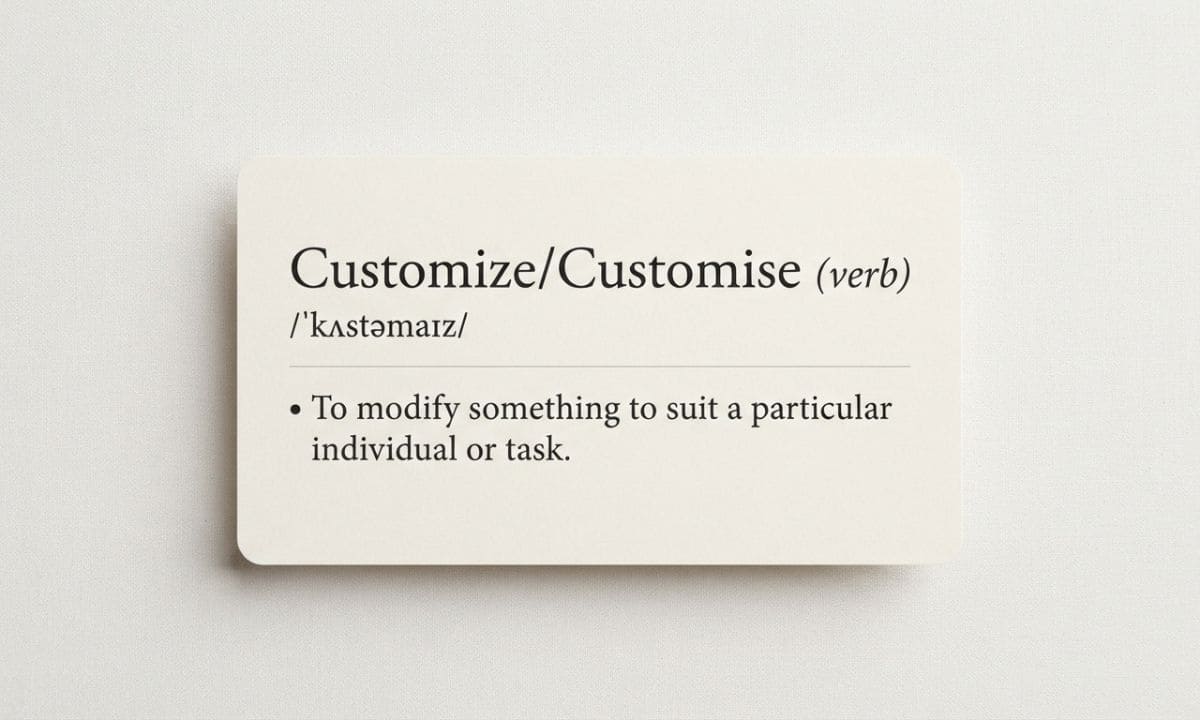
Customize is pronounced KUS-tuh-mize, with stress on the first syllable.
How to Pronounce Customise
Customise follows the exact same sound pattern: KUS-tuh-mize.
Are Customize and Customise Pronounced Differently?
No. The “s” in customise is pronounced like a “z,” so pronunciation never gives away which spelling someone uses.
The Origin of Customize and Customise
The Etymology of “Customize”
The word traces back to “custom,” meaning something made to individual order. Adding a verb suffix turned it into an action word.
How “Custom” Became “Customize”
Custom-made goods have existed for centuries, but “customize” only became common in the 20th century as manufacturing needed a word for tailoring products at scale.
The Development of the “-ise” Spelling
As the new American term spread worldwide, British English simply adapted it using its own established spelling pattern, giving us “customise.”
Customize vs Customise at a Glance
| Feature | Customize | Customise |
| Region | American, Canadian English | British, Australian, NZ English |
| Spelling | Ends in -ize | Ends in -ise |
| Meaning | Same | Same |
| Pronunciation | Identical | Identical |
| Word forms | customized, customizing, customization | customised, customising, customisation |
| Common in | US apps, marketing, tech | UK news, government, retail |
Formal vs Informal Writing
Customize in Formal Writing
In American business documents and official communication, “customize” is the expected spelling.
Customise in Formal Writing
In UK contracts, government publications, and formal British correspondence, “customise” is the standard choice.
Which Form Should You Use Professionally?
Match your spelling to your reader’s location.
A US client expects “customize”; a UK client expects “customise.”
Customize vs Customise in Everyday Sentences
Example Sentences With Customize
I want to customize my resume for each job application.
The app allows users to customize their privacy settings.
Example Sentences With Customise
I want to customise my resume for each job application.
The app allows users to customise their privacy settings.
Common Situations Where Customize Is Used
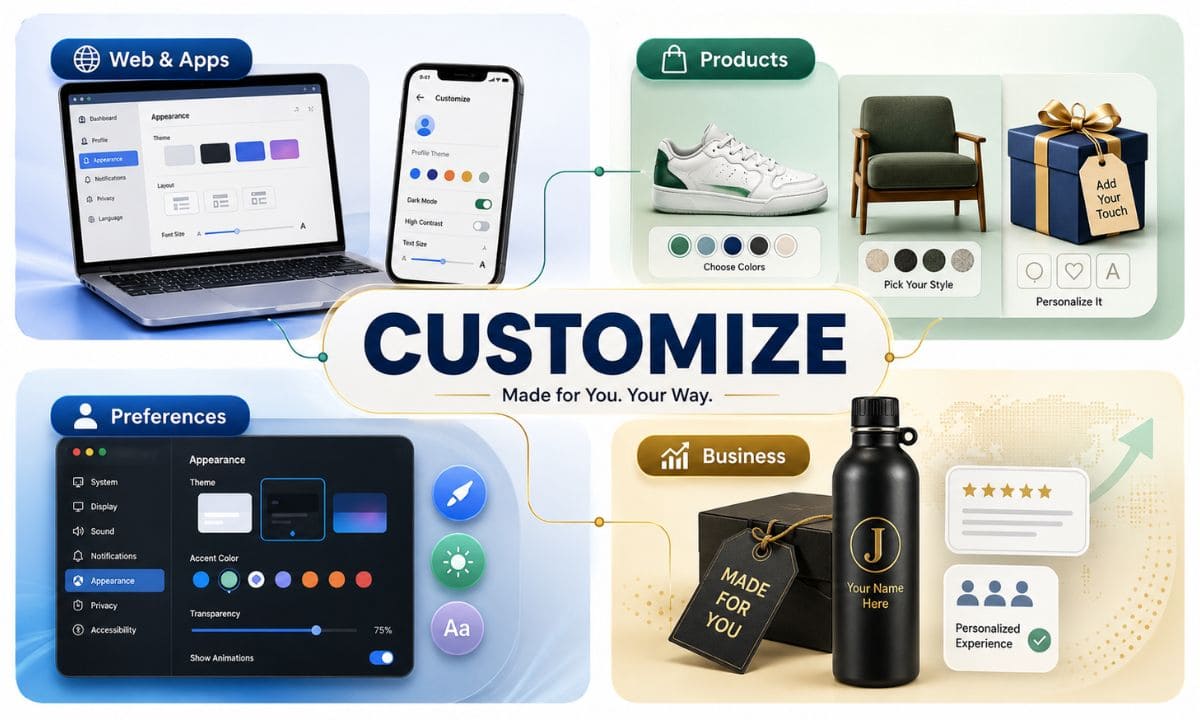
Websites and applications:
US apps and SaaS tools almost always use “customize” in menus and settings.
Products and services:
American retailers advertise the ability to customize sneakers, furniture, or gift boxes.
User preferences:
American OS settings use phrases like “customize your experience.”
Business and marketing:
US copy leans on “customize” to promise a personal touch on made-to-order goods.
Common Situations Where Customise Is Used
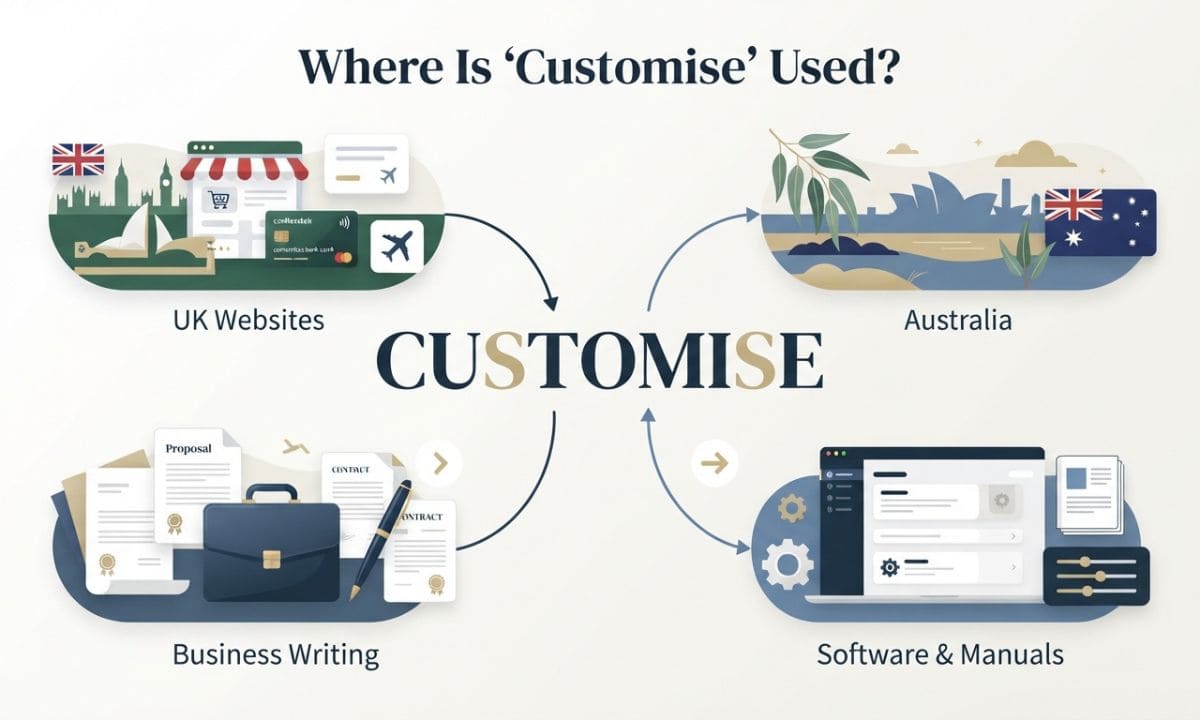
British English websites:
UK retailers and service providers, from banks to airlines, use “customise” throughout.
Australian English writing:
Australian brands, news outlets, and universities follow the British pattern.
Business and professional communication:
Formal UK business writing, including tenders and proposals, sticks to “customise.”
Product and software instructions:
UK-developed manuals typically instruct users to “customise” settings.
Customize vs Customise in Technology and Software
Customize in American Software
Apple, Google, and Microsoft’s US builds use “customize” throughout menus, help docs, and settings.
Customise in British Software
UK-localized versions of global software switch the spelling to “customise” for British users.
Why Software Uses Different Spellings
Large tech companies localize interface language by region, so the same app might say “customize” in the US store and “customise” in the UK store.
When One Choice Sounds Wrong
Using Customize in British English
“Customize” for a British audience isn’t wrong, but it looks out of place similar to spelling “colour” as “color” in a UK newspaper.
Using Customise in American English
The reverse is true too “customise” in American content can look like a typo, even though it’s a legitimate British spelling.
When Consistency Matters More Than Preference
Using one spelling consistently throughout a document matters more than which one you pick.
Explore More Grammar Guides
Stutter vs Studder: Correct Spelling and Meaning Guide in 2026
Anise vs Aniseed: Are They the Same? Find Out the Real Difference
Friend vs Freind: Common Mistake and Correct Usage Explained
Really vs Realy? A Quick Guide to Correct English Spelling (2026)
Barrel vs Barrell: Correct Spelling, Meaning, and Sentence Examples
Habit vs Habbit: Common Error, Meaning, and Usage Guide
Customize vs Customise: Common Mistakes
Treating one spelling as incorrect
Both are valid, and neither is a grammar mistake.
Mixing -ize and -ise in the same article
This looks unpolished and confuses readers.
Confusing spelling with pronunciation
Both words sound identical out loud.
Assuming -ise is always British
Words like “capsize” keep -ize even in UK English, so the rule isn’t absolute.
Why Do People Spell Customize as Customise?
Influence of British English
Writers who read a lot of UK content naturally start typing “-ise” without noticing.
Influence of American English
Heavy exposure to American media pushes writers toward “-ize,” even in UK-based writing.
Exposure to Different Dictionaries
Autocorrect set to different regions can quietly swap your spelling without you noticing.
Memory Tricks to Remember the Correct Spelling
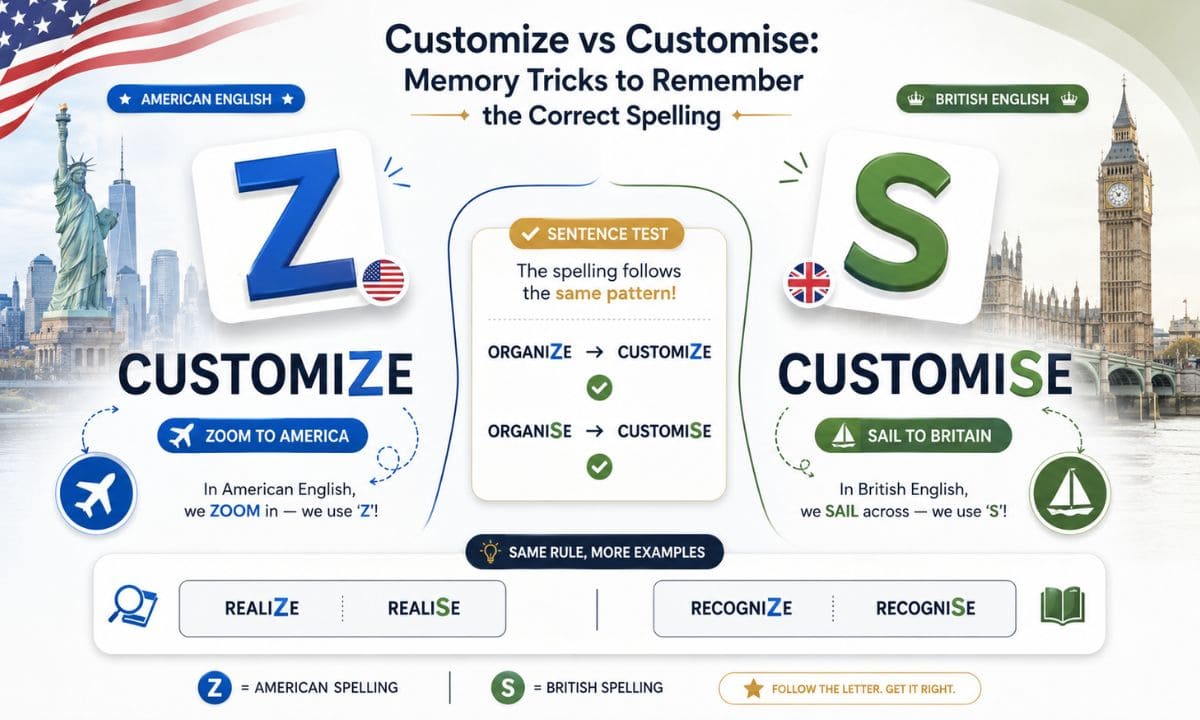
The American “Z” Trick
Think: “Zoom to America” Z belongs to the US spelling, customize.
The British “S” Trick
Think: “Sail to Britain” S belongs to the UK spelling, customise.
A Simple Sentence Test
If you’d spell “organize” with a Z, use “customize.” If you’d spell “organise” with an S, use “customise.”
Easy Memory Examples
Recognize / Recognise → Customize / Customise
Realize / Realise → Customize / Customise
Different Parts of Speech
Customize and Customise as Verbs
Both words function primarily as verbs describing an action of change or adaptation.
Customized vs Customised
Both are past tense and past participle forms, used the same way grammatically.
Example: “I customized/customised my laptop with new software.”
Customization vs Customisation
These are the noun forms describing the process or result of the change.
Example: “The website offers full customization/customisation of the checkout page.”
Customizable vs Customisable
These adjective forms describe something that can be adapted or personalized.
Example: “This template is fully customizable/customisable.”
Synonyms and Alternatives for Customize and Customise
Tailor to make or adjust for a specific purpose
Adapt to change something to suit new conditions
Modify to make partial changes
Personalize to make something specific to one person
Adjust to alter slightly for a better fit
Antonyms and Opposite Ideas
Standardize to make uniform
Uncustomize (informal) to return to default
Keep as standard no modification at all
American vs British English Differences
| Region | Preferred Spelling | Example Word |
| United States | Customize | Organize, Realize |
| Canada | Customize | Organize, Realize |
| United Kingdom | Customise | Organise, Realise |
| Australia | Customise | Organise, Realise |
| New Zealand | Customise | Organise, Realise |
Dictionary-Style Word Details
| Word: Customize | Word: Customise | |
| Part of Speech | Verb | Verb |
| Definition | To modify or build something to individual specifications | To modify or build something to individual specifications |
| Pronunciation | /ˈkʌstəmaɪz/ | /ˈkʌstəmaɪz/ |
| Word Forms | customized, customizing, customization, customizable | customised, customising, customisation, customisable |
What Major Dictionaries Say
American Dictionary Usage:
Merriam-Webster lists “customize” as the main entry, noting “customise” as a British variant.
British Dictionary Usage:
Cambridge and Collins list “customise” as the main UK entry, while still recognizing “customize” as valid.
Dictionary Treatment of -ize and -ise
Most dictionaries treat these as regional variants, confirming that the choice between customize vs customise is stylistic, not grammatical.
Are Both Spellings Standard?
Yes. Both are standard English; no dictionary labels either spelling as slang or incorrect.
Pro Tip: Choosing the Right Spelling
Check Your Target Audience
Look at where most of your readers or customers are based before deciding.
Follow Your Website’s Style Guide
If your company already has a house style, stick with it rather than switching mid-article.
Prioritize Consistency
One consistent spelling looks far more professional than switching styles within the same page.
Quick Test I Created
Quick Test: Customize or Customise?
Fill-in-the-Blank Test
“Can you help me ______ this order for a UK customer?” (A) Customize (B) Customise
Choose the Correct Spelling
Pick the option that matches British spelling conventions.
Answer and Explanation
B) Customise the sentence specifies a UK customer, and British English uses the -ise spelling.
Frequently Asked Questions
Is Customize or Customise Correct?
Both are correct. The choice depends entirely on whether you’re writing in American or British English.
Customize American or British English?
Customize is the American English spelling, also used in Canada.
Is Customise American or British English?
Customise is the British English spelling, also used in Australia and New Zealand.
Can British English be Customized?
Technically yes, since Oxford style permits -ize endings, but most British writers still prefer customise.
Can American English Use Customise?
It’s understood but looks unusual, since customisation is the expected American standard.
Which Is More Common: Customize or Customise?
Customization is more common globally, largely due to the size of the US market and American software.
Is Customized or Customised Correct?
Both are correct, customized follows American spelling, customized follows British spelling.
Is Customization or Customisation Correct?
Both are correct nouns, with customization used in American English and customisation used in British English.
Is Customizable or Customisable Correct?
Both are correct adjectives, again split by American (customizable) and British (customisable) preference.
Do Customize and Customise Have the Same Meaning?
Yes, they mean exactly the same thing to adapt or personalize something to individual needs.
Conclusion
The customize vs customise question isn’t about grammar rules, it’s about regional spelling habits. Customize belongs to American and Canadian English, while customise belongs to British, Australian, and New Zealand English. Both share the same meaning, pronunciation, and grammatical function.
The smartest approach is to identify your audience first. Write for US readers, and customize is your safest bet. Write for UK or Commonwealth readers, and customise will feel more natural. Whichever you settle on, the golden rule is consistency: never mix the two within one piece of writing.
Once you understand this regional split, you’ll never have to pause and second-guess yourself again. Customize vs customise stops being confusing the moment you remember it’s really a matter of geography, not correctness.
