

I used to stare at my screen every time I typed a deadline into an email. Should it be timeframe vs time frame? The uncertainty made me look less confident in my own writing.
After years of writing reports, blogs, and client emails, I finally tracked down the real rule behind timeframe usage. It turns out the answer is simpler than most grammar guides make it sound.
In this guide, I’ll share the exact tricks I use to pick the right timeframe form every single time, plus definitions, examples, a quiz, and answers to the questions people search for most.
Timeframe vs Time Frame: Quick Answer
Both spellings are grammatically correct, and both mean the same thing: a specific period during which something happens. The real difference comes down to formality and consistency, not right versus wrong.
Correct: “Time frame” (two words) is the traditional, formal spelling used in academic papers, legal documents, and official reports.
Incorrect: Using “timeframe” and “time frame” interchangeably within the same document. That’s the actual mistake, not the spelling itself, but the inconsistency.
Why I Found It’s Spelled “Misclick”
Early on, I assumed every double-word confusion in English happened by accident, almost like a typing “misclick” that stuck around. But timeframe followed a normal pattern: two separate words slowly merged into one as people typed them faster over decades.
This is common in English. “Every day” became “everyday,” and “web site” became “website.” Timeframe is simply following the same natural path toward becoming one word.
Any Rule About Stopping
There isn’t an official rule that stops this merging process.
Dictionaries update gradually based on how often a spelling appears in real usage, so timeframe may eventually become the only accepted form but it isn’t there yet.
Pronunciation Guide I Use
I always tell people to say the word out loud before typing it. Both forms sound exactly the same, so pronunciation won’t tell you which spelling to use but it helps you remember the word itself.
Phonetic Pronunciation
Timeframe is pronounced /ˈtaɪm.freɪm/ TIME-frame, with equal stress on both syllables.
Time frame is pronounced identically, since spacing doesn’t change spoken English at all.
Definitions with Examples
Time Frame (Definition)
A time frame is a defined period during which a task, project, or event is expected to happen or be completed.
Examples:
- The team has a time frame of six weeks to finish the audit.
- Please confirm the time frame for the product launch.
- Our time frame for feedback is three business days.
Timeframe (Definition)
Timeframe carries the identical meaning as a set duration for completing something, written as a single compact word.
Examples:
- The app tracks progress over a custom timeframe.
- What’s the timeframe for shipping this order?
- We adjusted the timeframe to meet the new deadline.
Simple Meaning
Whichever spelling you choose, a timeframe simply answers the question: “By when?” or “During what period?”
The Origin of Time Frame
The phrase time frame first appeared in mid-20th-century English, combining “time” (a measurable duration) with “frame” (a structure or boundary).
Writers used it to describe the “frame” around a period, much like a picture frame borders a photo.
Over the following decades, especially in American business and tech writing, the two words gradually fused into the single-word timeframe we see everywhere today.
British English vs American English Spelling
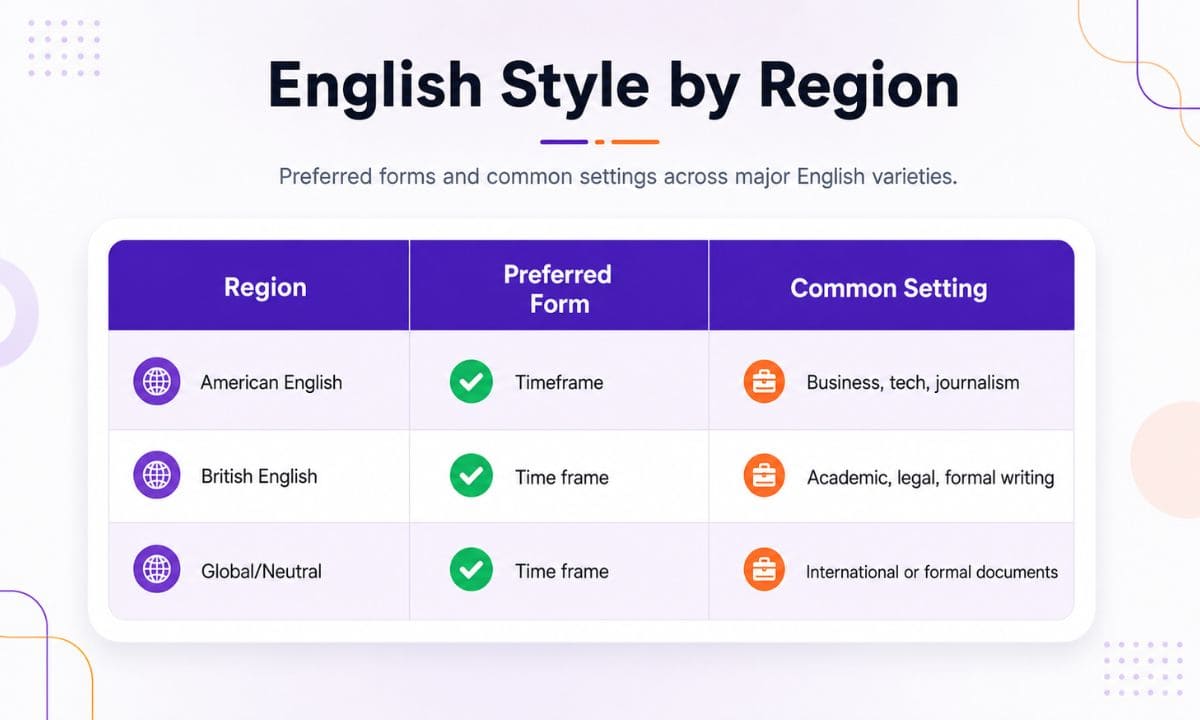
American English adopted the single-word timeframe faster, especially in journalism, tech blogs, and casual business writing. British English still leans toward the traditional two-word time frame, particularly in formal and academic contexts.
Comparison Table:
Timeframe vs Time Frame: Key Difference Explained
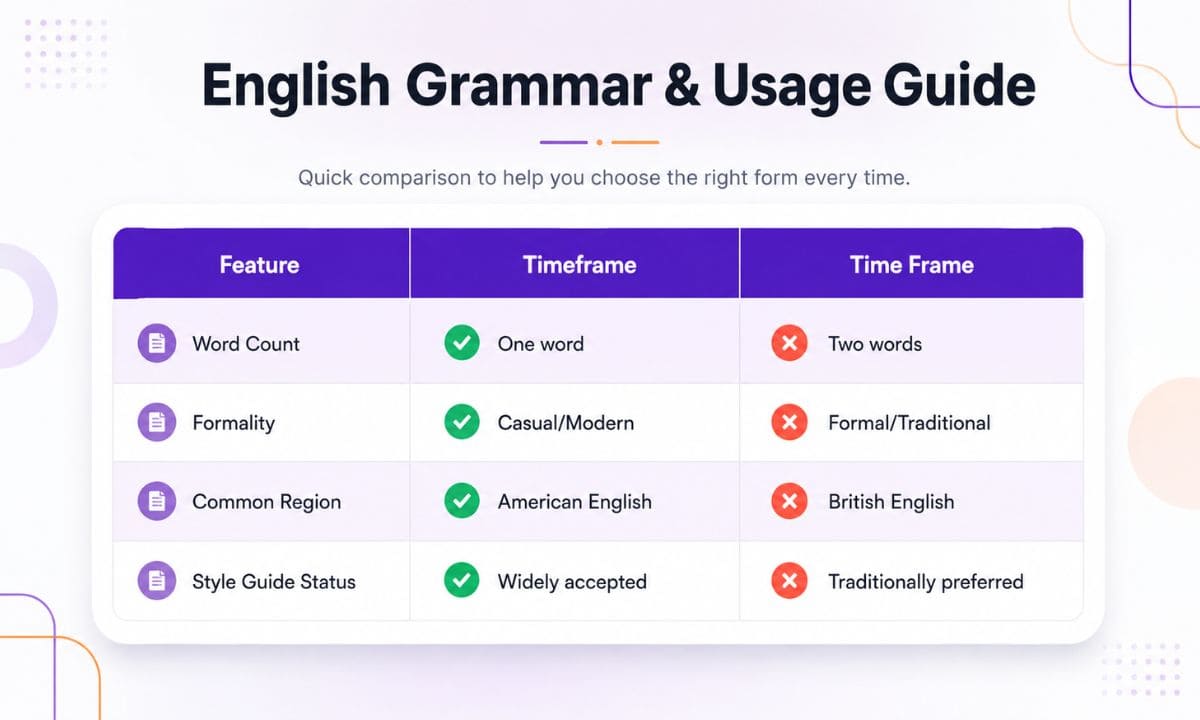
There is no difference in meaning between the two.
The only real difference is tone: timeframe feels modern and streamlined, while time frame feels traditional and formal.
Style guides like AP and Chicago Manual of Style still list time frame as the standard entry, even though timeframe appears constantly in everyday digital content.
My Memory Tricks and Tips: Timeframe vs Time Frame
I built these five tricks after years of double-checking myself in emails and articles.

Memory Trick 1: The Formal Suit Rule
Picture “time frame” wearing a formal suit that belongs in reports, contracts, and academic essays. If your writing needs to look professional and traditional, keep it as two words.
Memory Trick 2: The Speed Typing Rule
If you’re typing fast texting, Slack messages, casual blog posts your fingers naturally merge words for speed. That’s exactly how the timeframe became one word, so let casual writing use the single-word form.
Memory Trick 3: The Consistency Checklist
Before publishing anything, search your document for both spellings. If you find both, pick one and replace every instance. Consistency matters more than which version you choose.
Memory Trick 4: The Style Guide Anchor
If you write for a company, school, or publication, check their style guide first. Most organizations already have a preferred timeframe spelling, and following it removes the guesswork entirely.
Which One Should You Use? Timeframe vs Time Frame
Use Time Frame When:
- Writing academic papers, theses, or legal contracts
- Following a style guide that specifies two words
- Writing for a British or international audience
- You want the most traditionally “safe” option
Use Timeframe When:
- Writing blog posts, emails, or casual business content
- Working in tech, startups, or digital marketing
- Your audience is primarily American and informal
- You want a shorter, modern-looking word
Easy Tip
When unsure, default to time frame for anything formal and timeframe for anything digital or casual then stay consistent throughout the piece.
Common Mistakes with Timeframe vs Time Frame
Mistake #1: Switching between timeframe and time frame within the same document, which looks careless to editors and readers.
Mistake #2: Hyphenating it as “time-frame” outside of rare compound-modifier situations, where it’s usually unnecessary.
Mistake #3: Assuming one spelling is “wrong” and correcting colleagues unnecessarily, since both are accepted.
Mistake #4: Ignoring the required style guide for academic, legal, or client work, which can cost points or professionalism.
Timeframe vs Time Frame in Everyday Examples

In Business Emails
“Please let us know your expected timeframe for the deliverables.” This casual, quick form fits everyday professional communication.
In Legal Documents
“The contract must be executed within the agreed time frame.” Formal writing calls for the traditional two-word spelling.
In Project Management
“Our sprint timeframe is two weeks.” Tech and agile environments almost always favor the single-word form.
In Academic Writing
“The study was conducted over a twelve-month time frame.” Academic papers typically stick with the formal, traditional spelling.
Explore More Grammar Guides
Misclick vs Missclick: 10 Must-Know Facts for Perfect English Spelling
Spicy vs Spicey: 14 Quick Grammar Facts You Need to Know
Their or Thier? The Ultimate 2026 Grammar Guide with 10 Easy Examples
Naive vs Nieve: The Definitive Guide with 15 Powerful Real-Life Examples
Triple vs Tripple: 5 Expert Examples to Master the Correct Spelling
Focusses vs Focuses: The Ultimate 2026 Guide with 10 Easy Examples
Fourteen vs Forteen: 7 Proven Ways to Spell It Correctly
31st or 31th? 7 Proven Rules to Master the Correct Ordinal Spelling
Timeframe Usage, Synonyms & Translation Searches
Timeframe (also “time frame” vs “time-frame”) is a noun meaning a specific period during which something happens, is planned, or must be completed.
Usage
- “What’s the timeframe for this project?”
- “We need this done within a reasonable timeframe.”
- “Can you give me a timeframe for delivery?”
Grammar notes: All three spellings are used “timeframe” (most common in American English), “time frame” (common in British/formal writing), “time-frame” (less frequent, hyphenated).
It’s countable (a timeframe/timeframes) and often follows prepositions like within, in, or over a timeframe.
Synonyms
| time period | General, neutral |
| timeline | Sequence of milestones |
| deadline | Fixed end point |
| duration | Length of time |
| window | Limited opportunity |
| schedule | Structured timing |
| span | Stretch of time |
| turnaround time | Completion speed |
Timeframe: Google Trends & Usage Data
Trends
Search interest in “timeframe” has stayed consistently higher than “time frame” over the past several years, especially across the United States, reflecting its dominance in everyday digital writing.
Region Table
| Region | Trending Preference |
| United States | Timeframe |
| United Kingdom | Time frame |
| Canada | Timeframe |
| Australia | Time frame |
| India | Timeframe |
Top 10 Searches
Timeframe pronunciation
Timeframe or time frame
Is timeframe one word
Timeframe meaning
Time frame synonym
Timeframe vs time period
How to use timeframe in a sentence
Timeframe definition business
Correct spelling of timeframe
Time frame example
Comparison Table: Timeframe vs Time Frame
Pro Tip I Learned Timeframe vs Time Frame
Whenever I’m unsure, I check how the target publication or client has used timeframe before, then match their existing pattern instead of guessing.
Quick Test I Created
Timeframe vs Time Frame Quiz
Test yourself with these uick uestions.
1: Which spelling is more traditional?
Time frame is the traditional, formal spelling.
2: Is timeframe one word or two?
Timeframe is one word; time frame is two words.
3: Which form suits legal documents?
Time frame is preferred in legal and academic writing.
4: Which form is common in tech writing?
Timeframe is the standard choice in tech and business content.
5: Is “time-frame” with a hyphen correct?
Rarely it’s mostly unnecessary except as a compound modifier.
6: True or False: Both spellings mean the same thing.
True. Both describe a defined period for something to happen.
7: Which region favors “timeframe” more?
American English favors the single-word timeframe.
8: Which region favors “time frame” more?
British English tends to favor the two-word time frame.
9: What’s the biggest mistake writers make?
Mixing both spellings inconsistently within one document.
10: What’s a good synonym for timeframe?
Duration, period, window, or schedule all work well.
11: Should you follow a company style guide?
Yes always matches the organization’s preferred spelling.
12: Does pronunciation differ between the two forms?
No, both are pronounced identically: TIME-frame.
13: Which spelling is trending higher in search data?
Timeframe currently trends higher in search volume overall.
14: Is timeframe accepted in modern dictionaries?
Yes, most modern dictionaries now list timeframe as standard.
15: What matters more than which spelling you pick?
Consistency throughout your document matters most.
Frequently Asked Questions
Is timeframe one word or two words?
Both forms exist: timeframe as one word and time frame as two words, and both are correct.
Which is more correct, timeframe or time frame?
Neither is the “correct” time frame more traditional, while timeframe is more modern and widely accepted.
What does timeframe mean?
Timeframe means a specific period during which something is planned, expected, or required to happen.
Can I use timeframe in formal writing?
Yes, though many formal style guides still prefer the two-word time frame for academic or legal contexts.
Is “time-frame” with a hyphen ever correct?
Rarely hyphenation is generally unnecessary unless it’s functioning as a compound modifier before a noun.
What’s a good synonym for timeframe?
Duration, period, window, span, and schedule are all reliable alternatives.
Do British and American English differ on this word?
Yes, American English leans toward timeframe, while British English leans toward time frame.
How do I stay consistent with timeframe usage?
Pick one spelling, check your style guide, and search your document to confirm you used it every time.
Why do so many people search “timeframe or time frame”?
Because both forms look correct, autocorrect flips between them, and no single universal rule fully settles it.
Is timeframe used more often today than time frame?
Yes, search and usage data show timeframe trending higher, especially in American digital content.
Conclusion
After digging through style guides, dictionaries, and years of my own writing habits, I’ve landed on one simple truth about timeframe usage: both spellings are correct, and neither will get you flagged as wrong.
What actually matters is picking a lane timeframe for casual, modern, or tech-focused writing, and time frame for formal, academic, or legal work then staying consistent throughout your document.
Next time you pause before typing a deadline, remember these tricks. Whether you write timeframe or time frame, confident and consistent usage is what makes your writing look polished and professional.
