


Need better broken synonyms? This guide gives you 72 alternatives, sorted by meaning, tone, and situation.
You will find words for cracked objects, failing machines, heartbreak, broken promises, casual slang, and money trouble.
Every word comes with its pronunciation, meaning, and two examples.
At a Glance: Choosing the Right Word
- Best all-purpose word: damaged
- Best formal or professional word: defective, malfunctioning, or inoperative
- Best casual word: busted
- Best for glass and objects in pieces: shattered or cracked
- Best for deep sadness: heartbroken or devastated
- Best for a failing system: dysfunctional
- Best for no money: broke (this is not the same word as broken)
Quick Answer: What Are the Best Synonyms for Broken?
The best synonym for broken depends on what is broken. Use damaged for general harm, shattered or cracked for objects, defective or malfunctioning for products and machines, heartbroken for deep sadness, and busted for casual talk. Choose the word that matches the situation, not just the dictionary meaning.
Best All-Purpose Synonyms for Broken
Damaged, faulty, and impaired work in most situations. They are clear, neutral, and easy to understand.
Example: “The package arrived damaged.”
Best Words for Something Physically Broken
Cracked, shattered, fractured, smashed, and splintered describe things that have split or come apart.
Pick cracked for a line in a surface and shattered for many small pieces.
Best Words for Someone Emotionally Broken
Devastated, heartbroken, crushed, and wounded describe pain, not damage to a body. These words work best in personal conversation and storytelling.
Best Formal and Professional Alternatives
Defective, malfunctioning, inoperative, nonfunctional, and compromised fit reports, emails, and technical writing. They sound more precise than “broken.”
Best Casual and Slang Alternatives
Busted, wrecked, messed up, toast, and kaput suit friendly talk. Avoid them in formal writing.
Quick-Answer Table
| Word | Best Used For |
| Damaged | Something harmed but not necessarily destroyed |
| Shattered | Something broken into pieces |
| Cracked | A surface with a crack |
| Defective | A product with a fault |
| Malfunctioning | A machine or device not working correctly |
| Devastated | Someone deeply emotionally hurt |
| Heartbroken | Deep sadness after emotional loss |
| Dysfunctional | A system or relationship not working properly |
| Busted | Informal word for broken or damaged |
| Inoperative | Something that is not functioning |
Also Read This: Synonyms for Partner
What Does Broken Mean?

Broken is an adjective. It is also the past participle of the verb break.
Dictionaries list many senses. Merriam-Webster, for example, includes “violently separated into parts,” “damaged,” “having gaps,” “not kept” (a broken promise), and “subdued completely” (a broken spirit).
Oxford Learner’s Dictionaries describes it as damaged or injured, and no longer whole or working correctly.
In short, broken means that something is no longer whole, working, kept, or emotionally strong. The exact meaning depends on the noun that follows it.
Broken as a Physical Condition
Here, an object or body part has split, cracked, or come apart.
Examples: a broken window, a broken leg, broken glass. Good alternatives are cracked, shattered, fractured, and smashed.
Broken as an Emotional Condition
Here, broken describes deep emotional pain, such as grief, loss, or betrayal.
Examples: a broken heart, a broken spirit. Good alternatives are heartbroken, devastated, and crushed. These words describe how someone feels right now. They do not describe who the person is.
Broken as a Financial Expression
Careful here. The word for having no money is broke, not broken. “I’m broke” means you have little or no money, in informal English. Do not say “I’m broken” for this meaning, because it will sound like you are hurt or damaged.
Broken as a Technical or Functional Problem
Here, a machine, app, or system does not work as it should.
Examples: a broken printer, a broken link. Good alternatives are malfunctioning, faulty, inoperative, and out of order.
Broken in Figurative and Poetic Language
Writers use broken words for ideas that are not physical.
Examples: broken promises, broken sleep, broken English, a broken home, broken dreams.
Broken vs. Broke: What Is the Difference?
The two words look alike but do different jobs.
| Word | Part of Speech | Meaning | Example |
| Broken | Adjective / past participle | Damaged, not working, or emotionally hurt | “The phone is broken.” / “I have broken the phone.” |
| Broke | Past tense verb | Damaged something (past action) | “I broke the phone.” |
| Broke | Informal adjective | Having little or no money | “I’m broke until Friday.” |
Remember this:
“I broke it” means you damaged something.
“I’m broke” means you have no money.
“It’s broken” means something does not work.
70+ Synonyms for Broken With Meanings and Examples
These 72 words are not perfect copies of each other. Some describe damage, some describe a failing function, and some describe feelings.
Common Synonyms for Broken
1. Damaged
Pronunciation:
US /ˈdæmɪdʒd/ | UK /ˈdæmɪdʒd/
Meaning:
Harmed so that something is worse or less useful, but not always destroyed.
Examples:
- The box arrived damaged, but the cup inside was fine.
- Heavy rain left the roof damaged.
2. Cracked
Pronunciation:
US /krækt/ | UK /krækt/
Meaning:
Having a thin line or split, often without falling apart.
Examples:
- My phone screen is cracked in one corner.
- She noticed a cracked plate in the sink.
3. Shattered
Pronunciation:
US /ˈʃætərd/ | UK /ˈʃætəd/
Meaning:
Broken suddenly into many small pieces.
Examples:
- The glass hit the floor and shattered.
- A shattered window let the cold air in.
4. Busted
Pronunciation:
US /ˈbʌstɪd/ | UK /ˈbʌstɪd/
Meaning:
An informal word for broken or not working.
Examples:
- The dryer is busted again.
- He rode home on a busted bike.
5. Fractured
Pronunciation:
US /ˈfræktʃərd/ | UK /ˈfræktʃəd/
Meaning:
Broken or cracked, most often used for bones and hard materials.
Examples:
- The doctor said the bone was fractured, not crushed.
- A fractured pipe caused the leak.
6. Defective
Pronunciation:
US /dɪˈfektɪv/ | UK /dɪˈfektɪv/
Meaning:
Having a fault from the start, usually said of a product.
Examples:
- The store replaced the defective charger.
- A defective part caused the recall.
7. Flawed
Pronunciation:
US /flɔːd/ | UK /flɔːd/
Meaning:
Having a weakness or mistake that makes something less reliable.
Examples:
- The plan was flawed from the beginning.
- A flawed design made the chair unstable.
8. Ruined
Pronunciation:
US /ˈruːɪnd/ | UK /ˈruːɪnd/
Meaning:
So badly damaged that it is spoiled or no longer worth using.
Examples:
- The rain ruined the paper maps.
- One spilled drink left the keyboard ruined.
9. Smashed
Pronunciation:
US /smæʃt/ | UK /smæʃt/
Meaning:
Broken violently into pieces, often by a hard hit.
Examples:
- The smashed mirror lay across the hallway.
- Someone smashed the car window.
10. Wrecked
Pronunciation:
US /rekt/ | UK /rekt/
Meaning:
Badly damaged or destroyed, often in an accident.
Examples:
- The wrecked boat sat on the beach.
- The storm left the garden wrecked.
11. Fragmented
Pronunciation:
US /ˈfræɡmentɪd/ | UK /fræɡˈmentɪd/
Meaning:
Divided into small, separate parts.
Examples:
- Archaeologists found fragmented pottery.
- The fragmented report was hard to follow.
12. Deteriorated
Pronunciation:
US /dɪˈtɪriəreɪtɪd/ | UK /dɪˈtɪəriəreɪtɪd/
Meaning:
Became worse in quality or condition over time.
Examples:
- The old bridge has deteriorated badly.
- Her wooden chair had deteriorated after years outside.
13. Impaired
Pronunciation:
US /ɪmˈperd/ | UK /ɪmˈpeəd/
Meaning:
Weakened or damaged so it does not work as well as before.
Examples:
- Dust left the sensor impaired.
- Heavy fog left visibility impaired.
14. Collapsed
Pronunciation:
US /kəˈlæpst/ | UK /kəˈlæpst/
Meaning:
Fallen down or caved in.
Examples:
- The collapsed roof blocked the road.
- The old shed collapsed under the snow.
15. Malfunctioning
Pronunciation:
US /ˌmælˈfʌŋkʃənɪŋ/ | UK /ˌmælˈfʌŋkʃənɪŋ/
Meaning:
Not working the way it should, though it may still partly work.
Examples:
- The malfunctioning sensor kept giving wrong readings.
- A malfunctioning printer delayed the report.
16. Faulty
Pronunciation:
US /ˈfɔːlti/ | UK /ˈfɔːlti/
Meaning:
Not working correctly because of a fault.
Examples:
- A faulty wire caused the lights to flicker.
- He returned the faulty headphones.
17. Torn
Pronunciation:
US /tɔːrn/ | UK /tɔːn/
Meaning:
Pulled apart or split, usually said of cloth or paper.
Examples:
- She sewed up the torn sleeve.
- The torn page was missing from the book.
18. Ripped
Pronunciation:
US /rɪpt/ | UK /rɪpt/
Meaning:
Torn roughly or quickly; more casual than torn.
Examples:
- His jeans were ripped at the knee.
- The bag had a ripped strap.
19. Splintered
Pronunciation:
US /ˈsplɪntərd/ | UK /ˈsplɪntəd/
Meaning:
Broken into thin, sharp pieces, usually wood or bone.
Examples:
- The splintered fence post scratched his hand.
- The door was splintered by the force of the storm.
20. Chipped
Pronunciation:
US /tʃɪpt/ | UK /tʃɪpt/
Meaning:
Having a small piece broken off the edge.
Examples:
- My favorite mug is chipped, but I still use it.
- The chipped paint showed the wood underneath.
Stronger Words for Completely Broken
These words describe damage that is severe or final. Wrecked and ruined (entries 8 and 10) also belong here.
21. Destroyed
Pronunciation:
US /dɪˈstrɔɪd/ | UK /dɪˈstrɔɪd/
Meaning:
Damaged so badly that it no longer exists or cannot be used.
Examples:
- The fire destroyed the warehouse.
- Floodwater left the carpet destroyed.
22. Demolished
Pronunciation:
US /dɪˈmɑːlɪʃt/ | UK /dɪˈmɒlɪʃt/
Meaning:
Pulled down or knocked down completely, often on purpose.
Examples:
- The old stadium was demolished last year.
- The truck demolished the wall.
23. Obliterated
Pronunciation:
US /əˈblɪtəreɪtɪd/ | UK /əˈblɪtəreɪtɪd/
Meaning:
Wiped out so completely that almost nothing is left.
Examples:
- The storm obliterated the sandcastle.
- Time had obliterated the old writing on the stone.
24. Irreparable
Pronunciation:
US /ɪˈrepərəbəl/ | UK /ɪˈrepərəbl/
Meaning:
Too badly damaged to be repaired.
Examples:
- The engine suffered irreparable damage.
- The cracked screen was irreparable.
25. Pulverized
Pronunciation:
US /ˈpʌlvəraɪzd/ | UK /ˈpʌlvəraɪzd/
Meaning:
Crushed into powder or very small pieces.
Examples:
- The machine pulverized the rock.
- The old wall was pulverized into dust.
26. Devastated
Pronunciation:
US /ˈdevəsteɪtɪd/ | UK /ˈdevəsteɪtɪd/
Meaning:
Destroyed on a large scale, or deeply shocked and upset.
Examples:
- The earthquake left the town devastated.
- He was devastated by the news.
Words for Something Slightly Broken
Use these for small, light damage. Chipped, cracked, and damaged (entries 20, 2, and 1) also fit here.
27. Scratched
Pronunciation:
US /skrætʃt/ | UK /skrætʃt/
Meaning:
Marked on the surface by a sharp object.
Examples:
- The scratched table needed polish.
- A scratched lens blurred the photo.
28. Dented
Pronunciation:
US /ˈdentɪd/ | UK /ˈdentɪd/
Meaning:
Pushed inward, leaving a hollow in a surface.
Examples:
- The car door was dented in the car park.
- She tossed the dented can aside.
29. Bent
Pronunciation:
US /bent/ | UK /bent/
Meaning:
Curved or twisted out of its normal shape.
Examples:
- The bent fork would not stay straight.
- A bent wheel made the bike wobble.
30. Worn
Pronunciation:
US /wɔːrn/ | UK /wɔːn/
Meaning:
Thinner or weaker from long use.
Examples:
- The worn carpet near the door needs replacing.
- His worn boots finally gave out.
Technical and Professional Alternatives
These words suit reports, emails, and manuals. Some are close synonyms. Others describe a specific type of problem. For example, inoperative means something is not working, while compromised means its effectiveness, security, or integrity has been weakened.
31. Inoperative
Pronunciation:
US /ɪnˈɑːpərətɪv/ | UK /ɪnˈɒpərətɪv/
Meaning:
Not working or not in use.
Examples:
- The elevator is currently inoperative.
- Staff marked the machine as inoperative.
32. Inoperable
Pronunciation:
US /ɪnˈɑːpərəbəl/ | UK /ɪnˈɒpərəbl/
Meaning:
Unable to be operated or used. In medicine it can also mean that surgery is not possible.
Examples:
- The crane became inoperable after the storm.
- The software was inoperable on older devices.
33. Nonfunctional
Pronunciation:
US /ˌnɑːnˈfʌŋkʃənəl/ | UK /ˌnɒnˈfʌŋkʃənl/
Meaning:
Not doing the job it was made to do.
Examples:
- The button is nonfunctional.
- A nonfunctional alarm is a safety risk.
34. Disconnected
Pronunciation:
US /ˌdɪskəˈnektɪd/ | UK /ˌdɪskəˈnektɪd/
Meaning:
No longer linked to a power source, network, or other part.
Examples:
- The printer is disconnected from the Wi-Fi.
- A disconnected cable caused the screen to go blank.
35. Disabled
Pronunciation:
US /dɪsˈeɪbəld/ | UK /dɪsˈeɪbld/
Meaning:
Switched off or made unable to work, on purpose or by a fault. Use it for devices and features, not for people.
Examples:
- The feature is disabled in this version.
- The system left the alarm disabled overnight.
36. Compromised
Pronunciation:
US /ˈkɑːmprəmaɪzd/ | UK /ˈkɒmprəmaɪzd/
Meaning:
Weakened in security, quality, or integrity.
Examples:
- The password was compromised in the breach.
- Water exposure compromised the seal.
37. Disrupted
Pronunciation:
US /dɪsˈrʌptɪd/ | UK /dɪsˈrʌptɪd/
Meaning:
Interrupted so that normal operation is blocked.
Examples:
- A power cut disrupted the network.
- Train services were disrupted by snow.
38. Out of order
Pronunciation:
US /ˌaʊt əv ˈɔːrdər/ | UK /ˌaʊt əv ˈɔːdə/
Meaning:
Not working, used mainly for public machines and facilities.
Examples:
- The vending machine is out of order.
- A sign on the door said the lift was out of order.
Also Read This: gramarnesty.com/opportunity-synonyms
Words for a Failing System or Process
39. Dysfunctional
Pronunciation:
US /dɪsˈfʌŋkʃənəl/ | UK /dɪsˈfʌŋkʃənl/
Meaning:
Not working normally or properly, often said of systems, teams, or relationships.
Examples:
- The approval process had become dysfunctional.
- They grew up in a dysfunctional household.
40. Failing
Pronunciation:
US /ˈfeɪlɪŋ/ | UK /ˈfeɪlɪŋ/
Meaning:
Not succeeding, or slowly stopping working.
Examples:
- The failing pump needs replacing soon.
- Many people felt the failing system let them down.
Emotionally Broken: Words for Feelings
These words describe feelings. They do not describe a person’s worth or identity, and they are not medical terms.
41. Crushed
Pronunciation:
US /krʌʃt/ | UK /krʌʃt/
Meaning:
Deeply disappointed or hurt.
Examples:
- She was crushed when the offer fell through.
- He felt crushed by the harsh feedback.
42. Wounded
Pronunciation:
US /ˈwuːndɪd/ | UK /ˈwuːndɪd/
Meaning:
Emotionally hurt, often by criticism or betrayal.
Examples:
- He gave her a wounded look.
- Her wounded pride kept her silent.
43. Distressed
Pronunciation:
US /dɪˈstrest/ | UK /dɪˈstrest/
Meaning:
Very upset, worried, or in pain.
Examples:
- The distressed child called for his mother.
- She sounded distressed on the phone.
44. Anguished
Pronunciation:
US /ˈæŋɡwɪʃt/ | UK /ˈæŋɡwɪʃt/
Meaning:
Showing or feeling severe pain or grief.
Examples:
- He let out an anguished cry.
- Her anguished letter described the loss.
45. Traumatized
Pronunciation:
US /ˈtraʊmətaɪzd/ | UK /ˈtrɔːmətaɪzd/
Meaning:
Deeply shaken by a shocking or painful event. Use it carefully, because it can also be a clinical term.
Examples:
- The crash left the passengers traumatized.
- The children were traumatized by the storm.
46. Desolate
Pronunciation:
US /ˈdesələt/ | UK /ˈdesələt/
Meaning:
Feeling empty, lonely, and without hope. It can also describe an empty, bleak place.
Examples:
- He felt desolate after the move.
- The desolate road stretched for miles.
47. Heartbroken
Pronunciation:
US /ˈhɑːrtbroʊkən/ | UK /ˈhɑːtbrəʊkən/
Meaning:
Overwhelmed by sadness, especially after a loss or a breakup.
Examples:
- She was heartbroken when her dog died.
- The fans were heartbroken by the late goal.
48. Grief-stricken
Pronunciation:
US /ˈɡriːf ˌstrɪkən/ | UK /ˈɡriːf ˌstrɪkən/
Meaning:
Overcome by sorrow, usually after a death.
Examples:
- The grief-stricken family thanked the nurses.
- He was too grief-stricken to speak.
49. Inconsolable
Pronunciation:
US /ˌɪnkənˈsoʊləbəl/ | UK /ˌɪnkənˈsəʊləbl/
Meaning:
So sad that no comfort helps.
Examples:
- The inconsolable child cried for an hour.
- She was inconsolable after the news.
50. Forlorn
Pronunciation:
US /fərˈlɔːrn/ | UK /fəˈlɔːn/
Meaning:
Sad and lonely, as if abandoned.
Examples:
- A forlorn dog waited at the gate.
- He looked forlorn at the empty station.
51. Bereft
Pronunciation:
US /bɪˈreft/ | UK /bɪˈreft/
Meaning:
Deprived of something or someone, often after a loss.
Examples:
- She was bereft after her mother died.
- The team was bereft of ideas.
52. Disheartened
Pronunciation:
US /dɪsˈhɑːrtnd/ | UK /dɪsˈhɑːtnd/
Meaning:
Having lost hope or confidence for now.
Examples:
- He felt disheartened by the results.
- Don’t be disheartened by one bad draft.
53. Overwhelmed
Pronunciation:
US /ˌoʊvərˈwelmd/ | UK /ˌəʊvəˈwelmd/
Meaning:
Feeling that there is too much to handle.
Examples:
- She felt overwhelmed by the workload.
- He was overwhelmed with emails.
Casual and Slang Words for Broken
Slang changes by region and age group. Not every word below means “broken” in every situation, so each entry explains the real use.
54. Messed up
Pronunciation:
US /ˌmest ˈʌp/ | UK /ˌmest ˈʌp/
Meaning:
Informal for damaged or not working properly. It can also mean confused or in a bad situation.
Examples:
- My laptop is messed up after the update.
- The schedule got messed up again.
55. Toast
Pronunciation:
US /toʊst/ | UK /təʊst/
Meaning:
Informal for ruined or finished beyond saving.
Examples:
- If the hard drive fails, we’re toast.
- My old phone is toast.
56. Kaput
Pronunciation:
US /kəˈpʊt/ | UK /kəˈpʊt/
Meaning:
Informal and a little playful for broken or no longer working.
Examples:
- The washing machine went kaput.
- Our plan has gone kaput.
57. On the blink
Pronunciation:
US /ɑːn ðə ˈblɪŋk/ | UK /ɒn ðə ˈblɪŋk/
Meaning:
Informal phrase for a device working badly or on and off. It is mostly British.
Examples:
- The TV is on the blink again.
- Our internet has been on the blink all week.
58. Packed up
Pronunciation:
US /ˌpækt ˈʌp/ | UK /ˌpækt ˈʌp/
Meaning:
British informal for a machine that has stopped working.
Examples:
- The boiler packed up in January.
- My car packed up on the motorway.
59. Haywire
Pronunciation:
US /ˈheɪwaɪər/ | UK /ˈheɪwaɪə/
Meaning:
Working wildly or out of control, as in “gone haywire.”
Examples:
- The GPS went haywire in the tunnel.
- The software went haywire after the update.
60. Conked out
Pronunciation:
US /ˌkɑːŋkt ˈaʊt/ | UK /ˌkɒŋkt ˈaʊt/
Meaning:
Informal for stopped working suddenly, especially an engine or machine.
Examples:
- The truck conked out on the hill.
- The old fridge conked out overnight.
61. Cooked
Pronunciation:
US /kʊkt/ | UK /kʊkt/
Meaning:
Slang for finished, in trouble, or exhausted. It does not always mean broken.
Examples:
- If we miss this deadline, we’re cooked.
- That graphics card is cooked.
62. Knackered
Pronunciation:
US /ˈnækərd/ | UK /ˈnækəd/
Meaning:
British informal. Usually means very tired, but people also use it for worn-out or broken things.
Examples:
- I’m absolutely knackered after the trip.
- This old van is knackered.
Also Read This: gramarnesty.com/policy-synonyms
Words for Broken Rules, Promises, and Dreams
63. Breached
Pronunciation:
US /briːtʃt/ | UK /briːtʃt/
Meaning:
Broken or violated, as in a contract, rule, or security wall.
Examples:
- The company breached the agreement.
- Hackers breached the network.
64. Violated
Pronunciation:
US /ˈvaɪəleɪtɪd/ | UK /ˈvaɪəleɪtɪd/
Meaning:
Broken or ignored, usually a rule, right, or law.
Examples:
- The driver violated the speed limit.
- The deal was violated by both sides.
65. Dashed
Pronunciation:
US /dæʃt/ | UK /dæʃt/
Meaning:
Ruined or destroyed, said of hopes and plans.
Examples:
- Her hopes of winning were dashed.
- A late goal dashed their plans.
66. Thwarted
Pronunciation:
US /ˈθwɔːrtɪd/ | UK /ˈθwɔːtɪd/
Meaning:
Stopped from happening or succeeding.
Examples:
- The storm thwarted our travel plans.
- His thwarted plan left him frustrated.
Poetic and Descriptive Words for Broken
Poetic words add mood. They fit stories, songs, and essays more than everyday talk.
67. In ruins
Pronunciation:
US /ɪn ˈruːɪnz/ | UK /ɪn ˈruːɪnz/
Meaning:
Badly damaged or destroyed, whether a building or a hope.
Examples:
- The old castle lay in ruins.
- Their plans were in ruins.
68. In pieces
Pronunciation:
US /ɪn ˈpiːsɪz/ | UK /ɪn ˈpiːsɪz/
Meaning:
Broken apart, physically or emotionally.
Examples:
- The vase lay in pieces on the floor.
- She felt she was in pieces after the breakup.
69. Crumbled
Pronunciation:
US /ˈkrʌmbəld/ | UK /ˈkrʌmbld/
Meaning:
Broken down into small bits or slowly fallen apart.
Examples:
- The crumbled wall was covered in ivy.
- Their friendship slowly crumbled.
70. Tattered
Pronunciation:
US /ˈtætərd/ | UK /ˈtætəd/
Meaning:
Torn and worn out, often at the edges.
Examples:
- He carried a tattered notebook.
- The tattered flag still flew.
71. Frayed
Pronunciation:
US /freɪd/ | UK /freɪd/
Meaning:
Worn so that threads come loose, or nerves or tempers are stretched thin.
Examples:
- The frayed rope was unsafe.
- Her nerves were frayed after the long week.
72. Beyond repair
Pronunciation:
US /bɪˌjɑːnd rɪˈper/ | UK /bɪˌjɒnd rɪˈpeə/
Meaning:
Too damaged to fix.
Examples:
- The laptop was beyond repair.
- The old boat is beyond repair.
Compact List: All 72 Broken Synonyms at a Glance
For a quick scan, here is the full set by group.
- Common: damaged, cracked, shattered, busted, fractured, defective, flawed, ruined, smashed, wrecked, fragmented, deteriorated, impaired, collapsed, malfunctioning, faulty, torn, ripped, splintered, chipped
- Stronger: destroyed, demolished, obliterated, irreparable, pulverized, devastated
- Slight: scratched, dented, bent, worn
- Technical: inoperative, inoperable, nonfunctional, disconnected, disabled, compromised, disrupted, out of order, dysfunctional, failing
- Emotional: crushed, wounded, distressed, anguished, traumatized, desolate, heartbroken, grief-stricken, inconsolable, forlorn, bereft, disheartened, overwhelmed
- Casual: messed up, toast, kaput, on the blink, packed up, haywire, conked out, cooked, knackered
- Rules, promises, dreams: breached, violated, dashed, thwarted
- Poetic: in ruins, in pieces, crumbled, tattered, frayed, beyond repair
How to Say Broken in Different Ways
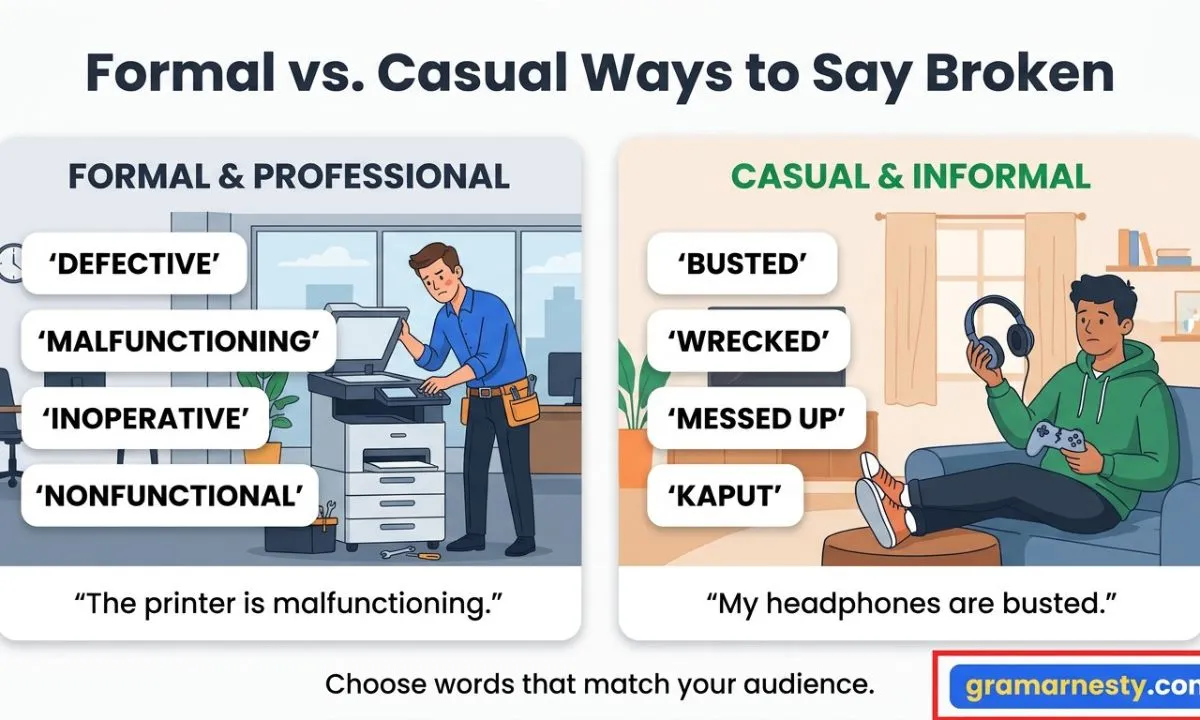
The right word changes with the audience. A repair technician, a friend, and a poet would each pick a different one. Fancy and poetic words are not always right for everyday conversation, so use them when tone matters more than speed.
Formal Ways to Say Broken
Damaged, defective, impaired, inoperative.
Example: “The unit was returned because it was defective.”
Professional Ways to Say Broken at Work
Malfunctioning, nonfunctional, compromised, out of service.
Example: “The scanner is malfunctioning, so we have raised a ticket.”
These sound calmer and more exact than “broken” in an email to a client.
Casual Ways to Say Broken
Busted, wrecked, messed up, toast, kaput. Example: “My headphones are busted again.”
Fancy Words for Broken
Fractured, dilapidated, defunct, irreparable.
Example: “The defunct machine sat in the corner.” Use fancy words for writing, not quick chat.
Stronger and Deeper Words for Broken
Devastated, desolate, shattered, anguished.
Example: “He was devastated when the shop closed.” These words fit strong emotion or heavy damage.
Poetic Words for Broken
Shattered, fractured, fragmented, in ruins.
Example: “A fractured sky of grey clouds.” Poetic words add mood, but they can sound dramatic in plain speech.
Emotionally Broken Synonyms and Words for a Broken Person
Emotional words describe what someone is feeling or going through. They do not describe who the person is. A person is not permanently “broken,” and these words are not medical diagnoses.
Emotionally Broken Synonyms
Devastated, shattered, wounded, distressed, anguished, traumatized, desolate, crushed. Use devastated for sudden, heavy news. Use wounded for hurt caused by another person.
Mentally Broken Synonyms
Overwhelmed, exhausted, distressed, emotionally drained, mentally worn down. These describe stress and tiredness. If you are writing about a real person’s mental health, choose gentle words and avoid labels.
Example: “After months of pressure, she felt mentally worn down.”
Synonyms for a Broken Person
Wounded, hurt, devastated, troubled, emotionally exhausted, disheartened. Often the kindest option is to describe the situation, not the person: “He is going through a hard time.”
Deep Words for Someone Who Is Brokenhearted
Heartbroken, grief-stricken, inconsolable, forlorn, crushed, bereft. Use grief-stricken for death, forlorn for lonely sadness, and bereft for deep loss.
How to Describe Someone Who Feels Broken
- Personal talk: “I know you’re hurting right now. I’m here.”
- Story writing: “She sat in the dark, hollowed out by the news.”
- Emotional writing: “He felt crushed, but not finished.”
Notice that each example describes a moment, not a permanent state.
Also Read This: gramarnesty.com/history-synonyms
Synonyms for a Broken Heart
A broken heart is emotional pain after a loss, a breakup, or a betrayal. Dictionaries list heartbroken and broken-hearted as standard words for this feeling.
Common Words for a Broken Heart
Heartbroken, saddened, hurt, crushed.
Example: “She was heartbroken when the move was cancelled.”
Deep and Emotional Words for Heartbroken
Devastated, grief-stricken, inconsolable, desolate.
Example: “The family was grief-stricken.”
Poetic Alternatives to Brokenhearted
Shattered, forlorn, bereft, in pieces.
Example: “A forlorn letter lay unopened on the desk.”
Examples of Broken Heart Synonyms in Sentences
Heartbroken: “He was heartbroken when the shop closed.”
Shattered: “She felt shattered after the breakup.”
Crushed: “I was crushed by the rejection.”
Devastated: “They were devastated by the loss.”
Grief-stricken: “The grief-stricken town held a vigil.”
Forlorn: “He looked forlorn at the airport.”
Inconsolable: “The child was inconsolable.”
Desolate: “The house felt desolate without her.”
Broken Synonyms Slang: Casual and Gen Z Expressions
Slang is fun, but it changes fast and varies by place. Some words below mean “broken.” Others mean “finished,” “ruined,” or “tired.” The notes explain which is which.
Common Slang Words for Broken
Busted, wrecked, messed up, kaput.
Example: “The projector is busted.”
British Slang for Broken
Knackered: British informal. Usually means exhausted, but can describe worn-out or broken things.
Packed up: a machine that has stopped working.
On the blink: working on and off.
Fooked: vulgar British slang for broken or ruined. It is offensive in many settings, so avoid it in public or professional writing.
Funny Ways to Say Something Is Broken
- “It has gone to the big recycling bin in the sky.”
- “It has officially retired.”
- “It is no longer with us.”
- “It’s having a moment.” (used when something keeps failing)
Gen Z Expressions for Something That Is Not Working
Cooked: finished, in trouble, or exhausted.
Example: “My laptop is cooked.”
Toast: ruined or finished.
Example: “That old charger is toast.”
Bricked: a device that no longer works at all, often after a failed update.
Example: “The update bricked my phone.”
Fried: burned out, for electronics or a tired brain.
These words are informal and can fade quickly.
When Should You Avoid Broken Slang?
Avoid slang in work emails, school essays, customer service replies, and any writing for an unknown audience. Also avoid vulgar words in public. In those places, use faulty, malfunctioning, or damaged.
What Is Another Way to Say “I’m Broke”?
You can say “I’m short on cash,” “Money is tight right now,” or “I’m on a tight budget.” These are polite and clear. Remember that “broke” means having little or no money. It is a different word from “broken.”
Polite Ways to Say “I’m Broke”
- I’m short on cash.
- Money is tight right now.
- I’m on a tight budget.
- I’m running low on funds.
Funny Ways to Say “I’m Broke”
- My wallet is empty.
- My bank account needs a hug.
- I’m broke as a joke.
Casual Ways to Say You Have No Money
- I’m flat broke.
- I’m out of cash.
- I’m tapped out.
- I’m strapped for cash. This one often suggests a temporary shortage.
Professional Ways to Say You Cannot Afford Something
- I can’t afford it at the moment.
- That is outside my budget right now.
- We don’t have the budget for that this quarter.
Gen Z Slang for Having No Money
Many people simply say “I’m broke,” often with humor: “I’m so broke this week.” Fun phrases change quickly, and some slang for money (bread, dough, racks) is older than Gen Z.
British Slang for Being Broke
- Skint: British and Irish informal for having no money. It may not be understood everywhere.
- Boracic: British rhyming-slang term, from “boracic lint.”
- Hard up and stony broke are also common in British English.
Is It Correct to Say “I Am Broke”?
Yes. “I am broke” is correct in informal English and means you have little or no money.
- I am broke: I have little or no money.
- I broke it: I damaged something (simple past).
- I have broken it: present perfect; the damage matters now.
How to Say “I Broke” Without Saying It
Be careful here. “I broke it” means you damaged something. It has nothing to do with money. Softer wording can help, but hiding the truth rarely helps. If you broke something that belongs to someone else, say so clearly and offer to fix or replace it.
Funny Ways to Say “I Broke Something”
- “It did not survive me.”
- “It had a very short career.”
- “I accidentally retired it.”
Casual Alternatives to “I Broke It”
- “I messed it up.”
- “I wrecked it.”
- “It stopped working while I was using it.”
Polite Ways to Admit You Damaged Something
- “I’m sorry, I damaged it. Can I replace it?”
- “It got damaged while I had it, and I’d like to make it right.”
Funny Ways to Say You Have No Money
- “I’m running on loose change and hope.”
- “My savings left without a goodbye.”
- “My budget has left the chat.”
Examples for Text Messages and Social Media
- “Sorry, I broke your mug. I’ll buy you a new one.”
- “Can’t come tonight, I’m broke until payday.”
- “Update: the camera is busted.”
The first line is about damage. The second is about money. The third is about function.
Also Read This: gramarnesty.com/category/synonyms
Broken System Synonyms: Better Words for a Failing System
A “broken system” is often too vague. A precise word shows exactly what is wrong.
Synonyms for a Broken System
Dysfunctional, defective, inefficient, malfunctioning, flawed, disrupted, failing, compromised. Inefficient means it works but wastes time or effort. Dysfunctional means it does not work properly.
Words for a Broken Process or Organization
Inefficient, disorganized, dysfunctional, outdated, ineffective.
Example: “The approval process is inefficient.”
Words for a Broken Network or Technical System
Disrupted, disconnected, down, unavailable, malfunctioning.
Example: “The network is experiencing a disruption.”
Professional Examples of Broken System Alternatives
- The system is dysfunctional.
- The network is experiencing a disruption.
- The process is inefficient.
- The software is malfunctioning.
Broken Synonyms for Different Situations
Different things break in different ways. Pick the word that fits what is broken.
Synonyms for Broken Objects
Damaged, cracked, chipped, dented, smashed.
Example: “The smashed lamp lay on the floor.”
Synonyms for Broken Machines and Electronics
Malfunctioning, faulty, inoperative, out of order, busted.
Example: “The scanner is out of order.”
Synonyms for Broken Glass
Shattered, cracked, smashed, splintered, chipped.
Example: “Shattered glass covered the road.”
Synonyms for Broken Bones
Fractured, cracked, snapped, splintered. Fractured is the usual medical word.
Example: “She fractured her wrist.”
Synonyms for Broken Relationships
Strained, damaged, fractured, estranged, ended.
Example: “Their friendship was fractured by the argument.”
Synonyms for Broken Promises
Breached, unkept, violated, betrayed.
Example: “A breached promise cost him her trust.”
Synonyms for Broken Rules and Agreements
Violated, breached, disregarded, infringed.
Example: “The company breached the agreement.”
Synonyms for Broken Dreams and Plans
Dashed, shattered, thwarted, crushed, in ruins.
Example: “Their plans were shattered by the delay.”
Broken vs. Similar Words: What’s the Difference?
Many of these words overlap, but they are not identical. Here is how they differ.

Broken vs. Damaged
Broken means no longer whole or working. Damaged means harmed, but it may still work. A dented car can be damaged but not broken.
Broken vs. Cracked
Cracked has a split line. Broken may mean fully apart or not working. A cracked screen may still work.
Broken vs. Shattered
Shattered means many small pieces, so it is stronger. A broken plate may be in two parts, while a shattered plate is in many.
Broken vs. Destroyed
Destroyed means it no longer exists as a usable thing. A broken toaster can be fixed. A destroyed toaster cannot.
Broken vs. Defective
Defective means it had a fault from the start. Broken means something went wrong, often later.
Broken vs. Faulty
Faulty means not working properly because of a fault. It is common in British English and in everyday talk about wires and devices.
Broken vs. Fractured
Fractured is the formal word for a break, often in bones or hard materials. Broken is the everyday word.
Broken vs. Ruined
Ruined means spoiled or badly damaged. It does not need to involve pieces. Rain can ruin a picnic, but it cannot break one.
Broken vs. Wrecked
Wrecked means badly damaged, usually in a crash or storm. It is stronger and more dramatic than broken.
Broken vs. Broke
Broken means damaged or not working. Broke is the past tense of break, or an informal word for having no money.
Comparison Table
| Word | Meaning | Severity | Example |
| Broken | Not whole or not working | Medium | “The chair is broken.” |
| Damaged | Harmed but may still work | Low to medium | “The box is damaged.” |
| Cracked | Has a split line | Low to medium | “The cup is cracked.” |
| Shattered | Broken into many pieces | High | “The window shattered.” |
| Destroyed | Gone or unusable | Very high | “Fire destroyed the shop.” |
| Defective | Faulty from the start | Medium | “The charger is defective.” |
| Faulty | Not working because of a fault | Medium | “The wiring is faulty.” |
| Fractured | Broken, often bone | Medium to high | “The bone is fractured.” |
| Ruined | Spoiled badly | High | “The storm ruined the party.” |
| Wrecked | Badly damaged in a crash or storm | High | “The car was wrecked.” |
Stronger and Softer Words for Broken
Match the strength of your word to the size of the problem.
Words for Slightly Damaged Things
Scratched, chipped, dented, worn, scuffed.
Words for Moderately Damaged Things
Damaged, cracked, bent, torn, faulty.
Words for Severely Damaged Things
Shattered, smashed, wrecked, ruined, collapsed.
Words for Completely Destroyed Things
Destroyed, demolished, obliterated, pulverized, in ruins.
Words for Things That Cannot Be Repaired
Irreparable, beyond repair, unfixable, written off. Written off is common in British English for a car or item that is not worth repairing.
Broken Synonyms and Antonyms
An antonym shows what the opposite looks like. It also helps you pick the right synonym.
Common Antonyms of Broken
Fixed, repaired, working, functional, intact, whole, sound, undamaged, restored.
Broken vs. Fixed
Fixed means repaired and working again. “The laptop was broken, but now it’s fixed.”
Broken vs. Intact
Intact means whole and untouched. “The vase arrived intact.”
Broken vs. Functional
Functional means doing its job. “The old radio is still functional.”
Example Sentences Using Broken Antonyms
- The printer is working again.
- All the plates arrived undamaged.
- The bridge was restored last year.
- The system is sound and ready to launch.
Easy Memory Tricks to Remember Broken Synonyms
Cracked vs. Shattered
Think: cracked is a line, shattered is a crowd. One line means cracked. Many pieces means shattered.
Damaged vs. Destroyed
Damage can be repaired. Destroyed is gone.
Defective vs. Faulty
Defectiveness is born that way. Faulty failed in use. Both can describe the same product, so check the context.
Fractured vs. Torn
Fractures are hard, torn are soft. Bones fracture, and paper tears.
Broken vs. Irreparable
Broken may be fixable. Irreparable means no hope of repair.
Broken vs. Broke
“Broke” is the short word, like a wallet with little in it. “Broken” is the longer word, for things in pieces. Use broke for money and broken for objects.
Common Mistakes When Using Broken Synonyms
Using Cracked and Shattered Interchangeably
Wrong: “The phone shattered a little.”
Better: “The phone screen cracked.”
Use shattered only for many pieces.
Using Destroyed for Minor Damage
Wrong: “The cup is destroyed” (for a small chip).
Better: “The cup is chipped.”
Confusing Defective With Physically Damaged
Wrong: “The phone fell, so it is defective.”
Better: “The phone fell, so it is damaged.” Defective points to a fault in how it was made.
Using Fractured for Flexible Materials
Wrong: “The fabric was fractured.”
Better: “The fabric was torn.”
Confusing Broken and Broke
Wrong: “I’m broken, so I can’t pay.”
Better: “I’m broke, so I can’t pay.”
Using Emotional Words for Physical Objects
Wrong: “The table was heartbroken.”
Better: “The table was damaged.” Keep words like heartbroken and devastated for people and feelings.
Using Slang in Formal Writing
Wrong: “The server is toast” (in a client report).
Better: “The server is not functioning.”
Also Read This: gramarnesty.com/share-synonyms
What Major Dictionaries Say About Broken
These are summaries in plain words, not quotations. Dictionary entries change, so check the live pages if you need exact wording.
Cambridge Dictionary
Editor note: I could not open the Cambridge Dictionary page for “broken” while researching this article. Please check the live entry at dictionary.cambridge.org and add a one-sentence summary here before publishing.
Merriam-Webster
Merriam-Webster lists several senses, including violently separated into parts, damaged, rough or uneven, having gaps, not kept (as a promise), subdued completely, imperfectly spoken, and having undergone fracture. This covers the physical, emotional, and figurative uses.
Oxford Languages
Oxford Learner’s Dictionaries gives the main sense as damaged or injured and no longer whole or working correctly. It also lists senses such as an ended marriage or engagement and interrupted or disturbed things, like broken sleep.
Collins Dictionary
Collins-based entries, as shown on Dictionary.com, include reduced to fragments, not functioning, and spoiled by divorce, as in a broken home. Its thesaurus entries link broken with failed and ruined.
Across these sources, the physical and functional senses come first. The emotional, relational, and figurative senses are widely recorded as separate uses.
Final Thoughts
The best broken synonyms depend on what has gone wrong. Use damaged, cracked, or shattered for objects. Use malfunctioning, defective, or inoperative for machines and systems. Use heartbroken or devastated for deep sadness, and keep those words for feelings, not for labeling a person. If you mean you have no money, say broke or a gentler phrase like “money is tight.”
Before you choose, check the meaning, the tone, and the reader. A single well-chosen word beats a long list of near matches.
What Is a Better Word for Break?
It depends on the action. Use damage in general, crack for a split, shatter for many pieces, fracture for bones, and smash for a hard impact.
How Do You Say “Broken” in Different Ways?
Use damaged, cracked, shattered, faulty, defective, or busted. Pick the one that matches what is wrong and who will read it.
What Is a Deeper Word for “Broken”?
For feelings, use devastated, shattered, anguished, or desolate. For objects, use destroyed or obliterated.
What Is a Fancy Word for “Broke”?
Impecunious is a formal and literary word for having little money. Penniless and destitute are also formal, while insolvent is a financial or legal term for being unable to pay debts.
What Is a Poetic Word for “Broken”?
Shattered, fractured, fragmented, and in ruins all have a poetic feel. Use them in stories, songs, and reflective writing.
How Do You Say “Broke” in a Nice Way?
Say “I’m short on cash” or “Money is tight right now.” “I’m on a tight budget” also sounds polite and calm.
How Do You Say “Broke” in British Slang?
Skint is the most common British slang. You may also hear boracic, hard up, and stony broke.
How Do You Say “I Broke” in a Funny Way?
Try “It did not survive me” or “I accidentally retired it.” Add a sincere offer to fix it if it belongs to someone else.
How Do I Say “I Broke” Without Saying It?
Say “It got damaged” or “It stopped working while I was using it.” Be clear about what happened, since vague wording can sound like you are avoiding responsibility.
What Is Gen Z Slang for Money?
Common slang includes bread, dough, racks, and bands. Slang changes quickly, and some of these terms are older than Gen Z.
Is It Correct to Say “I Am Broke”?
Yes, in informal English. It means you have little or no money, and it is not the same as “I am broken.”
What’s Another Way to Say “I’m Broke”?
Try “I’m short on cash,” “I’m running low on funds,” or “I’m on a tight budget.” For casual talk, “I’m flat broke” works.
What Are Some Mentally Broken Synonyms?
Use overwhelmed, exhausted, drained, or mentally worn down. These describe stress, not a medical condition, so choose them with care.
What Are Some Emotionally Broken Synonyms?
Devastated, crushed, wounded, shattered, and anguished all work. They describe how someone feels in a moment.
What Are Synonyms for a Broken Person?
Wounded, hurt, troubled, disheartened, and emotionally exhausted are gentler options. It is often kinder to say “going through a hard time.”
What Are Some Synonyms for a Broken Heart?
Heartbroken, crushed, devastated, and grief-stricken are common. For a poetic touch, try shattered or forlorn.
What Are Deep Words for Brokenhearted?
Grief-stricken, inconsolable, bereft, and forlorn carry deeper sorrow. Use them for serious loss.
What Is Another Word for a Broken System?
Dysfunctional is the most common choice. Flawed, failing, inefficient, and malfunctioning describe different kinds of problems.
What Are the Antonyms of Broken?
Fixed, repaired, working, functional, intact, whole, sound, undamaged, and restored are all opposites. Choose by context.

1 thought on “70+ Broken Synonyms: Better Words for Damaged, Heartbroken, and Broke”