

⚡ The Best Especially Synonyms at a Glance
Purpose: 70 alternatives to “especially,” each with a meaning, an example sentence, and a usage tip.
Seven categories: formal, strong emphasis, priority, casual, literary, purpose-related, and positive tone.
Best default: particularly. For an example use notably, for priority use above all, for degree use exceptionally.
Formal vs. casual: chiefly, principally, and markedly suit formal writing. Really, mainly, and super suit speech and captions.
Not every word swaps cleanly. Specially, exclusively, deliberately, and essentially change the meaning.
This guide gives you 70 alternatives to the adverb “especially,” grouped by meaning and tone for essays, emails, and everyday writing. Each one comes with a short meaning, an example sentence, and a usage tip. Especially synonyms replace “especially” only some of the time, so the labels tell you which swaps are safe.
Here’s the catch. “Especially” does two jobs.
It points to a standout case (“I love fruit, especially mangoes”) and it raises the degree (“especially sweet”). Plenty of alternatives do only one of those.
A few change the meaning entirely.
So read the labels. Every usage tip starts by telling you whether the word is a direct swap, context-dependent, or changes the meaning, plus its tone.
⚡ Quick Answer: What Is the Best Synonym for Especially?
The best all-purpose synonym for especially is particularly. It singles out a case or raises the degree, just like especially, and it suits both formal and casual writing. After that, choose by sentence: notably for a standout example, chiefly for the main cause, exceptionally for degree.
- Pack warm layers, particularly if you’re hiking in October.
- Sales rose in every region, notably in the south.
📘 What Does “Especially” Mean?
🟣 Especially Meaning in Simple English
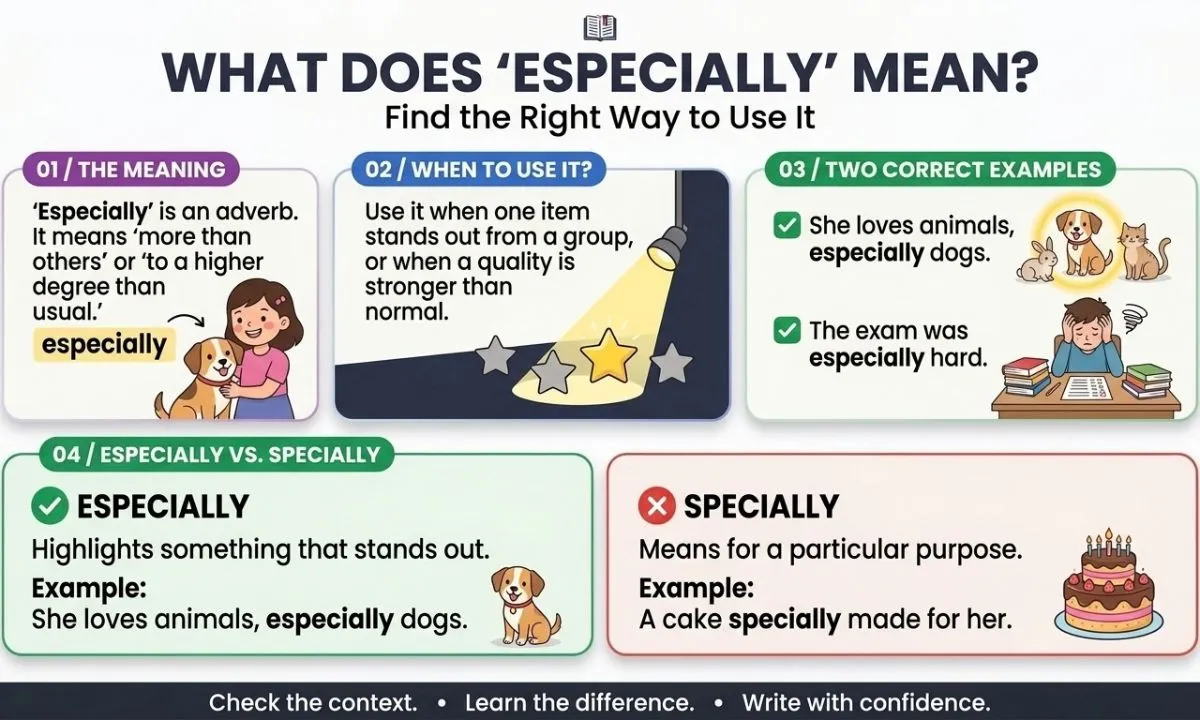
Especially as an adverb. It means “more than others” or “to a higher degree than usual.”
🟢 Highlighting: She loves animals, especially dogs.
🟢 Raising degree: The exam was especially hard.
🟣 When Should You Use “Especially”?
Use it when one item stands out from a group, or when a quality is stronger than normal. Don’t use it to mean “for a particular purpose.” That’s the job of specially, as in “a cake specially made for her.”
📊 Best Synonyms for Especially at a Glance
These twelve cover most situations. They are not identical in meaning, so check the “main function” column.
| Synonym | Main function | Best context | Example |
| particularly | Singles out a case or raises degree | General, neutral | Traffic is bad, particularly downtown. |
| in particular | Points to one item after a general term | Neutral writing | Check the budget, in particular travel costs. |
| notably | Flags an example worth noticing | Reports, essays | Several teams improved, notably sales. |
| chiefly | Names the main cause or part | Formal | The delay was chiefly a staffing issue. |
| primarily | Says “first and mostly” | Business, formal | Editors use the tool primarily. |
| mainly | Says “for the most part” | Everyday | I read mainly at night. |
| above all | Ranks one point first | Advice, persuasion | Be accurate, above all. |
| exceptionally | Raises degree sharply | Neutral to formal | An exceptionally clear answer. |
| markedly | Shows a noticeable change | Academic | Scores rose markedly. |
| really | Casual intensifier | Speech, texts | The soup is really good. |
| super | Informal intensifier | Social media | The view was super nice. |
| most of all | Names the strongest feeling | Conversation | I’ll miss the food most of all. |
🟣 Most Common Synonyms for Especially
Particularly, in particular, notably, mainly, and primarily appear in most dictionary and thesaurus entries and work in everyday writing.
🟣 Formal Synonyms for Especially
Notably, chiefly, principally, markedly, and with particular emphasis suit reports, essays, and policy writing.
🟣 Casual Alternatives to Especially
Really, mainly, mostly, extra, and most of all sound natural in speech. Super and big time are informal or slang.
🟣 Stronger Alternatives for Emphasis
Above all, first and foremost, extraordinarily, and supremely push harder than especially. Use them when you mean it.
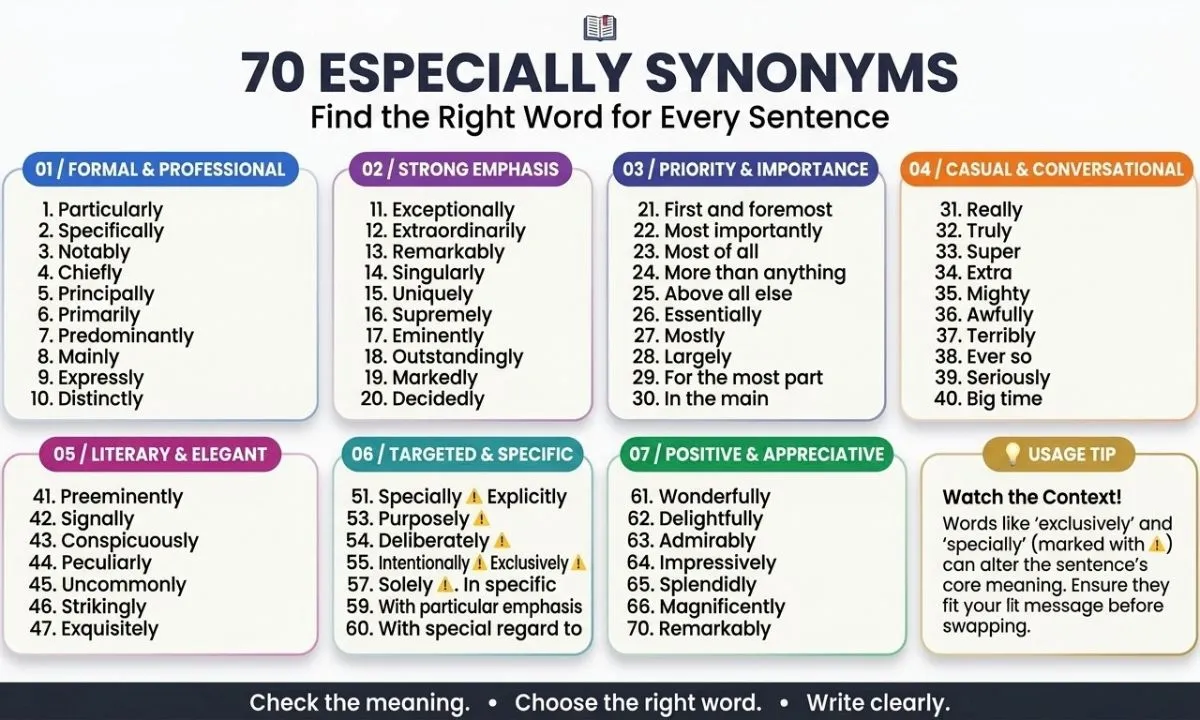
70 Especially Synonyms, Grouped by Meaning and Tone
Category 1: Formal / Professional
🔹 1. Particularly
🧠 Meaning
It means “more than others” or “to a high degree,” which is the same job as especially.
📝 Example
Sleep matters, particularly during exam week.
💡 Usage Tip:
Direct swap, neutral to formal. It’s the safest default. It also works before adjectives: particularly useful.
🔹 2. Specifically
🧠 Meaning
It means “in a precise, named way.” It narrows to an exact target instead of showing a standout case.
📝 Example
The memo applies specifically to new hires.
💡 Usage Tip:
Context-dependent, formal. “I like hiking, specifically in winter” suggests winter only. “Especially in winter” says winter is the best case among several.
🔹 3. Notably
🧠 Meaning
It means “in a way worth noticing,” so it marks an example as significant.
📝 Example
Several students improved, notably those who attended tutoring.
💡 Usage Tip:
Direct swap when introducing an example, formal. Before adjectives (notably cold) it reads closer to “remarkably.”
🔹 4. Chiefly
🧠 Meaning
It means “mainly” and names the biggest part or cause.
📝 Example
The delay was caused chiefly by bad weather.
💡 Usage Tip:
Context-dependent, formal. It says “main,” not “most striking,” so it can’t intensify adjectives. You can’t write “chiefly cold.”
🔹 5. Principally
🧠 Meaning
It means “in the first place” or “mostly.”
📝 Example
The fund serves principally rural clinics.
💡 Usage Tip:
Context-dependent, formal and a bit stiff. Good in reports. It sounds odd in casual speech.
🔹 6. Primarily
🧠 Meaning
It means “first and mostly,” describing the main purpose or group.
📝 Example
The course is aimed primarily at beginners.
💡 Usage Tip:
Context-dependent, neutral to formal. Especially says “this one stands out.” Primarily says “this is mostly what it is.”
🔹 7. Predominantly
🧠 Meaning
It means “for the most part,” usually in number or amount.
📝 Example
The audience was predominantly under thirty.
💡 Usage Tip:
Context-dependent, formal. Use it to describe makeup or proportion. It doesn’t add emphasis.
🔹 8. Mainly
🧠 Meaning
It means “most often” or “in the largest part.”
📝 Example
I use the app mainly for travel notes.
💡 Usage Tip:
Context-dependent, neutral. Fine when you mean “mostly.” Wrong when you mean “even more than usual.”
🔹 9. Expressly
🧠 Meaning
It means “clearly and on purpose,” often “for a stated purpose.”
📝 Example
The contract expressly forbids subletting.
💡 Usage Tip:
Context-dependent, formal or legal. It matches especially only in the “for a purpose” sense (“built expressly for beginners”).
🔹 10. Distinctly
🧠 Meaning
It means “clearly” or “noticeably.”
📝 Example
The second draft felt distinctly stronger.
💡 Usage Tip:
Context-dependent, neutral to formal. It replaces especially only before adjectives. It can’t introduce an example.
🔹 11. In Particular
🧠 Meaning
It’s a phrase that points to one item inside a larger group.
📝 Example
Check the exits, in particular the one by the stairs.
💡 Usage Tip:
Direct swap for pointing, neutral. Put it after the general term. It doesn’t go before adjectives: “in particular cold” is wrong.
🔹 12. Above All
🧠 Meaning
It means “more than anything else,” ranking one point at the top.
📝 Example
Keep the design simple and, above all, readable.
💡 Usage Tip:
Context-dependent, neutral to formal. It’s stronger than especially. Use it only for the true top priority.
🎨 Category 2: Strong Emphasis / Intensity
🔹 13. Exceptionally
🧠 Meaning
It means “to an unusual degree.”
📝 Example
The weather was exceptionally warm for March.
💡 Usage Tip:
Degree only, neutral to formal. It replaces especially before adjectives but can’t introduce an example. “I like fruit, exceptionally mangoes” is wrong.
🔹 14. Extraordinarily
🧠 Meaning
It means “far beyond ordinary,” a very high degree.
📝 Example
The lab’s results were extraordinarily consistent.
💡 Usage Tip:
Degree only, stronger than especially. Overuse feels inflated.
🔹 15. Remarkably
🧠 Meaning
It means “in a way that deserves comment,” usually with a hint of surprise.
📝 Example
The tiny team shipped remarkably fast.
💡 Usage Tip:
Degree only, neutral. Skip it if nothing is surprising.
🔹 16. Singularly
🧠 Meaning
It means “to a unique or striking degree.”
📝 Example
She was singularly unimpressed by the offer.
💡 Usage Tip:
Degree only, formal and slightly literary. It often pairs with words like unimpressed or gifted.
🔹 17. Uniquely
🧠 Meaning
It means “in a way that applies to only one thing.”
📝 Example
The app is uniquely suited to small teams.
💡 Usage Tip:
Changes the meaning. “Uniquely suited” claims nobody else fits. “Especially suited” only says it fits very well.
🔹 18. Supremely
🧠 Meaning
It means “to the highest degree.”
📝 Example
He was supremely confident before the final.
💡 Usage Tip:
Degree only, formal or literary. Save it for top-end qualities.
🔹 19. Eminently
🧠 Meaning
It means “to a notable degree,” almost always with positive qualities.
📝 Example
The plan is eminently reasonable.
💡 Usage Tip:
Degree only, formal. It goes with words like reasonable, qualified, and suitable. It sounds strange with negatives.
🔹 20. Outstandingly
🧠 Meaning
It means “in a way that stands out above the rest.”
📝 Example
The team performed outstandingly well.
💡 Usage Tip:
Degree only, positive, neutral to formal. It usually pairs with well, good, or successful.
🔹 21. Markedly
🧠 Meaning
It means “noticeably,” often when comparing two states.
📝 Example
Sales were markedly higher in June.
💡 Usage Tip:
Degree only, formal. It’s best with comparisons. Dictionary.com lists markedly inside its definition of especially.
🔹 22. Decidedly
🧠 Meaning
It means “definitely” or “without doubt.”
📝 Example
The new layout is decidedly better.
💡 Usage Tip:
Degree only, formal. It adds certainty and works well with comparatives.
🔹 23. Immensely
🧠 Meaning
It means “hugely” or “to a very great extent.”
📝 Example
We were immensely grateful.
💡 Usage Tip:
Degree only, neutral. It adds size, not focus. It works with feelings and verbs: immensely enjoyed.
🔹 24. Profoundly
🧠 Meaning
It means “deeply,” usually about serious or emotional impact.
📝 Example
The ruling profoundly affected small farms.
💡 Usage Tip:
Degree only, formal or literary. Keep it for weighty topics. “Profoundly tasty” is a joke.
🎨 Category 3: Priority / Importance
🔹 25. First and Foremost
🧠 Meaning
It means “before anything else.”
📝 Example
First and foremost, check your sources.
💡 Usage Tip:
Context-dependent, neutral to formal. It ranks priorities rather than highlighting a case. It’s a sentence opener, not an adjective modifier.
🔹 26. Most Importantly
🧠 Meaning
It introduces the point that matters most.
📝 Example
Most importantly, save your draft.
💡 Usage Tip:
Context-dependent, neutral. It opens a sentence where a bare “Especially,” usually can’t.
🔹 27. Most of All
🧠 Meaning
It means “more than anything else.”
📝 Example
She misses her friends most of all.
💡 Usage Tip:
Context-dependent, conversational to neutral. It goes at the end of a clause and shows the strongest feeling or preference.
🔹 28. More Than Anything
🧠 Meaning
It means “to a greater extent than anything else,” usually about wants and feelings.
📝 Example
More than anything, he wanted to go home.
💡 Usage Tip:
Context-dependent, casual and emotional. It’s too informal for reports.
🔹 29. Above All Else
🧠 Meaning
It’s a heavier version of above all.
📝 Example
Above all else, protect patient privacy.
💡 Usage Tip:
Context-dependent, formal and emphatic. Best for rules and principles. It sounds heavy in light contexts.
🔹 30. Essentially
🧠 Meaning
It means “at its core” or “basically.”
📝 Example
The two proposals are essentially the same.
💡 Usage Tip:
Changes the meaning. Essentially simplifies. It doesn’t emphasize. Don’t swap it in for especially.
🔹 31. Mostly
🧠 Meaning
It means “for the most part” or “usually.”
📝 Example
The guests were mostly family.
💡 Usage Tip:
Context-dependent, casual to neutral. It describes proportion, not standout quality.
🔹 32. Largely
🧠 Meaning
It means “to a great extent.”
📝 Example
The error was largely due to poor labeling.
💡 Usage Tip:
Context-dependent, formal. It suits causes and proportions.
🔹 33. For the Most Part
🧠 Meaning
It means “in most cases” or “in general.”
📝 Example
For the most part, the trip went smoothly.
💡 Usage Tip:
Context-dependent, neutral. It makes a general claim and leaves room for exceptions. That’s the opposite of highlighting one.
🔹 34. In the Main
🧠 Meaning
It means “on the whole” or “chiefly.”
📝 Example
The reviews were, in the main, positive.
💡 Usage Tip:
Context-dependent, formal and slightly dated. Set it off with commas. It’s rare in casual speech.
🎨 Category 4: Casual / Conversational
🔹 35. Really
🧠 Meaning
It means “to a high degree,” as an everyday intensifier.
📝 Example
The movie was really funny.
💡 Usage Tip:
Degree only, casual. It can’t introduce an example. Keep it out of formal writing.
🔹 36. Truly
🧠 Meaning
It means “genuinely,” adding sincerity to a strong quality.
📝 Example
It was a truly memorable night.
💡 Usage Tip:
Degree only, neutral and warm. Common in thank-yous and reviews.
🔹 37. Super
🧠 Meaning
It’s an informal way to say “very.”
📝 Example
This pizza is super good.
💡 Usage Tip:
Degree only, casual. Fine in texts and captions. Replace it in essays.
🔹 38. Extra
🧠 Meaning
It means “more than usual” before an adjective.
📝 Example
Be extra careful on the stairs.
💡 Usage Tip:
Degree only, informal. It’s common with careful, cute, and cheesy. It can’t point to an example.
🔹 39. Mighty
🧠 Meaning
It means “very,” in a folksy, regional way.
📝 Example
That’s a mighty fine idea.
💡 Usage Tip:
Degree only, informal and old-fashioned. It adds voice to dialogue. Avoid it in formal work.
🔹 40. Awfully
🧠 Meaning
It means “very,” without the “terrible” sense.
📝 Example
You’re awfully kind to help.
💡 Usage Tip:
Degree only, casual and polite. Context matters, since “awfully” can also mean “badly.”
🔹 41. Terribly
🧠 Meaning
It means “extremely” in informal speech.
📝 Example
I’m terribly sorry about the delay.
💡 Usage Tip:
Degree only, polite casual. It’s common with sorry, sad, and important.
🔹 42. Ever So
🧠 Meaning
It means “very,” in a British, chatty way.
📝 Example
She was ever so helpful.
💡 Usage Tip:
Degree only, casual and British. Many American readers will find it unfamiliar.
🔹 43. Seriously
🧠 Meaning
It means “in a real and significant way,” used as an informal intensifier.
📝 Example
The sauce is seriously spicy.
💡 Usage Tip:
Degree only, casual. Good for bold claims in speech and social posts. Not for essays.
🔹 44. Big Time
🧠 Meaning
It’s slang for “to a great degree.”
📝 Example
We messed up big time.
💡 Usage Tip:
Slang, casual. It follows a verb phrase. Avoid it in formal writing.
🎨 Category 5: Literary / Elegant
🔹 45. Preeminently
🧠 Meaning
It means “above all others,” holding the highest rank.
📝 Example
The city is preeminently a center of trade.
💡 Usage Tip:
Context-dependent, formal and literary. It names the foremost quality. Rare, so keep the sentence simple around it.
🔹 46. Signally
🧠 Meaning
It means “notably” or “in a striking way.” The word is rare.
📝 Example
The committee signally failed to explain the delay.
💡 Usage Tip:
Context-dependent, literary. Dictionary.com lists it as a synonym. Many readers won’t know it, so use it sparingly.
🔹 47. Conspicuously
🧠 Meaning
It means “in an easily noticed way.”
📝 Example
He was conspicuously absent from the meeting.
💡 Usage Tip:
Context-dependent, formal. It leans toward things that are obvious, often negative or ironic: conspicuously absent.
🔹 48. Peculiarly
🧠 Meaning
It can mean “especially” or “particular to,” but it also means “strangely.”
📝 Example
The soil is peculiarly suited to grapes.
💡 Usage Tip:
Context-dependent and ambiguous, formal. “Peculiarly shaped” means oddly shaped. Use it only when the “particular to” sense is clear.
🔹 49. Uncommonly
🧠 Meaning
It means “unusually.”
📝 Example
The winter was uncommonly mild.
💡 Usage Tip:
Degree only, formal and slightly literary. It works before adjectives.
🔹 50. Strikingly
🧠 Meaning
It means “in a way that catches attention.”
📝 Example
The two photos are strikingly similar.
💡 Usage Tip:
Degree only, neutral. Good for noticeable qualities in descriptive or academic prose.
🔹 51. Exquisitely
🧠 Meaning
It means “in a delicate, finely made way.”
📝 Example
The cake was exquisitely decorated.
💡 Usage Tip:
Context-dependent, literary and positive. It suits beauty and craft. It isn’t a neutral swap.
🔹 52. Superlatively
🧠 Meaning
It means “to the highest degree,” usually about excellence.
📝 Example
The violinist played superlatively well.
💡 Usage Tip:
Degree only, formal and rare. It’s grand for ordinary situations.
🎨 Category 6: Specific Purpose / Targeted
🔹 53. Specially
🧠 Meaning
It means “for a particular purpose” or “in a special way.”
📝 Example
The cake was specially baked for her birthday.
💡 Usage Tip:
Changes the meaning. Oxford Learner’s Dictionaries says specially usually means “for a particular purpose.” In informal speech it overlaps especially, but in formal writing keep them apart.
🔹 54. Explicitly
🧠 Meaning
It means “clearly and in detail, leaving no doubt.”
📝 Example
The rules explicitly ban food in the lab.
💡 Usage Tip:
Changes the meaning. It stresses clear statements, not importance. Formal.
🔹 55. Purposely
🧠 Meaning
It means “on purpose.”
📝 Example
He purposely left early to avoid traffic.
💡 Usage Tip:
Changes the meaning. It overlaps with especially only in the “for a purpose” sense: “I came especially to see you.”
🔹 56. Deliberately
🧠 Meaning
It means “consciously and with care.”
📝 Example
She deliberately chose a quiet seat.
💡 Usage Tip:
Changes the meaning. It adds planning. Neutral to formal.
🔹 57. Intentionally
🧠 Meaning
It means “on purpose, not by accident.”
📝 Example
The font is intentionally plain.
💡 Usage Tip:
Changes the meaning. Use it when you want to say something was planned. Neutral to formal.
🔹 58. Exclusively
🧠 Meaning
It means “only,” leaving everything else out.
📝 Example
The lounge is for members exclusively.
💡 Usage Tip:
Changes the meaning. “I read mysteries, especially British ones” still allows other mysteries. “Exclusively British ones” doesn’t.
🔹 59. Solely
🧠 Meaning
It means “only” or “entirely.”
📝 Example
The decision rests solely with the board.
💡 Usage Tip:
Changes the meaning. Same trap as exclusively. Formal.
🔹 60. In Specific
🧠 Meaning
It’s a spoken, informal phrase meant to point at one thing.
📝 Example
I’m looking for one specific book in specific, the red one.
💡 Usage Tip:
Context-dependent, informal. It’s rare in edited writing. Choose in particular or specifically instead.
🔹 61. With Particular Emphasis
🧠 Meaning
It means “giving extra focus to.”
📝 Example
The course covers grammar, with particular emphasis on punctuation.
💡 Usage Tip:
Context-dependent, formal. It follows a noun phrase. Good in syllabi and reports. It’s heavy on speech.
🔹 62. With Special Regard To
🧠 Meaning
It means “paying special attention to.”
📝 Example
The policy was written with special regard to part-time staff.
💡 Usage Tip:
Context-dependent, formal and stiff. It suits policy writing and doesn’t work before adjectives.
🎨 Category 7: Positive / Appreciative Tone
🔹 63. Wonderfully
🧠 Meaning
It means “in a delightful way” or “to a pleasing degree.”
📝 Example
The room was wonderfully quiet.
💡 Usage Tip:
Degree only, positive. It carries approval, so it’s not neutral. You can’t say “wonderfully dangerous.”
🔹 64. Delightfully
🧠 Meaning
It means “in a charming, pleasing way.”
📝 Example
The garden was delightfully overgrown.
💡 Usage Tip:
Degree only, positive, literary casual. The thing described must feel pleasing.
🔹 65. Admirably
🧠 Meaning
It means “in a way worthy of respect.”
📝 Example
He stayed admirably calm.
💡 Usage Tip:
Degree only, positive, neutral to formal. It adds praise, so don’t use it for neutral facts.
🔹 66. Impressively
🧠 Meaning
It means “in a way that earns admiration.”
📝 Example
The new battery lasts impressively long.
💡 Usage Tip:
Degree only, positive, neutral. Great for reviews and reports. It doesn’t fit negatives.
🔹 67. Splendidly
🧠 Meaning
It means “in an excellent or magnificent way.”
📝 Example
The team played splendidly.
💡 Usage Tip:
Degree only, positive, slightly old-fashioned. Common with performance verbs.
🔹 68. Magnificently
🧠 Meaning
It means “in a grand, impressive way.”
📝 Example
The orchestra played magnificently.
💡 Usage Tip:
Degree only, strongly positive. It’s too big for small things.
🔹 69. Brilliantly
🧠 Meaning
It means “in a very clever or excellent way.”
📝 Example
She argued the case brilliantly.
💡 Usage Tip:
Degree only, positive, neutral to casual. It describes manners more than degree. Brilliantly simple works, brilliantly average is a joke.
🔹 70. Gloriously
🧠 Meaning
It means “in a magnificent way,” often with vivid, sensory images.
📝 Example
The morning was gloriously sunny.
💡 Usage Tip:
Degree only, literary and positive. Best in descriptive or creative writing. It’s too florid for reports.
📘 Especially vs. Similar Words
Especially vs. Particularly
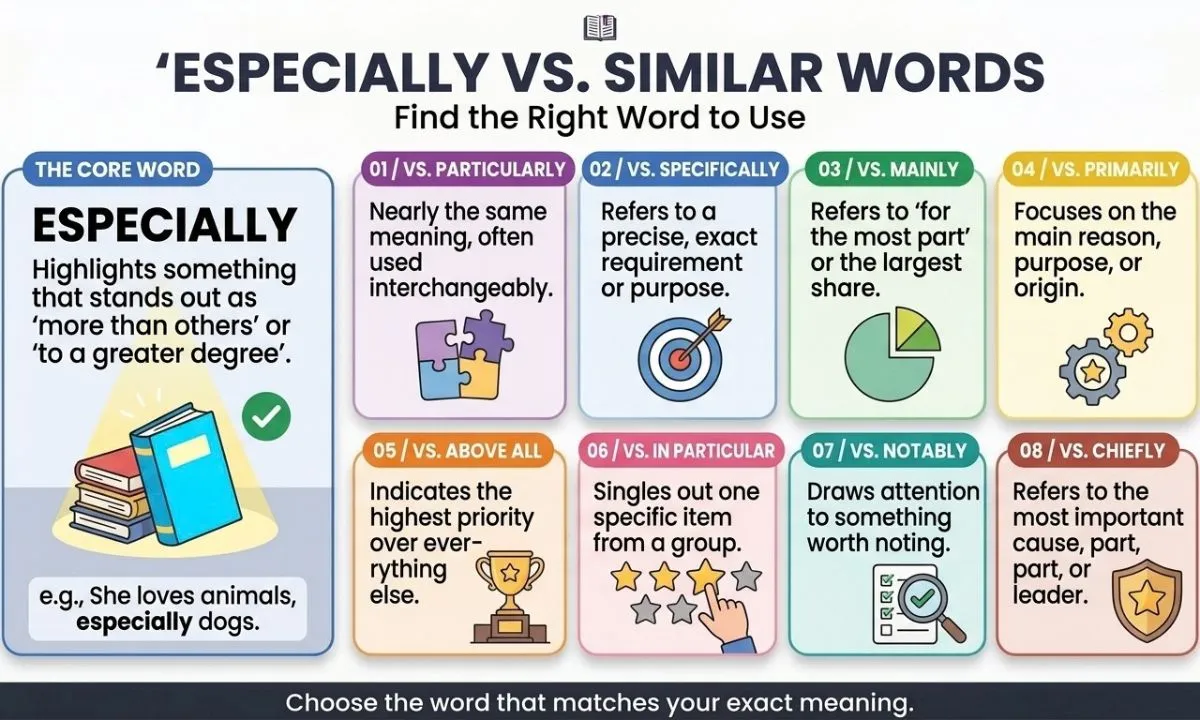
They’re nearly identical in meaning. I enjoy podcasts, especially true-crime ones.
Especially vs. Specifically
It especially shows a standout. Specifically names exactly what you mean. “Bring snacks, especially fruit” suggests fruit is best. “Bring snacks, specifically fruit” says fruit is what’s needed.
Especially vs. Mainly
Mainly describes the largest share. Especially describing what stands out. “The audience was mainly students” gives a proportion. “I loved the music, especially the drums” gives a favorite.
Especially vs. Primarily
Primarily is more formal. It says what something mostly is or is mostly for.
Especially vs. Particularly vs. Specifically
- The roads are icy, especially at night. (night is the worst case)
- The roads are icy, particularly at night. (same meaning)
- The roads are icy, specifically at night. (only at night)
Especially vs. Above All
Above all ranks a point as number one. Especially only singles it out.
Especially vs. In Particular
In particular follows the noun or clause it points at. Especially can also come before an adjective: especially useful, but not “in particular useful.”
Especially vs. Notably
Notably adds “and this is worth noticing.” Especially only adds “more than the rest.”
Especially vs. Chiefly
Chiefly names the main cause or part. Especially names of the standout.
When Should You Use Each Word?
| Word | Use it when | Example |
| especially | One case stands out, or the degree is high | Dogs are great, especially puppies. |
| particularly | Same job, slightly more formal | Costs rose, particularly rent. |
| specifically | You mean “precisely” | Call me, specifically about the invoice. |
| mainly | You describe the largest share | The team is mainly remote. |
| primarily | You describe the main purpose | It’s used primarily by nurses. |
| above all | One point outranks the rest | Above all, stay safe. |
| in particular | You point to one item after a group | Read chapter three in particular. |
| notably | The example deserves attention | Many wins, notably in Asia. |
| chiefly | You name the main cause or part | It failed chiefly for cost reasons. |
📘 Especially Synonyms for Different Writing Purposes
🟣 Especially Synonyms for Essays
Use notably to bring in evidence and above all to land your strongest claim. The novel explores memory, notably through its unreliable narrator.
🟣 Especially Synonyms for Research Papers
Be precise: markedly, particularly, and predominantly describe data. Symptoms were markedly reduced in the treatment group.
🟣 Especially Synonyms for Business Emails
Short and polite wins. We’d appreciate your feedback, in particular on pricing.
🟣 Especially Synonyms for Reports and Presentations
Primarily, notably, and above all make bullet points sharper. Growth came primarily from renewals.
🟣 Especially Synonyms for Social Media Captions
So, really, super, and most of all feel natural here. Rainy Sundays, with a book, most of all.
🟣 Especially Synonyms for Creative Writing
Strikingly, gloriously, and exquisitely add texture. The valley was gloriously green after the storm.
📘 Especially Synonyms in Sentences
🟣Everyday Examples Using Especially Synonyms
- I love breakfast, particularly pancakes.
- The kids were really tired after the trip.
- We’ll miss the beach most of all.
🟣Formal Sentence Examples
- The proposal is primarily a cost-saving measure.
- Several clauses are unclear, notably the second.
- The data were markedly different across regions.
🟣Academic Sentence Examples
- Participation rose, in particular among first-year students.
- The effect was predominantly visible in older samples.
- The theory is eminently testable.
🟣Professional Email Examples
- Thanks for your work this quarter, notably on the launch.
- Please confirm the dates, in particular for the Berlin event.
- I’d particularly welcome your view on timing.
🟣Before-and-After Examples: Replacing Especially
- 🔴 Before: The lecture was especially helpful.
- 🟢After: The lecture was exceptionally helpful.
- 🔴 Before: I love dessert, especially chocolate.
- 🟢After: I love dessert, in particular chocolate.
- 🔴 Before: Be especially careful here.
- 🟢After: Above all, be careful here.
- 🔴 Before: Mornings are busy, especially Mondays.
- 🟢After: Mornings are busy, notably Mondays.
🟣Examples of Especially at the Beginning of a Sentence
Cambridge’s dictionary blog and Oxford Learner’s Dictionaries both steer writers away from opening a sentence with a bare “Especially.” It does show up as a clause opener or a deliberate fragment: Especially when it rains. In formal writing, use an opener built for the job.
- Above all, keep the instructions short.
- Most importantly, check the dates.
- Notably, two schools reported higher scores.
- In particular, review the final section.
🟣Examples of Especially in the Middle of a Sentence
It was an especially cold morning.
I especially liked the final chapter.
The roads are icy, especially at night.
Prices, especially in big cities, keep climbing.
📘 Common Mistakes When Using Especially Synonyms
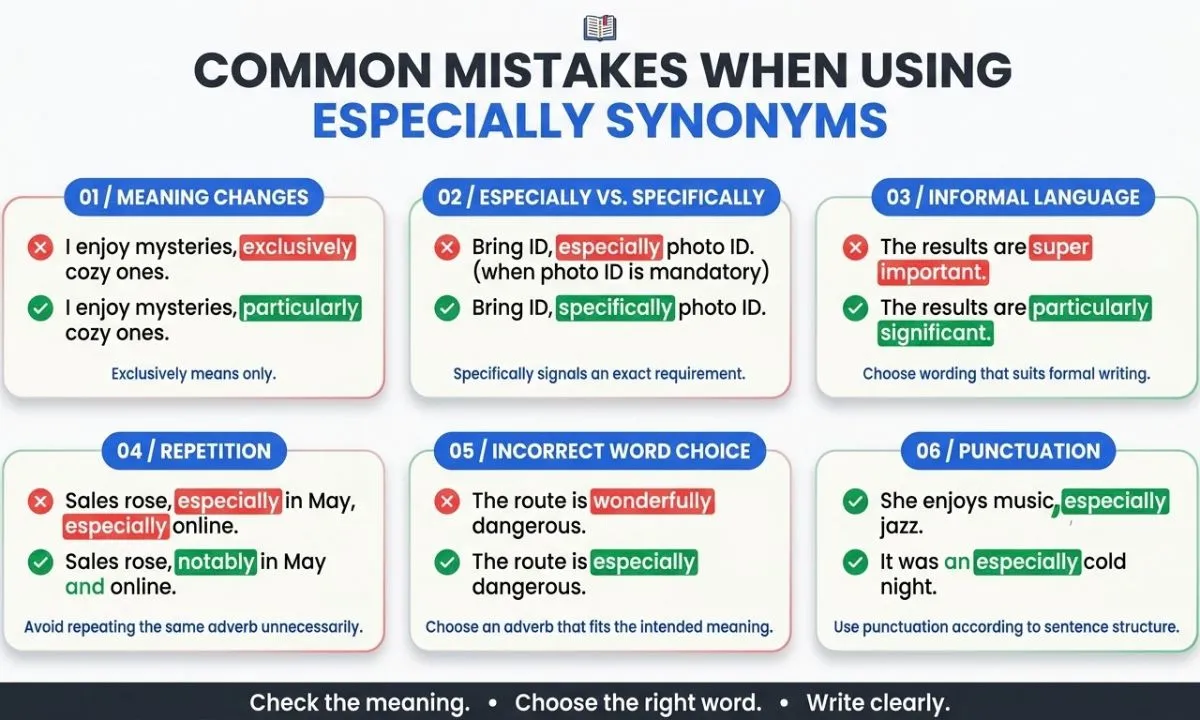
🟣 Using a Synonym That Changes the Meaning
🔴 ❌ Wrong: I enjoy mysteries, exclusively cozy ones. That says you enjoy only cozy ones.
Right: I enjoy mysteries, particularly cozy ones.
🟣 Confusing Especially With Specifically
“Please bring ID, especially photo ID” suggests photo ID is the best kind. “Please bring ID, specifically photo ID” says photo ID is required. Pick the one you mean.
🟣 Using Informal Words in Formal Writing
❌ Wrong: The results are super important.
Right: The results are particularly significant.
🟣 Repeating Especially Too Often
🔴 ❌ Wrong: Sales rose, especially in May, especially among retail clients, especially online.
Right: Sales rose, notably in May and among online retail clients.
🟣 Choosing a Word That Does Not Fit the Sentence
🔴 ❌ Wrong: The route is wonderfully dangerous.
Right: The route is especially dangerous. Positive adverbs only fit positive things.
🟣 Incorrect Punctuation With Especially
Use a comma before especially when it adds an example: She enjoys music, especially jazz. Skip the comma when it modifies the next word: It was an especially cold night. If the phrase sits mid-sentence, set it off on both sides: Prices, especially in cities, keep rising.
📘 How to Choose the Right Synonym for Especially
Ask four quick questions, in this order.
🟣 Consider the Meaning of Your Sentence
Are you highlighting an example, raising a degree, or ranking a priority? Highlight: notably, in particular. Degree: exceptionally, markedly. Priority: above all.
🟣 Match the Word to Your Tone
Chiefly and principally are formal. Really and super are casual. I particularly travel everywhere.
🟣 Choose a Synonym Based on Your Audience
Professors and clients expect restraint. Friends and followers expect natural speech. International readers do best with common words like particularly and mainly.
🟣 Check Whether the Word Adds Emphasis or Specificity
Above all emphasizes. Specifically narrows. If you only want emphasis, don’t use a word that also narrows.
🟣 Avoid Replacing Especially When It Is Already the Best Choice
One especially in a paragraph is fine. Swap only the repeats, and don’t reach for rare words like signally if a plain one reads better.
📘 Especially Synonyms by Meaning
🟣 Synonyms for Especially That Show Importance
For priority, reach for first and foremost , most importantly , above all, or above all else.
🟣 Synonyms for Especially That Add Emphasis
Degree adverbs such as exceptionally, remarkably , and markedly intensify a quality. Casual ones like really and super do the same in speech.
🟣 Synonyms for Especially That Highlight a Specific Thing
To point at one item, use in particular, notably, specifically, or with particular emphasis.
🟣 Synonyms for Especially That Mean “To a Great Degree”
Exceptionally, immensely, profoundly, and supremely all raise the degree. Pair each with the right kind of adjective.
🟣 Synonyms for Especially That Mean “Above All”
Above all , most of all , more than anything , and preeminently rank one thing first.
🟣 Synonyms for Especially in Specific Situations
For purpose, see specially and expressly. For limits, see exclusively and solely. Both groups change the meaning.
📘 Especially Synonyms by Context
🟣 Another Word for Especially in Everyday English
Use particularly, mainly, or really. I like pizza, particularly with extra cheese.
🟣 Synonyms for Especially in Academic Writing
Go with notably, particularly, in particular, or primarily. Results improved across groups, notably among older participants.
🟣 Synonyms for Especially in Business Writing
Particularly, primarily, and above all stay clear and professional. We’re focusing primarily on mid-size clients.
🟣 Synonyms for Especially in Essays
Notably introduces evidence. Above all closes an argument. Several poets used the sea as a symbol, notably Walcott.
🟣 Synonyms for Especially in Emails
Keep it short: particularly and in particular do the job. Please review the second table, in particular the totals.
🟣 Synonyms for Especially in Conversations
Most of all, mainly, and really sound natural. I loved the trip, the food most of all.
🟣 Synonyms for Especially When Giving Examples
Notably and in particular both introduce a standout case. Many cities have this problem, notably older ones.
🟣 Synonyms for Especially When Comparing Things
Markedly and distinctly work with comparisons. The new model is markedly quieter than the old one.
🟣 Synonyms for Especially When Highlighting Importance
Above all and most importantly put the key point first. Most importantly, back up your files.
📘 Formal and Professional Synonyms for Especially
🟣 Especially Alternatives for Business Communication
Replace the name-checking especially with in particular. Before: “Thanks to the support team, especially Maria.” After: “Thanks to the support team, in particular Maria.”
🟣 Especially Alternatives for Academic and Professional Reports
Notably, primarily, predominantly, and markedly keep claims precise. Before: “The effect was especially strong in group B.” After: “The effect was markedly stronger in group B.”
🟣 How to Replace Especially in Formal Sentences
Match the replacement to the job especially was doing.
Highlight: “We need help, especially on weekends.” → “We need help, particularly on weekends.”
Degree: “It was an especially complex case.” → “It was an exceptionally complex case.”
Priority: “Be especially careful with dates.” → “Above all, be careful with dates.”
📘 Casual and Conversational Synonyms for Especially
🟣 Natural Alternatives to Especially in Daily Speech
Really, mainly, most of all, and more than anything sound like real speech. Super is informal. Big time is slang.
🟣 Simple Words to Use Instead of Especially
Mostly, mainly, really, truly, and extra are plain, short, and clear. “It’s extra cold today” beats “It’s especially cold today” in a text to a friend.
🟣 How to Avoid Repeating Especially in Conversations
Often the best fix is to rebuild the sentence. Instead of “I love summer, especially the evenings, especially the long ones,” say “I love summer. The long evenings are the best part.”
📘 Strong and Emphatic Synonyms for Especially
🟣 Words That Add Extra Emphasis
Extraordinarily, supremely, profoundly, and immensely turn the volume up. “Especially tired” becomes “profoundly tired” when it’s serious.
🟣 Words That Highlight the Most Important Point
Above all, first and foremost, and most importantly rank a point. They don’t raise a degree.
🟣 Strong Alternatives to Especially in Persuasive Writing
Highlighting an item is different from describing a high degree. “We need donors, above all local ones” picks an item. “The need is exceptionally urgent” raises the degree. Decide which one your sentence needs, then choose the word.
📘 Polite and Natural Alternatives to Especially
🟣 Softer Alternatives to Especially
Particularly, in particular, and mainly are gentler than above all or supremely.
🟣 How to Emphasize a Point Without Sounding Too Strong
Use particularly or notably and let the content carry the weight. “Your report was particularly clear” lands better than “Your report was supremely clear.”
🟣 Polite Alternatives for Emails and Professional Messages
“I would particularly appreciate your input on the budget.”
“Thank you for your help, in particular with the client call.”
“We’re grateful to everyone, notably the night team.”
📘 What Major Dictionaries Say About “Especially”
🟣 Cambridge Dictionary: Meaning and Usage
The Cambridge Dictionary usually means “particularly” or “above all,” often opening the second clause after a comma, and it also appears in negatives like “not especially.
🟣Merriam-Webster: Definition and Examples
Merriam-Webster’s thesaurus groups especially under particularly (singling out one person or thing from others) and notably (marking something mentioned explicitly). It gives example sentences for both. Source
Oxford Learner’s Dictionaries: Usage Guidance
Oxford says especially usually means “particularly” and isn’t normally placed first in a sentence. It also separates specially (for a particular purpose) and notes that British speakers often use the two the same way. Source
🟣 What Dictionary Definitions Have in Common
All three point to particularly as the nearest match. Dictionary.com goes further and describes especially, chiefly, particularly, and principally as words that point to significant cases. Dictionary.com
Explore More Synonyms Guide
Above Average Synonyms: 70 Better Ways to Say “Above Average” Clearly
Synonyms for Legislature: 70 Clear Words for Better Communication
20+ Primary Synonyms: Other Ways to Say “Primary” With Meaning & Examples
History Synonyms: 22+ Words, Meanings, Examples & How to Use Them
70+ Important Synonyms: Other Ways to Say “Important” With Meaning & Examples
Frequently Asked Questions
What is another word for especially?
Particularly the most common one. Notably, in particular, and mainly also work, depending on the sentence.
What is the best synonym for especially in a sentence?
Particularly is usually the best fit. If you only want to point to an example, try in particular or notably.
What is a formal word for especially?
Notably and chiefly are formal choices. Principally and markedly also suit reports and essays.
What is a stronger word for especially?
Above all is stronger for priorities, and extraordinarily is stronger for degree. Use them when plain especially feels too weak.
What is a casual synonym for especially?
Really, mostly, and most of all are natural. Super and big time are more informal.
Is specifically the same as especially?
No. Specifically means “precisely,” while especially means “more than others.” “I love tea, specifically green tea” is one kind. “Especially green tea” means green tea stands out.
What is the difference between especially and specially?
Especially usually means “particularly.” Specially usually means “for a particular purpose,” as in “specially made.”
Which especially synonyms work best in academic writing?
Notably, particularly, in particular, and markedly fit most academic sentences. Keep casual words like really out.
How can I avoid repeating especially in an essay?
Keep one especially and swap the rest for notably, in particular, or above all. Better yet, rebuild the sentence so you don’t need an intensifier.
Conclusion: Choose the Best Especially Synonym for Your Sentence
There’s no single perfect swap. The best alternative depends on what specifically is doing in your sentence, how formal you need to be, and who’s reading.
When in doubt, start with particularly. Then read the sentence again. If the meaning shifted, put especially back. In some sentences it’s still the best word.
