

Almost every English learner types refer vs reffer into Google at least once. It looks like a small spelling slip, but it trips up students, professionals, and even native speakers. The confusion usually starts when someone adds “-ed” or “-ing” to the word and forgets which letter actually doubles. This guide breaks down the entire refer vs reffer debate so you never second-guess yourself again.
I’ve spent years editing resumes, emails, and academic papers, and the refer vs reffer mistake shows up more often than you’d think. It’s one of those words that sounds tricky to spell but follows a very simple, teachable rule once you see it clearly. By the end of this article, the refer vs reffer question will feel like second nature instead of a guessing game.
This article covers pronunciation, origin, British vs American usage, memory tricks, common mistakes, and a quick quiz. Every section is built around real search questions people ask about refer vs reffer, so nothing here is filler. Let’s settle the refer vs reffer debate for good, one simple rule at a time.
Refer vs Reffer: Quick Answer
Correct: ✅ Refer
Incorrect: ❌Reffer
“Refer” is spelled with a single “f” and a single “r” in every form of standard English. “Reffer” is not a recognized word in any dictionary, and it’s simply a spelling error caused by mixing up consonant-doubling rules. No matter the country, context, or writing style, refer is the only accepted spelling.
Pronunciation Guide I Use
Getting the sound right helps lock in the correct spelling. I always tell learners to break the word into two short beats instead of rushing through it.
Phonetic Pronunciation
- Refer: /rɪˈfɜːr/ (ri-FUR)
- Stress falls on the second syllable, not the first
- The “f” sound is soft and short, never doubled when spoken
Refer vs Reffer: Which One Is Correct in English?
Only one spelling passes the test of every dictionary, grammar guide, and style manual: refer. The word refer vs reffer comparison isn’t really a fair fight, because “reffer” has zero grammatical standing. It’s a common typo, not an alternate spelling.
My Definition and Meaning Analysis
“Refer” is a verb that means to direct attention to something, mention a source, or send someone to another person or place for help. It’s used constantly in medical, academic, legal, and everyday conversation.
To Mention or Cite Something
When you refer to a book, article, or fact, you’re pointing your reader or listener toward it for support or context.
To Direct Someone Elsewhere
Doctors refer patients to specialists, and managers refer employees to HR both use the word to describe redirection.
To Look Something Up
You might refer to a manual or dictionary when you need clarification, which is another everyday use of the word.
To Relate or Apply
In formal writing, a clause or rule may “refer to” a specific situation, meaning it applies or connects to it.
To Recommend Someone
In business, you refer a candidate or client, meaning you personally recommend them to another party.
The Origin of Refer vs Reffer
- The word refer traces back to the Latin verb referre, meaning “to carry back” or “to bring back.”
- It entered Middle English as “referren” and slowly simplified into the modern spelling we use today.
- “Reffer” never existed in this history it’s a modern typing error, not a forgotten archaic form.
- Understanding this origin makes the refer vs reffer confusion easier to dismiss, since only one version has any linguistic roots.
British English vs American English Spelling
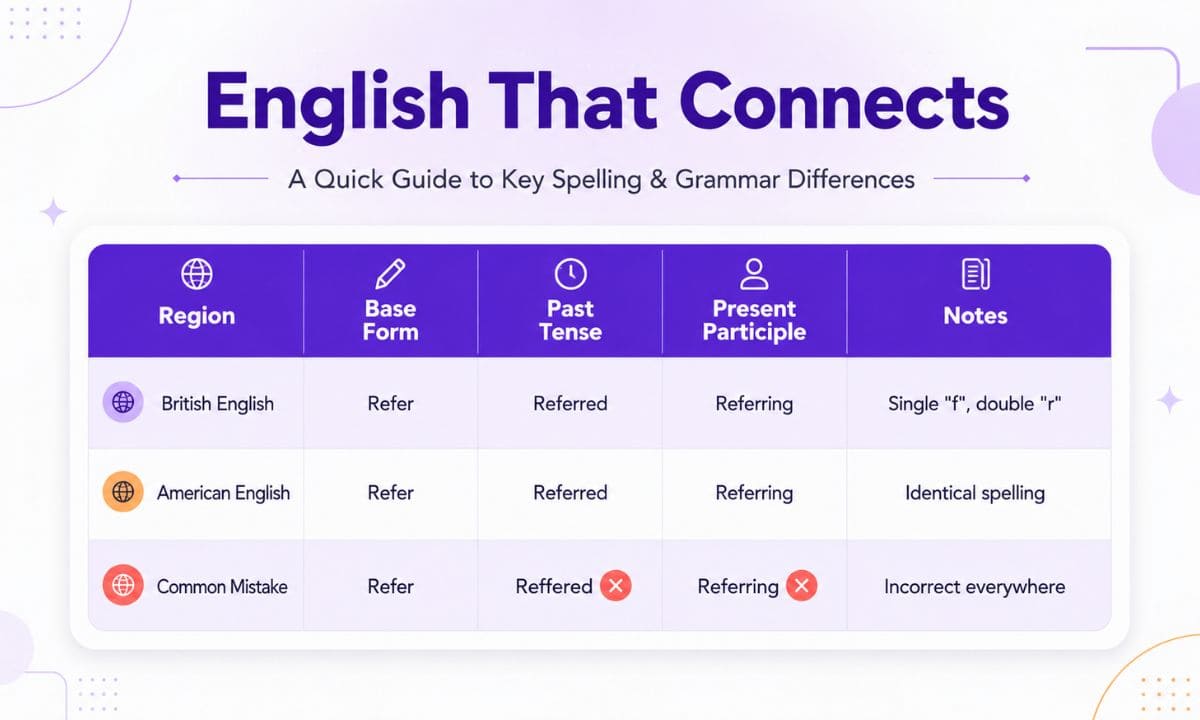
One reason people search refer vs reffer is that many English words change spelling between British and American English (colour vs color, for example). Refer is not one of them.
Which Spelling Should You Use?
Always use “refer.” There is no regional exception, no informal variant, and no context where “reffer” is acceptable not in casual texts, business emails, or academic essays. If you remember only one rule from this refer vs reffer guide, remember this one.
🔹 How to Spell “Refer” Correctly
People often search for slightly different versions of this word while trying to avoid the refer vs reffer mistake. Here’s a quick breakdown of the related forms.
What about “refers”?
“Refers” is the correct third-person singular present tense form, used with he, she, or it (example: “She refers to her notes”). It follows the same single-f, single-r spelling as the base word.
My Memory Tricks and Tips
These four tricks have helped my students stop second-guessing the refer vs reffer spelling for good.

Memory Trick 1: One “F,” One Friend
Think of “refer” as having just one friendly “f” ; it never brings a plus-one.
Memory Trick 2: The “R” Doubles, Not the “F”
Say it out loud: “referred” and “referring” double the “r,” never the “f.” Lock that pattern in your memory.
Memory Trick 3: Compare It to “Prefer”
“Prefer” follows the exact same rule preferred, preferring so if you know one, you know both.
Memory Trick 4: Picture the Latin Root
Remembering that refer comes from referre (carry back) reminds you there’s no reason for an extra “f” to appear.
Explore More Grammar Guides
Unfazed vs Unphased: 15 Powerful Differences You Must Know (2026 Guide)
Spicy vs Spicey: 14 Quick Grammar Facts You Need to Know
Their or Thier? The Ultimate 2026 Grammar Guide with 10 Easy Examples
Naive vs Nieve: The Definitive Guide with 15 Powerful Real-Life Examples
Focusses vs Focuses: The Ultimate 2026 Guide with 10 Easy Examples
Fourteen vs Forteen: 7 Proven Ways to Spell It Correctly
31st or 31th? 7 Proven Rules to Master the Correct Ordinal Spelling
Common Mistakes with Refer vs Reffer
Mistake #1: Writing “reffer” instead of “refer” in the base form of the verb.
Mistake #2: Doubling the “f” in “referred,” writing “refferred” by mistake.
Mistake #3: Dropping the second “r” in “referred,” writing “refered” instead.
Mistake #4: Confusing “refer” with “reference” or “referral,” which are related but different words.
Refer in Everyday Examples

Can you refer a friend for this job opening?
The doctor will refer you to a cardiologist for further testing.
Please refer to page twelve for the full instructions.
My colleague referred me to a great accountant last year.
She’s always referring to old case studies during meetings.
⚠️ Refer: Google Trends & Usage Data
Search interest around refer vs reffer and its related forms stays consistently high because the word appears across so many industries.
- Healthcare and legal writing show the highest frequency of the word “refer” overall
- “Refer a friend” spikes heavily in marketing and referral-program searches
- “Referred” ranks as the most commonly misspelled variant online
- “Reffer” and “reffered” appear mainly as typo-driven searches, not accepted usage
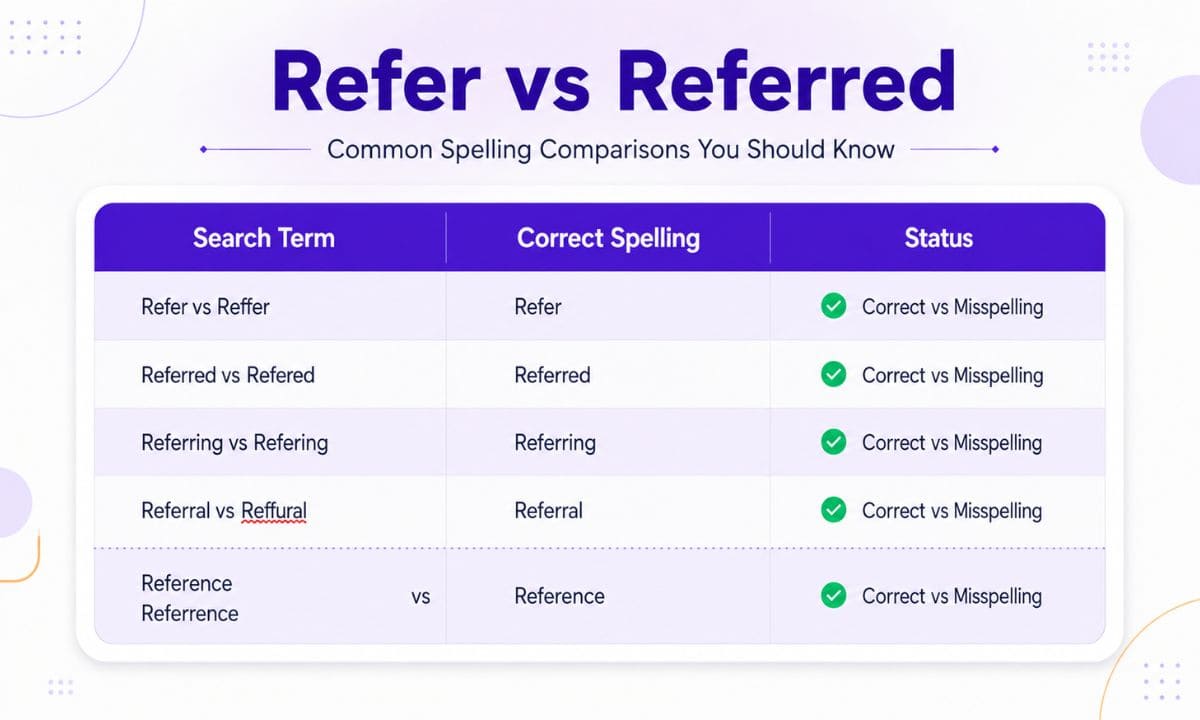
Keyword Variations Comparison Table
Expert Opinions and Dictionary Evidence I Found
Every major dictionary, including Merriam-Webster, Cambridge, and Oxford, lists only “refer” as a valid entry.
Linguists note that the refer vs reffer confusion stems from consonant-doubling rules that trip up even confident writers, since English doubles the final consonant only when the last syllable is stressed and ends in a single vowel plus consonant which explains “referred” but never “reffer.”
🔹 Refer, Referring, or Referred: Spelling Rules Explained
Correct Forms:
✅ Refer (base form)
✅ Referring (present participle)
✅ Referred (past tense/past participle)
Incorrect Forms:
❌ Reffer
❌ Reffering
❌ Reffered
Why does the spelling change?
English doubles the final consonant when a short verb is stressed on its last syllable before adding “-ed” or “-ing.” Since “refer” ends in a single vowel plus “r,” the “r” doubles not the “f.”
Common search variations covered:
Refer vs reffer, referred vs refered, referring vs refering, and reffered vs referred all point back to the same single correct root: refer.
Synonyms and Related Terms I Found
| Synonym | Best Use | Example |
| Direct | Sending someone to a resource or person | “I directed her to the nearest office.” |
| Mention | Casually bringing something up | “He mentioned the report in passing.” |
| Consult | Looking something up for guidance | “Consult the manual before installing.” |
| Recommend | Suggesting someone for a role or service | “I’d recommend her for the position.” |
| Point to | Indicating a source or evidence | “The data points to a clear trend.” |
Pro Tip I Learned
Whenever you’re unsure about refer vs reffer, say the word slowly and picture the Latin root referre. If your instinct says “double the r, not the f,” you’re already spelling it correctly every single time.
Quick Test I Created
Refer vs Reffer Quiz
Test yourself with these quick questions:
- Which is correct: refer or reffer?
- What is the past tense of refer?
- Is “reffered” ever correct?
- What is the present participle of refer?
- Which letter doubles when adding “-ed”?
- Is “refering” a correct spelling?
- What does “refer” mean in a medical context?
- Fill in the blank: She ____ to her notes. (refers/reffers)
- Which spelling appears in Merriam-Webster: refer or reffer?
- What is the Latin root of refer?
- Is there a British vs American spelling difference for refer?
- Which is correct: referral or reffural?
- What part of speech is “refer”?
- Does “refer” ever double its “f”?
- Which sentence is correct: “Please refer to the guide” or “Please reffer to the guide”?
Answers: 1. Refer 2. Referred 3. No 4. Referring 5. The “r” 6. No, it’s “referring” 7. Directing a patient to a specialist 8. Refers 9. Refer 10. Referre 11. No 12. Referral 13. Verb 14. No, never 15. “Please refer to the guide”
Frequently Asked Questions
Is “reffer” a real word?
No, “reffer” is not a recognized word in any English dictionary. It’s a common misspelling of “refer.”
Why do people confuse refer vs reffer?
The confusion happens because verbs like “occur” and “prefer” double their final consonant, leading writers to assume “refer” doubles its “f” too.
What is the correct past tense of refer?
The correct past tense is “referred,” with a doubled “r” and a single “f.”
Does British English spell differently?
No, British and American English spell “refer” identically in every form.
Is “refering” correct?
No, the correct spelling is “referring,” with a doubled “r.”
What’s the difference between refer and reference?
“Refer” is a verb meaning to direct attention, while “reference” is usually a noun describing the source itself.
How do I remember refer vs reffer permanently?
Remember that only the “r” doubles in “referred” and “referring” the “f” always stays single.
Is “refferal” correct?
No, the correct spelling is “referral,” with one “f” and a doubled “r.”
Can “refer” be used in casual conversation?
Yes, “refer” works in both formal and casual English, from business emails to everyday chats.
What is the noun form of refer?
The common noun forms are “referral” and “reference,” depending on the context.
Conclusion
The refer vs reffer debate really comes down to one simple rule: only the “r” doubles, and the “f” never does. Once that clicks, every related form referred, referring, referral falls into place naturally. Whether you’re writing a resume, an email, or a school essay, remembering the refer vs reffer rule keeps your writing polished and error-free.
Dictionaries, grammar guides, and language experts all agree that “refer” is the only correct spelling in any English-speaking region. The refer vs reffer mix-up is common, but it’s also one of the easiest mistakes to permanently fix with a little practice. Use the memory tricks, the comparison tables, and the quiz above anytime you need a quick refresher.
Spelling confidence comes from repetition, and now you have everything you need to never misspell this word again. Bookmark this refer vs reffer guide so it’s always one click away when doubt creeps in. With these tips in hand, you’ll spell “refer” correctly every single time, no exceptions.
