

Is it 31st or 31th? Many people get confused when writing this number. The correct spelling matters for clear, professional writing. This guide settles the debate once and for all.
The question of 31st or 31th trips up even native English speakers. Ordinal numbers follow specific rules that aren’t always obvious. Understanding these rules helps you write with confidence every time.
Knowing whether to use 31st or 31th isn’t just about grammar. It affects resumes, emails, and everyday writing. Below, you’ll find 7 proven rules to master ordinal spelling for good.
31st or 31th: Quick Answer
31st is correct.
31th is always wrong.
The number 31 is spoken as “thirty-first,” and the written ordinal form mirrors that pronunciation. Since the word ends in “first,” the number form ends in -st, not -th. No dictionary, style guide, or grammar authority recognizes “31th” as a valid spelling — it’s simply a common typo that spreads through fast typing and autocorrect confusion.
Whether you’re writing a date, a rank, an age, or an anniversary, the rule never changes: always write 31st.
31st or 31th in Dates: Correct Usage Examples
Dates are where this mix-up shows up the most, especially in emails, invitations, and forms. Here are correct examples across different contexts:
The meeting is scheduled for May 31st.
Her lease ends on December 31st.
We’re closing the books on August 31st.
His flight departs January 31st at noon.
The offer expires March 31st, 2026.
Notice that the month never changes the rule. Whether it’s January, March, May, or December, the ordinal ending stays the same because it depends on the number itself, not the surrounding word.
Pronunciation Guide I Use
Phonetic Pronunciation
✅The number 31 is pronounced /ˌθɜːrti ˈfɜːrst/ “thirty-first.”
✅Say it slowly and you’ll hear it: the final syllable is “first,” not “firth” or “fir-th.”
✅That single sound is the entire reason the written form takes -st instead of -th.
My Definition and Meaning Analysis
Definition
An ordinal number shows position or order in a sequence — first, second, third, and so on — rather than quantity. 31st is the ordinal number that falls between 30th and 32nd. It’s used to describe a birthday, an anniversary, a ranking, a date, or a step in a numbered list.
31th, by contrast, has no accepted definition in English. It doesn’t appear in the Cambridge Dictionary, Merriam-Webster, or any recognized style guide. It’s purely a spelling error, not an alternative or informal form.

1. Ordinal vs. Cardinal Numbers
Cardinal numbers (31, 32, 33) show quantity. Ordinal numbers (31st, 32nd, 33rd) show position or sequence.
2. Why Pronunciation Rules the Ending
English ordinal suffixes follow the spoken word, not a fixed formula. “Thirty-first” ends in “first,” so it gets -st.
3. The Role of the Last Digit
For two-digit and larger numbers, only the final digit decides the ending — 21, 31, 41, 51 all behave like “1.”
4. Consistency Across Contexts
Whether you’re writing about a birthday, a race finish, or a calendar date, 31st is the only accepted spelling in every context.
5. Common Digital Autocorrect Traps
Many phone keyboards and quick-typing habits accidentally produce “31th” because typists default to “-th” as a catch-all ending. Always double-check before sending..
The Origin of 31st or 31th
Ordinal number suffixes trace back to Old English and Middle English counting traditions, where special endings marked sequence rather than amount. Over centuries, English settled into a pattern:
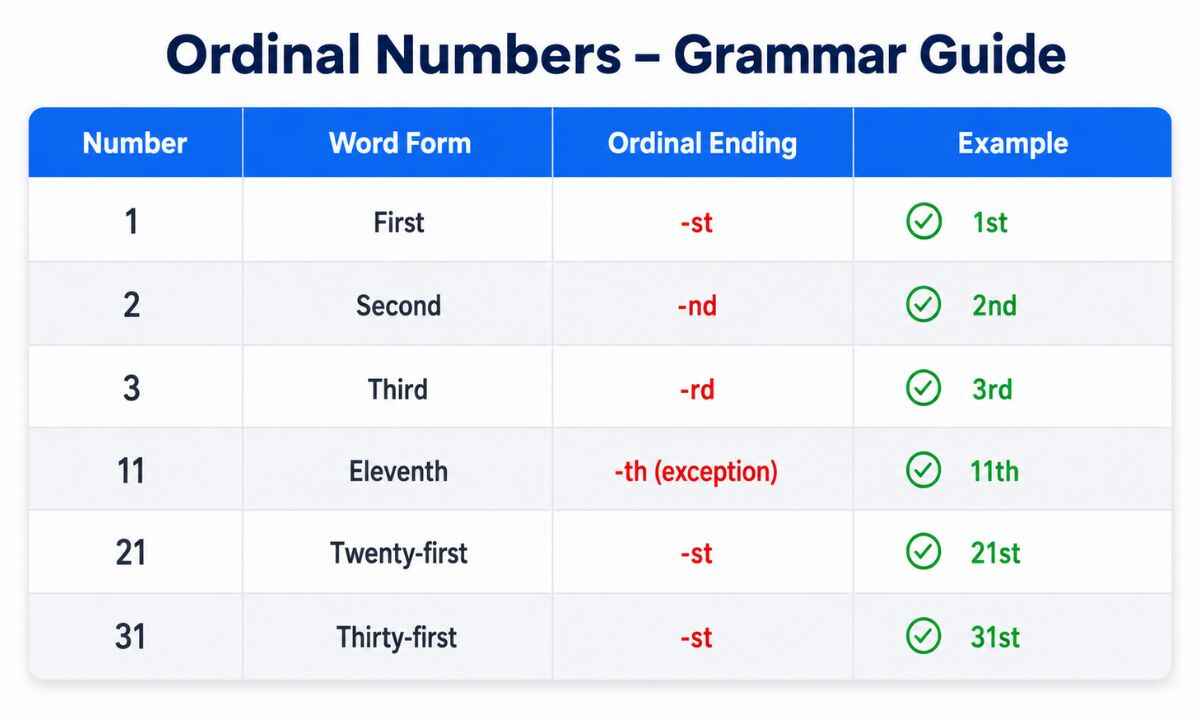
- Numbers ending in 1 take -st (first, twenty-first, thirty-first)
- Numbers ending in 2 take -nd (second, twenty-second, thirty-second)
- Numbers ending in 3 take -rd (third, twenty-third, thirty-third)
- All other numbers take -th (fourth, fifth, thirty-fourth)
The exceptions are 11, 12, and 13, which always take -th regardless of their last digit — hence eleventh, twelfth, and thirteenth, not “eleventh-st” or similar. Since 31 doesn’t fall into that exception group, it follows the standard rule and becomes 31st.
British English vs American English Spelling
Here’s some reassuring news: this isn’t a regional debate like “color” versus “colour.” Both British and American English use the exact same ordinal rule.
| Feature | British English | American English |
| Correct spelling | 31st | 31st |
| Date format example | 31st December 2026 | December 31st, 2026 |
| Spoken form | Thirty-first | Thirty-first |
| Incorrect form | 31th | 31th |
| Regional variation | None | None |
The only difference between the two dialects is date order (day-month vs. month-day), not the ordinal spelling itself.
Which Form Should You Use 31st or 31th?
Always use 31st. There is no formal, informal, British, American, academic, or casual context where “31th” becomes acceptable. If you’re writing:
A social media caption → use 31st
A formal letter → use 31st
A text message → use 31st
A resume or report → use 31st
Summary Table: Ordinal Number Endings
Common Mistakes with 31st or 31th
Why “31th” Feels Tempting to Write
Many learners assume every ordinal number should end in “-th” because most numbers do (4th, 5th, 6th, 7th…). This over-generalization is the single biggest reason 31st or 31th becomes a search question in the first place. The brain pattern-matches to the majority rule and forgets the exception group.
31st or 31th: Common Search Questions Answered
People typing “31st or 31th” into search engines are usually looking for one of these answers:
Is this a British vs. American issue?
No, both dialects agree.
Is 31th ever correct?
No, never, in any context.
Why is it 31st and not 31th?
Because “thirty-first” ends in “first.”
Does the month change the rule?
No, the rule is identical for every month.
Explore More Grammar Guides
Shiney vs Shiny :Which Spelling Is Correct? 7 Easy Rules + Examples
Good Morning vs Goodmorning: The Ultimate Grammar Guide with 5 Real Examples
Take Effect vs Take Affect: 7 Easy Grammar Hacks for Perfect Writing
Vendor vs Vender: The Ultimate 2026 Spelling Guide with 10 Easy Examples
Unfazed vs Unphased: 15 Powerful Differences You Must Know (2026 Guide)
Spicy vs Spicey: 14 Quick Grammar Facts You Need to Know
Their or Thier? The Ultimate 2026 Grammar Guide with 10 Easy Examples
Naive vs Nieve: The Definitive Guide with 15 Powerful Real-Life Examples
31st or 31th in Everyday Examples

Birthdays
“She’s turning 31st… wait, she’s turning 31, and it’s her 31st birthday.”
Anniversaries
“They celebrated their 31st wedding anniversary in Rome.”
Race Rankings
“He crossed the finish line in 31st place.”
Calendar Dates
“Rent is due on the 31st of every applicable month.”
Countdown Lists
“This is the 31st tip on our list of productivity hacks.”
Expert Opinions and Dictionary Evidence I Found
Language reference sites and grammar authorities consistently agree that ordinal endings follow spoken pronunciation, not a blanket “-th” default.
Numbers ending in 1 — including 21, 31, 41, and beyond — take -st, matching how “first” sounds at the end of the spoken number.
None of the major English dictionaries list “31th” as a recognized variant, which confirms it as a spelling error rather than an accepted alternative form.
My Memory Tricks and Tips
Struggling to remember? These tricks make it stick permanently.
Memory Trick 1: Say It Out Loud
If you say “thirty-first” before writing the number, your ear will naturally reject “31th.”
Memory Trick 2: Link It to “1st”
Remember that 1 always becomes 1st. Since 31 ends in 1, it behaves exactly the same way — 31st.
Memory Trick 3: Picture a Calendar
Visualize December 31st on a wall calendar. Seeing it repeatedly in that familiar format reinforces the correct spelling.
Memory Trick 4: The “No TH for 1, 2, 3” Rule
Create a simple mental list: 1 → st, 2 → nd, 3 → rd, everything else → th (except 11, 12, 13).
Common Mistakes I’ve Learned to Avoid
Mistake #1: Typing “31th” out of habit because most numbers end in “-th.”
Mistake #2: Assuming date format changes the ending (it doesn’t — day or month position makes no difference).
Mistake #3: Confusing 31st with 21st and 41st rules — remembering only one and forgetting the pattern applies to all numbers ending in 1.
Mistake #4: Relying on autocorrect without double-checking, since some keyboard shortcuts default incorrectly.
How to Spell 31st With Examples and Common Uses
Spelling 31st correctly comes down to three parts: the number (31), followed directly by the ordinal suffix (st), with no space, hyphen, or period in standard usage. Common uses include:
Sequences: “The 31st item on the checklist”
Dates: “March 31st”
Ages: “Her 31st year”
Rankings: “31st in the league standings”
Common Phrases with “31st”
1. “31st birthday”
Example: “We threw her a surprise party for her 31st birthday.”
2. “31st of the month”
Example: “Invoices are due by the 31st of the month.”
3. “31st anniversary”
Example: “They marked their 31st anniversary with a quiet dinner.”
4. “31st place”
Example: “He finished 31st place in the marathon.”
5. “December 31st”
Example: “The lease officially ends on December 31st.”
6. “January 31st”
Example: “The report is due by January 31st.”
7. “31st edition”
Example: “This is the 31st edition of the annual conference.”
8. “31st floor”
Example: “Our office is located on the 31st floor.”
9. “31st chapter”
Example: “The plot twist happens in the 31st chapter of the novel.”
10. “31st time”
Example: “This was the 31st time she’d rewritten the opening line.”
Comparison Table: 31st or 31th
| Aspect | 31st | 31th |
| Grammatically correct | Yes | No |
| Found in dictionaries | Yes | No |
| Matches pronunciation | Yes (thirty-first) | No |
| Accepted in formal writing | Yes | Never |
| Common typo source | N/A | Autocorrect/habit |
How to Spell 31st With Examples and Common Uses
Spelling 31st correctly comes down to three parts: the number (31), followed directly by the ordinal suffix (st), with no space, hyphen, or period in standard usage. Common uses include:
Sequences: “The 31st item on the checklist”
Dates: “March 31st”
Ages: “Her 31st year”
Rankings: “31st in the league standings”
Synonyms and Related Terms I Found
| Term | Best Use | Example |
| Thirty-first | Formal writing, spoken form | “The thirty-first of December” |
| 31st | Standard written form, dates, lists | “See you on the 31st” |
| Final day of the month | Descriptive, conversational | “Rent is due on the final day of the month” |
| Last day (for 31-day months) | Casual speech | “It’s due the last day of May |
Pro Tip I Learned 31st or 31th
Before submitting any document with a date, do a quick “sound test.” Say the number out loud in full (“thirty-first,” not “thirty-one”). If it ends in “first,” “second,” or “third,” you’ll instantly know whether to use -st, -nd, or -rd.
Quick Test I Created
31st or 31th Quiz
Test yourself! Choose the correct form for each sentence.
- Her birthday is on July ___ (31st or 31th)
- He came ___ in the race (31st or 31th)
- This is the ___ chapter (31st or 31th)
- December ___ is New Year’s Eve (31st or 31th)
- It’s their ___ anniversary (31st or 31th)
- The deadline is January ___ (31st or 31th)
- She lives on the ___ floor (31st or 31th)
- This is the ___ edition (31st or 31th)
- He turned ___ last week, celebrating his ___ birthday (31st or 31th)
- The event falls on the ___ of the month (31st or 31th)
- Is “31th” ever correct? (Yes/No)
- Which suffix matches “first”? (-st/-th)
- Which suffix matches “second”? (-nd/-th)
- Which suffix matches “third”? (-rd/-th)
- Does British English use a different form? (Yes/No)
- Is 11 an exception to the -st/-nd/-rd rule? (Yes/No)
- What is 41 in ordinal form? (41st/41th)
- What is 21 in ordinal form? (21st/21th)
- Does the month change the ordinal ending? (Yes/No)
- What’s the correct spelling for thirty-first in numeral-plus-suffix form? (31st or 31th)
(Answer: every blank above is 31st, -st, -nd, -rd, No, No, 41st, 21st, No, 31st.)
Frequently Asked Questions
Is 31th ever correct in English?
No. Standard English never accepts “31th” in any context, formal or informal.
Why is it 31st instead of 31th?
Because the spoken form “thirty-first” ends in “first,” matching the -st suffix.
Does British English spell it differently than American English?
No. Both dialects use 31st with no regional variation.
Is 31th a word at all?
No, it doesn’t appear in any major English dictionary and is considered a typo.
Do all numbers ending in 1 take “-st”?
Yes, except 11, which always takes “-th” (eleventh).
How do you pronounce 31st?
It’s pronounced “thirty-first,” which is the reason for the -st ending.
Can I use “31th” in casual texting?
No — even in casual writing, “31th” is incorrect and can look unprofessional.
What’s the ordinal form of 41 and 51?
They follow the same pattern: 41st and 51st.
Why do people confuse 31st with 31th so often?
Because most numbers end in “-th,” so writers over-generalize the pattern and forget the exception.
Is there a quick trick to remember 31st?
Yes — say the full word “thirty-first” out loud before writing the number; your ear will catch the correct ending.
Conclusion
So, is it 31st or 31th? The answer is simple and permanent: 31st is always correct, and 31th is always a mistake. This rule holds true across dates, birthdays, rankings, and every other context where ordinal numbers appear.
Remembering why helps more than memorizing blindly. Since “thirty-first” ends in “first,” the written form logically takes -st, just like 1 becomes 1st and 21 becomes 21st. This pattern never changes based on month, dialect, or writing style.
Next time you type a date or an age, trust the rule: 31st or 31th isn’t really a debate — it’s a spelling fact. Write 31st with confidence, and you’ll never second-guess a birthday invite or deadline email again.
