

Many people get confused between puting vs putting This mix-up happens because of spelling rules in English. Knowing the right form helps you write with confidence.
“Putting” is the correct spelling in English. It follows a simple doubling rule for short vowel words. “Puting” is simply a common misspelling that should be avoided.
This guide will explain the difference clearly and simply. You will learn why “putting” is correct and “puting” is wrong. By the end, you’ll never confuse these two words again.
Quick Answer
Putting is the correct spelling. Puting is not a real word in standard English.
Whenever you’re adding “-ing” to the verb “put,” the “t” must be doubled. This gives you “putting” whether you’re talking about placing an object somewhere or lining up a golf shot.
What Does Putting Mean?
“Putting” is the present participle (or gerund) of the verb “put.” It describes the ongoing action of placing, positioning, or moving something.
Here’s how it works in everyday sentences:
- She is putting her shoes by the door.
- He kept putting off the meeting.
- They are putting the final touches on the report.
In golf, “putting” has a specialized meaning: the act of gently striking the ball with a putter to roll it into the hole. Both meanings share the same spelling — there’s no separate version for sports.
Why Is “Puting” Incorrect? Puting vs putting
“”Puting” breaks a basic rule of English spelling. When a short verb ends in a single consonant preceded by a single vowel, you double that final consonant before adding a suffix like “-ing” or “-ed.”
Without the second “t,” the word “puting” would technically be pronounced with a long “u” sound, like “pyoo-ting,” rather than the short vowel sound we actually use when we say “putting.” Doubling the consonant keeps the pronunciation and spelling consistent.
So no matter how casual or formal your writing is, “puting” is always a mistake.
The CVC Rule I Follow
The rule that governs this spelling is known as the CVC rule — Consonant-Vowel-Consonant.
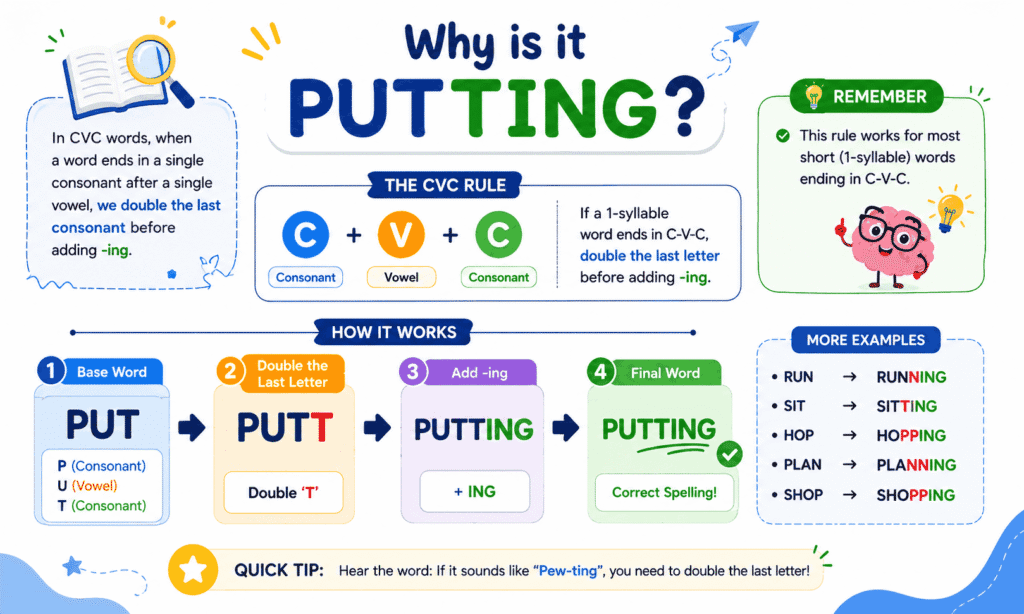
- Look at the base verb: put.
- Check its last three letters: p-u-t, which follow the consonant-vowel-consonant pattern.
- Because the verb is short (one syllable) and stressed on that final consonant, you double the last letter before adding “-ing.”
- Put + t + ing = putting.
This same CVC pattern explains why “run” becomes “running,” “sit” becomes “sitting,” and “stop” becomes “stopping.” It’s a predictable, reliable rule once you know what to look for.
Also Read more Grammar rules on GramarNesty
Puting vs Putting: Main Difference
The core difference isn’t about meaning — it’s purely about correctness.
- Putting = the real, dictionary-recognized word.
- Puting = a misspelling with no accepted meaning of its own.
There’s no context, tone, or dialect where “puting” becomes acceptable. It’s simply an error, usually caused by typing quickly or forgetting the doubling rule.
The Origin of Puting vs Putting
The verb “put” traces back to Old English and Middle English forms related to pushing or placing an object. As English spelling conventions developed over centuries, grammarians standardized the doubling of final consonants in short verbs to preserve consistent pronunciation across written and spoken forms.
“Puting” isn’t an older or alternate historical spelling — it’s simply a modern typo that has become common because of fast typing, autocorrect gaps, and unfamiliarity with the doubling rule.
British English vs American English Spelling
Here’s some good news for anyone worried about regional spelling differences: this particular rule doesn’t change across dialects.
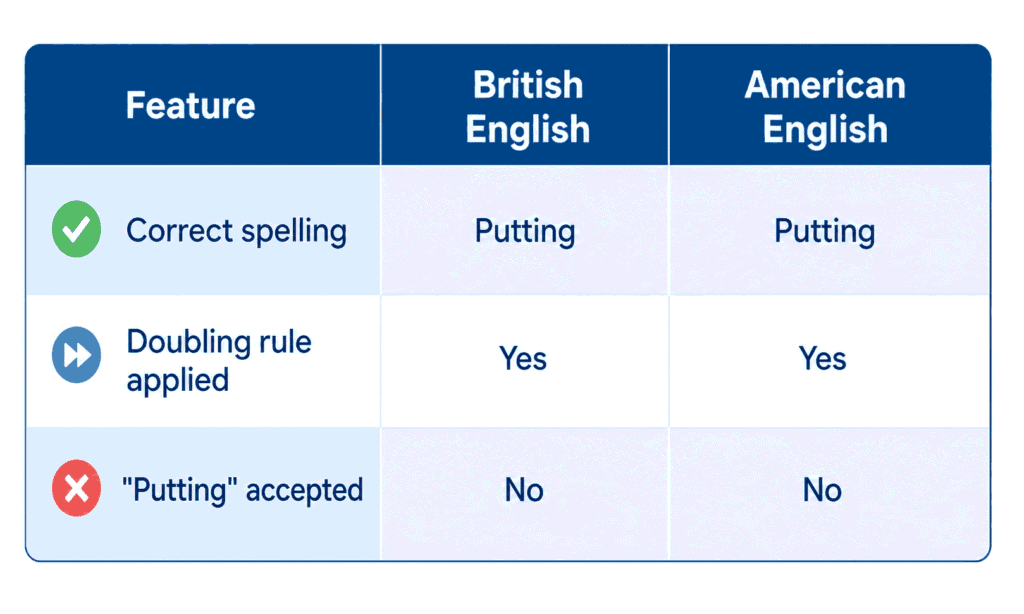
Whether you’re writing for a UK audience or a US audience, putting is the only correct spelling. In the putting vs puting debate, there’s no regional difference to consider. Unlike words such as colour/color or travelling/traveling, putting is the standard form accepted across all English-speaking countries, while puting is simply a misspelling.
Common Uses of Putting
“Putting” shows up constantly in daily conversation and writing. A few common contexts include:
- Placing objects: “I’m putting the dishes away.”
- Golf: “Her putting has really improved this season.”
- Idiomatic expressions: “Putting two and two together,” “putting your foot down,” “putting it off.”
- Effort or focus: “He’s putting a lot of work into this project.”
- Decision-making: “We’re putting the plan into action next week.”
Putting vs Puting: My Summary Table
| Aspect | Putting ✅ | Puting ❌ |
| Correct spelling | Yes | No |
| Follows CVC rule | Yes | No |
| Found in dictionaries | Yes | No |
| Used in formal writing | Yes | Never |
| Used in golf terminology | Yes | No |
Putting as Different Parts of Speech
“Putting” isn’t limited to one grammatical role. Depending on the sentence, it can function as:
- A verb (present participle): “She is putting her keys on the counter.”
- A gerund (acting as a noun): “Putting things off rarely helps.”
- Part of a noun phrase in golf: “His putting stroke needs work.”
Understanding these roles helps you use the word correctly in more advanced or varied sentence structures.
Common Mistakes People Make
Even careful writers slip up sometimes. Here are the most frequent errors linked to this word about puting vs putting:
- Dropping the second “t” — writing “puting” instead of “putting.”
- Typing too fast without proofreading, especially in emails or texts.
- Assuming the doubling rule doesn’t apply to short, familiar words.
- Autocorrect gaps on certain devices or apps that don’t flag the error.
- Confusing it with longer verbs that don’t double their final consonant, like “visiting” or “editing.”
Why Correct Spelling Matters
A single missing letter might seem minor, but it can affect how your writing is perceived. Correct spelling:
- Builds credibility in professional and academic writing.
- Prevents confusion for readers.
- Reflects attention to detail, especially in resumes, emails, and reports.
- Helps your content perform better for readers and search engines alike.
Small errors like “puting” can distract from your message, even when the rest of your writing is strong.
Easy Trick to Remember the Correct Spelling
Here’s a simple memory trick: “Put” needs a partner.
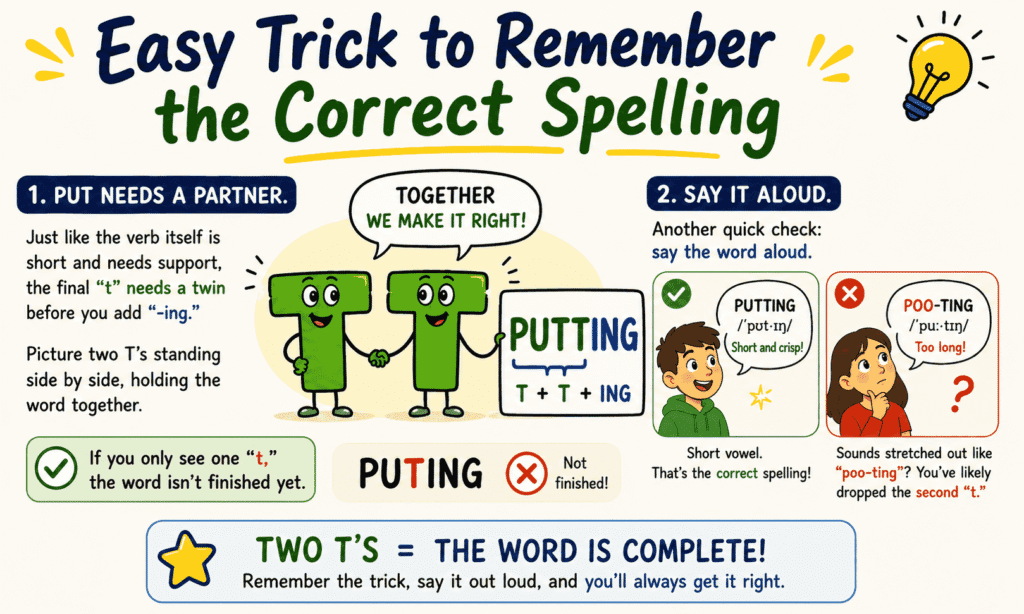
When deciding between puting vs putting, remember this simple trick: the verb put is short and needs support, so the final “t” gets a twin before you add “-ing.” Picture two T’s standing side by side, holding the word together. If you only see one “t,” the word isn’t finished yet—putting is the correct spelling, while puting is a common mistake.
Another quick way to remember the difference between puting vs putting is to say the word aloud. Putting has a short, crisp vowel sound. If it sounds stretched out like “poo-ting,” you’ve likely dropped the second “t.” Keeping both T’s ensures you always spell putting correctly.
Related Word Forms
Understanding related forms of “put” can reinforce the doubling rule:
- Put — base verb (present tense): “I put the book on the shelf.”
- Putting — present participle/gerund: “I am putting the book on the shelf.”
- Put — past tense (irregular, no change): “I put the book on the shelf yesterday.”
- Puts — third-person singular: “She puts the book on the shelf.
Notice that “put” doesn’t change in the past tense, which is why “putting” (with the doubled “t”) is the main form people misspell.
Puting vs Putting in Everyday Examples
- Correct: “I’m putting the laundry away right now.”
- Incorrect: “I’m puting the laundry away right now.”
- Correct: “Her putting technique needs more practice.”
- Incorrect: “Her puting technique needs more practice.”
- Correct: “We’re putting off the meeting until next week.”
- Incorrect: “We’re puting off the meeting until next week.”
Comparison Table: Putting vs Puting
| Category | Putting | Puting |
| Standard English spelling | Correct | Incorrect |
| Appears in dictionaries | Yes | No |
| Grammar rule followed | CVC doubling rule | Rule ignored |
| Acceptable in formal writing | Yes | No |
| Common in casual typos | No | Yes |
| Used in golf terminology | Yes | No |
Frequently Asked Questions
Is “puting” ever correct?
No. “Puting” is always a misspelling. The correct form in every context is “putting.”
Why does “put” double the “t” before adding “-ing”?
Because “put” is a short verb following the consonant-vowel-consonant (CVC) pattern, English spelling rules require doubling the final consonant.
Does British English spell it differently than American English?
No. Both British and American English use “putting” with the double “t.”
Is “putting” a noun or a verb?
It can be both. It functions as a present participle verb or as a gerund (noun) depending on the sentence.
What does “putting” mean in golf?
It refers to the action of striking the ball gently with a putter to roll it toward or into the hole.
How can I remember the correct spelling?
Think of “put” needing a partner: double the “t” before adding “-ing” to keep the short vowel sound intact.
Conclusion
The confusion between puting vs putting comes down to one missing letter, but the rule behind it is easy to master once you understand the CVC (Consonant-Vowel-Consonant) pattern. If you’ve ever wondered is it puting vs putting, the answer is simple: putting is always the correct spelling in every dialect, every context, and every type of writing—from casual text messages to professional reports.
The next time you pause while typing puting vs putting, just picture the doubled “tt” holding the word together. This simple memory trick makes it easier to remember why putting is correct. By getting into the habit of double-checking short verbs that follow the CVC rule, you’ll avoid the puting mistake and spell putting correctly every time.
